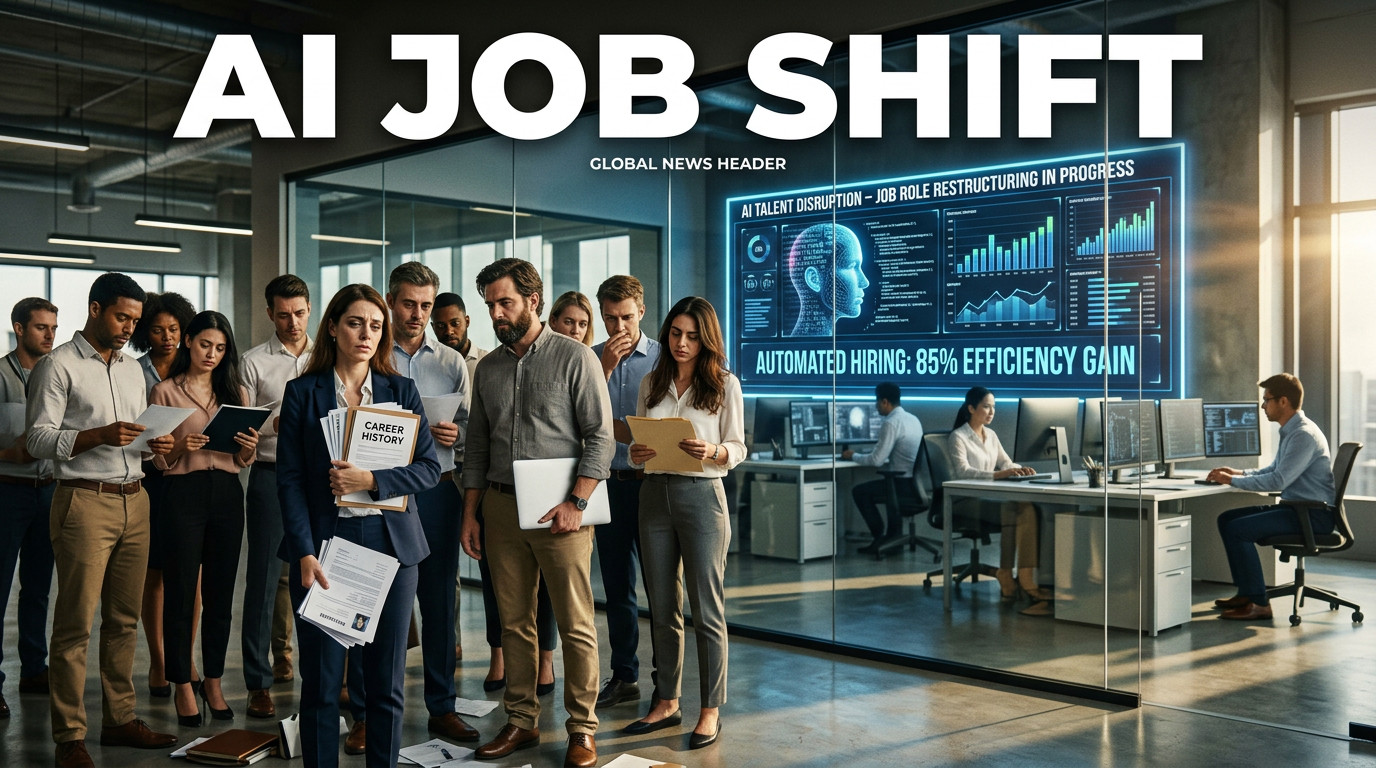
● AI Talent Gap Splits HR Boundaries Disappears
In the AI era, “jobs, talent, and learning” change all at once… The gap in core talent widens from 10%→0.1%, and HR boundaries disappear
3 big points you shouldn’t miss (Be sure to take these from today’s post)
1) The share of core talent is being reorganized from 10% to 0.1%. The reason isn’t simply a matter of ability; it’s because the computing power and accessibility to AI agents that core talent can use are different.
2) The job classification system (HR/marketing/education, etc.) leaves only “broad categories” and the rest disappears. In the end, work will likely be redefined into two axes: “planning/design” versus “execution.”
3) AI can’t directly do goal setting (planning). That is, the argument is strong that in the AI era, the core areas that people must still handle (values, context, goals, coordination) remain.
If you grasp these three, the changes discussed in today’s article (professor interview) get summarized all at once. Now let’s go through them like news, item by item.
Part 1) The 기준 for learning is shifting: memory/rote memorization → higher-order thinking
- The standard of learning before AI: There’s an observation that “smart people” have been explained in terms of memory ability/rote memorization ability/test performance.
- The standard of learning after AI: Since AI takes on a substantial part of memory and search, educational and organizational learning shifts its weight toward higher-order thinking.
- What changes? Lower-level thinking (lower-order thinking) is quickly assisted by AI, but higher-level thinking requires “context diagnosis, evaluation, and new creation,” so the role of people becomes even clearer.
Part 2) How to build higher-order thinking: “the field” + “simulation” + “problem-solving loops”
- The best training method: Experience solving problems directly in the field (Because knowledge without context doesn’t work well in reality, the process of encountering problems becomes the development point.)
- Alternative: Repeat experiences by designing “virtual environments” well, such as simulation/games/case studies
- Important premise: Higher-order thinking is not about “knowing,” but about “the ability to diagnose and redesign,” so experience–feedback–reattempt must be structurally built in.
Part 3) The core of organizational talent development: your manager’s questions change people
- The role of the manager is emphasized as being very significant. A culture that asks questions like “What is the essential value?” “Why do we need to do this now?” “Who will we contribute to?” creates higher-order thinking habits.
- Result: There’s an observation that practitioners’ way of thinking is moving toward “seeing the entire situation and reordering intent and context.”
Part 4) “Business acumen (understanding the structure that makes money)” grows alongside technical acumen
- Core competencies mentioned in organizations include “acumen.”
- In the past: The tone was that people with business acumen had a relatively lower entry barrier to understanding technology.
- After AI: In the process of learning technical acumen, AI strongly supports learning/assistance, which lowers the entry barrier, and as a result, the speed of “design–judgment–execution” can increase.
- But cognitive risks also appear. Phenomena are mentioned such as judgment becoming blurred (whether it’s my judgment or a recommendation generated by AI) and the resulting confusion during retrospection.
Part 5) Will AI make people “dumb”? The key is that the “form of memory” changes
- The explanation says two viewpoints have been clashing.
- The concern view: The claim that AI/Internet makes you think less and can weaken cognitive ability (a logic traditionally like “you end up not thinking”).
- The positive view: The claim that productivity rises because you delegate memory to the Internet/tools and focus people on higher-level thinking.
- Conclusion from observations in the Internet era: Rather than “one side is absolutely correct,” from an organizational perspective/the view of a small group of top talent, there are many cases where tool usage leads to performance.
- Key takeaway (the summary point of this article): It’s not so much that “intelligence decreases,” but that the elements/dimensions of memory (where you store what, and how you bring it back) change—and that is more realistic.
Part 6) The real reason talent gaps widen from 10%→0.1%: computing power and AI agents
- In the past (the Internet era): It mentions a flow where a frame like “core talent is 10% in the organization” was accepted.
- Now (the AI era): There’s a forecast that it won’t be 9:1, but 99:1—and even further like 99.9:0.1.
- Why does it widen? It’s not just about intellectual ability; it’s because the computing resources that core talent can use differ, and the number of AI agents each person can run can change exponentially.
- Why this segment matters: The “war for talent” can’t be explained only by “credential competition” or “education time,” and an environment where you can run AI (accessibility, cost, permissions) becomes the new battleground.
Part 7) HR boundaries disappear: a scenario where job classification (mid-category/sub-category) vanishes
- Collapse of job analysis/classification systems: In the past, HR would design by breaking down into mid-categories/sub-categories such as hiring, training, evaluation, and compensation.
- After AI adoption: Now it feels like functions such as hiring and training are being merged,
- As more time passes: You may end up with only broad categories and a handful of mid-categories, and the direction could become one where things are divided only around big axes like “B2B/B2C.”
- Redefinition of work (two axes): In the end, there’s a view that work is divided into two things horizontally.
- Planning (preparation, design, creation)
- Execution (solve problems in the field)
Part 8) “One thing AI can’t do”: goal setting (planning) remains human work
- As phrased from Entropy (report), it’s summarized that AI can perform tasks well after “receiving” goals, but its ability to set goals (the area where you directly throw them in) is limited.
- Therefore how an organization must change, framing things like “what we will do/with what value/with what issue” will likely remain as the core areas that people (the organization) must take responsibility for.
Part 9) Organizational theory shock: “the subject of labor” shifts from humans to AI agents
- Existing organizational theories assumed that “the subject of labor is human, and organizations also work by humans gathering together,” but
- When AI replaces execution, the diagnostic says the foundational assumptions behind organizational theory, psychology, HR, and talent development are shaken.
- Going even further (agent + robotics as well) There’s also a perspective that it could be reorganized into a new unit like cointelligence (a combination of human + intelligent systems), not centered on the “HR department,” by breaking it down even further down to the level of task units.
Part 10) The future of education & universities: “Universities are over” vs “Value can actually grow even more”
- Professor Kwon Ki-beom’s claim: Even in the AI era, universities must change, and the current evaluation is that there’s a lack of investment, curricula, and hardware/software.
- Problems with how education is run: Most programs are fixed in 16-week units, making it hard for individuals to keep up and difficult to reflect changing knowledge.
- Practical logic against the “no need for US universities” argument: In the US, tuition is expensive, so ROI may feel low, and in service-industry structures, undergraduate knowledge may be hard to directly connect to job performance.
- Korea (manufacturing) context: There’s a viewpoint that high-level knowledge is actually needed—such as design, drawings, implementation, and reporting—and since there’s a larger connection to the advanced manufacturing ecosystem, the role of universities may be even more significant.
- Professor Kim Seong-joon’s “mission of university” perspective: The mission of universities evolved from knowledge sharing to knowledge production, but LLMs like GPT have the power to “lower the wall of top-down approaches,” so the curriculum model itself needs to be reconsidered.
- Questions about curriculum operation: In the past, brick-by-brick build-up (prerequisites → stages) was needed, but in the AI era, “faster and more efficient learning” could become possible, so it leads to the conclusion that universities must redefine why they exist in the first place.
Part 11) Direction of change in exams/evaluation: ideas like LN (individual thinking traces) and prompt tracking
- There’s a problem awareness that it’s hard to capture the AI environment 그대로 with traditional exam rules.
- It mentions attempts to platformize exams and evaluate more clearly based on individual performance/thinking traces (e.g., prompts, process).
- The point is that the question “what exams should measure in the AI era” must change.
Part 12) Practical advice: you need to “use AI directly” and “keep a balance (books, people, relationships)”
- It’s seen that while you should use AI a lot, even if there’s fear, the boundaries disappear only if there’s an “experiment where you do it with your own hands.”
- At the same time, as you increase AI use, you may feel a reduction in human interactions like books/family/friends, so there’s a suggestion that you need to consciously “see people’s faces.”
Here, the single most important one-line summary that “isn’t usually said elsewhere”
The core competition in the AI era isn’t “the amount of knowledge,” but the difference in each organization’s granted “goal-setting authority (planning)” and in “computing power and AI agent accessibility.”
Once this is organized, it connects at once why HR/education/job classification/organizational theory all get shaken at the same time.
SEO keywords (naturally incorporated)
The main keywords of today’s post are summarized as generative AI, AI agents, human capital, organizational reorganization, and the trend of educational innovation.
Main points you want to convey (conclusion at a glance)
- The gap in core talent grows not only because of ability, but because of differences in AI utilization resources (computing/agents).
- Learning shifts from memory/confirmation-search centered to higher-order thinking (diagnosis, evaluation, creation).
- AI substitutes strongly for execution, but goal setting (planning) remains a human role.
- Detailed division of jobs (HR hiring/training/evaluation/compensation) becomes increasingly meaningless, and there’s a high likelihood of reorganization into two axes: planning/execution.
- Universities can maintain and expand their value only by redesigning curriculum, evaluation, and learning methods to fit the AI environment—not by “disappearing.”
< Summary >
As generative AI spreads, learning moves from a memorization-focused style to a higher-order thinking-focused style, and organizations may weaken the boundaries of job classification—making it more likely that HR will be redefined around planning/execution as well. Also, while AI can strongly replace execution, it can’t do goal setting (planning), which shakes the foundations of organizational theory and talent development. The gap in core talent can widen from 10% to around 0.1%, and that is due to differences in the computing power and number of AI agents that core talent can access, not differences in individual intelligence. Finally, even if there’s a “universities are useless” debate, the advice is that the value can grow even more in the direction of changing curriculum, evaluation, and learning operations. The key is to use AI directly, but maintain a balance attitude like interacting with books and people.
[Related Articles…]
*Source: [ 티타임즈TV ]
– 직무의 중분류, 소분류가 사라진다. 대분류만 남는다 (고려대 권기범 교수, 국민대 김성준 교수)