● AI-Bubble, Debt-Fueled, Chip-Rally
A Big Tech–Driven “Leverage War” Has Begun: NVIDIA Bond Issuance, Trump’s Semiconductor Push, Memory Shortage, and AI Infrastructure Beneficiaries
This cycle is not adequately explained by “AI stocks are rising again.” The core drivers are broader and increasingly structural.
First, Big Tech is moving beyond funding AI solely with internal cash flows and is scaling investment via external financing (including bond issuance).
Second, near-term market price action is being influenced more by Big Tech–driven liquidity and CAPEX than by central-bank tightening.
Third, memory, CPUs, foundry capacity, power infrastructure, data centers, and optical networking are increasingly moving as a single, integrated supply chain.
Fourth, a pro–U.S. manufacturing and semiconductor policy stance under a Trump administration framework is reinforcing private-sector investment and adding a policy premium.
Fifth, the current move is less a thematic rally and more a connected shift spanning U.S. equities, global liquidity, AI, semiconductor supply chains, and energy infrastructure.
1. Weekly Market Summary (One Line): “Big Tech is acting as a larger liquidity provider than central banks”
Recent U.S. equity performance has been characterized by increasing leadership concentration. Index gains have been driven disproportionately by AI infrastructure exposures—semiconductors, data centers, power infrastructure, and optical networking—rather than broad-based participation.
Semiconductors remain near highs, while AI server supply-chain segments show simultaneous earnings optimism and incremental positioning.
The key driver has shifted from rate-cut expectations to the scale and intensity of Big Tech funding and deploying capital to secure AI leadership.
2. The Primary Macro Catalyst: Why NVIDIA’s Large-Scale Bond Issuance Matters
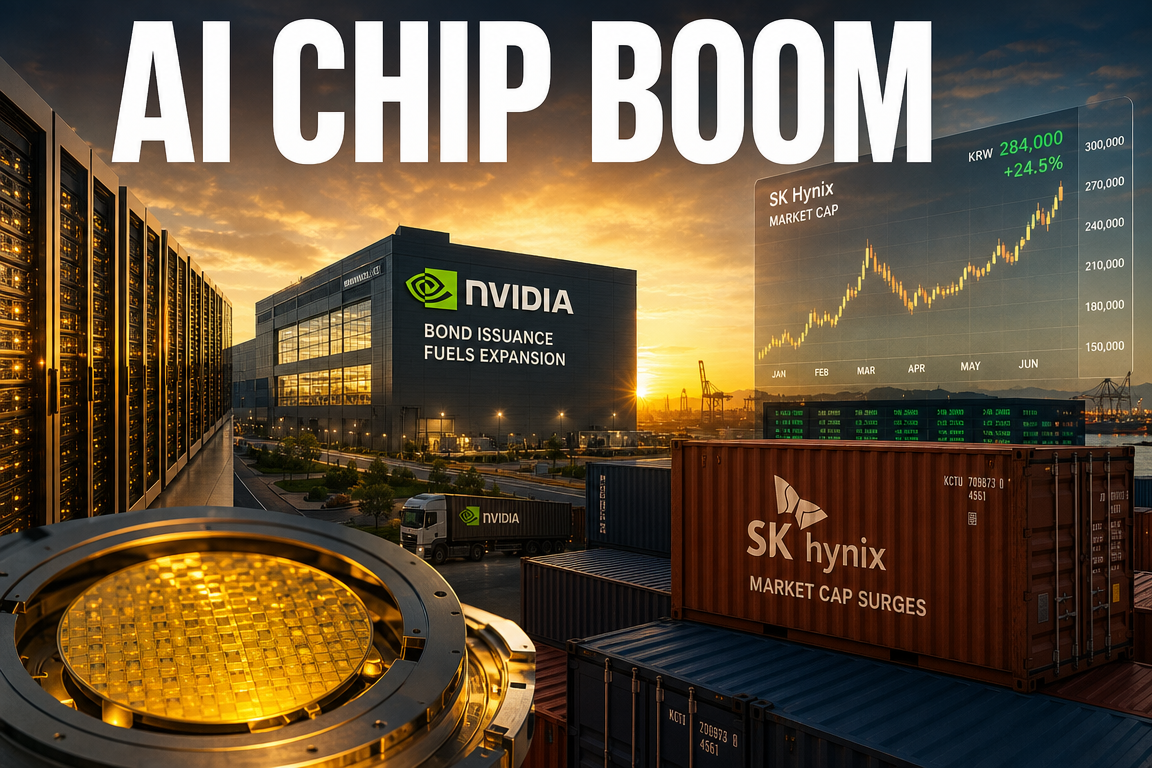
A central event this week was NVIDIA’s large-scale bond issuance, executed with strong demand that exceeded the target size. The significance is not the borrowing itself, but what it signals about the duration and magnitude of AI infrastructure capital needs.
2-1. NVIDIA did not issue debt due to cash constraints
NVIDIA is not capital-constrained and has strong cash generation. Issuing longer-dated debt indicates that AI infrastructure investment requirements are increasingly viewed as long-cycle and structural. It also suggests a shift from “funding investment from current cash flows” to “scaling investment via capital markets.”
2-2. Strong demand implies institutional conviction in sustained AI infrastructure expansion
Robust bond demand indicates continued institutional confidence in long-term growth and ongoing investment intensity. Incremental proceeds are likely to translate—directly or indirectly—into demand across data-center build-outs, semiconductors, memory, networking, and power infrastructure.
2-3. This is part of a broader Big Tech pattern
This behavior is not isolated. Market attention has also focused on AI CAPEX expansions and financing flexibility across large platforms (e.g., Amazon, Alphabet, Oracle). The AI “arms race” is increasingly reflected in measurable funding and deployment, not only in earnings commentary.
3. Why Big Tech Liquidity Can Dominate Despite Central-Bank Tightening
A key market question persists: why AI-linked assets remain resilient amid a relatively restrictive global policy backdrop.
3-1. This is increasingly a private CAPEX cycle rather than a monetary-policy cycle
Unlike the liquidity regime of 2020–2021, capital is being created and deployed through corporate balance sheets and financing strategies. The funding source has shifted from central banks to large corporates.
This distinction matters because investment may remain firm even under higher rates if strategic imperatives (AI leadership) outweigh financing costs.
3-2. Markets are prioritizing CAPEX trajectories over incremental rate signaling
For current leadership groups, the marginal driver is less the policy path and more the forward CAPEX outlook for major buyers and builders of AI infrastructure. This does not eliminate macro risk, but it does define near-term price discovery.
4. SpaceX Entering the AI Investment Narrative
SpaceX is increasingly discussed as a potential additional large-scale capital allocator, alongside renewed interest tied to potential listing expectations.
4-1. Why SpaceX is being framed as AI infrastructure-adjacent
Beyond launch services, the business model is increasingly interpreted through satellite connectivity, data processing, AI applications, and large-scale infrastructure operation. Any credible acceleration of AI-related M&A or internal build-out would further embed the company in the AI ecosystem.
4-2. Additional financing capacity is viewed as a market-positive signal
Potential incremental funding beyond refinancing could support investment into data and AI infrastructure. Markets interpret this as another large participant potentially contributing to the AI CAPEX cycle.
5. Trump’s Semiconductor and Manufacturing Drive: Implications for Intel, NVIDIA, Apple, and Tesla
Policy considerations are increasingly relevant. A Trump administration framework emphasizes U.S.-based manufacturing, semiconductor production, and domestic supply-chain reinforcement.
5-1. Intel could function as a policy instrument, not only an earnings story
Intel may be positioned as a strategic asset for rebuilding advanced domestic semiconductor capacity. This can translate into non-market supports such as policy funding, tax incentives, regulatory preference, and procurement linkage.
5-2. NVIDIA, Apple, and Tesla may face stronger U.S. production pressure
If U.S.-based manufacturing alignment intensifies, supply-chain reconfiguration could accelerate. Potential beneficiaries extend across TSMC and Intel capacity expansion, equipment and tooling, advanced packaging, power infrastructure, and industrial real estate.
6. Why Memory is Leading: Moving from “tightness” to “physical shortage”
Memory remains among the strongest segments, supported by the narrative shifting from expectations to tangible supply constraints.
6-1. Apple’s shortage commentary is a high-signal indicator
References to memory constraints imply AI data-center demand is pressuring broader memory availability. High-bandwidth and server memory demand can crowd out supply across consumer electronics and general IT.
6-2. Pricing pass-through risk supports earnings revisions
Indications of potential end-product price increases suggest component cost inflation is reaching levels that can be passed through. This supports stronger pricing power for memory suppliers, including higher ASPs and potentially more long-term supply agreements.
6-3. Potential U.S. listing interest around SK hynix is not purely an event catalyst
Growing attention reflects investor demand for direct exposure to AI memory leadership (notably HBM). U.S. investor accessibility is a key driver of incremental interest as listing-related developments emerge.
7. CPU, Foundry, and AI Agent Beneficiaries: Intel, AMD, ARM, Qualcomm
As AI agents expand, CPUs, low-power compute, edge AI silicon, and foundry capacity regain prominence.
7-1. Why ARM remains supported
ARM is increasingly relevant beyond mobile due to AI agents, on-device AI, low-power servers, and broader custom silicon design adoption. As hyperscalers expand internal chip design, the ARM ecosystem can broaden further.
7-2. Intel is increasingly about foundry optionality rather than PC CPUs
The market focus is shifting toward domestic advanced-node capacity, advanced packaging, and system integration. Combined with potential policy tailwinds, Intel can be valued partly as strategic infrastructure.
7-3. Qualcomm may be re-rated from handset cycle exposure to AI hardware platform exposure
Investor attention is centered on whether Qualcomm can articulate credible data-center AI silicon, new hardware platforms, and on-device AI strategy. If validated, valuation can become less dependent on smartphone cycles as the device category is reframed as an AI endpoint.
8. Why Intel’s Talent Hiring Matters: Semiconductor competitiveness is talent-intensive
Hiring key talent with relevant memory and packaging experience is strategically meaningful because semiconductor execution depends on process control, yield, packaging, and manufacturing optimization. Advanced packaging is a critical determinant of performance and power efficiency in AI compute systems, making leadership reinforcement a constructive signal.
9. Why Semiconductor Equipment Should Be Considered Alongside Chips
Equipment demand is a direct function of fab expansion. If memory CAPEX rises, foundry capacity expands, and U.S. onshore investments accelerate, equipment orders typically follow. Capturing the breadth of the cycle requires monitoring equipment suppliers as well as chip makers.
10. Why Power and Data-Center Exposures Are Re-emerging as Core Themes
AI compute is power-intensive. As GPU density rises and data-center footprints expand, demand increases across transmission and distribution, cooling, transformers, and generation capacity.
10-1. Power infrastructure is a required pillar, not a secondary theme
Without power build-out, AI data centers cannot scale. Power infrastructure should be treated as a core supply-chain component within the AI ecosystem.
10-2. Data centers, optical networking, and custom silicon move together
Names tied to custom silicon, optical interconnect, and data-center networking are leveraged to AI server expansion. Overlapping catalysts such as hyperscaler custom chip plans and index inclusion can amplify near-term flows.
11. ETF Framing Can Simplify Portfolio Implementation
When the supply chain is moving as a system, ETFs may provide more efficient exposure than single-name concentration.
11-1. Semiconductor ETFs
Broad semiconductor ETFs can capture GPU leaders, CPUs, foundries, memory, and equipment in a single allocation.
11-2. Memory-focused ETFs
Memory-concentrated vehicles may be more responsive when HBM and server-memory constraints are the dominant driver.
11-3. Power and data-center ETFs
While less momentum-driven than semiconductors, these exposures may offer more balanced entry points if infrastructure build-out persists.
12. Key Items to Monitor Next Week
12-1. Micron earnings
Focus areas: HBM demand, pricing leverage, supply constraints, and CAPEX guidance.
12-2. SK hynix U.S. listing-related updates
Any formal updates on timing or process can influence global memory sentiment.
12-3. Qualcomm Investor Day
Key variables: data-center AI silicon roadmap, on-device AI strategy, and platform announcements.
12-4. Index inclusion catalysts
Potential S&P 500 or Nasdaq-100 inclusion can create short-term technical demand.
13. Why Many Stocks Are Being Left Behind
The current regime reflects extreme liquidity concentration into a narrow AI infrastructure supply chain. Relative underperformance outside that corridor is consistent with flow-driven leadership concentration. In this setup, understanding capital direction and supply-chain linkage is more actionable than chasing late-cycle momentum.
14. The Under-Discussed Core Point: The Rally Is Entering a “Private Credit Creation” Phase
The central feature is not single-name performance, but the transition from earnings expectations toward balance-sheet-driven funding and deployment.
14-1. Big Tech is becoming a liquidity engine
Bond issuance and CAPEX expansion create and distribute liquidity into the AI ecosystem.
14-2. Funding capacity is increasingly the differentiator
Not all AI-exposed firms will sustain investment through higher rates. Large entities with superior financing capacity can maintain outsized investment intensity, making this both a technology competition and a balance-sheet competition.
14-3. Semiconductor supply chains are increasingly tied to national strategy
Semiconductors are now intertwined with security, jobs, trade policy, and election incentives. Markets can therefore price not only operating performance but also policy support and strategic premiums.
15. Conclusion: Market Weight Remains on Liquidity Expansion Over Leadership Breakdown
The current market cannot be explained solely through central-bank tightening. Big Tech is expanding AI infrastructure investment via bond markets and higher CAPEX, while U.S. industrial and semiconductor policy adds supportive framing. As a result, memory, CPUs, foundry capacity, equipment, power, data centers, and optical networking are moving as one structural theme.
Short-term drawdowns remain possible. However, the dominant signal is the scale of funding and the pace of investment deployment toward AI leadership. Under that framework, it is premature to conclude that AI infrastructure leadership has decisively rolled over.
< Summary >
Big Tech is scaling AI infrastructure investment using both internal cash flows and bond-market financing.
NVIDIA’s large bond issuance is a visible signal of this shift.
In the near term, Big Tech–driven liquidity and CAPEX appear to exert more influence than central-bank tightening.
Memory strength reflects physical supply constraints and increased ability to pass through pricing.
Intel, ARM, AMD, and Qualcomm are positioned within the AI agent and U.S. semiconductor strategy framework.
Power, data centers, and optical networking are essential components of the AI infrastructure build-out.
The core shift is structural: a private CAPEX and credit-creation cycle rather than a short-lived theme.
[Related Articles…]
- NVIDIA and the AI Infrastructure Build-Out: Funding, Supply Chain, and Key Beneficiaries
- Semiconductors Supply-Chain Reconfiguration and the Memory Upcycle: What to Monitor
*Source: [ 소수몽키 ]
– 빅테크발 본격 빚투 전쟁의 시작, 유동성 폭발의 수혜주들
● AI-Supply-Chain-Shock
From the Re-emergence of a Fed Rate-Hike Scenario to SK Hynix Taking No. 1 Market Cap and Record Highs in Japan and Taiwan: The Market’s Core Theme Is the “AI Semiconductor Supply Chain”
This move is not a generic equity upswing.
A renewed tilt in the Fed’s policy-rate outlook toward tightening, record highs in Japanese and Taiwanese equities, and SK Hynix overtaking Samsung Electronics as the largest market-cap name in Korea can be framed as one connected narrative.
Macro variables (rates, inflation, oil) still shape the global cycle, but capital allocation has become more concentrated and explicit: AI infrastructure—semiconductors, power, and networking—now anchors the dominant industrial regime.
This report summarizes:
- why Bank of America has revived the possibility of a rate hike this year,
- why Japan, Taiwan, and Korea are outperforming,
- why SK Hynix and Micron are rising in tandem,
- why the current semiconductor cycle differs from prior cycles, and
- why “business-friendly” jurisdictions such as Texas are becoming structurally more important.
It also highlights three under-discussed points:
- the paradox in which an HBM boom can tighten supply and lift pricing for mainstream DRAM,
- the shift in competition from output scale to AI-ecosystem partnership positioning, and
- the role of tax policy and power infrastructure in reshaping the global semiconductor investment map.
1. Market Snapshot: U.S. Equities Were Mixed, but Semiconductor Concentration Intensified
U.S. equities opened mixed and stabilized later in the session.
The Nasdaq lagged early, while the S&P 500 and Dow were relatively resilient. The Russell’s strength suggested partial broadening beyond mega-cap tech.
However, the effective market driver remained semiconductors. Memory and AI-infrastructure exposures moved higher in parallel, including Micron, Intel, SanDisk, Dell, Lam Research, and Applied Materials.
Alphabet declined materially. While commentary referenced risk around AI talent attrition, the magnitude of the move suggests broader market sensitivity to one question: which companies are most directly positioned for AI infrastructure monetization.
2. Why Bank of America Shifted the Fed Outlook Toward “Hike” Risk: The Market May Be Prematurely Priced for Easing
A key development is Bank of America’s more hawkish revision to its policy-rate view, including discussion of potential tightening later this year.
Markets have not fully abandoned the probability of a rate cut; some banks still expect at most one cut conditional on clearer disinflation or slowing growth. Post-FOMC, the balance of risks has shifted.
2-1. Oil Has Fallen, but Inflation Pressure Has Not Fully Dissipated
Brent moved to the high-$70s and WTI to the low-to-mid $70s, reducing Middle East-related market stress.
This is supportive at the margin. However, services inflation, wage dynamics, and consumption-linked pricing may remain sticky even with stable energy.
2-2. The Fed Has Not Declared the Tightening Cycle Over
FOMC communication remains inconsistent with urgency toward easing.
The tone suggests resistance to overly rapid market repricing toward accommodation. Bank of America’s reference to a September hike reflects the importance of the signal: the Fed may not rule out further tightening if inflation re-accelerates.
The relevant framing is not only “cut vs. hold,” but “hold with residual hike risk.”
2-3. This Week’s Key Catalysts: Micron Earnings and PCE Inflation
Two near-term events are central:1) Micron earnings on June 24
2) May Personal Consumption Expenditures (PCE) inflation on June 25
PCE is the Fed’s preferred inflation gauge. A higher-than-expected print could reinforce hike-risk narratives and pressure growth multiples. Conversely, a strong Micron report could broaden the AI semiconductor rally. This is a week where macro and AI-cycle momentum intersect.
3. Why SK Hynix Overtook Samsung Electronics in Market Cap: A Shift in the Market’s Valuation Framework
The significance is less the headline and more the mechanism that made it possible.
Historically, Samsung Electronics’ scale and diversified portfolio supported its market leadership. That logic remains relevant, but the market’s weighting has changed.
3-1. The Valuation Anchor Has Shifted from “Mass Production” to “AI Critical Partner”
Since 2022, semiconductor premiums have increasingly been determined by supply-chain positioning within the AI buildout, rather than production volume alone.
SK Hynix is viewed as central to the Nvidia HBM supply chain, making it an intuitive proxy for incremental AI infrastructure capex. Samsung Electronics, as a diversified conglomerate, tends to receive a different multiple framework, contributing to relative performance divergence.
3-2. The Re-rating Reflects Structural Earnings Expectations
The move is better interpreted as a structural earnings re-assessment than a short-lived momentum trade.
HBM demand remains strong, AI server investment continues, and the memory pricing backdrop is materially improved versus prior down-cycles. The market is increasingly discounting a higher through-cycle profitability profile.
4. Why Micron Earnings Matter: The “Memory Paradox” Extending Beyond HBM
Micron’s report is important not only for near-term beats/misses, but for what it implies about industry structure.
4-1. HBM Prioritization Tightens Mainstream DRAM Supply
SK Hynix, Samsung Electronics, and Micron are allocating capacity and engineering resources toward HBM because it is currently the highest-return product.
Given constraints in fabs, tools, labor, power, and time, this reallocation reduces effective supply available for conventional DRAM used in smartphones, PCs, and general-purpose servers.
4-2. An HBM Boom Can Lift Commodity Memory Prices
In a typical cycle, advanced products outperform while legacy pricing weakens. The current dynamic is the opposite: HBM absorbs resources, mainstream DRAM supply tightens, and commodity DRAM pricing strengthens.
This differs from earlier memory cycles characterized by rapid capacity additions, oversupply, inventory accumulation, and sharp price reversals. The current setup implies potential for a dual-support mechanism: AI-led demand plus constrained mainstream supply.
4-3. The Big Three Memory Vendors Have Greater Pricing Leverage
HBM customers are large-scale AI buyers, while conventional DRAM supply is tightening. This combination can increase negotiating leverage and sustain improved pricing discipline versus prior cycles.
5. A Simplified Framework for the Semiconductor Rally: Compute, Memory, Networking, Power
The current rally is best understood as a four-layer AI infrastructure stack.
5-1. Compute: Nvidia as the Symbolic “AI Brain”
Training and inference are anchored by accelerated compute (GPUs and related silicon). Nvidia remains the primary benchmark for this layer.
5-2. Memory: SK Hynix, Samsung Electronics, and Micron as High-Speed Bandwidth Providers
Compute throughput is limited by data access. HBM has become essential, driving a re-rating of memory vendors within the AI ecosystem.
5-3. Networking: Why Marvell and Broadcom Remain in Focus
AI clusters scale through massive interconnect. Networking silicon, optics, and data-movement infrastructure become critical as deployments move from thousands to tens of thousands of accelerators.
Marvell and Broadcom benefit from this structural expansion, including participation across multiple ecosystem architectures.
5-4. Power and Data Centers: AI Infrastructure Is Power-Intensive
Even with compute, memory, and networking in place, scaling is constrained by electricity availability and grid stability.
As a result, the AI theme is extending into power generation, grid equipment, and data-center infrastructure. This is not merely thematic rotation; it reflects physical constraints on AI deployment.
6. Why Japan and Taiwan Reached Record Highs: Markets with Semiconductor Supply-Chain Roles Are Being Re-rated
Japan and Taiwan are not outperforming by coincidence.
A common feature among stronger markets is clear strategic positioning within the semiconductor ecosystem.
6-1. Taiwan: TSMC as the Dominant Index Driver
Taiwan’s equity performance is heavily influenced by TSMC, the central node of leading-edge foundry capacity for AI silicon.
6-2. Japan: Governance Reform Plus Semiconductor Revival
Japan’s move reflects more than a handful of semiconductor names. Structural reforms (governance, market initiatives), household asset shifts toward equities, and strength in semiconductor materials, components, and equipment have supported a broader re-rating.
6-3. Korea: A Premium for AI Memory Exposure
Korea is increasingly viewed less as a generic cyclical market and more as a strategic AI memory hub, with additional spillover into equipment, materials, power, and infrastructure-linked names.
7. Why Europe and the U.K. Are Lagging: The Core Issue Is Limited Growth Engines
Capital is not avoiding Europe primarily because valuations are unattractive, but because growth visibility is weaker.
7-1. Political Instability in the U.K. Reflects Economic Fragility
Leadership turbulence should be read in the context of post-Brexit growth challenges and weaker macro momentum. Real purchasing-power trends have also highlighted relative slippage versus faster-growing peers.
7-2. European Indices Remain Weighted Toward Legacy Sectors
Banks, energy, internal-combustion autos, luxury, and traditional manufacturing remain large index components. While many franchises are high quality, exposure to AI, cloud, semiconductors, software, and aerospace—currently the market’s highest-multiple growth narratives—is comparatively limited.
7-3. Low P/E and High Dividend Yield Can Be a Value Trap
Low multiples and high payouts do not necessarily imply opportunity if structural growth is constrained. Global capital tends to migrate toward markets with stronger long-term growth trajectories.
8. Middle East Risk Moderation and Oil Stability: Markets Are Pricing De-escalation Over Escalation
Markets do not assume regional risk has disappeared, but financial pricing increasingly reflects higher probability of negotiation progress rather than broadening conflict.
The decline in Brent and WTI is the clearest signal.
8-1. Implementation Signals Matter More Than Rhetoric
Markets are more responsive to negotiation and implementation language (inspection, asset releases, phased measures) than to headline political statements, interpreting such details as evidence of active diplomacy.
8-2. Stable Oil Is Supportive for Both the Fed and Risk Assets
Lower energy-price pressure reduces one channel of inflation risk and marginally eases the Fed’s constraints. This does not imply imminent cuts, but it reduces the probability of an energy-driven inflation shock.
9. What Samsung’s U.S. Headquarters Move from New Jersey to Texas Signals: Taxes, Power, and Permitting Speed Will Shape Semiconductor Competitiveness
This is not simply a location change; it is an indicator of where long-duration capital will concentrate.
9-1. Texas Is Attractive Beyond Its Existing Semiconductor Footprint
Proximity to production matters, but the more structural drivers are taxation and business conditions.
Relative to high-tax states such as New Jersey, Texas is more capital-friendly. For AI and semiconductors—industries requiring large, long-lived investments—tax differentials can materially influence siting decisions.
9-2. Similar Logic Applies to Comments About Offshore Investment
Statements implying that investment may shift abroad if domestic conditions are restrictive should be interpreted as industrial economics: fabs require power, water, permitting, logistics, and customer proximity. During periods of urgent AI-driven demand, capital tends to move to jurisdictions that can scale fastest.
9-3. Competitiveness Increasingly Depends on “Ease of Scaling,” Not “Ability to Attract a Single Facility”
The strategic objective is less about one-time facility wins and more about system capacity: tax incentives, grid expansion, permitting speed, and labor flexibility. Execution speed is likely to be a decisive variable.
10. Key Investor Takeaway: The Market Is Pricing an “AI Industrial Re-ordering,” Not a Narrow Semiconductor Trade
Concentration risk is evident, and the rally has been narrow. The critical distinction is whether this narrowness reflects transient positioning or a durable reconfiguration of industrial value chains.
10-1. Legacy Semiconductor Cycle Playbooks May Be Insufficient
Past cycles were dominated by capacity expansion, oversupply, inventory builds, and price collapses followed by consolidation and recovery.
The current cycle includes synchronized growth across compute, memory, networking, and power, creating a more complex demand and constraint profile.
10-2. Semiconductors Are Both Cyclical and Infrastructure-Like
Semiconductors still exhibit cyclical traits, but AI has shifted perception toward infrastructure-asset characteristics. In drawdowns, market interpretation may increasingly focus on relative supply-chain value and capacity constraints rather than a simple “demand collapse” narrative.
11. Under-Discussed Points That Matter
11-1. The HBM Boom Benefits More Than HBM
HBM allocation can tighten conventional DRAM supply, supporting broader memory pricing and profitability.
11-2. The Basis of Semiconductor Leadership Has Shifted
Competitive advantage is increasingly determined by ecosystem positioning with major AI platforms and hyperscale buyers, not solely by fab scale.
11-3. Taxes and Grid Capacity May Become Strategic Moats
Corporate relocations and investment warnings should be viewed as signals that power availability, tax regimes, and permitting speed will materially shape competitive outcomes.
11-4. Japan/Taiwan/Korea Strength Is Structural, Not Simple Rotation
Outperformance is consistent with a re-rating of markets directly embedded in the AI semiconductor supply chain.
12. Forward Monitoring Checklist
12-1. Micron Guidance
Focus areas: HBM capacity plans, conventional DRAM pricing, and customer demand visibility.
12-2. U.S. PCE Inflation
An upside surprise could revive hike-risk pricing and weigh on growth valuations in the near term.
12-3. Samsung Electronics’ HBM Execution
Progress in next-generation HBM (including HBM4) could reshape competitive positioning within Korea’s memory complex.
12-4. Expansion Into Networking/Optics
Sustained strength in interconnect and optical supply chains (e.g., Broadcom, Marvell ecosystems) would support broader AI-rally participation beyond GPUs and memory.
12-5. Korea’s Power and Tax Policy Direction
Policy credibility on grid capacity, permitting, and tax competitiveness will influence the ability to retain domestic semiconductor and data-center investment.
Conclusion: The Market’s Dominant Driver Is AI Industrial Reconfiguration More Than Rates
Rates and inflation remain key inputs for near-term volatility, and Fed communication can shift discount rates rapidly.
However, the more persistent market driver is the AI infrastructure buildout and its impact on semiconductor and power supply chains.
SK Hynix’s market-cap leadership, Micron expectations, record highs in Japan and Taiwan, re-ratings in networking, and corporate investment migration toward business-friendly regions align under a single framework:
Compute, memory, networking, and power.
< Summary >
Bank of America revised its Fed policy outlook in a more hawkish direction, reintroducing rate-hike risk.
Equity-market leadership remains centered on the AI semiconductor ecosystem.
SK Hynix’s rise to the top market-cap position in Korea reflects a valuation shift from production scale toward AI partnership and supply-chain centrality.
Micron matters not only for HBM strength, but because HBM-focused capacity allocation can tighten mainstream DRAM supply, supporting broader memory pricing.
Japan/Taiwan/Korea outperformance is consistent with a structural premium for markets embedded in the AI semiconductor supply chain.
Europe and the U.K. lag due to weaker growth engines and heavier legacy-sector composition, despite seemingly attractive valuations.
Beyond rates, investor focus is likely to increasingly include power availability, tax regimes, data-center buildout, and networking infrastructure as determinants of AI-era competitiveness.
[Related Articles…]
- AI Infrastructure: Supply Chain Drivers and Market Transmission
- Semiconductors: Memory, Foundry, and the New Cycle Framework
*Source: [ Maeil Business Newspaper ]
– BofA, 올해 연준 기준금리 전망 ‘인상’으로 변경ㅣ일본&대만 증시 사상 최고치 경신ㅣSK하이닉스, 삼성 꺾고 코스피 시총 1위 올라ㅣ홍키자의 매일뉴욕