● Samsung Soars as Kospi Rebounds, Micron Looms
Samsung Electronics May Be Regaining Leadership? The Real Reason It Outperformed SK Hynix as the KOSPI Rebounded
The key point in today’s market is not simply that the KOSPI rebounded.
The focus is why the index recovered one day after a sharp decline, why Samsung Electronics moved more strongly than SK Hynix, and why Micron’s earnings release tomorrow could shape the direction of global AI investment.
In particular, the market is linking Samsung Electronics’ potential share buyback, speculation about a U.S. ADR listing, the memory semiconductor cycle, and the AI semiconductor cycle.
Although this may appear to be a short-term rebound, the market is entering a critical phase in which Samsung Electronics could again become the primary driver of the KOSPI.
1. KOSPI Rebounds the Day After a Sharp Selloff: Why the Market Returned to Buying
Yesterday, the KOSPI fell sharply, and investor sentiment deteriorated quickly.
Today, however, the market is rebounding.
This move appears to reflect three factors acting at the same time rather than a purely technical bounce.
1-1. First Factor: Inflow of Bargain Buying
The most direct reason is bargain buying.
Investors judged that valuations had fallen too far and stepped in to buy.
Because Samsung Electronics and SK Hynix are large-cap semiconductor stocks with significant index impact, buying in these names quickly supports the broader market.
After a sharp decline, fear typically rises, but investors with cash on the sidelines may also view the move as an entry opportunity.
This rebound appears to have been driven by that type of buying.
1-2. Second Factor: Expectations Based on Historical Patterns
The second factor is historical market data.
Analyses showing that the KOSPI often rebounds the next trading day or within a month after a sharp drop have circulated in the market.
Such data provide investors with psychological support.
The idea that past selloffs were followed by recoveries can encourage buying.
While historical patterns do not guarantee future returns, they often influence short-term trading decisions.
1-3. Third Factor: The Memory Semiconductor Cycle Has Not Clearly Turned
The third factor is a reassessment of the memory semiconductor cycle.
The market’s main concern was whether the AI semiconductor and memory cycle would weaken.
Current indications, however, do not show clear signs of deterioration in the memory semiconductor environment.
DRAM, HBM, and server memory demand remain closely tied to AI investment.
If data center investment by global technology companies and AI server demand remain firm, earnings expectations for Samsung Electronics and SK Hynix are unlikely to weaken meaningfully.
In short, today’s rebound suggests that the market may have priced in excessive fear rather than a fundamental breakdown.
2. The Main Point Today: Why Samsung Electronics Rose More Than SK Hynix
The most notable feature of today’s market is Samsung Electronics’ relative strength.
Until recently, SK Hynix had led the AI semiconductor rally, supported by its HBM competitiveness.
Today, however, Samsung Electronics is showing stronger performance than SK Hynix.
This appears to reflect a partial re-rating of Samsung Electronics rather than a simple rotation trade.
2-1. Expectations for a Samsung Electronics Share Buyback
The market has been discussing the possibility that Samsung Electronics could pursue a large-scale share buyback.
The original report mentioned a potential buyback of approximately 90 trillion won.
That figure, however, must be confirmed through official disclosure.
A share buyback is fundamentally a shareholder return policy.
When a company repurchases its own shares in the market, the number of shares outstanding may decline, potentially increasing per-share value.
For a company with a market capitalization as large as Samsung Electronics, a strong shareholder return policy could change the view of foreign and institutional investors.
In global markets, shareholder returns matter as much as earnings.
One reason companies such as Apple, Nvidia, and Microsoft command premium valuations is their strong cash flow and shareholder-friendly capital allocation.
If Samsung Electronics fully aligns with this trend, one of the valuation discounts in the Korean market could be partially reduced.
2-2. Speculation About a U.S. ADR Listing
The second factor is speculation regarding a U.S. ADR listing for Samsung Electronics.
ADR stands for American Depositary Receipt, a certificate that allows foreign company shares to be traded in the U.S. market.
In practical terms, it would make Samsung Electronics more accessible to U.S. investors.
As interest in investment access to SK Hynix has increased, the market has begun to consider the possibility that Samsung Electronics could also be re-rated in the U.S. market.
This remains speculation rather than a confirmed announcement.
What matters, however, is why the market reacts to such speculation.
If trading access improves through an ADR structure or U.S. listing, global investors may find it easier to add Samsung Electronics to their portfolios.
This could improve access for foreign capital focused on AI semiconductors, memory semiconductors, and data center investment themes.
3. Samsung Electronics vs. SK Hynix: The Market’s Focus Has Shifted
Recently, the market’s attention has been more heavily concentrated on SK Hynix.
The reason is clear.
SK Hynix has been viewed as strongly linked to Nvidia’s supply chain through its HBM competitiveness.
As demand for high-bandwidth memory used in AI servers surged, earnings expectations for SK Hynix improved quickly.
Samsung Electronics, by contrast, faced concerns over its HBM competitiveness, losses in foundry operations, and slower growth in smartphones and home appliances.
Today, however, the market is beginning to reflect a different view of Samsung Electronics.
Samsung Electronics combines memory semiconductor recovery, HBM catch-up potential, a large cash position, shareholder return capacity, and strong global brand value.
In other words, while SK Hynix has been treated as a pure AI memory growth stock, Samsung Electronics may again be viewed as a discounted global semiconductor conglomerate.
4. Why Micron’s Earnings Release Tomorrow Matters
The market’s attention is now shifting to Micron’s earnings release.
Micron is a key barometer for the global memory semiconductor market.
Its earnings are not simply the report of one U.S. chip company.
They are a critical event for assessing AI investment, data center demand, DRAM pricing, HBM growth, and the direction of the memory cycle.
4-1. If Micron Delivers Strong Results
If Micron reports results above market expectations, it would signal that the global memory semiconductor cycle remains resilient.
In that case, Samsung Electronics and SK Hynix would likely receive positive spillover effects.
If comments indicate continued AI server demand, ongoing data center investment, and sustained memory price strength, semiconductor stocks could return as market leaders.
For the KOSPI, a simultaneous rebound in Samsung Electronics and SK Hynix could improve index momentum.
4-2. If Micron Disappoints
On the other hand, if Micron misses expectations or issues weak guidance, the market could turn volatile again.
In particular, signals of slowing AI investment could increase concerns about valuation in the recent semiconductor rally.
In that case, both Samsung Electronics and SK Hynix could face short-term corrections.
That said, Samsung Electronics may be relatively better positioned defensively because its valuation burden is generally considered lower.
5. The Most Important Point Often Overlooked in Other Coverage
The most important issue today is not simply that Samsung Electronics rose.
The real question is whether the composition of leadership in Korean semiconductors is changing.
Until now, the market has largely interpreted the AI semiconductor theme through SK Hynix.
HBM competitiveness, Nvidia supply chain exposure, and high-margin memory demand have driven SK Hynix’s share price.
However, if Samsung Electronics combines share buyback expectations, shareholder returns, improved access for U.S. investors, and HBM recovery potential, the market may begin to view it differently.
In that case, Samsung Electronics could be re-rated not as a cyclical semiconductor stock, but as a discounted large-cap beneficiary of the global AI investment cycle.
This is the most important background to Samsung Electronics’ stronger move versus SK Hynix today.
The key issue is therefore not the short-term rebound itself, but whether the center of market liquidity is beginning to shift.
6. Key Variables Investors Should Watch Now
6-1. Official Disclosure on Samsung Electronics
Share buyback expectations and ADR speculation can create strong market sentiment.
However, official disclosure remains the most important factor for investment decisions.
Stocks may move on rumors, but if nothing is confirmed, expectations can fade quickly.
6-2. Micron’s Earnings and Guidance
The key items to watch in Micron’s earnings release are not only revenue and profit.
Investors should also review forward guidance, DRAM pricing outlook, HBM demand, AI server customer demand, and inventory levels.
Comments indicating that AI-related demand remains strong will be especially important.
6-3. Foreign Investor Flows
Samsung Electronics and SK Hynix are highly sensitive to foreign investor flows.
For the KOSPI rebound to continue, foreign investors need to resume buying Korean semiconductor stocks.
If foreign investors increase net buying in Samsung Electronics, the market may assign greater weight to the possibility of Samsung Electronics regaining leadership.
6-4. KRW-USD Exchange Rate and U.S. Interest Rates
Semiconductor stocks are also influenced by global growth conditions, exchange rates, and U.S. interest rate trends.
A sharp rise in the KRW-USD exchange rate or higher U.S. interest rates could drive foreign capital out of the Korean market.
Conversely, stable rates and a weaker dollar would create a more favorable environment for the KOSPI and semiconductor stocks.
7. One-Sentence Summary of the Market
Today’s KOSPI rebound reflects bargain buying after a sharp decline, historical expectations of a recovery, and confidence that the memory semiconductor cycle has not weakened materially.
Within that move, Samsung Electronics outperformed SK Hynix on expectations of a share buyback and speculation about a U.S. ADR listing.
The real inflection point, however, is Micron’s earnings release tomorrow.
If Micron provides a strong signal on AI investment and memory demand, Samsung Electronics and SK Hynix could again lead the KOSPI.
If results or guidance are weak, today’s rebound may remain a short-term technical move.
< Summary >
The KOSPI rebounded after the previous day’s sharp decline, supported by bargain buying, historical recovery patterns, and expectations that the memory semiconductor cycle remains intact.
Samsung Electronics outperformed SK Hynix today, which is the key market development.
The strength in Samsung Electronics appears to reflect expectations for a share buyback and speculation about a U.S. ADR listing.
However, both themes require confirmation through official disclosure, and investors should be cautious about rumor-driven positioning.
Micron’s earnings release tomorrow will be a critical event for assessing the direction of the global AI investment and memory semiconductor cycle.
If Micron reports strong results, Samsung Electronics and SK Hynix may re-emerge as leading drivers of the KOSPI.
The main question is not whether the market is rebounding in the short term, but whether leadership in Korean semiconductors can expand from SK Hynix to include Samsung Electronics.
[Related Articles…]
Samsung Electronics and the Outlook for the Semiconductor Cycle
Micron Earnings and the AI Semiconductor Cycle
*Source: [ 내일은 투자왕 – 김단테 ]
– 삼성전��� 다시 주도주 되나? 닉스보다 더 오른 이유
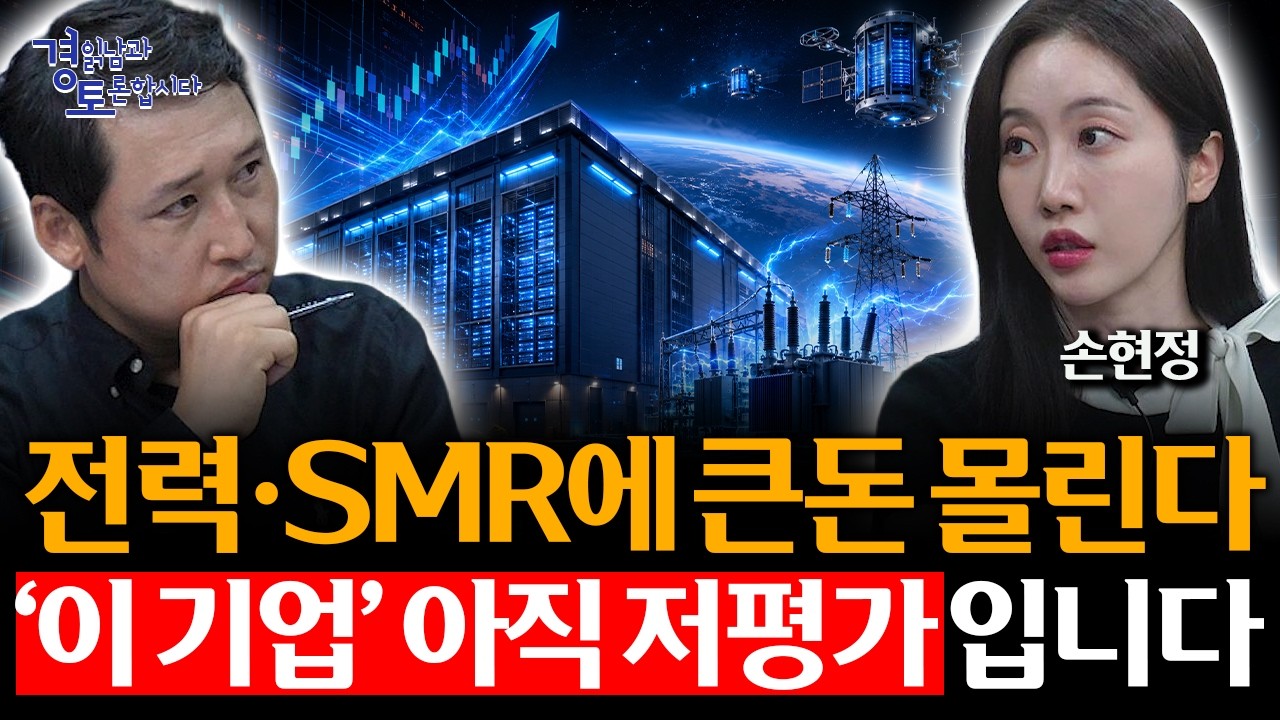
● SpaceX, Power Shock, Delayed Shift
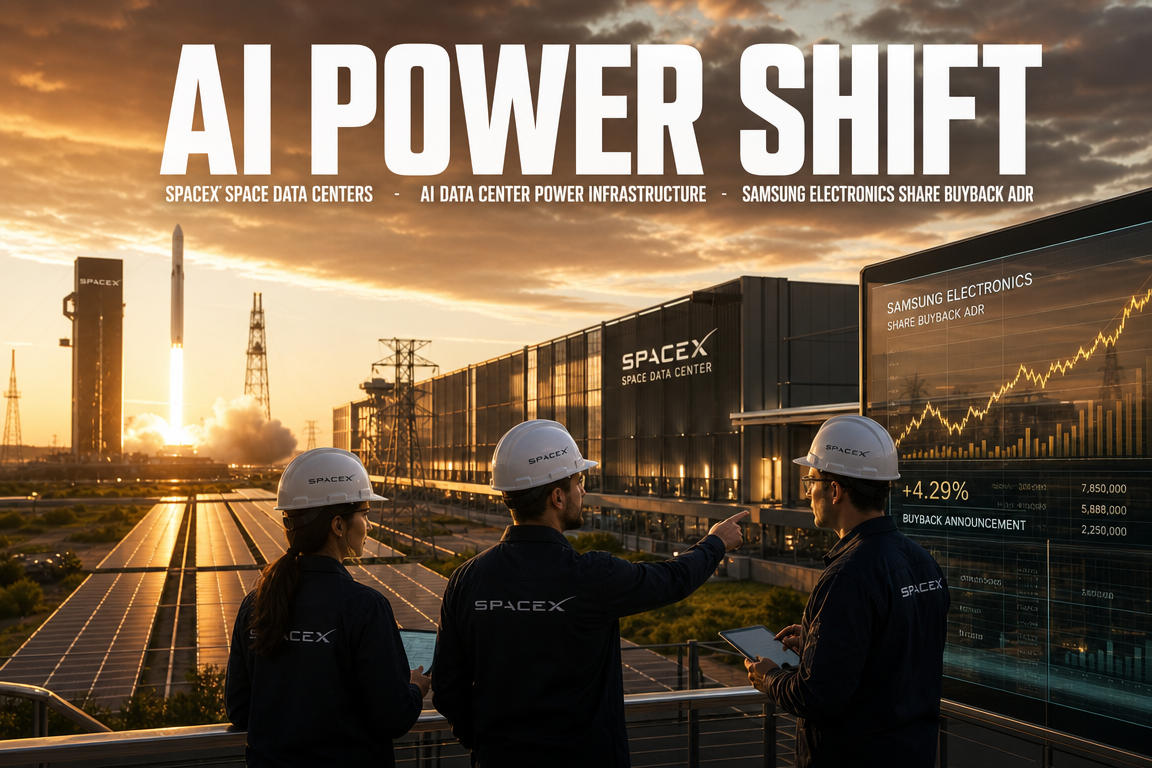
Will SpaceX’s Space Data Center Pressure Utility Stocks? The Key Issue Is Not Substitution, but Timing
The most important point in this issue is not simply whether “space data centers will replace terrestrial data centers.”
The real issue is the wide time gap between the technical feasibility of space-based data centers, the economics of terrestrial AI data centers, and infrastructure investment in the power sector.
Until around 2030, AI data centers, power infrastructure, data center electricity demand, ESS, SMR, and utility sector trends should be viewed as one AI infrastructure value chain rather than separate themes.
This article reviews whether SpaceX’s space data center concept is truly a negative for utilities, why the distribution market is drawing renewed attention, and how to assess specialized transformer companies and mid-cap power equipment names such as Sanil Electric.
1. Is the SpaceX Space Data Center Issue a Negative for Utility Stocks?
The short answer is that it is not yet a structural negative for utility stocks in the near term.
The space data center concept discussed by SpaceX and Elon Musk is a powerful narrative.
Mounting GPUs on satellites, performing computation in space, and using solar power are all plausible long-term directions.
However, the current market concern that space data centers will soon replace terrestrial data centers is premature.
- If space data centers are commercialized at scale, they could reduce some demand for terrestrial data centers.
- At present, however, economics, scalability, maintenance, data transmission latency, and launch costs matter more than technical feasibility.
- It is difficult to build a scale that would displace hyperscale terrestrial data centers by 2030.
- Power equipment and infrastructure companies are not currently incorporating space data centers as a material risk in their business plans.
In other words, the news may pressure utility stocks in the short term.
But it is not yet a negative large enough to alter earnings, orders, or the broader power infrastructure cycle.
2. Why Space Data Centers Cannot Easily Replace Terrestrial Data Centers
SpaceX has already demonstrated the ability to launch dozens of satellites at once and conduct multiple launches per week.
A satellite equipped with cameras becomes an imaging satellite, one with communication hardware becomes a communications satellite, and one with GPUs could represent a data center satellite concept.
The issue is not whether this is possible, but whether it is cheaper and more efficient than terrestrial data centers.
| Category | Space Data Center | Terrestrial Data Center |
|---|---|---|
| Technical feasibility | Long-term potential exists | Already commercialized and expanding |
| Economics | Launch and maintenance costs are high | Power cost and site economics are key factors |
| Scalability | Requires mass satellite deployment | Can scale through hyperscaler-led expansion |
| Power usage | Potential use of solar power in space | Requires grid power, renewables, and onsite generation |
| Near-term impact | Affects market sentiment | Physical demand continues to grow |
This does not mean space data centers are impossible.
They may become a new axis of AI compute infrastructure over the long term.
But given ongoing investment in NVIDIA GPU-based AI data centers, Big Tech cloud capex, and U.S. power grid expansion, they are not yet positioned to displace terrestrial demand.
3. Markets May React, but Industrial Demand Has Not Yet Turned
Markets are highly sensitive to headlines.
News about a SpaceX listing, a space data center announcement, or advances in radiative cooling could trigger short-term weakness in utility stocks.
Investors may reasonably worry that if AI data centers move into space, demand for terrestrial power infrastructure could decline.
However, the perspective is different for power equipment companies.
Current power infrastructure investment is already driven by multiyear backlogs and supply bottlenecks.
Demand for transformers, switchgear, circuit breakers, cables, transmission, and distribution systems is linked not only to AI data centers, but also to manufacturing reshoring, EV charging infrastructure, and renewable energy expansion.
- Space data center news may weigh on short-term sentiment.
- It is not yet sufficient to change earnings forecasts for power equipment companies.
- The power infrastructure industry does not currently view space data centers as a direct competitor.
- Investors should focus more on backlog, margins, capacity expansion, and customer diversification than on space-themed headlines.
4. The Real Bottleneck in Data Center Power Demand Is the Grid, Not Generation
The main challenge for AI data centers is their heavy electricity consumption.
However, generating power is not enough.
Electricity must be delivered reliably from the plant to the data center and distributed efficiently within the facility.
As a result, the bottleneck cannot be solved by a single generation source.
Transmission, distribution, transformers, power equipment, ESS, and onsite generation all need to develop together.
- Nuclear power provides stable baseload supply, but construction timelines are long.
- Renewables can be deployed relatively quickly, but output is variable.
- SMR is attracting attention as a candidate for distributed and onsite power supply.
- ESS helps stabilize loads and mitigate the intermittency of renewables.
- The distribution market is gaining importance as the power layer closest to data centers.
AI infrastructure investment is therefore not only a semiconductor story.
It also requires data centers, electricity, and the grid infrastructure needed to deliver that electricity safely.
5. Why SMR Matters: A Candidate for Faster Distributed Power Deployment
Conventional large-scale nuclear plants require long lead times from order and contract signing to construction and commissioning.
In many cases, the entire process from procurement to power delivery can take more than 10 years.
Against this backdrop, SMR, or small modular reactors, is receiving increased attention.
SMRs are smaller than conventional reactors, modular by design, and potentially suitable for onsite deployment near data centers or industrial parks.
That said, SMRs still require commercialization, regulatory approval, safety validation, and cost verification.
However, because AI data center electricity demand is rising so quickly, the market is likely to continue monitoring SMR commercialization timelines and practical data center applications.
- SMRs could become an important long-term power supply option for data centers.
- They fit well with distributed power and onsite generation trends.
- They may reach commercialization faster than large-scale nuclear projects.
- Investors should still assess regulatory approval, cost competitiveness, and customer acquisition.
6. ESS Is Becoming More Important Inside Data Centers
ESS is not merely a storage solution for renewables.
Its role inside AI data centers is also expanding.
Data centers have large and sometimes sharply fluctuating power loads.
ESS can help stabilize these loads.
In the United States, the simultaneous expansion of data centers and renewables is supporting higher ESS demand.
In regions with constrained grid capacity, ESS also improves operational reliability for data centers.
- ESS helps offset renewable intermittency.
- It stabilizes internal data center power loads.
- It can also serve as backup for outages and power quality issues.
- The share of ESS in future AI data center designs may increase.
This may still be underappreciated by the market.
As AI data center investment continues, ESS may be re-rated not as a battery theme, but as a core power infrastructure component.
7. Why the Distribution Market Is Drawing Renewed Attention
The power distribution market has recently come back into focus.
However, this should not be interpreted as “transmission is over and distribution has begun.”
Transmission remains critical, and extra-high-voltage equipment continues to offer strong margins and high technical barriers.
That said, investors who previously focused more heavily on transmission now also need to consider distribution, which is closer to data centers.
- Internal power distribution within data centers is becoming more important.
- Onsite generation increases demand for shorter transmission paths and direct distribution.
- Distribution equipment demand may rise alongside the number of data centers.
- Competition is more intense than in transmission, but the market is expanding quickly.
Transmission offers strong barriers to entry and high margins.
Distribution has more competitors, but benefits from data center growth and onsite generation trends.
Accordingly, investors should evaluate not just transmission and distribution separately, but which companies are gaining share across the broader data center power infrastructure value chain.
8. The Specialized Transformer Market and Sanil Electric
The specialized transformer market has historically received less attention in Korea.
The main reasons are limited competition and a market size smaller than that of extra-high-voltage transmission transformers.
Companies such as Sanil Electric are recognized for their strength in specialized transformers.
Although the term “specialized” may sound niche, the physical size is often comparable to distribution transformers.
These products also tend to be closer to medium-voltage categories than to the highest-voltage transmission equipment.
A transmission transformer may sell for hundreds of billions of won per unit, while specialized transformers are typically lower in unit value.
As a result, the market has historically assigned higher multiples to companies focused on transmission transformers.
- Sanil Electric has shown strong profitability in specialized transformers.
- Its operating margin is above 30%, which is unusually high.
- However, its revenue base remains smaller than that of large power equipment peers.
- Before entering the extra-high-voltage market, it was subject to a valuation discount.
- Its planned entry into 154 kV transformer production in 2028 could be a re-rating catalyst.
A 154 kV product is better described as a medium-voltage-to-high-voltage transition segment rather than the top end of extra-high-voltage equipment.
Even so, expansion from specialized transformers into a higher-voltage market is meaningful.
It supports the view that Sanil Electric should be assessed not only as a niche transformer maker, but as a broader power equipment company.
9. Sanil Electric’s High Operating Margin Is Both a Strength and a Risk
For Sanil Electric, a high operating margin is attractive on its face.
However, the market may also see it as a risk.
The main concern is whether such margins are sustainable.
In particular, investors tend to be cautious toward companies whose revenue base is still relatively small.
If quarterly revenue is around 150 billion won, the market is more likely to classify the company as a mid-cap rather than a large-cap power equipment name.
Sanil Electric is not yet viewed as a top-tier player with dominant U.S. market share, unlike HD Hyundai Electric.
Therefore, even with strong margins, it may be difficult to justify a valuation of 30x to 40x earnings immediately.
- High operating margin indicates strong competitiveness.
- But exceptionally high margins can also raise peak-margin concerns.
- Revenue growth and customer diversification remain important.
- Entry into 154 kV products could support multiple expansion.
- Additional order wins, including from Blue Energy, should be monitored.
In summary, Sanil Electric may offer value in a small- to mid-cap framework.
However, it is still prudent to avoid applying the same multiple as large-cap power equipment leaders.
10. Is the Power Supercycle in Its Early Stage, or Has Much of It Already Played Out?
It is important to distinguish between the industry cycle and the stock cycle.
From an industry perspective, the power infrastructure cycle still appears to be in an early to mid stage.
AI data center demand is still expanding, and physical AI has not yet fully materialized.
As robotics, autonomous driving, smart factories, and industrial automation scale up, power demand could rise further in a structural way.
From a stock-market perspective, however, the situation is different.
Some utility and power equipment stocks have already appreciated substantially.
With some names up more than sevenfold, it is difficult to argue that the sector is still in its earliest phase from a valuation standpoint.
| Category | Current Position | Interpretation |
|---|---|---|
| Industry cycle | Early to mid stage | AI data centers and physical AI still have room to expand |
| Stock cycle | Past the earliest stage | Some names have already re-rated sharply |
| Earnings cycle | Expansion phase | Backlog, margins, and capacity expansion must be verified |
| Investment stance | Selective | Valuation discipline matters more than broad sector exposure |
This distinction is critical.
The framework for evaluating the real economy is not the same as the framework for evaluating the stock market.
Power infrastructure remains a long-term growth industry, but stock selection requires comparing current prices with future earnings potential.
11. The Core Point Often Missed in Other Coverage
Most commentary focuses on whether space data centers are a negative or positive for utilities.
What matters more is that power infrastructure demand is not driven by a single event.
Utility stocks are not moving on AI data centers alone.
They are also linked to U.S. manufacturing reshoring, EV charging infrastructure, renewable energy expansion, replacement of aging grids, rising data center electricity demand, and the emergence of physical AI.
Even if space data centers eventually capture some compute demand, that does not automatically mean terrestrial power grid investment will decline.
If AI compute demand continues to grow rapidly, a parallel structure in which both space and terrestrial infrastructure expand is also possible.
- Space data centers are more likely a long-term complement than an immediate substitute for terrestrial data centers.
- For utilities, valuation risk, order slowdown, margin peak concerns, and excess capacity are more important than space-related headlines.
- The distribution market is a new growth area driven by data centers and onsite generation.
- ESS may be revalued as a power stabilization asset inside data centers.
- SMR is a long-term option for an era of power scarcity, but commercialization timing remains the key variable.
The key issue is not “space versus terrestrial.”
The real point is that AI electricity demand is growing so quickly that all power supply models and power equipment segments are becoming necessary at the same time.
12. Key Metrics to Monitor from an Investment Perspective
Utility stocks should not be viewed only through the lens of a thematic story.
Not every company tied to AI data centers, power infrastructure, SMR, or ESS belongs in the same category.
The following metrics should be evaluated together.
- How quickly backlog converts into revenue
- Whether the company has direct exposure to U.S. data center customers
- Which segment it is strongest in: transmission, distribution, or specialized transformers
- Whether operating margin is structurally sustainable
- When capacity expansion will begin to affect results
- Whether the company can pass through higher raw material and labor costs
- Whether it benefits from U.S. grid investment, IRA-related demand, and reshoring
- How much of future earnings is already reflected in the share price
The more the market speaks of a power supercycle, the greater the differentiation between companies is likely to become.
Not all companies in a strong industry grow at the same pace.
Within a good industry, the best companies and the most expensive stocks are not always the same.
13. Final Takeaway: More Important Than SpaceX Is the Grid Bottleneck
SpaceX’s space data center concept is an interesting long-term theme.
However, it is not the key variable for assessing utility stocks today.
The more important issue is that AI data center construction is accelerating faster than power supply expansion.
Resolving this bottleneck requires transmission, distribution, ESS, SMR, renewables, and onsite generation to advance together.
For that reason, the power infrastructure market should be viewed as a structural growth sector rather than a short-term theme.
At the same time, many stocks have already risen substantially.
The industry remains favorable, but stock selection is increasingly important.
Investment in utility and power stocks should be based not on “AI equals upside,” but on whether orders, margins, capacity, customers, and valuation are aligned.
< Summary >
SpaceX’s space data center is an important long-term technology concept, but it is unlikely to replace terrestrial AI data centers by around 2030.
As a result, it should not yet be viewed as a near-term earnings negative for utility and power infrastructure companies.
AI data center electricity demand continues to rise, and the main bottleneck lies in the grid, distribution, transformers, and ESS rather than generation alone.
SMR is emerging as a long-term alternative for distributed power supply and onsite generation.
The distribution market is gaining importance as power infrastructure closest to data centers.
Specialized transformer companies such as Sanil Electric offer strong profitability and expansion potential, but valuation, revenue scale, and top-tier status must be assessed carefully.
The power infrastructure industry is still in the early stage of a supercycle, but some stocks have already re-rated significantly, making selective investment essential.
[Related Articles…]
- AI Data Centers and the Power Infrastructure Supercycle
- SMR and ESS in the Next Generation Energy Investment Landscape
*Source: [ 경제 읽어주는 남자(김광석TV) ]
– 스페이스X 우주 데이터센터, 전력주에 진짜 악재일까? | 경읽남과 토론합시다 | 손현정 연구원 [3편]