● Gold Crash, Won Wobbles, 1600 Risk
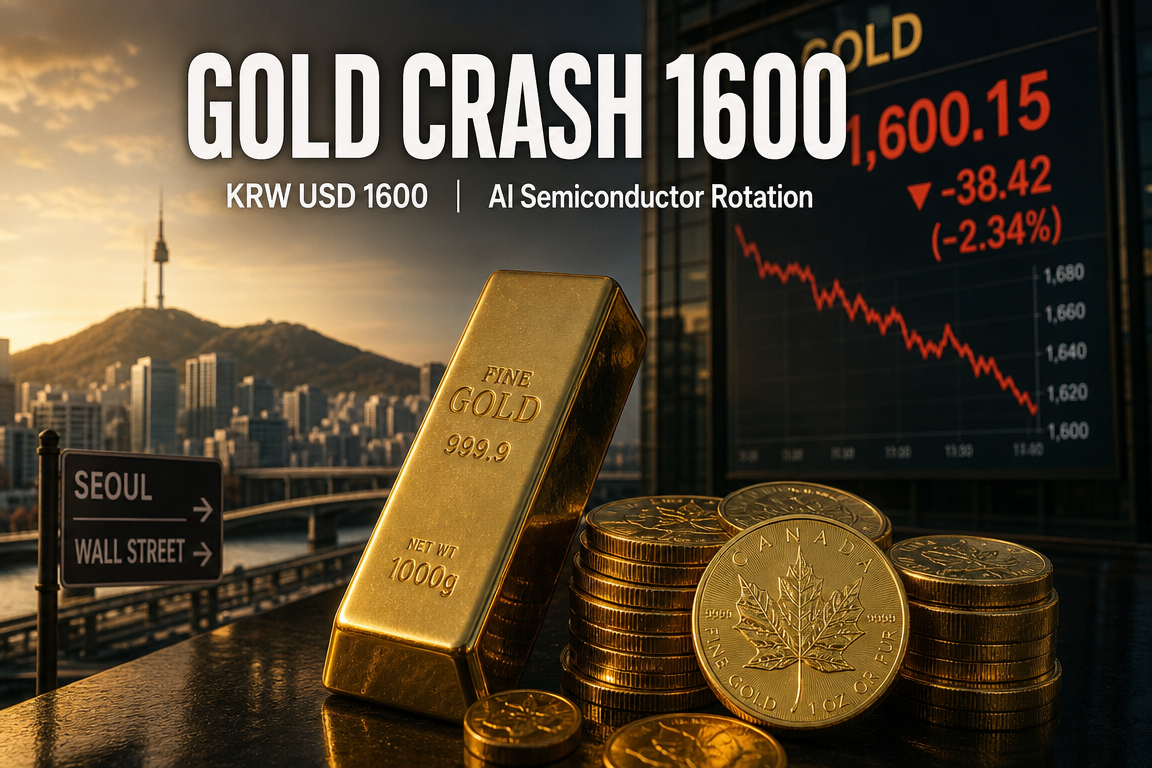
Gold Falls 30% and KRW/USD Approaches 1,600: The Key Variable the Market May Be Missing
The most important point in this move is not simply that gold fell or that the exchange rate rose.
The core issue behind the gold correction is not a collapse in safe-haven demand, but a shift of capital from gold into equities and the AI semiconductor sector.
The core issue behind the sharp rise in the KRW/USD exchange rate is not one that can be solved within the foreign exchange market alone; it also reflects weakening concerns over Korea’s growth outlook, fiscal soundness, and liquidity management.
At the same time, U.S. policy rates, inflation, labor data, Samsung Electronics earnings, and semiconductor exports are converging, placing global financial markets in a renewed phase of directional uncertainty.
1. A 30% Gold Decline: A Capital Rotation Problem, Not a Simple Correction
Gold has recently corrected by roughly 30% from its peak.
Silver also retreated sharply after setting a historic high.
On the surface, this raises the question of why gold, a traditional safe haven, would fall.
But asset prices are ultimately determined by supply and demand, or more precisely, by the movement of capital.
- When equities rise, capital is flowing into stocks.
- When property prices rise, capital is flowing into real estate.
- When gold rises, capital is flowing into gold.
- When Bitcoin rises, capital is flowing into digital assets.
This gold correction appears to reflect not a loss of gold’s intrinsic value, but a reallocation of funds away from gold and into other assets.
In particular, capital has concentrated in global equities, AI semiconductors, and semiconductor-related ETFs and large-cap technology stocks.
2. Three Key Drivers of Gold Prices
The outlook for gold does not require an overly complex framework.
Three variables are sufficient to understand much of the direction.
1) Uncertainty: Gold Rises When Geopolitical Risk Increases
Gold is a classic safe-haven asset.
Demand for gold tends to rise when war, financial stress, trade conflict, or geopolitical risk intensifies.
Gold strength in 2025 was supported by U.S.-China trade tensions, tariff disputes, and broader geopolitical instability.
As uncertainty increases, investors move away from risk assets toward safe havens, which supports gold prices.
2) Liquidity: Gold Benefits When Rate-Cut Expectations Rise
Gold does not generate interest income.
As a result, higher policy rates reduce its relative appeal.
Conversely, when rate cuts are expected and liquidity expands, gold tends to perform better.
Since mid-2024, markets had priced in policy easing and liquidity support across major economies.
During that period, gold posted a strong upward trend.
3) Dollar Strength: A Stronger Dollar Weighs on Gold
Gold is denominated in dollars.
When the dollar strengthens, the dollar price of gold typically comes under pressure.
Accordingly, a rising Dollar Index usually places downward pressure on gold.
When the dollar weakens, gold generally finds it easier to advance.
3. Why Gold Failed to Rally Further During the Middle East Conflict
War is usually supportive of gold.
However, during the Middle East conflict, gold did not sustain a strong rally and instead corrected.
The reason is that inflation and rate-hike concerns outweighed the war-driven safe-haven effect.
- The conflict raised concerns about higher crude oil prices.
- Higher oil prices increased inflation expectations.
- Rising inflation increased the likelihood of tighter U.S. monetary policy.
- Rate-hike expectations strengthened the dollar and weighed on gold.
In short, geopolitical uncertainty supported gold, but inflation and U.S. rate-hike concerns offset that effect.
4. Five Reasons Behind the Gold Selloff
1) Geopolitical risk moved past its peak and eased
Indicators such as the VIX and CDS spreads reflect market fear.
Fear rose sharply after the Middle East conflict began, but over time markets began to place more weight on de-escalation than on further expansion.
As geopolitical risk eases, demand for safe havens declines.
This was the first driver of the gold correction.
2) Inflation expectations were reaccelerated
Gold is also viewed as an inflation hedge.
However, when rising inflation is interpreted as a reason for tighter central bank policy, the picture changes.
Recent markets have treated firmer inflation expectations as increasing the probability of U.S. rate hikes.
That has put downward pressure on gold.
3) Rate-hike concerns broadened across major economies
Rate-hike expectations have emerged in the euro area, Japan, Australia, and some Asian emerging markets.
In Korea as well, inflation and exchange rate volatility have raised questions about possible policy tightening.
Higher rates improve the appeal of deposits and bonds.
By contrast, gold, which pays no interest, becomes less attractive.
4) The probability of further U.S. tightening increased
The Federal Reserve remains the most important policy reference for markets.
When PCE inflation and core PCE inflation are projected to remain elevated, the Fed may lean more toward tightening than easing.
Relative to the 2% target, inflation remains above comfortable levels.
As a result, markets have been pricing in the possibility that the Fed could tighten again.
This supports dollar strength and weighs on gold.
5) Capital moved from gold into AI semiconductors and equities
This is the most important factor in the correction.
Global capital has recently shifted away from gold and Bitcoin toward equities with visible earnings momentum.
Capital has concentrated in AI infrastructure, semiconductors, power, data centers, and semiconductor equipment.
In Korea, the rise in the KOSPI has been led by semiconductors.
Funds have moved into Samsung Electronics, SK hynix, memory semiconductors, and the broader AI semiconductor value chain.
5. What Would Be Needed for Gold to Recover
For gold to rebound meaningfully, several conditions would need to align.
- U.S. inflation would need to slow more quickly than expected.
- Expectations for U.S. rate hikes would need to fade.
- The Dollar Index would need to decline.
- Geopolitical risk would need to rise again.
- Central bank gold purchases would need to expand.
- Capital would need to rotate back from AI semiconductors and equities into safe havens.
In other words, the gold outlook should not be assessed only through the lens of war or peace.
Uncertainty, liquidity, the dollar, interest rates, and capital rotation all need to be considered together.
6. KRW/USD Near 1,600: Why the Market Is Concerned
The KRW/USD exchange rate recently exceeded 1,560 intraday, signaling significant stress.
On a monthly average basis, it has reached levels described as the highest since the Asian financial crisis.
The problem is not a one- or two-day spike, but the persistence of elevated exchange rates over time.
The authorities intervened by selling a large amount of dollars to stabilize the market.
In the source material, roughly KRW 50 trillion in intervention was cited.
However, the exchange rate remained difficult to contain.
This suggests that the sources of pressure are not confined to the FX market alone.
7. Foreign Reserves and Korea’s Policy Capacity
Korea’s foreign reserves rank lower than in the past.
That does not by itself signal an imminent currency crisis.
Korea’s external debt profile differs materially from the 1997 crisis, with external assets exceeding external liabilities and the current account structure remaining comparatively stronger.
Accordingly, treating the current situation as a replay of the IMF crisis would be excessive.
The issue is that continuously using reserves to defend the exchange rate is not sustainable.
It is like repeatedly taking fever medicine without treating the underlying cause.
Without addressing the root issue, the symptom will return.
8. Temporary Drivers of the KRW/USD Surge
1) Heavy foreign selling of Korean equities
When foreign investors sell Korean stocks on a large scale, dollars leave the market.
Selling equities and converting won into dollars weakens the won and raises dollar demand.
This supports a higher KRW/USD exchange rate.
In particular, foreign net selling in the first half of 2026 was reportedly very large.
2) Rising retail overseas investment
As domestic investors buy U.S. equities, global ETFs, Nasdaq, and S&P 500 products, dollar demand rises.
Capital moving overseas creates downward pressure on the won.
However, this is difficult to restrain through policy.
Overseas investment is a rational asset allocation choice for individuals.
3) Dollar retention by exporters
Exporters receive more won revenue when the exchange rate is higher.
For companies in semiconductors, autos, consumer electronics, and displays, a weaker won can improve profitability.
As a result, exporters often delay converting dollars into won and keep dollar balances longer.
This reduces dollar supply in the market and adds upward pressure to the exchange rate.
9. Structural Drivers of the KRW/USD Surge
Temporary factors are difficult for policymakers to control.
Structural factors, however, can be addressed through policy.
The key issue is not intervention alone, but strengthening the fundamentals of the Korean economy.
1) The U.S.-Korea policy rate gap
When Korea’s policy rate is below the U.S. rate, the won becomes less attractive.
Investors tend to prefer dollar assets that offer higher yields.
As a result, the rate gap is a source of upward pressure on KRW/USD.
That said, the rate differential is not the sole cause.
There have been periods of policy rate inversion in the past without producing the same degree of structural won weakness.
Accordingly, rate hikes may help stabilize the exchange rate, but they are not a complete solution.
2) The pace of liquidity expansion in Korea
When money supply expands too quickly, currency value tends to weaken.
Even if the United States is also adding liquidity, Korea’s won may come under greater pressure if M2 growth is stronger than in the U.S.
This is a structural driver of KRW depreciation.
Monetary and fiscal authorities need to manage the pace of liquidity expansion.
3) Deterioration in fiscal soundness
The value of a currency is linked to confidence in the economy behind it.
If fiscal deficits persist and government debt rises, foreign investors may become less willing to hold the won.
OECD assessments have also highlighted the need for Korea to maintain fiscal discipline.
Fiscal soundness is not only a budget issue; it is also an exchange rate issue.
4) Slowing potential growth
Investors prefer currencies of economies that grow.
As Korea’s potential growth rate declines and its ranking among OECD economies weakens, the attractiveness of the won also declines.
The more entrenched the low-growth structure becomes, the stronger the downward pressure on the currency.
Accordingly, restoring growth potential is more important than short-term FX intervention for exchange rate stability.
5) Net outflow of outward direct investment
Korean companies are building factories overseas at a rapid pace, while inbound investment from foreign firms remains relatively weak.
That creates net capital outflows and puts downward pressure on the won.
The solution is to make Korea a more attractive destination for foreign investment.
AI data centers, semiconductor clusters, global R&D centers, and advanced manufacturing projects need to be actively attracted.
10. The Core of FX Policy Lies Outside the FX Market
What is needed now is not merely dollar-selling intervention.
Treating a foreign exchange problem only within the foreign exchange market has clear limits.
Stabilizing KRW/USD requires strengthening confidence in the broader economy.
- The U.S.-Korea rate gap must be managed appropriately.
- The pace of liquidity growth should be controlled.
- Fiscal soundness should be reinforced.
- Strategies to restore potential growth must be implemented.
- Inbound foreign direct investment should be increased.
- AI semiconductors, advanced manufacturing, and data centers should be developed as national growth engines.
The exchange rate is not just a number set by dealers.
It is a composite measure of a country’s growth potential, stability, and credibility.
11. U.S. Labor Data: Distinguish Between the Unemployment Rate and Nonfarm Payrolls
When assessing U.S. labor data, investors should look at the unemployment rate, nonfarm payroll changes, and wage growth together.
Over the long term, the unemployment rate is the most important indicator.
The Federal Reserve also uses it as a core reference for maximum employment.
In the short term, however, markets react more strongly to nonfarm payroll changes.
In the latest release, the unemployment rate remained stable, but nonfarm employment growth slowed.
That led markets to interpret the data as a sign of labor-market cooling.
Overall, however, the U.S. labor market still appears to be in a gradual slowdown rather than a recessionary shock.
12. Samsung Electronics Earnings and KOSPI Volatility
Samsung Electronics’ preliminary results on July 7 could be a major variable for the domestic market.
Preliminary earnings typically include total revenue and operating profit, while segment details are released later.
Markets expect second-quarter earnings to improve sequentially.
The key issue is not simply whether earnings are good or bad, but whether they exceed or fall short of expectations.
- A result above expectations would be an earnings surprise.
- A result below expectations would be an earnings miss.
- The KOSPI and semiconductor stocks could see significant volatility immediately after the release.
AI semiconductor demand, memory pricing, server investment, and global data-center expansion remain the key variables for Samsung Electronics and SK hynix.
Given that capital has shifted from gold into semiconductors and equities, Samsung Electronics’ earnings should be viewed not only as a corporate event, but also as a test of global capital flow.
13. Semiconductor Export Data: Correction Point
The source material also included a correction related to semiconductor export data.
Semiconductor exports rose sharply year over year and were presented as the main driver of overall export growth.
However, there was a correction indicating that non-semiconductor exports were also positive, not negative.
The key point is that semiconductors remain the leading contributor to Korea’s export recovery.
However, the breadth of growth beyond semiconductors still needs to be assessed separately.
14. What Other Reports Often Miss
First, the gold selloff is primarily a capital rotation issue rather than a gold-specific problem.
The market is assigning higher value to AI semiconductors and global equities with visible earnings momentum than to safe havens.
Second, the KRW/USD surge cannot be resolved through FX intervention alone.
The real issue lies in Korea’s growth trajectory, fiscal soundness, liquidity, and cross-border capital flows.
Third, U.S. labor data must be interpreted differently in the short and long term.
Markets react to nonfarm payrolls in the short run, while the Fed places more weight on the unemployment rate and inflation trends.
Fourth, Samsung Electronics earnings are not merely a corporate update.
They are a key indicator of whether global capital is continuing to rotate from gold into AI semiconductors and the KOSPI.
Fifth, the more important issue than whether the exchange rate briefly touches 1,600 is whether elevated FX levels persist.
A prolonged move in the 1,500 range would create greater pressure on import prices, small and medium-sized enterprises, consumer inflation, and policy-rate decisions.
< Summary >
The 30% decline in gold reflects weaker safe-haven demand, a stronger dollar, renewed U.S. rate-hike concerns, and capital rotation into AI semiconductors and equities.
Gold would require slower inflation, weaker rate-hike expectations, a softer dollar, and renewed geopolitical stress to recover.
The rise in KRW/USD reflects both temporary factors such as foreign equity selling, retail overseas investment, and exporter dollar retention, and structural factors such as the U.S.-Korea rate gap, liquidity growth, fiscal soundness, and slower potential growth.
Exchange rate stabilization depends more on Korea’s economic fundamentals than on FX intervention alone.
Samsung Electronics earnings and semiconductor exports are likely to remain key indicators for KOSPI performance and global capital flows.
[Related Articles…]
- KRW/USD Near 1,600: Korea’s Currency Risk Outlook
- Gold Correction and Safe-Haven Allocation Strategy
*Source: [ 경제 읽어주는 남자(김광석TV) ]
– [LIVE] (1)금값 -30% 급락한 ‘진짜 이유’ (2)원달러 환율 1600원 가는가? [즉시분석]