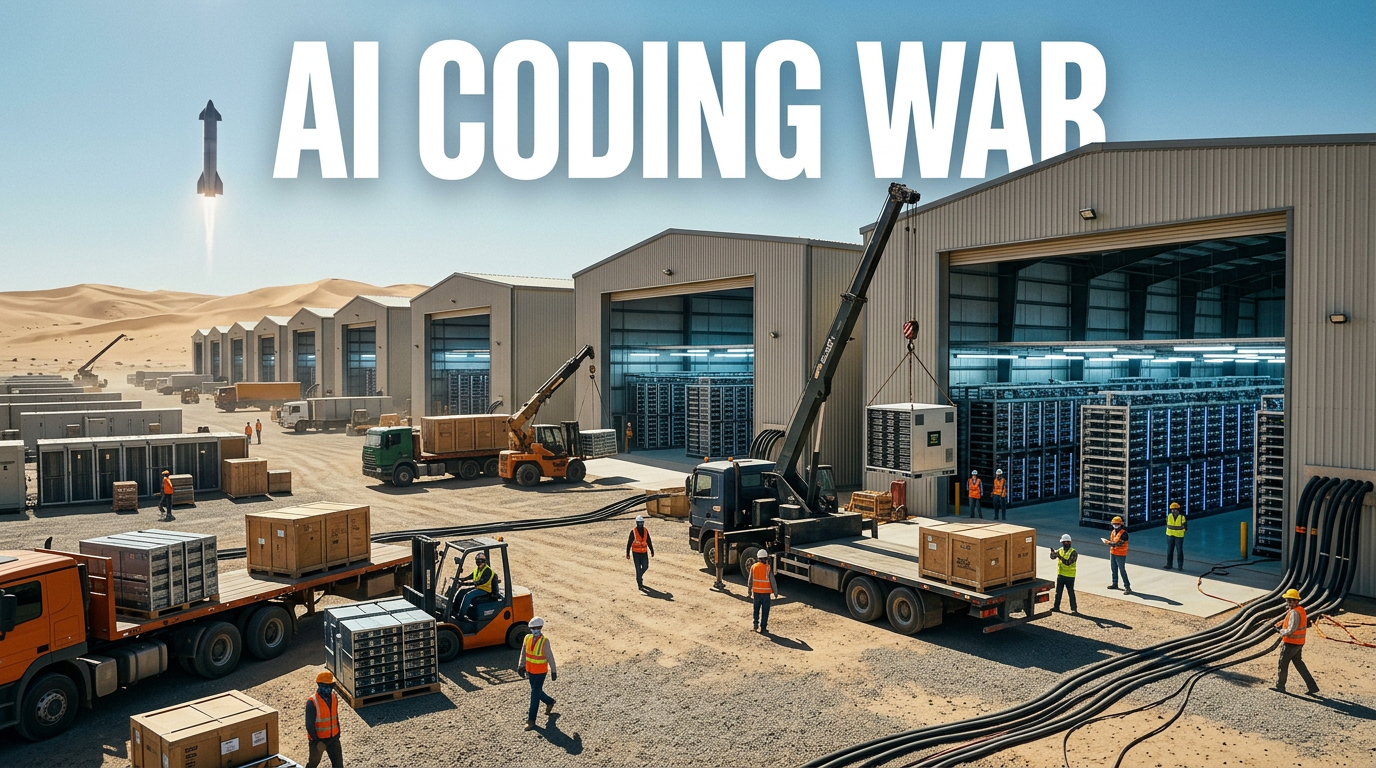
● GPU Power Struggle
Why Did SpaceX Want to Snatch Coding Agent Company “Cursor”? The Center of the AI War Has Shifted from Models to GPUs, Electricity, and Data Centers
The core point of this issue is not simply, “Why did a rocket company buy a coding company?”
The truly important takeaway is where the money in the AI industry is being made, and who will capture the margins going forward.
Right now, the AI market is rapidly moving from model performance competition to coding agent competition, and then again to competition over AI data centers, GPU shortages, and power infrastructure.
In other words, big tech’s investment direction is shifting from “who built the smarter model” to “who can produce more tokens more cheaply.”
This shift becomes much clearer when looking at the moves of SpaceX, xAI, Microsoft, AWS, Google, Anthropic, and OpenAI.
1. The battleground of the AI industry has changed: models → tokens → agents → data centers
From 2023 to 2025, the center of the AI market was competition over model performance.
OpenAI’s GPT, Anthropic’s Claude, and Google’s Gemini were competing over who was smarter.
But the atmosphere has changed now.
Models have already reached a certain level of parity, and companies and individuals have started asking, “So how much real work can this AI automate?”
-
Stage 1: Model wars
Competition over the performance of large language models like GPT, Claude, and Gemini was the core issue.
-
Stage 2: General AI wars
AI services that users interact with directly, such as ChatGPT, Claude, and Gemini, became widespread.
-
Stage 3: Coding agent wars
Development automation tools such as Cursor, Claude Code, GitHub Copilot, Codex, Kiro, and Google Antigravity emerged as the market’s core.
-
Stage 4: Work agent wars
AI that performs reports, analysis, documents, meetings, and strategy work in place of humans is spreading, such as Microsoft 365 Copilot and Claude’s work automation features.
-
Stage 5: AI data center wars
Ultimately, running all of these AI services requires GPUs, electricity, cooling, networking, and data centers.
The most important conclusion from this flow is simple.
The more AI services are sold, the more important the underlying AI data centers become.
2. Why did SpaceX want a coding agent company like Cursor?
On the surface, SpaceX is a rocket company, and Cursor is a coding agent company used by developers.
They look like completely different industries.
But when you look at the structure of the AI industry, the connection becomes very clear.
-
First, coding agents are the earliest AI agent market to make money.
It is difficult to evaluate whether AI writes reports well or makes good strategy.
But coding is different.
You can immediately verify whether it works according to spec, whether it passes tests, and whether bugs have decreased.
That is why coding is the area where AI agents commercialize the fastest.
-
Second, coding agents consume an enormous amount of tokens.
When developers use Cursor or Claude Code, it does not end with one or two simple questions.
Huge numbers of tokens are consumed while reading code, analyzing it, modifying it, testing it, and fixing it again.
This means coding agents are a core service that explosively increases demand for AI data centers.
-
Third, for SpaceX and xAI, improving internal productivity is a direct benefit.
Rockets, satellites, autonomous driving, communication networks, and AI model development all require advanced software engineering.
Securing coding agents can speed up internal development and increase productivity per developer.
-
Fourth, coding agents are the entry point to the AI platform war.
They start as tools for developers, but the structure can expand into work agents.
Once AI that writes code manages projects, creates documents, designs tests, and automates operations, it becomes a core layer of enterprise work.
In the end, the reason SpaceX wanted Cursor is not simply because it wanted to buy a coding company.
It should be seen as a strategy to preempt the first major market in the AI agent era and connect that to the token consumption and data center demand that follow.
3. The most expensive resources in the AI market now are not models, but GPUs and electricity
Building a good AI model is important, but the bigger bottleneck now is GPUs and power infrastructure.
GPUs are not hardware you can just buy whenever you want.
NVIDIA cannot supply them endlessly, and the semiconductor production ecosystem of companies like TSMC and Samsung Electronics cannot suddenly multiply output several times over.
On top of that, data centers, electricity, and cooling facilities are needed to house high-performance GPUs.
The reason AI chip prices have risen sharply in a short period is also here.
Demand is exploding, but supply is increasing slowly.
That means prices have no choice but to rise.
-
As AI service usage rises, token consumption is increasing sharply.
-
The share of GPUs used for inference and serving is growing relative to training.
-
Coding agents and work agents require far more computation than ordinary chatbots.
-
Data centers are difficult to expand quickly because of electricity, cooling, land, and permitting issues.
-
Ultimately, the companies that already secured AI data centers are likely to gain market leadership.
In simple terms, whereas the core question used to be “who built the better AI model,” now it is “who can supply more tokens reliably and cheaply.”
4. The core point of the token economy shift: from the era of heavy usage to the era of efficient usage
A few months ago, in the AI market, using more tokens was almost treated as synonymous with better performance.
Longer context, more reasoning, and more complex agent tasks looked like symbols of advanced AI.
But now skepticism about token maxing is growing.
The reason is clear.
Tokens are not free.
Using more tokens means running GPUs longer, using more electricity, and paying more for data center costs.
-
From the producer’s perspective
AI companies improve margins when they can process more requests with the same GPUs.
That is why model compression, caching, routing, and inference optimization are becoming important.
-
From the consumer’s perspective
Companies want to use AI heavily, but they cannot easily absorb explosive cost increases.
In fact, some companies are already seeing cases where coding agent usage grows so quickly that AI budgets are exhausted early.
-
From the platform’s perspective
Handling simple tasks with cheaper models and sending only difficult tasks to high-performance models becomes a key competitive advantage.
Going forward, a company’s strength in AI will likely hinge not merely on how smart the model is, but on how efficiently it can be made to use tokens.
5. The coding agent war: the hottest market everyone in big tech has entered
The fiercest battlefield in the current AI market is coding agents.
Developer work is highly digitized, outcomes are clearly verifiable, and willingness to pay is high.
That is why both big tech and AI startups are jumping into this market.
-
GitHub Copilot
Built on the Microsoft and GitHub ecosystem, it is deeply embedded into developer workflows.
-
Cursor
Representing the vibe coding boom, it rapidly popularized the experience of writing and editing code with natural language.
-
Claude Code
It is rapidly spreading among developers based on Anthropic’s powerful coding performance.
-
OpenAI Codex
It is expanding the coding automation space by combining with the ChatGPT ecosystem.
-
Amazon Kiro
It aims to connect the AWS ecosystem with developer tools and drive cloud-based development automation.
-
Google Antigravity
Google is trying to counterattack in the coding agent market by bundling Gemini with development tools.
The important thing here is not “coding,” but “agent.”
Coding agents are not simple autocomplete tools.
They perform a sequence of tasks: breaking down requirements, making plans, writing code, testing, and fixing.
This structure can later expand into finance, marketing, HR, legal, and strategy work.
6. The work agent war: Microsoft 365 Copilot is the most advanced
The next battlefield after coding agents is work agents.
This is the market where ordinary office workers entrust document writing, meeting summaries, report creation, data analysis, email handling, and strategic planning to AI.
The company currently in the most advantageous position is Microsoft.
The reason is simple.
It already dominates the core tools of enterprise work: Word, Excel, PowerPoint, Outlook, and Teams.
-
Microsoft 365 is the basic work infrastructure for enterprises.
-
Copilot is the AI layer attached on top of that infrastructure.
-
From an enterprise perspective, AI that naturally fits into existing work environments is more likely to be preferred over a separate tool.
The pricing structure is also telling.
Microsoft 365 itself is around the $30 per month range, and Copilot is also added at roughly $30 per month.
This means a time may come when AI features cost more than the software itself.
Google is pursuing a similar strategy.
It is attaching Gemini to Gmail, Google Docs, Google Sheets, and Chrome.
However, because Google has such a large free-user base, broadly distributing AI features for free could sharply increase GPU and electricity costs.
7. The real competitiveness of the three cloud giants: not models, but “AI data center leasing”
OpenAI and Anthropic are famous as model companies, but neither of them fully owns huge AI data centers on its own.
OpenAI has relied heavily on Microsoft Azure infrastructure, and Anthropic is closely connected to AWS.
In this structure, the party making the most stable money may ultimately be the company providing cloud infrastructure.
-
Azure
Based on its collaboration with OpenAI, it holds a strong position in AI revenue.
It is currently regarded as one of the cloud providers most ahead in terms of securing GPUs.
-
AWS
It works with Anthropic and serves various models through Bedrock.
Enterprise customers can choose and switch among multiple models through a layer like AWS Bedrock rather than being locked into one model.
-
GCP
It has TPU and the Gemini ecosystem, but compared with the pace of AI service expansion, its computing resources are insufficient, which is leading to the use of external GPU leasing as well.
The important concept here is orchestration.
Companies do not always use the most expensive model.
Simple tasks are handled by cheaper models, while complex tasks are sent to high-performance models.
Results that have already been processed are reused through caching.
Cloud and platform companies that build this structure well may capture higher margins going forward.
8. The meaning of xAI Colossus: 220,000 GPUs are not just for show
xAI’s AI data center Colossus is said to be on the scale of about 220,000 GPUs.
The reason this number matters is that it is large enough to be compared to national-level AI infrastructure.
Colossus is such a symbolic facility in the global AI infrastructure war that it is mentioned as being at a scale similar to the GPUs South Korea is negotiating with NVIDIA to secure.
What is interesting, however, is that xAI does not appear to use all of these GPUs solely for training and serving its own model, Grok.
There are reports of a structure in which spare GPU resources are leased out to external parties such as Anthropic and Google.
This means SpaceX and xAI can make money not just as AI model companies, but also as AI data center operators.
-
It is difficult to use all 220,000 GPUs with Grok usage alone.
-
In a situation where GPU prices have surged, GPUs secured in advance become powerful assets.
-
Companies with exploding AI demand, like Anthropic and Google, need external GPU leasing.
-
Ultimately, xAI can become both a model company and an AI infrastructure leasing business.
This is the most important point of the issue.
The real strength of SpaceX and xAI is not a single model, but propulsion, power 확보, data center construction, GPU preemption, and the speed at which they can commercialize all of this.
9. Google’s dilemma: strong technology, but an unclear number-one battlefield
Google is a company close to the origin of AI technology.
It has powerful assets such as Transformer research, DeepMind, TPU, search data, Android, Chrome, and Workspace.
Yet in today’s AI market, Google is in an ambiguous position.
-
In general AI, ChatGPT is strong.
-
In coding agents, Cursor, Claude Code, and GitHub Copilot are pulling ahead strongly.
-
In work agents, Microsoft 365 Copilot has an advantage in the enterprise market.
-
In cloud AI infrastructure, Azure and AWS hold strong positions.
Google is putting Gemini into all of its services.
It is pushing AI across Chrome, Gmail, Docs, Sheets, Search, and Android.
The problem is that this strategy comes with enormous compute costs.
The more broadly AI features are offered to free users, the greater the GPU and electricity burden becomes.
So Google’s move to lease external data center resources should not be seen as a mere supplement.
It can be viewed as a signal that the strategy of pushing Gemini across the entire company is being translated into real infrastructure cost pressure.
10. The core point that other news does not explain well: the winner in AI may not be the “model company”
Most news focuses on the model performance of OpenAI, Anthropic, and Google Gemini.
But the real flow of money is more complex.
The players capturing margins in the AI industry can largely be divided into three layers.
-
First layer: user-facing services
Services like ChatGPT, Cursor, Copilot, and Claude Code directly meet users.
By controlling brand and user experience, they can command high prices.
-
Second layer: model providers
Companies like OpenAI, Anthropic, and Google DeepMind provide AI models.
But as model competition intensifies, they may face price pressure.
-
Third layer: infrastructure providers
Data center operators like Azure, AWS, GCP, and xAI Colossus provide GPUs and electricity.
When demand exceeds supply, this layer can capture the most stable margins.
It is similar to how McDonald’s may make money, but the landlord steadily collects rent.
In the AI market as well, model companies may look famous, but in reality, the companies owning the data centers may have stronger bargaining power.
In particular, once an AI service is hosted on a specific cloud, it is not easy to move it.
That is because data, APIs, operating environments, security, and cost structures are all intertwined.
So cloud companies like Azure, AWS, and GCP are building an additional abstraction layer on top of model companies.
If customers are made to call multiple models through a single platform like AWS Bedrock, they become tied to the platform rather than to a specific model.
11. Over the next two years, the AI data center war will intensify
From 2026 to 2027, the AI data center war is likely to begin in earnest.
This war is not just about building more servers.
It is a complex competition involving GPU acquisition, power contracts, cooling technology, land permitting, network costs, and the semiconductor supply chain.
-
Who secured GPUs first
As GPU prices rise, companies that bought in large volume early gain a cost advantage.
-
Who secured electricity stably
AI data centers are power hogs.
Without power infrastructure, even if you buy GPUs, you cannot run them properly.
-
Who can produce tokens more cheaply
As AI service price competition intensifies, the cost of producing tokens will determine corporate competitiveness.
-
Who controls agent usage
Coding agents and work agents are key applications that explode token consumption.
Ultimately, the future AI economy will become a market where “model performance” and “infrastructure cost” matter at the same time.
Even companies with great models are constrained in growth if they lack GPUs and electricity.
Conversely, even if their models lag a bit, companies that dominate data centers and cloud ecosystems can generate stable revenue.
12. Key checkpoints to consider from an investment perspective
When looking at AI-related companies, it is no longer enough to simply say, “the model is good.”
Going forward, the following indicators should be considered together.
-
GPU holdings
How many GPUs have been secured, and which generation they belong to, is important.
-
Power acquisition capability
You need to check whether the company has the electricity contracts and infrastructure to operate AI data centers stably.
-
The real source of AI revenue
You should distinguish whether the revenue comes from user subscriptions, API revenue, cloud usage fees, or data center leasing revenue.
-
Agent market share
What matters is whether actual usage is increasing in coding agents and work agents.
-
Token efficiency technology
Companies that can handle the same tasks with fewer tokens and lower cost will have the long-term advantage.
-
Cloud lock-in structure
You should also look at how deeply customers are tied to a particular cloud or platform.
With this framework, you can interpret the movements of Microsoft, AWS, Google, xAI, NVIDIA, and coding agent companies in a much more three-dimensional way.
13. If this issue is summed up in one sentence
The reason SpaceX wanted Cursor should be seen not as wanting one coding tool, but as a strategy to simultaneously capture the usage explosion in the AI agent era and the data center economy beneath it.
The center of the AI industry is now moving beyond boasting about model performance.
Going forward, who secured GPUs, who secured electricity, who can make tokens cheaply, and who can control agent usage will matter more.
< Summary >
The AI war is moving from model competition to competition over coding agents and work agents.
Coding agents are the earliest AI agent market to make money, and they create massive token and GPU demand.
The reason SpaceX and xAI want companies like Cursor is to capture development productivity, the agent platform, and data center demand at the same time.
The core point of the AI industry going forward is GPU shortages, power infrastructure, AI data centers, and token efficiency.
Model companies like OpenAI and Anthropic are still important, but in the long run, companies with infrastructure such as Azure, AWS, GCP, and xAI Colossus may have greater bargaining power.
The real battleground in the AI market after 2026 is likely to be not “who built the smarter AI,” but “who can run AI more cheaply and reliably.”
[Related Articles…]
*Source: [ 티타임즈TV ]
– 우주 회사 ‘스페이스X’는 왜? 코딩 회사인 ‘커서’를 인수했을까 (박종천 지란지교소프트 CAIO)