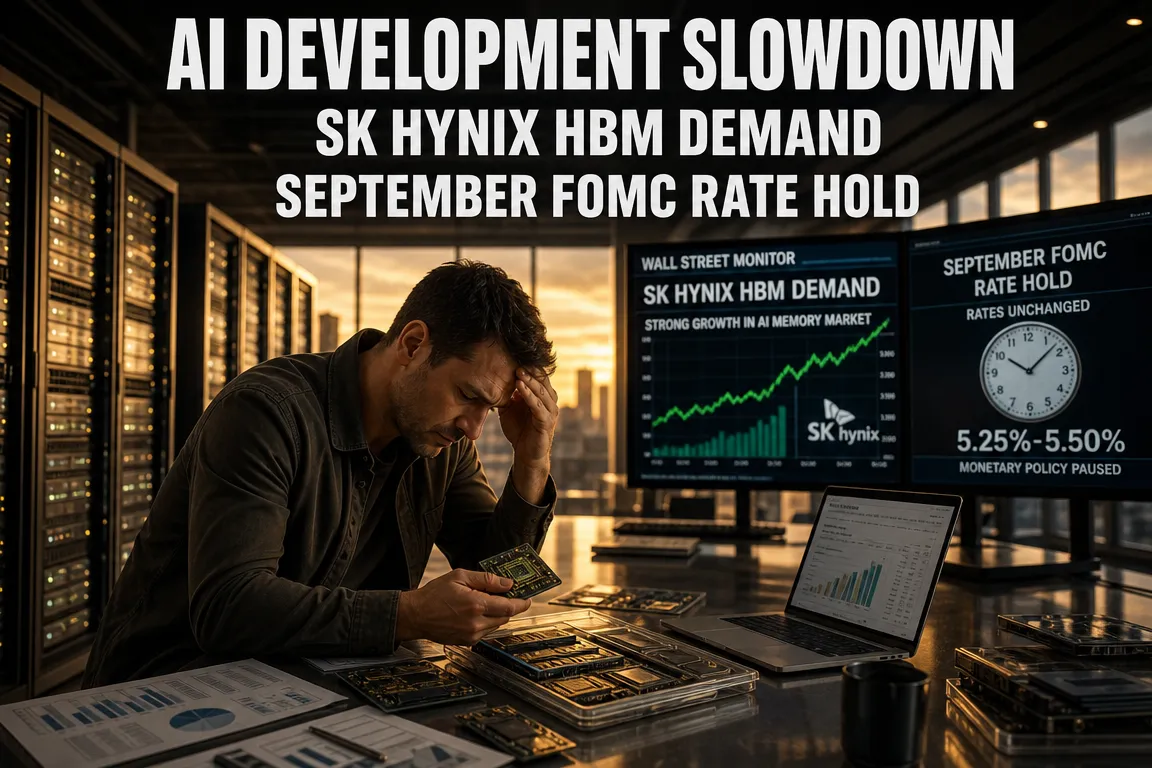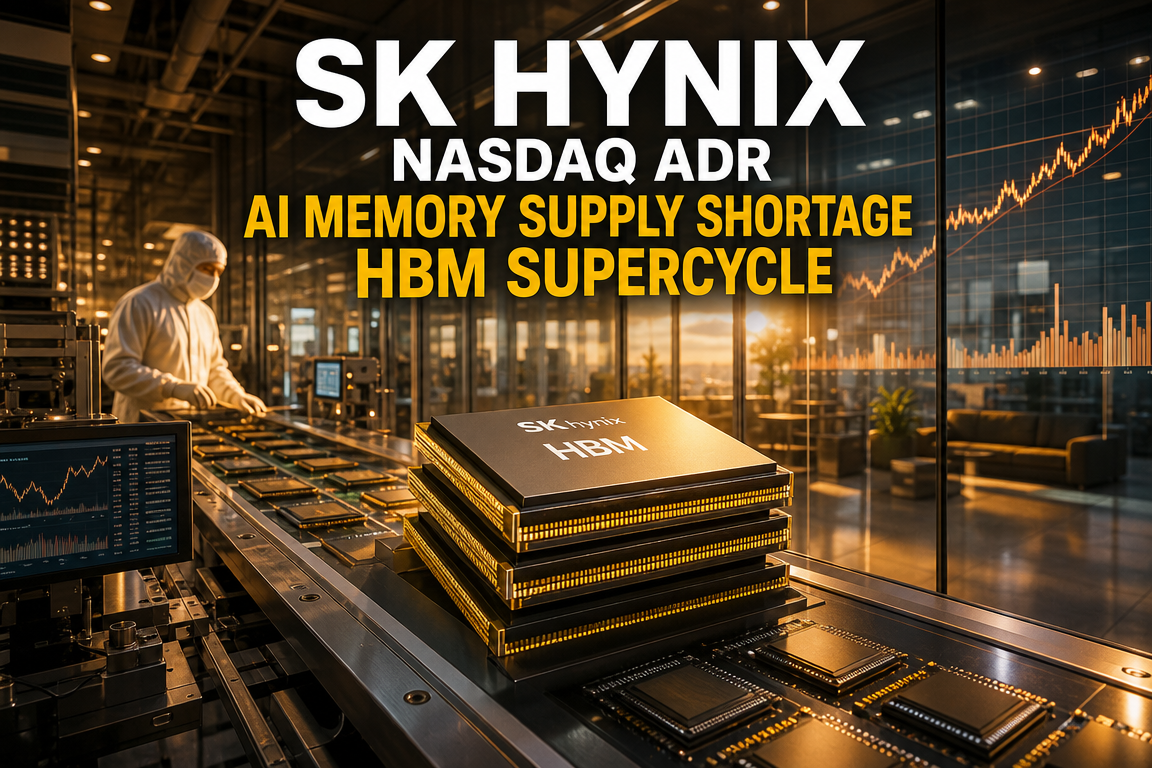
● SK Hynix Nasdaq Surge AI Memory Power Play
On SK Hynix’s First Day of Nasdaq Listing, It Surpasses Micron in Market Cap… The AI Semiconductor Investment Landscape Is Changing Again
Today’s Key Takeaway at a Glance
SK Hynix showed a strong presence from its very first day of listing on the U.S. Nasdaq through ADRs.
The most notable point is that its market capitalization rose to around $1.2 trillion based on the closing price, surpassing Micron and AMD.
This can be interpreted not simply as an overseas listing, but as a signal that SK Hynix’s bargaining power and market expectations in the AI semiconductor supply chain have both increased.
This issue connects the semiconductor cycle, global capital markets, AI demand outlook, and Korean companies’ overseas capital-raising strategies all at once.
From an investor’s perspective, it is especially important to look at the memory semiconductor supercycle, expanding AI infrastructure investment, the Nasdaq listing effect, the ADR structure, and the reshaping of global semiconductor market capitalization together.
News-Style Summary: SK Hynix Shakes the Market from Its First Day on Nasdaq
SK Hynix listed on Nasdaq through American Depositary Receipts, or ADRs.
It closed its first trading day at $168.01, far exceeding market expectations.
The Wall Street Journal reported that SK Hynix’s market capitalization based on the closing price reached $1.2 trillion, surpassing Micron and AMD.
On the same day, Micron’s market capitalization was compared at around $1.1 trillion, while AMD’s was around $909 billion.
In other words, this listing is not simply a “successful listing,” but carries the meaning that SK Hynix has moved into the top tier of the global semiconductor investment landscape.
Korean investors, U.S. institutional investors, and global AI-related funds have all begun reassessing the company.
Why It Matters: The AI Semiconductor Market’s Perspective Has Changed
The most important point in this article is that the market reacted more strongly to the “possibility of future supply shortages” than to “current earnings.”
The Wall Street Journal analyzed that investors focused more on a future situation in which AI companies may not be able to secure enough SK Hynix chips, rather than on external variables.
This can be interpreted to mean that demand for HBM and high-performance memory is much stronger than expected.
As AI data centers continue to expand, Nvidia, AMD, and major cloud companies are demanding more memory and faster supply.
Ultimately, SK Hynix is moving beyond being just a “semiconductor company” and is positioning itself as a core supplier of AI infrastructure.
From this perspective, the market is now reflecting not just a simple memory price cycle, but a supply-constraint premium in the AI era.
You Need to Understand the Listing Structure to See Its Real Meaning
This Nasdaq listing is different from a typical overseas direct listing.
SK Hynix listed by placing its common shares with the Korea Securities Depository, while a U.S. depositary bank issued ADRs based on those shares.
Under this structure, 10 ADRs correspond to 1 SK Hynix share listed on the Korean stock market.
In other words, U.S. investors can conveniently trade in dollars while holding securities linked to the value of the Korean common shares.
The advantage of this structure is that it makes it easier for global capital to flow in.
Another major benefit is that a Korean company’s value can be re-rated within the higher valuation framework of the U.S. market.
On the other hand, simple comparisons should be approached cautiously because exchange rates, trading volume, liquidity, and arbitrage structures all interact in complex ways.
Even so, this case should be seen as a signal that Korean semiconductor companies’ access to global capital markets has moved to a higher level.
Market Reaction: It Held Up Despite Volatility in AI-Related Stocks
Global AI-related stocks were broadly volatile this week.
There were concerns about an overheated AI rally, and the possibility of renewed tensions between the United States and Iran also raised inflation worries again.
In this kind of environment, growth stocks, especially semiconductor and AI-related stocks, are usually among the first to come under pressure.
However, SK Hynix confirmed strong demand from the first day and instead strengthened its presence.
This means investors are placing greater weight on the structural growth potential of AI semiconductors than on short-term macroeconomic uncertainty.
In other words, the global market is now reacting more sensitively to “how long AI demand can last” than to “whether the economy or growth is slowing.”
Another Signal Investors Noticed: Early Entry by Institutional Capital
According to the article, major technology investment firms such as Baillie Gifford and Coatue Management expressed their intention to acquire $7 billion worth of shares ahead of the listing.
This is a fairly important signal.
Large institutions usually do not move at this scale unless they have conviction.
In other words, SK Hynix is beginning to be categorized not simply as a semiconductor company that is doing well in Korea, but as a global long-term growth asset.
Henry Susanto, portfolio manager at Gabelli Funds, also said that questions remain about the durability and cycle of the memory industry, but he assessed the 2026 and 2027 road map optimistically.
Put simply, this means that although short-term volatility may remain, the medium-term growth story is still intact.
The Core Point from an Economic Outlook Perspective: Semiconductors Are Returning to the Center of Global Asset Markets
This news is not simply a positive development for one company.
From the perspective of the global economic outlook, semiconductors are returning as central assets in capital markets.
In particular, the following five keywords are moving together.
First, AI semiconductor demand.
As data centers, generative AI, and inference servers expand, demand for HBM and memory also grows alongside them.
Second, expectations for a memory semiconductor supercycle.
The market is no longer focused only on price increases; the share of high-value memory for AI is structurally expanding.
Third, the reshaping of global supply chains.
The semiconductor roles of the United States, Korea, Taiwan, and Japan are becoming clearer.
Fourth, the Nasdaq listing effect.
It creates an opportunity for U.S. capital to reassess Korean technology stocks.
Fifth, the reshaping of semiconductor market capitalization.
A market capitalization that surpasses Micron and AMD is an event that changes market sentiment itself.
When these five factors overlap at the same time, the industry’s status changes before short-term stock prices do.
The Most Important Point That Other Articles May Miss
The most important point is not the “first-day stock price increase.”
The real core point is that the global AI ecosystem has begun pricing SK Hynix’s supply capability as a source of future competitiveness.
In other words, the market is now looking not at “how much it has earned,” but at “how important a bottleneck it controls in the AI era.”
When this perspective changes, the valuation method for semiconductor companies also changes.
In the past, memory semiconductors were treated only as cyclical stocks, but now they are being re-rated as essential core assets of AI infrastructure.
Another important point is that Korean companies are not simply following the U.S. market, but are entering the axis that leads a global megatrend.
This also has major implications for the Korean capital market.
From the perspective of domestic investors, it is necessary to reexamine the structure in which “strong companies receive higher valuations overseas,” and from a policy perspective, the importance of capital market internationalization and support for the semiconductor industry may grow further.
Points to Watch Going Forward
Going forward, the following trends should be monitored together.
The speed at which SK Hynix expands its AI memory supply.
It will be necessary to confirm how far HBM demand actually continues.
It is also important to see how well trading volume and liquidity are maintained after the U.S. listing.
Investors should also watch whether Nasdaq investors accept Korean semiconductors as long-term holding assets.
Finally, the strategic changes of global competitors such as Samsung Electronics, Micron, AMD, and Nvidia should continue to be monitored.
Because semiconductors are always shaped by the interaction of supply and demand, whether this strength is a one-time event or a structural change will likely become clearer through quarterly earnings and guidance.
In Summary
SK Hynix’s Nasdaq ADR listing is an event that has raised the status of Korean companies in the global semiconductor market by another level.
As expanding AI demand and supply shortage concerns overlap, the market has begun viewing memory semiconductors not simply as cyclical stocks, but as core AI infrastructure assets.
This change could affect not only the semiconductor sector, but also the broader global economic outlook and technology stock investment strategies.
< Summary >SK Hynix was re-rated as a core AI semiconductor stock after surpassing Micron’s market capitalization on its first day of Nasdaq ADR listing.
The market’s key takeaway was the possibility of future AI memory supply shortages rather than current earnings.
This listing is also significant in terms of the rising global status of Korean semiconductors and the internationalization of capital markets.
[Related Articles…]
- AI Memory Supply Shortage Is Redrawing the Semiconductor Investment Map
- Nasdaq Listing Effect and the Revaluation of Korean Technology Stocks
*Source: https://zdnet.co.kr/view/?no=20260711143318