● AI-Fueled Semiconductor ETF Bubble, Hidden Risk Shock
Are Semiconductor ETFs Truly Safe? Risk Signals Individual Investors Must Not Ignore in the AI Investment Era
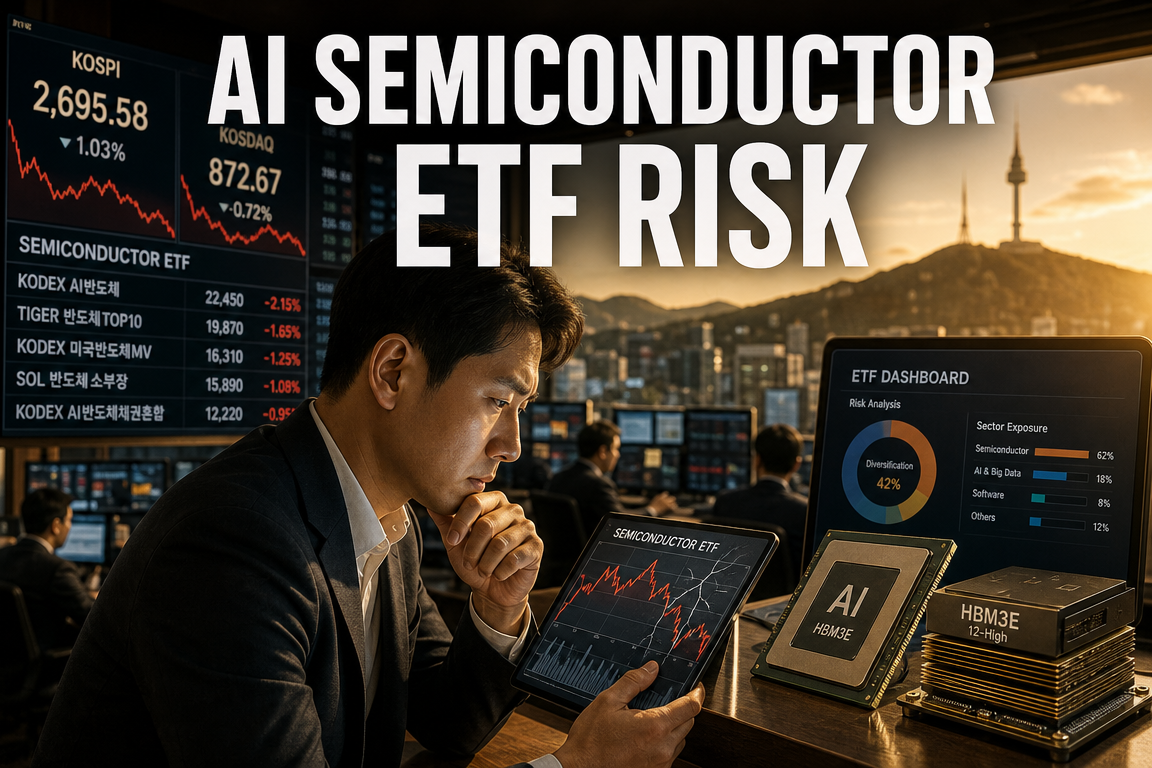
This report summarizes the risks associated with semiconductor ETFs, AI-driven investing, thematic ETFs, leveraged ETFs, and stock selection based on AI recommendations.
The core issue is straightforward.
The semiconductor industry has strong growth potential.
However, that does not mean semiconductor ETFs are always safe investments.
Rising semiconductor demand in the AI era is a separate issue from whether semiconductor ETFs purchased at current valuations can deliver stable returns.
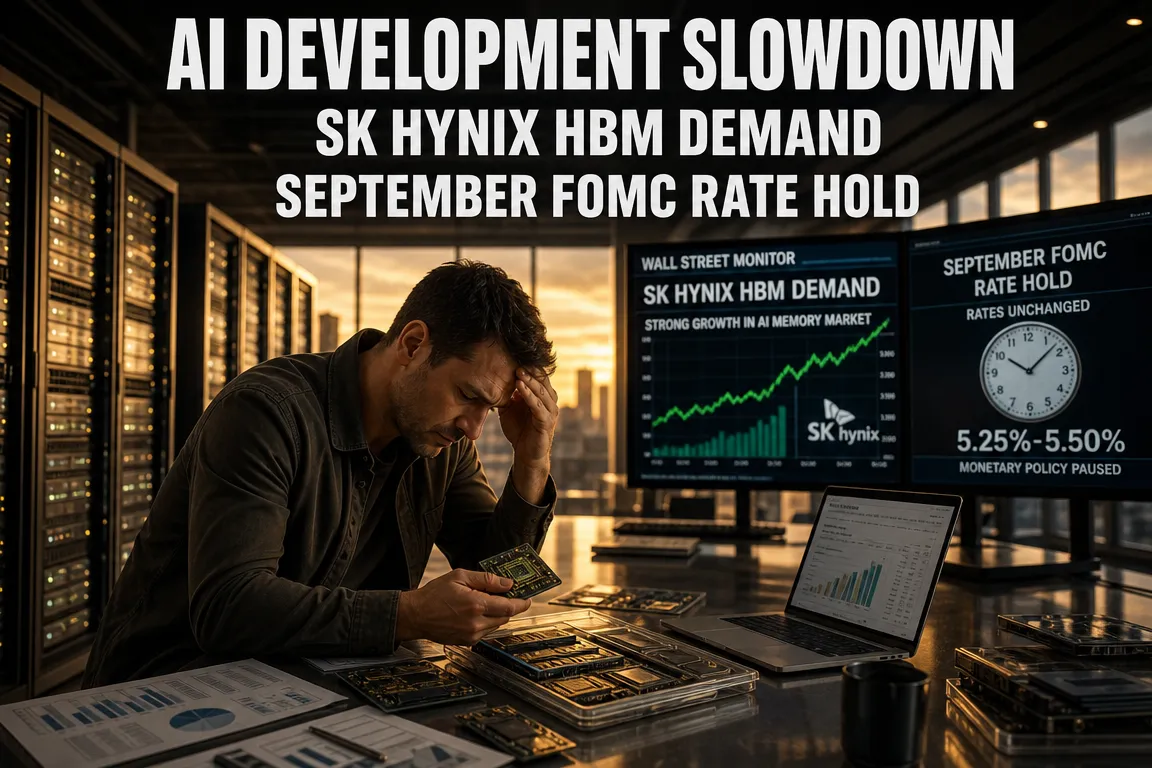
As investor sentiment has become concentrated around HBM, Nvidia, Samsung Electronics, SK hynix, AI semiconductors, and data centers, structural risks have become more pronounced for individual investors.
When AI-generated stock picks are followed without independent judgment, the process can resemble a new form of paid stock-picking service rather than a disciplined investment strategy.
This report outlines why semiconductor ETFs can be risky, why thematic ETFs may not provide true diversification, and why investors in the AI era need a “collective intelligence” framework.
1. Why the Semiconductor ETF Rally Is So Strong
The main driver of recent inflows into semiconductor ETFs and AI semiconductor stocks is the expansion of generative AI.
As services such as ChatGPT scale up and major technology companies increase data center investment, demand for high-performance semiconductors has surged.
In particular, AI workloads have driven demand for Nvidia GPUs, while high-bandwidth memory, or HBM, has emerged as a critical component.
HBM is a high-performance memory technology that enables AI systems to access and process data more quickly.
Compared with conventional memory architecture, HBM functions more like placing more data directly within immediate reach for faster processing.
As a result, Samsung Electronics and SK hynix have attracted global investor attention.
Demand may also continue to increase with the expansion of electric vehicles, autonomous driving, robotics, physical AI, smart factories, and data centers.
From this perspective, the long-term growth case for semiconductors is compelling.
However, in investing, industry growth and stock price stability are not the same thing.
2. Semiconductor Industry Growth Does Not Guarantee ETF Stability
Many investors make a critical assumption.
They believe that because semiconductors are the “grain of the future,” semiconductor ETFs must also be safe.
But a growing industry does not guarantee that a particular country, company, or ETF will continue to outperform.
Semiconductors are no longer a simple industrial sector; they are a strategic industry linked to global macro conditions and national security.
The United States, China, Japan, and Europe are all seeking to rebuild semiconductor supply chains around domestic priorities.
This is not only industrial competition but also a geopolitical risk factor.
In the 1970s and 1980s, Japan dominated the memory semiconductor market.
However, after U.S. pressure and trade friction, Japan’s semiconductor position weakened significantly, and Korea filled the gap.
Today, Samsung Electronics and SK hynix hold major positions in the memory semiconductor market, a structure that shares similarities with Japan’s earlier dominance.
Given the strategic importance of semiconductors, it is unlikely that the United States and China will allow Korea-centered memory supply chains to remain unchanged.
The United States is strengthening its domestic semiconductor value chain around Micron.
China is promoting self-sufficiency through domestic players such as CXMT.
As this trend intensifies, Korean semiconductor companies may face long-term pressure on global market share.
In other words, rising semiconductor demand does not automatically translate into sustained gains for Korean semiconductor ETFs.
3. HBM May Not Remain the Permanent Winner
HBM is currently a critical technology in the AI semiconductor market.
As AI workloads increase, faster data processing becomes more important, which has lifted demand for high-performance memory.
That is why HBM-related stocks have moved sharply higher.
But one of the most dangerous assumptions in technology investing is that a current leading technology will remain dominant indefinitely.
HBM is important now, but within the next two to three years, a different approach to accelerating AI computation may emerge.
Even preliminary research or theoretical claims about alternative architectures can move related stock prices materially.
Market prices often react to future expectations before those technologies are commercially proven.
Therefore, while current HBM demand is important, a strategy built solely around HBM should not be assumed to remain valid over time.
4. Thematic ETFs Can Be “Concentrated Bets on the Same Narrative” Rather Than Diversification
The main advantage of ETFs is diversification.
Compared with investing in a single stock, holding multiple securities can reduce idiosyncratic risk.
However, thematic ETFs are different.
ETFs focused on semiconductors, AI, batteries, or robotics may contain many names, but they often move in the same direction.
For example, if the semiconductor cycle weakens, the impact is not limited to Samsung Electronics.
SK hynix, equipment makers, materials suppliers, fabless firms, and foundry-related names may all decline together.
What appears to be diversification across 30 or 50 holdings may, in practice, be concentrated exposure to a single industry cycle.
This is closer to owning multiple assets with the same underlying risk than to true diversification.
Leveraged ETFs are even more volatile.
They can outperform strongly in rising markets, but losses can accumulate quickly in weak or range-bound markets.
Individual investors who assume that an ETF is inherently safe may incur losses larger than expected.
5. Four Risk Signals Semiconductor ETF Investors Must Monitor
First, technology substitution risk.
It is unsafe to assume that HBM or the current AI semiconductor architecture will remain central in the future.
Technology shifts can occur faster than expected, and a new computation or memory architecture could undermine the existing investment case.
Second, geopolitical risk.
The United States and China are both restructuring semiconductor supply chains around domestic priorities.
With sovereign AI gaining traction, countries are increasingly seeking domestic procurement of critical semiconductor components.
This could affect the long-term market share of Korean semiconductor companies.
Third, overinvestment risk.
Semiconductor companies are making large capital expenditures.
But if future demand falls short of expectations, or if competing countries expand capacity rapidly, supply glut conditions may emerge.
The semiconductor industry is historically cyclical.
It can look exceptionally strong at the top of the cycle and deteriorate rapidly when conditions reverse.
Fourth, sentiment overheating risk.
When terms such as AI, Nvidia, HBM, and data centers dominate the narrative, investors tend to become overly optimistic.
Prices may already reflect much of the positive story.
The higher the expectation, the more vulnerable prices become to even modest disappointments.
6. Why Following AI-Selected Stocks Can Be Risky
Many investors now ask AI questions such as:
“Which stocks should I buy now?”
“Which semiconductor ETF is best?”
“Is Samsung Electronics or SK hynix better?”
The problem is that AI does not bear investment responsibility.
AI can provide plausible answers, but it does not provide certainty.
If an AI-recommended stock declines, the AI does not absorb the loss.
In that sense, AI-based stock selection can become functionally similar to a paid stock-picking service.
The difference is simply whether a human or a machine is making the call.
In both cases, the investor may be outsourcing judgment.
7. The Three Pitfalls of AI Investing
First, confidence inflation.
When AI gives an answer, people tend to perceive it as more objective and data-driven.
They may distrust a human recommendation, but accept an AI-generated answer more readily.
However, AI responses still depend on training data and prompt design.
Different platforms can produce different answers to the same question.
Confidence rises simply because AI was involved, which can increase investment risk.
Second, confirmation bias.
When an investor asks, “What do you think of this company?” the question itself signals interest.
AI may generate arguments that support the user’s inclination.
Even weak companies can receive persuasive-sounding reasons for investment if the question is framed that way.
For that reason, AI should also be asked to challenge the thesis.
“Why should I not invest in this company?”
“What are the downside scenarios for this ETF?”
“What risks am I missing?”
This is a more effective use of AI.
Third, speed amplification.
AI accelerates information processing.
That also accelerates decision-making.
The problem is that faster information often leads to more frequent trading.
Higher turnover is statistically associated with lower returns for many individual investors.
Information overload can lead to overtrading, which in turn increases losses.
8. Individual Investors Using AI Are Still Slower Than Institutional AI
Most individual investors use public AI tools.
Institutional investors and asset managers, by contrast, have access to faster data, specialized algorithms, and more advanced execution systems.
When a retail investor asks AI whether a stock is attractive, the answer is usually based on information already available in the market.
Institutions may already have analyzed, bought, or sold that information.
As a result, the retail investor’s AI-based insight may arrive after the institutional decision has already been made.
This is similar to entering a battlefield with a basic weapon while others operate far more advanced systems.
Using AI does not mean individual investors suddenly gain an information advantage over institutions.
9. What Collective Intelligence Means
The most important concept here is collective intelligence.
Collective intelligence does not mean delegating decisions to AI.
It means using AI to expand one’s own thinking.
AI should not be used as a substitute for judgment, but as a tool to test, refine, and strengthen it.
For example, asking “Should I buy a semiconductor ETF?” and following the answer directly is risky.
A better approach is to ask:
“What is the case for investing in semiconductor ETFs?”
“What are the risks against that case?”
“Which stocks are most vulnerable if HBM is displaced?”
“How would U.S. and China semiconductor policy affect Korean companies under different scenarios?”
“What signs of sentiment overheating am I missing?”
AI should be used as the starting point for analysis, not the final authority.
10. In the AI Era, the Gap Between Experts and Non-Experts May Widen
Many argue that AI democratizes knowledge.
That is true.
Anyone can now quickly access basic information on macroeconomics, supply chains, equity markets, and asset allocation.
However, a critical gap remains.
Experts can verify AI outputs.
Non-experts are more likely to accept them as fact.
Experts can question outdated data or identify factual inconsistencies.
Non-experts may treat well-written AI responses as accurate even when they are not.
For this reason, the advantage in the AI era will not belong to those who use AI the most, but to those who use it most critically.
That distinction may increasingly determine productivity, investment outcomes, and professional competitiveness.
11. The Most Dangerous Assumption in the AI Era Is That the Future Can Be Predicted
As AI advances, many people believe the future will become easier to forecast.
That assumption may be the most dangerous one.
At the 1900 Paris Exposition, people imagined a future profession called “flying mail carriers.”
They pictured individuals using personal flying devices to deliver letters.
But the future did not unfold that way.
Electronic communication replaced the need for physical mail delivery far more quickly than expected.
In other words, people assumed the postal system would remain intact and only the transportation method would change.
The real transformation was that mail itself became less necessary.
The same applies to AI investing.
Assuming that today’s AI, today’s semiconductors, and today’s data center structure will continue unchanged can lead to incorrect conclusions.
Three years ago, few expected generative AI to reshape daily life and industry so quickly.
Three years from now, a different technology could challenge today’s investment logic.
12. The Lesson from Kodak
Kodak did not fail because it lacked digital camera technology.
In fact, it possessed the technology.
The problem was misjudging the pace of adoption.
Kodak expected digital cameras to replace film gradually.
What it failed to anticipate was a different variable.
Cameras were integrated into smartphones.
Consumers adopted mobile phones with cameras before purchasing standalone digital cameras.
The company understood the direction of change, but misread the adoption path.
This example is highly relevant to semiconductor investing.
The direction of AI growth may be correct.
But which technologies dominate, which companies capture profits, and which countries control supply chains can still evolve differently from expectations.
13. AI Financial Planning Is Still Only a General Framework
When asked to create a 10-year financial plan, AI can generate a credible answer.
It can outline asset allocation, systematic investing, retirement planning, cash flow, and risk exposure.
However, these plans are mostly general frameworks.
They cannot fully account for the specific variables in an individual’s life.
Marriage, childbirth, job changes, unemployment, health issues, caregiving obligations, property purchases, war, interest-rate shocks, exchange-rate moves, and political events can all alter the plan materially.
Robo-advisory systems are similar.
They can incorporate numeric variables such as interest rates, volatility, and price trends.
But they cannot easily incorporate unexpected events such as policy shifts, conflict, or abrupt regulatory changes.
Therefore, AI-generated financial plans should be treated as drafts that require continuous revision.
The core value of collective intelligence is not prediction, but adaptability.
AI should be used to improve response speed and to adjust plans continuously based on changing conditions.
14. The 51% of Responsibility That Humans Must Retain
Even in the AI era, humans must retain a critical 51% share of responsibility.
This does not mean humans must perform 51% of every task manually.
AI may handle 99% of routine work.
It can draft reports, summarize meetings, structure data, generate investment ideas, and prepare industry analysis.
But the final 1% of judgment and responsibility must remain with the human user.
That final step determines the outcome.
AI does not define direction on its own.
AI does not fully understand context.
AI does not bear responsibility for results.
For that reason, humans must do three things.
First, define direction.
They must ask the right questions and set the analytical frame.
Second, provide context.
Investment objectives, time horizon, risk tolerance, cash flow, and job stability must be incorporated.
Third, accept final responsibility.
If AI drafts a report incorrectly and it is submitted without verification, the responsibility is not AI’s alone.
The same applies to investing.
If an investor buys because AI recommended it, the resulting loss is still the investor’s responsibility.
15. The Most Important Points Often Missed in Media Coverage
First, rising semiconductor demand is not the same as rising semiconductor ETF returns.
Media coverage often emphasizes AI semiconductor demand growth.
But if valuations already reflect those expectations excessively, returns may be limited.
Second, thematic ETFs may only appear diversified.
Even if they hold many names, exposure remains concentrated if they are tied to the same industry, supply chain, and sentiment cycle.
Third, AI recommendations are not true forecasts.
They are often combinations of already known information and historical patterns.
Institutional investors may already have acted on that information more quickly.
Fourth, human hesitation can still be an advantage.
Algorithmic systems buy and sell mechanically.
Humans can pause, question, and wait for context.
While emotional investing is risky, human judgment and restraint can sometimes outperform mechanical execution.
Fifth, the key skill in the AI era is not prompt writing but verification.
The ability to challenge, fact-check, and validate AI outputs matters more than the wording of the prompt itself.
Future competitiveness will likely depend less on how often AI is used and more on how effectively its outputs are verified.
16. A Practical Checklist for Individual Investors
Before investing in a semiconductor ETF, ask the following:
What is the weight of the top 10 holdings?
Is the exposure overly concentrated in Samsung Electronics and SK hynix?
How much of the HBM growth story is already priced in?
What long-term effects could U.S. and China semiconductor self-sufficiency policies have?
If the product is leveraged, is it suitable for long-term holding?
Is this a true diversified portfolio, or a concentrated bet on a single theme?
Am I outsourcing investment judgment to AI?
Have I considered downside scenarios thoroughly?
Does the investment fit my horizon and risk tolerance?
Do I have predefined rules for adding, holding, or exiting if prices decline?
17. The Right Way to Use AI in Investing
The point is not to avoid AI.
The point is to use it properly.
AI should be used as a tool to expand analysis, not as a stock-picking service.
Effective uses include the following:
Ask AI to summarize industry structure.
Ask AI to compare the competitiveness of major companies.
Ask AI to construct risk scenarios.
Ask AI to challenge your own investment thesis.
Ask AI to summarize recent news, but verify the original sources.
Ask for both bullish and bearish views, not just one side.
The final decision should remain with the investor.
That is the appropriate investment approach in the AI era.
18. Conclusion: More Important Than Semiconductor ETFs Is the Investor’s Mindset
This is not an argument against semiconductor ETFs.
It is also not an argument that AI semiconductor growth will disappear.
Semiconductors are likely to remain central to global economic competition and technological leadership.
What individual investors need now is not a one-sided view of the future.
They must avoid the assumptions that semiconductor ETFs are automatically safe, that thematic ETFs are truly diversified, and that AI provides definitive answers.
In the AI era, investors can access more information than ever before.
But more information makes judgment more important, not less.
The investors most likely to succeed will not be those who simply trust AI, but those who use AI to strengthen their own judgment.
The key is collective intelligence.
Investment should not be delegated to AI; it should be conducted with AI, while final responsibility remains with the investor.
< Summary >
The semiconductor industry is a core growth sector in the AI era, but that does not mean semiconductor ETFs are always safe investments.
Investors should consider HBM substitution risk, U.S. and China semiconductor self-sufficiency policies, supply chain restructuring, overinvestment, and sentiment overheating.
Thematic ETFs may hold many stocks, but if they are tied to the same industry cycle, they may not provide true diversification.
Following AI-recommended stocks without independent judgment can resemble a new form of stock-picking service and may be risky.
AI should be used as a thinking partner to support analysis, not as a substitute for judgment.
The key capability in the AI era is collective intelligence, and final responsibility must remain with the investor.
[Related Articles…]
AI Investment Era: Market Changes Individual Investors Must Understand
Semiconductor Cycle and Global Supply Chain Restructuring: Investment Implications
*Source: [ 경제 읽어주는 남자(김광석TV) ]
– [풀버전] 반도체 ETF, 정말 안전할까? AI 시대 투자자가 놓치면 안 되는 위험 신호 | 경읽남과 토론합시다 | 이시한 교수님
● Polo-soars,-Tommy-discounts
Polo Ralph Lauren Has Become More Expensive, While Tommy Hilfiger Remains Discounted: The Result of Two Very Different Brand Strategies in the Same Outlet
At U.S. outlet malls, comparing Polo Ralph Lauren and Tommy Hilfiger is not simply a matter of which brand looks better.
The price tags show how each brand has pursued a different strategy over the past 20 years, and how that has translated into a roughly 7x gap in market capitalization on the New York Stock Exchange.
This report summarizes the outlet price gap between Polo Ralph Lauren and Tommy Hilfiger, U.S. distribution strategy, brand value, pricing power, and the key points investors should consider.
The key issue is not how much discounting exists, but which brand has protected the consumer’s reference price.
1. Why Does Polo Feel Expensive While Tommy Feels Cheap at the Same Outlet?
At a large U.S. outlet such as The Mills at Jersey Gardens in New Jersey, Polo Ralph Lauren and Tommy Hilfiger are often located near each other.
Both brands have long competed for similar customers as leading American casualwear labels.
However, the in-store experience is noticeably different.
Polo Ralph Lauren tends to maintain higher base prices even at outlets, with relatively limited discounting.
Tommy Hilfiger, by contrast, often displays prominent 30%, 40%, and 50% discount tags at the entrance.
For example, Polo shirts and T-shirts may carry price points around $100 before partial markdowns.
Tommy Hilfiger products in similar categories are often priced lower from the outset, with additional discounts of 40% or more.
As a result, consumers tend to think of Polo as a premium brand and Tommy as a brand to buy on sale.
This difference has translated into long-term differences in brand value and pricing power.
2. The Two Brands Started from Similar Positions, but Took Different Paths
Polo Ralph Lauren became a symbol of American preppy style and classic lifestyle branding.
Tommy Hilfiger launched in 1985 and entered the preppy market with a younger, more accessible positioning.
In the 1990s, Tommy Hilfiger expanded rapidly as hip-hop culture and pop stars adopted the brand.
The period when Snoop Dogg and Aaliyah wore Tommy marked the brand’s peak.
At that time, Tommy Hilfiger was closer to a fashion icon associated with street culture than a conventional preppy label.
The shift began in the 2000s.
Tommy Hilfiger experienced slowing U.S. sales and increasingly relied on department stores and outlets.
Its exclusive distribution strategy with Macy’s provided short-term channel stability, but it also tied the brand to mass-market shelving and discounting.
By contrast, Ralph Lauren gradually reduced distribution and exercised stronger control over where the brand appeared.
3. Distribution Strategy: Tommy Stayed on the Shelf, Polo Chose Its Position
Tommy Hilfiger and Calvin Klein are owned by PVH, one of the company’s core brand assets.
PVH began in 1881 as a shirt company and became a global apparel group after acquiring Calvin Klein in 2003 and Tommy Hilfiger in 2010.
Tommy Hilfiger once opened a large flagship store on Fifth Avenue in New York, which symbolized the brand’s peak.
After that store closed in 2019, Tommy’s standalone full-price retail presence in the U.S. declined materially.
Today, the brand is primarily encountered through department stores, outlets, and online channels.
Ralph Lauren also closed its Fifth Avenue flagship in 2017.
However, its subsequent strategy was fundamentally different.
Ralph Lauren significantly reduced department store exposure and kept only the channels that supported brand positioning.
The company concentrated on spaces that reinforced its image, such as premium lifestyle-format stores on Madison Avenue.
In other words, for Tommy Hilfiger, outlets and department stores became the center of the U.S. business, while for Polo Ralph Lauren they became selectively retained channels.
4. The Key Issue Is Not Discounting, but the Direction of Discount Exposure
Polo Ralph Lauren also discounts its products.
It has outlet stores and department store promotions.
So the issue is not simply that Polo does not discount while Tommy does.
The real difference is that one brand has reduced discount exposure over time, while the other has remained dependent on it.
Ralph Lauren has increased average selling prices by reducing promotional dependence.
In the latest fiscal year, average selling prices in company-owned stores and direct online channels reportedly rose about 15% year over year.
During the holiday quarter, they reportedly increased by as much as 18% year over year.
This does not merely indicate higher prices; it reflects a higher share of full-price sales.
By contrast, Tommy Hilfiger and Calvin Klein remain frequently exposed to promotional pricing in U.S. department stores and outlets.
When consumers repeatedly see a brand at a discount, the reference price becomes the sale price rather than the original price.
At that point, full-price selling becomes materially harder.
5. Tommy Hilfiger in Korea Can Feel Different from Tommy Hilfiger in the U.S.
For Korean consumers, Tommy Hilfiger may not appear to be a low-price brand.
The reason is that Tommy’s distribution structure in Korea differs from that in the U.S.
In 2017, Hanssem acquired SK Networks’ fashion division and took over the Korean Tommy Hilfiger business.
Since then, some sizing, materials, and design elements have been adjusted to suit local consumer preferences.
Tommy Hilfiger sold in Korean department stores can therefore carry a different image from Tommy sold at U.S. outlet markdowns.
The same logo can represent different brand value depending on who manages it, through which channel, and under what pricing policy.
This distinction is important in consumer-sector equity analysis.
6. The Stock Market Has Already Priced in the Difference
The gap between the two companies is also clear in the U.S. equity market.
PVH owns Tommy Hilfiger and Calvin Klein.
Ralph Lauren trades independently under ticker RL.
PVH has the larger top line.
Annual revenue is about $8.9 billion for PVH versus about $8.1 billion for Ralph Lauren.
However, investors focus on profit retention rather than sales volume.
Ralph Lauren’s gross margin is estimated at about 69.9%, compared with about 57.5% for PVH.
The gap in net income is even wider.
Ralph Lauren reportedly generates annual net income of about $940 million, while PVH is around $25 million.
When two companies generate similar sales but retain very different levels of profit, their valuations diverge significantly.
That is why PVH may be larger on revenue, yet Ralph Lauren commands a much higher market valuation.
7. Why Has PVH’s Stock Been So Volatile?
PVH’s share price has shown significant volatility this year.
After declining early in the year, the stock fell toward its 52-week low in early March.
It then rebounded sharply after a late-March earnings report showed revenue and profit above market expectations.
At one point, the stock approached the upper end of its 52-week range in the high $90s.
However, it later weakened again.
Risks related to China, tariff costs, and softer demand in Europe and the Middle East weighed on sentiment.
Investor confidence also weakened after management said tariff costs could meaningfully affect annual EPS.
Although early June results exceeded expectations, the company lowered full-year guidance, triggering a sharp sell-off.
PVH’s all-time high was around $166 in June 2018, while the current share price has remained well below that level.
This reflects not only cyclicality, but also market concern over the brand structure and earnings quality.
8. Why Did Ralph Lauren Reach a Record High Despite Tariff Risks?
Ralph Lauren is not immune to tariff risk.
Apparel companies are exposed to sourcing costs, exchange rates, logistics, and import expenses.
Even so, Ralph Lauren’s stock recently reached a new all-time high.
The reason is pricing power.
When brand equity is strong, a company can pass through some cost increases to consumers.
If discounting can be reduced and full-price selling increased, tariff pressure can be absorbed through margins.
By contrast, if consumers already view a brand as one that should only be bought on sale, price increases become difficult.
In that case, cost shocks quickly compress margins and weaken guidance.
This difference is reflected in the valuation gap between Ralph Lauren and PVH.
9. The Most Important Point Rarely Emphasized in Other Coverage
The most important point is that outlet price tags can act as an earlier indicator than earnings releases.
Investors usually focus on quarterly results, revenue growth, operating margin, and EPS.
These remain essential.
But for consumer companies, the market often signals shifts before the earnings report.
Discount depth, full-price product share, shelf placement, inventory buildup, and consumer willingness to buy without promotion all provide clues about future brand performance.
Over the past several years, Ralph Lauren has built a model in which it can sell less volume but at higher prices.
Tommy Hilfiger still faces the challenge of moving away from a discount-dependent structure.
In consumer equities, the key is not revenue size, but the ability to protect price.
Companies that can sell at higher prices and still maintain demand generally command higher long-term valuations.
10. Why Are Polo and Tommy in the Same Place?
On the surface, Polo Ralph Lauren and Tommy Hilfiger appear to be similar brands targeting similar customers.
But being in the same outlet does not mean they are positioned at the same level.
Polo has narrowed its distribution and retained only the best locations.
Tommy has become more reliant on department stores and outlets after losing standalone full-price retail presence and brand control.
The fact that both brands appear in the same outlet reflects not convergence, but the overlap of two very different strategies.
This matters for investors because it links directly to business quality.
Same outlet does not mean same brand value, and same revenue does not mean same corporate value.
11. Key Takeaways for Investors
Ralph Lauren has a clear advantage in brand management and pricing power.
That said, the stock has already rallied substantially, so valuation is no longer cheap.
A strong business is not always a strong stock at any price.
By contrast, PVH’s problems are already well known, and the stock has been heavily discounted, which leaves room for recovery.
The central question is whether Tommy Hilfiger and Calvin Klein can break out of a discount-led structure.
If PVH can rebuild brand equity and strengthen control over distribution and licensing, a rerating is possible.
However, if 40% to 50% discount tags continue to dominate U.S. department stores and outlets, closing the gap will be difficult.
For that reason, investors should watch store-level pricing, not only earnings releases.
The key indicators are whether Tommy Hilfiger discounting is narrowing, whether full-price product share is increasing, and whether outlet dependence is declining.
12. A Framework That Can Be Applied to Other Consumer Brands
This case is not limited to Polo and Tommy.
The same framework applies to global consumer brands such as Nike, Lululemon, Coach, Burberry, Gucci, and Gap.
When analyzing a brand company, revenue growth alone is insufficient.
Discounting, inventory, direct-channel share, average selling price, gross margin, and consumer perception must also be considered.
This becomes even more important in an environment where inflation and tariff risks remain elevated.
The gap between brands that can pass costs through to consumers and brands that cannot will widen over time.
That is why brand companies matter in global macro and U.S. consumer analysis.
13. Forward View: Can PVH Recover?
PVH’s next chapter is not yet settled.
Tommy Hilfiger and Calvin Klein still have strong global recognition.
If the brands can be repositioned, the market’s current low expectations could become an opportunity.
However, success will be visible in stores before it appears in financial statements.
Investors should monitor whether discount tags are declining in U.S. outlets and department stores.
They should also watch whether full-price merchandise is increasing and whether consumers begin buying without promotions.
Without such changes, the valuation gap with Ralph Lauren is unlikely to narrow materially.
If these trends begin to improve, the investment case may emerge before the next earnings cycle.
14. In One Sentence
Polo Ralph Lauren protected the consumer’s reference price, while Tommy Hilfiger became vulnerable to sale-based pricing.
Over the past 20 years, Polo won the strategic contest.
That outcome is reflected in the roughly 7x gap in market capitalization.
But the next round in the stock market is still open.
If PVH can move away from discount shelves and regain full-price selling, market perception could change.
For consumer investing, the key variable is not the logo, but the price tag.
[Related Articles…]
How Pricing Power Shapes Consumer Company Valuations
Why Brand Equity Matters in Consumer Sector Investing
*Source: [ Maeil Business Newspaper ]
– [어바웃 뉴욕] 폴로는 비싸졌는데, 타미는 왜 늘 할인할까 | 이나연 특파원