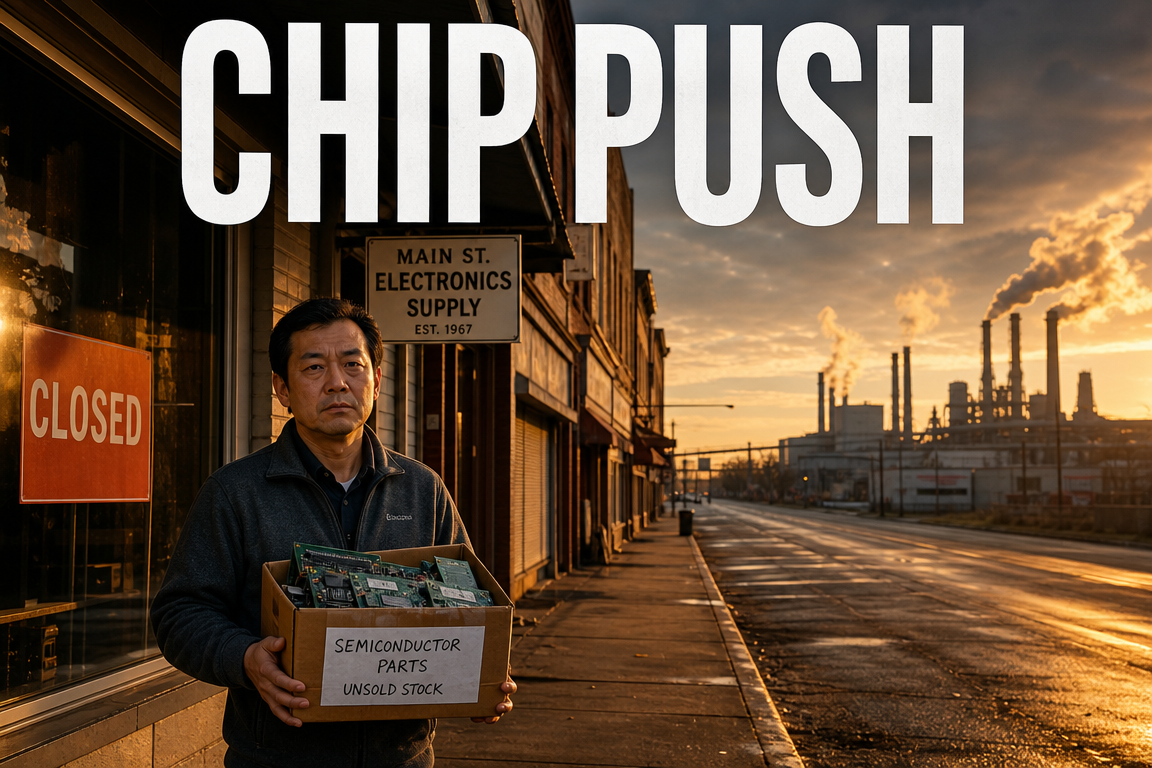
● Shocking-Closures,Recession-Illusion,Semiconductor-Boom,Forced-Entrepreneurship
Why Small Business Closures Feel Worse Than During COVID: The “Semiconductor Illusion” and “Forced Entrepreneurship”
This report summarizes why recent small business closures are perceived as the most severe in 15 years, and how the issue reflects broader structural changes in the Korean economy rather than a simple decline in sales.
The key points are fourfold.
First, financial markets and the real economy are moving in different directions, deepening the sense of domestic recession.
Second, the semiconductor upcycle is creating a “semiconductor illusion” that makes the overall economy appear stronger than it is.
Third, retirees in their late 40s and 50s are being pushed into entrepreneurship rather than reemployment, increasing unprepared startup activity.
Fourth, online shopping and platform-based consumption are rapidly shrinking the operating space for offline small businesses.
If the question is why export, semiconductor, and equity market performance can look strong while neighborhood businesses weaken, this framework provides a clear answer.
1. Key Takeaway: Why Small Business Closures Feel Worse Than During COVID
In recent months, owners and industry participants in food service and small business sectors have increasingly reported closures.
An industry source with 15 years of experience said such frequent closure reports are unprecedented over that period.
What stands out is that current closure pressure is being felt as more severe than during COVID-19.
During the pandemic, businesses were partially supported by subsidies, loan maturity extensions, and compensation tied to social distancing measures.
Today, however, that support has eased while high interest rates, rent, labor costs, ingredient inflation, and weaker consumption are affecting businesses simultaneously.
The issue is that headline economic indicators do not imply a full-scale collapse.
Semiconductor exports have recovered, some large-cap corporate earnings have improved, and capital markets have rebounded.
Yet local commercial districts, food service, retail, franchise stores, and independent cafes are experiencing a very different reality.
This is the defining feature of Korea’s current K-shaped divergence.
Sectors moving higher include AI semiconductors, major exporters, and parts of the capital market.
Sectors moving lower include small businesses, offline retail, domestic services, and local merchants.
2. Why Capital Markets and the Real Economy Are Moving Separately
Many investors assume that rising equity markets indicate a stronger economy.
At present, however, capital markets and the real economy must be analyzed separately.
Equity markets discount future expectations.
They respond quickly to themes such as AI growth, semiconductor demand, and investment by global technology leaders.
By contrast, the real economy is reflected in actual consumption, employment, revenue, rent burdens, and closure rates.
In other words, stronger performance by Samsung Electronics or SK hynix does not automatically translate into higher sales at local restaurants.
Recovery led by large semiconductor firms can lift GDP and export indicators, but its impact on domestic consumption and small business revenue is limited.
This is why the gap between reported economic improvement and on-the-ground business conditions is widening.
This distinction is also important in the context of the 2026 economic outlook.
Even if aggregate growth turns positive, the economy experienced by small business owners, salaried workers, retirees, and younger households may remain very different.
3. The Semiconductor Illusion: Why AI Gains Do Not Reach Everyone
A key term used in the video is “AI enabling product.”
In simple terms, this means a core product that enables the AI era.
Semiconductors are the prime example.
As AI data centers, high-performance servers, generative AI services, and cloud infrastructure expand, demand for advanced memory and AI chips has increased sharply.
As a result, the semiconductor cycle is showing near-record strength.
The issue is that semiconductors account for a large share of Korea’s economy, so their strength can make the overall economy look better than it is.
However, this recovery is not being transmitted evenly across industries.
For example, higher semiconductor exports do not automatically raise sales at cafes, snack shops, restaurants, salons, or offline specialty retailers.
Rising share prices in semiconductor firms do not directly increase card spending at small businesses.
This is the “semiconductor illusion.”
The national economy appears to be improving, while only selected industries are recovering strongly and domestic demand sectors remain under pressure.
AI is changing the economy, but the more important point is that its benefits are not distributed evenly.
4. The Core Problem Is “Forced Entrepreneurship”
The most important issue is not only small business closures, but forced entrepreneurship.
Forced entrepreneurship refers to starting a business not because one identified an opportunity and prepared for it, but because reemployment is difficult and alternative income options are limited.
This problem is becoming more pronounced as workers in their late 40s and 50s leave primary careers in large numbers.
Income is still needed after retirement or career transition.
However, reemployment opportunities for middle-aged workers remain limited.
From the corporate side, hiring is constrained while automation and AI adoption continue to reduce labor demand.
As a result, many people turn to entrepreneurship instead of reemployment.
The problem is that this is often unprepared entrepreneurship.
Many enter familiar categories such as cafes, chicken restaurants, dining outlets, convenience stores, delivery-only brands, and small franchise operations without sufficient market analysis, differentiation, financial planning, digital marketing, or brand strategy.
5. The Neighborhood Business Trap: Revenue Stays Flat While Store Count Rises
The video illustrated this issue with a coffee shop example.
Assume one cafe in a neighborhood generates monthly sales of 3 million won.
Seeing that, another person concludes that coffee shops are profitable and opens one nearby.
Then the same area expands from one coffee shop to two, three, or four.
However, total neighborhood coffee demand does not increase by a factor of four.
If total sales remain around 3 million won while the number of stores rises, each store receives a smaller share.
Eventually, businesses struggle to cover rent, labor, and ingredient costs, leading to closures.
This pattern is repeating across the small business market.
More businesses are opening, but consumption is not expanding.
Competition is intensifying, but average transaction value is difficult to raise.
Fixed costs continue to increase while revenue is fragmented.
This leads to simultaneous overentry and overclosure.
6. Demographic Change Is Intensifying the Small Business Crisis
The small business downturn is not only a cyclical problem.
Demographic change is now having a structural impact.
Korea is facing both low birth rates and rapid aging.
The consumer base is shrinking while the retiree population is increasing.
A key point is that workers in their late 40s and 50s are entering the phase where they leave primary long-term employment.
They are often too young to fully retire, while education and housing costs remain significant.
They therefore need to keep generating income.
Because reemployment is difficult, many move into entrepreneurship.
The problem is that too many people enter the same industries.
Demographic change is therefore creating excess supply in the small business market, and excess supply is leading to more closures.
This trend is unlikely to resolve quickly.
For the 2026 outlook, middle-aged employment, reemployment, and small business restructuring are likely to remain key variables.
7. Online Shopping Is Pressuring Offline Small Businesses
The third structural factor is the expansion of online shopping.
Consumers are increasingly purchasing without visiting physical stores.
Platforms such as Coupang, Naver Shopping, delivery apps, Kurly, Musinsa, and Today’s House have transformed shopping behavior.
Items once bought from local stores are now ordered through same-day, early-morning, or subscription delivery services.
The same is true for food service.
While destination dining remains relevant, delivery, meal kits, prepared foods, and frozen food products are substituting part of restaurant demand.
Offline stores bear rent and labor costs, while online platforms benefit from economies of scale and logistics efficiency.
Under this structure, average offline small businesses face a difficult competitive environment.
In the same downturn, businesses that can adapt digitally are more resilient, while those dependent on offline traffic are more exposed.
8. A Survival Case in Food Service: Why Slunch Factory Chose Exports Over the Domestic Market
The video highlighted Slunch Factory as a case study.
Slunch Factory was presented as a food service company that also prepared meal kits, food manufacturing, and exports.
A notable point is that it began preparing for exports during the COVID period.
Anticipating weaker domestic demand and a more difficult small business environment, the company chose to sell Korean food products overseas and earn dollar-based revenue.
This strategy offers an important lesson for small businesses and mid-sized firms.
Relying only on the domestic market means limited demand and intense competition.
By contrast, categories such as K-food, vegan food, health-oriented meals, ready-to-eat products, and meal kits can generate new demand abroad.
In periods of a stronger won weakness and higher exchange rates, export-oriented companies can also benefit from foreign currency revenue.
This is not an easy strategy to execute.
It requires manufacturing capability, certification, logistics, local distribution, quality control, and branding.
Still, in an era of domestic demand constraints, even small businesses need to consider global expansion.
9. A Core Element of the Slunch Factory Strategy: Vegan Without Calling It Vegan
One particularly notable strategy in the Slunch Factory case is the approach of selling “vegan food without labeling it as vegan.”
Vegan food is often marketed through health, ethical consumption, or dietary positioning.
However, this can narrow the customer base by appealing only to consumers already interested in vegan products.
Slunch Factory took the opposite approach.
The company first positioned itself as a taste-driven brand, with the vegan attribute discovered afterward.
This is a commercially effective strategy.
Consumers do not feel they are purchasing something because it is vegan; they feel they are buying it because it tastes good.
The added value comes later, when they realize the product is also healthier or more aligned with their values.
This approach also fits broader AI-era consumption trends.
Consumers are increasingly less responsive to corporate slogans alone.
Taste, quality, price, and experience come first, followed by value-based considerations.
10. Another Reason to Choose Exports Over Domestic Distribution: Rapid Imitation
The Slunch Factory CEO noted that when a strong product is launched domestically, similar products can appear within a year.
Large corporations may release comparable menu items or similar subscription and restaurant models.
This is a common reality for Korean startups and small firms.
Once a good idea is introduced, companies with stronger capital and distribution networks can copy it quickly.
Smaller firms therefore need to move faster.
They must develop faster, launch faster, and expand into overseas markets faster.
The advantage of a smaller firm is decision-making speed.
It can respond to trends and adjust products more quickly than larger companies.
In the future, survival for small businesses and mid-sized firms will depend not only on product quality.
They must build a brand, broaden distribution channels, and secure foreign demand before imitation erodes their position.
11. The Most Important Point Missing From Many Other Reports
First, the core of small business closure is more about livelihood-driven entry by retirees than about recession alone.
Many reports focus on closure rates, weak consumption, and high interest rates.
However, the more important issue is that middle-aged retirees continue entering the startup market.
Demand is shrinking while supply keeps increasing.
Even if the economy improves modestly, competitive pressure in small business markets may not ease quickly.
Second, the semiconductor boom does not guarantee a domestic demand recovery.
Stronger semiconductor exports improve aggregate economic indicators.
However, this does not mean domestic consumption, small business sales, and local economies recover in parallel.
Going forward, economic analysis must separate “exports are improving” from “my economic situation is improving.”
Third, businesses that fail to adapt to online channels are structurally disadvantaged.
Consumers increasingly rely on search, reviews, maps, delivery apps, and short-form content rather than spontaneous walk-in traffic.
Offline stores without a digital acquisition strategy are rapidly losing competitiveness.
Fourth, “good taste” alone is insufficient; manufacturing, branding, and export structures are needed.
Even successful food service businesses face limits if they rely only on store sales.
To grow, they need revenue streams beyond the store, such as meal kits, sauces, dressings, frozen products, subscriptions, B2B supply, or overseas sales.
Fifth, the central issue for 2026 is divergence rather than growth alone.
Even if GDP growth turns positive, some sectors may remain in boom conditions while others stay in recession.
AI semiconductors and major exporters may continue to grow, while small businesses and domestic service sectors remain under pressure.
12. Investment Note: Personal Framework Matters More Than Following Another Portfolio
In the latter part of the video, a question was raised about investment portfolios.
Professor Kim Kwang-seok emphasized that investors should not try to copy his portfolio directly.
The reason is that each person has different investment preferences, asset scale, access to products, and risk tolerance.
He noted that a large portion of his financial assets is in unlisted equities.
However, unlisted equities are not readily accessible to most investors and carry liquidity risk.
Accordingly, retail investors should focus on building their own investment principles rather than copying a specific portfolio.
He also referenced a diversified approach similar to that of the National Pension Service, covering domestic equities, overseas equities, passive investments, gold, and cryptocurrencies.
The key point is diversification.
In a period of high interest rates, exchange-rate volatility, slowing global growth, and AI-driven industry restructuring, concentration in a single asset class may be risky.
13. Checklist for Existing and Prospective Small Business Owners
1) Determine whether the business is truly a voluntary choice.
If the business is being started because reemployment is unavailable, the decision requires even more caution.
Livelihood-driven startups are harder to recover from if they fail.
2) Check how many similar businesses already operate in the area.
If the local market is already saturated with cafes, restaurants, convenience stores, or delivery-focused outlets, the business will be competing for a fixed customer base.
Unless there is a clear reason why the new store will outperform others, entry should be reconsidered.
3) Assess whether there is a digital customer acquisition strategy.
Map search, blog reviews, Instagram, short-form video, delivery apps, smart store channels, and platform listings are increasingly important.
Operating only as a physical store and waiting for customers is becoming less viable.
4) Determine whether the business can generate revenue beyond the store.
Meal kits, sauces, merchandise, classes, subscription services, B2B supply, and export channels can improve resilience.
5) Model costs conservatively.
Rent, labor, delivery fees, ingredients, utilities, and interest expenses must all be included to assess true profitability.
14. Small Business Outlook in the Context of 2026
When assessing Korea’s 2026 economy, headline growth alone is not sufficient.
The key question is which sectors are growing and which groups are being left behind.
AI semiconductors, data centers, power infrastructure, robotics, cloud services, and selected export manufacturers are likely to remain in focus.
By contrast, small businesses dependent on domestic demand, offline retail, and conventional food service may continue to face structural pressure.
If high interest rates persist and household debt remains elevated, consumers are likely to reduce spending on dining and shopping.
As a result, small businesses may face both declining revenue and rising costs.
The survival themes for small businesses going forward are threefold.
First, differentiation.
Second, digital transformation.
Third, reducing dependence on domestic demand through expansion.
In the current environment, location, famous franchises, or simple effort are no longer sufficient.
< Summary >
The reason small business closures feel more severe than during COVID is not simply weaker consumption.
A semiconductor upcycle is creating an illusion of broad economic strength while domestic demand and small businesses have not recovered.
As middle-aged retirees are pushed into forced entrepreneurship rather than reemployment, unprepared startups and closures are rising simultaneously.
Online shopping and platform-based consumption are further reducing the operating space for offline small businesses.
Going forward, small businesses must consider online transformation, branding, and expansion models such as meal kits, exports, and subscriptions in addition to store operations.
The central issue for 2026 is divergence rather than growth, and understanding the K-shaped economy created by strong AI semiconductors and weak domestic demand is essential.
[Related Articles…]
Semiconductor Cycle and Korea Economic Outlook
Small Business Closures and Domestic Demand Pressure
*Source: [ 경제 읽어주는 남자(김광석TV) ]
– “코로나 때보다 심각하다”… 자영업 폐업이 15년 만에 쏟아진 진짜 이유 | 채널 50만 특별영상 | 취중전망 [4편]