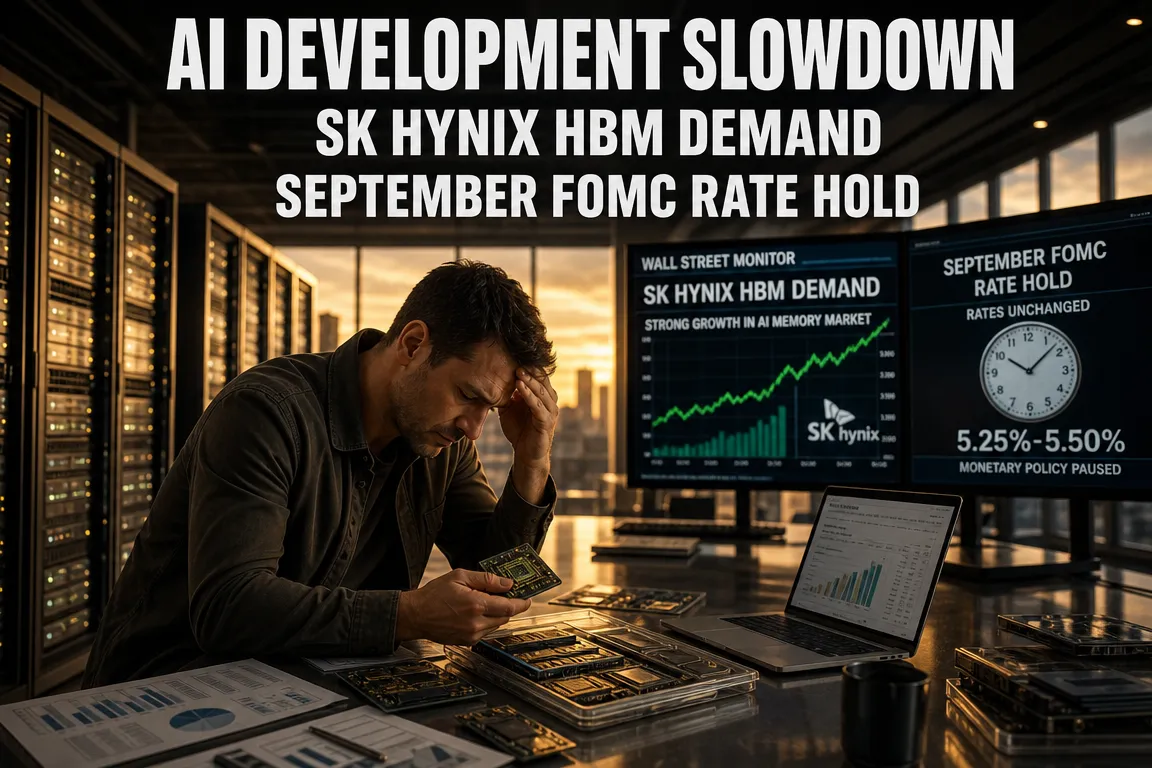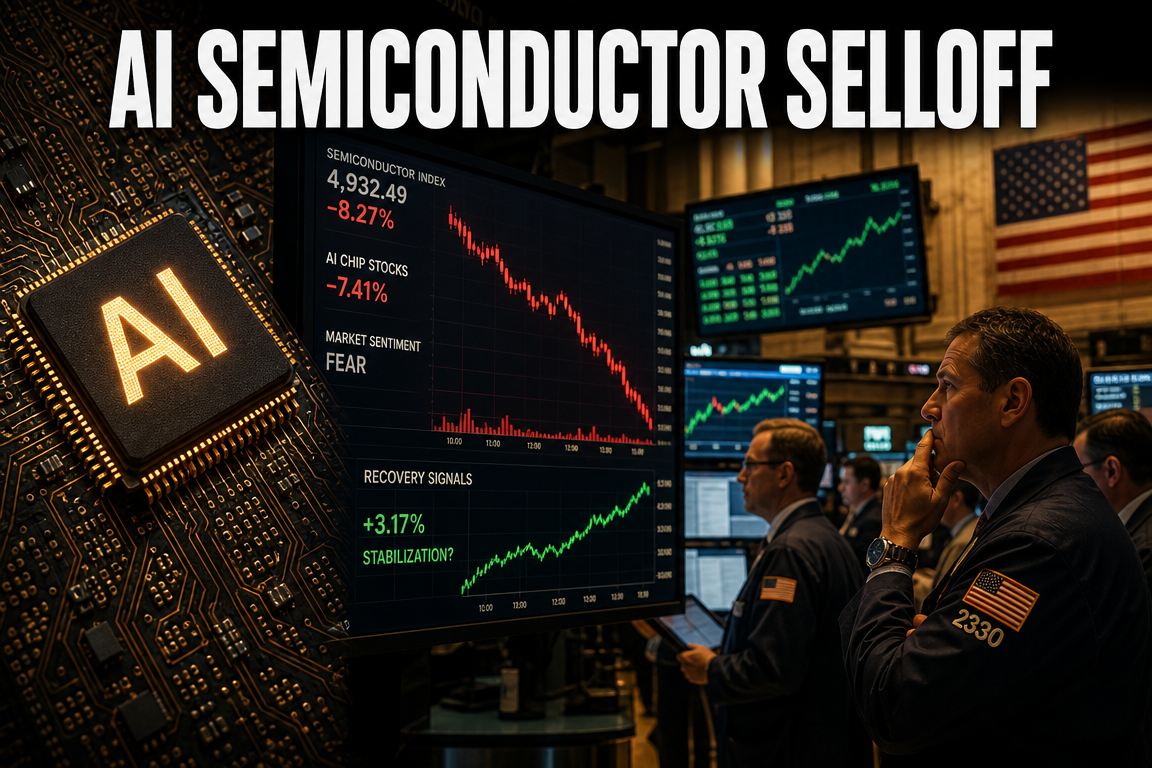
● AI, Panic, Crash
Will a Real Opportunity Emerge After the Semiconductor Selloff, AI Infrastructure Reset, and Margin-Driven Liquidation?
This semiconductor decline is not simply a case of “a Chinese AI model performed well.”
The key issue in the market is the simultaneous pressure from AI infrastructure spending skepticism, Chinese low-cost competition, data center policy risk, leverage unwinding, geopolitical risk, and interest rate pressure.
More important than the visible decline in semiconductor equities is the rapid unwinding of U.S. equity margin positions and leveraged AI semiconductor trades that had become overcrowded.
In other words, the market is not signaling that the AI cycle has ended. It is in a phase where overheated capital is being forced out of heavily crowded AI leadership names.
This report reviews semiconductor ETFs, memory semiconductors, AI infrastructure stocks linked to Nvidia, China’s Kimi K3 AI model, concerns over delayed data center construction, U.S. rate expectations, and Middle East geopolitical risk.
1. Semiconductor Selloff Overview: Leadership Stocks Led the Decline
The most notable recent trend in equities has been the sharp decline in semiconductor indices.
At one point this year, the semiconductor index had risen by nearly 100%.
However, recent corrections have reduced that gain to the 60% range, with a roughly 10% weekly decline in a highly volatile trading environment.
The Nasdaq also fell by about 4%, reflecting weaker sentiment across technology stocks.
AI infrastructure leaders have generally fallen 30% to 40% from their peaks.
- Memory semiconductors: down about 35% from highs
- Semiconductor ETF: down about 20% from highs
- Nasdaq: down about 7% from highs
- AI infrastructure stocks: many down 30% to 40% from highs
In market practice, a decline of more than 20% from a peak is often interpreted as entering a bear market.
By that standard, semiconductor ETFs and AI infrastructure names are already in bear-market level corrections.
The key point is that this is not an isolated company-specific issue.
Nvidia, memory semiconductors, data center names, and power infrastructure stocks tied to AI have largely moved in the same direction.
This indicates a broader reset in AI infrastructure sentiment rather than a single earnings problem.
2. The First Catalyst: China AI Shock 2.0
The initial trigger for the correction was the emergence of a new Chinese AI model.
China’s Kimi K3 drew attention and was described by some as a “DeepSeek Shock 2.0.”
In January 2025, DeepSeek had already disrupted U.S. AI equities and semiconductor markets by offering a low-cost alternative.
Kimi K3 differs in that the market reaction was driven more by performance concerns than by pricing alone.
Some AI benchmarking platforms suggested that Kimi K3 approached the performance of top U.S. models such as ChatGPT and Claude.
For investors, the core question became: how could China deliver comparable AI performance without spending at the same scale as U.S. firms?
That question became a key pressure point for semiconductor valuations.
Why the Chinese AI Model Moved the Market
- U.S. hyperscalers have been allocating massive capital expenditures to AI infrastructure.
- Nvidia’s latest GPUs, high-performance data centers, and advanced semiconductor equipment have been viewed as essential to AI leadership.
- If China can produce comparable performance with lower investment, the necessity of large-scale AI spending comes into question.
- Low-cost open-source AI from China could also weaken the revenue outlook for OpenAI, Anthropic, and similar firms.
This does not necessarily mean AI infrastructure investment is over.
However, in a corrective market, Chinese AI developments are an effective catalyst for sentiment deterioration.
Historically, Chinese AI models, semiconductors, EVs, and battery stories have often served as justification for corrections in leadership stocks.
3. The Deeper Issue Behind Kimi K3: Distillation Concerns
The more important issue around Kimi K3 is not simple performance competition.
The central concern is the possibility that Chinese AI firms may have trained on U.S. AI model outputs without authorization.
There were reports that when Kimi K3 was asked “Who are you?”, it responded that it was “Claude.”
If accurate, this would suggest possible use of dialogue data from models such as Anthropic’s Claude or OpenAI systems.
In the AI industry, this is commonly referred to as distillation.
In practical terms, distillation means generating large volumes of outputs from a strong model and using those outputs to train a lower-cost model.
OpenAI and Anthropic have reportedly raised these concerns repeatedly with U.S. authorities and Congress.
As a result, China’s AI progress may not be viewed solely as technological innovation.
From a U.S. perspective, it also raises intellectual property and national security concerns.
In the short term, this is negative for semiconductors. Over the medium term, it may intensify U.S.-China AI competition.
4. China’s Strategy: Closed U.S. AI vs. Open-Source Chinese AI
China is pursuing a different AI strategy from the United States.
The U.S. continues to strengthen a closed AI ecosystem centered on OpenAI, Anthropic, Google, Meta, and Microsoft.
China, by contrast, is building a low-cost open-source AI ecosystem through firms such as DeepSeek, Alibaba, and Moonshot AI.
President Xi Jinping’s statement that “AI should not be dominated by a single country” is symbolically important.
China has also formed an AI cooperation framework with 29 countries, including Russia, Brazil, Venezuela, and Cuba.
This is best understood as a move toward a counter-U.S. AI coalition.
China recognizes that it is difficult to beat the U.S. in frontier AI under current GPU access constraints.
Its alternative strategy is to spread low-cost open-source models globally and gain ecosystem influence.
This resembles China’s approach in electric vehicles.
By using subsidies and aggressive pricing, China disrupted the global EV market.
In AI, a similar low-cost competition could pressure the profitability assumptions of U.S. AI firms.
5. Why Lower AI Token Costs Matter for Semiconductors
In AI markets, tokens are the basic unit used to process text.
AI providers charge based on the tokens generated and consumed by users.
High token pricing supports revenue and margin assumptions for frontier AI companies such as OpenAI and Anthropic.
By contrast, if Chinese AI models enter the market at lower prices, token costs decline.
That leads investors to ask:
- Can OpenAI achieve profitability as expected?
- Can Anthropic maintain its current valuation?
- Will hyperscalers continue to spend at the same scale on AI infrastructure?
- Could demand for Nvidia GPUs and high-performance memory slow more than expected?
These concerns affect not only software companies but also semiconductor demand, data center investment, and power infrastructure spending.
For that reason, token pricing is increasingly treated as a forward indicator for AI capital spending.
As token prices fall, the market is more likely to interpret this as intensifying low-cost competition in AI.
6. The Second Headwind: U.S. Data Center Construction Risk
Another important factor in the AI infrastructure correction is political risk around U.S. data center construction.
Markets had assumed that hyperscalers would continue building large-scale data centers, supporting ongoing AI semiconductor demand.
However, with U.S. midterm elections approaching, data center construction could become a political issue.
Data centers consume large amounts of electricity.
Local communities may object to higher power costs, environmental pressure, land usage, and water consumption.
Policymakers may respond by restricting permits or tightening regulation.
Some U.S. policy voices have warned that blocking data center development and adding regulatory burdens would be a way to lose the AI race.
That warning also implies that regulatory risk is becoming more concrete.
AI infrastructure investment depends on more than GPU purchases.
Power grids, cooling systems, land, permitting, local government support, and utility investment all need to align.
If data center construction slows, near-term semiconductor demand expectations can weaken as well.
7. The Core Driver Behind the Selloff: Leverage Unwinding
The most important underlying factor in the semiconductor correction is margin and leverage unwinding.
Chinese AI models, data center regulation, and geopolitical risk all serve as visible catalysts.
But the scale of the selloff reflects how much capital had already concentrated in semiconductors and AI infrastructure.
According to a Bank of America fund manager survey, semiconductors were identified as one of the most crowded trades.
More than 80% of respondents reportedly viewed the sector as overly crowded.
Goldman Sachs also pointed to large-scale leverage liquidation as a key driver of the recent correction.
When investors borrow to buy more stock, they amplify upside as well as downside.
Once a market becomes crowded with leveraged exposure, there may be too few incremental buyers at higher prices.
At that point, even a modest negative catalyst can trigger sharp declines.
Leveraged investors may then be forced to reduce positions.
Highly leveraged ETFs and derivatives can lose value quickly even in flat markets.
For institutions, the market often only stabilizes after speculative retail leverage has been cleared out.
8. Why a V-Shaped Recovery May Be Difficult
A short-term rebound in semiconductors and AI infrastructure stocks is always possible after a sharp decline.
However, a rapid V-shaped recovery may be difficult.
The reason is the large amount of overhead supply from investors who bought near the highs.
Many positions were initiated at elevated levels, including leveraged trades.
Even if prices rebound, sellers aiming to reduce losses may emerge.
In this environment, time correction may matter more than price correction alone.
Market participants expect the consolidation phase could extend into early or mid-August, or even toward the U.S. midterm period.
The timing is uncertain.
For now, a more practical approach is phased buying and cash management rather than trying to call the exact bottom.
9. IPO Activity May Signal Overheating
Another signal worth monitoring is the rising number of IPOs in AI- and semiconductor-related sectors.
Companies such as Cambricon, DeepSeek, and Unitree are attracting attention for potential listings.
When market conditions are strong, companies tend to accelerate IPO plans.
They prefer to raise capital when investor interest and valuations are highest.
Historically, heavy IPO activity in a sector has often coincided with short-term overheating.
The dot-com bubble, the EV cycle, and parts of the biotech and metaverse trades followed similar patterns.
Even if the AI cycle remains valid over the long term, equity markets do not move in a straight line.
Corrections, leadership rotation, and leverage unwinding are normal during an ongoing bull market.
10. Why Apple Has Been Relatively Strong: A Rotation Into Less AI Exposure
Paradoxically, Apple has recently shown relative strength among major tech companies.
For some time, the market criticized Apple for lagging in AI.
However, as AI infrastructure spending has become more expensive, Apple’s relatively limited exposure to heavy AI capex has become an advantage.
Companies such as Nvidia, Meta, Alphabet, and Microsoft are facing pressure to prove the return on their AI investments.
Apple, by contrast, has a more stable cash flow profile and a strong consumer ecosystem.
Additional support from expectations around AI expansion in China has also helped the stock behave more defensively.
This suggests the market is currently favoring stability and cash flow over aggressive growth spending.
11. Macro Headwinds: Rates, Oil, and Geopolitical Risk
AI infrastructure is not the only source of pressure.
The broader macro environment is also weighing on markets.
Oil prices have moved higher again, while geopolitical tensions in the Middle East have reemerged.
Rising military casualties and escalating tensions involving Iran are factors the market can use as short-term risk triggers.
Higher oil prices can increase inflation pressure.
Inflation concerns may push U.S. rate expectations in a more hawkish direction.
Higher real rates tend to weigh on growth stocks and thematic equities.
Early-stage themes such as space, quantum computing, robotics, and AI software are particularly vulnerable in a higher-rate environment.
Markets had previously expected rate cuts and easier liquidity conditions.
Instead, higher oil and rate expectations are increasing volatility across growth equities.
12. This Week’s Key Event: Alphabet Earnings May Shape AI Sentiment
The most important upcoming event for the market is Alphabet’s earnings release.
Alphabet is directly linked to AI through Google Cloud, Gemini, search AI, and data center investment.
Investors will focus on several points:
- How much have AI-related costs increased?
- Is cloud revenue growth holding up?
- Is AI adoption translating into actual revenue?
- Are data center investment plans intact?
- Is there any discussion of Chinese low-cost AI competition?
If Alphabet reports strong results and maintains its AI investment thesis, semiconductors and AI infrastructure stocks may gain a rebound catalyst.
If results are weaker or capital expenditure pressure becomes more visible, the correction may continue.
As a result, the earnings release could be a major short-term directional driver.
13. Investment Strategy: Survival Matters More Than Aggression
At this stage, the focus should be on risk management rather than maximizing returns.
The long-term AI cycle does not appear to be over.
U.S.-China competition in AI is likely to intensify further.
AI is not just a sector theme; it is tied to national security, productivity, defense, cloud computing, and semiconductor leadership.
For that reason, both the U.S. and China will find it difficult to slow investment materially.
However, long-term fundamentals and short-term price action are not the same.
Even a strong structural theme can experience 30% to 40% drawdowns.
Leveraged products are especially risky because timing errors can outweigh correct directional views.
Possible responses in the current environment
- Manage exposure to leveraged ETFs conservatively.
- Maintain some cash and use staged accumulation.
- Avoid deploying all capital into a short-term bounce.
- For long-term AI exposure, consider broad semiconductor ETFs, memory ETFs, or Nasdaq ETFs.
- If uncertainty remains high, short-duration Treasury ETFs or cash-like instruments may help preserve capital.
Investors already holding core positions may be able to wait through volatility.
Those holding leveraged products, however, face much greater risk from time-based drawdowns and should remain more defensive.
14. Key Points Often Understated in Other Coverage
First, this correction is more about crowded leverage than the end of the AI cycle.
Chinese AI and data center issues are visible catalysts, but the underlying driver is capital leaving an overcrowded semiconductor trade.
Second, Chinese low-cost AI competition may be a near-term negative but could support more U.S. AI investment over time.
The more clearly China closes the gap, the harder it becomes for the U.S. government and major tech firms to slow AI spending.
Third, data center risk is political rather than purely technological.
Semiconductor demand is shaped not only by Nvidia GPU performance but also by power grids, local opposition, permitting, midterm politics, and regulation.
Fourth, falling token prices affect not only AI software margins but also semiconductor valuations.
As competition pushes AI services cheaper, markets may reprice the expected return on large-scale capex.
Fifth, the most dangerous mistake now is rushing to call a bottom.
Leadership corrections often require both price consolidation and time.
It is unrealistic to expect an immediate return to prior highs after such a sharp move.
15. Conclusion: A Real Opportunity May Emerge, but Key Confirmations Are Still Needed
The long-term direction for semiconductors and AI infrastructure still appears intact.
AI model competition, data center expansion, memory demand, high-performance GPUs, and power infrastructure remain important investment themes.
However, the market is currently in a phase where elevated expectations are being reset.
Chinese AI low-cost competition, U.S. data center policy risk, leverage unwinding, rate pressure, and geopolitical risk are all acting at once.
This should not be read as the end of the theme, but it is also not a justification for assuming valuations are simply cheap.
A more disciplined approach is to maintain cash, scale in gradually, and monitor core AI infrastructure leaders through ETFs and select large-cap exposure.
Alphabet earnings and the capital spending plans of major tech firms may be the most important near-term signals for the next move in semiconductors and AI infrastructure stocks.
The current correction may eventually create a better entry point.
Before that happens, the market may continue to clear out excessive leverage.
In that sense, this is both an opportunity and a preservation phase.
< Summary >
Semiconductors and AI infrastructure stocks have corrected sharply from their highs.
The visible triggers are China’s Kimi K3 AI model, low-cost AI competition, and data center construction risk.
But the core issue is the liquidation of margin and leveraged capital that had concentrated in semiconductors and AI infrastructure.
China’s open-source strategy may pressure U.S. AI profitability in the near term, while reinforcing the broader U.S.-China AI race over time.
Higher rates, rising oil, and geopolitical risk are also weighing on growth equities.
At this stage, investors may be better served by cash management, staged accumulation, and reduced leverage rather than trying to identify the exact bottom.
Alphabet earnings and major tech capex guidance may be the key events that define the next direction for semiconductor ETFs and AI infrastructure stocks.
[Related Articles…]
*Source: [ 소수몽키 ]
– 반도체 폭락으로 빚투 빠르게 청산 중? 절호의 기회 올까
● AI-Rebound, Semiconductor-Surge, Alphabet-Earnings, China-Shock, Inflation-Risk
The key drivers of the U.S. equity rebound are semiconductor oversold conditions and AI capex
The main point in today’s market is not simply that the Nasdaq advanced.
Semiconductors have stabilized, and Wall Street is debating whether the recent AI chip correction represents a buying opportunity or the beginning of a peak-out phase.
Investors are also linking Alphabet’s earnings, SK Hynix’s results, U.S. tariff risks, oil and inflation, and signs of U.S. consumer slowdown from Domino’s Pizza.
This week is a first major turning point for the earnings season and may determine the direction of U.S. equities.
Although the market appears to be experiencing a pullback in semiconductors, the real issue is whether large-cap technology companies can continue to justify AI investment spending.
1. New York market update: all four major indices rise, led by semiconductors
U.S. equities were higher in early trading, with all four major indices advancing.
-
The Nasdaq rose about 0.94%, led by technology shares.
-
The S&P 500 gained about 0.63%.
-
The Dow Jones Industrial Average rose about 0.38%.
-
The Russell 2000 advanced about 0.48%, with small caps also participating in the rebound.
However, gains narrowed as trading progressed.
The Nasdaq gave back some of an earlier near-1% advance, and the Dow briefly turned slightly negative intraday.
Overall, the move looked more like a technical rebound concentrated in semiconductors and AI-related names than a broad-based trend reversal.
2. Semiconductor rebound: Micron, Nvidia, and Broadcom lead the recovery
The standout sector of the session was semiconductors.
Markets began to question whether the recent chip correction had run its course.
-
Micron rose about 4.9%.
-
Broadcom gained about 2.34%.
-
Nvidia climbed back to around the $207 level, rising close to 2%.
-
Western Digital and SanDisk also moved higher.
-
AMD rebounded despite recent selling pressure.
Recent reports that some hedge funds and well-known investors sold AMD and Micron had weighed on sentiment.
Based on today’s action, however, the tone was more consistent with an oversold rebound than with a peak-out narrative.
3. This week’s key event: Alphabet earnings as a turning point for the AI chip rally
This week, corporate earnings matter more than macro headlines.
Alphabet, Tesla, Texas Instruments, Intel, and SK Hynix could all help determine market direction.
-
Alphabet’s results, due after the close, are a key test of the sustainability of AI capex.
-
Tesla’s earnings will also be closely watched for EV demand, robotaxi prospects, and autonomy expectations.
-
Texas Instruments will provide a read on industrial semiconductors and cyclical demand.
-
Intel’s report is important for the CPU market and the U.S. semiconductor manufacturing strategy.
-
SK Hynix’s results are a major event for the Korean market, given their relevance to HBM and server memory demand.
For this earnings season, investors are focusing less on top-line growth and more on the efficiency of AI investment.
The key question is whether large-cap technology companies are monetizing AI effectively, or at least maintaining a rationale for continued large-scale AI infrastructure spending.
If Alphabet posts strong cloud and AI-related figures, sentiment could improve across Nvidia, Micron, Broadcom, and SK Hynix.
4. The China AI shock: why DeepSeek and Kimi K3 rattled semiconductors
One of the main reasons for the recent volatility in semiconductors has been the rapid progress of Chinese AI models.
The market was struck by a reported 137-fold cost difference.
-
The cost of running Anthropic’s Claude once was cited at around $2.75.
-
DeepSeek’s latest model was reported to require only about $0.02 per use.
-
Kimi K3, built on roughly 280 billion parameters, showed that chip design may be possible without expensive U.S. proprietary software.
That led to a clear concern: if AI models become much cheaper to run, demand for high-end semiconductors could slow.
This was a key factor behind last week’s decline in chip stocks.
Wall Street, however, has offered a different interpretation.
5. The bullish semiconductor case: cheaper AI may drive higher memory demand
The central argument from semiconductor bulls is Jevons’ paradox.
In simple terms, when a technology becomes cheaper to use, total usage tends to rise sharply.
If AI model execution costs fall sharply, companies may deploy large numbers of agentic AI systems across workflows.
Agentic AI refers to systems that do not simply answer questions but can also make decisions and take actions.
If these systems scale across enterprises, computing loads and memory requirements could increase materially.
The most important component here is KV cache.
AI systems need substantial memory to retain context from prior interactions.
As a result, cheaper AI models could still require more HBM, DDR5, and high-performance SSD capacity per server.
From this perspective, the beneficiaries of low-cost Chinese AI could be memory leaders such as Samsung Electronics, SK Hynix, and Micron.
6. The bearish case remains: supply glut risk in 2028-2030
The bearish view is centered on ROI pressure.
ROI refers to return on investment.
Although large technology companies are spending heavily on AI infrastructure, there is concern that those investments may not be monetized fast enough, leading to a capex slowdown.
Current estimates suggest that the global memory industry’s three major producers will invest roughly $1.5 trillion over the next 15 years.
The issue is that many of these new plants are expected to come online around 2030.
If AI enthusiasm weakens around 2028 and a wave of new memory supply enters the market in 2030, excess supply could emerge.
There is also a China-related supply risk.
Chinese companies such as CXMT are expected to account for a meaningful share of global memory capacity expansion by 2028.
If Chinese producers become more aggressive in commodity DRAM, pricing pressure could intensify in PC and smartphone memory markets.
7. Important divergence: HBM and commodity DRAM should not be treated the same
The key point is that the memory market should not be viewed as a single segment.
HBM, server DDR5, and high-performance SSDs are very different from commodity PC and smartphone DRAM.
-
Customized HBM used by Nvidia and major cloud companies faces a lower risk of oversupply.
-
Server DRAM tied to the expansion of AI agents may also remain structurally strong.
-
By contrast, commodity DRAM targeted by Chinese suppliers could face pricing pressure after 2029.
When evaluating Samsung Electronics and SK Hynix, investors should therefore focus not only on memory price trends but also on which memory products are benefiting.
If HBM-led demand remains strong, the semiconductor rally may continue.
If commodity memory supply begins to rise sharply, performance divergence across semiconductor names may widen.
8. JPMorgan’s view: the gap between chip valuations and fundamentals is a buying opportunity
JPMorgan sees the current semiconductor correction as a buying opportunity.
The reason is straightforward.
Share prices have fallen sharply, while earnings estimates have continued to move higher.
Under normal conditions, a 30% to 40% decline in stock prices would typically be accompanied by lower earnings expectations.
In this case, however, forward 12-month net income estimates for semiconductor companies remain on an upward trend.
In other words, earnings prospects are improving even as share prices reflect panic.
Technical indicators also suggest that the semiconductor index has entered oversold territory.
JPMorgan argues that the recent correction has already cleared out much of the speculative positioning that had built up to dot-com-bubble levels.
Once weaker hands are removed, a new base for recovery could emerge.
9. Physical supply data: server 64GB DRAM spot prices surge
Physical market data also supports the constructive view on semiconductors.
As of July 2026, spot prices for server-grade 64GB DRAM were reported to have exceeded $3,100.
That represents an increase of about 146% versus the previous month’s contract price.
This matters because stock prices and actual supply-demand conditions are moving differently.
Some market participants believe contract prices have not yet fully reflected the rise in spot prices.
If higher server memory prices begin to show up in earnings, the profit outlook for Micron, Samsung Electronics, and SK Hynix could improve further.
10. Key names to watch amid China’s AI progress: Tencent, Micron, and Alibaba
China’s AI progress should not be viewed solely as a threat to U.S. chipmakers.
Wall Street is also identifying potential beneficiaries from the same trend.
-
Tencent is viewed as a key enabler in the DeepSeek and broader Chinese AI ecosystem.
-
Micron is considered a direct beneficiary of stronger demand for HBM, server DDR5, and high-performance SSDs.
-
Alibaba is drawing renewed attention as a proxy for Chinese cloud and AI infrastructure expansion.
Micron was recently pressured by short-selling concerns, but its exposure to surging server memory prices and AI data center demand could support a re-rating.
Its forward P/E is still being cited at around 11x to 12x, which suggests that valuation remains relatively undemanding.
11. Oil and geopolitical risk: why tensions with Iran have not triggered a spike
Geopolitical risk in the Middle East, including tensions involving the U.S., Israel, and Iran, remains an important market variable.
Reports that the U.S. military had attacked Iran for nine consecutive days initially raised concerns about an oil shock.
Even so, oil prices remained relatively contained.
-
WTI traded around the low $81 range.
-
Brent moved near the $88 level.
-
The VIX fell 4% to 5% and moved below 18.
There are three main reasons oil has not surged.
-
First, Chinese oil demand has softened.
-
Second, U.S. production and strategic reserve measures have helped offset supply concerns.
-
Third, investors have not been willing to build aggressive long positions due to the possibility of a ceasefire or abrupt policy shifts.
China’s EV and electric taxi adoption has also reduced demand for internal combustion vehicles.
Lower activity in industrial and petrochemical sectors has further absorbed part of the shock from Middle East tensions.
If oil rises further, inflation and rate pressure could return.
For now, however, the market does not appear to be entering a sustained oil spike that would destabilize U.S. equities.
12. U.S. tariff risk: 25% tariffs on Brazil and possible expansion to 60 countries
U.S. trade policy is again becoming a source of market uncertainty.
Measures under discussion include a 25% tariff on Brazil and the possibility of extending tariffs to as many as 60 additional countries.
Tariffs are more than a trade issue.
They affect U.S. growth, global supply chains, corporate earnings, and inflation at the same time.
-
Higher import prices could reaccelerate consumer inflation.
-
Companies could face margin pressure from rising input costs.
-
A broader tariff regime could renew concerns about a global trade war and pressure emerging-market currencies and commodities.
-
For the Federal Reserve, tariff-driven inflation would complicate any decision to cut rates.
Inflation has clearly not been fully contained.
If oil, tariffs, and shipping costs all rise together, companies may face renewed pressure to raise prices.
At the same time, consumer sensitivity to prices remains elevated, limiting the ability to pass through costs.
13. Domino’s Pizza Q2 results: stock gains, but signs of U.S. consumer weakness
Domino’s Pizza reported second-quarter 2026 results that modestly exceeded revenue expectations, and the stock rose more than 7% in premarket trading.
-
Revenue was about $1.19 billion, slightly above expectations.
-
EPS came in at $4.07, below consensus.
-
U.S. same-store sales growth was only around 0.1%.
Domino’s matters because pizza is a useful proxy for U.S. consumer spending at the value end of the market.
When conditions weaken, households often cut back on higher-end dining and rely more on relatively inexpensive pizza.
Flat same-store sales suggest that even value-oriented consumption may be under pressure.
This trend could influence the Federal Reserve’s rate outlook.
If consumption is weakening, the case for rate cuts improves.
If oil and tariffs push inflation higher, however, the Fed may have limited room to ease.
The market is therefore still balancing expectations for cuts against the risk of renewed inflation.
14. Domino’s also highlighted corporate margin pressure
Management said EPS missed expectations because of fuel and transportation costs.
That points to higher logistics expenses linked to Middle East tensions and oil prices.
In the past, companies could offset these costs by raising prices.
That is more difficult now.
Consumers are already under pressure from higher rates and accumulated inflation.
Policymakers are also highly sensitive to food and household cost stability.
Walmart and grocery chains such as Giant Eagle have announced price cuts on hundreds of items through the summer holiday period.
That suggests companies have less flexibility to pass on higher costs.
In this environment, even stable sales can translate into weaker margins.
15. SpaceX Starship test flight: target set for the 23rd, re-energizing the space sector
SpaceX is targeting a Starship test flight by the 23rd.
Starship is not just a rocket test; it is a project that could reshape the economics of space transportation.
If the test program continues successfully, it could lower launch costs, expand satellite internet, and create broader implications for lunar and Mars exploration as well as defense-related space activity.
Although SpaceX is private, it is already valued as one of the most important assets in the global growth ecosystem.
That is why Tesla investors also follow SpaceX developments closely.
The Musk ecosystem links Tesla, SpaceX, xAI, Starlink, robotaxis, and humanoid robotics.
For that reason, the Starship test matters for sentiment across future-growth names even though SpaceX is not publicly listed.
16. Global market cap trends: Nvidia and Apple continue to compete for the top spot
In global market capitalization rankings, Nvidia and Apple continue to compete for first place.
Broadcast commentary indicated that the gap between the two companies had narrowed significantly, and Apple briefly reclaimed the top spot intraday last Friday.
Key company trends are as follows.
-
Nvidia remains the central AI semiconductor name.
-
Apple is being re-rated on the basis of its ecosystem strength and cash generation, despite a slower AI rollout.
-
Alphabet, Microsoft, and Amazon remain central to AI cloud and capital spending.
-
TSMC and Broadcom occupy critical positions in the AI supply chain.
-
Tesla and SpaceX continue to shape expectations for future mobility and space infrastructure.
Bitcoin also remains a major global asset, with a market value of roughly $1.2 trillion.
It was trading in the mid-$64,000 range based on broadcast data.
17. The most important takeaway from today’s market
The most important issue in this session is not simply that semiconductors rose.
The key question is whether the AI investment cycle can still progress from lower costs to higher usage and then to stronger memory demand.
Many observers interpret cheaper Chinese AI models as a threat to U.S. chipmakers.
However, if AI becomes less expensive, companies may deploy more AI agents, which could further increase demand for server memory and data center infrastructure.
In that sense, DeepSeek and Kimi K3 may create near-term pressure on Nvidia while supporting longer-term demand for memory makers such as Micron, SK Hynix, and Samsung Electronics.
That said, not all semiconductor subsectors are equally positioned.
HBM and server-grade memory may remain strong, while commodity DRAM could face pressure from Chinese supply growth in the 2028-2030 period.
Failure to distinguish between those segments could lead to poor semiconductor investment decisions.
18. Key items investors should monitor this week
-
Alphabet’s results should be assessed for AI cloud revenue and whether capex guidance meets expectations.
-
Tesla’s report matters less for EV margins than for potential changes in robotaxi and autonomy strategy.
-
SK Hynix’s earnings should be evaluated for HBM demand and the extent of server DRAM price pass-through.
-
For Micron, the key issue is how much the surge in server memory spot prices is reflected in earnings.
-
Oil is important if it moves above $90 and sustains that level, given the impact on inflation and rates.
-
Possible U.S. tariff expansion could weigh on consumer, retail, and manufacturing margins.
-
Domino’s Pizza should be monitored as a practical indicator of U.S. consumer slowdown.
< Summary >
U.S. equities rebounded, led by the Nasdaq and semiconductors.
Micron, Nvidia, and Broadcom were among the strongest AI chip names.
The most important event this week is Alphabet’s earnings, which will help determine whether AI capex remains justified.
Chinese AI models such as DeepSeek and Kimi K3 have triggered concerns over cheaper AI, but they may also support higher memory demand.
HBM and server memory may remain strong, while commodity DRAM faces medium-term risk from Chinese supply growth.
JPMorgan views the current semiconductor correction as a buying opportunity given the gap between stock prices and fundamentals.
Oil has not spiked despite Middle East tensions, supported by weaker Chinese demand and U.S. supply responses.
Domino’s results pointed to softer U.S. consumption and pressure on corporate margins.
Potential U.S. tariffs on Brazil and other countries remain a risk for inflation and rates.
SpaceX’s Starship test flight could influence the outlook for the space sector and future-growth sentiment.
[Related Articles…]
*Source: [ Maeil Business Newspaper ]
– SpaceX, 23일까지 스타십 시험 비행 목표ㅣ美, 브라질 25% 관세 → 60개국 추가 부과 가능ㅣ도미노피자 2Q호실적, 주가 상승ㅣ홍키자의 매일뉴욕