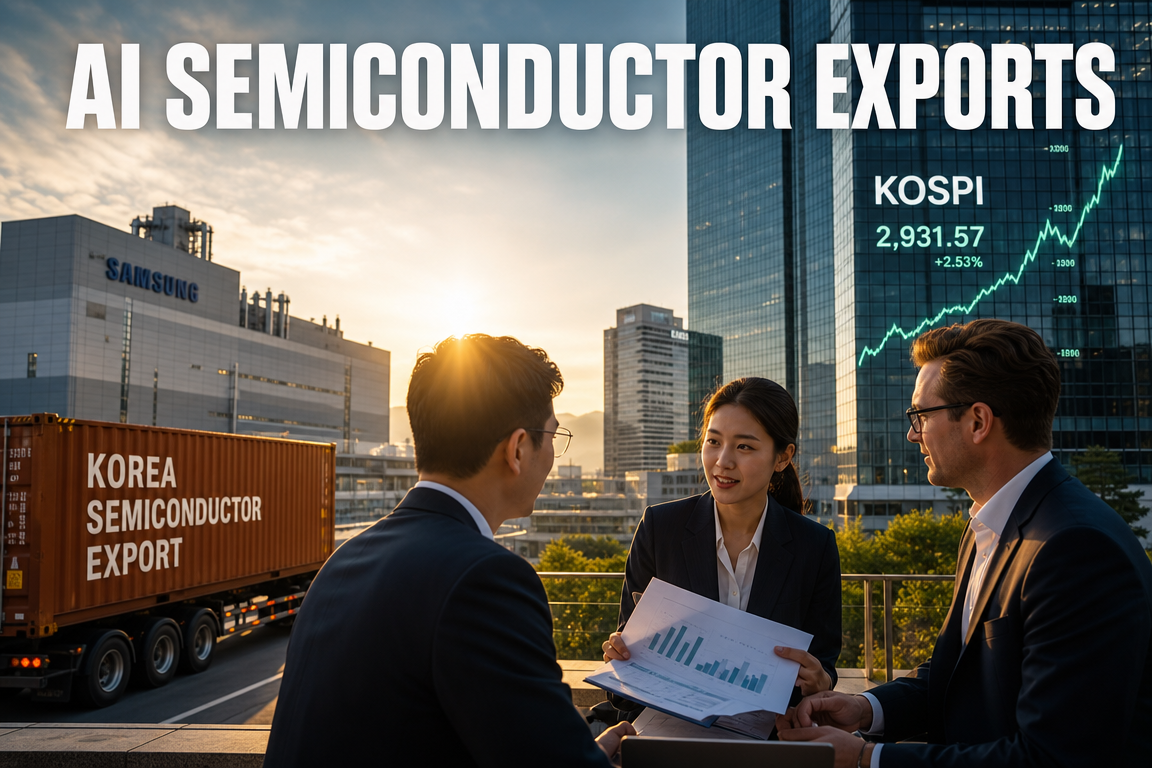
● Semiconductor Surge, KOSPI Sidecar, Foreign Buying
Why Samsung Electronics and SK Hynix Rebounded Despite the KOSPI Sidecar Trigger: The Key Drivers Were July Semiconductor Exports and Foreign Investor Flows
The key point in today’s market was not simply that the KOSPI rose.
What matters is that volatility was high enough to trigger a KOSPI sidecar, yet the move was driven by upside momentum rather than downside panic.
In particular, Samsung Electronics and SK Hynix rebounded at the same time, supported by July semiconductor export data, a Wall Street reassessment of Korean semiconductors, and net buying by foreign investors and institutions.
By contrast, the KOSDAQ failed to gain the same traction, likely reflecting pressure on sentiment from a biotechnology clinical trial issue.
Overall, today’s session can be viewed as one in which the market signaled that semiconductors remain resilient, while risks in the KOSDAQ remain unresolved.
1. Today’s KOSPI sidecar reflected upside volatility rather than a crash warning
A sidecar is a mechanism that temporarily halts program trading when futures prices move sharply.
Investors usually associate a sidecar with a sharp decline, but it can also be triggered during a rapid rally.
The important point today was not the sidecar itself, but that the market was moving sharply higher rather than lower.
This suggests a rapid shift in sentiment from fear toward stabilization.
- The KOSPI posted gains.
- Samsung Electronics rebounded.
- SK Hynix also showed strength.
- Foreign investors and institutions were seen as buying KOSPI large caps.
Until recently, domestic equities had been pressured by a correction in semiconductor large caps, volatility in U.S. technology stocks, recession concerns, and shifting expectations for rate cuts.
Today, at least for semiconductors, the market appeared to revive the view that valuations had fallen too far.
2. The first catalyst was that July semiconductor export data remained more stable than expected
The most direct factor behind the rebound was the July semiconductor export data.
The key point in the source material is that DRAM exports were up roughly 300% to 400% year on year.
It also mattered that the figure increased slightly from the previous month.
Strong year-on-year growth partly reflects a low base from last year’s weak cycle.
However, continued month-on-month growth suggests that demand has not yet weakened materially.
- DRAM exports: Estimated to have risen 300% to 400% year on year.
- Month-on-month trend: Slight growth helped ease concerns about a slowdown.
- Market interpretation: Demand from AI semiconductors and high-bandwidth memory continued to support the memory cycle.
- Investor sentiment: Reduced concerns that the semiconductor upcycle had already ended.
SK Hynix is widely viewed as a beneficiary of AI memory demand through its HBM exposure.
Samsung Electronics is seen as a play on both the recovery in conventional memory and expectations for improved HBM competitiveness.
Accordingly, when semiconductor export data holds up, the market tends to reassess Samsung Electronics and SK Hynix first.
That explains why semiconductor large caps led the KOSPI rebound today.
3. The second factor was a Wall Street reassessment that Korean semiconductor stocks had fallen too far
Another major driver was a Wall Street report.
The report argued that fundamentals for Korean semiconductor stocks remain intact, while share prices had declined excessively.
Such reports may appear to be only opinions, but in practice they can materially influence foreign capital flows.
Global investors typically assess not only company-specific news but also sector valuation and earnings cycles.
A more constructive Wall Street view on Korean semiconductors gave foreign investors a clearer rationale to buy.
- Core Wall Street view: Korean semiconductor fundamentals remain resilient.
- Valuation view: The recent decline was seen as excessive.
- Flow impact: Foreign investors and institutions were drawn into KOSPI large caps.
- Market result: The KOSPI rebounded, led by semiconductor heavyweights.
The key issue is not simply that positive news emerged, but that foreign investors now had a reason to buy.
In Korea’s equity market, KOSPI direction is closely tied to foreign fund flows.
In particular, when foreign buying enters Samsung Electronics and SK Hynix, it has an outsized effect on the index.
4. Samsung Electronics and SK Hynix rose together because the market is refocusing on the AI semiconductor cycle
The fact that Samsung Electronics and SK Hynix rose together indicates that the market is again viewing the semiconductor cycle as a whole rather than focusing on single-name catalysts.
AI infrastructure investment remains a central theme in global markets.
As demand rises for data centers, AI servers, and high-performance GPUs, demand typically extends to HBM, DRAM, NAND, packaging, and power semiconductors.
Korean chipmakers occupy a central position in that supply chain.
- SK Hynix: Strong expectations for HBM competitiveness and AI memory demand.
- Samsung Electronics: Exposure to memory recovery, HBM expansion, and potential foundry improvement.
- KOSPI: The index has high semiconductor weight, so gains in these two stocks directly lift the market.
- Foreign investors: The AI semiconductor cycle provides a clear buying rationale for Korea equities.
Today’s rebound may still be viewed as a technical move in the short term, but it was supported by a clear combination of data and flows.
Semiconductor exports held up, Wall Street highlighted valuation appeal, and foreign investors and institutions responded accordingly.
5. Why did the KOSDAQ lag?
In contrast to the KOSPI, the KOSDAQ was relatively weak today.
The main explanation appears to be a biotechnology-related clinical trial issue, likely linked to Celltrion or a similar name, which weighed on sentiment.
The KOSDAQ has greater exposure to biotech, secondary batteries, and growth stocks than the KOSPI.
In such a market, bad news or uncertainty around one biotech company can affect sentiment across the broader sector.
- KOSPI: Foreign and institutional buying concentrated in semiconductor large caps.
- KOSDAQ: Biotechnology-related concerns and growth stock pressure had a stronger impact.
- Investor sentiment: Large caps stabilized, but smaller growth stocks remained cautious.
- Market structure: The gap in strength between the KOSPI and KOSDAQ became visible again.
This is important.
An index rally does not mean all stocks move together.
Today was closer to a selective rebound led by semiconductor large caps, rather than a broad recovery in risk appetite across the KOSDAQ.
6. The most important issue not emphasized in many reports is whether the upside sidecar leads to sustained follow-through
The key question today is this:
Was yesterday the bottom, and is this the start of a genuine recovery?
It is too early to confirm a bottom based on one day of gains.
However, this rebound matters because it was supported by both data and flows, not just technical buying.
That said, one important point is often missed.
For the KOSPI to continue rising, Samsung Electronics and SK Hynix alone are not enough; foreign net buying must continue for several sessions.
In addition, semiconductor export data must remain firm in the next release, not just for one month.
The market is likely to pay more attention to month-on-month changes than to year-on-year growth rates going forward.
- Key checkpoint 1: Whether foreign net buying continues beyond one day.
- Key checkpoint 2: Whether trading value in Samsung Electronics and SK Hynix keeps expanding.
- Key checkpoint 3: Whether the next semiconductor export release also shows month-on-month growth.
- Key checkpoint 4: Whether biotechnology-related risks in the KOSDAQ broaden further.
- Key checkpoint 5: Whether U.S. technology stocks and AI semiconductor names stabilize.
In other words, today’s rebound is clearly positive.
But confirmation of a trend reversal will require alignment across flows, earnings, exports, and U.S. market conditions.
7. How investors should interpret today’s market
In a market like this, the priority is not to chase strength indiscriminately, but to identify which sectors are being supported first.
The current hierarchy is clear.
Semiconductor large caps, AI infrastructure, export-oriented blue chips, and foreign-favorite stocks are leading the rebound.
By contrast, biotech, unprofitable growth stocks, and thematic small caps may remain volatile.
- Aggressive investors: May consider staged exposure during pullbacks in semiconductor large caps.
- Conservative investors: Should focus on continued foreign buying and whether the KOSPI can hold its gains.
- KOSDAQ investors: Need to monitor biotech clinical risk and company-specific uncertainty more closely.
- Long-term investors: Should track whether the AI semiconductor cycle is translating into actual earnings and exports.
At the same time, domestic equities remain sensitive to rate-cut expectations, the KRW/USD exchange rate, U.S. mega-cap earnings, and the global growth outlook.
For investors, it is more important to ask why the market moved, who was buying, and which sectors led, rather than focusing only on the fact that the market rose.
8. One-sentence summary of today’s session
Today’s KOSPI rally was driven by stable July semiconductor export data and a Wall Street reassessment of Korean semiconductors, which encouraged foreign and institutional buying.
Samsung Electronics and SK Hynix led the market higher, while the KOSDAQ lagged due to biotechnology-related clinical trial concerns.
Accordingly, today’s session should be interpreted as a semiconductor-led KOSPI recovery signal rather than a broad market rebound.
< Summary >
The KOSPI triggered an upside sidecar amid strong volatility.
Samsung Electronics and SK Hynix rebounded on robust July semiconductor exports and a Wall Street report highlighting valuation appeal.
DRAM exports were estimated to have grown 300% to 400% year on year, with slight month-on-month growth also viewed positively.
Foreign investors and institutions were seen as buying KOSPI large caps.
By contrast, the KOSDAQ was weaker due to a biotechnology-related clinical trial issue.
The key question is whether foreign net buying continues and whether the next semiconductor export release also shows month-on-month growth.
Today’s rebound is constructive, but confirmation of a trend shift will require several more sessions.
[Related Articles…]
- AI Semiconductor Cycle and the Outlook for Korean Equities
- Foreign Flows and Large-Cap Strategy in the KOSPI
*Source: [ 내일은 투자왕 – 김단테 ]
– 오늘도 코스피 사이드카지만.. #하이닉스 #코스피 #삼성전자
● AI-Driven Job Shock, Hidden Cash Flow, K-Shaped Divide
Where Capital May Flow After AI Reduces Employment: Employment-Lite Growth, AI Semiconductors, and K-Shaped Polarization
The core issue is not simply whether AI will replace jobs.
The more important question is who captures the value created by AI and how income is sustained for displaced workers.
This discussion centers on four points.
First, some jobs will remain viable in the AI era.
Second, repetitive operational work is likely to decline quickly.
Third, capital is increasingly concentrating in AI infrastructure, AI semiconductors, big tech, cloud, and data centers.
Fourth, the policy debate is likely to shift from job preservation to non-labor income, basic capital, basic services, and AI taxation.
1. The key issue in the AI labor debate: not disappearance, but reallocation
When discussing AI and employment, many people first ask whether their job will disappear.
The more important issue is not total employment alone, but how employment structure changes.
AI is unlikely to eliminate all jobs at once. It will most likely first replace repetitive and standardized tasks.
- Excel data entry
- Insurance document processing
- First-line customer service
- Routine data cleanup
- Recurring report drafting
- Rule-based operations management
These are high-ROI use cases for AI.
From a corporate perspective, if a single AI model, server stack, and semiconductor infrastructure can replace large volumes of repetitive work, adoption incentives increase sharply.
AI adoption is therefore driven less by technology alone and more by economic feasibility.
2. Conditions for jobs that are more likely to survive: uniqueness, human touch, niche markets
Some jobs are more likely to remain viable in the AI era.
Examples include unique businesses, highly personalized content, and services that require human interaction.
Freelance announcers, independent content creators, and specialists with distinct brands are harder to replace at scale in the near term.
The reason is straightforward.
Even if AI can perform similar tasks, companies may have little incentive to build fully automated systems for small markets.
In other words, technical feasibility and economic justification are not the same.
Jobs more likely to endure will have the following characteristics.
- Low replacement economics: small markets and high dependence on individual capability
- Trust-based roles: counseling, education, healthcare, care services, leadership, negotiation
- Roles requiring creativity and contextual judgment: content, strategy, branding, planning, communication
- Customer-experience-driven roles: premium services, high-involvement sales, community-based businesses
3. Employment is likely to split into three groups: tech-driven, operations, and human-touch
In the AI economy, employment is likely to be reorganized into three broad areas.
① Tech-driven jobs: those building AI
Tech-driven jobs include AI, cloud, semiconductors, data centers, software, security, robotics, and platform development.
These roles involve improving AI, deploying it in enterprises, and designing the underlying infrastructure.
In the near term, demand for developers, AI engineers, data engineers, semiconductor designers, and cloud architects may remain stable or increase.
However, there is an important counterpoint.
AI can also move into tech-driven functions themselves.
It is increasingly capable of coding, testing, semiconductor design, model optimization, and data analysis.
As a result, it is not clear that this transition will replicate the previous industrial pattern in which operational jobs declined while technical jobs expanded significantly.
② Operations jobs: the first area to shrink
Operations jobs are centered on management, repetition, processing, input, and response.
This is similar to the decline in toll collection jobs after high-pass systems were introduced.
When chatbots are deployed, first-line phone support roles decline.
As AI-based office automation spreads, Excel cleanup, document classification, and routine reporting also decline.
This is where AI tends to enter first.
The reason is that the work is clearly defined, repetitive, and directly linked to cost reduction.
③ Human-touch jobs: becoming more important
Human-touch jobs require trust, emotion, relationships, care, and judgment between people.
AI can provide information, but roles that require reassurance, persuasion, and accountability are still likely to remain human-led.
- Elder care services
- Psychological counseling
- Premium education
- Medical communication
- Organizational leadership
- Customer-specific consulting
- Brand-based content businesses
Future job competitiveness is likely to depend less on performing calculations better than AI and more on using AI while still building human trust.
4. Industrial revolutions have always eliminated jobs, but this one is different in speed and concentration
The first industrial revolution was powered by steam.
Steam replaced human and animal labor, while creating new factories and industrial ecosystems.
The second industrial revolution was powered by electricity.
Electricity replaced existing labor while enabling mass production and manufacturing expansion.
The third industrial revolution was driven by the internet and PCs.
It automated parts of office work while creating jobs in platforms, e-commerce, software, and IT services.
The fourth industrial revolution is led by AI.
The key difference is that AI is affecting not only manual labor, but also knowledge work, creative work, and technical work at the same time.
For that reason, it is difficult to assume that new jobs will emerge in sufficient quantity, as they did in earlier transitions.
5. Where capital is moving: AI semiconductors, big tech, and data centers
In the AI economy, capital is first flowing into the infrastructure that makes AI possible.
Key areas include AI semiconductors, data centers, cloud services, power infrastructure, and large platform companies.
In the United States, the so-called M7 firms have accounted for roughly 35% of S&P 500 market capitalization.
In China, the so-called China Dragon 7 firms have also taken a significant share of the Hang Seng Index.
Concentration is even higher in Korea.
Samsung Electronics and SK hynix together are often cited as approaching half of the KOSPI’s market capitalization.
This is not only a stock-market issue.
It indicates that the gains from AI-driven productivity are concentrating in a limited number of companies, industries, and countries.
6. AI semiconductor concentration is strengthening in Korea
One of the most important variables in the Korean outlook is semiconductors.
In the past, semiconductors represented a much smaller share of Korea’s exports.
More recently, their export share has risen materially, and the expansion of AI servers and HBM demand has further increased market concentration around Samsung Electronics and SK hynix.
This trend is both positive and risky.
It is positive because Korea can occupy a critical position in the AI infrastructure supply chain.
It is risky because the gains from growth may concentrate among a small number of large firms, shareholders, and highly skilled workers.
Korea may be able to achieve total growth through the AI semiconductor cycle.
At the same time, K-shaped polarization may intensify.
Companies and workers positioned at the top may accumulate wealth more quickly, while lower-tier labor may face weaker income foundations.
7. The most important shift: the labor-income-based model is weakening
The most important point in this discussion is that “employment” and “income” must be analyzed separately.
Many people say they want to keep working.
In practice, however, the desire to work often reflects the fact that income comes from employment.
Accordingly, the core issue in the AI era may not be whether all jobs must be preserved.
Instead, the more important question is how to maintain income in a society where labor income is declining.
This is where employment-lite growth becomes relevant.
AI may raise productivity and corporate profits without creating commensurate employment growth.
The economy may expand while labor income weakens.
8. Is basic income the answer? Practical drawbacks may outweigh the benefits
As AI reduces employment, basic income is often proposed as a response.
However, basic income has several practical limitations.
- Fiscal burden: universal recurring cash transfers require very large tax resources
- Inflation pressure: large-scale cash distribution can increase price pressure
- Consumption distortions: unconditional transfers may not lead to productive spending
- Public resistance: taxpayers may object to subsidizing non-working recipients
Human psychology also includes a strong aversion to perceived free-riding.
This sentiment cannot be ignored in policy design.
Even if basic income is economically defensible, securing social consensus may be difficult.
9. More practical alternatives to basic income: basic services, basic capital, and non-labor income
Several alternatives to basic income are being discussed.
These include basic services, basic capital, and non-labor income.
① Basic services: providing essential services instead of cash
Basic services means providing education, healthcare, AI tools, transportation, housing, and communications rather than cash transfers.
This is similar to the universal basic services framework discussed in some Scandinavian countries.
The provision of free AI services such as ChatGPT or Gemini in Abu Dhabi can also be viewed in this context.
This approach may create less inflation pressure than cash transfers.
It may also improve productivity more directly.
② Basic capital: providing assets at adulthood
Basic capital refers to providing cash, stock, funds, or asset accounts when individuals reach a certain age.
Proposals such as Trump Accounts, birth-based asset grants, and child capital accounts fall into this category.
Basic capital differs from basic income because it supports asset formation rather than near-term consumption.
However, the risk remains that recipients may not manage the assets effectively and could deplete them quickly.
③ Non-labor income: income that does not depend on work
Non-labor income comes from investments, dividends, tokens, state-provided assets, or social dividends rather than work.
As labor’s relative value declines in the AI era, there may be stronger calls to design a broader system of non-labor income.
The challenge is funding.
Services, assets, and non-labor income all require capital.
That leads to the next issue.
10. AI taxation in the new economy: more important than robot taxes are token taxes and Pigouvian taxes
If the value created by AI is concentrated among a small number of firms, those firms are likely to face pressure to bear part of the social cost.
This is where the concept of Pigouvian taxation becomes relevant.
Pigouvian taxes are designed to make firms internalize the social costs of their activity.
For example, if a steel company emits carbon while producing steel, the resulting damage is a negative externality borne by society, which supports carbon taxation.
The same logic can be applied to AI.
If AI firms generate large productivity gains and profits while also contributing to large-scale displacement and weakening income foundations, those effects can be treated as social costs.
In that case, taxes on AI beneficiaries could be used to fund basic services or basic capital.
This may be framed as a robot tax, AI tax, or token tax.
The basic token concept discussed by Sam Altman is aligned with this direction.
Under such a system, citizens would receive monthly tokens at a certain age, and the growth of the AI economy would be shared more broadly.
11. AI taxes remain difficult in practice: coordinated action across major economies would be required
AI taxation is economically plausible in theory.
In practice, however, it is difficult.
The reason is global competition.
If only Korea adopts an AI tax, Korean firms could lose competitiveness.
If U.S. firms pay less tax and Chinese firms invest more aggressively, Korean firms could be placed at a disadvantage.
For that reason, AI taxes are difficult to implement unilaterally.
They would require coordination among major economies such as the United States, China, Europe, Korea, and Japan.
Given current geopolitical competition, however, a common AI tax framework is unlikely to emerge easily.
This is one of the central dilemmas in AI economics.
The solution is visible, but implementation is difficult.
12. If unemployment reaches 20-30%, it becomes a political issue, not just an economic one
If AI drives unemployment toward 20-30%, the issue would extend beyond labor markets.
It could destabilize the broader social system.
Historically, unemployment and income collapse have often led to unrest and political extremism.
Similar dynamics appeared during the first industrial revolution in the 19th century.
Technology increased productivity, but the jobs of manual workers disappeared before new jobs were created.
Social instability increased during that transition.
Social insurance, health insurance, pensions, and unemployment benefits emerged to address this problem.
Bismarck, a conservative politician, introduced social insurance to preserve systemic stability.
It was not done out of idealism, but to prevent institutional breakdown.
The same may be true in the AI era.
Whether through basic income, basic capital, or basic services, the objective is the same.
The goal is to prevent society from collapsing when labor income is no longer sufficient.
13. K-shaped polarization is likely to intensify
The defining feature of the AI economy is that aggregate growth and distributional deterioration can occur at the same time.
AI can raise productivity.
GDP and total value added may rise.
But if those gains are concentrated among a small number of firms, shareholders, and highly skilled workers, the broader labor market may experience worsening conditions.
This is K-shaped polarization.
One side moves upward on the back of AI semiconductors, big tech, data centers, and capital-market returns.
The other side moves downward due to lower operations employment, wage stagnation, and weaker job security.
This pattern is already visible in equity markets.
Capital has flowed into AI beneficiaries such as the M7, Samsung Electronics, and SK hynix, increasing the influence of a small number of names on the market as a whole.
For investors, understanding this trend is important.
For the broader economy, however, it also implies risks related to wealth concentration and weaker consumption support.
14. Where investors should track capital flows
As AI reduces employment, the areas attracting capital are becoming clearer.
- AI semiconductors: HBM, GPUs, memory, and advanced packaging remain critical
- Data centers: AI training and inference require large-scale infrastructure investment
- Power and cooling: data center expansion increases demand for grids, nuclear, renewables, and cooling systems
- Cloud platforms: cloud firms remain the foundation for AI services
- AI software: enterprise automation, security, and productivity tools are expanding
- Human-touch industries: aging, education, counseling, and premium services may see stronger demand
Investors should not rely on the label “AI beneficiary” alone.
The firms that actually capture profits are those that control infrastructure bottlenecks.
Supply-chain position in semiconductors, data-center power access, cloud market share, and platform lock-in effects should all be assessed together.
15. The most important point often overlooked
The most important issue is that AI reduces jobs faster than institutions can redesign the mechanisms for distributing the gains.
Technology moves quickly.
Companies adopt automation when ROI is compelling.
Equity markets quickly price in expectations and channel capital toward AI semiconductors and big tech.
By contrast, tax policy, welfare systems, basic capital, basic services, and retraining frameworks require political consensus and therefore move much more slowly.
This timing gap is the main risk.
If jobs disappear quickly while income-support mechanisms are delayed, social stress will rise.
Another important point is that the assumption that operations workers will naturally move into technical roles may be too optimistic.
Just as a coachman could not immediately become a bus driver, workers in routine operations cannot easily become AI engineers.
Transition capacity varies significantly by age, education, region, and asset position.
Therefore, the real policy agenda is not only retraining.
It must also include income security, asset formation, AI access, human-touch industry development, and regional economic redesign.
16. What individuals should prepare for now
Individuals should prepare in three ways.
- AI usage capability: become a user of AI rather than someone displaced by it
- Human-touch capability: persuasion, empathy, trust, relationships, and communication will matter more
- Non-labor income structure: build dividend, investment, knowledge-asset, content, and automation-based income streams beyond salary
Relying solely on labor income may become increasingly fragile.
In the AI economy, those with assets and those investing in AI infrastructure are likely to capture a larger share of the gains.
Office workers should therefore continue studying economic trends, capital markets, industrial change, and the AI semiconductor value chain.
17. What companies and governments should prepare for
Companies should not view AI only as a way to reduce labor costs.
Cost savings should be redirected into new products, service expansion, and market growth.
That is how employment losses can be offset and the overall economic pie expanded.
Governments should not try to block AI adoption.
Instead, they should design how AI-generated wealth is redistributed.
Priority areas include the following.
- Income protection for occupations displaced by AI transition
- Basic services that improve productivity rather than simple cash transfers
- Asset formation support for younger generations through basic capital
- Global tax coordination for firms benefiting from AI infrastructure
- Support for human-touch industries and care economies
- Universal access to AI education
Competitive strength in the AI era depends not only on how quickly technology is adopted, but also on how effectively society absorbs the shock.
< Summary >
AI is likely to replace repetitive operational work first rather than eliminate all jobs at once.
Employment is likely to reorganize into tech-driven, operations, and human-touch segments.
Operations jobs are likely to decline, while human-touch roles and some AI infrastructure jobs may become more important.
Capital is concentrating in AI semiconductors, data centers, cloud platforms, and major firms such as Samsung Electronics and SK hynix.
As a result, employment-lite growth and K-shaped polarization may intensify.
The real issue is not job preservation alone, but how income is sustained in a society where labor income weakens.
Basic income, basic services, basic capital, non-labor income, and AI-related taxation are likely to become more important policy debates.
Individuals should prepare through AI capability, human-touch skills, and non-labor income streams.
[Related Articles…]
- AI Labor Reallocation and the Outlook for Employment-Lite Growth
- AI Semiconductor Supercycle and the Korean Economic Outlook
*Source: [ 경제 읽어주는 남자(김광석TV) ]
– AI가 일자리를 없앤 뒤, 돈은 결국 ‘이쪽’으로 몰립니다 | 50만 특집 경읽남과 토론합시다 | 김대식x이광용 [3편]