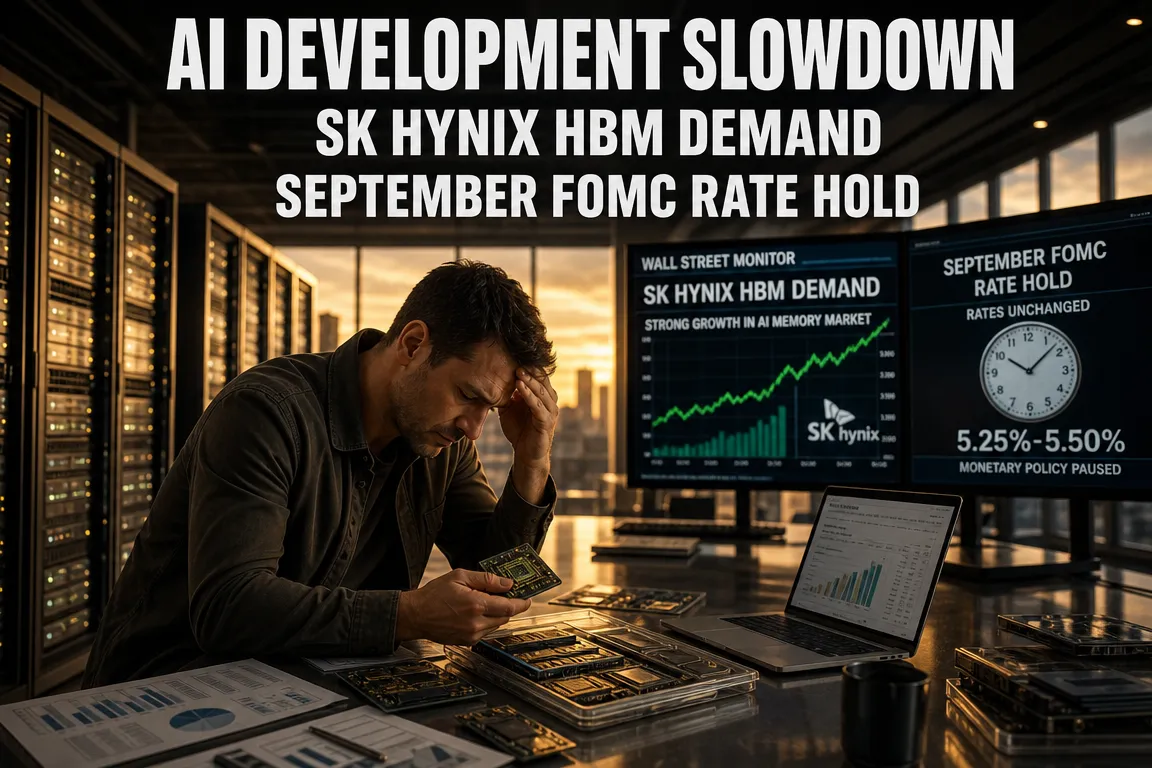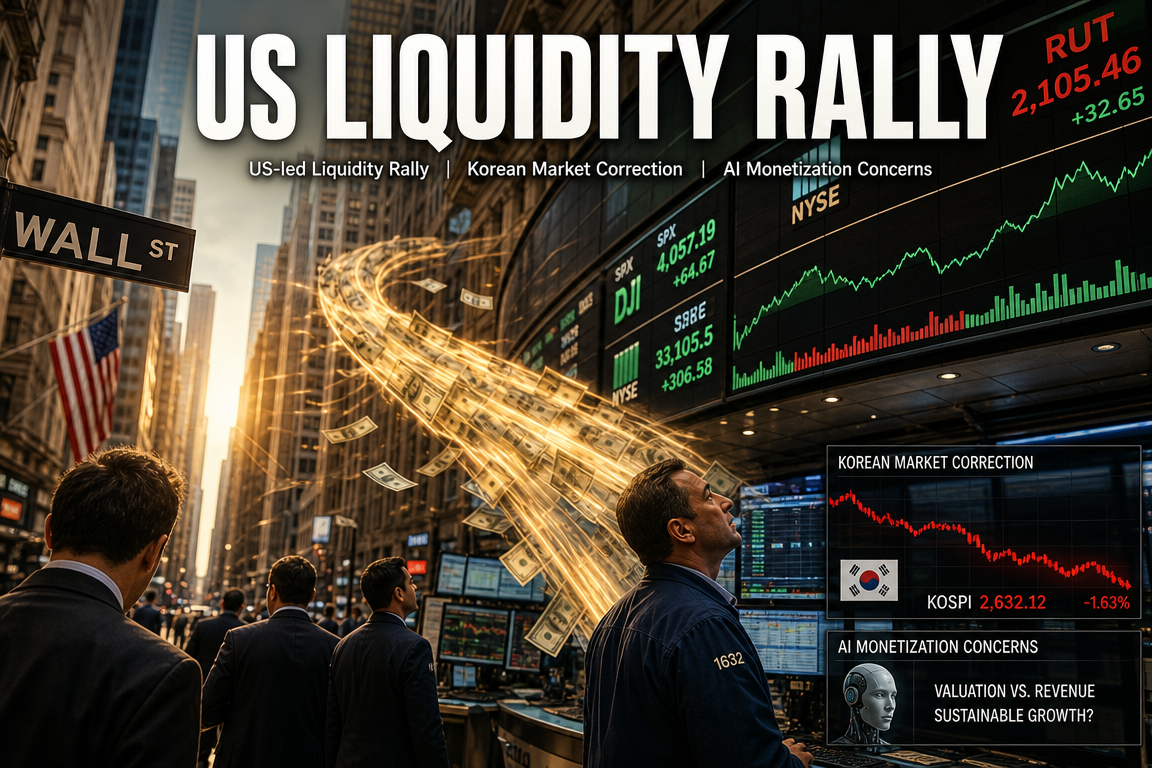
● Market Shakeout, AI Hype, Liquidity Surge
Five Real Reasons Behind the June–July Market Correction and the Outlook for a US-Led Liquidity Rally in August
The key point of this article is not simply that equities declined.
This report explains why the June and July correction was more pronounced in the Korean market, and how National Pension Service rebalancing, foreign selling, leveraged ETFs, AI bubble concerns, and expectations of Bank of Korea rate hikes interacted at the same time.
More importantly, it also looks beyond August.
The United States may attempt to recreate a liquidity-driven market through fiscal policy rather than monetary policy, which could widen the gap in market performance between US and Korean equities.
A particularly important point, which is often overlooked in other coverage, is not simply a slowdown in AI semiconductor demand, but the possibility that AI service monetization failure and the rise of Chinese AI models may affect the pace of investment by US big tech.
1. The June–July correction was closer to a volatility phase than a trend breakdown
The June and July market move was a classic volatility-driven correction.
At first glance, the decline in the KOSPI and major semiconductor names may appear to signal a broader trend reversal.
However, the more accurate interpretation is that this was a short-term shock caused by multiple supply-demand and policy variables converging at once, rather than a full collapse of the longer-term uptrend.
In that sense, the June–July correction may have been a consolidation phase ahead of a potential liquidity-driven rally in August and beyond.
This is not a certainty, but a scenario.
For investors, understanding why the market fell is essential to avoiding overreaction in the next correction.
2. Reason ① National Pension Service rebalancing weighed on market direction
The first major factor was rebalancing by the National Pension Service.
The NPS adjusts its asset allocation across domestic equities, overseas equities, and bonds according to target weights.
When a particular asset class performs strongly, its weight rises, and part of the position is sold to restore the target mix.
In June and July, NPS domestic equity rebalancing appears to have created a headwind for the market.
Notably, selling pressure became more visible in July, but preemptive adjustments appear to have begun in June to reduce market disruption.
Large one-time sales can destabilize the KOSPI, so the position adjustment was likely spread out over time.
This rebalancing exerted downward pressure on market direction.
However, NPS selling alone does not necessarily trigger a major correction.
The more important question was how foreign flow would interact with it.
3. Reason ② Foreign selling amplified the pressure from NPS rebalancing
The second factor was large-scale foreign selling.
If foreign investors buy aggressively while domestic institutions sell, the market impact can remain limited.
When both NPS selling and foreign selling occur at the same time, the impact becomes much larger.
This was a key point in the original analysis.
The June–July correction deepened because institutional rebalancing and foreign selling moved in the same direction.
This mattered especially because the Korean market is heavily weighted toward Samsung Electronics and SK hynix.
When foreign capital exits these large-cap semiconductor names, the entire index comes under pressure.
In short, NPS selling created the directional bias, while foreign selling amplified the correction.
4. Reason ③ Leveraged ETFs intensified concentration in Samsung Electronics and SK hynix
The third factor was leveraged ETFs.
The launch of single-stock leveraged ETFs increased capital concentration in specific large-cap names.
In Korea, Samsung Electronics and SK hynix have a large impact on index performance.
Both are closely tied to the semiconductor cycle and AI investment expectations.
The issue is that leveraged products can magnify inflows in a rising market, but they also amplify downside pressure in a correction.
When Samsung Electronics and SK hynix rise, leveraged ETFs linked to them can accelerate gains.
When a correction begins, the same structure intensifies selling pressure.
As a result, concentration in a small number of large-cap names increased overall KOSPI volatility.
This is an important point for market outlook.
A decline in the index does not mean fundamentals deteriorated across all sectors.
However, because leveraged capital was concentrated in the most index-sensitive names, the correction looked broader than it actually was.
5. Reason ④ Despite record earnings, semiconductors fell on AI monetization concerns
The fourth factor was skepticism around the AI value chain.
July was earnings season.
Some companies reported record results, yet share prices often corrected on the announcement day.
Normally, strong earnings would support higher share prices.
But equity markets discount future expectations more than current earnings.
Even when semiconductor earnings are strong, shares can fall if the market expects AI infrastructure spending to slow.
The key issue here is the hyperscaler group.
Hyperscalers are large-scale cloud and data center operators, mainly among the major US technology companies.
They have been the primary drivers of AI semiconductor demand.
They develop AI models, build data centers, and purchase high-performance chips on a large scale.
That is why semiconductor names such as Samsung Electronics and SK hynix have benefited directly from AI infrastructure expansion.
The problem is that AI services have not yet shown sufficient monetization.
Usage is growing quickly, but the market remains uncertain whether revenue can justify the scale of investment.
This has revived concerns about an AI bubble.
The question is whether AI growth is generating enough cash flow to support current investment levels.
6. Reason ⑤ The rise of Chinese AI models adds pressure on US big tech profitability
Another important variable is the rise of Chinese AI models.
The original analysis highlighted the expansion of Chinese AI platforms and models as a key risk factor.
As Chinese AI competitiveness improves, global demand for AI services may become less concentrated in the United States.
In the past, AI service demand was heavily centered on US big tech companies.
But if Chinese AI services gain share, US hyperscalers may face lower profitability.
This has weakened sentiment toward semiconductor investment.
If US firms lose some of their pricing power and dominance in AI services, their investment plans may be revised.
A slowdown in data center spending would also reduce expectations for AI semiconductor demand.
That means semiconductor stocks can correct even when earnings remain strong.
In short, the correction reflects not just earnings, but also AI monetization, the sustainability of US big tech investment, and Chinese model competition.
7. Reason ⑥ Expectations of Bank of Korea rate hikes created a larger burden for Korean equities
The final major factor is interest rates.
The original text frames 2026 as a period of renewed rate-hike risk.
What matters most is the policy divergence between the United States and Korea.
The US already has relatively high real policy rates, so further hikes may be less likely as a policy response.
Korea, by contrast, may need to keep a tighter stance or leave room for additional hikes depending on inflation, the exchange rate, household debt, and property-market conditions.
Policy rates influence market rates.
When market rates rise, equity valuations come under pressure.
This is especially relevant for growth stocks, semiconductors, and AI-related names, where a large part of valuation depends on future earnings.
As a result, Korean equities experienced a larger correction than US equities.
This is where the idea of “US exceptionalism” becomes relevant.
For investors, the US may appear more favorable than Korea because US policy retains greater room to support liquidity, while Korea faces tighter policy constraints.
8. The core outlook for August is a US-centered liquidity phase
The key question now is what happens after August.
The original analysis suggests the possibility of a large US-led liquidity phase starting in August.
However, the liquidity in question is not primarily based on Federal Reserve easing.
The main driver is fiscal policy.
The US government may expand spending ahead of the election cycle.
A liquidity phase refers to an environment in which abundant money supports risk appetite across markets.
Even without lower rates, stronger fiscal spending can support corporate investment, consumption, and overall market sentiment.
The US can also inject liquidity through Treasury issuance and fiscal expenditure.
Even if that money does not flow directly into equities, it can support the market by improving overall economic liquidity.
9. Trump administration scenario: creating an environment where rate cuts become possible
The most notable scenario in the original text concerns the Trump administration’s policy approach.
Interest rates are set by the Federal Reserve.
But the administration can help create conditions in which the Fed does not need to raise rates, or may eventually be able to cut them.
The key variable here is US-China relations.
If the US reduces tariff pressure and allows more imports of Chinese consumer goods, inflation could ease.
Inflation is usually measured year over year.
If Chinese goods were more expensive or restricted last year due to tariffs, and imports rise this year, the inflation rate may decline.
In that case, the Fed would face less pressure to tighten policy.
This does not mean a rate cut is immediate, but it could reduce the risk of further hikes.
That is highly relevant for equities.
Markets can respond strongly not only to rate cuts, but also to the removal of rate-hike risk.
10. Higher imports of Chinese consumer goods could reduce US inflation
The original analysis also points to the possibility that a stronger flow of Chinese exports to the US could help lower consumer inflation.
If Chinese consumer goods enter the US market in larger volumes, they could help moderate CPI growth.
Of course, a rebound in oil prices could reintroduce inflation pressure.
But stable consumer goods prices are highly visible to households.
From a political perspective, consumer price stability is especially important ahead of an election.
That creates a linkage between tariff relief, higher Chinese imports, lower inflation, and reduced pressure for rate hikes.
If this dynamic materializes, it would support US equities.
Investors may rotate back into growth and technology stocks simply on the signal that rates are not likely to rise further.
11. Large-scale Treasury issuance and fiscal spending could become part of the election strategy
The original text also refers to the OBBA legislation passed in 2025 and the increase in the debt ceiling.
The key point is that the US government may raise funds through large Treasury issuance and use that capacity for fiscal policy during the election period.
Treasury issuance is a way for the government to borrow money.
If borrowed funds are used for infrastructure, industrial policy, subsidies, tax measures, or other support programs, liquidity is injected into the economy.
This type of fiscal liquidity moves differently from monetary policy.
Even if the Fed does not cut rates, government spending can still circulate money through the market.
Accordingly, the main assumption behind the August liquidity outlook is not immediate Fed easing.
The key assumption is that the government may use fiscal policy to expand liquidity.
12. Why US equities may be more favorable than Korean equities
The original text suggests that US equities may offer a more favorable setup than Korean equities.
There are three main reasons.
First, the US has greater capacity to support markets through fiscal policy.
Second, the pressure for additional rate hikes may ease in the US.
Third, global capital tends to favor US assets when uncertainty rises.
By contrast, Korean equities face structural pressure from foreign flows, the exchange rate, Bank of Korea rate concerns, and concentration in large-cap semiconductors.
Because the KOSPI is heavily dependent on Samsung Electronics and SK hynix, any weakening in semiconductor sentiment can pull down the entire index.
For that reason, Korea and the US should not be viewed through the same lens in the second half.
The US is more exposed to liquidity dynamics, while Korea is more exposed to flow and rate pressure.
13. Key indicators investors should watch in August
To assess the market after August, investors should look beyond day-to-day price changes.
The following indicators matter most.
First, whether foreign investors return to net buying in the KOSPI.
It is important to see whether foreigners begin buying Samsung Electronics and SK hynix again.
If large-cap semiconductor flow does not recover, the KOSPI rebound may remain limited.
Second, whether NPS rebalancing pressure eases.
Institutional selling needs to slow.
If supply pressure eases, the market can absorb future shocks more easily.
Third, US inflation data.
Investors should confirm whether increased imports of Chinese consumer goods are reflected in a softer CPI trend.
If inflation slows, rate-hike concerns may diminish.
Fourth, the pace of US Treasury issuance and fiscal spending.
It matters whether fiscal liquidity is actually entering the market.
Government spending can have a direct impact on market liquidity.
Fifth, investment plans of major AI platforms.
Investors should monitor whether hyperscalers continue to expand spending on data centers and AI semiconductors.
If AI monetization concerns deepen, the rebound in semiconductor stocks may remain limited.
14. The most important point often missed in other coverage
The most important issue is the real driver of the AI semiconductor correction.
Many reports explain semiconductor weakness through earnings, exports, or memory pricing alone.
But the core issue is deeper.
AI semiconductor demand ultimately depends on investment by US big tech.
Semiconductor upcycles remain strong only if US hyperscalers continue building data centers and purchasing GPUs, HBM, and server chips at scale.
If AI services are not yet generating enough revenue, the picture changes.
At the same time, the rise of Chinese AI models could reduce the profitability of US platforms.
In other words, the correction is not just about whether AI is a bubble.
The real question is whether AI services are earning enough to sustain the current level of infrastructure investment.
Until that becomes clearer, AI-related stocks may remain volatile even if earnings stay strong.
Understanding this point allows for a more realistic view of the second-half market outlook.
15. One-sentence summary of the overall picture
The June–July correction was the result of NPS rebalancing, foreign selling, leveraged ETF concentration, AI monetization concerns, and Bank of Korea rate pressure.
By contrast, after August the market may shift toward a US-centered liquidity phase supported by fiscal policy, easing US-China tensions, stable inflation, and reduced rate-hike risk.
The key investment issue in the second half is not simply buying after a pullback.
Investors need to identify where liquidity is flowing, which earnings expectations are being sustained, and which assets are less vulnerable to rate pressure.
< Summary >
The June–July correction was closer to a volatility phase than a trend reversal.
NPS rebalancing and foreign selling combined to weaken KOSPI supply-demand conditions.
Leveraged ETF concentration in Samsung Electronics and SK hynix increased index volatility.
AI semiconductors were affected less by earnings and more by AI monetization concerns and the rise of Chinese AI models.
Expectations of Bank of Korea rate hikes added further pressure on Korean equities.
After August, the key focus is the possibility of a US-led liquidity phase driven by fiscal policy.
Easing US-China tensions and higher imports of Chinese consumer goods could help stabilize US inflation.
If rate-hike pressure declines, US equities and technology stocks may benefit.
In the second half, investors should monitor US liquidity flows more closely than Korean market movements.
[Related Articles…]
- US Liquidity Rally and the Second-Half Market Outlook
- AI Semiconductor Cycle and Big Tech Investment Trends
*Source: [ 경제 읽어주는 남자(김광석TV) ]
– 6·7월 조정의 진��� 이유 5가지, 그리고 8월 유동성 장세 전망 | 김광석의 경제강의
● Raging, Hidden, Rally, Shocking, Winners
Why the second-half market leader is not limited to semiconductors: Cosmetics ODM, transformers, shipbuilding, construction, and dividend stocks
The key point is straightforward.
Markets remain focused on the semiconductor rally led by Samsung Electronics and SK hynix, but several sectors with improving earnings have seen sharp share price declines.
For the second half, candidates for market leadership include cosmetics ODM, transformers, shipbuilding, large-cap construction, and high-dividend financial stocks.
The issue is not simply buying because prices have fallen.
The focus should be on sectors with earnings visibility, long industry cycles, and structurally expanding global demand.
This report summarizes which sectors could become the next leaders in a KOSPI rebound and why the market remains concentrated in semiconductors.
1. The key investment criterion: earnings visibility matters more than stock price declines
Markets have undergone broad sector corrections recently.
However, the core view is that investors do not need to abandon sectors solely because prices have fallen.
In fact, many companies still have intact momentum and earnings, despite share prices having declined substantially.
The key criterion is clear.
Numbers must confirm the thesis.
Earnings must be visible, and profits must be expected to hold or improve going forward.
Short-term rebounds can occur across many sectors, but sustainable leadership tends to emerge from companies with earnings visibility.
In other words, the core strategy for the second half is not simple value buying, but identifying sectors where earnings are improving while valuations have fallen excessively.
2. Cosmetics: K-beauty is being validated by execution, not just trend
The first non-semiconductor sector highlighted as a potential leader is cosmetics.
Korean cosmetics is no longer merely a theme; it is being validated through performance in global markets.
The APR Mediheal case is a representative example.
Korean brands now hold meaningful positions in Amazon’s beauty rankings, and brand recognition among U.S. consumers has increased.
What initially appeared to be a marketing-driven move has continued for more than a year, indicating competitive strength beyond promotional effects.
The strength of Korean cosmetics lies in the combination of agile product development, fast trend response, and ODM manufacturing capabilities.
For consumer goods, once a brand establishes itself with consumers, repeat purchases can follow.
As a result, K-beauty can be viewed not as a short-term theme but as a long-term growth industry.
3. Why cosmetics ODM is preferred over branded companies
Within cosmetics, branded companies and ODM companies have different risk profiles.
Brand companies can rise sharply when conditions are favorable, but competition is intense.
If trends shift or competitors enter quickly, earnings volatility can rise materially.
By contrast, cosmetics ODM firms are structurally more stable.
They benefit regardless of which brand wins, since they supply production across the market.
This structure is similar to TSMC in semiconductors, which manufactures for multiple fabless clients.
Representative names include Korea Kolmar and Cosmax.
Korea Kolmar is particularly recognized for its strength in sun care products, including sunscreen.
If demand for sunscreen in the U.S. expands further, Korean ODM firms with FDA compliance and manufacturing capacity may benefit.
Another important development is that L’Oreal, the world’s largest cosmetics company, has outsourced production of some products to Korean ODM firms.
Global luxury cosmetics companies have traditionally preferred in-house production.
That L’Oreal has utilized Korean ODM services indicates that Korean manufacturing capabilities are now being recognized at a top-tier global level.
4. Transformers: a long-cycle theme driven by AI data centers and U.S. grid replacement
The second candidate is transformers.
Hyosung Heavy Industries, HD Hyundai Electric, and LS Electric are among the representative names.
The sector has already experienced a strong rally.
That made valuations a concern for some time.
However, following a correction of roughly 40% to 50% from recent highs, the sector is now considered more investable again.
The core driver is the U.S. power grid replacement cycle.
The United States still relies on many transformers that are 40, 50, or even 60 to 70 years old.
This infrastructure will need to be replaced over time.
AI data center demand is adding a second layer of growth.
Data centers require large amounts of electricity, making stable grid infrastructure and transformer investment essential.
Because grid replacement and data center expansion are occurring simultaneously, the transformer cycle may extend at least through 2028.
This is directly linked to AI investment.
Even if AI semiconductors continue to advance, data center expansion remains constrained without sufficient power infrastructure.
Accordingly, transformers should be viewed not simply as power equipment, but as a core part of the AI infrastructure value chain.
5. Shipbuilding: the U.S. naval rebuild cycle presents a structural opportunity for Korean shipbuilders
The third candidate is shipbuilding.
The industry is already seeing earnings improvement through commercial vessel orders.
In addition, a new long-term catalyst may emerge from the U.S. naval market.
The U.S. has historically rarely relied on foreign countries to build warships.
However, Korean shipbuilders are now opening possibilities for maintenance and construction cooperation in the U.S. naval sector.
From the U.S. perspective, maritime competition with China is becoming a strategic burden.
China is expanding its fleet rapidly, while the U.S. lacks sufficient shipbuilding labor and capacity.
Since the Reagan era, the U.S. shipbuilding base has weakened, making it difficult to expand naval construction at the necessary pace.
Sea power remains a core condition of great-power status.
Historically, the U.K., Spain, the Netherlands, and the U.S. all relied on naval strength as a foundation of national power.
If the U.S. proceeds with a naval rebuild, Korean shipbuilders could gain long-term opportunities not only in commercial vessels but also in defense and naval construction.
This cycle is not simply a matter of stock price movement, but a structural demand theme driven by geopolitics and security strategy.
For that reason, shipbuilding should be monitored as a long-term sector alongside exchange rates, interest rates, and global growth conditions.
6. Construction: investors should focus on data centers and mega projects rather than housing alone
Construction was also mentioned as an unexpected candidate.
Construction stocks are typically associated with housing cycles, real estate regulation, and PF risk.
However, the next phase of the sector requires a broader view.
The focus should be on major domestic infrastructure projects and data center investment.
As large-scale infrastructure spending accelerates, major construction companies will be the main executors.
Data center construction alone is expected to involve significant investment over the next decade.
A data center is not just a building.
It integrates power, cooling, security, networks, and server systems.
As a result, large construction firms with relevant experience and technology are likely to have an advantage in contract competition.
Some construction names rallied sharply on restructuring themes and later corrected significantly.
However, if earnings and order momentum remain intact, the sector may merit renewed attention after its correction.
7. Dividend stocks: banks and securities firms remain the stabilizing part of a portfolio
Even in a growth-oriented market, dividend stocks remain important.
Banks and securities firms were mentioned as sectors with strong dividend appeal.
These sectors are not high-growth names.
However, allocating around 10% to 20% of a portfolio to dividend stocks can help stabilize performance during market volatility.
In shifting interest-rate environments, financial stocks can regain appeal through dividends and shareholder return policies.
That said, Samsung Electronics remains an important benchmark.
If Samsung Electronics combines earnings recovery with potential special shareholder returns, it may compete directly with traditional dividend stocks in terms of investor appeal.
8. Why Samsung Electronics and SK hynix remain the top names
The most notable point is that, while other sectors remain attractive, Samsung Electronics and SK hynix have become exceptionally strong from a market perspective.
In other words, the concentration in semiconductors is not arbitrary; capital is flowing there for clear reasons.
Samsung Electronics is seeing a meaningful improvement in earnings estimates and remains attractive on valuation grounds.
If next year’s earnings outlook continues to improve, expectations for special shareholder returns and higher dividends could rise.
Samsung Electronics has historically returned excess cash to shareholders on a three-year cycle, based on free cash flow.
This refers to returning part of the cash remaining after capital expenditures to shareholders.
If semiconductor earnings improve significantly, both common and preferred shares may also become more attractive from a dividend perspective.
SK hynix is also directly linked to AI semiconductors, HBM, and data center demand.
Ultimately, semiconductors remain the center of KOSPI leadership, while cosmetics, power equipment, shipbuilding, construction, and dividend stocks should be considered as part of portfolio construction.
9. Key points that are often overlooked
First, cosmetics ODM has a broader winner structure than branded competition.
While branding success depends on which company wins, ODM firms can capture growth across multiple brands simultaneously.
Korea Kolmar and Cosmax should be viewed as infrastructure providers for the expansion of K-beauty.
Second, transformers are a hidden bottleneck in AI development.
As AI data centers expand, pressure on power infrastructure increases.
Investors focused only on GPUs and HBM may overlook the power grid cycle.
Third, shipbuilding may be re-rated not as a cyclical industry, but as a security cycle.
This is due to the structural backdrop of U.S. naval rebuilding and competition with China.
The cycle may last much longer than a standard commercial ship cycle.
Fourth, construction should be viewed as an AI infrastructure execution sector, not just a real estate sector.
As data centers, power facilities, and advanced industrial complexes expand, the role of major construction firms may grow.
Fifth, the real market issue is not the absence of investable names, but portfolio allocation.
With opportunities across semiconductors, cosmetics, transformers, shipbuilding, construction, and dividend stocks, the key question is how to size positions appropriately.
10. Three criteria for selecting second-half market leaders
Step 1 is earnings confirmation.
Investors should verify whether sales and operating profit are actually increasing.
Companies with themes but no earnings support may remain volatile after a rebound.
Step 2 is cycle duration.
Sectors with long-term demand, such as cosmetics exports, U.S. grid replacement, AI data center investment, and U.S. naval rebuilding, are more favorable.
Step 3 is valuation.
Even strong sectors can deliver limited returns if valuations are too high.
Conversely, companies with improving earnings and deeply corrected share prices may present renewed opportunities.
Ultimately, second-half leaders are likely to emerge where both value and quality align.
Although short-term volatility in both the KOSDAQ and KOSPI may continue, earnings are likely to remain the key driver of medium- to long-term share prices.
< Summary >
Second-half market leadership is not limited to semiconductors.
Cosmetics ODM, transformers, shipbuilding, construction, and dividend stocks also warrant attention based on earnings and structural demand.
Cosmetics is supported by K-beauty exports and ODM competitiveness.
Transformers are linked to AI data centers and the U.S. grid replacement cycle.
Shipbuilding could benefit from U.S. naval rebuilding alongside commercial vessel orders.
Construction should be evaluated through data centers and large-scale infrastructure projects.
Dividend stocks can provide stability within a portfolio.
Nevertheless, Samsung Electronics and SK hynix remain the market center in terms of earnings, valuation, and shareholder returns.
The key issue is not the lack of opportunities, but how to allocate capital among attractive names.
[Related Articles…]
KOSPI Leadership and Second-Half Investment Strategy
AI Data Center Power Infrastructure Investment Cycle
*Source: [ Jun’s economy lab ]
– 하반기 주도주는 이 업종입니다(ft.염승환 이사 2부)