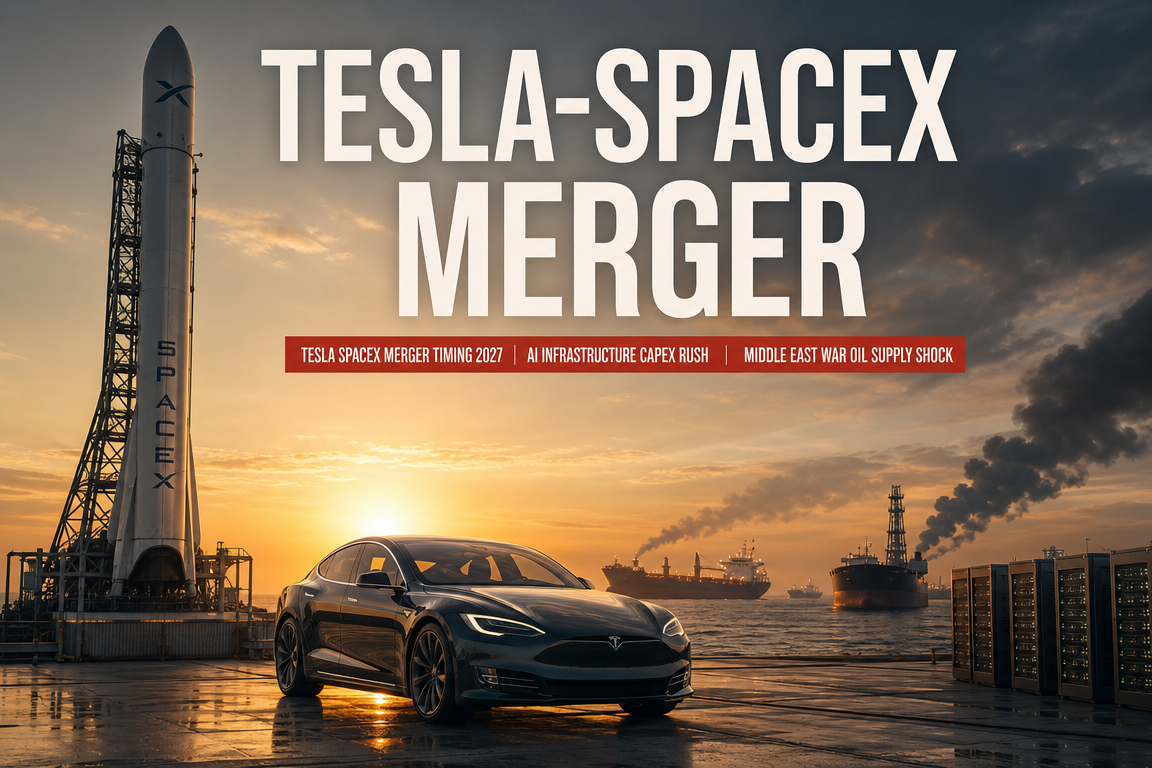
● Tesla-SpaceX Merger Shock, Musk Power Play, AI Bubble, Timing Blast
Tesla–SpaceX Merger Speculation: The Key Issue Is No Longer Possibility, but Timing
The main takeaway from this development is not Tesla’s share-price decline itself.
Tesla’s earnings miss, SpaceX volatility, expanded AI infrastructure spending, Elon Musk’s ownership structure, and the possibility of a mega-merger linking Optimus, robotaxi, and Starlink are all moving at once.
On the surface, the story looks like a simple report that Tesla shares fell to $313. In reality, the more important question is why Elon Musk did not dismiss the possibility of combining Tesla and SpaceX at this time.
Some in the market have raised the merger probability to as high as 90%, while prediction markets are also showing growing bets on a merger around 2027.
This report reviews Tesla’s stock outlook, the SpaceX merger scenario, AI infrastructure investment, major tech earnings pressure, and the broader capex expansion trend.
1. Tesla at $313: More Than a Simple Earnings Disappointment
In the source report, Tesla closed at $313.03, down 2.08% on the day.
This followed a 14.52% drop after the earnings release.
The broader market was not in a full selloff.
The Nasdaq fell 0.64%, the S&P 500 rose 0.05%, and the Dow Jones gained 0.45%.
In other words, market volatility was present, but Tesla underperformed materially versus the broader market.
- Tesla closing price: $313.03
- Daily decline: -2.08%
- Post-earnings decline: approximately -14.52%
- Options market expected move: approximately 7%
- Actual move: roughly 14% to 15%
The market focused less on revenue deceleration and more on rising capital expenditures and weaker free cash flow.
Tesla continues to pursue robotaxi, Optimus, in-house semiconductors, and AI training infrastructure simultaneously.
As a result, near-term profitability is under pressure.
For investors, the key debate is whether this spending represents future growth capacity or an expanding cost burden.
2. A Key Moment in the Earnings Call: “Could Tesla and SpaceX Merge?”
The central issue was not the reported figures, but a question raised during the conference call.
Wells Fargo analyst Colin Langan asked whether Tesla and SpaceX, given increasing collaboration, could eventually merge.
In the past, such a question may have been dismissed quickly.
This time, Elon Musk did not shut it down.
Instead, he said the two companies are collaborating across multiple areas, with meaningful overlap in larger projects.
Musk added that a merger is not something that can be decided or discussed on an earnings call and would require the proper process.
Tesla’s legal head, Brandon Ehrhart, also described the relationship with SpaceX as beneficial and said the partnership remains strong.
The important point is that Musk did not explicitly rule out a merger.
That, combined with the legal team’s serious response, has reinforced market speculation.
3. Why Gene Munster Raised the Merger Probability to 90%
Gene Munster of Deepwater Asset Management raised his estimate of a Tesla–SpaceX merger within the next few years from 80% to 90%.
His focus was less on Musk’s exact wording and more on the fact that Tesla’s management treated the question seriously in a public forum.
Munster’s core linkage thesis includes the following:
- Potential connectivity between Cybercab and Starlink
- AI models and software entering Tesla vehicles
- Semiconductor and AI hardware requirements for Optimus production
- Integration of Tesla robotics with SpaceX communications and space infrastructure
- Rising demand for AI data centers and autonomous-driving data processing
Under this framework, Tesla can no longer be viewed solely as an electric vehicle company.
SpaceX also extends beyond being a launch provider.
Both companies are increasingly tied to AI infrastructure spending, data processing, robotics, communications networks, and energy efficiency.
4. Prediction Markets Also Moved: Higher Bets on a 2027 Merger
On Kalshi and similar prediction platforms, the probability of a Tesla–SpaceX merger by March 2027 has been priced at around 44%.
Extending the timeline to May 2027 has brought implied odds to roughly 50%.
Reported betting volume exceeded $400,000.
Prediction markets are not official guidance.
However, the fact that participants are committing real capital makes them useful for gauging sentiment.
Bloomberg has also noted that the question may be shifting from whether the companies will merge to when that might happen.
5. Why Now: Why Earnings Pressure and Merger Talk Emerged Together
The key question is this:
Why did merger speculation surface publicly at the same time Tesla’s shares were under pressure?
The timing is difficult to view as random.
Tesla is currently facing earnings pressure and concerns over rising capex.
SpaceX, based on the source report, is also approaching events that could increase volatility, including earnings disclosure and a lockup-related catalyst.
If both companies have seen their valuations moderate from recent highs, this may be a more practical window to discuss merger economics.
There is also a point investors often overlook:
A merger is not only a growth story; it is also a matter of ownership structure and control.
6. The More Important Issue: Musk’s 25% Ownership Timeline
Most coverage focuses on potential synergies between Tesla and SpaceX.
The more important issue is Elon Musk’s Tesla ownership and voting control.
Musk has previously indicated that maintaining strong influence at Tesla requires meaningful voting power.
The market generally interprets that level as roughly the mid-20% range, or around 25%.
If that ownership goal is tied to long-term milestones, it may take a considerable amount of time to achieve.
As Optimus moves toward production and robotaxi commercialization begins, Tesla’s enterprise value could be reassessed materially higher.
That creates an incentive to address the ownership structure earlier.
This is where a SpaceX merger becomes a structural shortcut.
Using the source valuation assumptions, SpaceX is estimated at about $1.515 trillion and Tesla at about $1.236 trillion.
Under that framework, a combined company could imply roughly 45% ownership for Tesla shareholders and 55% for SpaceX shareholders.
Given Musk’s major ownership stake in both entities, a merger would allow him to restructure control more quickly than waiting for a long-term compensation path.
7. Tesla and Alphabet Share a Common Problem: Capex, Not Earnings Quality
To understand the market reaction, Tesla should not be viewed in isolation.
Alphabet also reported strong numbers but saw its stock weaken.
In the source report, Alphabet posted second-quarter revenue of $119.8 billion, up 24% year over year.
Cloud revenue was also said to have grown 82%.
On the surface, that is a strong result for a large-cap tech company.
Yet the stock fell after the announcement and again during regular trading.
The reason was capital expenditure.
Alphabet’s quarterly capex reached $44.9 billion, up 101% year over year.
As a result, free cash flow turned negative, which unsettled the market.
Tesla shows a similar pattern.
In the source report, Tesla’s quarterly capex rose 142% to $5.79 billion.
Free cash flow was negative at $190 million.
The CFO indicated that capex could continue rising over the next two to three years.
The market is clearly concerned about the AI infrastructure investment cycle.
Semiconductors, data centers, robotaxi systems, and humanoid robot production lines are expensive to build now, but hard to catch up on later.
At the same time, they depress near-term profitability.
This tension is central to the difficulty in valuing Tesla.
8. Tesla’s Quiet Acquisition of an AI Hardware Company
The source report also noted that Tesla acquired an unnamed AI hardware company during the second quarter for roughly $1.95 billion.
The acquisition was not broadly announced and surfaced later through a 10-Q filing.
The structure is notable:
- Total deal value: approximately $1.95 billion
- Patents and technology assets: approximately $222 million
- Contingent milestone-based payments: approximately $1.73 billion
Tesla has historically not been a frequent acquirer.
If the company purchased an AI hardware business, it suggests internal development alone may not have been sufficient to close a technology gap.
This likely relates to Optimus, robotaxi, in-house AI chips, and data infrastructure.
In other words, Tesla is no longer just waiting for EV sales to recover.
It is buying needed technology, building needed infrastructure, and aligning with needed partners.
9. SpaceX’s Role: Reframing It as an AI Infrastructure Asset
In the merger discussion, many investors focus only on Starlink.
However, the broader point is that SpaceX could be linked to AI data centers, communications infrastructure, orbital systems, and compute-related services.
The source report also stated that SpaceX is renting excess computing capacity from its data center infrastructure to external customers.
It mentioned large-scale computing usage by companies such as Anthropic and Google.
Those specific figures should be treated with caution, but the strategic direction is important.
In the AI era, power, semiconductors, data centers, and networks are all core assets.
If SpaceX becomes more deeply embedded in this ecosystem through satellite communications and orbital infrastructure, it could connect more directly with Tesla’s autonomy and robotics data.
10. Potential Synergies if a Merger Occurs
If Tesla and SpaceX were combined, the main benefit would be greater integration across business lines.
- Robotaxi: stronger connectivity and real-time data handling through Starlink
- Optimus: access to AI chips, robotics production automation, and large-scale training infrastructure
- Energy: broader power solutions for data centers and space-related infrastructure
- AI software: integration of data generated across vehicles, robots, satellites, and data centers
- Operating efficiency: reduced management burden from overseeing multiple separate entities
If this structure were created, the market could begin to value Tesla less as a car company and more as a platform spanning AI, robotics, energy, and space infrastructure.
That would imply a very different valuation framework for Tesla over the long term.
11. The Risks Are Real: A Merger Is Not Free Synergy
A merger may sound compelling, but investors should not treat it as automatically positive.
For Tesla shareholders in particular, several concerns would arise.
- Potential dilution depending on the merger exchange ratio
- SpaceX’s capital-intensive projects could affect Tesla’s financial profile
- Further pressure on cash flow before robotaxi monetization is established
- A more complex corporate structure that makes valuation harder
- Regulatory, shareholder approval, and conflict-of-interest issues
Tesla’s capex is already rising quickly.
Adding SpaceX’s space infrastructure and AI data center ambitions could make near-term cash flow more volatile.
As a result, merger speculation is not necessarily a short-term positive for Tesla shares.
12. The Core Conclusion: Tesla Is Moving from an Auto Company to an AI Infrastructure Company
Viewed separately, Tesla’s earnings disappointment and the SpaceX merger narrative may seem complex.
Viewed as one trend, the direction is clearer.
Both Tesla and SpaceX are moving toward control of the physical infrastructure needed for the AI era.
Tesla has robotaxi, Optimus, AI chips, and energy storage.
SpaceX has Starlink, launch systems, space communications, and potential compute infrastructure.
xAI provides the model and software layer.
As these three pillars move closer together, merger speculation becomes increasingly natural.
That is why the question raised on the earnings call was not a passing remark.
It was a sign that the market is beginning to price the possibility of a more integrated Musk ecosystem.
13. Key Dates and Variables Investors Should Monitor
- Additional Tesla disclosures: details on the AI hardware acquisition
- SpaceX earnings and lockup-related events: potential volatility in early August, based on the source report
- Tesla-related events: possible updates on major projects and merger commentary
- Optimus production timeline: actual ramp speed may affect ownership and merger discussions
- Robotaxi commercialization: the pace of revenue conversion remains central to Tesla’s valuation
- Capex guidance: the degree to which AI infrastructure spending pressures cash flow
- Shareholder approval framework: governance and conflict-of-interest issues in any merger process
This is not a situation where investors should simply conclude that Tesla is cheap because the stock has fallen, or that a merger would automatically lift the share price.
The key question is whether Tesla can succeed in AI infrastructure investment while absorbing lower near-term earnings.
Investors also need to determine whether a SpaceX merger would add to that burden or create a more efficient long-term structure.
Bottom Line: What Matters Most Is Not the Merger Itself, but the Capital and Control Structure Behind It
The essence of this merger discussion is not whether Tesla and SpaceX “fit” together.
The real issue is how Musk’s ecosystem will structure ownership, capital, data, and compute resources in the AI infrastructure era.
With Tesla shares under pressure, the merger ratio could be less favorable for Tesla shareholders.
From Musk’s perspective, however, this may be the point at which structural issues are addressed before Optimus and robotaxi materially expand enterprise value.
That is more important than the usual merger narrative.
Investors should focus on the following questions:
- Would the merger ratio be fair to Tesla shareholders?
- How would Musk’s voting control and conflict-of-interest issues be handled?
- When would AI infrastructure spending begin to translate into cash flow?
- How quickly can Optimus and robotaxi generate meaningful revenue?
- How much would SpaceX’s data and communications infrastructure contribute to Tesla’s valuation?
Once those questions are answered, Tesla’s outlook could move into a materially different phase.
[Related Articles…]
- Tesla Stock Outlook and the AI Infrastructure Cycle
- SpaceX Merger Speculation and the Space AI Data Center Strategy
*Source: [ 오늘의 테슬라 뉴스 ]
– 블룸버그도 인정했다 — “이젠 언제냐다?”, 먼스터 확률도 90%, $313 테슬라 주주는?
● Global War Shock
Why the Middle East War, U.S.-China Rivalry, and the Russia-Ukraine War Continue Despite Trump
The central issue is not simply whether these wars will end.
The Middle East war, the Russia-Ukraine war, and the U.S.-China rivalry may appear to move independently, but in practice they are linked through a single broad cycle affecting oil prices, dollar dominance, supply-chain restructuring, geopolitical risk, and investment strategy.
The key point in this discussion is not whether there is an intention to end the wars, but whether there is the capacity to do so.
Publicly, ceasefires and negotiations continue to recur, but behind them are oil inventories, air-defense depletion, military-industrial interests, border disputes, maritime dominance, and fractures in the dollar system.
This report organizes these fragmented news developments into a single macroeconomic framework.
1. Why the Middle East War Does Not End Even After a Ceasefire
The first key point is that the ceasefire agreement between the United States and Iran appears more like a delay mechanism than a genuine peace settlement.
Professor Jin Jae-il argued that although the agreement appears to have been mediated by the United States, the terms indicate a settlement that is not particularly unfavorable to Iran.
At the same time, the interpretation is that the United States is not necessarily committed to maintaining such an arrangement over the long term, but is instead buying time because it lacks the capacity to sustain continued escalation.
The first reason is oil.
Although the United States is officially an oil-producing country, it remains both an exporter and importer of crude oil.
In particular, U.S. refining capacity was historically configured around Venezuelan heavy crude, and shortages of Middle Eastern heavy crude can create pressure on diesel and jet fuel output.
This affects not only oil prices but also U.S. military operations, logistics costs, and inflation expectations.
Strategic petroleum reserves were also discussed.
The discussion noted that U.S. strategic reserves may have fallen below 300 million barrels, which was presented as a factor limiting Washington’s ability to sustain long-term military conflict in the Middle East.
Exact figures must be verified by date, but from a market perspective the key issue is the renewed concern over U.S. energy security.
The second reason is the depletion of weapons and air-defense systems.
The discussion highlighted the practical limits of Western air-defense networks such as Patriot and THAAD, including inventory constraints.
The simultaneous consumption of air-defense missiles in the Middle East and Ukraine makes it difficult for the United States and its allies to expand multiple fronts indefinitely.
The third reason is Israeli domestic politics.
Regardless of the ceasefire, domestic pressure within Israel to continue confrontation with Iran remains strong.
In particular, the Netanyahu government is constrained by domestic political survival and a long-term strategic agenda, making full U.S. control difficult.
2. Three Scenarios for the Middle East War and Their Global Economic Impact
From a macroeconomic perspective, the Middle East war cannot be reduced to a single outcome.
The discussion therefore framed the issue through three scenarios.
- Scenario 1: End of war or stable ceasefire within 2026
- Scenario 2: Repeated localized conflict and unstable peace
- Scenario 3: Full-scale war or renewed high-intensity conflict after the U.S. midterm elections
The most severe risk is Scenario 3.
The Trump administration may seek to project stability and ceasefire before the midterm elections, but could return to a harder line afterward.
In that case, Iranian retaliation, preemptive Israeli action, and renewed risks around the Strait of Hormuz could all intensify.
The impact on the global economy is clear.
If the Strait of Hormuz becomes unstable again, oil transport volumes could decline and global crude prices could rise sharply.
Higher oil prices would pass through to airfares, shipping costs, fertilizer prices, food prices, and manufacturing input costs.
This would revive global inflation and could slow the pace of rate cuts by the Federal Reserve and other major central banks.
From an investment standpoint, volatility is likely to increase in energy, defense, gold, the dollar, and shipping-related assets.
Rather than chasing short-term momentum, the more important approach is to identify companies with durable cash flow that can withstand prolonged geopolitical risk.
3. Is the U.S.-China Rivalry a Proxy War or Structural Erosion?
The most notable interpretation in the discussion is that China is not seeking to destroy the United States directly.
The United States views China as a strategic challenger, while China sees itself as pursuing survival and growth.
In other words, Washington interprets the relationship through a Thucydides Trap framework, while Beijing rejects that framing.
China’s strategy is closer to supply-chain dominance than military dominance.
China already holds significant influence in rare earths, battery materials, solar, electric vehicles, steel, chemicals, electronic components, and manufacturing platforms.
As the United States imposes more restrictions, U.S. companies and consumers are also affected.
Russia and Iran are not formal allies of China, but part of a resistance bloc to the U.S.-centered order.
Russia controls energy and military power, Iran controls a strategic position in the Middle East, and China controls manufacturing and supply chains.
India, meanwhile, maintains a non-aligned strategy rather than aligning fully with either the United States or China.
The world is therefore not simply splitting into two rigid blocs, but is being reconfigured around shifting interests.
BRICS expansion, increased yuan settlement, higher gold purchases, and reduced holdings of U.S. Treasuries are part of this trend.
4. The Dollar Is Not Collapsing, but Eroding
One of the most important statements in the discussion is that the dollar is not collapsing overnight; it is being eroded.
This means a structural decline in trust and usage rather than an abrupt collapse of the dollar system.
One major trigger was sanctions involving SWIFT.
After Russia and Iran were excluded from international payment channels, many countries observed that the dollar system can be used as a geopolitical weapon, not merely as financial infrastructure.
As a result, China, Russia, parts of the Middle East, and some Latin American countries have accelerated efforts to reduce dollar dependence and increase settlement in gold, commodities, and local currencies.
U.S. Treasury holdings are another important factor.
The discussion suggested that major holders such as China are reducing exposure gradually rather than selling U.S. Treasuries in a single disruptive move, while increasing gold reserves.
This is a strategy to reduce dollar dependence while minimizing market disruption.
To summarize Putin’s remark: dollars can be printed, but oil cannot.
The West fights through financial systems and currency power, while Russia, Iran, and China rely on energy, raw materials, and manufacturing in the real economy.
This distinction is likely to remain a core variable in the global economic outlook.
5. Why the Russia-Ukraine War Has Become a Long Attritional Conflict
The discussion criticized Western media for focusing on event-driven coverage rather than the actual trajectory of the war.
For example, Ukrainian drone attacks on Russian refineries may be strong headlines, but their strategic impact on the overall front must be assessed separately.
The interpretation offered was that Russia is not rushing to end the war because it is preparing for a long confrontation with NATO.
Rather than seeking a rapid victory, Russia appears to view the conflict as part of a broader long-term struggle with the West.
As a result, it is relying on slow attrition through artillery, missiles, drones, and airpower instead of excessive manpower losses.
Drone production is also a key factor.
The discussion cited a claim that Russia produces as many as 15,000 drones per day, illustrating how modern warfare is shifting toward AI-driven drones, autonomous weapons, and mass low-cost production.
Exact production numbers require verification, but the broader direction is clear.
Military advantage is increasingly determined not by a few expensive fighter jets, but by the capacity to produce and deploy large numbers of low-cost drones.
From an AI trend perspective, the Russia-Ukraine war represents a shift in the defense technology paradigm.
Satellite intelligence, AI-based target detection, drone swarm operations, electronic warfare, automated ammunition production, and OSINT analysis are becoming core infrastructure for warfare.
This is also directly linked to the future growth of defense stocks, semiconductors, sensors, batteries, communications equipment, and cybersecurity industries.
6. Borders Are Both a Cause of War and a Condition for Peace
The philosophical core of the discussion is the concept of borders.
As the cited map-based argument suggests, borders can be both the cause and the result of peace, and likewise the cause and the result of war.
Artificial borders are not necessarily negative.
Although they may initially appear unnatural, over time people may accept them and stability may emerge.
The Korean Demilitarized Zone is a border created by war, yet it has served as a de facto stabilizing line for decades.
The problem arises when borders are not recognized.
The argument presented is that Israel did not establish a clear border settlement at the time of UN membership in 1948, contributing to ongoing territorial disputes with neighboring states.
The Golan Heights, southern Lebanon, Syria, and Palestine can all be understood through recurring conflict driven by unresolved borders.
Ukraine is similar.
After the collapse of the Soviet Union in 1991, Ukraine’s borders were established, but the presence of Russian-speaking populations, Donbas, Crimea, and NATO expansion complicated the issue and brought borders back to the center of war.
In the end, a border is not merely a line on a map, but a question of whether parties accept that line.
What matters more than drawing the line is whether major powers and neighboring states are willing to recognize it.
7. The Sea Is Becoming the New Border
Future geopolitical risk is likely to be greater at sea than on land.
Following the UN Convention on the Law of the Sea, the expansion of territorial waters and exclusive economic zones has made the sea a border of resources and logistics.
The South China Sea is a clear example.
China has expanded its influence there through the nine-dash line framework, while the Philippines, Vietnam, and Malaysia remain under pressure.
The United States counters through freedom of navigation operations, while China has expanded its position through de facto control and artificial island construction.
Chokepoints in the Middle East are also critical.
The Strait of Hormuz, Bab el-Mandeb, the Suez Canal, and the Strait of Malacca are bottlenecks for global oil and trade flows.
Disruption at any one of these points can affect shipping rates, insurance costs, commodity prices, and oil prices simultaneously.
The Arctic route is another emerging variable.
As climate change opens Arctic shipping lanes, logistics strategies for Russia, China, the United States, and Europe may shift.
This is not just a shipping issue, but one tied to energy, military bases, seabed resources, and communications infrastructure competition.
8. Key Points Rarely Emphasized in Other News Coverage and Commentary
First, wars are determined more by inventories and logistics than by ideology.
If oil, diesel, jet fuel, shells, air-defense missiles, or drone components are in short supply, even strong political will is insufficient to sustain war.
Second, dollar dominance does not collapse all at once.
Most commentary treats dollar collapse in extreme terms, but in practice the more important trend is gradual erosion through lower Treasury holdings, higher gold purchases, and greater use of non-dollar settlement.
Third, China aims to win through supply chains rather than direct military confrontation with the United States.
For China, batteries, rare earths, and manufacturing platforms matter more than aircraft carriers or missiles.
Fourth, borders are not just lines on a map; they are variables that move markets.
The Strait of Hormuz, Donbas, the South China Sea, the Golan Heights, and the Taiwan Strait are all market-relevant geopolitical risks affecting oil prices, exchange rates, interest rates, and equities.
Fifth, AI and drones are fundamentally changing the cost structure of war.
As warfare shifts from high-cost weapons to low-cost mass drones, AI-based target analysis, electronic warfare, and cyber operations, the distinction between defense and technology sectors is becoming less distinct.
9. Key Indicators for Investors
- Oil prices: Monitor the Strait of Hormuz risk and any renewed escalation in the Middle East.
- The dollar and gold: As dollar erosion accelerates, strategic exposure to gold and real assets becomes more important.
- Defense and AI: Drones, sensors, semiconductors, communications, and cybersecurity firms should be viewed as long-term structural growth themes.
- Supply-chain restructuring: U.S. and European efforts to reduce dependence on China may reshape manufacturing investment flows.
- Shipping and logistics: Risks in the Suez Canal, Red Sea, Malacca, and Hormuz can materially affect freight rates and insurance costs.
- The Korean economy: Oil import dependence, semiconductor exports, the KRW/USD exchange rate, and defense exports may all be affected.
< Summary >
The Middle East war is difficult to end because of oil, air-defense constraints, Israeli politics, and U.S. election dynamics, even when ceasefires are in place.
The U.S.-China rivalry should be understood as a long-term contest over supply chains, the dollar system, commodities, and technology standards rather than a purely military confrontation.
The dollar is not collapsing abruptly, but is being gradually eroded through lower Treasury holdings, higher gold purchases, and greater non-dollar settlement.
The Russia-Ukraine war has become a long attritional conflict shaped by drones, artillery, missiles, and industrial capacity.
Future geopolitical risk is likely to emerge primarily from borders and the sea, making the Strait of Hormuz, the South China Sea, the Arctic route, and the Taiwan Strait key areas to monitor.
Investment strategy should be based on oil prices, dollar erosion, AI-enabled defense, supply-chain restructuring, and the direction of gold and real assets rather than short-term headlines.
[Related Articles…]
- Dollar Erosion and Investment Strategy in Gold and Commodities
- How AI Drones Are Reshaping Defense and Supply Chains
*Source: [ 경제 읽어주는 남자(김광석TV) ]
– [풀버전] 트럼프도 막지 못한다… 중동전쟁이 계속되는 이유 | 경읽남과 토론합시다 | 진재일 교수