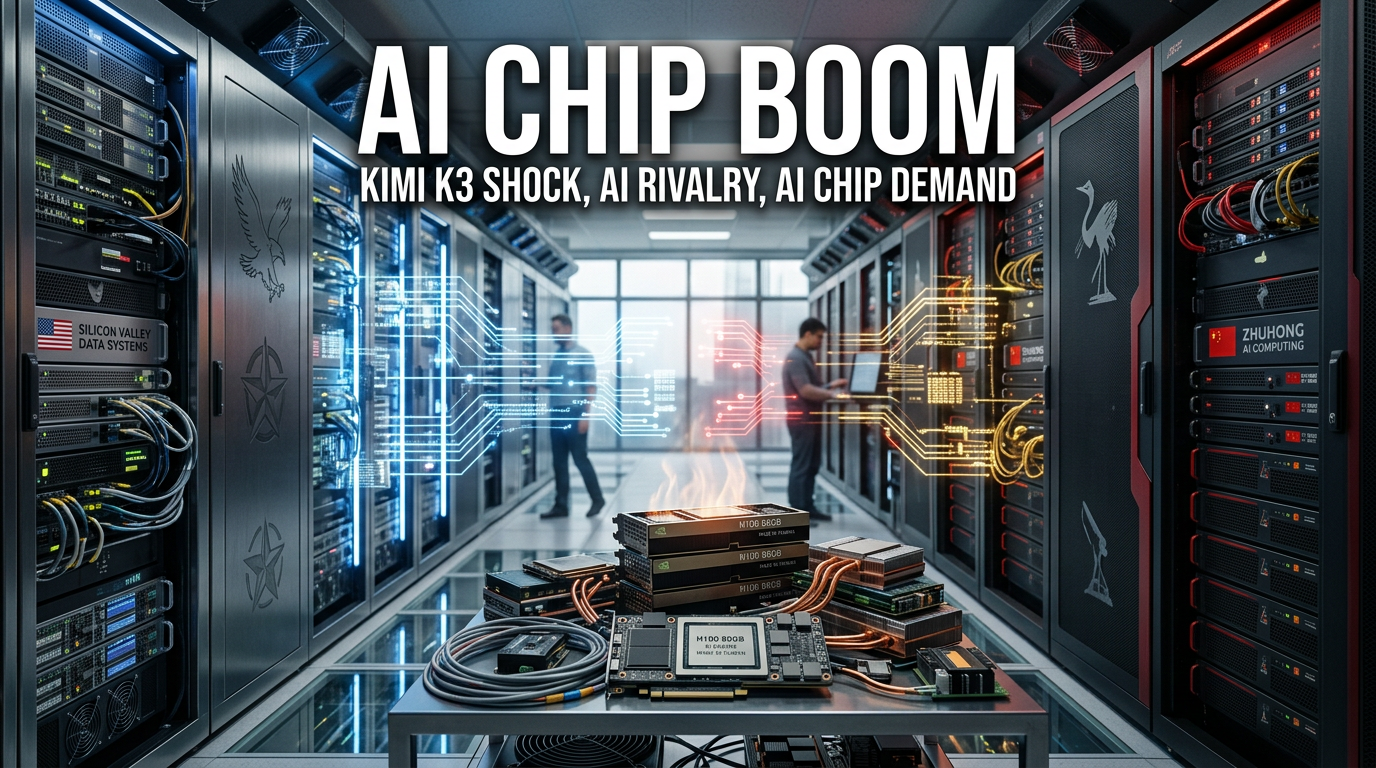
● Kimi K3 Shock Sparks AI Enterprise Shift and GPU Market Repricing
The Reason the U.S.-China AI Race Has Lost Its Gap: Why the ‘Kimi K3 Shock’ Is Shaking Corporate AI Strategy and the Semiconductor Market
The core point you must look at in this article comes down to just three things.
First, China’s Moonshot AI Kimi K3 has gone beyond being simply a “cheap and decent model” and has become an agentic AI model that enterprises can actually deploy in real work.
Second, the center of AI competition is shifting from “who built the smarter model” to “how stably, how cheaply, and with what ROI can enterprises use it.”
Third, Chinese models like Kimi K3 may actually have a positive effect on U.S. hyperscalers and demand for Korean AI semiconductors.
On the surface, it may look like news that Chinese AI has caught up with U.S. AI, but the real core lies in the commoditization of AI models, control over cloud infrastructure, changes in enterprise digital transformation costs, and shifts in the demand structure of the semiconductor market.
1. What Is Kimi K3: The Shock Chinese AI Has Delivered Again After DeepSeek
Kimi K3, unveiled by Chinese startup Moonshot AI, is being evaluated as the model that once again shook the global AI market after DeepSeek.
If DeepSeek delivered the shock that “China can also build AI close to U.S. levels at low cost,” Kimi K3 went one step further and delivered the message that “Chinese AI has also reached a quality level that enterprises can use right away.”
In particular, Kimi K3 is mentioned as a model with strengths not so much in a general chatbot, but in agentic AI, coding, work automation, and enterprise AI workflows.
Agentic AI refers to AI that does not merely answer questions, but understands goals and independently carries out multiple steps to complete work.
For example, AI can sequentially handle tasks such as report writing, code editing, data analysis, email sorting, schedule coordination, customer support, and integration with internal systems.
For enterprises, this kind of agentic AI is far more important than a simple conversational AI.
That is because the purpose of AI adoption is no longer “just letting employees try it once,” but linking it to actual improvements in corporate productivity, cost reduction, revenue growth, and work automation.
2. The Difference Between the DeepSeek Shock and the Kimi K3 Shock
The DeepSeek shock was mainly a cost shock.
While U.S. big tech poured massive amounts of GPUs and capital into AI model development, the fact that China’s DeepSeek achieved similar performance at a far lower cost stunned the market.
By contrast, the Kimi K3 shock is closer to a shock in enterprise usability.
Kimi K3 is not simply about being “cheap.”
What matters is that it delivers performance close to Anthropic’s high-performance models in certain areas, while remaining relatively low-priced and structured in a way that enterprises can fine-tune and use.
In other words, if DeepSeek showed that “Chinese AI can be built cheaply too,” Kimi K3 showed that “Chinese AI has reached a level stable enough for enterprises to use.”
- DeepSeek: low-cost high-performance development shock
- Kimi K3: shock over the viability of enterprise agentic AI
- DeepSeek: a signal that the gap with U.S. AI is narrowing
- Kimi K3: a signal that it is competing on the same playing field as U.S. AI
3. Technical Features of Kimi K3: Open Weights, Ultra-Large Scale, and Room for Fine-Tuning
It is important that Kimi K3 is expected to be released in an open-weight format.
Open weights mean that the model’s weights are disclosed so that external companies or developers can download and use them.
However, this is not the same as fully open source.
Because the training data, algorithms, and full structure are not all disclosed, separate licensing agreements may be required for commercial use.
The parameter scale mentioned in the original text for Kimi K3 is around 2.8 trillion parameters.
This is not a size that ordinary enterprises can download onto internal servers and run easily.
Operating a model of this scale stably requires large data centers, high-performance GPUs, HBM, inference optimization technology, and experience running large-scale servers.
An interesting point is that Kimi K3 is interpreted as being distributed not as a 100% finished model, but with about 10% room left for fine-tuning.
This means enterprises can modify Kimi K3 to fit their own industries.
- Financial firms can fine-tune it for financial data analysis
- Law firms can fine-tune it for legal document review
- Manufacturers can fine-tune it for production process optimization
- Developers can further specialize it for coding agents
- Retail firms can use it for customer support and inventory forecasting
This structure is a strategy precisely aimed at the B2B market.
The direction is clearly to make money in the enterprise AI market rather than in consumer chatbots.
4. How Will Kimi K3 Make Money: A Licensing Strategy More Important Than Free Public Release
Even if Kimi K3 is released as open weights, that does not mean Moonshot AI is giving up revenue.
The key point is the enterprise license.
Ordinary users may be able to access the service for free or at low cost, but large corporations or cloud providers are likely to need a licensing agreement to operate it commercially at scale.
If DeepSeek adopted a relatively more open licensing strategy, Kimi K3 is closer to a path of generating revenue through enterprise contracts and operational support.
This strategy is quite realistic.
That is because an ultra-large AI model is not a business that ends simply because the model file exists.
Enterprise customers care more about stable APIs, security, data isolation, fault response, SLAs, fine-tuning support, and regulatory compliance than about the model itself.
In the end, Moonshot AI is likely to make money through enterprise operations know-how and licensing, even if it makes the model public.
5. Will Enterprises Use Kimi K3 a Lot: The Core Issue Is Stability and Error Rates, Not Just Price
If you think enterprises will always choose the cheapest LLM, you are reading the market incorrectly.
Enterprises prefer AI that makes fewer mistakes and is more stable over AI that is merely cheap.
If AI gives a wrong answer or writes code incorrectly, humans have to find and fix those errors again.
If the time developers and practitioners spend finding and fixing errors increases, then the point of using a cheap model disappears.
In enterprise operations especially, a single error can stop the entire process.
Just as a production line stops when power goes out in a semiconductor factory, once AI becomes core work infrastructure, AI failures also become corporate operational risks.
That is why enterprises do not only look at token prices.
They also look at accuracy, response speed, error rates, security, connection stability, long-term operating costs, and integration with business systems.
The reason Kimi K3 is drawing attention is not because it is simply a low-priced model, but because it offers quality close to high-performance models in certain areas while also having price competitiveness.
Simply put, it is closer to an AI that offers “luxury-car performance at a mid-size-car price” rather than a “super-low-cost AI at the price of a compact car.”
6. AI Model Competition Is Coming to an End: We Are Entering the Era of Routing and Operations
The most important message from the Kimi K3 shock is that AI models themselves are increasingly becoming commoditized.
Going forward, models such as GPT, Claude, Gemini, DeepSeek, Kimi, and GLM will continue competing, but enterprises will find it difficult to rely on just one model.
Enterprises need model routing capabilities that automatically select the most suitable model for each task.
For example, use the highest-end model for complex strategy reports, a mid-tier model for simple document summarization, and a cheaper model for repetitive customer support.
Only then can AI costs be controlled while maintaining performance.
In the future, the core of enterprise AI strategy will not be “which model do we use?” but “when, for what task, which model do we connect, and at what cost?”
In this process, companies specializing in model routing, inference operations, and AI infrastructure management are likely to grow significantly.
- Highly complex tasks: use top-tier LLMs
- Moderately complex tasks: use high-performance, mid-price models like Kimi K3
- Simple repetitive tasks: use low-cost models
- When failures occur: automatically switch to alternate models
- When costs exceed limits: route to cheaper models
This is a very important change in enterprise AI adoption.
Once AI becomes basic infrastructure like electricity, enterprises cannot rely on just one power plant.
Likewise, a strategy that depends on just one AI model can increase supply chain risk.
7. Why Hyperscalers Will Control the AI Model Supply Chain
Ultra-large models like Kimi K3 are difficult for just any company to operate directly.
Eventually, hyperscalers such as Microsoft, Amazon AWS, and Google Cloud are likely to become the key distribution channels.
Rather than connecting directly to Chinese servers to use Kimi K3, enterprises will likely prefer to use it in the form installed in U.S. or other countries’ cloud data centers.
This approach is far more advantageous in terms of security, regulation, data sovereignty, and network stability.
In fact, when enterprises use Claude, they often use it via AWS or Google Cloud rather than connecting to Anthropic directly.
OpenAI models are also strongly linked to Microsoft Azure.
In the end, in the AI economy, it is not only the model developers who matter, but also the cloud infrastructure providers that run the models stably and supply them to enterprises who gain even stronger positions.
In this structure, the AI model supply chain is reorganized around hyperscalers.
The true gateway to the enterprise AI market may be cloud providers rather than model developers.
8. Why Did the Semiconductor Market Shake: Two Signals Sent by Kimi K3
The reason the semiconductor market moved after the Kimi K3 announcement was that the memory of the DeepSeek shock was still fresh.
At the time of DeepSeek, the market worried that if AI models could be built with fewer GPUs, demand for Nvidia GPUs might decline.
When news spread that China had produced a high-performance AI model with Kimi K3 as well, semiconductor investment sentiment briefly weakened.
However, this shock did not last as long as it did with DeepSeek.
The market quickly absorbed it because there was a plausible interpretation that Kimi K3 could actually increase AI usage.
As AI models become cheaper and enterprises use them more, inference demand explodes.
When inference demand rises, demand for GPUs, HBM, data centers, and power infrastructure also rises.
In other words, Kimi K3 may create short-term uncertainty in the semiconductor market, but in the medium to long term it can become a factor that expands demand for AI semiconductors.
9. Why It Could Actually Be Good News for Korean Semiconductors
If a model like Kimi K3 runs on U.S. hyperscaler servers, a positive scenario opens up for Korean semiconductor companies as well.
As AI models become more diverse and cheaper, enterprises use AI more.
When enterprises use more AI, token usage rises.
When token usage rises, more inference servers are needed.
When inference servers increase, demand for GPUs and HBM also rises.
HBM is a field where Korean semiconductor companies have strengths.
In the end, the improvement of Chinese AI models should not necessarily be seen as a negative for Korea.
On the contrary, it can lower AI service prices, increase usage, and expand the overall semiconductor market.
The important thing is where the Chinese model is operated.
If it only runs in Chinese domestic data centers, the effect on Korean companies may be limited.
But if it runs on U.S. cloud infrastructure and global data centers, it is clearly positive for Korean memory semiconductors and HBM demand.
10. The Current State of Chinese AI: From Trailing the U.S. by Six Months to Competing on the Same Level
In the past, there was a strong perception that Chinese AI lagged significantly behind the U.S.
When DeepSeek appeared, the market thought, “China has caught up by about six months.”
But after Kimi K3, the view is now emerging that “they are competing almost on the same level.”
Of course, the United States still holds a strong advantage in the AI ecosystem, cutting-edge GPUs, cloud infrastructure, and global customer base.
But in terms of model performance alone, it is clear that China has risen to a level where it can compete with U.S. models in certain areas.
In particular, China has not only Moonshot AI, but also many other AI players such as DeepSeek, Zhipu AI, Alibaba Qwen, Baidu, Tencent, ByteDance, and Xiaomi.
If these players keep competing, the pace of Chinese AI model development is likely to accelerate further.
The U.S.-China technology rivalry is no longer just a competition between nations; it has shifted into the question of which AI global companies actually use.
11. Enterprise AX Strategy Is Changing: From Quantitative Adoption to ROI Focus
Enterprise AI transformation, or AX strategy, is also changing.
In the past, “our company also adopted AI” was what mattered.
But now, “how much value did AI create, and how do we measure that result?” has become more important.
In other words, the key metric for AI adoption is shifting from usage to ROI.
What matters more than using AI a lot is whether AI increased revenue, reduced costs, improved employee productivity, or raised customer satisfaction.
Models like Kimi K3 can play an important role in this trend.
If they are cheaper than high-performance models yet still sufficiently usable for work, they can reduce the burden of AI investment and increase AI ROI for enterprises.
Going forward, companies are likely to operate AI not as a single purchase, but as a portfolio by task.
- Top-tier models used for strategy, development, and complex analysis
- Mid-tier high-performance models used for repetitive but quality-critical tasks
- Low-cost models used for simple summarization, classification, and drafting
- Open-weight models used for industry-specific fine-tuning
- Model routing systems used to optimize both cost and performance
12. The Most Important Point That Other YouTube Channels or News Outlets Rarely Explain
The most important point in this Kimi K3 shock is not that “China caught up with the U.S.”
The truly important point is that power over AI models is moving from model developers to operating infrastructure providers.
In the future AI market, the place making the most stable money may not be the company that simply builds the best models.
Instead, hyperscalers, inference infrastructure companies, and model routing companies that help enterprises safely use multiple models may have stronger profitability.
AI models are increasing in number, and performance gaps are narrowing.
Then enterprises care more about stable operations, cost optimization, security, failure response, and data integration than the name of a particular model.
At that point, cloud providers become the gateway for all models.
This is why Microsoft, AWS, and Google continue to hold strong positions in the AI ecosystem.
And this trend has important implications for Korean companies as well.
Growing a domestic foundational model is necessary from a national strategy standpoint.
But if companies like Samsung Electronics, Hyundai Motor, Naver, financial firms, and manufacturers want to win in global competition, they need to use the best-performing models and the most efficient infrastructure available right now.
Nurturing domestic models and securing AI competitiveness in the corporate field are not the same issue.
Policy must grow the domestic AI ecosystem, while enterprises must use the best global AI combinations to increase productivity.
If these two things are confused, AI industry strategy can become unstable.
13. How Will AI Companies’ Competitive Strategy Change Going Forward
AI companies such as OpenAI, Anthropic, and Google may find it difficult to differentiate themselves through model performance alone.
As Chinese models catch up quickly and open-weight models proliferate, the scarcity of high-performance LLMs themselves decreases.
So AI companies are likely to move toward higher-level services.
For example, they may expand beyond simple chatbots into enterprise SaaS, digital workers, team intelligence, and internal work automation platforms.
Claude strengthening coding and work-agent capabilities, and OpenAI expanding enterprise workflows and agent ecosystems, are part of the same trend.
The revenue model of AI companies is likely to evolve in the following directions.
- Sale of high-performance model APIs
- Enterprise AI agent services
- Industry-specific AI solutions
- AI platforms linked to internal enterprise data
- Work automation SaaS
- Digital worker subscription models
In the end, the AI industry is shifting from model competition to work penetration competition.
What matters more than who built the smarter model is who can go deeper into actual enterprise work.
14. The AI Adoption Strategy Enterprises Should Prepare Right Now
After the Kimi K3 shock, the direction enterprises should prepare for is clear.
First, they should not rely on just one AI model.
Second, they must create an internal evaluation system that compares the performance and cost of different models.
Third, they should prepare an alternative model routing strategy to handle failures or regulatory risks.
Fourth, AI costs should be calculated by task-level ROI, not by token unit price.
Fifth, AI should be expanded on the premise of security and data governance.
Going forward, an enterprise’s AI competitiveness is likely to be determined not by “did we contract a good model?” but by “did we build a system to operate AI?”
- Establish a model portfolio strategy
- Create performance evaluation standards by task
- Build a token cost management system
- Secure a model failure response plan
- Design a structure linking internal data with AI
- Review security, regulatory, and licensing risks
- Introduce AI ROI measurement indicators
15. Key Points from an Investment Perspective
From an investment perspective, Kimi K3 should not be seen simply as bad news for Nvidia.
On the contrary, rising AI usage can increase demand for semiconductors, data centers, cloud infrastructure, power equipment, and HBM.
That said, in the short term, AI investment sentiment may weaken because of concerns that high-performance models can be developed at lower cost.
But in the medium to long term, the important issue is inference demand rather than training demand.
Once AI enters enterprise work in earnest, AI will be called every day, every hour, by every employee and every system.
The inference demand created at that point will be enormous.
Accordingly, the key investment points in the AI market may shift as follows.
- Attention shifts from AI training infrastructure to AI inference infrastructure
- Demand rises not only for GPUs, but also for HBM, networking, and power infrastructure
- Hyperscalers’ dominance over the AI supply chain strengthens
- Model routing and inference optimization companies grow
- The enterprise AI ROI solutions market expands
From the perspective of the global economy, AI is no longer just a technology trend; it has become a key variable that moves productivity, capital expenditure, cloud spending, and the semiconductor cycle all at once.
< Summary >
Kimi K3 is an agentic AI-specialized model released by China’s Moonshot AI.
If DeepSeek was a shock over low-cost development, Kimi K3 is closer to a shock over enterprise AI usability.
Kimi K3 is 평가 as offering price competitiveness while showing performance comparable to U.S. high-performance models in certain areas.
Going forward, enterprises need a model routing strategy that combines multiple models by task rather than relying on just one model.
AI models are becoming increasingly commoditized, and the real competitive edge is likely to come from cloud infrastructure, inference operations, security, stability, and cost optimization.
Kimi K3 may shake the semiconductor market in the short term, but in the medium to long term it could increase AI usage and positively affect HBM and data center demand.
For Korea, the growth of Chinese AI should not be seen only as a threat; the opportunity lies in expanding global AI usage and increasing semiconductor demand.
[Related Articles…]
- AI Semiconductor Market Outlook and HBM Demand Shifts
- Enterprise AX Strategy and AI ROI Measurement Methods
*Source: [ 티타임즈TV ]
– 수준차 사라진 미중 AI, ‘키미 쇼크’ 후폭풍은? (강정수 박사)