● Rate Shock, AI Boom, Short Squeeze, Tesla Risk
Key Variables in U.S. Equities: 10-Year Yield, AI Capex, Semiconductor Short Interest, and Tesla Robotaxi Risk
The key issue in the current market is not simply whether stocks are up or down, but why only certain names are advancing, why small-cap stocks continue to lag, and why capital is concentrated in semiconductors and large-cap technology.
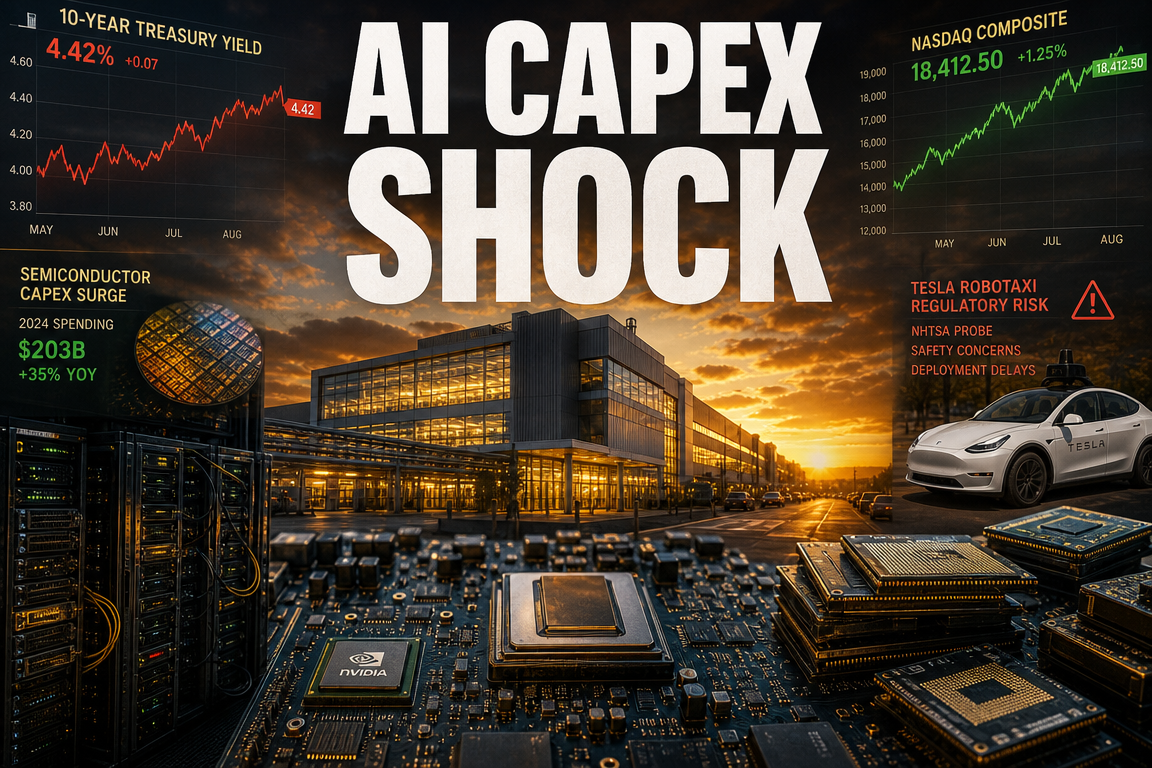
At present, the market is being shaped by the 10-year Treasury yield, inflation, oil, gold, AI capital expenditure, short selling, and Tesla’s robotaxi regulatory risk.
Although the market may appear to be undergoing a routine correction, capital concentration and stock-by-stock dispersion are intensifying within U.S. equities.
This report summarizes the latest developments involving SK Hynix, Samsung Electronics, Tesla, Micron, and SpaceX, and outlines how to interpret the Nasdaq trend.
It also highlights two points that are often underemphasized in other reports and media coverage:
Short selling is not inherently negative; it is a market mechanism that tends to follow stocks that have risen rapidly. Gold should no longer be viewed as an automatic safe haven.
1. The 10-Year Treasury Yield Is the Most Important Variable in U.S. Equities
The first indicator to monitor is the U.S. 10-year Treasury yield.
In the original context, the yield rising toward the 4.7% range was identified as the primary market headwind.
Previously, even the 4.5% level was viewed as a point of concern. The fact that yields have moved above that level is therefore significant.
-
Higher 10-year yields increase pressure on growth stocks and small-cap stocks.
-
Large-cap technology companies can absorb the impact more effectively, while firms with weaker funding capacity face greater strain.
-
As yields rise, the market tends to shift from broad participation to stock-specific dispersion.
This does not mean that higher yields automatically trigger a market crash.
Rather, elevated yields tend to create a more fragile environment in which individual stocks respond differently.
Even when the Nasdaq rises overall, capital may flow mainly into a small group of leaders such as Nvidia, Micron, Meta, and AMD.
By contrast, small-cap stocks may struggle to sustain rebounds.
This is commonly described as a concentrated market, a liquidity-driven market, or a dispersion-driven market.
In a healthy uptrend, large-cap technology usually leads first, followed by rotation into small-cap and mid-cap names.
However, in a higher-rate environment, capital often remains concentrated in large-cap technology and semiconductors.
2. “Caution” Does Not Necessarily Mean a Crash; It May Indicate Sideways Trading
A key point in the original text is that the phrase “exercise caution” should not be interpreted as a forecast of an immediate decline.
Markets are not limited to upward or downward moves; they also move sideways.
In particular, small-cap stocks often do not collapse abruptly when rates rise, but instead move sideways for an extended period, testing investor sentiment.
-
Caution does not necessarily mean a crash.
-
Caution can indicate a volatile phase in which gains, losses, and consolidation coexist.
-
In a sideways market, temporary declines should not be assumed to mark the end of the trend.
This is one of the most common points of confusion among retail investors.
When someone says to remain cautious, many interpret it as a signal that a sharp decline is imminent.
In practice, however, the message is usually that the market may be entering a phase in which aggressive chasing is less appropriate and direction should be confirmed first.
In U.S. equities, the focus should be on response rather than prediction.
The objective is not to be right in every instance, but to reduce risk in higher-probability setups.
3. Oil at Current Levels Is Not Yet a Market-Wide Panic Signal
Oil is among the first assets to react to war, geopolitical risk, and Middle East developments.
In the original analysis, oil moving into the $85 to $90 range was viewed as a burden, but not yet severe enough to destabilize the broader market.
The key question is how far oil continues to rise.
-
The $70 to $85 range is generally considered manageable for the market.
-
Above $90, inflation concerns may begin to re-emerge.
-
A rapid move above $100 could become a meaningful headwind for equities.
Low oil prices are not always positive.
A sharp decline in oil can raise recession concerns.
Conversely, excessively high oil prices can reignite inflation and weaken expectations for Federal Reserve rate cuts.
What the market prefers is a stable range that is neither too high nor too low.
At present, the more important issue is whether oil can break decisively above $100.
4. Gold Should No Longer Be Treated as an Automatic Safe Haven
When market uncertainty rises, investors often turn to gold.
However, the original text argues that gold should no longer be regarded as a guaranteed safe-haven asset.
In the past, gold benefited strongly during war, financial crises, and periods of currency distrust.
Today, most investors access gold through ETFs, gold-related equities, or futures rather than physical bullion.
As a result, gold prices are still influenced by sentiment and liquidity.
-
Gold does not always rise during periods of stress.
-
In a higher-rate environment, the appeal of the dollar and Treasuries can pressure gold.
-
Even during war or recession, investors may sell gold to raise cash.
-
Gold should be viewed as an asset shaped by inflation, currency value, central bank buying, and market psychology.
It is also important not to oversimplify the relationship between rates and gold.
Gold is influenced simultaneously by yields, the dollar, inflation, war risk, central bank demand, and sentiment.
For that reason, gold investing requires cycle awareness rather than a fixed rule.
The original text noted that gold can generate returns in the right environment, but mistiming the cycle can lead to prolonged drawdowns.
5. In the AI Era, Cash Flow and Capital Expenditure Matter More Than PER
In the current earnings season, the common theme across Google, Tesla, and Intel is AI-related capital expenditure.
Google continues to expand investment in AI infrastructure.
Tesla must continue investing in robotaxis, autonomous driving, and AI-related infrastructure.
Intel also requires substantial investment to compete in semiconductor manufacturing and foundry services.
For investors, the key issue is no longer only EPS or revenue growth.
Cash flow, especially free cash flow, has become critical.
-
AI companies will need to sustain large capital expenditures.
-
Higher capex can weaken cash flow in the short term.
-
The market is increasingly focused on whether a company can absorb investment spending.
-
If cash flow deteriorates, the stock may re-rate even when earnings remain acceptable.
In the past, investors often relied primarily on PER, PBR, and EPS.
However, AI semiconductor and large-cap technology companies require massive investments in data centers, GPUs, power infrastructure, and cloud capacity.
As a result, the question is no longer only how much a company earns, but how well it can fund its investment cycle.
This is one reason why stocks such as Google or Tesla can come under pressure even when headline results are not weak.
The AI growth narrative remains intact, but the market is now evaluating growth alongside investment burden and cash generation.
6. The AI Bubble Debate Remains Unresolved
Opinions on the AI bubble debate remain divided on Wall Street.
Some argue that AI-related stocks have risen too far, too fast.
Others believe that hyperscaler spending is unlikely to slow materially and that the AI infrastructure cycle may continue.
The key point is that expert opinion remains split.
In other words, this is a market that requires response rather than certainty.
-
If AI capex continues, semiconductor companies such as Nvidia, AMD, Micron, and SK Hynix should benefit.
-
However, if investment spending becomes excessive, companies such as Google, Meta, and Tesla may face cash flow pressure.
-
The more important issue than whether AI is a bubble is the speed of monetization.
AI is not a short-term theme; it is a structural industry shift.
At the same time, not every AI-related stock will continue rising.
Over time, the market is likely to distinguish between companies supplying AI infrastructure, companies using AI to reduce costs, and companies whose AI spending weighs on cash flow.
7. Rising Short Interest in Semiconductors Is Not Automatically Negative
When news emerges that short interest in Micron or broader semiconductor names has increased, many investors become concerned.
However, the original text emphasizes that short selling should be interpreted differently.
Short selling is not attached only when a company is expected to fail.
It also tends to follow stocks that have risen sharply in a short period.
This is especially true for semiconductor names such as Micron, Nvidia, AMD, and SK Hynix, which have benefited from the AI cycle and strong stock performance.
-
Rising short interest can reflect a stock’s recent acceleration.
-
Short sellers often act on sentiment, overheating, and valuation pressure.
-
High short interest does not necessarily imply a decline.
-
Even after a short squeeze, new short positions can emerge.
Short selling is best understood as a normal market mechanism rather than a special signal.
Stocks that have risen significantly and attracted intense attention are more likely to draw short interest.
When evaluating short-selling headlines, investors should distinguish between structural business deterioration and short interest caused primarily by rapid price appreciation.
This distinction is particularly important in semiconductors.
8. The SpaceX Short-Selling Debate Should Be Viewed Through the Same Lens
The original text also referenced Elon Musk’s comments regarding short sellers.
The same framework applies here.
When a high-growth company such as SpaceX attracts strong attention, short sellers naturally follow.
This is not unusual when market expectations are elevated and prices have moved sharply higher in a short time.
Criticism of short sellers does not eliminate them.
In fact, after a sharp rally or a short squeeze, short sellers may re-enter the name.
Short selling follows profit opportunities, not emotions.
Investors should focus less on short interest alone and more on valuation, earnings visibility, liquidity, and market sentiment.
9. Tesla Robotaxis: Regulation May Matter More Than Technology
Tesla robotaxis represent a major long-term growth opportunity.
However, the original text argues that their expansion will not be determined by technology alone.
Labor unions, Uber and Lyft drivers, local politics, and regulatory issues may become more important constraints.
Waymo’s autonomous taxi service has already faced resistance from drivers and regulatory barriers as it expands region by region.
-
For robotaxis, local approval and political interests may matter more than the technology itself.
-
Taxi unions and drivers may resist due to concerns over income and job displacement.
-
State and city governments, along with local policymakers, can influence the pace of expansion.
-
When Tesla stock rallies sharply on robotaxi expectations, risk management becomes essential.
Tesla’s autonomous driving capability remains a major market focus.
However, commercial deployment is not determined by technology alone.
Insurance, liability, licensing, local regulation, and labor resistance are all relevant factors.
Robotaxis remain a long-term growth catalyst, but they should not be treated as a guaranteed short-term driver of the stock.
10. The Nasdaq’s Key Support Level Is a Useful Gauge of Market Sentiment
The original text placed significant emphasis on a specific Nasdaq level.
The central point is that investors should track the broad index, not only individual stocks.
All names discussed here, including Tesla, Micron, semiconductors, and SpaceX-related themes, are ultimately linked to overall market sentiment.
In the original context, the 28,200 area was highlighted as an important reference point for the Nasdaq.
Such support levels are not precise forecasts, but psychologically important zones where market participants may react.
-
If the Nasdaq holds above a key support area, rebound expectations in growth stocks may improve.
-
If support is broken, caution may increase and buying interest could weaken.
-
Monitoring the index before individual stocks can help reduce risk.
Monitoring price levels is not simply a charting exercise.
It is a way to assess where buyers are likely to step in, where fear may emerge, and where expectations for a rebound may form.
In a volatile U.S. equity market, Nasdaq direction can serve as a reference point for growth-stock positioning.
11. Tesla and Google Are Currently a Matter of Confirmation, Not Cheapness
Tesla and Google remain structurally strong companies.
However, the original text places both in a short-term watch-and-wait category.
Tesla is affected by earnings, margins, capex, robotaxi expectations, and regulatory risk at the same time.
Google benefits from AI investment and cloud strength, but capex pressure may affect valuation in the short term.
-
Tesla should not be viewed as an automatic buy simply because it has declined.
-
Google’s AI investment is positive over the long term, but short-term cash flow should be monitored.
-
At present, it is more important to confirm the quality of any rebound and the broader market tone.
Strong companies and good entry points are not the same thing.
Tesla and Google may be high-quality companies, but even strong names can remain under pressure in a fragile market.
For that reason, investors should focus less on whether the stock is “cheap” and more on where buying interest begins to appear.
12. Samsung Electronics and SK Hynix Remain Important in the AI Semiconductor Cycle
The original text also referenced Samsung Electronics and SK Hynix.
Within the AI semiconductor cycle, Korean chipmakers cannot be separated from U.S. semiconductor trends.
SK Hynix remains a major focus for global investors due to HBM demand and its exposure to Nvidia’s supply chain.
For Samsung Electronics, the key issues are memory market recovery, foundry competitiveness, and whether it can strengthen its HBM position.
-
SK Hynix is driven by AI memory demand and HBM competitiveness.
-
Samsung Electronics depends on memory recovery and its ability to re-establish itself in the AI supply chain.
-
Micron, Nvidia, and AMD trends also affect sentiment toward Korean semiconductor names.
When evaluating Korean semiconductors, investors should look beyond a single earnings release.
U.S. 10-year yields, the dollar, the Nasdaq, AI capex, Micron’s stock performance, and Nvidia’s demand outlook should all be considered together.
Semiconductors are influenced by both the industry cycle and market liquidity.
13. S&P 500 E-Mini Futures and Nasdaq Futures Are Useful for Pre-Market Sentiment
The original text also mentioned a way to monitor the S&P 500 E-mini futures chart.
For U.S. equity investors, it is useful to check S&P 500 futures and Nasdaq futures before the market opens.
-
S&P 500 futures help assess the overall tone of the U.S. market.
-
Nasdaq futures are useful for gauging sentiment toward large-cap technology and growth stocks.
-
Platforms such as TD, TradingView, and MarketWatch provide access to futures data.
However, futures should not be used to determine the market direction in isolation.
They are best viewed as a pre-market reference point.
During the session, Treasury yields, the dollar, oil, major news flow, and institutional positioning can all alter the direction.
Key Points Often Underemphasized in Other Coverage
First, short selling is not inherently negative.
Short interest does not appear only when a company is weak; it also tends to follow sharp price gains.
In names such as Micron, Nvidia, and SpaceX-related themes, rising attention naturally attracts short sellers.
Rather than reacting to short-interest data alone, investors should understand why short positions are being added.
Second, gold is no longer a fully reliable safe haven.
The assumption that gold should always be bought in periods of stress is weaker than it once was.
In many situations, investors sell gold alongside other assets in order to raise cash.
Gold should be viewed as an asset shaped by rates, the dollar, inflation, central bank buying, and sentiment.
Third, in the AI era, cash flow matters more than PER.
Companies such as Google, Tesla, Intel, and Meta must continue funding AI-related capital expenditures.
Even strong growth stories can come under pressure if cash flow weakens.
Investors should evaluate revenue growth together with capex and free cash flow.
Fourth, robotaxis may be constrained more by regulation than by technology.
Tesla’s robotaxi strategy must overcome local regulation, labor opposition, insurance issues, and liability concerns.
Expectations alone should not be used as a valuation anchor.
Fifth, the market is currently characterized more by dispersion than by a broad selloff.
This is not a market in which all stocks decline together. Strong names are holding up while weaker ones continue to underperform.
In this environment, stock selection becomes more important.
Large-cap technology, semiconductors, and AI infrastructure names may behave differently from small-cap growth stocks.
Investor Checklist
-
U.S. 10-year yield: Above 4.5% may continue to pressure growth and small-cap stocks.
-
Nasdaq support: Confirm whether the index is holding key support levels.
-
Oil: Above $90 may increase concern; a move through $100 would signal rising inflation risk.
-
Dollar and gold: Gold should be evaluated together with dollar trends, not treated as a standalone safe haven.
-
AI capex: Monitor changes in free cash flow at Google, Tesla, Meta, and Intel.
-
Semiconductor short interest: Distinguish between structural weakness and price-driven short positioning.
-
Tesla robotaxi: Regulation and commercialization speed matter more than narrative momentum.
-
Samsung Electronics and SK Hynix: Monitor U.S. semiconductor trends and HBM demand.
< Summary >
The most important variable in U.S. equities is the 10-year Treasury yield.
When yields rise, the market is more likely to shift from broad participation to dispersion centered on large-cap technology and semiconductors.
Oil remains manageable around $90, but a decisive move above $100 would heighten inflation risk.
Gold should no longer be treated as an automatic safe haven; it must be analyzed alongside rates, the dollar, inflation, and sentiment.
In the AI era, cash flow and capital expenditure matter more than PER.
Rising short interest in Micron and other semiconductor names is not necessarily negative; it may reflect a normal market response to strong price performance.
Tesla’s robotaxi thesis is likely to be constrained more by regulation and local political dynamics than by technology alone.
Samsung Electronics and SK Hynix should be assessed within the broader AI semiconductor cycle, together with Nvidia, Micron, and AMD.
At present, the market requires caution and active response rather than certainty.
[Related Articles…]
*Source: [ 미국주식은 훌륭하다-미국주식대장 ]
– 평생 후회할 수도 있습니다. SK 하이닉스 삼성전자 테슬라 마이크론 스페이스X