● Tesla-Crash-AI-Panic
Tesla Stock’s Sharp Decline: The Key Issue Is Not the Earnings Miss, but the Pace of Physical AI Execution
The key point in Tesla’s recent selloff is not simply revenue, margin, or an earnings miss.
The market is now valuing Tesla less as a carmaker and more as an AI company, while demanding clearer evidence on how quickly Robotaxi and Optimus can become monetized.
In particular, Dan Ives argued that the substance of Tesla’s -14.52% decline was not that earnings were weak, but that the timing of returns on heavy AI investment remains unclear.
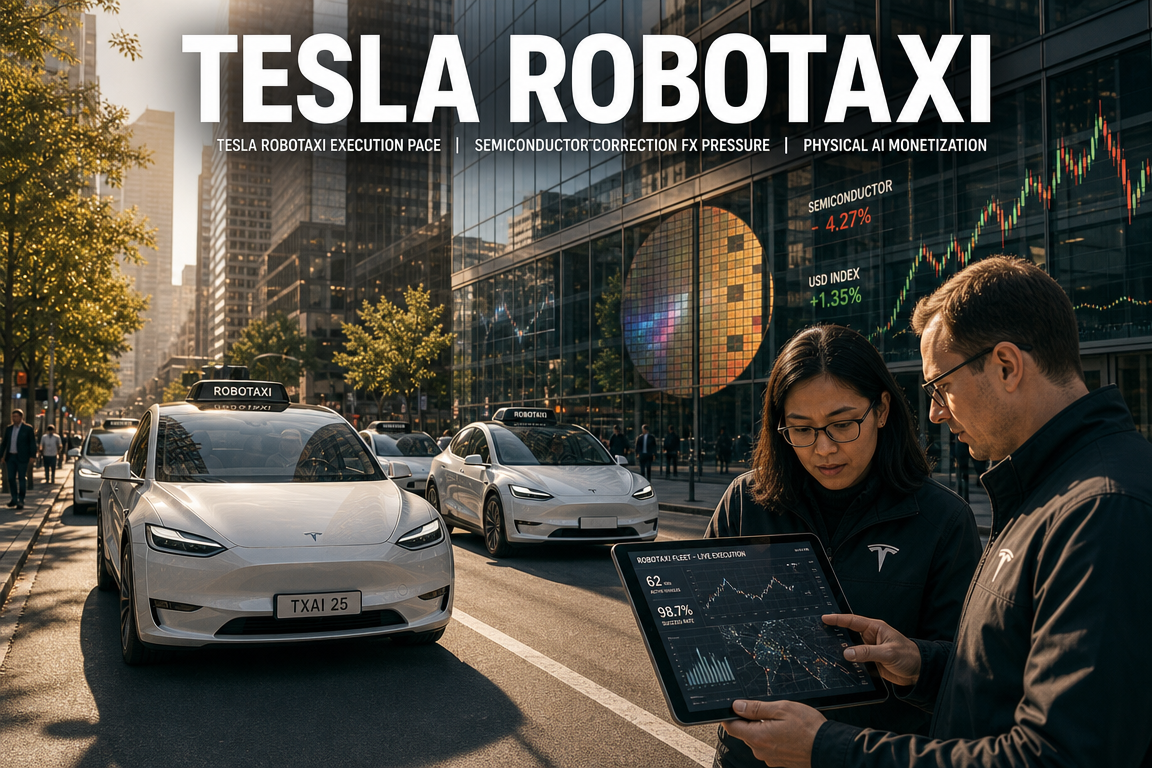
For investors holding Tesla shares near $313, the more important metric is not the near-term stock price, but how quickly the 175 Texas Robotaxi-registered vehicles can transition into actual driverless operations.
This report connects the post-earnings Tesla selloff, Dan Ives’ commentary, U.S. interest rate outlook, the AI investment cycle, Robotaxi expansion pace, and SpaceX Starship testing.
1. Last Week’s Tesla Selloff: Market Reaction Matters More Than the Numbers
Tesla shares fell approximately 17.81% over the past week, based on the source text.
The sharpest decline was concentrated on the day after earnings, with trading volume rising to roughly 2x to 3x normal levels.
This suggests position adjustments by institutions and short-term traders, rather than only retail selling.
The market reacted more strongly to margin pressure than to the fact that revenue came in better than expected.
In other words, profitability per unit mattered more than sales volume.
This also explains why Tesla continues to face valuation concerns.
Tesla is no longer a company that can be explained by traditional auto industry multiples.
Investors therefore focus more on the commercialization pace of autonomous driving, Robotaxi, Optimus, and the AI platform than on vehicle deliveries alone.
2. The Real Reason Behind Dan Ives’ View of the -14.52% Drop
Dan Ives, a long-time Tesla analyst on Wall Street, did not interpret the decline as a simple automotive earnings issue.
He described Tesla as closer to a disruptive AI technology company than a traditional car company.
The challenge is that Tesla is being valued as an AI company, yet it has not sufficiently demonstrated a clear return path on that AI investment.
The core of Ives’ argument is as follows.
- Tesla is allocating substantial capital to physical AI initiatives such as autonomous driving and Optimus.
- Near-term revenue contribution remains limited.
- Investor patience is becoming thinner.
- Robotaxi and physical AI now need to be validated through actual numbers.
The critical phrase is that patience is running low.
This does not mean the market has rejected Tesla’s long-term vision.
It does mean that the market now requires more than a narrative of future potential.
In the current AI investment cycle, Tesla shares are becoming harder to support on expectations alone.
3. Why Alphabet Held Up While Tesla Weakened: The Difference Is in the Return Path
Ives also compared Alphabet and Tesla.
Both companies are increasing AI infrastructure and capital expenditure.
However, the market response has been different.
Alphabet has a clear monetization path through Google Cloud.
AI spending can be justified by cloud revenue growth, enterprise demand, and improvements in advertising efficiency.
Tesla, by contrast, relies on Robotaxi and Optimus as its main return channels.
The issue is that both businesses are still far from being large-scale revenue contributors.
| Category | Alphabet | Tesla |
|---|---|---|
| AI Investment Areas | Cloud, search, advertising, data centers | Autonomous driving, Robotaxi, Optimus, physical AI |
| Return Structure | Visible through Google Cloud and advertising | Requires Robotaxi commercialization and Optimus scale-up |
| Investor Confidence | Cash flow can be verified in existing businesses | Execution speed in future businesses is critical |
In short, the market message is not that AI is being rejected, but that investors want evidence of how quickly AI can be converted into earnings.
4. This Week’s Market Variable: The Fed’s Tone Matters More Than the Rate Decision
Based on the source text, the U.S. Federal Reserve is scheduled to announce its policy decision this week.
The market expects the policy rate to remain at around 3.75%.
The key issue is not the hold itself, which is already largely priced in.
The real variable is whether the Fed places greater emphasis on inflation or growth.
- If the Fed maintains a strong anti-inflation stance, growth and technology stocks could face pressure.
- If it emphasizes slower growth and economic support, U.S. equities could benefit in the short term.
- Tesla, as a high-valuation growth stock, is especially sensitive to changes in rate expectations.
Tesla investors should therefore track not only company-specific developments, but also U.S. rate expectations.
AI investment, EV demand, and autonomous driving commercialization are all linked to the cost of capital.
5. Musk’s More Cautious Earnings Call: Why the Market Was Disappointed
Elon Musk sounded more cautious in the latest earnings call than in previous periods.
He continued to present a long-term vision, but spoke more carefully about Robotaxi expansion and full driverless operation.
For investors, that caution can be interpreted in two ways.
Positively, it reflects a realistic approach to safety and regulatory risk.
Negatively, it suggests that Robotaxi commercialization may take longer than the market expected.
Ives also highlighted this point.
Musk’s caution may be rational, but it contributed to the stock reaction.
Tesla’s short-term weakness reflects the fact that investors did not hear a sufficiently aggressive expansion plan in the earnings call.
6. Why Robotaxi Matters More Than Semi Truck Autonomy Right Now
Musk said on the earnings call that Semi Truck autonomy could arrive by the end of this year or early next year.
However, Tesla appears to be prioritizing autonomous-driving resources toward Model 3, Model Y, Cybercab, and Robotaxi.
Semi Truck may remain lower priority over the next six months because the number of vehicles on the road is still limited.
Semi Truck autonomy could eventually reshape logistics.
But Tesla’s most important near-term objective is Robotaxi commercialization.
That is because Tesla’s AI valuation is most strongly justified when the Robotaxi network is operational at scale.
The central question is whether Tesla can evolve from a vehicle seller into a vehicle-operating platform.
7. The 175 Texas Robotaxi Registrations: The Number That Matters
According to the source text, Tesla’s autonomous-driving registrations in Texas DMV data increased from 117 to 175 in one day, a gain of 58 vehicles.
The registration date was around July 15 U.S. time, roughly one week before the earnings call.
Notably, this pattern of registration increases before earnings has appeared previously in January and April as well.
However, registration counts and actual driverless operating vehicles are not the same.
Based on Robotaxi Tracker estimates, around 39 vehicles are reportedly operating without safety personnel in Austin and Dallas.
This is not a Tesla official figure and should be treated as an estimate.
Still, the direction for investors is clear.
- 175 vehicles represent registered potential capacity.
- 39 vehicles represent estimated actual driverless operation.
- The key issue is how many of the 175 registered vehicles transition into driverless service.
Waymo was described as operating around 677 vehicles in Texas, while Amazon’s Zoox was estimated at around 40.
Tesla’s 175 registered vehicles remain below Waymo’s level, but are difficult to dismiss relative to Zoox.
However, if Musk’s target of 1,000 Robotaxis by year-end is considered, the current pace is still below market expectations.
8. What Investors Near $313 Should Watch
For investors holding Tesla near $313, the key mistake is to focus only on daily price swings.
This decline reflects a conflict between short-term earnings disappointment and long-term AI expectations.
The evaluation framework should therefore be straightforward.
- First, track how many of the 175 registered Robotaxi vehicles transition into actual driverless operations.
- Second, monitor whether Robotaxi service expands beyond Austin and Dallas.
- Third, assess whether Optimus moves from demonstrations to internal productivity gains or external revenue.
- Fourth, check whether automotive margins stabilize or deteriorate further.
- Fifth, monitor whether the U.S. rate outlook becomes more supportive of growth-stock valuations.
Tesla will need more than the statement that it is an AI company.
It will need evidence that AI is already generating revenue.
The first such proof will likely come from the number of fully driverless Robotaxis in operation.
9. The Key Variable Most Coverage Misses: Conversion Rate, Not Registration Count
Many media reports focus on the 175 Robotaxi registrations themselves.
However, the more important metric is not registration count, but the conversion rate from registered vehicles to actual driverless operation.
For example, if 175 vehicles are registered but only about 39 operate without safety personnel, the market may still view the effort as experimental.
By contrast, if a significant share of the 175 vehicles moves into driverless service this quarter, Tesla’s physical AI narrative would become materially stronger.
This conversion rate is the most direct indicator of whether Tesla can move autonomous driving from a software demo to a real service.
In my view, the key KPI for this Tesla story is not vehicle deliveries, but the ratio of fully driverless vehicles to registered vehicles.
10. The Common Pattern Between SpaceX Starship Flight 13 and Tesla Robotaxi
Ives referred to Tesla and SpaceX as two of Musk’s core ventures.
The relevance of that comparison is that both companies validate technology in similar ways.
They do not aim for perfect success on the first attempt; instead, they test critical functions and move to the next stage.
According to the source text, SpaceX conducted its 13th Starship launch on July 24.
The first attempt on July 16 was automatically aborted due to an engine ignition issue, followed by an engine replacement and retry.
The purpose of the 13th launch was not a dramatic success, but a stress test of heat shield tile seams.
The upper stage successfully deployed 20 Starlink satellites and landed in the Indian Ocean without an explosion, allowing visual inspection of the heat shield.
However, the test was not flawless.
The booster achieved relight on 8 to 10 of 13 engines and ended with a hard landing, including some engine loss.
But the main point was data collection, not perfection.
SpaceX advances by reducing one problem at a time and increasing the difficulty of the next test.
Tesla’s Robotaxi program may follow a similar path.
Rather than scaling immediately to thousands of fully driverless vehicles, the more realistic path is to operate in limited cities, collect data, and expand gradually.
11. Starship Flight 14 and Tower Catch: A Symbol of Musk’s Scaling Model
Musk has mentioned a tower catch attempt for Starship itself in the next launch, Flight 14.
The booster catch has already been demonstrated several times, but catching a returning Starship at the tower is far more difficult.
If successful, it would be meaningful for reusability and for shortening turnaround times.
That would increase launch frequency and lower long-term transport costs.
However, exact timing remains uncertain because regulatory approval, including from the FAA, will be required.
This matters for Tesla investors because Musk’s companies generally follow the same pattern: impossible target, limited test, data collection, iterative improvement, and then scale-up.
Robotaxi is likely to evolve in the same way.
12. The AI Capital Expenditure Race: Only About 15% Complete
Ives compared the AI investment race to a military buildup.
He estimated that the current AI transformation is only about 15% complete.
His estimate for big tech AI spending was about $1.3 trillion.
Hyperscalers such as Alphabet, Microsoft, and Amazon continue to raise spending on data centers and AI infrastructure.
In the short term, higher capital expenditure can weigh on share prices.
But given enterprise AI demand, cloud usage growth, and rising demand for chips and memory, the trend is unlikely to reverse quickly.
Tesla’s distinction is that it is targeting physical AI rather than internet-based AI.
Its goal is to extend AI into vehicles, robots, logistics, and manufacturing operations.
That is why Tesla’s success could influence the broader direction of the AI industry in a different way than Nvidia or Alphabet.
13. Key Tesla Stock Watchpoints Ahead
Tesla’s near-term stock direction will likely depend on earnings, rates, sentiment, and AI expectations.
However, the following indicators matter more over the medium to long term.
- How many of the 175 Texas autonomous-driving registrations convert into actual driverless vehicles
- Whether expansion extends beyond Austin and Dallas
- Accident rates and regulatory approval pace for Robotaxi operations
- FSD improvement rates and reductions in intervention frequency
- Optimus deployment in factories and evidence of productivity gains
- Whether automotive margins remain resilient
- Whether AI investment continues to pressure cash flow
- Whether the U.S. rate outlook becomes more favorable for growth stocks
If Tesla is viewed only as an EV manufacturer, the valuation remains difficult to justify.
But if Robotaxi and Optimus move toward real monetization, the company could regain a premium that is difficult to explain under traditional auto-industry metrics.
If physical AI execution remains delayed, the stock could stay under pressure for longer.
14. Conclusion: Tesla Is Now in a Phase of Execution, Not Belief
This decline does not imply that the market has abandoned Tesla’s future.
It suggests the opposite.
The market still sees Tesla as an AI company, which is why it is demanding a higher standard of proof.
As Ives noted, Tesla is now a company that must prove Robotaxi, Optimus, and physical AI rather than vehicle deliveries alone.
Musk’s caution may be positive from a safety perspective, but investors may interpret it as concern over speed.
For investors near $313, the more important question is how quickly the 175 registered vehicles convert into actual driverless operations.
If that number rises, Tesla could be re-rated as an AI growth stock.
If registrations increase but driverless operations do not follow, market patience may continue to erode.
< Summary >
Tesla’s stock decline reflects concerns not only about earnings, but about the timing of returns on AI investment.
Dan Ives views Tesla as a physical AI company, but one that still lacks sufficient proof of Robotaxi and Optimus monetization.
Alphabet has a clear return channel through cloud services, while Tesla must rely on Robotaxi commercialization.
The more important metric is not the 175 Texas registrations, but how many vehicles transition into actual driverless service.
Investors near $313 should track Robotaxi conversion rates, geographic expansion, margins, and U.S. rate expectations.
Like SpaceX Starship testing, Tesla Robotaxi is likely to progress through staged validation.
Tesla is now in a phase of execution rather than belief.
[Related Articles…]
- Tesla Robotaxi Expansion and the Key Stock Drivers
- AI Spending Cycle and the Outlook for U.S. Mega-Cap Capital Expenditure
*Source: [ 오늘의 테슬라 뉴스 ]
– 머스크가 어닝콜에서 보인 신중함, 아이브스가 콕 짚은 -14.52%의 진짜 이유, $313 테슬라 주주는?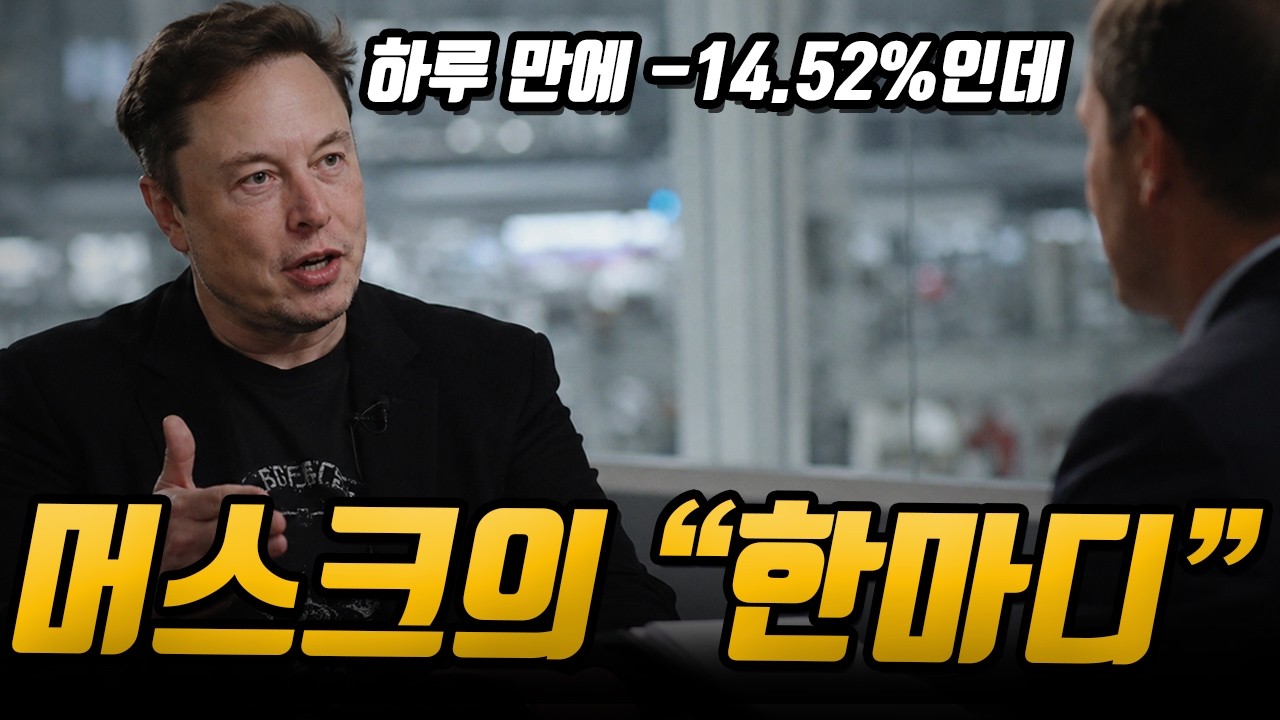
● Semiconductor Shock, FX Pain, Foreign Selloff Panic
The Real Selling Discipline for Super Investors: Investing Through Semiconductor Corrections, FX Pressure, and Foreign Net Selling
The key issue is not simply when to buy Samsung Electronics or SK Hynix.
The more important questions are why stocks can fall even after record earnings, how to distinguish a fear-driven market from a corrective one, and how individual investors can correct the most common mistakes in selling discipline.
This discussion brings together the background of the semiconductor correction, FX pressure, foreign net selling, changes in the AI investment cycle, growth-stock strategy, and a practical sell discipline built around keeping profits longer and cutting losses shorter.
Although the decline may appear to be driven by weaker-than-expected earnings, the actual backdrop is better understood as a complex correction shaped by US AI sector developments, geopolitical risk, a weaker won, foreign capital outflows, and overheated investor sentiment.
1. Is the market in panic, or is the euphoria phase ending in a correction?
Jeong Yun Lee said the market is not in a panic phase.
He also said it is not in a euphoria phase anymore.
His view is that the market has already moved past the euphoric stage and is now in a corrective phase after a rapid advance.
For investors, a decline of nearly 30% from the peak can naturally feel alarming.
If a portfolio falls from 100 million won to 80 million won, the situation can feel like a crisis.
However, in the broader market cycle, this is still not a true panic phase.
The reason is that semiconductor shares rose very sharply over a short period.
For example, SK Hynix moved from the 160,000 won range a year ago to around 290,000 to 300,000 won before entering a correction.
Samsung Electronics and SK Hynix should therefore be viewed as having entered a pause after a strong short-term advance, rather than as being at an obvious bottom.
Jeong Yun Lee said a true panic phase occurs when investors believe a bottom has formed, only to see prices fall further below that level.
In market terms, it is the stage where investors feel that there is a basement below the floor, then another level below that, and then something even lower.
At present, investors are not fully convinced that this is the final bottom, and there remains caution that the market could correct further.
The current phase is therefore better understood as a slowdown after overheating rather than as extreme panic.
2. Why stocks fell despite record earnings
One of the most frustrating questions for investors is simple.
Why do stocks fall when earnings are strong?
This is especially difficult to understand in semiconductors, where expectations were high due to AI expansion, HBM demand, and data center investment.
However, stock prices are not driven by earnings alone.
Jeong Yun Lee emphasized that many variables act simultaneously on prices.
Three factors were highlighted as particularly important in this correction.
First, geopolitical uncertainty around the United States and Iran.
When geopolitical risk rises, global investors tend to reduce exposure to risk assets, and capital typically leaves emerging markets and high-volatility growth stocks first.
Second, the trend in US AI and semiconductor stocks.
When US AI companies weaken, the market quickly begins to question whether the AI investment cycle is slowing temporarily.
Korean semiconductor stocks are closely tied to US AI infrastructure spending, so weaker sentiment in US technology shares inevitably affects Samsung Electronics and SK Hynix.
Third, FX pressure.
The original discussion noted that the won-dollar exchange rate remained in the 1,530 to 1,540 range for an extended period, which created a meaningful burden.
When the exchange rate stays high for too long, foreign investors become more sensitive to currency losses.
Even if domestic stocks rise, currency weakness can reduce their final return in won terms.
In short, strong earnings are a clear positive, but stocks can still correct when FX pressure, geopolitical risk, foreign capital flows, and US AI sentiment move in the opposite direction.
3. How foreign net selling weighed on Samsung Electronics and SK Hynix
Foreign capital flows were one of the most important points in the discussion.
The original text noted that foreign investors had sold a substantial amount of Korean equities since the start of the year, and that large-scale selling continued after the volatility in May.
Domestic investors had high expectations for Samsung Electronics and SK Hynix, but foreign investors may have had lower expectations than the market assumed.
Samsung Electronics and SK Hynix account for a very large share of the Korean market.
When foreign investors sell Korean stocks in size, these two names naturally become major selling targets.
The original discussion also noted that foreign ownership had fallen by approximately 6 percentage points for Samsung Electronics and 4 percentage points for SK Hynix since the start of the year.
That scale of change represents a significant shift in supply and demand, not just short-term profit-taking.
As a result, even strong semiconductor earnings cannot lift share prices easily when foreign selling persists.
Individual investors often assume that good earnings should automatically lead to higher prices, but foreign investors also evaluate FX, global rates, US technology valuations, and geopolitical risk.
That difference explains the current correction in semiconductor stocks.
4. When everyone agrees, the market often moves the other way
A key line from the discussion was:
“When everyone agrees, market disagrees.”
This means that when the market becomes too convinced in one direction, prices can move the other way.
At the end of May and in June, sentiment was very strong.
ETF inflows, semiconductor target-price upgrades, AI investment expectations, and forecasts for further gains in the second half all appeared at the same time.
At that time, forecasts for higher index levels and more rapid gains in Samsung Electronics and SK Hynix were widely circulated.
Jeong Yun Lee viewed that period as the euphoric stage.
When investors begin to believe that the current pace can continue indefinitely, the market reflects excess optimism.
After such a phase, price correction or time correction becomes necessary.
The current correction is therefore closer to an adjustment to an overly fast advance than to a deterioration in earnings.
5. The market may need a time correction more than a price correction
Jeong Yun Lee emphasized that the market may need a time correction rather than further downside.
This point is important.
When stocks rise too quickly, investors become accustomed to that speed.
Investors who entered the market after April this year experienced very fast returns over two months.
For them, even a one-month pause or decline can feel severe.
He compared this to driving speed.
When a car slows from 120 km/h on the highway to 50 km/h in the city, the new speed is normal, but it can feel unusually slow.
Investor sentiment is similar now.
When investors mistakenly assume that stocks should rise every day, a normal correction can feel abnormal.
From a long-term perspective, however, a period of consolidation after a rapid advance helps restore market balance.
6. Why individual investors most often fail at selling
The core issue in this content is the sell discipline.
Individual investors usually know how to buy.
The problem is selling.
Many lack a clear standard for when to take profits, how to respond to losses, and how much upside to leave on the table.
Jeong Yun Lee divided investors into three broad types.
7. First type: investors who cannot sell at all
The first type consists of investors who struggle to sell under any circumstance.
These investors find it emotionally difficult to exit a position.
Even when they have gains, they ask whether they should wait for more upside, and when they face losses, they refuse to sell at a loss.
For this profile, forced short-term trading is unnecessary.
A buy-and-hold approach may be more suitable.
This does not mean holding any stock indefinitely.
It should be limited to companies with durable industry positions, sustainable earnings growth, and global competitiveness.
Investors who naturally find selling difficult may be better served by selecting strong companies and holding them over time rather than trading frequently.
8. Second type: investors who sell winners quickly and hold losers too long
The second type is the most common among retail investors.
They sell quickly after a 5% or 10% gain.
By contrast, they refuse to sell losing positions.
As a result, profitable positions are already gone while the remaining portfolio consists mostly of losses.
Jeong Yun Lee said this type likely represents 8 out of 10 individual investors.
He also criticized common market slogans.
“Taking profit is always right.”
“An unrealized loss is not a loss.”
These phrases can comfort investors emotionally, but they are not always sound investment principles.
If a stock bought at 200,000 won could rise to 300,000 won, but it was sold at 220,000 won, that does not necessarily mean the sale was good simply because it generated a profit.
Likewise, if a stock bought at 350,000 won falls to 300,000 won and the investor says, “It is not a loss because I have not sold it,” that is also risky.
Large equity gains usually require holding strong stocks through an extended uptrend.
Even without aiming for ten-baggers, achieving twofold, threefold, or fourfold returns is difficult if investors keep selling at 5% or 10% gains.
At the same time, leaving losing positions unmanaged can turn moderate losses into severe drawdowns.
The core principle is therefore clear.
Let profits run, and cut losses quickly.
9. Third type: investors whose sell rules keep changing
The third type consists of investors without a fixed framework.
More precisely, they appear to have rules, but those rules change whenever pressure appears.
For example, they may say they will sell if bad news appears, but when the bad news actually arrives, they reinterpret it as temporary.
They may say they will sell when earnings weaken, but when results deteriorate, they again wait for the next quarter.
Once rules are repeatedly adjusted, they are no longer rules.
Investors are highly capable of rationalizing information that is unfavorable to them.
That is why a framework with minimal emotional discretion is necessary.
Jeong Yun Lee suggested a percentage-based sell rule as the clearest approach.
For example, if a stock is bought at 10,000 won, the investor should define both a target return and a stop-loss level at the time of purchase.
This could mean taking partial profits at 15,000 won or holding until 20,000 won.
At the same time, the loss threshold must also be defined.
If the target return is 50%, the stop-loss might be set at 20% to 30%.
If the target return is 100%, the loss limit should be lower than that.
The essential point is that the upside target should exceed the downside limit.
Only then does the portfolio have a positive expected value over time.
10. How to use a partial sell strategy
The partial sell rule discussed in the original text is a practical tool for retail investors.
Full liquidation is often emotionally difficult.
Investors worry about selling too early and missing further upside, or holding too long and losing gains.
A partial sell strategy reduces both concerns.
For example, once the target return is reached, the investor sells half the position.
This secures at least some realized profit and reduces psychological pressure.
The remaining half can then be held as long as the trend remains intact.
This allows investors to lock in gains while still leaving room for further upside.
It is especially useful in growth stocks.
Growth names can rise far more than expected once a trend begins.
However, the rule must be decided in advance.
If the investor makes the decision only after the price rises, it becomes emotional trading.
The plan should be set at the time of entry, such as “sell half after a certain percentage gain, then hold the rest based on trend conditions.”
11. The key to growth investing is reading the macro cycle before the stock
Jeong Yun Lee described himself as a growth investor and a top-down investor.
Where earlier investment styles focused on value stocks, financial statements, and undervalued companies, the market now moves quickly around growth themes.
In the AI era, looking at individual stocks alone is not sufficient.
Investors should first assess the global macro outlook, then the industry cycle, and only then select a stock.
That is top-down investing.
For example, investors should first examine the US economic cycle, the global rate environment, whether AI infrastructure spending is continuing, and where the semiconductor cycle stands.
They should then analyze sectors such as HBM, data centers, autonomous driving, aerospace, robotics, and cloud computing.
Only after that should they select companies with actual earnings strength and competitiveness.
This matters because growth stocks do not rise simply because they are good companies.
They rise when the macro environment, industry expansion, investment cycle, and market expectations align.
That is why semiconductor stocks tend to lead when the AI investment theme is strong.
12. The most important point that is often missed in other coverage
The core issue in this correction is not whether earnings were good or bad, but who bought at what price and with what expectations.
Many reports explain semiconductor earnings, target prices, FX, and foreign selling separately.
In reality, share prices reflect all of these variables at once.
Domestic investors viewed Samsung Electronics and SK Hynix as Korea’s leading AI beneficiaries and built strong expectations accordingly.
Foreign investors, by contrast, also considered FX risk, US AI valuation pressure, geopolitical risk, and global capital flows.
In other words, the expectation function differed between domestic and foreign investors.
The key lesson is that “good companies always rise” is a dangerous assumption.
Even strong companies can correct when they rise too quickly.
Even good earnings may not drive further upside if they are already priced in.
Even a growth industry can weaken in the short term if liquidity and FX conditions are unfavorable.
Investors should therefore focus less on identifying a stock and more on assessing how much expectation is already reflected in the price.
That is the central point in this semiconductor correction.
13. Practical checklist for individual investors
First, distinguish between a panic market and a correction.
A loss in a personal account does not mean the entire market is in panic.
Second, watch supply and demand, not earnings alone.
When foreign net selling continues, strong earnings may not translate into immediate share-price gains.
Third, if the market rose too quickly, allow for time correction.
A market that advanced rapidly needs time to consolidate.
Fourth, define the exit rule when you buy.
If target returns and stop-loss levels are not set in advance, decisions become emotional.
Fifth, stop taking profits too early while allowing losses to run.
Large gains come from holding strong stocks, while large losses come from leaving weak stocks unattended.
Sixth, growth investing requires reading the macro cycle and industry trend first.
AI, semiconductors, data centers, and autonomous driving are driven by the larger trend before the individual company.
14. One-sentence summary of the current market
The market is not in a phase for aggressive fear buying, but in a phase where investors must absorb the correction after euphoria and separate strong stocks from weak ones.
The fact that semiconductor stocks are volatile does not mean the AI investment trend is over.
However, it is also not prudent to assume that all prices will continue rising on AI optimism alone.
Investment decisions should incorporate FX, foreign net selling, US technology trends, and the global economic outlook.
Most importantly, investors must maintain a disciplined sell framework.
Do not sell profitable positions too early, and do not hold losing positions out of emotion.
In the long run, the investors who survive are not those who are right most often, but those who control losses and expand gains.
< Summary >
The current market is better characterized as a correction after euphoria rather than as an extreme panic phase.
The semiconductor correction reflects FX pressure, foreign net selling, US AI sector trends, and geopolitical risk rather than earnings weakness alone.
Retail investors most often make the mistake of selling winners too early and holding losers too long.
The true sell discipline is to let profits run and cut losses quickly.
Investors should define target returns and stop-loss levels at entry, and use a partial sell strategy where appropriate to reduce psychological pressure.
Growth investing requires a top-down approach that begins with the global economy, the AI investment cycle, and the semiconductor industry trend.
[Related Articles…]
Semiconductor Stocks Outlook and the AI Investment Cycle
Exchange Rate Pressure and Foreign Capital Flows in Korean Equities
*Source: [ 경제 읽어주는 남자(김광석TV) ]
– 슈퍼개미가 말하는 진짜 매도 원칙 이익은 길게, 손실은 짧게 | 경읽남과 토론합시다 | 이정윤 세무사 [3편]