● KOSPI-Rescued-by-CXMT,-Middle-East-Calms,-NVIDIA-Naver-AI-Boom
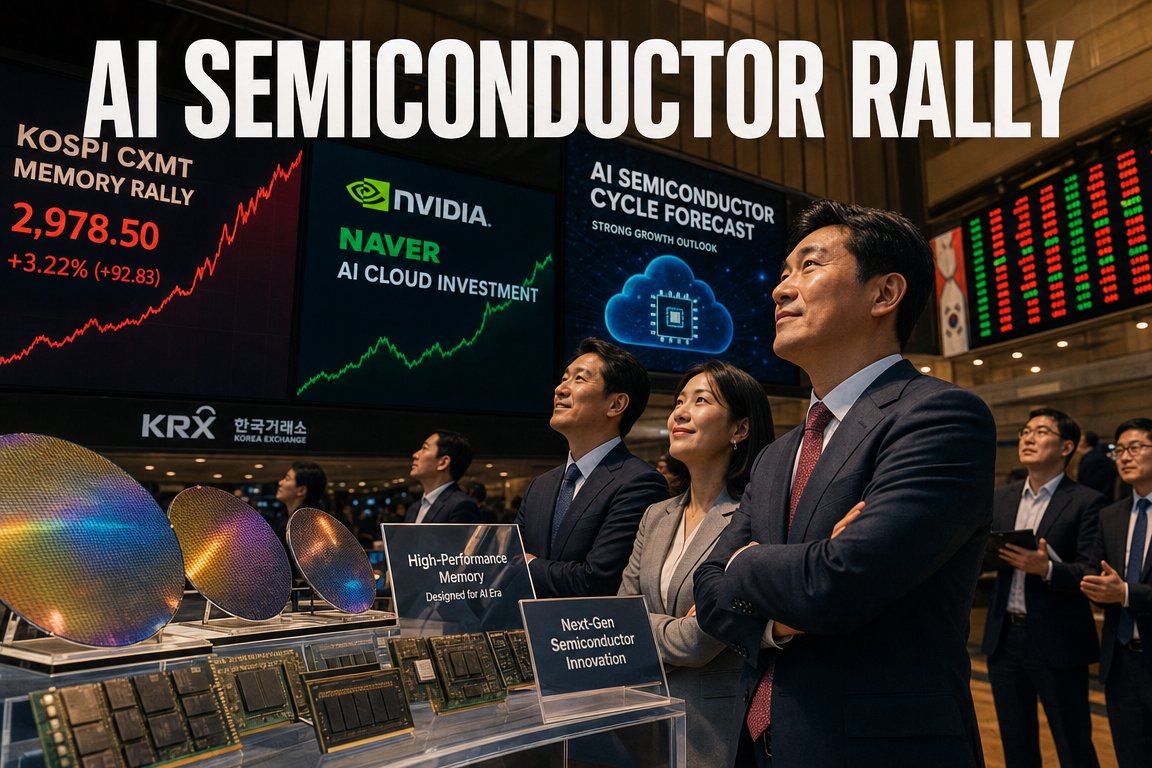
Kospi Rebounds on CXMT-Driven Semiconductor Sentiment, Easing Middle East Risk, and Nvidia-Naver AI Cloud Investment Expectations
The key reasons behind today’s intraday volatility and eventual modest gain in the Kospi can be summarized in three factors.
First, renewed attention on Chinese memory maker CXMT improved sentiment toward semiconductors.
Second, geopolitical risk in the Middle East, particularly involving Iran, was interpreted as easing rather than escalating.
Third, reports that Nvidia is considering a large-scale investment in Naver lifted expectations for domestic AI infrastructure spending.
Market attention is now shifting to SK Hynix’s earnings release scheduled for this week.
This move should be viewed not simply as a rise in the Kospi, but as a session shaped by expectations for a semiconductor upcycle, AI cloud competition, and broader global risk-off sentiment.
1. Why the Kospi Managed to Rebound
The Kospi moved sharply in both directions during the session.
For investors, the market showed typical volatility, with early-session weakness followed by late-session recovery.
The index ultimately closed slightly higher.
This does not indicate a full return to a strong uptrend.
However, the fact that the market held up despite negative headlines is notable.
It suggests that liquidity remains in the market and that expectations for semiconductors and AI-related shares have not faded.
- Expanded intraday volatility in the Kospi
- Support held despite Middle East risk
- Sentiment improved around large-cap semiconductors
- AI infrastructure expectations spread to platform stocks such as Naver
2. First Driver: CXMT Revived Semiconductor Sentiment
The most closely watched development in the market was CXMT, a Chinese memory company.
The key point is not simply that a Chinese company rallied.
The more important signal is that global investors continue to assign strong value to the memory semiconductor cycle.
CXMT is one of China’s leading DRAM manufacturers and a strategic player in the segment long dominated by Samsung Electronics and SK Hynix.
High valuation attached to such a company indicates that the market is viewing the memory recovery as structural rather than temporary.
This supported domestic semiconductor shares.
It also helped improve expectations ahead of SK Hynix’s earnings release.
3. Why CXMT Strength Matters for SK Hynix and the Kospi
CXMT is not a Korean company.
However, the memory semiconductor industry moves as a global cycle.
Higher valuations for Chinese memory makers can be interpreted as a positive signal for DRAM, HBM, and server memory demand.
In other words, the CXMT move should be read as a revaluation of the broader memory sector rather than a single-company event.
SK Hynix remains one of the primary beneficiaries of HBM demand.
It holds a central position in supplying high-bandwidth memory used in Nvidia AI GPUs.
As a result, a stronger valuation backdrop for memory companies can lead investors to reassess the valuation of SK Hynix and Samsung Electronics.
- CXMT’s rise supports expectations for a broader memory recovery
- Recovery in DRAM prices is positive for domestic semiconductor shares
- HBM demand expansion is directly linked to SK Hynix earnings
- Large-cap semiconductor strength supports overall Kospi liquidity
4. Second Driver: Middle East Risk Showed Signs of Easing
Another factor supporting the Kospi was the perception that Middle East risk was easing.
Recent tensions involving Iran had weighed on global equities.
When geopolitical risk rises, investors tend to favor safe assets such as the U.S. dollar, gold, and government bonds over equities.
However, reports from major foreign media suggested that the U.S. may refrain from military action against Iran, which helped reduce market concerns.
Comments linked to former President Trump and concerns within his team also reinforced expectations of a more limited military response.
This matters for the Korean market.
Korea has a high export dependence and is sensitive to oil prices and exchange-rate movements.
If Middle East risk worsens, it can lead to higher crude prices, a weaker won, and foreign capital outflows.
If the risk eases, foreign investors are more likely to return to large-cap semiconductor names.
5. The Practical Impact of Easing Middle East Risk on the Kospi
Middle East risk is not just a headline issue.
It has direct implications for the Kospi.
First, stable oil prices reduce cost pressure on Korean companies.
Second, a more stable exchange rate makes Korean equities more attractive to foreign investors.
Third, improved risk appetite supports growth sectors such as semiconductors, batteries, and AI-related stocks.
The market did not rally strongly today, but the fact that it closed higher despite negative external news suggests that investors are not pricing in the worst-case scenario.
6. Third Driver: Naver Is Being Repriced as an AI Cloud Company
Another major market event was Naver.
Shares gained attention after reports that Nvidia is considering an investment of around KRW 1.5 trillion in the company.
Such reports require careful verification of the final structure and terms.
Still, the market reaction was clear.
Investors are beginning to view Naver as more than a search platform.
Naver operates across search, advertising, commerce, and content platforms.
When combined with cloud services, data centers, generative AI, and sovereign AI strategy, a very different valuation framework emerges.
Any link with Nvidia could position Naver Cloud as a key domestic AI infrastructure play.
7. What the Market Should Watch if Nvidia Moves Toward Naver
Nvidia is not just a GPU seller.
It is now a platform company that shapes the AI data center ecosystem.
For Nvidia, partnerships with leading cloud providers in each market are strategically important.
As AI infrastructure expands beyond U.S. tech giants, governments and companies are seeking sovereign AI solutions that use local data and language models.
In Korea, Naver is one of the few companies capable of playing that role.
It combines Korean-language data, search technology, cloud infrastructure, and enterprise customer relationships.
For that reason, any potential Nvidia-Naver collaboration would affect not only short-term stock performance but also the direction of Korea’s AI industry.
- Potential revaluation of Naver Cloud as an AI infrastructure company
- Connection between Nvidia’s GPU ecosystem and Korea’s cloud market
- Greater recognition of Naver’s role in sovereign AI
- Shift in valuation from search and advertising to AI data center infrastructure
8. The Next Focus Is SK Hynix Earnings
Investor attention is now shifting to SK Hynix’s earnings release.
If the Kospi held up on semiconductor sentiment today, the next step is for actual earnings to confirm those expectations.
The most important issue in the results will be HBM.
Key points include whether AI server demand remains strong, how solid HBM supply contracts and margins are, and how much DRAM price recovery is reflected in earnings.
Because expectations are already high, merely delivering good earnings may not be enough.
Investors will be looking for stronger guidance.
They need confirmation that AI memory demand remains firm, HBM supply constraints continue, and profitability is sustainable.
9. Key Items to Watch in SK Hynix’s Results
- HBM sales mix: Whether AI semiconductor demand is clearly reflected in the numbers
- Operating margin: Profitability improvement from high-value products is more important than top-line growth alone
- DRAM price outlook: A recovery in mainstream memory prices is central to the semiconductor upcycle
- Supply stability to Nvidia: Whether SK Hynix can maintain its position in the HBM supply chain
- CAPEX plan: Excessive investment could raise future supply glut concerns
This earnings release is also important for the broader direction of the Kospi.
Semiconductor large caps make up a significant share of the Korean market.
If SK Hynix and Samsung Electronics weaken, the Kospi will struggle to advance.
Conversely, strong results and a favorable outlook from SK Hynix could bring foreign capital back into the market.
10. The Core Theme: Repricing of the AI Infrastructure Value Chain
The market should not interpret today’s move as merely a rally in Chinese semiconductor names, easing geopolitical risk, or a Naver-specific headline.
The more important point is that the entire AI infrastructure value chain is being repriced.
AI is no longer limited to chatbots or app-level services.
The market is now focused on who secures GPUs, who operates data centers, who provides cloud services, and who supplies high-performance memory.
From that perspective, SK Hynix and Naver belong to the same broader theme despite being in different industries.
SK Hynix supplies HBM for AI servers.
Naver provides the cloud and data infrastructure needed to run AI services.
Nvidia sits at the center of that global AI ecosystem.
Accordingly, today’s Kospi rebound may be better understood as a recovery in expectations for AI infrastructure investment rather than a short-lived relief rally.
11. Risks Investors Should Keep in Mind
Despite today’s rebound, investors should remain cautious.
The Kospi remains highly sensitive to global variables.
Middle East risk has not disappeared; it has only eased for now.
U.S. interest rate direction, dollar strength, oil prices, and U.S.-China semiconductor tensions also remain important.
CXMT is linked not only to short-term sentiment but also to China’s semiconductor expansion.
While positive for memory sentiment in the near term, it could become a competitive challenge for Korean firms over time.
If China rapidly expands DRAM capacity, it may create pressure on future memory pricing.
For that reason, investors should focus on earnings, supply-demand conditions, and valuation rather than chasing the move indiscriminately.
12. Outlook for the Kospi: Semiconductors Must Deliver, and AI Must Broaden
The Kospi’s next direction depends on two factors.
First, SK Hynix and Samsung Electronics must confirm the semiconductor recovery through earnings.
Second, platform companies such as Naver must demonstrate actual progress in AI cloud and data center businesses.
A rally led only by semiconductors is unlikely to last.
The broader market needs AI infrastructure investment to spread into cloud services, power equipment, data centers, software, security, and telecom equipment.
The market is moving from a narrow focus on semiconductors to a broader view of the AI infrastructure ecosystem.
If that shift continues, Korean equities could be re-rated not just as cyclical stocks, but as a key beneficiary of the global AI investment cycle.
13. One-Sentence Summary of Today’s Market
The Kospi closed slightly higher after easing Middle East risk reduced pressure, CXMT revived semiconductor sentiment, and Nvidia-Naver investment expectations lifted AI cloud sentiment.
However, the decisive test lies ahead.
For this rebound to develop into a trend, SK Hynix’s earnings must deliver numbers and guidance that exceed market expectations.
[Related Articles…]
*Source: [ 내일은 투자왕 – 김단테 ]
– 코스피 구사일생의 이유 #코스피 #하이닉스 #CXMT #네이버
● Warshock-AI-Boost
IMF 2026 Economic Outlook Summary: Middle East War and Oil Shock Risks Are Being Offset by AI Semiconductor Investment
The core message of this IMF outlook is not simply that the global economy is weak.
War is dragging global growth lower, while AI and semiconductor investment are offsetting part of that pressure.
In other words, the 2026 global outlook reflects a simultaneous collision between Middle East war-related oil shock risk and the AI semiconductor investment cycle.
At the surface, global growth appears to be holding near 3%, but beneath that average, capital flows are diverging sharply by country, industry, and asset class.
In particular, Korea, which could have been a direct casualty of Middle East conflict through energy exposure, is being cited in the IMF outlook as a key beneficiary of AI hardware exports, supporting an upward revision to growth.
1. IMF’s 2026 Global Outlook: Low Growth Is the Baseline, AI Is the Counterforce
The IMF has lowered its 2026 global growth forecast.
In the source report, the IMF reduced its 2026 global GDP growth projection from 3.1% to 3.0%.
Compared with the 3.6% average growth recorded in the 2010s, the global economy is now clearly in a low-growth regime.
In short, the prevailing pattern is structural low growth.
- 2010s average global growth: approximately 3.6%
- Post-pandemic recovery: weaker than expected
- IMF 2026 forecast: around 3.0%
- Key assessment: the global economy remains exposed to significant downside pressure
The IMF also highlighted the phrase Crosscurrents of War and Technology.
Middle East conflict is a downward force on the global economy.
By contrast, AI, semiconductors, data centers, servers, and manufacturing equipment investment are upward forces.
As a result, the current global slowdown is not an across-the-board decline in which all industries weaken simultaneously.
Energy-importing economies and traditional manufacturing sectors face pressure, while countries tied to AI infrastructure and the semiconductor supply chain are benefiting.
2. Capital Flows Have Shifted: Concentration in the M7, Chinese Tech, and Korean Semiconductors
The IMF report emphasizes capital allocation as much as growth figures.
When geopolitical risk rises, capital typically moves toward safe assets.
This time, however, capital is also concentrating heavily in AI and semiconductors.
- The U.S. M7 companies account for roughly 35% of the S&P 500’s total market capitalization
- Major Chinese technology stocks represent about 40% of Hong Kong’s Hang Seng Index
- In Korea, capital is also concentrating in semiconductor and AI hardware-related names
This indicates that markets are not simply pricing a broad economic recovery.
They are pricing an AI infrastructure investment cycle.
As data centers expand, demand for high-performance semiconductors rises.
As semiconductor demand rises, related sectors such as equipment, materials, components, power infrastructure, cooling systems, and server manufacturing also benefit.
In this sense, the AI semiconductor value chain is functioning as a buffer for the 2026 global economy.
3. Why Korea Is Drawing Attention in the IMF Outlook: AI Hardware Exporter
The IMF separately classifies countries benefiting from AI hardware exports.
In the source text, Korea, Malaysia, Taiwan, and Thailand are identified as representative AI hardware exporters.
- Korea: high-value semiconductors, memory, HBM, and ICT devices
- Taiwan: foundry and advanced semiconductor manufacturing
- Malaysia: semiconductor back-end processes, electronic components, AI supply-chain parts
- Thailand: computers, electronic devices, and intermediate goods manufacturing base
Korea and Taiwan are easy to recognize as direct beneficiaries of AI semiconductors.
Malaysia and Thailand are also important.
The AI industry does not rely only on GPUs or HBM.
It also requires servers, PCBs, power supplies, assembly, back-end processing, electronic components, and testing equipment.
Accordingly, the AI boom is not only a large-cap technology story; it is a supply-chain-wide industrial reallocation.
4. Why Korea’s Growth Forecast Was Revised Upward: Semiconductor Exports
The IMF reportedly raised Korea’s 2026 and 2027 growth forecasts.
The upward revision for Korea was described as one of the larger adjustments among the economies reviewed.
The key driver is semiconductor exports.
- Semiconductors reportedly account for about 38% of Korea’s total exports in the first half
- AI server and data-center investment is driving memory semiconductor demand
- HBM, high-performance DRAM, SSDs, and server semiconductors are improving exports
- Many products not directly classified as semiconductors are still linked to the ICT value chain
The key point is that Korea is not insulated from war-related shocks.
As an energy importer, Korea remains exposed to higher oil costs.
However, AI-related semiconductor exports are absorbing a meaningful share of that pressure.
Without the AI investment boom, Korea’s growth trajectory in 2026 would likely be materially weaker.
5. Middle East War and the Oil Shock: The Risk Has Not Disappeared
The IMF’s strongest warning concerns the prolonged Middle East conflict.
The war is not only a regional security issue; it is also a global energy supply-chain risk.
The Strait of Hormuz is a critical route in global crude transport.
If transit through the strait is blocked or restricted, oil prices can adjust quickly.
- The Strait of Hormuz is a key route for Middle Eastern crude shipments
- Shipping traffic reportedly declined sharply after the conflict began
- Traffic fell from roughly 120 vessels per day in normal periods to near-zero levels immediately after the outbreak
- Only limited shipments to China and India reportedly continued
The broader issue is the Gulf region’s oil value chain.
Production, storage, refining, and transportation are interconnected, and prolonged conflict can damage the entire chain rather than only isolated facilities.
The source notes that some production, processing, storage, and refining assets have already been damaged, with recovery potentially taking years.
In other words, the return to normal oil supply is not immediate even if hostilities stop.
6. Why Has a Major Oil Shock Not Materialized Yet?
This is one of the most important points in the IMF outlook.
Stable oil prices do not mean the risk has disappeared.
Part of the shock may have been absorbed through inventory drawdowns in major economies.
- OECD economies have drawn down strategic and commercial inventories
- Slower global growth has reduced some underlying oil demand
- Some producers have increased output to offset supply disruptions
- These factors have jointly softened the short-term oil shock
On the surface, oil prices may appear stable.
However, the system may simply be consuming its inventory buffer.
The source states that Korea’s existing crude inventories are being depleted over time and that U.S. inventories have fallen to their lowest levels since 1984.
This implies that conditions in the second half of the year become more important.
If inventories remain low and access through Hormuz tightens further, countries will need to re-enter the market for crude.
At that point, a move back above $100 per barrel cannot be ruled out.
7. Inflation Pressure: The Impact Extends Beyond Energy Into Food Prices
If the Middle East conflict continues, inflation pressure will extend beyond energy.
Higher oil and natural gas prices raise electricity costs, transportation costs, and chemical input costs.
Those pressures then feed into fertilizer and agricultural input prices.
Ultimately, the effect is transmitted to food prices.
- Higher crude prices raise transport and production costs
- Higher natural gas prices raise fertilizer costs
- Higher fertilizer costs raise grain and agricultural prices
- Higher raw material prices raise manufacturing costs
- Higher manufacturing costs feed into consumer inflation
For this reason, an oil shock is not simply a fuel-price issue.
It affects consumer inflation, corporate margins, household real income, and central bank policy.
In 2026, the most important inflation variable remains energy prices and geopolitical risk.
8. Monetary Policy Shift: The Return of Rate Hikes Remains Possible
If the war persists and inflation pressure intensifies, central banks will have fewer policy options.
When growth slows but prices rise, monetary policy becomes especially difficult.
This is the classic stagflation risk.
- Rate cuts become possible only if inflation remains contained
- Oil spikes would delay rate cuts
- Inflation re-acceleration could bring rate hikes back
- Emerging markets may tighten more quickly to defend their currencies
The source suggests that Korea, the euro area, Japan, Australia, New Zealand, Indonesia, and the Philippines have each adjusted policy according to their own conditions.
The United States is not currently expected to raise rates immediately, but major economies will still need to respond to inflation, currency, and growth conditions individually.
The key phrase is a period of differentiated rate policy.
The era of synchronized global easing has given way to a more fragmented policy environment.
9. A World Reliant on Fiscal Policy: But Fiscal Space Is Limited
When war, higher energy costs, and slower growth occur simultaneously, governments typically respond through fiscal measures.
Examples include fuel-tax cuts, energy subsidies, transfers to vulnerable households, and support for firms.
The problem is that fiscal space has already narrowed in many countries.
- Government debt rose after the pandemic
- Higher interest rates increased debt-service costs
- Expanded energy subsidies raise fiscal burdens
- Fiscal expansion may also re-ignite inflation
Fiscal policy can reduce short-term disruption, but over time it can add to public debt and inflation pressure.
This is why the IMF warns about prolonged conflict.
As the war drags on, central banks may be forced to tighten while governments are forced to spend more, creating a policy contradiction.
10. The Key Point Often Missed Elsewhere: Stable Oil Prices May Reflect Inventory Drawdowns, Not Safety
Many reports interpret stable oil prices as a sign that oil-shock risk has eased.
However, the IMF outlook suggests a different interpretation.
Oil prices may have held up not because supply is secure, but because major economies have been drawing down inventories.
- Key point 1: The oil-shock risk may not have disappeared; it may simply have been deferred
- Key point 2: If the war continues after inventories decline further, the price shock could intensify
- Key point 3: AI semiconductor exporters may benefit from growth, while energy importers face cost pressure
- Key point 4: A 3.0% global growth average reflects divergence, not stability
- Key point 5: Equity gains may reflect concentration in AI-related firms rather than broad economic recovery
This is the central takeaway.
The global economy is not avoiding weakness because the war risk is small.
It is being supported by AI semiconductor investment and the temporary use of energy inventories as shock absorbers.
If those buffers weaken, the second half of 2026 could become materially more volatile.
11. What Investors and Employees Should Watch in 2026
When assessing the 2026 outlook, growth alone is not sufficient.
Industry-level divergence is likely to remain pronounced.
- AI semiconductors: sustained demand for data centers, HBM, servers, and power infrastructure
- Energy: direction of crude prices depends on the Strait of Hormuz and the duration of the conflict
- Inflation: follow the second-round effects of oil, gas, and food prices
- Monetary policy: the response of emerging markets and energy importers may matter more than that of the United States
- Korean economy: the key question is whether semiconductor strength can offset weak domestic demand and higher energy costs
Korea faces both opportunity and risk.
It benefits from AI semiconductor demand, but it also remains vulnerable as an oil importer.
If semiconductor exports remain strong, growth can be sustained.
However, a sharp rise in oil prices would pressure the trade balance, inflation, the exchange rate, and policy rates simultaneously.
12. Conclusion: 2026 Global Growth Is a State of Unstable Balance Between War and AI
The IMF’s 2026 global outlook is neither clearly bullish nor clearly bearish.
It is best described as an unstable equilibrium.
Middle East conflict is weighing on global activity.
AI semiconductors are absorbing part of that shock.
Oil inventories are delaying a larger oil shock.
But if inventories decline further while the conflict continues, inflation pressure could re-emerge sharply.
At that point, monetary policy could also return to a tightening bias.
The key question for the second half of 2026 is straightforward.
Can the growth in AI semiconductors continue to outpace the economic damage from Middle East conflict and a potential oil shock?
The answer to that question will likely shape Korean growth, global equities, exchange rates, interest rates, and inflation.
< Summary >
The IMF lowered its 2026 global growth forecast to around 3.0%, signaling structural low growth.
Middle East conflict is a downside risk through oil shock and inflation pressure.
By contrast, AI semiconductors and data-center investment are supporting global activity.
Korea is classified as an AI hardware exporter, and its growth outlook was revised up on the back of semiconductor exports.
Stable oil prices may reflect inventory drawdowns rather than the disappearance of risk.
If the Strait of Hormuz risk escalates after inventories decline, oil prices and inflation could rise sharply again.
The second half of 2026 may see more differentiated rate policy across countries.
[Related Articles…]
*Source: [ 경제 읽어주는 남자(김광석TV) ]
– IMF 2026년 경제전망: AI-반도체가 중동전쟁 충격 흡수 [경읽남 255화]