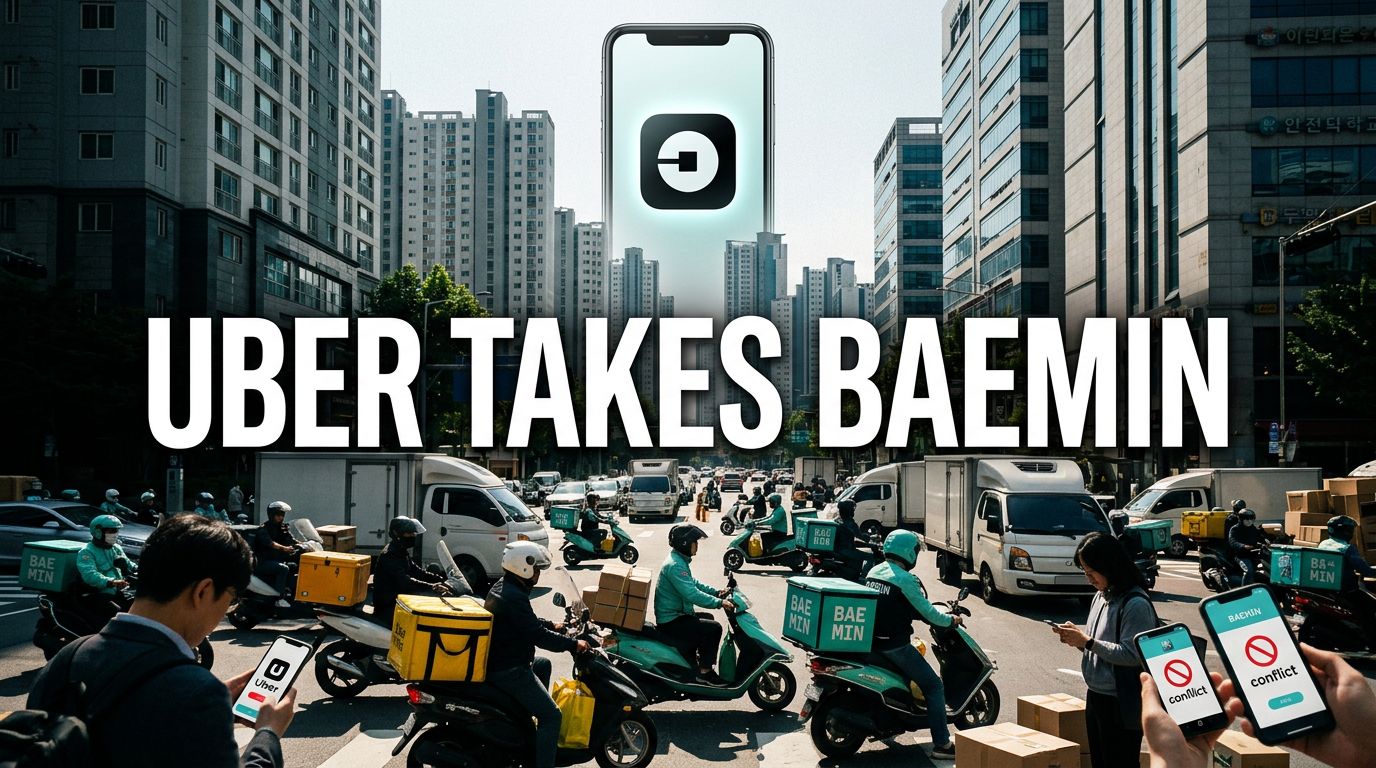
● Uber Buys Baemin’s Power Chain Amid Cash Squeeze and Regulation Storm
Why Uber’s acquisition of Delivery Hero turned Baemin from the family’s “oldest son” into the “youngest son of a chaebol family”
The core point of this issue is not simply that “Uber took Baemin under its wing.”
While Baemin sent more than 1.4 trillion won to its parent company Delivery Hero over the past five years, Coupang Eats rapidly surged ahead by offering free delivery and memberships.
Now, however, the top owner of Baemin is increasingly likely to change from Germany’s DH to Uber, the global mobility and delivery platform.
This shift could shake not only Korea’s delivery app market, but also the platform economy, quick commerce, mobility, fair trade risks, and AI transition strategies all at once.
What is especially important is that Baemin’s performance did not look bad on the surface, yet its cash was drying up.
This is the core point for judging how Uber will use Baemin going forward and how far the competition with Coupang Eats will intensify.
1. The Uber-DH acquisition structure: Baemin becomes Uber’s “great-grandchild company”
The apparent structure of this deal is not Uber directly acquiring Baedal Minjok.
Instead, Uber is taking control of Delivery Hero, Baemin’s parent company, or DH.
- Uber makes a tender offer for Delivery Hero shares.
- Delivery Hero controls Woowa DH Asia.
- Woowa DH Asia holds most of the shares in Woowa Brothers, the operator of Baemin.
- As a result, Baemin ends up in a structure that runs from Uber → DH → Woowa DH Asia → Baemin.
Looking at the structure mentioned in the original text, Woowa DH Asia is a Singapore-based company that functions as an intermediate holding company holding about 99% of Baemin’s shares.
Originally, founder Kim Bong-jin created this structure to oversee the Asia business, but after he left the company, its practical role in managing the business weakened.
It now looks more like an intermediate company holding Baemin shares.
2. Uber was already DH’s largest shareholder
What matters is that Uber did not suddenly buy DH, but already held a significant stake.
According to the original text, Uber was the largest shareholder with about 35% of DH shares.
However, under German law, holding more than 25% can trigger regulatory issues, so some of its holdings were explained as non-voting shares.
This time, Uber has gone one step further by launching a tender offer to secure control.
As Prosus, a major DH shareholder, announced that it would tender roughly 17% of its stake to Uber’s offer, Uber gained the possibility of securing more than 50% ownership.
In other words, it is moving from a simple investor to a de facto controlling shareholder.
3. The “sell 14 markets” card to avoid monopoly review
The smartest part of this M&A deal is that it reduces regulatory risk in advance.
In countries where Uber and DH overlap, antitrust issues can arise in merger reviews.
So Uber attached a condition that DH would sell its businesses in 14 countries to private equity firm SSW Partners.
- Uber acquires DH.
- But some country operations where Uber and DH competed are carved out and sold separately.
- SSW Partners acquires those businesses.
- Uber even structures the deal so it lends acquisition funds to the private equity firm.
In simple terms, it is a way of saying, “I’ll buy the businesses that might be monopolistic after splitting them off in advance.”
This is similar to the logic used when the Fair Trade Commission required the sale of Yogiyo as a condition for DH’s acquisition of Baemin.
This time, Uber has structured the risk beforehand.
4. The real reason Uber is buying DH: the global war with DoorDash
This transaction cannot be understood by looking only at the Korean delivery app market.
From a global economic perspective, Uber is considering competition with DoorDash in the global delivery platform market.
China is a separate market driven mainly by local companies such as Meituan.
Excluding China, the key players in the global delivery market can largely be seen as Uber Eats, DoorDash, and Delivery Hero.
- Uber Eats has a strong delivery network worldwide.
- DoorDash is rapidly expanding its dominant presence in North America.
- Delivery Hero has strengths in Europe, Asia, and emerging markets.
For Uber, taking over DH, the number-three player, is the fastest way to counter DoorDash.
Because the delivery app market has strong network effects, long-term competitiveness depends on how many number-one or number-two operators it can secure in each country.
5. Baemin’s presence inside DH was overwhelming
Baemin likely played a very large role in Uber’s decision to buy DH.
The original text explains that Baemin accounted for up to about 25% of DH’s total revenue and 60% to 70% of its Asia business.
More importantly, Baemin was not just a revenue-generating company; it was one of the few core assets actually producing profit.
DH as a whole was burdened by losses and debt on a global basis.
By contrast, Baemin generated operating profit in the billions of won every year, serving as DH’s cash cow.
So from DH’s perspective, Baemin was a cash cow, and from Uber’s perspective, it was one of the key attractions of acquiring DH.
6. Baemin’s “lost five years” with DH
Baemin was acquired by DH in December 2020.
It was a time when non-face-to-face consumption exploded due to COVID-19, and the delivery app market was growing at its fastest pace.
But after that, important changes followed inside Baemin.
- Founder Kim Bong-jin stepped down as CEO of Woowa Brothers in February 2023.
- He resigned as chairman in July 2023.
- The original lock-up period was reportedly until the end of 2023, but he left earlier.
- The plan to expand across Asia through Woowa DH Asia also effectively lost momentum.
Looking at this flow, it is reasonable to interpret that instead of pursuing an independent growth strategy under DH, Baemin became more of a company supporting its parent’s financial condition.
7. Baemin made money, so why did cash decrease?
The most important figure in this issue is cash flow, not revenue or operating profit.
Based on the original text, Baemin’s revenue rose from about 3.4 trillion won in 2023 to about 5.2 trillion won in 2025.
Operating profit slightly declined from about 700 billion won in 2023 to about 600 billion won in 2025.
On the surface, these are not bad results.
The problem is cash and cash equivalents.
By the end of 2025, cash and cash equivalents are said to have fallen to about 560 billion won.
There are three main reasons.
- Cash flowed out to the parent company DH through dividends, treasury share buybacks, and cancellations.
- Additional costs arose from DH’s global IT system usage fees.
- Delivery fee burdens increased due to competition with Coupang Eats’ free delivery.
In short, Baemin recorded accounting profits, but those profits did not stay within the company.
In the platform economy, the most dangerous situation is when profits exist but the capacity to reinvest weakens.
This is the background behind why Baemin could not respond as quickly as before to Coupang Eats’ offensive.
8. DH’s forced system transition: the Roadrunner controversy
One of the areas of greatest dissatisfaction inside Baemin was the introduction of a global system.
A representative example is the dispatch system called Roadrunner.
Baemin originally had its own dispatch system developed in-house.
However, as DH tried to apply a global standard system, the introduction of Roadrunner was pushed in some regions.
The problem was that this system did not fit the way domestic riders work.
Previously, riders were closer to gig workers who could freely pick up orders.
By contrast, Roadrunner is closer to a model where workers reserve specific time slots and work during those periods, which could intensify debates over employment status.
For delivery riders, it means less freedom; for the company, it is a sensitive issue that could heighten labor law and social insurance concerns.
This should be seen not as a simple IT system issue, but as a future labor issue combining algorithmic labor management and AI transition.
9. Coupang Eats’ catch-up: why Baemin is facing its first real threat
In platform markets, the number-one player usually has a huge advantage.
That is because users, merchants, riders, data, and brand awareness all gravitate toward the leader.
So it is not common for the number-two player to catch up to the leader.
But Coupang Eats brought out an exceptional weapon.
That weapon is the Coupang Wow membership.
- There are already many users of Coupang Rocket Delivery.
- Coupang Play is bundled in as well.
- Adding free delivery with Coupang Eats further increased the membership’s value.
- Consumers move toward the idea of “I already use Coupang Wow, so why not try Coupang Eats too?”
The original text explains that while Baemin’s user base has stagnated in the low 20-million range, Coupang Eats has grown past 10 million users and is even being mentioned at around 13 million.
Especially in Seoul and the metropolitan area, there are evaluations that Coupang Eats is threatening Baemin or has overtaken it in some segments.
Unlike the days when Baemin quickly copied single-order delivery services like Baemin One to respond, the membership ecosystem is now different.
Coupang has many more benefits it can offer, while Baemin is centered on food delivery and B Mart, leaving its defensive options limited.
10. Baemin Club succeeded, but it is still not enough to beat Coupang Wow
Baemin also launched its subscription model, Baemin Club.
The original text says about 50% of Baemin orders come from Baemin Club.
That makes it a successful subscription product in the short term.
However, the current pricing is strongly promotional in nature.
The standard price is said to be around 3,990 won per month, but new subscribers are offered it at around 1,990 won per month.
Baemin Club has clear advantages.
- It offers free value-priced delivery benefits.
- It lowers the minimum order amount for B Mart.
- It creates a lock-in effect that keeps existing Baemin users.
But in a situation where Coupang Eats is strongly offering free delivery to Wow members, it is hard for Baemin Club alone to create overwhelming differentiation.
From the consumer’s point of view, it can feel like “Coupang bundles delivery into a membership I already use, while Baemin requires extra payment.”
11. B Mart and quick commerce are Baemin’s clear assets
There are still areas where Baemin remains strong.
That is B Mart and quick commerce.
B Mart is not just a simple delivery brokerage service.
Baemin buys products directly, stores them in warehouses, and delivers them quickly when orders come in.
Because this structure allows Baemin to capture the entire sales value, it has greater scalability than a simple commission-based business.
On the other hand, grocery and shopping delivery is a model where riders pick up items from partner stores such as convenience stores, supermarkets, and electronics retailers and deliver them.
That is an area that Coupang Eats and Yogiyo can also do, so it is not a Baemin-exclusive competitive advantage.
Still, B Mart is different.
If you suddenly run out of meat while eating pork belly, or if you are a parent with children and cannot easily leave the house, or if you urgently need daily necessities, strong demand arises.
It also increases platform efficiency by providing additional work for Baemin’s rider network.
12. Fair Trade Commission risk: potential fines of up to 700 billion won
Another risk for Baemin is the Fair Trade Commission investigation.
The core allegations mentioned in the original text are broadly twofold.
- The suspicion that it required restaurants entering the platform to accept terms no less favorable than other delivery apps.
- Concerns about advertising that could confuse consumers regarding estimated delivery times.
Baemin tried to resolve the matter early through a consent decree, but the Fair Trade Commission is said to have rejected it.
A consent decree is a system where a company proposes voluntary corrective measures and win-win plans to close a case.
But the FTC appears to have judged that harm had already occurred and that the proposed win-win measures were not significantly different from ordinary marketing.
The original text mentions the possibility of fines of up to around 700 billion won for Baemin.
Of course, that amount is not finalized.
Still, considering Baemin’s cash and cash equivalents, a large fine could place a substantial burden on the company’s finances.
13. Uber and Baemin synergies: the most realistic card is Uber One + Baemin Club
If Uber comes to own Baemin, the first synergy that comes to mind is combining memberships.
Uber operates a subscription product called Uber One overseas.
It bundles taxi usage benefits with delivery fee benefits.
The original text also mentions that in Japan, Uber One members account for about 30% of total transactions.
If this model enters Korea, Uber Taxi and Baemin Club could be combined.
- Cashback or discounts on taxi rides.
- Delivery fee discounts or free delivery on Baemin orders.
- Combining mobility and delivery into one subscription product.
- Increasing per-user spending, or ARPU.
However, one variable is that the Fair Trade Commission is increasingly sensitive to membership bundling.
Regulatory debate is growing around structures that combine multiple services into one membership, such as YouTube and YouTube Music or Coupang Wow and Coupang Play.
Therefore, a combination of Uber One and Baemin Club may also be subject to conditional approval.
14. What Uber may really be aiming for is Korea’s mobility market
Uber has long been interested in Korea’s mobility market.
But it has faced repeated setbacks because of taxi regulations, Kakao T’s strong position, and domestic institutional barriers.
What Uber can gain through Baemin is not just a delivery app.
It is a user base of around 20 million, a rider network, a merchant network, dispatch and demand data, and local operating experience.
These assets can expand into the following areas going forward.
- Expansion of Uber Taxi users
- Corporate mobility services
- Freight transportation platform
- Quick commerce logistics network
- Advancement of dispatch algorithms for the autonomous vehicle era
- B2B catering, snacks, and office delivery services
In particular, Uber is also expanding freight businesses such as Uber Freight globally.
In Korea, if it uses Baemin’s local network, it could expand beyond food delivery into small-scale logistics, corporate delivery, and quick commerce.
15. From an AI trend perspective: the Baemin-Uber combination is the beginning of an “AI dispatch economy”
This issue is both an M&A story and an AI transition story.
Going forward, the key to delivery and mobility competition will be who can secure more riders, drivers, and consumer data.
And then how well that data is operated through AI.
Uber’s strength lies in global mobility data and real-time dispatch algorithms.
Baemin’s strength lies in Korea’s food delivery order data, commercial district data, and rider operation data.
If the two data sets are combined, the following changes become possible.
- AI-based demand forecasting can optimize rider allocation during peak times.
- Order volumes by commercial district can be predicted to automatically adjust B Mart inventory.
- Food delivery, grocery shopping, taxis, and freight transport can be integrated into one dispatch system.
- Rider compensation and promotions can be finely tuned by algorithms.
- Operational data can be accumulated in preparation for the era of autonomous vehicles and robot delivery.
However, there is also growing concern that in this process, algorithms may work against workers.
That is because AI can be used not only to improve efficiency but also to lower rider compensation or intensify labor.
So this deal is not just about delivery app market share; it is also connected to the future of platform labor.
16. The alliance with Naver is still only a possibility
At first, there were talks that Naver and Uber could form a consortium to acquire Baemin.
Naver has also consistently shown interest in delivery and offline commerce through local business, Naver Place, reservations, orders, and memberships.
There was also hope that with Uber benefits already included in the Naver Plus Membership, a Naver-Uber-Baemin alliance could emerge to challenge Coupang.
But under the current structure, Uber has moved toward directly acquiring DH.
Rather than Naver and Uber forming a deep strategic alliance, it is closer to Naver partnering with various companies to increase membership value.
So while it cannot be said that Naver is completely out, it is hard to say that a clear Naver-Uber-Baemin versus Coupang structure has been established immediately.
From Naver’s perspective, it is closer to having missed out on a major local commerce asset in Baemin.
17. Is this good news or bad news for Baemin?
As of now, there appear to be more positive factors for Baemin.
The original text even describes the outlook as “90% positive, 10% negative.”
The reasons for optimism are clear.
- The pressure of DH continuously draining Baemin’s cash may be reduced.
- Uber is a company that has long challenged the Korean market with strategic intent.
- If Uber’s capital and technology come in, Baemin may be better able to defend against Coupang Eats.
- Korea could apply a global success model that combines mobility and delivery.
But it would be wrong to say it is unconditionally good.
Uber has also faced criticism overseas over fees, driver and rider compensation, and algorithmic control.
Just because Baemin had a hard time under DH does not guarantee it will receive better treatment under Uber.
It is true that it now has a richer father, but whether that father will be more generous or simply more sophisticated at extracting profits remains to be seen.
18. The most important point that other news often misses
First, Baemin’s problem is not “losses” but weaker cash conversion.
Baemin is still a profitable company.
But as cash flows out to the parent company, gets burned in free-delivery competition costs, and leaks into system expenses, its ability to reinvest has weakened.
This is the real reason it could not respond to Coupang Eats’ offensive.
Second, what Uber wants is not only food delivery.
Baemin is not just a food-order app; it is a real-time demand, delivery, and commercial district data platform in Korea.
Uber can expand this data into mobility, freight, quick commerce, autonomous driving, and AI dispatch systems.
Third, the Fair Trade Commission’s conditional approval could determine the future competitive landscape.
More important than the acquisition itself is what conditions are attached to membership integration, data integration, fee policies, and rider algorithms.
Depending on what safeguards the FTC imposes, the burden on small businesses, riders, and consumers could change.
Fourth, Coupang Eats is likely to fight even harder until the Uber combination is fully completed.
Before Uber injects capital and technology into Baemin, Coupang Eats can use free delivery, coupons, and Wow membership even more aggressively.
Consumers may see short-term benefits, but the burden on self-employed business owners and platform workers may grow further.
Fifth, this deal is a test case for Korea’s platform regulation.
The key issue is how far it should be allowed when delivery, mobility, memberships, data, and AI algorithms are combined within one corporate group.
This issue could also influence how global big tech enters Korea in the future.
19. Key variables to watch going forward
- Whether Uber’s tender offer for DH is completed.
- The Korean Fair Trade Commission’s merger review conditions.
- The size of any fine related to Baemin and whether lawsuits follow.
- Whether the combination of Uber One and Baemin Club is approved.
- Whether Coupang Eats expands its offensive beyond the metropolitan area into the provinces.
- How much B Mart and quick commerce grow as Baemin’s defensive card.
- Whether there are changes in AI dispatch, algorithmic labor management, and rider compensation structures.
< Summary >
If Uber comes to control Delivery Hero, Baemin becomes Uber’s great-grandchild company.
Over five years under DH, Baemin played the role of the “oldest son” by sending more than 1.4 trillion won to its parent company.
On the surface, revenue and operating profit did not look bad, but cash flow worsened and its ability to respond to Coupang Eats’ free-delivery offensive weakened.
Through Baemin, Uber can expand not only in Korea’s delivery app market, but also into mobility, quick commerce, freight transport, and AI dispatch systems.
From Baemin’s perspective, Uber is likely better than DH, but risks such as fee increases, algorithmic control, and Fair Trade Commission regulation remain.
In the end, the core point of this acquisition is not simply that “Baemin’s owner changes,” but that the rules of Korea’s platform economy could be rewritten.
[Related Articles…]
*Source: [ 티타임즈TV ]
– 모기업 먹여살리다 ‘재벌집 막내아들’로 변신한 배민