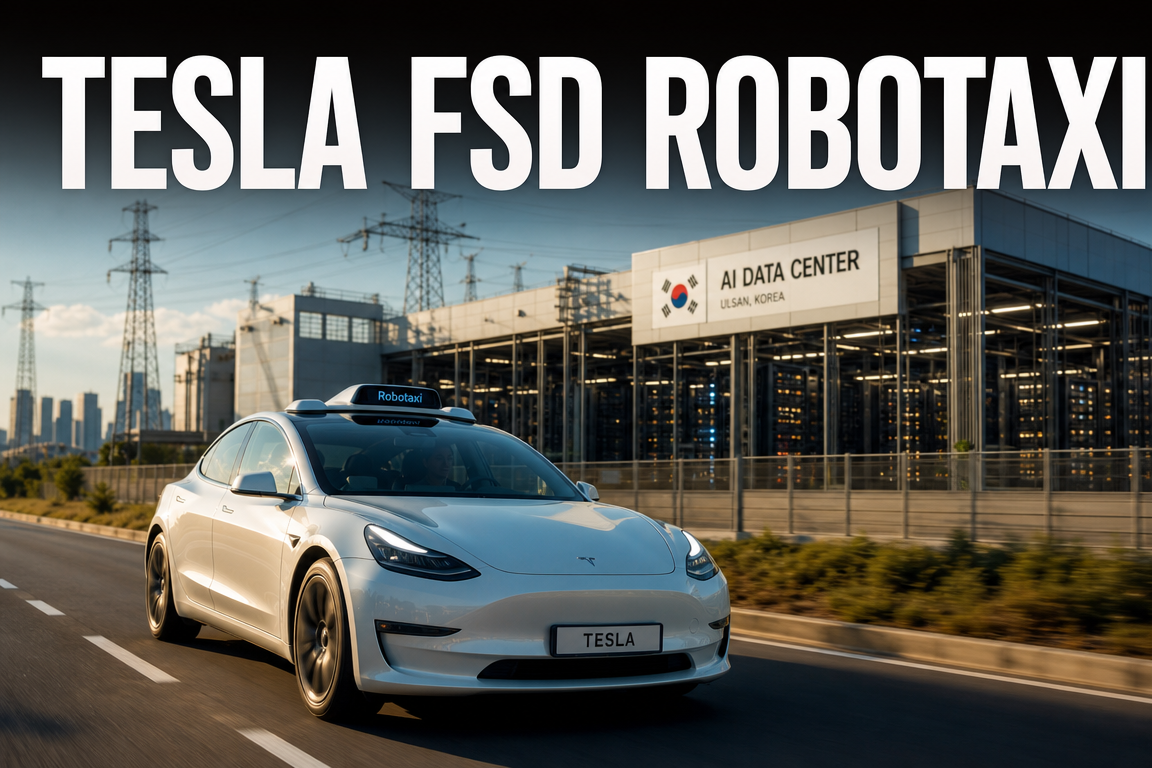
● Tesla FSD Storm, 47-Hour, LA Run, Stock Shock
Tesla FSD’s Non-Intervention Run from New York to Los Angeles in 47 Hours and the Key Issues Behind the $309 Tesla Share Price Debate
The core issue is not simply that “Tesla drove from New York to Los Angeles on FSD.”
The more important point is that Tesla FSD has moved beyond the stage of determining whether the technology is possible and entered a phase of competition over speed and consistency.
At the same time, Tesla shares around $309, the U.S. earnings season for major technology companies, the Federal Reserve meeting, AI semiconductor risk, and the robotaxi regulatory battle are all intersecting.
In particular, what many reports miss is that this dispute is not about whether someone plugged in a charging cable, but about a platform race over who will control driving data and customer touchpoints in the future robotaxi market.
1. Market backdrop: the broader drivers behind Tesla shares are macro factors and big tech earnings
Based on the source material, Tesla shares closed at $309.2.
The stock fell about 1.2% from the previous day, indicating that post-earnings pressure has not fully eased.
SSX, also referenced in the video, was reported near $113.55, down about 1.36%.
The U.S. market is currently being shaped by more than individual earnings results.
Major technology companies such as Microsoft, Apple, Amazon, and Meta are reporting earnings, while the Federal Reserve decision and oil trends are also being priced in simultaneously.
- Tesla shares: entering a short-term correction phase as expectations and disappointment remain mixed after the earnings call
- U.S. equities: shaped by both major tech earnings and the Federal Reserve meeting
- Oil: downward pressure following eased tensions related to Iran
- AI semiconductors: increased volatility in semiconductor equipment stocks such as ASML following reports on China’s extreme ultraviolet lithography technology progress
- Investor sentiment: growth stocks continue to face earnings, rate, and regulatory risks at the same time
In other words, the more important issue is not Tesla’s 1% to 2% daily move, but that investors are again reassessing whether Tesla should be valued as an automaker or as an AI-driven autonomous driving platform company.
2. Main development: Tesla FSD completes New York to Los Angeles in 47 hours 15 minutes 39 seconds
The most widely discussed event is the Tesla FSD cross-country run conducted by Davis Musk, Spencer Scott, and Owen Spark.
They drove from Red Ball Garage in Manhattan, New York, to the Portofino Hotel in Redondo Beach, Los Angeles.
This route is known as the traditional starting and ending point of the Cannonball Run.
- Start: Red Ball Garage, Manhattan, New York
- Finish: Portofino Hotel, Redondo Beach, Los Angeles
- Total distance: about 2,886 miles, or about 4,645 km
- Elapsed time: 47 hours 15 minutes 39 seconds
- Average speed: about 61 mph, or about 98 km/h
- Version used: Tesla FSD 14.3.6
- Key claim: the trip was completed without steering-wheel intervention during road driving
The significance of this result is not simply that a long-distance drive was completed.
Only two months earlier, the same New York-to-Los Angeles route was completed in 49 hours 55 minutes using FSD 14.3.2, and this time the result was improved by 2 hours 40 minutes 18 seconds.
Although the software changed only from version 14.3.2 to 14.3.6, a relatively minor update, the travel time was materially reduced.
3. Autonomous driving competition has shifted from “possible or not” to “how fast”
This is not Tesla FSD’s first cross-country record.
Last December, an FSD non-intervention trip from Los Angeles to Myrtle Beach, South Carolina, covering about 2,732.4 miles, was completed in 2 days and 20 hours.
A later example cited was a drive from Horseshoe Bay Terminal in Vancouver, Canada, to Halifax, covering about 3,760 miles in 4 days and 21 hours.
That Canadian route was considered more difficult because it crossed the Rocky Mountains and included wildlife-related variables.
Ashton Eluswami, identified as Tesla’s head of AI, posted on X that cross-country non-intervention driving was once viewed as a Turing-test-level event for autonomy, but is now becoming a routine milestone.
In this context, a Turing test is a symbolic standard for whether a machine can think or respond like a human.
Applied to autonomous driving, it refers to whether a vehicle can drive in a way that is difficult to distinguish from a human driver.
From this perspective, Tesla FSD is already shifting the center of the debate.
The market question is no longer whether Tesla FSD can complete long-distance driving, but how much time and cost it takes to repeat that performance reliably.
4. The core controversy: does plugging in the charging cable invalidate the non-intervention claim?
The main controversy surrounding the record is whether there was any human intervention at all.
The video shows the Tesla vehicle parking at a Supercharger, after which a person exits and connects the charging cable.
This led some observers to argue that the record should not be considered fully autonomous because a person intervened.
However, a distinction is necessary.
What FSD performed was the driving task itself: navigating roads, changing lanes, adjusting speed, and following the route to the destination.
Connecting a charging cable is a physical task that still requires human action in most current EV charging environments.
In other words, driving autonomy and energy replenishment automation are separate issues.
The essential question in this record is whether a person intervened in steering, pedals, or directional control during the road segment.
According to the source material, the driving data was recorded through the FSD Tracker site and an API-based method that verified the actual route and distance traveled.
Accordingly, this controversy is less about the technology itself than about how far the definition of “fully unmanned” should extend.
5. The most important point often overlooked: charging automation will determine robotaxi economics
The real point is not the charging-cable controversy itself.
In future robotaxi operations, as important as the vehicle driving itself is the full operating loop: self-charging, self-queuing, and self-accepting the next passenger.
This is also why Tesla is exploring wireless charging for the Cybercab or future robotaxi-specific vehicles.
Wired charging may be faster, but it creates operating costs because someone must still plug in the cable.
Wireless charging may be slightly slower, but it reduces human involvement and is more suitable for automated robotaxi operations.
This is not just a matter of convenience.
Robotaxi profitability depends on vehicle cost, battery life, insurance, maintenance, utilization rate, charging time, and idle time.
If Tesla can automate charging as well as driving, each robotaxi could achieve higher utilization and improve long-term operating margins.
Ultimately, the charging dispute is less about whether FSD is real or fake and more about whether Tesla can become a fully automated mobility service company.
6. The 20,000-mile non-intervention record: chance success or repeatable capability?
Another question raised by this run is whether it was simply a one-time success.
However, the source states that David Musk’s vehicle had already accumulated about 20,000 miles of non-intervention FSD driving.
Over the past eight months, it had collected data across city streets, highways, construction zones, and Supercharger movements in real-world conditions.
This matters to investors.
In autonomous driving, a strong demo video matters far less than repeatability, exception handling, and accumulated real-world experience.
Robotaxi commercialization requires a technology that is not merely capable of occasional success, but one that is predictably reliable most of the time.
That said, this record does not automatically imply regulatory approval for fully autonomous operation or the broad rollout of commercial robotaxis.
Tesla FSD is still classified as supervised autonomy, and legal responsibility and driver oversight remain unresolved.
7. A downside remains: rearward perception issues in FSD 14 Lite on Hardware 3
There are also negative signals.
The source notes rear-obstacle recognition problems in FSD 14 Lite deployed on Hardware 3 vehicles.
For example, videos reportedly showed the vehicle failing to recognize a blue plastic trash bin in front of or behind the car, resulting in a collision, and another case in which a person seated behind the vehicle was not recognized, requiring manual intervention.
This issue is sensitive.
Hardware 3 still accounts for a significant share of Tesla’s installed base.
Compared with the latest Hardware 4, Hardware 3 has limited memory bandwidth, and the source describes it as having roughly 15% of Hardware 4’s capacity.
Tesla is trying to deliver FSD experiences on older hardware through software optimization, but if the goal is robotaxi-level stability, the hardware gap becomes an important variable.
Future OTA updates may improve performance, but large-scale nationwide deployment would likely require a cautious approach.
8. The real obstacle to robotaxi expansion: regulation and platform competition, not technology
Many investors may assume that if FSD has reached this level, robotaxi deployment should follow immediately.
In reality, the bottleneck is not only technical.
The most important regulatory issue in the source material is the proposed New Jersey robotaxi pilot legislation.
It mentions that Uber is lobbying to include a specific provision in that bill.
That provision reportedly requires that at least 85% of operations be carried out by a human driver.
If passed, companies such as Tesla or Waymo seeking to operate their own autonomous fleets could face significant obstacles in that market unless they use the Uber platform.
Another draft reportedly requires at least two sensor types, such as lidar or radar in addition to cameras.
If such a rule becomes law, it would disadvantage Tesla, which relies on a camera-based vision strategy.
In effect, the law could exclude a specific technical approach.
9. Why is Uber moving so aggressively?
Uber is not a company that directly develops robotaxi technology and manufactures vehicles; it is a platform company that connects demand and supply.
Its strength has historically come from its app, customer data, dispatch network, and payment system.
However, if Tesla operates robotaxis through its own app and Waymo also strengthens its independent app, Uber’s core advantage could weaken.
The source also mentions the possible end of some regional partnerships between Uber and Waymo.
Waymo is reportedly pursuing independent app-based operations starting in January 2028.
If that is accurate, Uber’s biggest concern is that robotaxi companies may acquire customers directly without routing them through Uber’s platform.
Ultimately, robotaxi competition is both an automotive technology race and a platform fee battle.
If Tesla integrates vehicle manufacturing, FSD software, charging infrastructure, and the customer app, the role of intermediary platforms such as Uber would diminish.
10. Key investment points for Tesla shareholders
At the $309 level, the key issue for Tesla shares is not short-term price movement but the source of its valuation.
If Tesla is viewed only as an EV manufacturer, the main drivers are vehicle deliveries, margins, pricing pressure, and competition.
If Tesla is viewed as an AI-based autonomous driving platform company, the key factors are FSD penetration, robotaxi approval, data scale, and operating margin.
- Positive factor: repeated long-distance non-intervention FSD records are increasing confidence in the technology
- Positive factor: faster results achieved through software updates suggest AI learning effects
- Positive factor: robotaxi commercialization could create a recurring revenue model with higher potential than vehicle sales
- Risk: hardware limitations on Hardware 3 and quality issues in FSD 14 Lite
- Risk: state-level regulation may slow Tesla’s expansion
- Risk: conflicts with Uber, legacy taxi operators, insurers, and local governments
Accordingly, Tesla investors should not stop at saying that the record is impressive.
They should assess whether it translates into robotaxi revenue, regulatory approval, lower insurance costs, and higher fleet utilization.
As those linkages become clearer, the market may increasingly describe Tesla not as an EV company but as an autonomous driving AI infrastructure company.
11. Significance from the perspective of the global economy and AI trends
This Tesla FSD development is also important in the broader AI trend.
Recent AI markets have focused on chatbots, generative AI, and AI semiconductors, but autonomous driving is a leading example of AI making real decisions in the physical world.
It is AI on the road, not AI on a screen.
The reason AI semiconductor companies are attracting attention in U.S. equities is ultimately tied to the expansion of physical AI.
Autonomous driving, robotics, drones, and smart factories all require more data processing and inference capability.
As Tesla FSD advances in real-world driving, the ecosystem spanning automotive AI chips, data centers, software subscriptions, insurance, and charging infrastructure could expand.
At the same time, supply chain risks remain important, as reflected in reports on China’s progress in semiconductor equipment technology.
The AI competition has now expanded beyond corporate rivalry into industrial policy competition among the U.S., China, and Europe.
12. Conclusion: the real issue is not whether a person intervened, but who will control the future mobility market
At first glance, the New York-to-Los Angeles 47-hour run appears to be a dispute over whether a person plugged in the charging cable.
In reality, the issue is much larger.
Tesla FSD has begun to demonstrate repeatable performance in long-distance driving, and the focus in the robotaxi market is shifting from technical proof to regulation, platform control, and operational automation.
For Tesla, three questions matter most going forward.
First, can FSD operate reliably on both Hardware 3 and Hardware 4?
Second, how can Tesla overcome state-by-state regulatory barriers to robotaxi deployment?
Third, can Tesla maintain an independent ecosystem in competition with platform companies such as Uber?
In the end, this record is less a short-term trading catalyst than a checkpoint in Tesla’s transition from an automaker to an autonomous driving AI platform company.
< Summary >
Tesla FSD drove approximately 4,645 km from New York to Los Angeles in 47 hours 15 minutes 39 seconds, cutting the prior record by about 2 hours 40 minutes.
The controversy centers on the fact that a person plugged in the charging cable, but road-driving intervention and charging automation should be evaluated separately.
The key point is that Tesla FSD has moved beyond the question of feasibility and into competition over speed and repeatability.
However, the rearward perception issue in FSD 14 Lite on Hardware 3 remains a material risk before broader deployment.
In the robotaxi market, regulation and platform control may matter more than technology alone.
The Uber lobbying issue in New Jersey is an important warning signal for Tesla’s future expansion.
Tesla shareholders should monitor not only short-term stock performance but also FSD commercialization, robotaxi regulatory approval, charging automation, and platform independence.
[Related Articles…]
- Robotaxi Regulatory Risks and the Platform Competition Ahead
- Key Variables in AI Semiconductors and the U.S. Earnings Season
*Source: [ 오늘의 테슬라 뉴스 ]
– 뉴욕→LA 47시간 완주, 근데 ‘이거 사람이 한 거 아니냐’ 논쟁까지 — $309 주주는?
● Globalization, War, AI, Power, Survival
Has Globalization Ended? Five Shifts Korean Industry Must Track to Remain Competitive in the Next Era
The key issue here is not simply that “globalization has ended.”
The more important point is the paradox that, even as globalization fragments, war, AI, drones, data centers, and energy security still depend on global supply chains.
Over the past 30 years, the Korean economy has been one of the principal beneficiaries of globalization, but whether it can succeed in a more fragmented era through the same model is a different question.
In particular, China’s manufacturing rise, the AI arms race, power shortages, renewed reliance on fossil fuels, and U.S.-China strategic rivalry are converging simultaneously, requiring a full reassessment of Korea’s industrial strategy.
1. Why Globalization Is Being Judged a Failure
Globalization was once viewed as a system that created gains for all participants.
Cheap labor, efficient production bases, free trade, and lower consumer prices combined to drive rapid global growth.
After China joined the WTO, global trade expanded sharply, and Korea benefited significantly from that trend.
Korea generated substantial trade surpluses across semiconductors, displays, petrochemicals, auto parts, machinery, and steel by leveraging China’s high growth.
In practical terms, Korean firms grew alongside China’s expansion by integrating deeply into a large growth engine.
However, the benefits of globalization were not distributed evenly.
Manufacturing workers in the United States and Europe lost jobs as plants moved offshore.
Some Southeast Asian economies remained trapped in subcontracting roles and did not move beyond the middle-income threshold.
Globalization expanded aggregate GDP, but it also intensified inequality and regional decline within many countries.
2. Korea Was a Winner in the Globalization Era, but Not Yet in the Next One
Korea was clearly a major winner during the era of globalization.
Although it faced the 1997 Asian financial crisis, it recovered rapidly by benefiting from China’s growth and the expansion of global trade.
Large corporations became global players, and Korean manufacturing became a core part of international supply chains.
The question is whether this model will continue to work.
In the past, Korean firms transferred technology and operational know-how to China while growing together with the market.
Today, however, Chinese firms have not only caught up in some sectors but in certain areas have moved ahead.
China’s competitiveness in batteries, electric vehicles, solar, drones, displays, and selected semiconductor equipment and materials has become difficult to ignore.
Where Korea once led and trained China, the relationship is now shifting toward direct competition and market displacement.
The central question for Korea is therefore straightforward:
Can a country that won in the globalization era also win in a fragmented, security-driven era?
3. War Undermines Globalization, Yet Still Depends on It
The Russia-Ukraine war is a leading symbol of fragmentation and geopolitical risk.
War weakens trust between nations, forces supply chain reconfiguration, and encourages more state-centered industrial policy.
In that sense, war clearly reduces the scope of globalization.
Yet modern warfare remains difficult to conduct without global supply chains.
Many of the drones used by Ukraine rely on Chinese-made components.
Russian drones also depend heavily on Chinese inputs.
Both sides are competing to secure more Chinese parts, faster, to sustain battlefield operations.
This is one of the clearest paradoxes in the current global system.
War destroys globalization, but warfighting capacity still depends on globalized manufacturing and logistics.
A single drone contains cameras, sensors, batteries, communication modules, semiconductors, motors, and control systems.
These components are tied to industrial ecosystems across China, Taiwan, Korea, Japan, the United States, and Europe.
As a result, even as deglobalization advances, full self-sufficiency remains unlikely.
4. AI Drone Warfare Is Lowering the Threshold for Conflict
In the past, war was a decision associated with heavy losses.
With the emergence of AI-enabled drones, the structure of warfare is changing materially.
Attacks can now be conducted without direct human presence on the battlefield, and low-cost systems can target far more expensive weapons platforms.
In particular, low-cost fiber-optic drones, autonomous flight systems, and AI-based target recognition are making conflict easier to sustain.
For policymakers, lower human casualty exposure may reduce the perceived cost of military action, increasing the risk of more frequent use.
This is ushering in an AI warfare era.
AI was not originally developed solely for military purposes.
But, as with dynamite, which was developed for industrial use and later adapted for warfare, AI and drones are being rapidly absorbed into military applications.
Human history has consistently shown that new technologies are first deployed in two domains.
One is war, and the other is high-intensity consumer entertainment.
AI is no exception.
5. The Last 80 Years of Peace May Have Been the Exception
Many people now feel that the world has become unusually unstable.
This is driven by the Russia-Ukraine war, conflict in the Middle East, U.S.-China rivalry, tensions across the Taiwan Strait, and disputes in the South China Sea.
Historically, however, the past 80 years may have been the exception rather than the rule.
Following World War II, direct conflict between major powers was limited, and after the collapse of the Soviet Union in 1991, the United States became the central force shaping the global order.
The world traded, invested, and grew within rules and institutions largely defined by a single superpower.
This was a highly unusual period in human history.
It combined the absence of major-power war with a globally managed order under one dominant power.
As a result, the current period of instability may be less abnormal than it appears; historically, it may represent a normalization of disorder.
6. AI Is Reshaping the Energy Transition
One of the first constraints to emerge with the expansion of AI has been electricity.
Training and operating AI models require massive computing capacity.
That capacity is delivered through data centers, which consume significant amounts of power.
Only a few years ago, the key themes of the global economy were carbon neutrality, clean energy, and renewables.
But as the AI race accelerates, electricity demand is rising faster than expected.
As a result, major economies in the United States, Europe, and Asia are beginning to treat data center power shortages as a national economic security issue.
It would be excessive to say AI has revived fossil fuels, but it is clear that it has renewed the case for both fossil fuels and nuclear power.
In Korea, nuclear generation is increasingly being viewed again as part of the electricity base needed to support data centers and semiconductor manufacturing.
7. Environmental Policy Has Also Faced Equity Challenges
The energy transition remains important, but it cannot be implemented uniformly across all countries.
Advanced economies built industrialization through heavy use of coal, oil, and gas.
Yet developing countries are now being asked to reduce fossil fuel consumption.
Several African countries have raised this issue directly.
For them, the need is not a few solar panels for lighting and small appliances, but a large-scale grid capable of supporting industry and daily life.
Air conditioners, refrigerators, factories, hospitals, and schools require stable and affordable electricity.
From this perspective, the clean-energy transition cannot be reduced to a moral slogan.
Energy security, industrialization, poverty reduction, and climate response must all be addressed together.
8. Extreme Heat in Europe Is Changing Energy Priorities
Europe has long pursued aggressive environmental policy.
However, repeated heat waves in Southern Europe have sharply increased demand for air conditioning.
Regions that once criticized high air-conditioning use in the United States and Asia are now facing similar conditions.
When regions with low historical air-conditioning penetration experience repeated temperatures near 40 degrees Celsius, electricity demand rises rapidly.
As climate volatility intensifies, electricity becomes a survival infrastructure rather than a discretionary good.
Energy policy is therefore no longer only an environmental issue.
It has become a central variable for inflation, industrial competitiveness, public safety, and national security.
9. The Data Center Race Depends More on Grids and Rules Than on Power Plants
Many assume that data center power shortages can be resolved simply by building more power plants.
In reality, the issue is more complex.
Generating electricity is important, but so is deciding where it flows, how it is delivered, and at what cost.
Data centers create highly concentrated electricity demand in specific locations.
Existing power grids were often not designed for this type of load concentration.
The United States, in particular, has accumulated a complex legacy in electricity systems and regulation dating back to the Edison era.
That legacy makes structural change slow.
China, by contrast, can push through infrastructure expansion quickly under state direction.
Korea also increasingly recognizes that power infrastructure expansion is essential for semiconductor clusters, AI data centers, and advanced manufacturing.
Future AI competitiveness will not be determined solely by access to GPUs.
It will depend on the full national infrastructure stack, including grids, generation mix, siting rules, local acceptance, and electricity pricing.
10. The Main Risks Korea Must Watch
Korea grew by leveraging manufacturing, exports, China’s growth, and global supply chains during the globalization era.
In the deglobalization era, all four of those pillars are under strain.
First, China is no longer only a production base; it is now a direct competitor.
Second, the United States is pursuing a stronger domestic supply chain reconfiguration.
Third, AI and data center competition may penalize countries with insufficient power infrastructure.
Fourth, war and geopolitical risk will continue to add uncertainty for an export-dependent economy.
Fifth, as technological and military power become more closely linked, civilian industry can no longer be separated from national security considerations.
Korea’s survival strategy can no longer rely on the model of producing cheaply and selling in volume.
The country needs a new industrial portfolio built around AI semiconductors, power infrastructure, defense technology, nuclear power, batteries, robotics, data centers, energy storage, and advanced materials.
The Most Important Point Missing from Most Coverage
The most important point is not that globalization has ended, but that its character is changing.
Earlier globalization was driven by efficiency and low cost.
The next phase will be driven by security, energy, technology control, and supply chain resilience.
Global supply chains will not disappear.
What will matter more is who countries connect with, which technologies they share, and which components they keep domestic.
Drone components still come from China.
AI semiconductors remain heavily influenced by Taiwan and the United States.
Battery raw materials still depend on China and resource-rich countries.
Data centers are shaped by power grids and local politics.
In the end, the winner in the fragmented era will not be the most isolated country.
The winner will be the country that preserves essential external links while retaining control over core technologies and energy infrastructure.
This is the central challenge for Korea.
Korea cannot fully detach from China, nor can it rely exclusively on the United States.
It must maintain a strategic position within global supply chains while building independent resilience in AI and energy security.
< Summary >
Globalization created major opportunities for the Korean economy, but it also contributed to manufacturing decline in the United States and rising inequality globally.
The Russia-Ukraine war is accelerating fragmentation, yet drone supply chains still depend on global trade.
AI-enabled drone warfare is lowering the cost and threshold of conflict, increasing geopolitical risk.
The expansion of AI data centers is driving higher electricity demand and restoring the strategic relevance of fossil fuels and nuclear power.
For Korea, the key challenge is to move beyond the legacy model of globalization and redesign its strategy around AI, energy security, supply chain restructuring, and advanced manufacturing.
[Related Articles…]
- Korea’s Industrial Strategy in the Deglobalization Era
- AI Data Center Power Constraints and Energy Security
*Source: [ 경제 읽어주는 남자(김광석TV) ]
– 세계화는 끝났다… 한국은 다음 시대에도 살아남을 수 있을까? | 경읽남과 토론합시다 | 최준영 박사님 [1편]