● KOSPI Bloodbath, Big Tech Debt Shock
The key driver of the KOSPI’s crisis-level selloff is not China’s semiconductor progress, but a “Big Tech funding shock”
Interpreting the recent KOSPI decline solely as a reaction to news that China has developed semiconductor equipment would miss the main point.
The more important issue is that the sharp declines in Samsung Electronics and SK Hynix are being driven less by semiconductor technology competition than by heightened stress in the global bond market.
In particular, as Big Tech and hyperscalers continue issuing large volumes of corporate bonds to finance AI investment, the market has started questioning whether the AI infrastructure investment cycle is sustainable.
This report reviews the apparent cause of the KOSPI selloff, the underlying cause, the actual impact of China’s DUV issue, the transmission mechanism from bond yields and CDS spreads to semiconductor equities, and the earnings risk for memory semiconductors in 2027–2028.
1. What happened in the market today: a simultaneous plunge in the KOSPI, Samsung Electronics, and SK Hynix
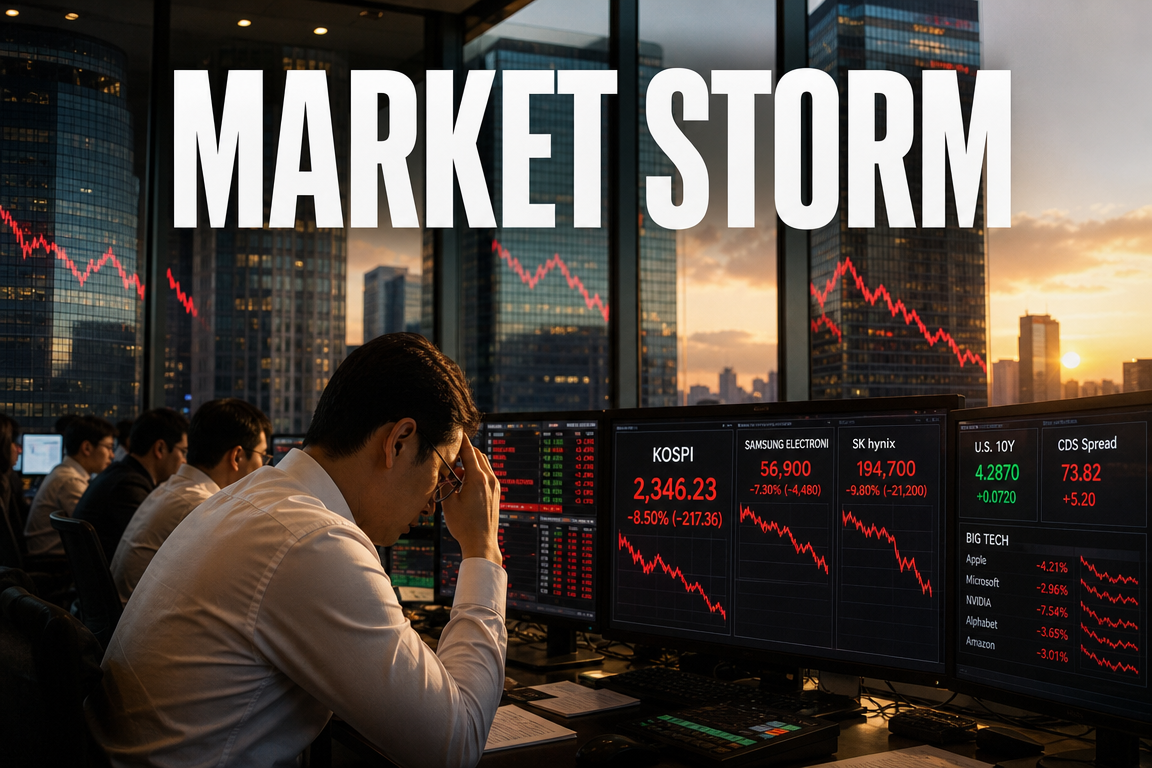
According to the original report, the KOSPI fell by more than 10% in a single day.
On a monthly basis, it also recorded one of its steepest declines on record, with the market experiencing a shock comparable to the global financial crisis period.
In particular, the simultaneous drop in Samsung Electronics and SK Hynix, the core pillars of the Korean equity market, sharply weakened investor sentiment.
-
The KOSPI posted a crisis-level decline.
-
SK Hynix reportedly fell by around 15%.
-
Samsung Electronics reportedly fell by around 14%.
-
The simultaneous weakness in semiconductor large caps destabilized the broader Korean equity market.
At first glance, the news on China’s semiconductor localization appears to be the direct trigger.
However, the market’s deeper concern lies elsewhere.
The core question is whether AI investment can continue to be funded.
2. Downside driver 1: China’s DUV equipment development is primarily a near-term sentiment negative
The first issue was the news that China has begun producing DUV lithography equipment domestically.
DUV is one of the key tools used to pattern circuits onto wafers.
China’s localization of this equipment raised concerns about the global semiconductor supply chain and ASML’s monopoly-like position.
However, the critical distinction is between making a piece of equipment and deploying it reliably in mass production.
-
In semiconductors, process stability matters far more than basic equipment functionality.
-
Overlay precision, throughput, reliability, and maintenance capability must all be secured.
-
There is typically a long validation period between a prototype and a mass-production tool.
-
China’s ability to produce DUV equipment does not automatically imply a rapid erosion of ASML’s market position.
JP Morgan also characterized this issue as primarily a sentiment factor rather than one that would materially alter the earnings trajectory.
In other words, the China DUV development may pressure semiconductor sentiment in the short term, but it is unlikely to immediately undermine the medium- to long-term earnings outlook for Samsung Electronics and SK Hynix.
3. DUV versus EUV: why concerns about China’s semiconductor localization should not be overstated
In lithography equipment, EUV remains the more difficult technology node.
EUV is essential for leading-edge semiconductor processes, and ASML effectively holds a dominant position in this segment.
DUV remains important, but it is generally considered less technologically demanding than EUV.
ASML’s history illustrates how long the gap can be between equipment development and production deployment.
-
ASML had working EUV equipment as early as the late 2000s.
-
However, meaningful production deployment only became possible around 2018.
-
EUV mass production systems became broadly established only in the 2020s.
-
The period from prototype to commercial mass-production use can exceed 10 years.
From this perspective, China’s DUV announcement is meaningful in the context of China’s broader semiconductor localization efforts.
That said, it is unlikely to be a factor that immediately reverses global semiconductor industry conditions, memory pricing, ASML’s competitive position, or the earnings outlook for Samsung Electronics and SK Hynix.
4. Downside driver 2: the real issue is bond yields and the funding burden of Big Tech bond issuance
The more important source of the selloff lies in the bond market.
The market is now focusing less on the potential of AI innovation and more on whether the capital required to fund AI infrastructure can continue to be raised.
In particular, the repeated issuance of large corporate bonds by Big Tech and hyperscalers to finance data centers, GPUs, servers, and power infrastructure has become a concern.
Hyperscalers are companies that operate large-scale cloud infrastructure.
Examples include Amazon, Microsoft, Google, Meta, and Oracle.
They are investing heavily to avoid falling behind in AI competition.
The problem is the sheer scale of these companies.
When a small number of firms issue bonds, the impact on the market is limited.
But when Big Tech issues debt on a large scale, it can affect supply and demand conditions in the global corporate bond market itself.
-
AI investment spending by Big Tech has become extremely large.
-
Corporate bond supply is increasing rapidly.
-
Bond investors are beginning to demand higher yields.
-
Rising funding costs are raising questions about the durability of the AI investment cycle.
5. What rising CDS indicates: the market is repricing Big Tech risk
One of the key indicators currently under close observation is the CDS of Big Tech and hyperscalers.
CDS stands for Credit Default Swap, which is effectively an insurance premium against corporate default risk.
When CDS rises, the market is assigning a higher perceived credit risk to that company.
This does not mean Big Tech is near default.
However, it does indicate that the market is starting to question whether these firms can continue to fund AI expansion through debt at the current pace.
-
AI investment expansion has driven semiconductor demand higher.
-
Higher semiconductor demand has lifted earnings expectations for Samsung Electronics, SK Hynix, and Micron.
-
But if Big Tech funding becomes constrained, AI data center spending could slow.
-
That in turn could weaken pricing and shipment assumptions for memory semiconductors.
In other words, the current KOSPI selloff should be viewed not as an isolated domestic equity correction, but as an event linked to the global bond market, the AI investment cycle, and semiconductor industry expectations.
6. Why Samsung Electronics and SK Hynix were hit harder
Samsung Electronics and SK Hynix have been viewed as major beneficiaries of the expansion in AI infrastructure investment.
In particular, stronger demand for HBM, DRAM, NAND, and server memory has lifted earnings expectations in line with AI data center expansion.
However, stock prices discount future earnings in advance.
As a result, concerns about the sustainability of the future investment cycle tend to be reflected in share prices first.
The market concern is straightforward.
-
Big Tech may no longer be able to issue bonds as easily as before.
-
AI data center investment could then slow.
-
Slower AI server investment could reduce demand growth for HBM and high-performance memory.
-
As a result, EPS estimates for Samsung Electronics, SK Hynix, and Micron could be revised downward.
Semiconductor equities tend to rerate quickly when earnings are improving.
Conversely, when peak-earnings concerns emerge, the pace of decline can also be very sharp.
This selloff appears to have occurred at that point.
7. Why 2027–2028 matters: the validation period for the AI investment cycle
The market’s current concern is not near-term earnings.
Short-term results may still remain resilient.
The key question is whether AI investment can sustain its current pace in 2027 and 2028 and beyond.
Earnings estimates for semiconductor companies have continued to rise as AI demand has been priced in.
However, if Big Tech funding costs rise and bond market resistance increases, those earnings estimates could be revised lower again.
Memory semiconductors are a B2B market.
Even if Samsung Electronics and SK Hynix produce strong products, pricing power can weaken if hyperscaler customers reduce spending.
-
AI data center expansion supports higher prices for high-performance memory.
-
But if customer funding capacity weakens, further price increases become more difficult.
-
Capex slowdowns translate into weaker semiconductor demand forecasts.
-
That would lower EPS estimates and place pressure on valuation.
8. Four possible paths for hyperscalers
Going forward, Big Tech and hyperscalers face four broad options.
Scenario 1. Continue issuing bonds at higher yields
The first option is to keep issuing corporate bonds while accepting higher funding costs.
If the competitive imperative to invest in AI remains strong, this path remains viable.
Some management teams have already signaled that AI investment will not be curtailed.
However, this approach materially raises financing costs.
Over time, higher yields can pressure both shareholder returns and enterprise value.
Scenario 2. Use equity issuance or other equity-linked funding
The second option is to raise capital through equity issuance, convertibles, or strategic investments.
If the bond market becomes less receptive, equity markets may become a funding alternative.
However, this would dilute existing shareholders.
If confidence in AI investment remains strong, companies may still choose this route despite the dilution.
Conversely, equity financing may also be difficult if share prices weaken further.
Scenario 3. Invest only within operating cash flow
The third option is to limit investment to internally generated cash flow.
This would improve financial stability, but it could slow the pace of AI infrastructure expansion.
For semiconductor companies, this is the most sensitive scenario.
If hyperscalers restrict capex to operating cash flow, demand growth for GPUs, servers, HBM, and storage could slow.
That would shorten the market’s expected semiconductor upcycle.
Scenario 4. Reduce capex and reallocate investment priorities
The fourth option is not to stop AI investment entirely, but to slow the pace and adjust priorities.
For example, companies could delay new data center construction, spread out GPU purchase plans, or pursue custom chip development to improve cost efficiency.
If this scenario materializes, earnings estimates for semiconductor companies are likely to be revised lower.
AI semiconductors and memory stocks that had been priced for high growth would likely face pressure.
9. Counterpoint 1: AI is now a national security industry
Nevertheless, the market is unlikely to move in only one direction.
The first counterpoint is potential U.S. government intervention.
AI is increasingly being treated not only as a technology industry, but as a national security industry.
In the U.S.-China technology rivalry, AI infrastructure is closely linked to defense, cybersecurity, and industrial competitiveness.
Accordingly, if a key AI infrastructure company or major cloud provider faces funding stress, U.S. government support in the form of guarantees or investment cannot be ruled out.
As during the 2008 financial crisis, when the U.S. government supported systemically important financial institutions, a similar rationale could emerge for AI infrastructure.
Such intervention is not likely in the near term.
It would require the market to perceive a significantly more severe stress environment.
However, over the long term, it could serve as an important backstop for the AI investment cycle.
10. Counterpoint 2: earnings releases and shareholder returns could drive a near-term rebound
The second counterpoint is corporate earnings and shareholder-return policy.
After a sharp selloff, share buybacks, dividend increases, and strong guidance can trigger a short-term rebound.
However, for that rebound to become a trend reversal, certain conditions must be met.
The market is looking for more than just evidence that this year’s earnings are strong; it wants proof that AI demand can remain intact in 2027 and 2028.
-
Strong near-term earnings alone may not be sufficient.
-
AI data center investment plans must remain in place.
-
The Big Tech corporate bond market must stabilize.
-
CDS spreads must stop widening for sentiment to recover.
11. The most important point often missed in other coverage: the issue is funding, not technology
The most important question in this KOSPI selloff is not whether AI technology is valid.
The real question is whether AI investment can continue to be funded.
Most headlines focus on the surface issues, such as China’s DUV equipment, Samsung Electronics’ decline, or SK Hynix’s losses.
But a deeper reading shows that the key macro variable is bond yields and funding conditions.
If AI proves capable of materially improving productivity and generating substantial returns, the bond market may again support Big Tech.
In that case, the AI investment cycle could continue and semiconductor demand could remain firm.
By contrast, if AI monetization proceeds more slowly than expected and corporate bond yields keep rising, investment momentum could weaken.
In short, the market is currently balancing two forces.
-
The first is the strong technological potential of AI.
-
The second is the funding constraint facing Big Tech.
The outcome of this contest is likely to shape Korean semiconductor equities, U.S. Big Tech, global markets, and the direction of the KOSPI.
12. Key indicators investors should monitor
This issue cannot be assessed using stock charts alone.
Investors should also monitor bond market indicators.
-
CDS trends for Big Tech and hyperscalers.
-
Widening in U.S. corporate bond spreads.
-
Demand in the market for new Big Tech bond issuance.
-
Changes in AI data center capex guidance.
-
HBM pricing power at Samsung Electronics and SK Hynix.
-
Earnings guidance from Micron, Nvidia, and ASML.
-
U.S. Treasury yields and global liquidity trends.
In particular, bond market stability is crucial.
AI-related equities are no longer moving only within the equity market; they have become assets that also trade with the bond market.
13. A realistic interpretation of the KOSPI and semiconductor selloff
The recent decline may have reflected an excessive level of fear.
The China DUV issue alone is primarily a short-term sentiment negative.
However, bond yields and Big Tech funding risk are not merely temporary noise.
The long-term competitiveness of Samsung Electronics and SK Hynix has not disappeared in one day.
Nor has demand for AI semiconductors and high-bandwidth memory suddenly vanished.
That said, the market is now repricing the fact that even good industries can become risky when valuations are too elevated.
Accordingly, investors should focus on more than just buying on the dip.
Rather than entering the market simply because prices have fallen, they should monitor the sustainability of Big Tech AI investment, corporate bond market reactions, and memory pricing trends.
< Summary >
The apparent trigger for the KOSPI selloff is news about China’s DUV equipment localization.
However, the more important underlying cause is funding stress related to Big Tech’s AI investment cycle.
The China DUV issue is primarily a short-term sentiment negative and is unlikely to immediately disrupt ASML or the global semiconductor supply chain.
By contrast, higher bond yields, rising corporate bond supply, and widening CDS spreads directly challenge the sustainability of the AI investment cycle.
If Big Tech cannot continue borrowing easily, AI data center spending may slow, and earnings estimates for Samsung Electronics and SK Hynix could be revised lower.
The key issue going forward is the balance between AI’s technological potential and the ability to finance it.
Investors should monitor the KOSPI alongside Big Tech CDS, corporate bond spreads, capex guidance, and memory pricing trends.
[Related Articles…]
- AI Semiconductor Investment Cycle and Memory Market Outlook
- Impact of Rising Bond Yields on Global Equity Markets
*Source: [ 내일은 투자왕 – 김단테 ]
– 코스피 금융위기급 대폭락의 진짜 이유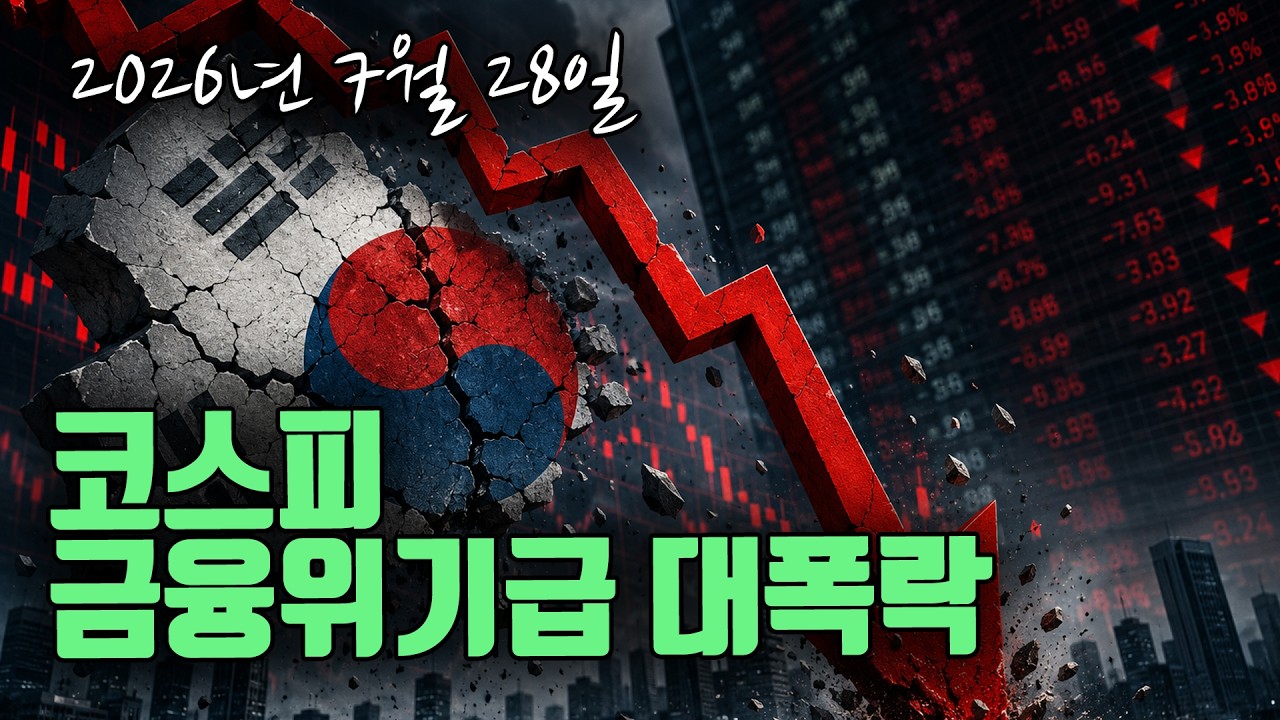
● Market Shock, Structural Rout, Volatility Frenzy
The Real Driver of Unprecedented Market Volatility: What Hit Korean Equities Was Not “Bad News” but Structure
The key point in this Korean equity volatility episode is that the market did not simply fall because it had risen too much.
The real backdrop to the KOSPI correction was a combination of National Pension Service rebalancing, leveraged ETFs, AI bubble concerns, concentration in semiconductors, rate-hike fears, and uncertainty stemming from Middle East conflict and rising crude oil prices.
Most importantly, the force that pushed prices lower was different from the force that amplified volatility.
National Pension Service rebalancing set the direction, while single-name leveraged ETFs increased the magnitude of the swings.
AI peak-out concerns, higher crude oil prices, and rate-hike caution then pushed the market beyond a simple correction into an episode of extreme volatility.
1. Is this really an “unprecedented volatility” environment?
The answer is yes.
Recent volatility in Korean capital markets has moved well beyond a normal correction.
Frequency of sidecar activations, sell-sidecar events, buy-sidecar events, and circuit breaker triggers shows how unusually unstable the market has been.
This episode may also feel more severe in capital market terms than the 2008 global financial crisis.
The important distinction is between the real economy and capital markets.
Korea is not in a situation where growth has completely collapsed.
However, capital markets can swing far more sharply than the real economy when fund flows, investor sentiment, derivatives structures, and institutional rebalancing all coincide.
That is why investors ask: “If the economy is holding up, why is the stock market moving like this?”
2. Why “It fell because it had risen too much” is not enough
A correction after a strong rally is natural.
However, that explanation alone is insufficient for this KOSPI volatility.
Markets do not necessarily sell off immediately just because they have risen strongly.
Moving from 6,000 to 7,000 is a large move, and moving from 7,000 to 8,000 is also a large move.
The real question is where the market enters a broadly recognized overextended zone.
The key feature of this episode is not simple overheating, but the fact that selling pressure and leverage were layered on top of an already extended market.
In other words, there was a rationale for correction, a trigger for correction, and a mechanism that amplified the decline.
3. First driver: National Pension Service rebalancing set the direction
The most important structural factor in this volatility episode was National Pension Service rebalancing.
The National Pension Service must manage domestic equity exposure within a prescribed range.
Because its fund size is very large, changes in its allocation can create direct supply shocks in the Korean market.
Domestic equity limits were temporarily expanded under a special allowance.
However, that higher allowance is not permanent.
Any temporary increase must eventually be adjusted back.
As that process begins, the National Pension Service may need to reduce domestic equity exposure in advance.
This rebalancing sale creates downward pressure on the market.
In short, the fund’s continued holding support during the rally later turned into selling pressure once allocation adjustment began.
That is why National Pension Service rebalancing can be seen as one of the key reasons the market moved lower.
4. Second driver: Single-name leveraged ETFs amplified volatility
If National Pension Service rebalancing determined direction, leveraged ETFs increased the size of the decline.
Single-name leveraged ETFs in particular have become a major source of volatility in Korean equities.
These products magnify gains in rising markets and magnify losses in falling markets.
The issue is not only that they are attractive in the short term, but that compounding makes recovery much more difficult in declining markets.
For example, if a KRW 10,000 asset falls by 20%, it becomes KRW 8,000.
Even if it then rises by 20%, it reaches only KRW 9,600.
To return to the original KRW 10,000, it would need to rise by 25%.
When this pattern repeats, leveraged products can lose value much faster than many investors expect in sideways or falling markets.
That is why the decline in leveraged ETFs linked to Samsung Electronics or SK hynix was steeper than the decline in the underlying shares.
When leverage flows concentrate in semiconductors, the volatility of the overall KOSPI also rises.
5. Third driver: Korean equities are heavily concentrated in semiconductors
The Korean equity market has a structurally high dependence on semiconductors.
U.S. equities also have a high concentration in the Magnificent 7, but in Korea, Samsung Electronics and SK hynix have an even larger influence on the overall market.
As the M7 dominate major U.S. indexes, semiconductor leaders dominate market sentiment in Korea.
The problem is that this concentration works both ways.
It drives gains strongly in favorable conditions, but it also magnifies downside moves when sentiment turns negative.
As AI investment expectations rise, semiconductor stocks rally sharply. When AI bubble concerns emerge, the same stocks weaken together.
Korean equities have therefore become highly sensitive to the AI cycle and the semiconductor investment cycle.
In this structure, a single macro question such as “Will AI investment continue?” can move the entire market.
6. Fourth driver: AI bubble concerns acted as fear, not collapse
One of the main issues disturbing the market was concern over an AI bubble.
However, it is important to distinguish between concern and collapse.
This is not yet a case of an AI bubble bursting.
What the market is questioning is whether AI companies can continue funding massive capital expenditures at the current pace.
For large language model usage costs, cloud infrastructure investment, data center expansion, and GPU demand to keep rising, there must ultimately be paying customers.
Investors have therefore begun asking whether AI is generating sufficient cash flow.
Weakening free cash flow at major technology firms, including Google, has also increased concern.
When free cash flow weakens, investors worry about two things.
First, that large technology firms may slow future investment in data centers and AI infrastructure.
Second, that continued investment could require more debt issuance, which may place upward pressure on rates.
That is the core of the AI bubble concern.
In other words, this is less about present earnings collapse and more about fear over the sustainability of future investment.
7. Fifth driver: China’s AI rise may encourage, not reduce, U.S. AI investment
One common concern in the market is the spread of Chinese AI models.
The argument is that if Chinese AI models scale quickly at lower cost, the profitability of U.S. large technology firms could weaken.
On the surface, that argument appears reasonable.
China is expanding AI models at relatively low cost, while the United States is building AI infrastructure through very large capital expenditures.
Investors then ask whether U.S. firms can earn adequate returns on such spending.
However, the opposite interpretation is also possible.
The United States may choose to accelerate AI investment in order to maintain its lead over China.
The AI competition is not just corporate competition; it is also geopolitical competition.
For the United States, China’s progress may be a reason to invest more aggressively, not less.
The market may initially price fear, but the longer-term outcome may still involve sustained AI infrastructure investment competition.
8. Sixth driver: Middle East conflict and crude oil pushed rate-hike fears higher
Tension in the Middle East was also a key factor in volatility during June and July.
The conflict itself weakens risk appetite, but the more important issue is crude oil.
If crude oil rises sharply again, inflation concerns return.
When inflation concerns return, the market starts to worry about the possibility of rate hikes.
Rate-hike fears are generally negative for equities.
This is especially true for growth stocks, semiconductors, and AI-related names, where expectations of future earnings are heavily embedded in valuations.
Higher crude oil prices can lift inflation expectations, and higher inflation expectations can push government bond yields higher.
When yields rise, safe assets become relatively more attractive than risk assets.
As a result, investors tend to reduce exposure to equities, bitcoin, and other high-risk assets while increasing cash or bond allocations.
9. Seventh driver: Renewed rate-hike pressure across major economies
After the Middle East conflict intensified, the tone of global monetary policy also changed.
Japan, Korea, Australia, New Zealand, Indonesia, and the Philippines all faced renewed pressure to raise rates for their own reasons.
These reasons differ by country.
Some are defending their currencies, some are responding to inflation, and some are trying to prevent capital outflows.
For markets, however, the result is what matters.
When major economies shift back toward tighter policy, global liquidity conditions become less favorable.
The United States may have limited room for actual rate increases, but markets still react to the possibility that it could move again.
That fear alone is enough to pressure equities.
10. The market in one sentence
This KOSPI volatility episode was not a simple decline caused by one negative headline.
National Pension Service rebalancing created downward pressure, leveraged ETFs amplified the move, and AI bubble concerns plus semiconductor concentration weakened sentiment.
Middle East conflict, higher crude oil, and rate-hike fears then further reduced risk appetite.
That is why this was not a standard correction, but an episode of extreme volatility.
11. How should the market be viewed in August and September?
The important point is that some of the factors behind June and July volatility may now be easing.
National Pension Service rebalancing pressure may already have passed in large part.
Measures to address leveraged ETFs are also under discussion.
Restrictions on additional product listings, tighter investment eligibility, stronger risk disclosure, limits on marketing, and higher entry barriers could all reduce volatility amplification.
This does not mean a strong rebound will follow immediately.
However, the phase in which structural selling pressure and leverage amplification were acting at the same time may be passing.
For August and September, the key issue is not whether the correction continues, but whether volatility eases.
12. Key indicators investors should watch
-
Changes in the National Pension Service domestic equity allocation
Investors should monitor whether rebalancing creates additional selling pressure.
-
Trading volume in single-name leveraged ETFs
A renewed surge in turnover could reintroduce market volatility.
-
Fund flow into Samsung Electronics and SK hynix
Because Korean equities are highly concentrated in semiconductors, foreign flows into these two names remain critical.
-
Capex outlook for AI-related large technology firms
AI bubble concerns will ease only if data center investment and GPU demand remain intact.
-
Crude oil prices and Middle East tensions
Another spike in crude oil could revive inflation and rate-hike fears.
-
U.S. Treasury yields and inflation expectations
Rising yields are a headwind for growth stocks and AI-related names.
The most important point that is often missed in other coverage
The key issue in this episode is not simply that “the market fell because there were many negatives.”
The real point is that the market structure itself was built in a way that amplified volatility.
National Pension Service rebalancing created directional pressure.
Single-name leveraged ETFs intensified the move.
Heavy semiconductor concentration allowed sector weakness to spread into index-level weakness.
AI bubble concerns amplified fear over the sustainability of future investment rather than signaling an immediate earnings collapse.
Middle East conflict and crude oil revived rate-hike fears.
In other words, this correction was driven more by market structure and fund flows than by headlines alone.
Many investors focus on conflict, oil, rates, and AI bubble headlines, but what moved prices more sharply was the internal leverage structure of the market.
Going forward, investors should pay closer attention to fund flows, ETF turnover, institutional rebalancing, and semiconductor concentration than to headlines alone.
Investment conclusion
This is not a period to adopt a purely bullish or bearish stance.
It is a period to identify what actually caused the volatility.
Investors should assess whether the drivers of June and July volatility are still present in August or are beginning to fade.
If National Pension Service selling pressure eases and leverage-related regulatory measures advance, volatility may gradually decline.
However, AI bubble concerns, crude oil, rate-hike fears, and Middle East tensions remain relevant.
Accordingly, investors should focus first on signs of volatility normalization rather than near-term rebounds.
In a market centered on semiconductors, changes in Samsung Electronics and SK hynix flows can define the direction of the broader market.
Leveraged ETFs may be attractive in rising markets, but in falling or sideways markets, losses can accumulate much faster than expected.
< Summary >
This Korean equity volatility episode was not a simple correction, but the result of structural supply shocks.
National Pension Service rebalancing created downward pressure, while single-name leveraged ETFs increased the decline.
AI bubble concerns reflected fear over the sustainability of large technology investment rather than an actual collapse.
Because Korean equities are heavily concentrated in semiconductors, changes in Samsung Electronics and SK hynix affected the entire market.
Middle East conflict, higher crude oil prices, and rate-hike fears weakened investor sentiment.
For August and September, the key question is whether volatility will ease, not simply whether the correction continues.
[Related Articles…]
*Source: [ 경제 읽어주는 남자(김광석TV) ]
– 역대급 변동성 장세, 진짜 원인은 따로 있었습니다 | 경제학교 오프라인 특강 [1편]