● Semiconductor Bloodbath-AI Hype Crackdown-Micron,SK Hynix,Samsung Slump
U.S. Semiconductor Stocks Tumble: Is There Still Upside for Micron, SK Hynix, and Samsung Electronics?
The latest semiconductor selloff should be viewed not as a one-day correction, but as a reassessment of investment sentiment driven by concerns over the durability of AI spending, memory supply risks, China’s CXMT, elevated valuations, and upcoming megacap earnings.
Notably, the decline is concentrated in U.S. semiconductor stocks and memory-related names, rather than reflecting a broad collapse in the Nasdaq.
In other words, the market is not signaling that the AI cycle has ended. It is questioning whether current valuations remain justified.
This report examines the selloff in semiconductors and its implications for Micron, SK Hynix, Samsung Electronics, Nvidia, CXMT, crude oil, Middle East risks, and upcoming big-tech earnings.
1. Why U.S. Semiconductor Stocks Were Hit Disproportionately
The broader U.S. market did not experience a general collapse.
The Dow Jones Industrial Average rose about 1%, and the S&P 500 remained in positive territory.
The Nasdaq also avoided a broad-based sharp decline.
However, the semiconductor sector showed a very different pattern.
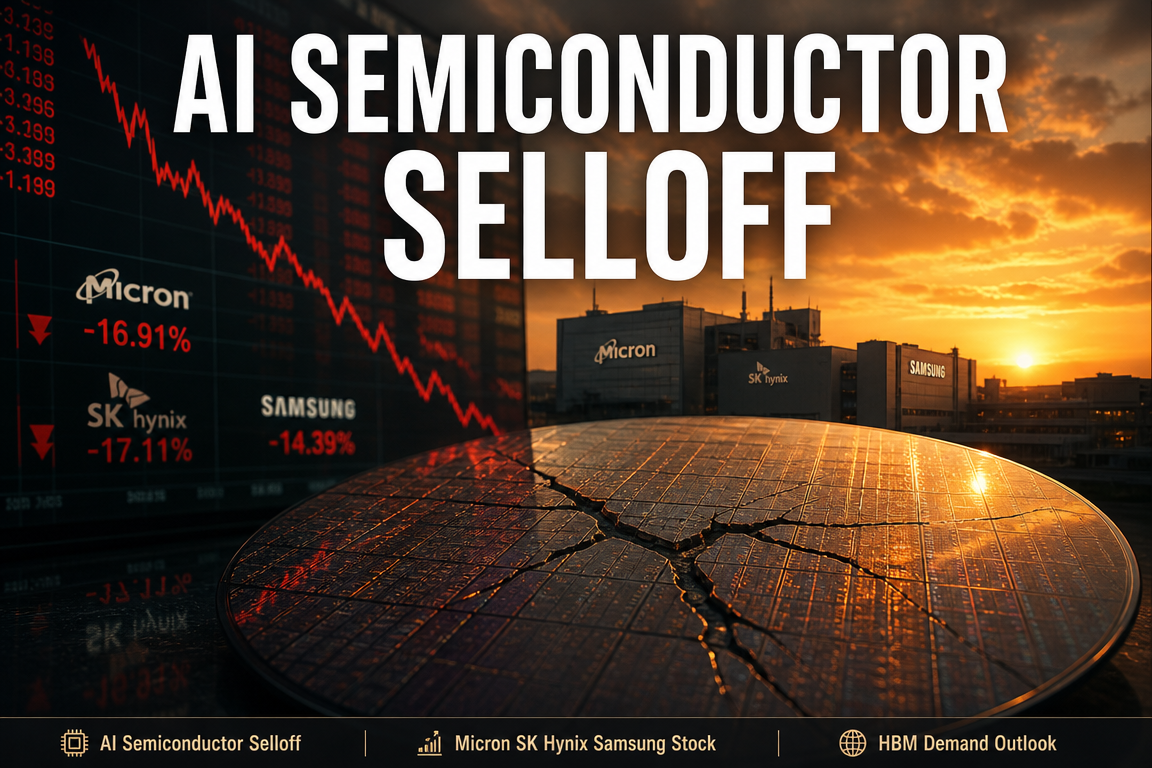
- Micron fell by nearly 9% intraday.
- SanDisk dropped by about 14%.
- SK Hynix ADR declined by around 7%.
- The Philadelphia Semiconductor Index fell for a fourth consecutive trading day.
This suggests the move was sector-specific rather than a market-wide risk-off event.
The selloff in U.S. semiconductor equities is also weighing on sentiment toward leading Korean names such as SK Hynix and Samsung Electronics.
That said, mildly positive overnight futures in Korea suggest the spillover into the local market may remain limited for now.
2. Why the Selloff Occurred Without a New Major Catalyst
The key driver appears to be not a new negative event, but rather the repricing of existing concerns that had already accumulated in the market.
Semiconductor stocks had rallied sharply on expectations of sustained AI investment.
Nvidia-led AI enthusiasm, rising HBM demand, and expanding data center spending had already been reflected in valuations.
When prices rise too far, even modest doubts can trigger rapid profit-taking.
The market is now focused on four main questions:
- Can AI investment remain elevated over time?
- Can big tech generate sufficient returns on large AI capital expenditures?
- Are current semiconductor valuations excessive?
- Could rising supply from China’s memory makers pressure global pricing?
The issue is less about fundamentals deteriorating and more about a reduction in the premium previously assigned to semiconductor equities.
In short, the market is repricing the sector’s risk premium.
3. Why CXMT Matters Beyond a Standard China Headline
China’s memory chip maker CXMT has drawn growing attention from the market.
U.S. lawmakers have urged scrutiny of CXMT’s IPO process and possible Communist Party influence.
While this appears political on the surface, investors are more concerned about the potential for CXMT to raise capital and expand memory supply.
Memory semiconductors are a classic cyclical industry in which even modest oversupply can significantly weaken pricing.
A decline in DRAM prices would directly affect earnings at Micron, SK Hynix, and Samsung Electronics.
To be sure, CXMT is not yet a major global supplier outside China.
It is therefore not a decisive near-term global market driver.
However, if global technology firms such as Apple were to consider Chinese memory chips as part of their supply chain, the implications would broaden materially.
U.S. efforts to scrutinize CXMT reflect concerns over both China’s semiconductor self-sufficiency and the reshaping of global supply chains.
4. Rising Doubts Over the Sustainability of AI Spending
AI spending has been the core driver of the recent semiconductor rally.
Microsoft, Amazon, Meta, and Alphabet have committed substantial capital to data centers and AI infrastructure, creating strong demand for semiconductors.
In particular, demand for Nvidia GPUs, HBM, and high-performance memory has increased sharply.
Investors are now asking a different question.
The issue is no longer whether AI is an important technology, but whether it can generate enough revenue to justify the scale of investment.
This is a critical distinction.
Continued AI investment depends on the strength of big tech cash flow, cloud revenue growth, and AI monetization.
If earnings reports indicate that AI infrastructure spending is still rising while monetization remains slower than expected, semiconductor stocks could face further volatility.
Conversely, if AI revenue growth and cloud demand remain strong, the current pullback could be viewed as a medium- to long-term buying opportunity.
5. Valuation Pressure: Why PBR May Matter More Than PER
Some investors argue that semiconductor stocks remain inexpensive on a PER basis.
However, semiconductors are traditionally a cyclical industry.
As a result, the market also places weight on PBR and long-term valuation bands.
PER may appear low when earnings are strong.
But if profits are elevated at the top of the cycle, a low PER does not necessarily indicate undervaluation.
By contrast, PBR may already be above historical averages.
This is why the market is asking not whether earnings are strong, but whether those results are already fully reflected in share prices.
This is especially relevant in memory semiconductors, where any turn in the pricing cycle can quickly change earnings expectations.
Investors are therefore watching forward guidance and shareholder return policies more closely than current earnings alone.
6. What the MSCI World Semiconductor Index and Philadelphia Semiconductor Index Are Signaling
The MSCI World Semiconductor Index fell about 16% in July.
That would rank among the weakest monthly performances since 2022.
At the same time, the index remains up roughly 28% year to date.
This creates a two-sided picture.
On the positive side, semiconductors remain one of the strongest sectors of the year.
On the negative side, the sector still carries significant gains, leaving room for further profit-taking.
The Philadelphia Semiconductor Index is also in a four-day decline.
While a technical rebound is possible in the short term, a sustained recovery will require a new catalyst.
Price weakness alone is unlikely to attract aggressive buying at this stage.
7. Why Dip-Buying Has Been Weak
Strong sectors typically attract buying on pullbacks.
That has not been the case here.
The reason is that investors still lack confidence in three areas:
- That AI spending will continue to expand.
- That AI services will translate into actual profits.
- That current semiconductor valuations are not stretched.
As a result, investors are choosing to sell first and wait for clearer evidence before re-entering.
In this environment, strong earnings alone may not be sufficient.
The market is likely to require better-than-expected guidance, strong shareholder returns, or clear signals from big tech confirming continued AI investment.
8. What the Market Will Focus on in SK Hynix’s Earnings Release
SK Hynix’s earnings report is a key event for Korean semiconductor sentiment.
However, the market is unlikely to focus only on revenue and operating profit.
HBM demand and the broader memory recovery are already largely priced in.
What investors will want to see is the following:
- How strong HBM demand really is.
- Whether supply plans for 2025 and beyond remain disciplined.
- How aggressively the company will pursue dividends and share buybacks.
In a weak sentiment environment, shareholder return messaging becomes especially important.
Even strong earnings may disappoint if they are not accompanied by a clear capital return policy.
Conversely, a combination of strong shareholder returns and conservative supply discipline could help restore confidence in both SK Hynix and Samsung Electronics.
9. What This Means for Samsung Electronics
Samsung Electronics has been viewed more cautiously than SK Hynix in the HBM segment.
As a result, the U.S. semiconductor selloff is a headwind, but it may also create an opportunity.
Investors continue to watch whether Samsung can improve its competitiveness in high-value memory products.
If the company shows meaningful progress in HBM, it could be re-rated after the current correction.
However, Samsung is not immune to potential weakness in standard DRAM pricing if CXMT-related supply concerns intensify.
Ultimately, Samsung’s share price will depend on HBM competitiveness, the memory pricing cycle, progress in foundry operations, and shareholder return expansion.
10. Crude Oil Decline Offers Some Offset
Despite the semiconductor weakness, broader equities did not deteriorate sharply in part because crude oil prices fell.
WTI dropped by nearly 5%, while Brent declined by more than 5%.
This reflected expectations of easing Middle East risk.
There was no additional escalation between the U.S. and Iran, and Iran’s foreign minister held calls with the foreign ministers of Saudi Arabia and Oman.
Both Saudi Arabia and Oman maintain diplomatic channels with the U.S., which has led markets to price in the possibility of mediation.
If tensions around the Strait of Hormuz ease, global inflation pressures could also moderate.
Lower oil prices are constructive for interest rate expectations, consumer sentiment, and corporate cost structures.
In other words, while semiconductors are under pressure, the macro backdrop is not worsening across the board.
11. The Main Point That Is Often Missed
The core issue in this selloff is not a deterioration in semiconductor fundamentals, but concern over the capital allocation model of the AI era.
Until now, markets broadly assumed that when big tech increased AI spending, companies such as Nvidia, Micron, SK Hynix, and Samsung Electronics would all benefit in parallel.
Investors are now asking a more difficult question.
Who ultimately captures the economic return from AI infrastructure spending?
If Nvidia captures most of the profit, cloud providers absorb the cost burden, and memory chip makers face rising supply competition, valuation premiums may decline.
Another concern is the possibility of circular capital flows.
If AI ecosystems increasingly involve mutual investment and revenue generation among Nvidia, cloud providers, startups, and data center operators, the market may begin to question whether this reflects durable end demand.
Put simply, the key issue is whether there is a true paying customer at the end of the chain.
This is not something that can be inferred from chip prices or earnings releases alone.
Going forward, investors will need to track AI revenue, cloud growth, and data center payback periods alongside semiconductor fundamentals.
12. What Would Be Needed for Semiconductor Stocks to Rebound
For semiconductor equities to stage a sustained rebound, several conditions will need to be met.
First, big tech earnings must confirm continued commitment to AI spending.
Microsoft, Amazon, and Meta would need to signal that AI capex will not be reduced.
Second, there must be evidence that AI services are generating revenue growth.
The market needs proof that monetization is advancing alongside investment.
Third, SK Hynix and Samsung Electronics must show that supply expansion remains disciplined.
Oversupply concerns are highly damaging in memory semiconductors.
Fourth, shareholder return policies need to strengthen.
Dividend increases and share buybacks can help stabilize sentiment.
Fifth, the market needs confirmation that CXMT and broader Chinese memory supply will remain limited in its impact on global pricing.
If Chinese supply does not materially disrupt the market, sentiment toward memory semiconductors could recover.
13. Investment Scenarios to Watch
Positive scenario: Big tech reports strong earnings, AI investment remains intact, and SK Hynix confirms robust HBM demand and shareholder returns.
In this case, the current correction would likely be interpreted as excess froth being removed from the market.
Samsung Electronics and SK Hynix could regain attention as long-term AI beneficiaries.
Neutral scenario: Earnings remain solid, but guidance is mixed and shareholder return messaging is limited.
In this case, stocks could rebound temporarily before returning to a range-bound pattern.
Negative scenario: Big tech becomes cautious on AI investment efficiency, or concerns rise over memory supply expansion.
In that case, semiconductor stocks could face additional downside.
Volatility may be especially pronounced in names that have already posted strong gains.
14. Conclusion: There Is Still Upside, but the Market Now Demands Evidence
The decline in U.S. semiconductor stocks is significant, but it does not yet indicate a collapse in fundamentals.
AI demand remains firm, and big tech spending on data centers has not clearly reversed.
However, the market is no longer satisfied with a simple growth narrative.
It now wants evidence that AI investment is translating into earnings, that memory supply remains disciplined, and that current valuations are justified.
The key upcoming events are big tech earnings and SK Hynix’s results.
Shareholder returns, HBM demand, and continued AI capex will likely determine whether sentiment stabilizes.
At this stage, the focus should be on identifying the catalyst for a rebound rather than assuming the sector is simply cheap.
There is still upside potential in semiconductors.
But for that potential to translate into share price recovery, the market will need convincing evidence.
< Summary >
U.S. semiconductor stocks fell sharply, led by Micron, SanDisk, and SK Hynix ADR.
The move appears concentrated in semiconductors rather than the broader Nasdaq.
The main drivers are doubts over AI spending durability, elevated valuations, CXMT supply risk, and weak dip-buying.
The MSCI World Semiconductor Index fell about 16% in July, though it remains up significantly year to date.
Lower crude oil prices and easing Middle East risks are supportive for the broader market.
Going forward, big tech earnings, AI capex, SK Hynix shareholder returns, and Samsung Electronics’ HBM competitiveness will be key variables.
[Related Articles…]
- U.S. Semiconductor Selloff and the AI Investment Cycle
- How AI Spending Shapes Global Equities and Big Tech Earnings
*Source: [ 내일은 투자왕 – 김단테 ]
– 오늘도 폭락하는 미국 반도체 주식. 희망은 있는가?