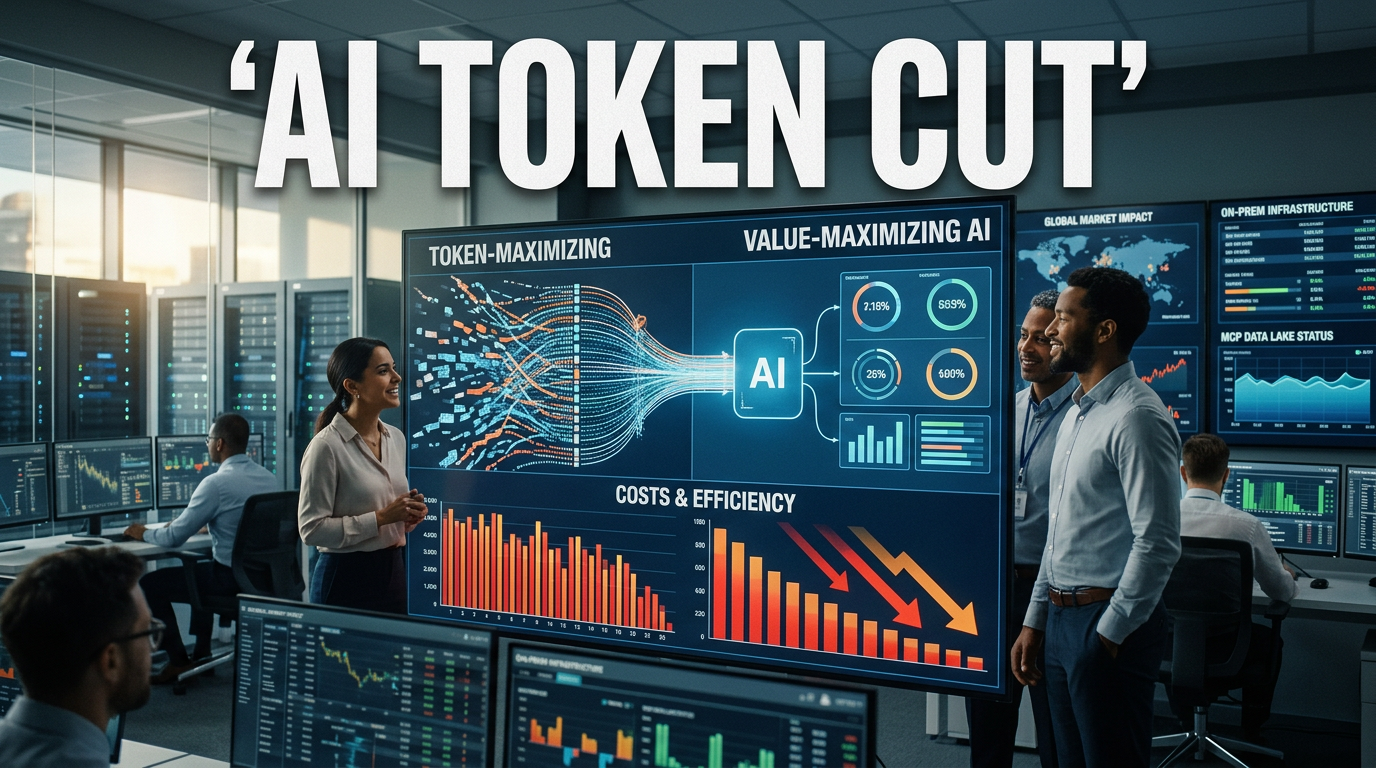
● Token Maximization Fails
Token maxing is over: Why enterprise AI adoption is shifting to “value maxing”
Companies are rapidly moving away from the stage of “let’s get people to use more AI.”
The core point now is not how many tokens employees used, but how much AI actually drove enterprise productivity, cost savings, decision-making speed, revenue contribution, and ROI.
The important points in this piece are broadly fourfold.
First, why companies started to stop token maxing in just a few months.
Second, why AI agents cause token costs to surge so dramatically.
Third, how companies that have properly done AX are now reducing token waste.
Fourth, why companies that have already built data lakes and internal data MCPs will become more advantaged in future AI competition.
1. Why the token maxing era ended too quickly
Token maxing is, simply put, a strategy where a company opens up AI usage broadly to employees and encourages them to use as much as possible.
At first, this approach seemed quite plausible.
That is because using AI heavily could generate automation ideas, improve employees’ usage capabilities, and speed up the company’s digital transformation.
In practice, many companies were extremely cautious before adopting AI solutions.
Decision-making took a long time because of security reviews, cost reviews, privacy issues, whether foreign LLMs could be used, and internal network integration problems.
But once the decision to adopt was made, the mood changed completely.
From management’s perspective, the attitude became, “We worked hard to adopt this, so let’s just let employees use it freely for now.”
So over the past six months to a year, many companies have been quite generous in opening up AI usage.
In some companies, developers’ token usage was even displayed like a leaderboard, and heavy usage was shown as a kind of achievement.
At the time, high token usage itself was seen as a sign that AI transformation, or AX, was going well.
But the problem surfaced quickly.
Token usage exploded, yet it was hard to clearly prove that enterprise productivity had improved by the same amount.
Costs are immediately visible as numbers, but productivity gains are difficult to quantify.
- Globally, token usage has reportedly increased about 22 times over the past two years.
- There is also a trend showing that about 73% of U.S. companies have exhausted or overspent their AI-related budgets early.
- AI agents can consume in a single task the amount of conversation that a person might use 100 times.
- Because employees are spending company money, they naturally prefer the most expensive flagship models.
In the end, token maxing started from the optimism that “if we use AI a lot, value will eventually emerge,” but for companies it became impossible to avoid the question: “Is actual performance being delivered at the same pace as costs are rising?”
At this point, enterprise AI adoption strategy is moving from token maxing to value maxing.
2. What value maxing is: an AX strategy shifting from quantity to quality
Value maxing is not about using AI heavily, but about maximizing actual value with AI.
More important than token usage, call counts, or model usage frequency are process improvement, decision automation, cost reduction, revenue contribution, and risk reduction.
This shift is also very important from the perspective of enterprise AI investment.
Early AI investment was closer to experimental spending.
But now AI budgets are also starting to be asked for clear ROI.
Companies now need to consider questions like “How much work time will this agent save?”, “How much cost will this workflow reduce in a specific department?”, and “How much faster will executive decision-making become?”
| Category | Token maxing | Value maxing |
|---|---|---|
| Core goal | Get employees to use AI as much as possible | Create tangible results with AI |
| Main metrics | Token usage, access rate, call count | ROI, cost reduction, shorter work time, decision quality |
| Operating model | Open broadly to all employees | Design around core business processes |
| Risks | Cost explosion, lower consistency, difficulty measuring results | Higher initial design difficulty, need for data integration |
| Required capabilities | AI usage training | Business analysis, data integration, workflow design, cost control |
In the end, AX in the value maxing era is not just AI training.
Now companies are asking less about “how to use ChatGPT well” and more about “which agents and which data should automate our company’s specific tasks?”
That is why the AI lecture market is also changing.
Demand is growing for AX consulting that diagnoses actual business processes and proposes concrete automation designs rather than abstract trend lectures.
3. What actually happened when companies opened up AI
When a company introduces AI services, usage often spikes sharply at first.
During the first week, employees try all sorts of things out of curiosity, and traffic surges.
But over time, usage naturally declines and converges to the company’s real level of AI utilization capability.
This point is quite important.
Many managers see only the first week’s traffic and panic, thinking costs will be too high, so they try to restrict usage.
But in reality, you need to observe it for a few weeks.
That is because once the initial curiosity usage falls away, the employees and organizations that truly weave AI into their work become visible.
There are also large differences by industry.
Sectors with strong network separation, such as finance and public institutions, may have lower utilization because they cannot freely use foreign AI models or cloud-based AI services.
By contrast, industries with fewer network separation constraints, more document-based work, and a high share of employees working in front of computers see utilization rise quickly.
- Manufacturing and construction may show lower average usage because of a high share of field workers.
- Service, planning, strategy, marketing, and development organizations tend to see AI usage rise quickly.
- Companies with many employees who were already using ChatGPT, Claude, and Gemini personally see usage keep increasing after adoption.
- On the other hand, organizations unfamiliar with AI need training and the spread of internal success cases after adoption.
In other words, adopting AI does not instantly mean AX.
What matters is whether the organization is already prepared to accept AI as part of its business language, and whether managers can use the usage data to improve training and systems.
4. The structure by which AI agents cause token usage to surge
AI agents use far more tokens than simple chatbots.
The reason is straightforward.
Users may enter only one or two sentences, but the agent performs multiple steps behind the scenes.
For example, suppose a user asks, “Can we do this new business in Korea?”
A traditional chatbot would provide a rough answer based on learned knowledge or web search results.
But an agent would look up data from the Ministry of Government Legislation, find the relevant legal provisions, compare related regulations, and organize the business feasibility.
The user input may be under 100 characters, but the data the agent pulls in can be thousands of characters.
Real estate reports work the same way.
If a user enters a specific address or land information, the AI agent can pull data from the Ministry of Land, Infrastructure and Transport, actual transaction data, KB real estate market prices, and zoning information, then organize it into tables and reports.
The quality of work definitely improves.
But in that process, both input tokens and output tokens increase.
For companies, this change is a double-edged sword.
AI agents are far more useful than before, but the cost structure has also become much heavier than before.
In particular, if you use high-performance models by default, AI costs rise quickly.
5. The solution found by companies that have done AX: lightweight LLM workflows
Companies that are actively pursuing AX recently do not let agents move around freely without control.
There are two reasons.
First, token waste becomes severe.
Second, the consistency of results declines.
Initially, many companies used a method where they gave a flagship LLM all the tools and data and told it to “just figure it out.”
For example, they would attach 20 tools such as a cost data MCP, production data MCP, public data MCP, and ERP data MCP, and let the AI choose whatever it needed.
But this approach had problems.
The AI could call tools in a different order every time.
Even for the same question, one day it would pull data from A first, and another day from B first.
As a result, the outputs subtly changed, and unnecessary tokens were consumed in the process.
That is why the structure with a lightweight LLM in the front has emerged.
First, a cheaper and faster lightweight LLM analyzes the user’s request.
Then it drafts the workflow by deciding which MCPs to call and in what order.
After that, the high-performance flagship LLM follows that workflow and handles the actual analysis and final report generation.
- The lightweight LLM designs the task sequence and tool-calling plan.
- The flagship LLM handles high-quality judgment, document writing, and executive report generation.
- Unnecessary tool calls are reduced, lowering token costs.
- The problem of different results each time is reduced, improving consistency in business outcomes.
Some companies also use Python programs or deterministic MCPs instead of a lightweight LLM.
For example, when a request comes in saying, “Tell me whether we should invest in this company,” the AI does not search freely but moves in a fixed sequence.
- It retrieves corporate disclosure information from DART.
- It fetches corporate credit information from a credit rating agency.
- If it is an unlisted company, it checks a separate corporate database.
- It organizes the collected data into a PDF or structured document.
- In the final step, the LLM writes the investment decision report.
The advantage of this method is clear.
Because the information collection process proceeds in a fixed order, consistency is high.
The AI focuses on the final judgment and explanation, reducing token waste.
In the end, the core point of value maxing is not “let the AI do everything,” but “design the work structure so the AI does what it does best.”
6. Why internal data MCP is becoming the real battleground for enterprise AI
The brain of AI models is already improving rapidly.
Model performance continues to improve across GPT, Claude, Gemini, and domestic LLMs.
But what really matters in enterprise work is not the model itself, but access to internal data.
No matter how smart the AI is, if it cannot access a company’s ERP, groupware, electronic approval system, accounting system, production data, customer data, or inventory data, there are limits to real-world automation.
Conversely, when connected to internal systems through MCP, AI becomes not just an answer tool but the front end of work.
For example, employees do not need to go into groupware and click through multiple menus.
If they ask, “How many vacation days do I have left?”, the AI checks the HR system.
If they ask, “Can I reserve a meeting room at 2 p.m. today?”, the AI checks the schedule and meeting room status.
If they ask, “Do I have any electronic approvals pending?”, it finds the documents waiting for approval.
If they say, “Approve this,” it can even carry out the action within the authorized scope.
The effect is even greater in manufacturing companies.
By connecting to SAP, they can automatically calculate cost information and generate executive reports every morning.
By connecting to the factory database, they can automatically analyze the previous day’s yield, defect rate, and production volume.
However, because factory data is sensitive, the structure must share agents only with departments that have access rights.
Enterprise AI competitiveness is now shifting from “which model do you use?” to “how safely and accurately can you connect your company’s data to AI?”
This is also a very important point in terms of future AI investment and economic outlook.
That is because AI infrastructure investment is expanding beyond simple model subscriptions into data pipelines, security, permission management, MCP development, and workflow orchestration.
7. Why companies that built data lakes in advance are now advantaged
A decade ago, during the big data boom, some companies built data lakes and data platforms.
At the time, many people said the return on investment was unclear.
That was because although data had been gathered, it was difficult to connect it naturally to actual automation or decision-making.
But the emergence of generative AI and MCP has changed the situation.
Companies that have already centralized and digitized data only need to plug in pipes to connect it to AI.
By contrast, companies whose data is scattered across departments and locked in Excel files and legacy systems need to clean it up now.
In other words, past digital transformation investments are only now creating meaningful results in earnest.
Companies that have done DT well can move much faster in AX conversion as well.
A data lake is not just storage; it is becoming the fuel for AI agents.
8. Why companies disappointed with RAG need to look at AI again
The core technology in early enterprise AI projects was mostly RAG.
The method is to upload PDFs, internal documents, and rulebooks, and have the AI find relevant passages to answer questions.
But many companies were disappointed with RAG.
It answered incorrectly with numbers, missed context by pulling only part of a document, or had lower accuracy than expected.
In fact, RAG is inherently not a technology for generating 100% exact answers.
Because it chops long documents into pieces and finds passages similar to the question to feed into the LLM, important context can be lost.
That is why many people complained, “Why isn’t our company’s RAG accurate?”
But the environment has changed now.
With MCP, AI can do more than just find document snippets; it can query actual databases.
It converts natural language questions into SQL, retrieves the needed data precisely, and then answers based on those results.
Model performance has also improved.
The ability to understand information within context, reduce hallucinations, and turn output into structured reports is much stronger than before.
So if a company tried RAG very early and concluded that “generative AI is not suitable for enterprise work,” it should take another look now.
This is actually closer to the real starting point of enterprise AI utilization.
9. The most important point that other news sources do not explain well
Most news stops at “AI costs have increased,” “token maxing is over,” or “value maxing matters.”
But the truly important issue is not cost reduction itself.
The core point is that a new AI control layer is being created inside companies.
Going forward, enterprise AI systems will not simply connect to models like ChatGPT.
A lightweight LLM, flagship LLM, MCP, data lake, permission management, workflow engine, and cost monitoring will all be bound together into a single operating system.
The companies that build this structure first can turn AI into a productivity asset rather than a cost.
Especially important is how much freedom to grant the agent.
If you leave every judgment to AI, creativity may rise, but cost and consistency issues arise.
Conversely, if you fix every process deterministically, costs may drop, but flexibility may suffer.
So companies need to design different degrees of AI freedom and control for different tasks.
- For repetitive and rule-based work, deterministic MCPs and automation scripts are better.
- For work that requires judgment, such as report writing, strategic analysis, or investment review, a high-performance LLM is needed.
- For large-scale data queries, the key is connecting internal databases with MCP.
- The final decision-making structure must remain one where humans, not AI, take responsibility.
From this perspective, value maxing is not just a cost-cutting strategy.
It is a change that alters the company’s entire operating model.
AI is becoming not a tool added on top of existing systems, but a new work interface that naturally operates ERP, groupware, and data platforms through natural language.
10. The AX strategy companies need to prepare for next
What companies need to do going forward is clear.
First, they must stop looking only at AI usage and create task-specific performance metrics.
Instead of which department uses AI the most, they need to see which tasks have reduced time and cut costs.
Second, they need to organize internal data.
If data is scattered, AI agents cannot work properly.
They need a data lake, data catalog, permission management, and API integration structure.
Third, they need an MCP-based connection strategy.
ERP, groupware, accounting, production, sales, and customer management systems must be safely queryable and executable by AI.
However, this should not mean opening all data to all employees; it must be controlled based on permissions.
Fourth, they need to use lightweight LLMs and high-performance LLMs for different roles.
If expensive models are used for everything, AI costs become hard to bear.
Classification, routing, workflow design, and simple summarization should be handled by lightweight models, while complex judgment and final documentation should be handled by high-performance models.
Fifth, they need to change the direction of AI training.
Simple prompt training is no longer enough.
They must analyze department-specific workflows and connect that to which tasks should be agentized, what data is needed, and which performance metrics should be used for evaluation.
< Summary >
Token maxing was an early strategy to get people to use AI heavily, but it quickly revealed its limits due to exploding costs and measurement problems.
Enterprise AI strategy is now moving toward value maxing, which prioritizes ROI, cost reduction, task automation, and improved decision-making over token usage.
AI agents improve business quality by directly querying diverse information such as legal, real estate, ERP, and factory data, but they also greatly increase token costs.
Companies ahead in AX are solving cost and consistency issues by having a lightweight LLM design the workflow first and a flagship LLM handle final judgment and documentation.
In the future, enterprise AI competitiveness will depend less on model choice and more on how well companies build internal data MCPs, data lakes, permission management, and workflow orchestration.
[Related Articles…]
- Enterprise productivity is changing with AI workflow automation
- How AI agents are reshaping task automation and investment opportunities
*Source: [ 티타임즈TV ]
– 토큰맥싱 위해 좌충우돌 했던 회사들이 요즘 하는 것 (표철민 AI3 대표)