● Tesla-Coup, Musk-Control, 1-Trillion-Bet
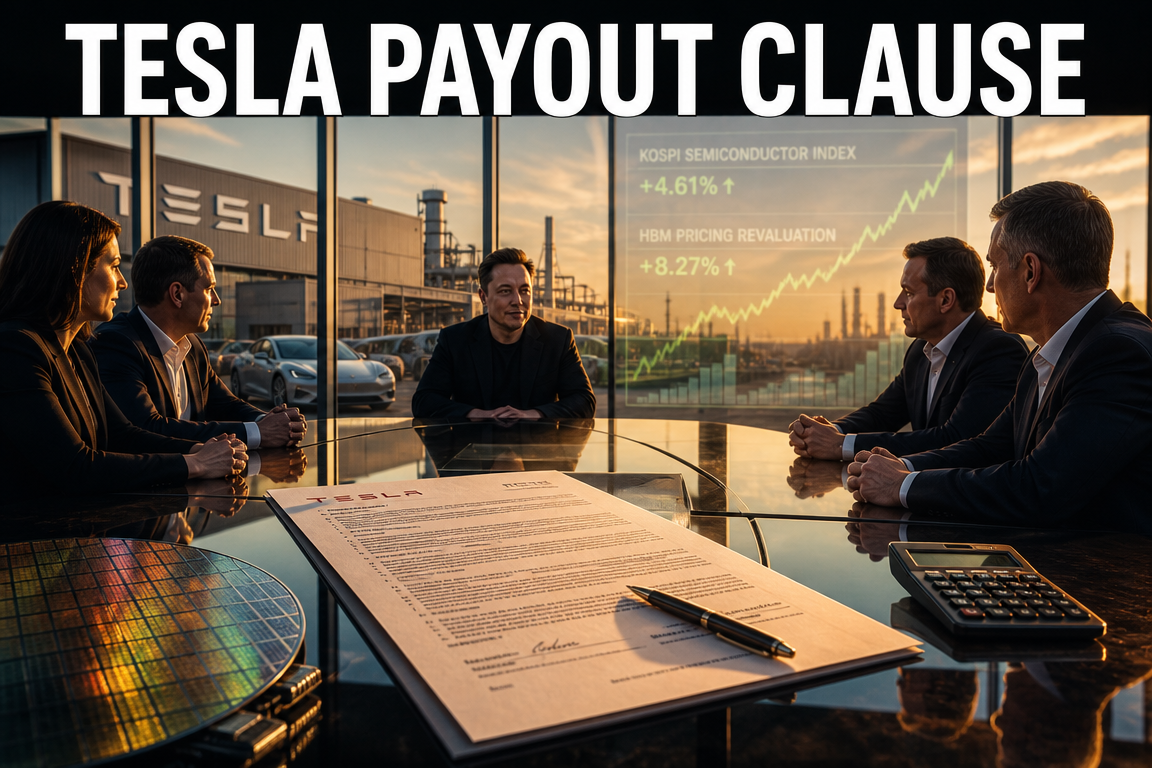
Tesla Compensation Plan, Page 5: For Tesla Shareholders at $332, the Key Variable Is Not the Recall but Control
Today’s key Tesla story is not simply that Tesla shares closed at $332.81.
The Model 3 and Model Y recall matters, but the larger issue is a single clause on page 5 of Elon Musk’s compensation agreement.
That provision states that if Tesla is acquired or control changes, the core conditions of the existing compensation package may change materially.
In simple terms, the package originally required real operating performance, such as robotaxi commercialization, Optimus mass production, and cumulative vehicle output targets.
However, in a merger or acquisition scenario, those operating milestones could be disregarded, and compensation eligibility could be determined largely by market capitalization.
This matters because a Tesla merger with SpaceX or another Musk ecosystem company is no longer just a theoretical scenario; it is increasingly tied to control structure and AI industry strategy.
For shareholders near the $332 level, this should not be viewed only as a short-term positive or negative development.
Future Tesla share performance, overseas equity strategy, AI valuations, autonomous driving commercialization, and robotaxi expectations may all become linked to this control issue.
1. Market conditions today: Tesla rises modestly as markets remain cautious ahead of CPI
Tesla closed at $332.81, up 0.58%.
U.S. equities were broadly weaker.
- The Dow Jones Industrial Average fell 0.11%.
- The S&P 500 declined 0.06%.
- The Nasdaq dropped 0.32%.
The declines reflected caution ahead of this week’s CPI inflation data.
In addition, oil prices rose more than 5% on uncertainty related to the Strait of Hormuz, adding to renewed inflation concerns.
Gold also climbed to its highest level since June.
Overall, global markets remain highly sensitive to rates, oil, and inflation.
In that context, Tesla’s modest gain is constructive, but the broader market was not in a strong risk-on position.
2. Tesla recall: Model 3 and Model Y headlight issue
Tesla also faced a recall update.
The U.S. National Highway Traffic Safety Administration accepted a recall involving certain Model 3 and Model Y vehicles due to a headlight issue.
The issue concerns Marelli headlamp assemblies that may exceed U.S. federal brightness limits.
Initial estimates indicated roughly 19,917 vehicles, but the formal filing suggests a larger final scope.
Tesla reportedly challenged the regulator’s position, but NHTSA rejected the objection and moved the matter into a formal recall.
It is not yet clear whether the issue can be resolved through a software update.
Tesla is said to expect some service-center visits.
From an investment perspective, this is a short-term negative.
The more important medium- to long-term variables are the compensation plan, merger potential, and changes in control.
3. The one-line clause in page 5 of the compensation plan
The key issue is a clause reported by The Wall Street Journal in Elon Musk’s compensation agreement.
The compensation package, approved in 2025 and described as worth up to $1 trillion, included widely known performance conditions.
Originally, Musk had to satisfy two requirements at the same time.
- Tesla had to reach staged market capitalization targets.
- Tesla had to complete 12 operating milestones.
Those milestones reportedly included cumulative vehicle production of 20 million units, 1 million Optimus robots sold, and 1 million robotaxis in commercial operation.
The key clause states that if Tesla is acquired or control changes, the operating milestones may be waived.
In other words, in a merger or acquisition scenario, execution targets such as robotaxi deployment, Optimus sales, and cumulative production could disappear, leaving market capitalization as the primary test.
This is not a routine contractual detail.
It means the mechanism intended to verify Tesla’s future operating performance could be removed in a control change scenario.
4. Why the clause matters: the compensation package becomes far less demanding
Musk’s compensation plan was originally viewed as exceptionally difficult.
It effectively required Tesla to evolve from an auto manufacturer into a self-driving platform, robotaxi network, and humanoid robotics company.
That changes materially if a merger or acquisition occurs.
Operational milestones drop out, and only market value remains.
Under that structure, Tesla would not necessarily need to operate 1 million robotaxis.
It would not need to sell 1 million Optimus units.
It would not even need to meet cumulative production targets.
What would matter is the valuation at the time of the transaction.
The clause can be interpreted as highly favorable to Musk.
If the package was originally designed to vest over a decade, the merger provision may effectively accelerate the path to payout.
5. The numbers make the issue clearer: a $2 trillion acquisition versus an $8.5 trillion target
The scenario highlighted by The Wall Street Journal is a possible SpaceX acquisition of Tesla.
For example, if SpaceX were to acquire Tesla at a 54% premium, the transaction could be valued at roughly $2 trillion, according to the report.
In that case, Tesla shareholders might receive about 3.8 SpaceX shares for each Tesla share, under the illustrative scenario described.
However, that would still fall far short of the maximum compensation outcome.
The final market-cap target in the package is understood to be about $8.5 trillion.
To receive the full award, including roughly 423.7 million shares, Tesla would need to be valued near that level at the time of acquisition or equivalent event.
Accordingly, a $2 trillion transaction would satisfy only part of the framework.
The “$1 trillion compensation package” description would be more consistent with an $8.5 trillion or equivalent valuation.
This shows that Tesla is not simply a question of whether the stock trades at $332 or $400.
The key issue is whether the market can revalue Tesla as an AI and robotics platform rather than only an automaker.
6. What a Tesla shareholder at $332 should focus on
For investors holding Tesla around $332, or monitoring the stock closely, three layers should be separated.
- Short-term drivers: CPI, rates, recalls, and EV demand.
- Medium-term business drivers: FSD, robotaxi rollout, energy storage, and Optimus progress.
- Long-term governance drivers: Elon Musk’s compensation plan, institutional ownership, and merger potential.
Many investors still evaluate Tesla primarily through vehicle deliveries.
However, Tesla’s current valuation is difficult to explain using only an EV framework.
For the stock to justify a higher multiple, the market must increasingly view Tesla as an AI company.
Conversely, if the market concludes that robotaxis and Optimus remain too distant, valuation pressure could reemerge.
At this level, the central question is not whether Tesla is cheap or expensive.
The real question is what kind of company Tesla will become, and under whose control.
7. The rise in institutional ownership is the most important structural change
According to the report, Tesla now has 5,771 institutional holders with 2.113 billion shares in aggregate.
Based on approximately 3.95 billion Tesla shares outstanding, institutional ownership is estimated at about 53.5%.
Elon Musk’s stake, after option exercise, is described as approximately 19.9%.
On a simple basis, individual investors would represent about 26.6%.
- Institutional investors: about 53.5%
- Elon Musk: about 19.9%
- Retail investors: about 26.6%
This matters because any future merger proposal would be decided under a different voting structure than in Tesla’s earlier history.
Tesla was once seen as a stock where retail investors had substantial influence.
Today, institutional ownership is larger, and passive support from major holders may matter more than retail sentiment.
Large institutions also tend to rely heavily on proxy advisers such as ISS and Glass Lewis.
That factor is often overlooked, but it could materially affect any vote outcome.
8. The Texas re-domestication is more than a headquarters move
Tesla re-incorporated from Delaware to Texas in 2024.
This should not be viewed as a purely administrative change.
From a governance perspective, it is significant.
Delaware is known as the center of U.S. corporate law, with extensive precedent on executive compensation and board independence.
Texas corporate law is sometimes viewed as comparatively more favorable to management and boards in certain situations.
If a future merger between Tesla and SpaceX or another Musk ecosystem company is proposed, legal jurisdiction and approval mechanics may become important variables.
That is highly relevant for Tesla shareholders.
Even if the merger itself is desirable or undesirable, the legal framework in which the vote occurs could shape the result.
9. SpaceX governance explains why Musk emphasizes control
At Tesla, Musk’s ownership is described at about 19.9%.
That is substantial, but not a majority control position.
SpaceX is structured very differently.
It reportedly uses Class A and Class B shares, with Class B carrying stronger voting rights.
According to the report, Musk holds 12.2% of Class A shares and 93.3% of Class B shares.
Based on that structure, Musk’s voting power at SpaceX is estimated at about 83.6%.
The key point is that ownership and voting power are not the same.
At SpaceX, Musk’s economic stake is described as about 42%, but his voting control is far higher.
At Tesla, simply increasing ownership does not easily create majority control.
If Tesla were brought into a SpaceX-like structure, Musk’s decision-making authority could become much stronger.
That is why merger discussions should be viewed as a governance issue, not just a strategic combination.
10. Musk’s objective is likely control over the AI era, not just money
Many reports frame Musk’s compensation in financial terms.
The $1 trillion figure is obviously enormous.
But given Musk’s existing wealth, money alone does not fully explain the motivation.
The recurring theme is control.
Musk has previously said publicly that he wants at least 25% voting power at Tesla.
He has linked that view to the need for sufficient influence over large-scale robotics development.
His recent remarks follow the same logic.
He has said that AI will ultimately become too intelligent for humans to fully control.
He compared the process to raising an extraordinarily gifted child: one cannot fully control AI, but one can still shape its values and principles.
This is not just philosophical language.
From Musk’s perspective, AI models, robotics hardware, compute infrastructure, and satellite networks must move in one strategic direction.
He appears to believe Tesla, SpaceX, xAI, and Optimus should be coordinated within a single strategic framework to compete effectively in AI.
11. The less discussed issue: the merger may be about voting design more than synergy
Most coverage of a Tesla-SpaceX combination focuses on synergy.
The combination of rockets, satellites, AI, autonomous driving, and robotics is presented as a future industrial platform.
That is relevant, but the more important issue may be voting control.
In Tesla’s current public-company structure, Musk’s 19.9% stake still leaves him exposed to institutional influence, the board, and proxy advisers.
In SpaceX’s structure, he reportedly holds about 83.6% of the vote.
If Tesla were absorbed into that framework, future decision-making could become far more centralized.
In that sense, the compensation clause is not simply about making it easier for Musk to be paid.
It may be about whether Tesla’s decision-making structure can shift toward a Musk-led, dual-class system.
That is the most important point in today’s news.
12. Three possible scenarios for Tesla shareholders
There are three broad scenarios to consider.
Scenario 1: Tesla continues as an independent company
Tesla remains a listed company and continues expanding FSD, robotaxi, Optimus, and energy businesses.
In that case, the stock will likely continue to trade on execution and commercialization progress.
That provides relatively high transparency, but Musk’s desired control remains limited.
Scenario 2: Deeper strategic cooperation with SpaceX or other Musk ecosystem companies
Rather than a merger, Tesla could increase collaboration with xAI, SpaceX, or related entities.
That could support a stronger AI-related valuation framework.
However, questions about conflicts of interest, technology transfer, and cost allocation would remain.
Scenario 3: An actual merger or governance restructuring
The biggest change would come from a merger between Tesla and SpaceX, or another Musk ecosystem company.
In that case, Tesla shareholders might receive SpaceX shares or equity in a new combined entity.
The key issue would be the exchange ratio.
The value assigned to Tesla and SpaceX would determine shareholder outcomes.
Investors would also need to examine liquidity, listing status, and voting rights after the transaction.
13. Key risks investors should not overlook
This development is interesting from a long-term perspective, but the risks are clear.
- First, the compensation clause may face criticism as not sufficiently shareholder-friendly.
- Second, Tesla shareholders could receive unfavorable exchange terms in any merger.
- Third, a dual-class structure could weaken the influence of ordinary shareholders.
- Fourth, robotaxi and Optimus commercialization could be delayed.
- Fifth, CPI and higher interest rates could pressure growth-stock valuations.
Overseas investors should not view Tesla only as a growth stock.
It is increasingly a complex asset shaped by EVs, AI, robotics, governance, legal jurisdiction, and institutional voting power.
Accordingly, investors should monitor proxy materials, SEC filings, and compensation terms, not only quarterly delivery data.
14. Conclusion: the key question for Tesla shareholders at $332
The fact that Tesla closed at $332.81, up 0.58%, is only the surface story.
The real issue is the one-line clause on page 5 of the compensation agreement.
That provision could materially simplify Musk’s compensation conditions if Tesla is acquired or control changes.
It also forces investors to revisit the possibility of a Tesla-SpaceX combination through the lens of governance and AI strategy.
The central question is whether Musk prioritizes money or decision-making power in the AI era.
Current evidence suggests he places greater value on control.
In an era when AI may exceed human intelligence, the key issue becomes who defines the system’s values.
Can Tesla, SpaceX, xAI, Optimus, and robotaxi be integrated into a single framework?
For Tesla shareholders, returns may increasingly depend not only on vehicle sales, but also on the answer to that question.
< Summary >
Tesla closed at $332.81, up modestly.
The Model 3 and Model Y headlight recall is a short-term issue, but the more important topic is the hidden clause in Elon Musk’s compensation plan.
If Tesla is acquired or control changes, operating milestones such as robotaxi and Optimus targets may be waived, leaving market capitalization as the main condition.
Institutional ownership has risen to about 53.5%, making any future merger vote structurally important.
SpaceX’s dual-class structure reportedly gives Musk strong voting control.
The core issue is therefore not compensation alone, but control in the AI era and the possibility of a Tesla governance reset.
Shareholders at $332 should focus on merger potential, exchange ratios, voting rights, and whether Tesla is revalued as an AI platform company.
[Related Articles…]
*Source: [ 오늘의 테슬라 뉴스 ]
– 테슬라 보상안 계약서 다섯 페이지, 아무도 몰랐던 한 줄이 다 바꿔놨다 — $332 테슬라 주주는?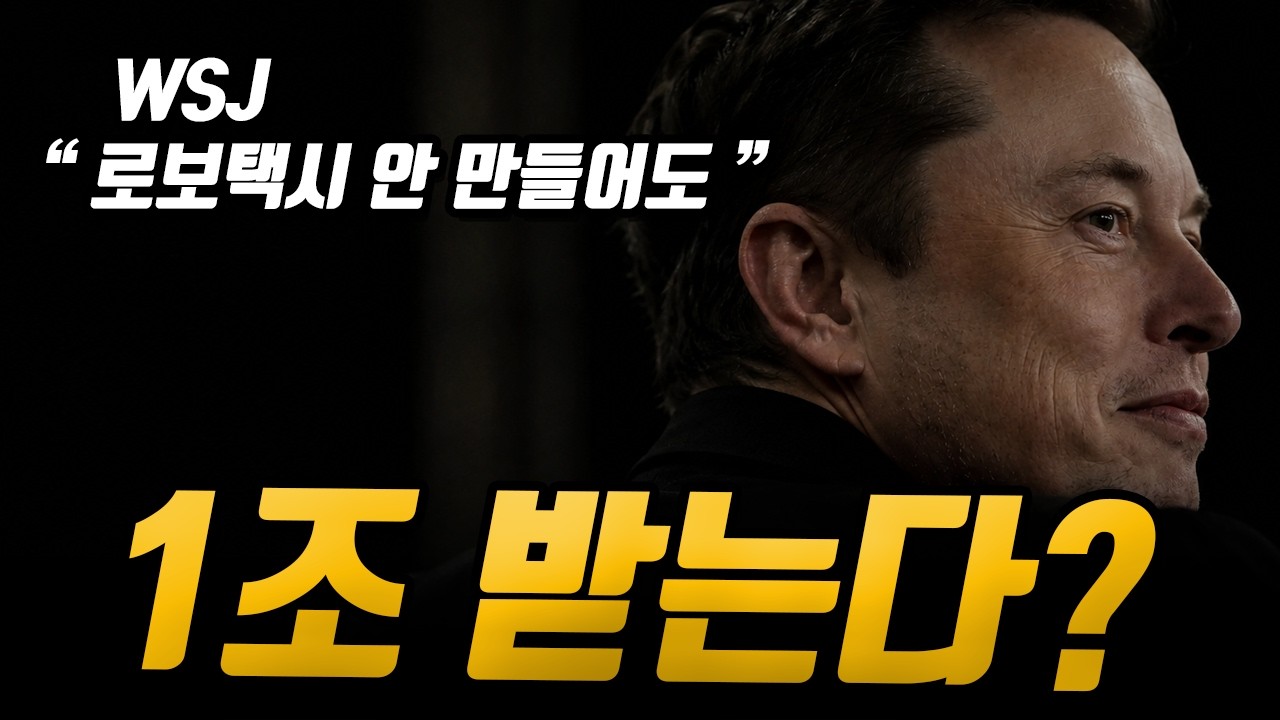
● Semiconductor-Rally, Samsung-Buyback, SK-Hynix-HBM-Boost
Kospi Surge: Samsung Electronics Shareholder Returns Expectations and Resolution of SK hynix HBM Pricing Concerns Drive Semiconductor Rally
The recent surge in the Kospi is not a simple case of “semiconductors rallied.”
The key drivers are rising expectations for Samsung Electronics’ shareholder returns, a revaluation of SK hynix’s HBM pricing, the outlook for persistent memory supply shortages, and the AI semiconductor cycle moving in tandem.
A less obvious but important issue is whether Samsung Electronics can fund the expected shareholder returns from actual cash flow, how much SK hynix’s HBM contract pricing can improve profitability, and whether the current Kospi rally represents a short-term rebound or a structural re-rating.
1. Why the Kospi rose sharply: Large-cap semiconductors led the market
The latest Kospi rally has been driven primarily by Samsung Electronics and SK hynix.
Because both stocks account for a substantial share of the Korean market’s total capitalization, their simultaneous strength can lift the index quickly.
In particular, the continued strength in global AI semiconductor demand has supported domestic semiconductor leaders and acted as the direct catalyst for the move.
This rally appears to reflect more than a mere technical rebound; investors are once again pricing in earnings improvement for Samsung Electronics and SK hynix.
2. Samsung Electronics: Expectations for large-scale shareholder returns
The main positive factor cited for Samsung Electronics is KB Securities’ outlook for shareholder returns.
The core view is that Samsung Electronics could return approximately 700 trillion won to shareholders over the next three years.
If realized, this would be a powerful catalyst for the stock.
Shareholder returns may take the form of higher dividends, share buybacks, and share cancellations.
For investors, this means the company is returning cash generated from operations, which supports the share price and can expand valuation multiples.
The key question is whether the figure is realistic.
The original report refers to Samsung Electronics’ market capitalization at around 1,500 trillion won and notes that 700 trillion won would be close to half of that amount.
In practice, investors should verify the original report, current market capitalization, cash flow, and capital expenditure requirements before making any judgment.
Samsung Electronics requires substantial investment in memory, foundry, and AI server-related capacity.
As shareholder return expectations rise, the market will ask whether the company can simultaneously increase investment, dividends, and share repurchases.
The stronger the answer to that question, the more robust the stock’s upside case becomes.
3. SK hynix: Pricing concerns around HBM have eased
One of the main concerns weighing on SK hynix was the possibility that HBM had been supplied at overly low prices.
HBM, or high bandwidth memory, is a critical component used in Nvidia GPUs and AI servers.
It is effectively a bottleneck product in the AI semiconductor market.
Demand is rising rapidly, but the number of suppliers and total output remain limited.
If SK hynix had sold HBM at deeply discounted prices, revenue would have increased, but profitability could have lagged expectations.
As a result, the market had debated whether SK hynix was the main beneficiary of the AI semiconductor cycle or simply a company with strong volume but limited margin expansion.
The original text cites a Cantor report suggesting that SK hynix contracted HBM at roughly $4 to $5 per gigabit.
If accurate, this would significantly reduce concerns that SK hynix sold HBM too cheaply.
That has important implications for the stock.
If HBM pricing remains strong, SK hynix can be viewed not only as a revenue growth company but also as one that is likely to benefit from margin expansion.
4. Core point from the Cantor report: Memory supply shortages may persist
Another important point is the outlook for a prolonged memory supply shortage.
Cantor reportedly expects the broader memory supply deficit to continue for as long as 10 years.
This matters because it can change how the market views the semiconductor cycle.
Historically, memory semiconductors have been highly cyclical.
When demand improved, companies expanded capital spending, and later oversupply caused prices to collapse.
However, the situation changes if AI servers, data centers, cloud infrastructure, and on-device AI demand continue to grow structurally.
HBM, in particular, is more difficult to manufacture than standard DRAM, and production efficiency is limited relative to wafer input.
In other words, supply cannot adjust immediately even if demand increases.
In such an environment, memory companies may sustain higher prices and stronger margins for longer than in the past.
This is the core rationale behind the move in both the Kospi and semiconductor stocks.
5. What investors should not overlook: These are expectations, not confirmed figures
One important caution is that the market is still reacting to expectations rather than confirmed results.
Samsung Electronics’ shareholder return outlook and SK hynix’s HBM pricing are both positive developments, but they still require confirmation through official management guidance or earnings releases.
Accordingly, the market is currently pricing in reports and expectations ahead of confirmed results.
In such a market, share prices can rise quickly, but volatility can also increase if actual numbers fall short.
For SK hynix, investors should examine actual ASP, customer-specific contract structure, long-term supply terms, input cost increases, and yield improvements.
For Samsung Electronics, the focus should not be limited to shareholder returns; investors should also evaluate semiconductor operating profit recovery, foundry losses, memory pricing, and cash generation.
6. The most important point often missed in other coverage
The key issue in this Kospi rally is not simply that “semiconductor conditions are improving.”
The real point is that the earnings structure of semiconductor companies may be changing relative to the past.
In earlier cycles, memory companies earned substantial profits during upcycles, but earnings fell sharply during downturns.
That made the market cautious about assigning high valuation multiples to Samsung Electronics and SK hynix.
However, AI-related HBM demand differs from conventional memory demand.
Customer demand is shifting toward Nvidia, AMD, large-scale data centers, and cloud providers, and products are becoming more differentiated and higher value-added.
In that case, semiconductor companies may be re-rated not merely as manufacturers but as core suppliers in the AI infrastructure supply chain.
That is the key factor behind the potential re-rating of Samsung Electronics and SK hynix.
In other words, the current move is not just a short-term catalyst-driven rally; it reflects the market’s assessment of how important Korean semiconductors can become within the AI infrastructure cycle.
7. Why Samsung Electronics and SK hynix should be viewed differently
Although both are leading semiconductor stocks, the investment case for Samsung Electronics differs from that of SK hynix.
Samsung Electronics is influenced by memory recovery, foundry competitiveness, mobile and home appliance businesses, and shareholder return policy.
In that sense, Samsung Electronics is viewed as a diversified semiconductor and IT blue chip where stability and capital return matter.
By contrast, SK hynix is more directly exposed to HBM competitiveness and AI server demand.
Because SK hynix is regarded as a leader in the HBM market, HBM pricing and shipment volume translate directly into earnings expectations.
For Samsung Electronics, the main drivers are cash flow and shareholder returns.
For SK hynix, the main drivers are HBM pricing and margin expansion.
Understanding this distinction is essential to interpreting the semiconductor-led rally in the Kospi.
8. Key factors to monitor going forward
The first is Samsung Electronics’ official shareholder return policy.
The market impact will differ depending on whether the company increases dividends, repurchases shares, or cancels treasury stock.
In particular, share cancellations can have a stronger effect because they directly increase per-share value.
The second is SK hynix’s actual HBM selling price.
Investors need to confirm whether the reported $4 to $5 per gigabit pricing is accurate, whether pricing differs by customer, and whether long-term contracts include adjustment clauses.
The third is whether the memory supply shortage truly persists.
If HBM capacity expands faster than expected, the supply shortage narrative could weaken.
Conversely, if yield issues and packaging bottlenecks continue, HBM pricing may remain firm.
The fourth is the global AI investment cycle.
If major technology companies continue expanding AI data center spending, both Samsung Electronics and SK hynix could benefit.
The fifth is foreign investor flow into the Kospi.
Because foreign ownership is significant in the Korean market, sustained foreign buying of large-cap semiconductors would amplify index gains.
9. One-sentence summary of the latest Kospi rally
The recent Kospi rally reflects simultaneous gains in Samsung Electronics and SK hynix, as expectations for Samsung’s shareholder returns and easing concerns over SK hynix’s HBM pricing have led investors to reassess Korean semiconductors as key beneficiaries of the AI semiconductor cycle.
However, because these developments have not yet been fully confirmed through official results and management guidance, the most important issue ahead is whether upcoming disclosures validate current market expectations.
The market has now moved beyond asking whether semiconductors will improve and is focusing instead on how long the improvement can last and how high margins can remain.
< Summary >
The core of the Kospi rally is the simultaneous strength of Samsung Electronics and SK hynix.
Samsung Electronics rose on expectations for large-scale shareholder returns.
SK hynix improved as concerns eased that HBM had been sold too cheaply.
The Cantor report’s view that memory supply shortages may persist over the long term also supported semiconductor stocks.
The most important issue is whether AI-related demand can improve the earnings structure of memory companies more than in past cycles.
However, Samsung Electronics’ shareholder return scale and SK hynix’s HBM contract pricing still require confirmation through official disclosures and earnings data.
Going forward, investors should monitor shareholder return policy, HBM pricing, memory supply shortages, global AI investment, and foreign investor flows together.
[Related Articles…]
AI Semiconductor Supercycle and Korea Market Outlook
Global Capital Flows Driving the Kospi Higher
*Source: [ 내일은 투자왕 – 김단테 ]
– 코스피 급등의 진짜 이유 #코스피 #삼성전자 #하이닉스