● AI Bottleneck Shifts, Power Crisis, HBM Fade
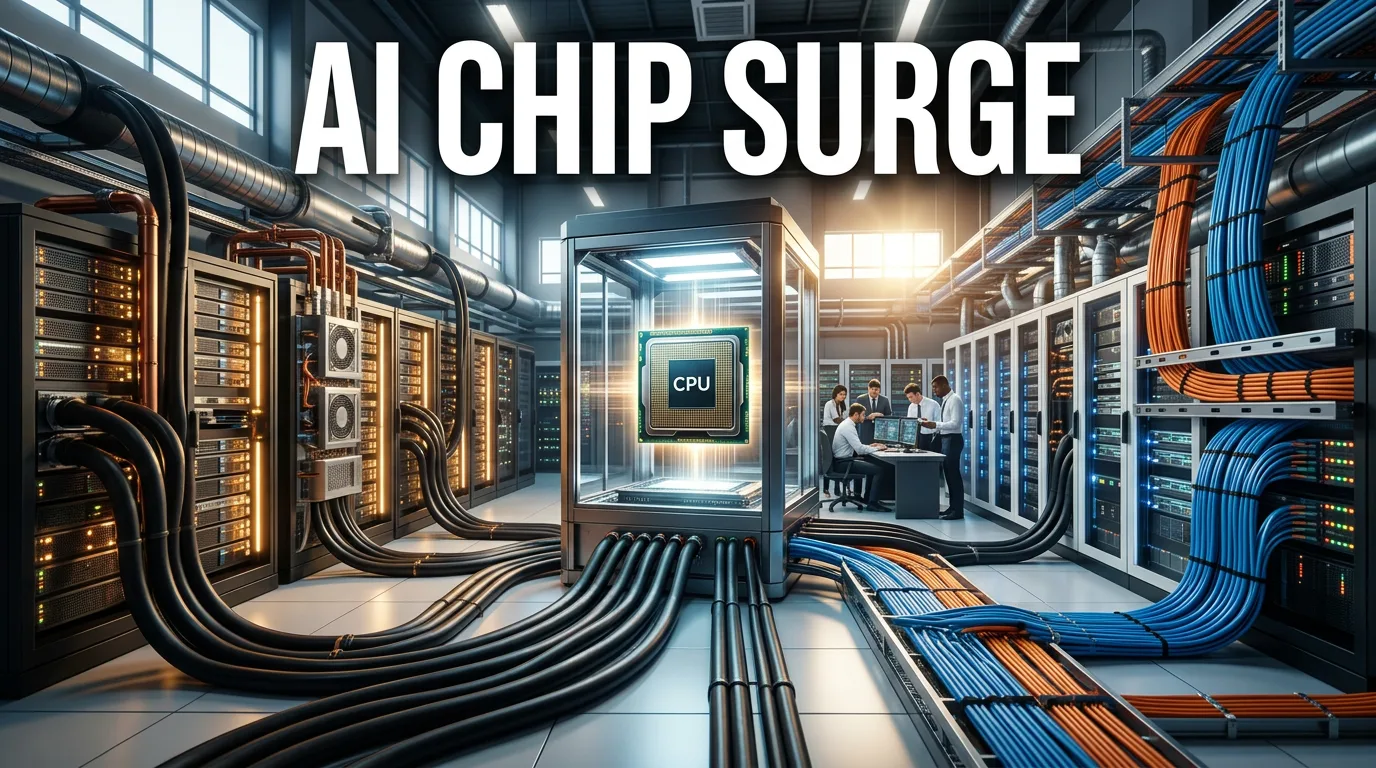
Samsung Electronics and SK Hynix Are Not Done Yet: AI Bottlenecks Are Shifting from GPUs and HBM to Power Infrastructure
The key point of this article is not simply whether semiconductor stocks will rise or fall.
The real issue is where the bottleneck in the AI semiconductor market is moving, and how that shift is changing investment flows across Samsung Electronics, SK Hynix, Nvidia, data centers, and power infrastructure companies.
One point the market often misses is that AI investment may continue even if hyperscalers’ free cash flow declines.
Another important point is that AI leadership may continue to shift beyond GPUs and HBM toward power grids, transmission and distribution, optical communications, and networking equipment.
In short, the story for Samsung Electronics and SK Hynix is not over.
However, viewing the AI semiconductor cycle now requires more than monitoring HBM alone; it also requires tracking data center power demand, U.S. interest rates, big tech capital expenditures, and China-related AI variables.
1. The Main Source of Market Volatility: The Conflict Between FCF and CAPEX
When AI semiconductors and big tech stocks become volatile, two terms recur.
These are FCF, or free cash flow, and CAPEX, or capital expenditure.
- Big tech companies are making large capital investments to build AI data centers.
- As a result, free cash flow is declining, and in some cases there is concern it could turn negative.
- The market interprets this as a possible sign that semiconductor purchases may slow.
- When that concern rises, AI value chain stocks such as Nvidia, Samsung Electronics, and SK Hynix tend to correct.
However, a decline in free cash flow does not necessarily mean AI investment will stop.
Big tech does not rely only on cash on hand.
It can continue investing by issuing corporate bonds, raising funds in capital markets, or using private credit structures.
In the end, the key variables are not simple cash flows but U.S. interest rates, the corporate bond market, credit spreads, and AI investment competition.
2. Why Big Tech Cannot Easily Stop AI Investment Even When Cash Is Tight
Hyperscalers have three main reasons for continuing AI investment.
First, cloud operations are already profitable.
Large cloud providers are reporting operating margins in the mid-20% to high-30% range.
In other words, data center investment is not merely a cost; it is a core profit-generating business.
Second, AI is directly tied to core competitive strength.
Microsoft, Amazon, Google, and Meta risk losing ground in search, advertising, cloud, software, and platform competition if they fail to secure AI infrastructure.
AI compute capacity is now a matter of survival, not choice.
Third, U.S.-China strategic competition is pushing AI investment forward.
In an environment where the United States and China are competing for AI leadership, any reduction in data center investment by U.S. big tech would mean falling behind in compute capacity.
Thus, while the market worries in the short term about weaker free cash flow, capital spending is unlikely to reverse easily at a structural level.
3. Why the Market Reacted to the Idea of “Renting Out Spare Cloud Capacity”
One issue that recently drew market attention was the comment that cloud companies would make external use of spare computing resources.
On the surface, this can be read as a sign of weak demand and excess server capacity.
That is why the market reacted with concern about AI overinvestment, data center oversupply, and slower semiconductor demand.
However, this is close to the basic model of cloud business.
It is similar to building a large warehouse and using part of it internally while leasing the remainder to other companies.
Cloud businesses secure large-scale infrastructure first, then create economies of scale by combining internal demand with external leasing demand.
As noted in the discussion, Amazon has said that the break-even period for servers and networking equipment is roughly within three years.
After about three years, depreciation is largely absorbed internally, allowing newer high-performance equipment to be used directly while relatively older assets are leased externally.
For that reason, interpreting the statement about external leasing as evidence of weakening AI demand may be excessive.
4. Market Noise Is Likely to Continue Through 2027
A key perspective from the discussion is that concerns over weaker free cash flow among big tech companies may recur through 2027.
Because AI data center investment is so large, cash flow may remain under pressure for some time.
As this continues, the market is likely to react in a familiar pattern.
- News emerges that big tech free cash flow is declining.
- The market starts worrying about a reduction in AI capital spending.
- Semiconductor and AI value chain stocks correct.
- In reality, investment continues through corporate bonds, private credit, and external financing.
- Once earnings and order data confirm demand, the market may recover, and the cycle may repeat.
For investors, the ability to distinguish noise from fundamentals has become increasingly important.
Noise includes weaker cash flow, short-term stock corrections, and concerns about CAPEX cuts.
Fundamentals include AI compute demand, cloud profitability, U.S.-China technology competition, and data center infrastructure expansion.
5. The AI Bottleneck Is Already Moving: GPU → HBM → Power
The most important concept in understanding the AI value chain is the bottleneck effect.
A bottleneck is the point at which demand grows faster than supply can keep up.
In the AI industry, this bottleneck is shifting over time.
- 2023: Nvidia GPUs were the main bottleneck.
- Later: HBM became the bottleneck needed to support GPU deployment.
- Now: The constraint is moving toward insufficient power to run data centers.
- Next: Optical communications, networking equipment, cooling systems, and transmission infrastructure may become new bottlenecks.
Initially, the market was dominated by the view that GPU supply was insufficient.
Next came the view that HBM supply was tight, which drove interest in Samsung Electronics and SK Hynix.
Now the more important question is whether data centers can be built at all if power is unavailable.
6. Why Power Infrastructure Is Harder Than GPUs and HBM
Building GPU and HBM capacity typically takes several years from factory construction to production.
Power infrastructure is even more complex.
- Power plants must be built.
- Transmission and distribution networks must be expanded.
- Data center sites must be secured.
- Permits must be obtained.
- Local opposition and environmental regulation must be addressed.
- Replacement demand for aging power grids must also be handled.
In the United States, the power grid is already aging, and AI data center demand is adding pressure to long-delayed replacement needs.
This is not just a matter of higher electricity costs; it is a constraint that could limit the pace of AI industry growth.
A 1GW-scale data center is comparable to the output of a nuclear reactor.
If multiple large AI data centers are built, they can create incremental demand comparable to the electricity consumption of an entire country.
As a result, understanding the AI semiconductor market now requires following the power infrastructure market as well.
7. Why Samsung Electronics and SK Hynix Are Not Finished
There are clear reasons why Samsung Electronics and SK Hynix stock prices have become volatile.
There are concerns about a peak-out in DRAM and NAND prices, and worries that HBM supply could become excessive.
There is also caution that hyperscaler capital expenditure may slow.
However, it is too early to interpret this correction as the end of the AI semiconductor cycle.
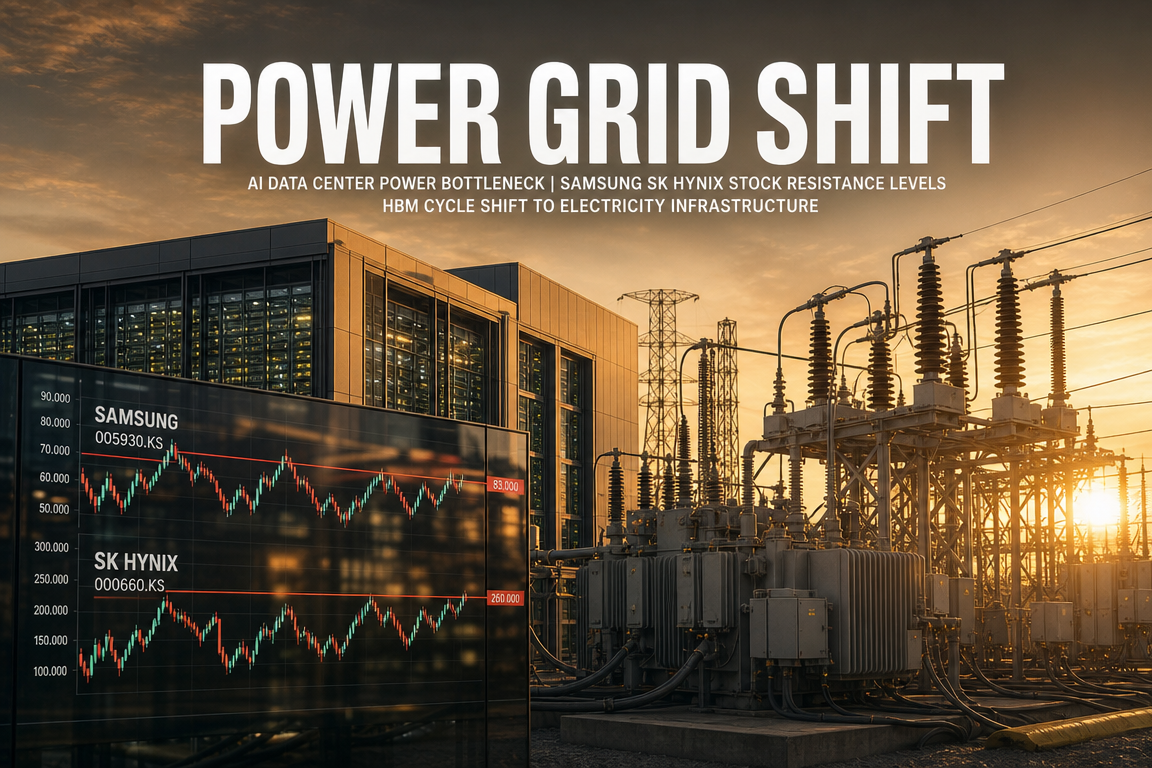
Rather, the current situation appears closer to a phase in which the bottleneck is moving from HBM to power infrastructure.
If power infrastructure expands too slowly, data center construction could be delayed.
In that case, GPU and HBM demand may appear weaker in the short term.
But once power infrastructure is expanded, GPU, HBM, server, and networking demand are likely to follow.
In other words, the key variables for Samsung Electronics and SK Hynix are no longer memory pricing alone.
Investors now need to consider AI data center construction pace, power infrastructure investment, hyperscaler CAPEX sustainability, and China’s memory supply strategy.
8. Why Power Equipment Companies Are Gaining Attention
A particularly notable point in the discussion is the assessment of domestic power equipment companies.
In the past, Korean power-related firms traded at valuation premiums versus global peers.
After recent share price corrections, valuations have moved closer to global peer levels.
At the same time, fundamentals remain constructive.
- Order backlogs are not declining; they are increasing.
- New orders are not falling; they are rising, particularly in the U.S.
- U.S.-related power infrastructure orders tend to have relatively better margins.
- AI data center demand and aging grid replacement demand are occurring simultaneously.
This combination matters to investors.
If share prices have corrected while order backlogs and new orders remain stable or improve, investment appeal may increase.
Although near-term volatility remains, the importance of power infrastructure within the AI value chain is clearly rising.
9. Why Nvidia Is Paying Attention to Power Infrastructure
Nvidia may appear to be only a GPU company, but in practice it occupies a position that requires managing bottlenecks across the AI ecosystem.
Even if Nvidia sells more GPUs, customers cannot deploy them unless data centers are built.
Even if HBM supply is sufficient, AI servers cannot operate without enough power.
For that reason, Nvidia’s efforts to work with power companies, financial institutions, and infrastructure partners are natural.
The discussion also referred to alliance structures for large-scale funding and the possibility of equity investment in power companies.
This can be read as a strong signal that the AI bottleneck is shifting toward power.
The key point is simple.
Demand for AI semiconductors does not move independently.
Power, cooling, land, networking, and financing must all move together before demand becomes actual deployment.
10. China AI Is a Risk, But the Winner Is Not Yet Known
Another variable affecting Korean semiconductor stocks is China AI.
AI model performance in China is improving quickly, and Chinese AI companies are expanding aggressively.
As a result, the market has become concerned that AI value creation could shift toward China.
However, the performance of Chinese AI stocks suggests the situation is more complex.
When a strong new model emerges in China, existing leaders can face sharp declines.
For example, when a particular AI model gains traction, previously favored companies may fall 15% or 30%.
This reflects an important feature of the AI industry.
AI is growing, but which companies capture the value remains uncertain.
In the past, OpenAI’s ChatGPT appeared dominant.
Later, Google Gemini attracted attention, and more recently many users have preferred Claude.
The same applies to China.
In foundation model competition, technological leadership is not permanent.
Therefore, investors should distinguish between industry growth and a specific company’s ability to capture value.
11. The Pressure CXMT Puts on Korean Memory Semiconductors
China’s memory semiconductor company CXMT is also an important variable.
CXMT is widely viewed as a core player in China’s DRAM localization strategy.
There have been allegations of technology leakage in the past, and the company is now expanding capacity with government support.
The discussion noted that CXMT has reached production capacity on the scale of the global top four.
It also mentioned that a very high valuation was assigned during its listing and market assessment.
This is one reason Korean investors have begun paying close attention to CXMT.
CXMT is currently growing mainly in commodity DRAM.
Its HBM technology is generally assessed to be one to two generations behind Samsung Electronics and SK Hynix.
In time terms, some estimates suggest a gap of three to four years.
However, the real issue is not the current technology gap.
The bigger question is how CXMT will behave in the next downcycle.
12. The Real Risk from CXMT: It May Choose Share Gain Over Profitability
The memory semiconductor industry is cyclical.
When conditions weaken, Samsung Electronics, SK Hynix, and Micron cut production to stabilize pricing.
Supply discipline is necessary for profitability to recover in the next cycle.
If CXMT continues expanding production without regard to profitability, the dynamic changes.
As a company supported by China’s strategic policy, it may prioritize technological independence and market share expansion over short-term losses.
In that case, supply discipline during a downturn could become less effective.
This is why the market does not see CXMT as a simple late entrant.
Even if CXMT remains behind Korean firms in HBM for now, it can still disrupt pricing in the commodity DRAM market.
For that reason, China’s memory capacity expansion must be monitored closely when evaluating Samsung Electronics and SK Hynix.
13. The Most Important Point Missing from Many Other Reports
First, concerns about AI investment cuts may recur, but they are not the same as actual investment stoppages.
The market may react every time free cash flow weakens, but big tech is likely to continue investing through corporate bonds and external financing.
Second, the AI bottleneck is shifting from semiconductors to infrastructure.
This does not mean GPUs and HBM are less important.
It means power grids, transmission, cooling, optical communications, and networking equipment are becoming the factors that determine the pace of AI growth.
Third, power infrastructure bottlenecks are difficult to solve quickly.
Compared with semiconductor plants, power infrastructure involves more complex permitting, local opposition, transmission construction, and generation capacity issues.
For that reason, power is likely to remain a long-term bottleneck in AI data center investment.
Fourth, China AI is a structural risk, but the investment winner is still unclear.
The AI model market is changing quickly, and a single new model can shift leadership.
Industry growth and company-level value capture are not the same thing.
Fifth, CXMT’s risk lies less in technology than in supply behavior.
It is not enough to note that CXMT is behind Korean firms technically.
If it continues expanding output even through downturns, supported by the Chinese government, it could disrupt the global memory pricing cycle.
14. Key Indicators Investors Should Watch
- Big tech CAPEX guidance: Monitor data center investment plans from Microsoft, Amazon, Google, and Meta.
- Free cash flow trends: Distinguish between temporary noise and genuine investment slowdown.
- U.S. rates and the corporate bond market: AI investment depends on external funding conditions.
- Power infrastructure order backlog: New orders and backlog levels for transmission, transformers, and power equipment companies are critical.
- DRAM and NAND pricing: Memory price peak-out risk has a direct impact on Samsung Electronics and SK Hynix.
- HBM supply contracts: Watch long-term supply agreements with Nvidia, AMD, and cloud companies.
- CXMT capacity expansion: China’s DRAM expansion could affect the next downturn.
- AI data center power availability: Whether new data centers secure power is a key variable.
15. Conclusion: The AI Semiconductor Cycle Is Not Ending, but Reallocating
The market currently fears the end of the AI semiconductor cycle.
However, the more accurate interpretation is that the bottleneck within the AI value chain is being reassigned.
In 2023, GPUs were the main focus.
After that, HBM became the critical component.
Now, power infrastructure is moving to the center of the market narrative.
Samsung Electronics and SK Hynix remain core AI semiconductor companies.
However, an investment approach focused only on semiconductors is no longer sufficient.
Investors now need to connect AI data centers, power infrastructure, cloud profitability, U.S. interest rates, China AI, and CXMT.
The market will remain volatile.
But investors who can distinguish between structural change and short-term noise are likely to be better positioned for the next AI investment cycle.
< Summary >
The AI bottleneck is moving from GPUs to HBM and now toward power infrastructure.
Weakening free cash flow among big tech companies is a source of market volatility, but it does not necessarily mean AI investment will stop.
Cloud businesses remain profitable, and U.S.-China strategic competition is likely to sustain data center investment.
Samsung Electronics and SK Hynix may face near-term corrections, but the AI semiconductor cycle does not appear to be over.
Power grids, transmission, transformers, optical communications, and networking equipment may become the next major bottlenecks in the AI value chain.
China AI and CXMT are risk factors, but the winner in AI models is not yet determined, and CXMT’s main risk lies more in aggressive supply expansion than in technology alone.
[Related Articles…]
- AI Memory Cycle: HBM Outlook for Samsung Electronics and SK Hynix
- Data Center Power Infrastructure as the Next AI Bottleneck
*Source: [ 경제 읽어주는 남자(김광석TV) ]
– “삼성전자·SK하이닉스, 아직 끝난 게 아닙니다” AI 병목이 이동하는 진짜 이유 | 경읽남과 토론합시다 | 목대균 대표님 [2편]
● KOSPI-Bounce, Real-or-Fake, Samsung, Hynix, Resistance-Zone
Is the KOSPI rebound real? Why retail investors keep selling and the key resistance levels for Samsung Electronics and SK Hynix
The most important point in this KOSPI rebound is not simply that the market has risen.
Retail investors sold about 4.8 trillion won over the past week, while foreign investors bought about 2.6 trillion won on a net basis.
However, the rebound appears to be driven more by institutions than by foreigners, and Samsung Electronics and SK Hynix still look more like a bounce from a trading range than a full return to a strong uptrend.
In particular, SK Hynix may face a key psychological resistance level around 1.95 million won as the stock moves higher from current levels.
This article summarizes the real meaning of the KOSPI rebound, why retail investors continue to sell, why foreign buying should not be interpreted too positively, and the conditions that should be monitored for Samsung Electronics and SK Hynix in a news-style format.
1. The core of the current KOSPI rebound is the contrast between retail selling and foreign buying
The KOSPI has rebounded sharply over a short period.
Based on the original text, the index rose by nearly 1,000 points in one week, and market sentiment changed quickly.
However, the flow of funds is more complex.
Retail investors were net sellers of about 4.8 trillion won during the period.
Foreign investors, by contrast, were net buyers of about 2.6 trillion won.
At first glance, this may suggest that foreign investors are the stronger force.
However, that interpretation would be too simple in the current market.
Foreign investors are not buying Samsung Electronics and SK Hynix aggressively on a concentrated basis, but rather buying across multiple sectors to support the broader market.
The actual upward push in the index also appears to have been supported significantly by institutional bottom-fishing.
In other words, this rebound is better understood as a combination of institutional and foreign dip buying, oversold conditions, and support from major trading ranges, rather than as a clear signal of a long-term foreign conviction trade.
2. Why retail investors continue to sell despite the rebound
There are three main reasons retail investors are selling into the rebound.
First, volatility has been high, and fear remains elevated.
Short-term gains do not immediately reverse the effect of a prior sharp decline.
From a retail investor perspective, the recent rebound may still feel temporary, and another decline may seem likely.
Second, many investors remain focused on breakeven levels.
Those who bought Samsung Electronics, SK Hynix, or other semiconductor names near their highs may feel stronger incentives to sell as prices recover.
If a portfolio that was down 40% improves to down 10%, investors may start thinking, “If it rises a little more, I can exit at breakeven.”
At the same time, fear of another decline encourages some investors to sell during the rebound.
Third, there is still uncertainty over whether this move is based on fundamentals or sentiment.
Although the KOSPI has rebounded, investors still need to assess memory semiconductor pricing, HBM demand, U.S. data center investment, the Nasdaq trend, and U.S. interest rate and currency conditions.
As a result, many retail investors prefer to raise cash rather than chase the rebound.
3. Three key factors driving stock prices
In a highly volatile market, it is important to return to the basic drivers of price action rather than overcomplicate the analysis.
The original text highlights three major factors behind stock performance: earnings, expectations, and public sentiment.
3-1. First factor: the pace of earnings growth
Stock prices do not necessarily rise simply because earnings improve.
The critical point is the rate of acceleration in earnings growth.
For example, if a company’s profit growth progresses from 10% to 20% to 30%, the market is more likely to respond strongly.
By contrast, even if revenue and earnings are still rising, a slowdown from 30% growth to 25% and then 20% may not support further share price gains.
This is a common case where investors ask why strong earnings are not translating into higher stock prices.
The same logic applies to memory semiconductors.
Even if revenue and earnings remain positive in 2027 and 2028, the market will likely demand more than stability.
Investors want not just continued growth, but accelerated growth.
If revenue growth is 50% in one year and expected to rise to 55% or 60% the next, the market may reward that path.
If that expectation weakens, share prices may turn lower first.
3-2. Second factor: order flow and technology expectations
The second driver is expectations.
AI semiconductors, HBM, data centers, power infrastructure, robotics, defense, and biotech often move on future orders and technological positioning rather than current earnings alone.
The challenge is that these companies may not yet generate strong current cash flow.
An expectation that they could earn significantly more in five years can be powerful, but it also increases volatility.
Orders can be delayed or canceled, and if follow-up demand fails to materialize, stock prices can weaken quickly.
As a result, stocks that rise on expectations often surge on news and sell off just as quickly when sentiment changes.
3-3. Third factor: public sentiment
The most important factor in the current market is public sentiment.
In a market shaped by 2026 economic expectations, fear and greed are amplifying volatility.
Even large-cap semiconductor names such as Samsung Electronics and SK Hynix are not moving solely on earnings.
At some point, prices are driven by how many investors still want to buy and how much fear remains in the market.
Even if earnings are not deteriorating sharply, sentiment alone can drive 30% to 50% swings in share prices.
Conversely, extreme fear can create attractive entry opportunities for long-term investors.
That said, resisting crowd psychology is difficult.
When most market participants move in the same direction, even those who do not fully understand the reason may follow.
Investors should therefore assess market sentiment before focusing only on their own portfolio performance.
4. KOSPI trading range analysis: why did the rebound occur now?
To understand the current rebound, it is necessary to look at the KOSPI’s trading range structure.
According to the original text, a strong support zone was formed around the 5,000 to 6,000 range.
Many investors bought in this area, which naturally created a support base.
When prices return to that zone, investors who view it as cheap are more likely to re-enter.
Foreign and institutional buying in this area may therefore reflect not just coincidence, but also support from oversold conditions and a favorable risk-reward setup.
The rebound may also have been supported by the view that Korean semiconductor stocks had become excessively cheap relative to the U.S. market, especially given the Nasdaq’s proximity to prior highs.
In other words, this move should be viewed less as the start of a new bull market and more as a technical and flow-driven rebound from a strong support zone.
5. The next resistance area may be around 7,500 on the KOSPI
The more important issue is the overhead supply.
The original text identifies the 7,000 to 8,000 range, especially the midpoint around 7,500, as a second major trading range.
This area is believed to contain a large number of prior retail entries.
At the time, foreign investors reportedly sold tens of trillions of won, while retail investors bought actively.
As a result, the 7,500 area may trigger breakeven selling from retail investors.
If the index approaches that level, investors who were previously in loss positions may be inclined to reduce exposure.
That could slow the advance or generate strong selling pressure.
Breaking through this range will likely require more than a simple technical rebound.
Stronger catalysts such as memory price increases, additional HBM orders, upside surprises from Nvidia, data center expansion, U.S. rate stability, and currency stability may be needed.
6. SK Hynix key price level: why 1.95 million won matters
The original text compares the KOSPI’s 7,500 area with the 1.95 million won level in SK Hynix.
If SK Hynix is currently trading around 1.57 million won, a move toward 1.95 million won could attract significant selling pressure.
The reason is straightforward.
Many investors are likely stuck at that price level.
As the stock approaches 1.95 million won, more accounts will move closer to breakeven or back into profit.
At that point, investors may decide to exit positions rather than wait.
This creates breakeven supply.
Therefore, for SK Hynix to break decisively above 1.95 million won, a simple rebound may not be enough.
Confirmation of stronger fundamentals, including higher HBM pricing, improvement in DRAM conditions, expansion in Nvidia-related supply chains, and continued AI data center investment, would likely be required.
7. Why foreign buying should not be interpreted too positively
Foreign buying does not necessarily imply a sustained uptrend.
An important point in the original text is that foreign investors also traded SK Hynix tactically.
From around May, when SK Hynix moved above 1.9 million won, foreign investors significantly reduced their exposure.
They sold heavily in the 2.0 million to 3.0 million won range.
Then around July 15, when the stock was trading near 1.9 million won, foreign ownership reportedly increased by about 3 percentage points.
After the stock fell to the 1.5 million won range, they reduced exposure again around July 28.
In roughly 13 days, they exited at a loss.
This example shows that foreign investors are not always right and that foreign buying can also be short-term trading.
Therefore, a net purchase by foreigners should not automatically be interpreted as a signal that the stock will keep rising.
What matters is whether foreign investors are buying cash and futures together, concentrating on specific sectors, or simply positioning for a short-term index rebound.
8. Key checkpoints for evaluating the rebound in Samsung Electronics and SK Hynix
To determine whether the rebound in Samsung Electronics and SK Hynix is a real trend reversal, several conditions should be monitored.
First, memory semiconductor prices must actually rise.
The market can move on expectations, but share prices are ultimately tied to earnings.
If DRAM, NAND, and HBM prices rise more than expected, the market may begin to re-rate future earnings growth.
Second, continued expansion in AI data center investment must be confirmed.
Capex trends at Nvidia, AMD, Broadcom, Microsoft, Amazon, and Google matter.
HBM demand expectations are unlikely to remain strong if data center investment weakens.
Third, the Nasdaq trend must remain intact.
Korean semiconductor stocks are closely linked to U.S. technology shares.
If the Nasdaq holds near prior highs or breaks out, that would support Korean semiconductors.
By contrast, weakness in U.S. tech would likely limit the domestic rebound.
Fourth, U.S. interest rates and the exchange rate need to be monitored.
If U.S. rates rise sharply again or the dollar strengthens materially, foreign inflows may weaken.
Because the Korean market is sensitive to the exchange rate and foreign positioning, stability in the won-dollar rate is important.
Fifth, investors should distinguish between a rally driven mainly by institutions and one supported by long-term foreign capital.
An institution-led rebound can move quickly, but it also faces resistance at major trading ranges.
A more durable rally usually requires sustained foreign participation.
9. What is required for the rebound to become real
For the current rebound to turn into a genuine uptrend, a strong catalyst must shift sentiment from fear to greed.
Such catalysts usually come from earnings, pricing, orders, policy, or global liquidity.
For example, repeated news of memory price increases could lead to higher earnings forecasts for semiconductor names.
If Nvidia signals stronger data center demand, expectations for the HBM supply chain could improve again.
If expectations for U.S. rate cuts rise and the dollar stabilizes, foreign capital may return to Korean and broader emerging markets.
In addition, if domestic earnings estimates are revised upward, KOSPI valuation pressure may ease.
Without these confirmations, a rebound driven only by oversold conditions may stall at resistance.
10. The most important point not emphasized in many media reports
The key issue is not simply that foreign investors bought.
What matters is why they bought and when they may sell.
Many reports show only the net buying figure.
However, foreign flows may include long-term allocation, passive rebalancing, short-term trading, currency positioning, and index rebound strategies.
In other words, the same net purchase can have very different implications.
In the current rebound, foreign investors do not appear to be buying Samsung Electronics and SK Hynix with overwhelming conviction on a concentrated basis.
This suggests that the flows may reflect a broader oversold rebound in Korean equities rather than a strong sector-specific conviction trade.
Another important point is that retail selling is not necessarily irrational.
Retail investors may sell due to fear, but they may also be reducing risk after buying near highs.
If there is a strong overhead supply and insufficient evidence of accelerating fundamentals, partial profit-taking or cash preservation may be reasonable.
Ultimately, the issue is not who is right or wrong.
The key is whether the stocks held by investors can show earnings acceleration, whether there are catalysts to break through overhead supply, and whether foreign flows are tactical or structural.
11. The most important psychological risks for investors now
Two assumptions are particularly dangerous at this stage.
The first is believing that once a stock rises, it must continue rising.
A rebound does not eliminate downside risk.
At major resistance levels, selling pressure can reappear quickly.
The second is believing that the market must return to an investor’s purchase price.
The market does not remember individual entry levels.
Stock prices move based on earnings, interest rates, exchange rates, global equities, supply-demand balance, and sentiment.
Whether a portfolio is down 10% or up 5% is not relevant to the market itself.
Investors should therefore focus not only on breakeven recovery, but also on whether the current trend can be sustained.
If the news flow weakens, foreign investors begin selling again, or earnings expectations decline, it may be necessary to reduce exposure even before breakeven is reached.
Conversely, if earnings expectations improve, memory prices rise, and data center investment remains strong, pullbacks may be viewed as opportunities.
12. Summary of the current market in one sentence
The current KOSPI rebound is meaningful, but it is not yet sufficient to confirm a full trend reversal.
Retail selling reflects a combination of fear and breakeven psychology.
Foreign buying is supportive, but it may also be temporary.
Samsung Electronics and SK Hynix need continued confirmation from memory upcycles and AI data center demand to justify further upside.
In particular, SK Hynix may face resistance around 1.95 million won, while the KOSPI may face a major test around 7,500.
Investors should therefore watch earnings acceleration, the durability of foreign flows, U.S. technology trends, and stability in interest rates and exchange rates before chasing the rebound.
< Summary >
The KOSPI has rebounded, but retail investors sold about 4.8 trillion won while foreign investors bought about 2.6 trillion won.
Retail selling reflects fear, breakeven psychology, and doubts about the durability of the rebound.
The key drivers of stock prices are earnings acceleration, forward expectations, and public sentiment.
This rebound can be viewed as a combination of strong support levels and oversold conditions.
The 7,500 area on the KOSPI and the 1.95 million won level in SK Hynix may act as important resistance zones.
Foreign buying is constructive, but it may also be short-term trading rather than a long-term signal.
A true uptrend will require higher memory prices, stronger HBM demand, sustained data center investment, and stability in U.S. rates and the exchange rate.
[Related Articles…]
KOSPI Rebound and Foreign Capital Flows
Semiconductor Stocks and AI Data Center Investment Outlook
*Source: [ Jun’s economy lab ]
– 이번 반등은 진짜일까? 개인들이 파는 이유