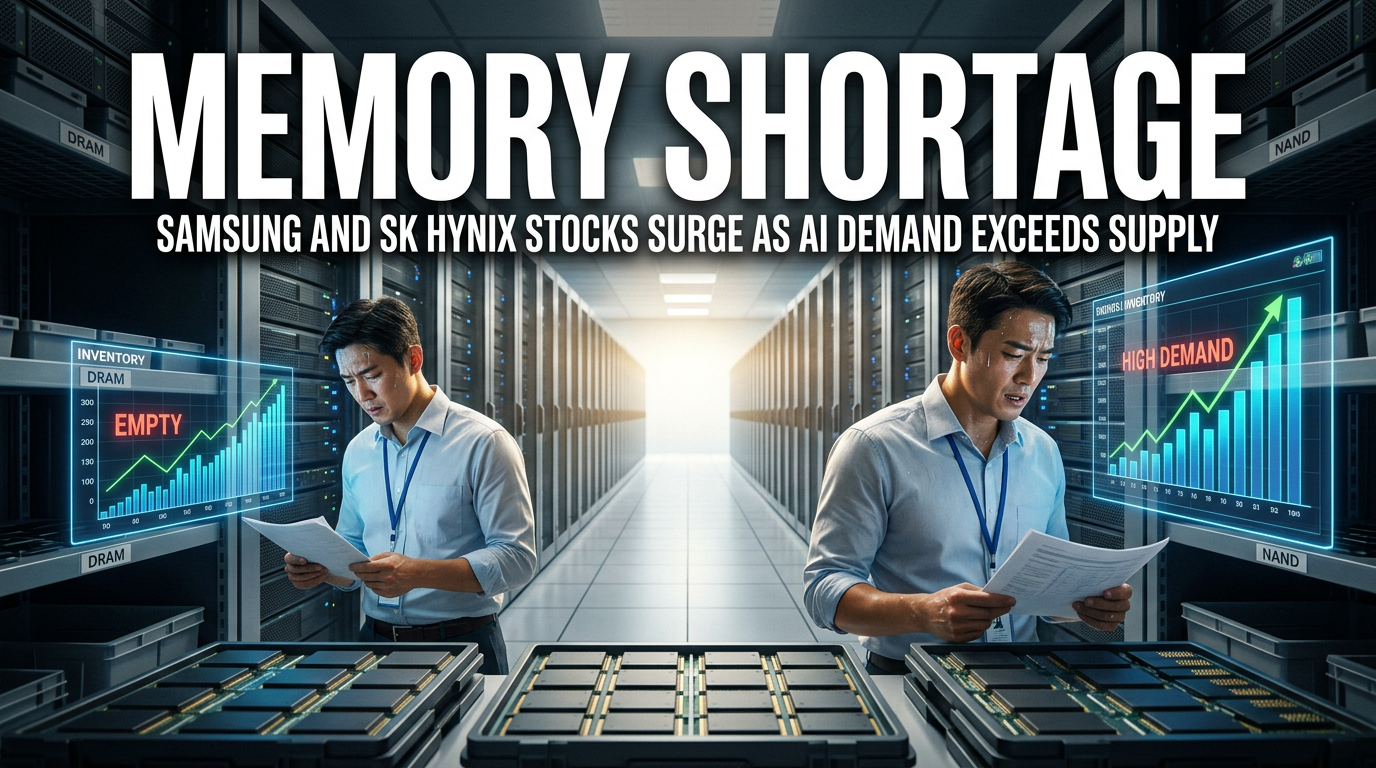
● AI DRAM Shortage Scare
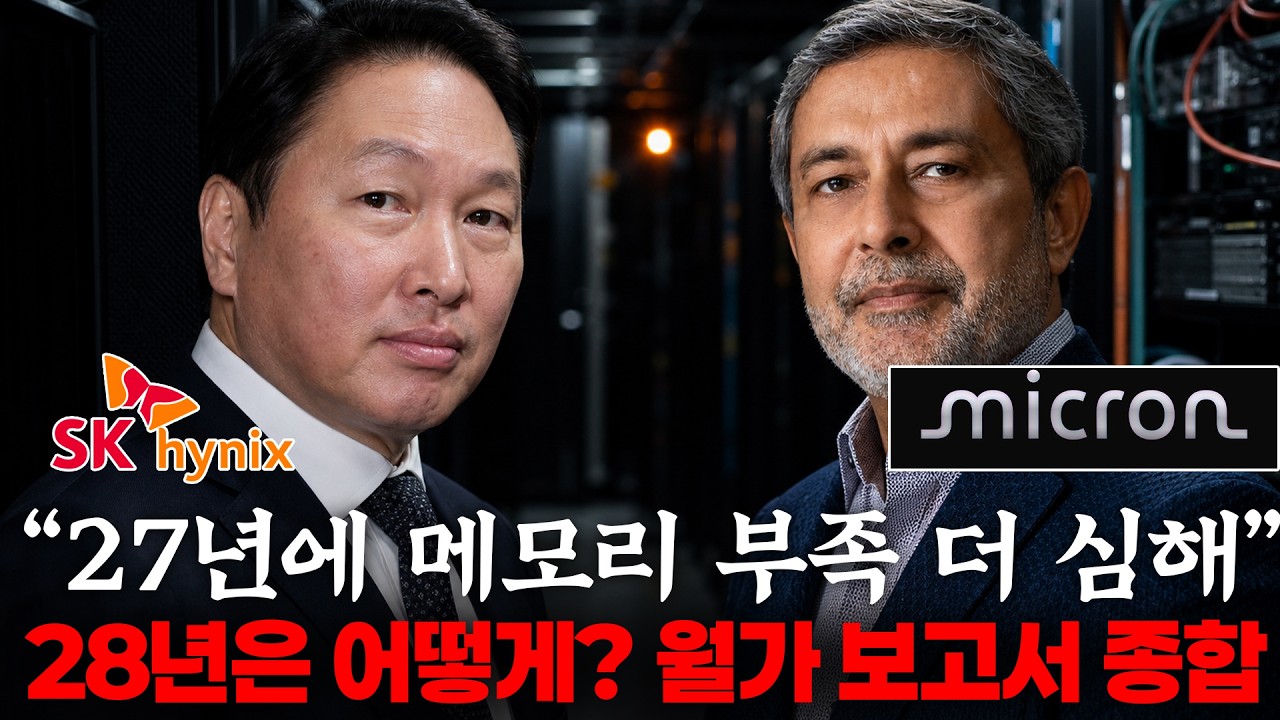
Why Are Samsung Electronics and SK Hynix at This Price: Key Takeaways from Six Wall Street Memory Semiconductor Reports and Micron’s Rebuttal
The core point of this issue is simple.
Stock prices have fallen, but memory semiconductor supply and demand are actually getting tighter.
What the Wall Street reports commonly say is that “due to expanding AI infrastructure investment, DRAM, NAND, and HBM shortages could continue until 2028.”
What is especially important is that while the market is only watching HBM, the real bottleneck is spreading to general-purpose DRAM and NAND.
On top of that, Micron’s CEO said directly at a conference that “memory supply and demand in 2027 could be tighter than in 2026,” which means the recent correction needs to be reconsidered: is it a fundamental deterioration, or just a temporary supply-demand wobble?
1. The Market’s Current Question: Is the Memory Shortage Real, or Is It a Wall Street Trap?
This is the point domestic investors are most suspicious about.
The suspicion is that “Wall Street investment banks are talking up Samsung Electronics and SK Hynix while actually taking money from Korean retail investors.”
To be honest, it is understandable that this suspicion comes up.
In the Korean stock market, foreign investor flows have moved share prices so strongly, and large semiconductor stocks are also the area where individual investors have been burned the most.
But this time, one thing needs to be separated.
Stock price movement and industry supply-demand are not the same thing.
Just because Samsung Electronics and SK Hynix shares corrected does not mean the companies have fundamentally changed from two months ago.
What major Wall Street research and independent semiconductor research firms are commonly saying now is that “memory demand keeps rising, and supply is not keeping up as expected.”
In other words, the recent price correction is viewed less as a sign that the semiconductor cycle has turned and more as the result of weaker Korean market flows, leverage unwinding, and short-term momentum rotation.
2. Citi: The Almost-Only Bearish View, Yet Not a Fully Negative One
Among the Wall Street reports mentioned in the original text, Citi is the most conservative.
Citi sees the peak of the memory industry cycle around the second quarter of 2027.
After that, it expects DRAM and NAND prices could decline.
The key risk Citi highlights is capacity expansion by Chinese memory companies.
The representative concern is that companies like CXMT and YMTC may aggressively expand production capacity.
The logic is that if they flood the market with supply, the timing of memory price declines could move forward.
But there is an important point here.
Even Citi did not present a completely bearish view on Micron.
It lowered its target price, but it still maintained the view that there is upside from the current share price.
In other words, Citi’s message is not “the memory industry is over,” but rather “be careful about the peak-out timing because of China’s expansion risk.”
3. China Memory Risk: Scary, But Not Something That Can Replace Samsung Electronics and SK Hynix Right Away
The risk from Chinese memory companies is real.
However, many say the market is pricing in this risk too early.
It is true that CXMT and YMTC are growing quickly.
Still, the most important factors in high-performance memory semiconductors are equipment, process, yield, and customer qualification.
Due to U.S. export restrictions on semiconductor equipment, Chinese companies face limitations in securing cutting-edge tools.
There are also discussions about China developing its own DUV equipment, but it will take time to catch up quickly to the level of high-performance DRAM and HBM required by the market today.
Industry assessments still often say Chinese companies are several years behind the three major memory makers: Samsung Electronics, SK Hynix, and Micron.
In conclusion, China is a medium- to long-term risk.
But right now, it is overly fearful to view it as a threat capable of disrupting the high-performance DRAM and HBM market for AI servers immediately.
4. UBS: It Actually Raised Its HBM Price Outlook
The most notable part of UBS’s report is its HBM price outlook.
It was previously seen as roughly a 67% increase, but in the latest outlook it was raised to around 79%.
In the market, there are also views that Samsung Electronics and SK Hynix may gain stronger pricing power in HBM negotiations.
The more important part is the DRAM margin.
Based on the original text, UBS sees DRAM margin levels currently close to 90%, and potentially expanding to 92% and even 95%.
Of course, this is a report estimate and should be interpreted differently from actual operating margins in corporate accounting.
Still, the direction is clear.
If DRAM shortages continue for a significant period, prices and margins may remain elevated.
What is especially important in UBS’s outlook is that it does not show margins collapsing sharply even after 2028.
Even if they decline, the scenario still allows for strong profitability.
This is also important from the perspective of the global economic outlook.
That is because AI data center investment is becoming a stage where it turns into real corporate earnings, not just a theme.
5. Bernstein: In the Agentic AI Era, DRAM and NAND Become More Important Than HBM
The core takeaway from Bernstein’s report is that “AI agents broaden memory demand.”
Until now, the market has focused only on HBM.
But the situation changes somewhat in the agentic AI era.
Agentic AI is not just AI that answers questions.
It is AI that understands the user’s goal, uses multiple tools, remembers past context, and plans the next action on its own.
This process requires huge amounts of context and intermediate calculations.
Here, the important concept is the KV cache.
To let an AI model remember long conversations and continue multi-step reasoning, it has to store prior information in memory.
HBM has strong bandwidth, but its capacity is limited.
By contrast, standard DRAM offers larger capacity, and NAND is advantageous for long-term storage and large-scale data retention.
In other words, as AI becomes more agentic, HBM is not the only thing needed.
Instead, DRAM and NAND may become even more important.
This is the most underappreciated part of the current memory semiconductor supply-demand outlook.
6. Goldman Sachs: The Memory Shortage Could Last Until 2028
Goldman Sachs suggested that the memory semiconductor shortage could continue until 2028.
Based on the original text, it sees around a 5% supply shortage across DRAM, NAND, and HBM in 2026.
In 2027, that shortage could widen further, and even in 2028 it may still remain unresolved rather than fully disappearing.
That 5% shortage may sound small.
But memory is an industry where prices can move sharply with even a slight supply-demand imbalance.
If demand is 100 and supply is only 95, customers start price competition to secure volume.
As a result, DRAM prices can move by multiples.
Because of this structure, memory stocks always have high volatility in the stock market outlook.
When conditions are good, profits rise explosively; when they are bad, prices fall sharply and profits quickly shrink.
Still, the common message across current reports is that supply pressure is not likely to ease easily through at least 2026 to 2028.
7. Morgan Stanley: The Correction Is Nearly Over, and This May Be Just a Small Wrinkle
Morgan Stanley recently assessed the memory correction as being close to a “small wrinkle.”
The key point is that current valuations are too low.
If the forward 12-month PER is around 3 to 4 times, the argument is that it can be viewed as a deeply undervalued area relative to fundamentals.
Morgan Stanley identified two major catalysts for upside.
The first is the revaluation of LTA, or long-term supply agreements.
The second is share buybacks.
LTA is a contract where memory companies and large customers set supply volume and pricing over the long term.
In the past, when the industry weakened, customers often broke contracts or renegotiated them.
But now, because of competition in AI infrastructure investment, customers are placing greater importance on securing stable memory supply.
Share buybacks are also important.
In the original text, a scenario is mentioned in which memory companies may use up to 50% of free cash flow for buybacks.
If large-scale buybacks do happen, they could become a catalyst for valuation rerating not only through earnings growth but also through shareholder return policy.
Still, this should be viewed cautiously.
It is not certain that every company will buy back shares as aggressively as suggested in the report’s estimates.
However, the fact that memory companies are now entering a stage where they can redirect cash flow toward shareholder returns is clearly an important change.
8. Micron CEO’s Rebuttal: 2027 Supply and Demand Could Be Tighter Than in 2026
At a recent conference with investment banks, Micron’s CEO made an important statement.
The core message was that memory supply and demand in 2027 could be tighter than in 2026.
This statement is similar to the direction mentioned by SK Hynix.
The bottleneck in AI data centers could spread beyond HBM into DRAM.
Especially if agentic AI and physical AI spread further, memory requirements can grow even more.
Physical AI refers to AI directly connected to the real world, such as robots, autonomous driving, and smart factories.
In these areas, sensor data, real-time decisions, past action records, and simulation data are all needed.
In the end, more DRAM and NAND will be unavoidable.
9. The Most Important Point: SCA Contracts May Be Different from Past LTAs
The most important detail from Micron’s conference is SCA.
SCA stands for Strategic Customer Agreement.
In the original text, this is explained as a long-term supply agreement similar to an LTA.
What matters is the contract structure.
According to Micron’s explanation, there is no contractual termination clause that lets the customer walk away freely, and the agreement is backed by upfront cash and letters of credit.
Why is this important? Because in past memory cycles, when the industry weakened, customers sometimes canceled long-term contracts or reduced volumes.
But in the AI data center era, if Nvidia, cloud companies, and big tech fail to secure memory, product launches and service expansion get delayed.
So the trend is shifting toward tighter contract structures.
This change could improve the earnings stability of memory companies.
It will not completely eliminate the boom-bust structure of the past, but at least in high-value-added memory, cycle volatility may ease.
10. The More HBM Is Produced, the Less General DRAM Supply There Is
In the market, people often think this way.
“If HBM production rises, doesn’t memory supply rise too?”
But in reality, it is closer to the opposite.
HBM is made by stacking multiple layers of standard DRAM dies.
In other words, making one HBM unit consumes a lot of existing DRAM production capacity.
As the industry moves from HBM3 to HBM4 and HBM4E, more dies and more complex processes are required.
Put simply, the more HBM is produced, the less volume remains available for general-purpose DRAM.
That is why stronger HBM demand can also worsen shortages in standard DRAM.
This is a key point many investors miss.
An HBM boom is not only good for HBM companies.
It can also become a structural factor pushing up general DRAM prices.
11. From HBM4 Onward, It Becomes More Like Custom Semiconductor
Another change starts from HBM4 onward.
Traditional DRAM was a relatively general-purpose product.
Customers bought it and applied it to servers or systems as needed.
But from HBM4 onward, the product becomes more customized by customer.
That is because the base logic die must be designed to customer requirements and packaged together with GPUs or AI accelerators.
This structure is similar to the foundry business.
This is where Samsung Electronics gains strategic meaning.
Samsung Electronics has not only memory, but also foundry and advanced packaging capabilities.
If customers can bundle HBM, logic, and packaging within one ecosystem, the lock-in effect may become stronger.
SK Hynix has a strong leadership image in the HBM market, while Samsung Electronics can look for opportunities from the perspective of a full semiconductor ecosystem.
Future competition is likely to shift from simply who makes more HBM to who can better integrate a customized AI semiconductor ecosystem for customers.
12. Nvidia’s Rubin Ultra Issue: The Architecture Is Being Pressured by Memory Shortages
Recently, the issue around Nvidia’s next-generation architecture, Rubin Ultra, has also become important.
According to the original text, Nvidia is considering reducing HBM4E capacity and also cutting DRAM capacity around the CPU.
What this means is simple.
Even Nvidia, with the strongest purchasing power, cannot easily secure as much memory as it wants.
Some interpret this as “if Nvidia reduces HBM per GPU, HBM demand will fall.”
But that interpretation is only half correct.
HBM capacity per GPU may decrease.
But at the full system level, total HBM usage can actually increase as the number of GPUs and rack scale expands.
In the past, structures like NVL72 were central, but in the future systems will expand in the direction of connecting more GPUs and racks.
Then even if memory per GPU declines, memory demand at the level of the entire AI cluster can keep rising.
13. After Memory, Optical Networking May Be Next
Recently, memory semiconductor stocks have corrected, but optical networking-related stocks have shown strong momentum.
This may not be just a simple sector rotation.
As AI data centers grow, networks connecting GPU to GPU, rack to rack, and data center to data center become increasingly important.
If HBM capacity is distributed across the entire system, data movement distances increase.
As data movement distances increase, latency and bandwidth issues become more serious.
Eventually, demand for optical communications, switches, and networking equipment rises.
The strong earnings from optical component companies like Lumentum and Coherent are also connected to this trend.
If the AI infrastructure investment cycle started with GPUs and HBM, the next stage could expand into optical networking and power infrastructure.
14. Why Were Samsung Electronics and SK Hynix Shares Pressured?
If fundamentals are strong, why did stock prices correct?
It can largely be explained by four factors.
-
First, Korean market supply-demand was weak.
Repeated foreign selling and retail buying kept pressure on the short-term share prices of large semiconductor stocks.
-
Second, semiconductor leverage positions were unwound.
Leverage capital that had ridden the AI semiconductor rally was quickly cleared out during the correction.
-
Third, market attention shifted to optical networking.
Some of the capital that made profits in memory appears to have moved into the next AI infrastructure beneficiaries.
-
Fourth, concerns about China’s expansion were priced in too heavily.
China risk is real, but whether it is enough to trigger an immediate supply shock in the high-performance memory market still needs more confirmation.
In conclusion, the recent correction looks more like a price wobble caused by supply-demand flows, sentiment, and position adjustments than a breakdown in fundamentals.
15. Is the Current Price Cheap? The Key Is Risk-Adjusted Return
No one knows whether Samsung Electronics and SK Hynix will bounce back in a V-shape immediately.
In the short term, they could shake around again, or move sideways for a long time.
In particular, semiconductor stocks often rest longer than expected once price momentum fades.
But from a medium- to long-term perspective, the current range looks more like a time to examine than a time to sell.
That is because memory semiconductor supply and demand remain tight, AI infrastructure investment is still expanding, and the bottleneck risk in DRAM and NAND is actually increasing.
The important thing is that “cheap” and “rising immediately” are not the same.
Even if a stock is undervalued relative to fundamentals, it may take time for the price to recover until supply-demand improves.
So investors should respond by checking earnings estimates, memory prices, customer contracts, and share buyback plans rather than focusing only on a short-term rebound.
16. Core Points Other News Often Misses
-
First, even if the HBM shortage ends, the DRAM shortage could get worse.
That is because HBM production uses up general DRAM capacity.
-
Second, AI agents could create even greater demand for DRAM and NAND than for HBM.
That is because long context, KV caches, tool-use records, and long-term memory storage are all needed.
-
Third, the SCA contract structure could change the past memory cycle.
Contracts backed by upfront cash and letters of credit can make unilateral cancellation by customers harder.
-
Fourth, Nvidia’s talk of reducing HBM may be a signal of supply shortage rather than lower demand.
Even if per-GPU capacity falls, total memory usage across the system is likely to keep rising.
-
Fifth, the next beneficiary after memory may be optical networking.
As AI clusters grow, data movement increases, and the value of optical communications and networking equipment rises.
17. Key Indicators Investors Should Watch
-
Spot DRAM prices and contract price trends
You need to check whether the price increase is sustained.
-
HBM4 and HBM4E customer qualification status
The speed at which Samsung Electronics and SK Hynix enter customer supply chains matters.
-
LTA and SCA contract terms
You need to see how much real binding force the contracts have.
-
Nvidia and big tech AI server investment plans
AI infrastructure investment has to continue for memory demand to continue.
-
Actual mass production level of China’s CXMT and YMTC
Yield and customer qualification matter more than expansion announcements.
-
Share buybacks and dividend policy
Greater shareholder returns can be a powerful catalyst for valuation re-rating.
-
Optical networking company earnings
They can show whether the AI data center investment cycle is expanding into the next stage.
18. Final View: Even If Stock Prices Fluctuate, the Memory Bottleneck Is Not Over Yet
The current correction in Samsung Electronics and SK Hynix shares is an uncomfortable phase for investors.
But when Wall Street reports and Micron’s conference remarks are combined, it is still hard to say that the structural demand for memory semiconductors has weakened.
Instead, while the market is only looking at HBM, the bottlenecks in DRAM and NAND are emerging as even more important variables.
Agentic AI, physical AI, large-scale data centers, and the spread of optical networking are all moving in a direction that increases memory usage.
It is difficult to predict short-term stock prices.
But from a fundamental perspective, it is worth checking whether current prices are already reflecting excessive fear.
Especially for investors who look at the semiconductor cycle, AI infrastructure investment, interest rate outlook, and stock market outlook together, this correction can be seen not simply as a decline, but as a phase to prepare for the next cycle.
< Summary >
Major Wall Street reports suggested that the memory semiconductor shortage could last until 2028.
Citi warned about China’s capacity expansion risk, but it was not fully bearish.
UBS raised its HBM price outlook and said DRAM margins could stay elevated.
Bernstein said broader agentic AI adoption could increase demand for DRAM and NAND.
Goldman Sachs projected that the memory supply shortage could continue through 2026 to 2028.
Morgan Stanley called the recent correction a small wrinkle and pointed to LTA and share buybacks as upside catalysts.
Micron’s CEO said supply and demand in 2027 could be tighter than in 2026.
Expanding HBM production reduces general DRAM supply, which could also support general DRAM prices.
Nvidia’s memory capacity adjustments are more likely to signal supply shortage than lower demand.
The next AI infrastructure beneficiary after memory may be optical networking.
[Related Articles…]
- How Far Can the Semiconductor Cycle Go in the AI Infrastructure Era
- How Agentic AI Is Changing Data Center Investment Strategy
*Source: [ 월텍남 – 월스트리트 테크남 ]
– 월가 보고서 6편 + 마이크론 반박문 = 삼전 닉스는 왜 이 가격인가?!