● Mega-Profit Secret
Investors Who Profit While Being Wrong Half the Time: The Real Secret of Top Fund Managers Is Not Stock Picking, but Risk-Reward
The fact that world-class fund managers have a win rate of around 50% is striking.
More importantly, they generated substantial long-term returns despite being wrong about half the time.
The key is not how often they are right, but how much they make when right and how little they lose when wrong.
This report summarizes the investment principle identified by Lee Freeman-Shor through analysis of actual trading data from leading fund managers.
In today’s market, marked by rising volatility, expectations of rate cuts, and renewed inflation concerns, portfolio risk management is a decisive driver of returns.
For investors tracking AI themes, growth stocks, and the global macro outlook, this is less a suggestion than a survival framework.
1. Even Top Fund Managers Are Wrong Half the Time
Former fund manager Lee Freeman-Shor ran the “Best Ideas” fund, built from the core recommendations of leading global portfolio managers.
While analyzing the fund’s actual accounts and trading records, he identified a notable pattern.
Despite their research depth and information access, top fund managers did not achieve a particularly high stock-picking hit rate.
Their win rate was roughly 50%.
In other words, one out of every two investment ideas was wrong.
That may be surprising to many individual investors.
People often assume that great investors are those who correctly identify most stocks.
In practice, that was not the case.
The distinction of great investors came from post-decision execution rather than prediction accuracy.
This matters because even with careful analysis of economic data, corporate earnings, interest rate direction, recession risk, and AI sector growth, markets can move differently from expectations at any time.
The most dangerous attitude in investing is overconfidence in one’s ability to predict outcomes.
2. The Real Driver Is Risk-Reward, Not Win Rate
Freeman-Shor’s conclusion was simple but powerful.
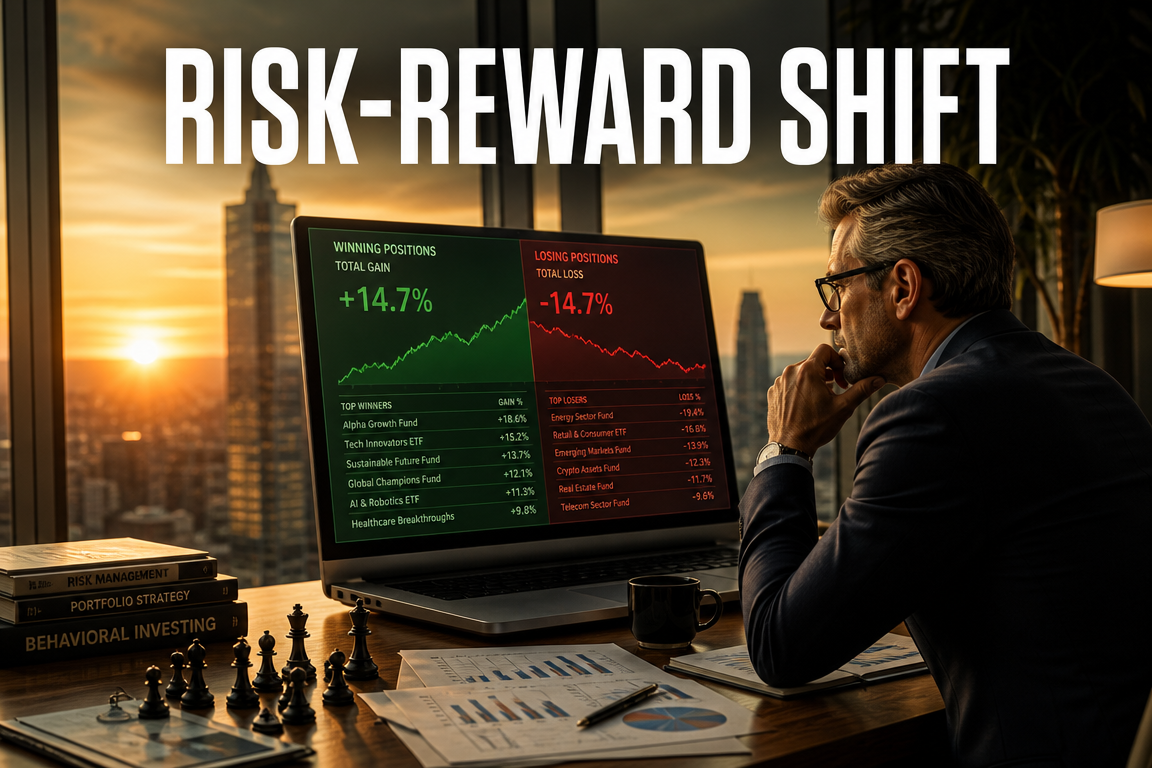
Investment performance is driven by risk-reward, not win rate.
Risk-reward refers to the ratio between average gains when right and average losses when wrong.
For example, even with a 50% win rate, a portfolio can grow if the average gain is 100% and the average loss is only 20%.
Conversely, a 70% win rate can still fail if winners make only 5% while losers lose 50%.
That is why leveraged all-in bets, concentrated single-stock positions, and undisciplined averaging down are dangerous.
They may work a few times by chance.
But one large loss can erase all prior gains.
Freeman-Shor compared this to picking up coins on a railway track while a train is approaching.
The first few attempts may succeed.
Eventually, repeating that behavior leads to a severe loss.
Investing works the same way.
A structure that seeks small gains while risking catastrophic downside is not sustainable over time.
3. The More Important Question Than “What Is the Best Stock?”
Many investors ask famous fund managers, “What is your largest holding?”
From Freeman-Shor’s perspective, that question misses the point.
Top investors did not make money simply because they selected good stocks.
They limited losses when wrong and allowed profits to compound when right.
In other words, the stock itself mattered less than what they did after buying it.
This does not mean any stock will do.
The ability to identify companies with meaningful upside potential remains important.
Finding businesses in AI semiconductors, cloud infrastructure, power systems, robotics, or biotech that can produce 10x or 20x returns is still essential.
But no one can know in advance with certainty which stock will become a major winner.
Good investing therefore requires two elements.
First, an idea with significant upside potential.
Second, a clear execution plan for both losses and gains.
4. The Trap of Price Targets: Selling at 30% Can Block Major Upside
Freeman-Shor was skeptical of the conventional price-target framework.
Analysts often assign targets such as $100 or $130 to a stock.
The problem is that investors often treat these figures as a fixed sell level.
Some companies may ultimately rise to $1,000 rather than $130.
Selling because a target was reached can mean missing a truly exceptional outcome.
Investors satisfied with 30% or 50% gains often remain stuck with average performance.
This does not mean price targets are useless.
The key is to update them continuously rather than treat them as fixed.
When a stock rises, the underlying thesis should be re-evaluated.
Estimates for earnings should be reviewed.
Valuation multiples should be checked.
Business quality should be reassessed.
The strength of the growth story should be tested.
In fast-moving sectors such as AI, selling based on an outdated valuation framework can lead to missed opportunities.
5. Three Ways Investors Handle Losing Positions: Rabbit, Assassin, and Hunter
Freeman-Shor divided investors into three broad types based on how they respond to losing positions.
5-1. Rabbit Investors: They Do Nothing Despite the Loss
Rabbit investors do nothing as prices fall.
They do nothing at -2%.
They do nothing at -20%.
They still do nothing at -40%.
At that point, losses become so large that they cannot make a decision.
The term comes from a rabbit frozen by headlights, unable to move before being hit.
In investing, paralysis after a loss is one of the most dangerous states.
Many individual investors fail at this stage.
They initially think the decline is only a correction.
Then they decide to wait until breakeven.
Eventually, losses deepen and the account becomes difficult to recover.
5-2. Assassin Investors: They Cut Losses When the Thesis Breaks
Assassin investors recognize when a position has failed and exit it.
For example, if a -20% or -30% loss means the original thesis is broken, they sell.
This is emotionally difficult but effective in preventing major damage.
The main advantage of this approach is survival.
It prevents one failed idea from damaging the entire portfolio.
At the same time, winners are allowed to remain in place and compound.
In an environment with high volatility and repeated recession concerns, loss limitation is especially important.
5-3. Hunter Investors: They Buy More When Prices Fall
Hunter investors add to positions when prices decline.
This is not the same as indiscriminate averaging down.
They increase exposure only when deep research suggests the market is wrong and they are right.
On paper, this can be an attractive strategy.
Some of the best investors have indeed profited by buying more when the market underestimated a company.
However, for most individual investors, it is highly risky.
In most cases, the market is correct.
Price declines may reflect deteriorating earnings, stronger competition, interest-rate pressure, or weakening industry cycles.
Without understanding the cause, “buying more because it is cheaper” can worsen losses.
To use this strategy properly, conditions are required.
You must be able to explain why you know more than the market.
You must define the event that would prove you wrong.
You must set a maximum loss even after adding to the position.
6. Two Ways to Handle Winners: Predator and Connoisseur
How investors manage winning positions is just as important as how they handle losses.
Freeman-Shor classified investors holding winners into predators and connoisseurs.
6-1. Predator Investors: They Sell at 10% to 20% Gains
Predator investors sell as soon as a stock rises 10% or 20%.
Their mindset is, “Take the profit and move on.”
They then search for the next opportunity.
The problem is that this approach makes it impossible to hold a 10x or 20x winner.
Stocks such as Nvidia, Apple, Tesla, and Amazon all passed through 20%, 50%, and 100% gain phases early on.
Selling at each stage would have prevented life-changing returns.
Predator investors may realize frequent small gains.
But the cost of missing a major winner is too high.
6-2. Connoisseur Investors: They Hold Great Businesses for a Long Time
Connoisseur investors hold strong businesses for extended periods.
They are willing to wait for 10x, 20x, 50x, or even 100x returns.
Historical studies of top investors show that a small number of exceptional winners often account for most of the total performance.
Warren Buffett is a clear example.
Many of his most important results came from long-held investments such as Coca-Cola, American Express, Apple, and GEICO.
Benjamin Graham also generated strong results through GEICO.
Large returns do not come only from active trading.
They come from identifying a high-quality business and holding it while the underlying growth continues.
7. Why Humans Tend to Become Rabbits
Most investors struggle to sell losing positions.
This is not only due to lack of skill.
It is also driven by behavioral biases.
First, the endowment effect.
Assets already owned tend to appear more attractive than they really are.
A company looks stronger simply because it is in the portfolio.
Second, sunk cost bias.
If an investor has spent considerable time studying a stock, they may hesitate to sell because the effort feels wasted.
They may think, “I studied this much, so I cannot be wrong.”
Third, overconfidence.
Investors often search only for positive views on names they like.
They consume favorable reports, favorable videos, and favorable community opinions while ignoring criticism.
That makes it easy to miss real risk.
Fourth, loss aversion.
Realizing a loss is psychologically painful.
As a result, investors delay action and convince themselves that the loss is not real yet.
But the market does not wait for emotions to settle.
8. Define Your Exit Before You Buy
Freeman-Shor’s most practical rule is straightforward.
Define your exit criteria before entering a position.
The exit rule may be price-based.
For example, an investor may decide to sell if the stock falls 25% below the purchase price.
It may also be thesis-based.
For example, sales growth may fall below a required threshold, operating margins may deteriorate, customer growth may slow, or a competitor may gain a technological advantage.
For AI growth stocks, the criteria should be more specific.
Investors should monitor whether GPU demand is slowing.
They should assess whether cloud providers are reducing AI capex.
They should review whether earnings estimates continue to rise.
The decision to hold should be based on whether the growth thesis remains intact, not simply on whether the share price has already moved higher.
9. A Powerful Question to Avoid Becoming a Rabbit
When holding a losing position, investors should ask themselves one question:
“If I had fresh capital today, would I buy this stock again?”
This question is important because it forces a fresh decision.
If the answer is no, then the reason for holding may be weak.
The position may simply reflect attachment to a past decision.
Investing is not a contest to defend prior choices.
It is a process of allocating capital to assets with the highest expected return.
10. When You Are Right, Add to Winners
To improve risk-reward, limiting losses is not enough.
Investors must also expand gains when the thesis is working.
One method is pyramiding into winners.
This means adding to a stock after it has moved higher.
If the original thesis was correct and the fundamentals continue to improve, position size can increase.
This should not be done simply because the stock price is rising.
Pyramiding only makes sense when earnings, industry growth, valuation, and flow support the move.
Stocks with rising earnings estimates, in particular, may sustain advances for longer periods.
By contrast, averaging down requires far greater caution.
If the reason for the decline is not understood, adding more can magnify losses.
11. Do Not Buy or Sell All at Once
Another important principle in Freeman-Shor’s framework is gradualism.
Instead of buying or selling all at once, increase or reduce exposure in stages.
This also helps psychologically.
For example, selling a full position after a -30% decline can be difficult.
Reducing part of the position is easier.
After partial sales, the business can be re-evaluated, and further reductions can follow if the thesis weakens.
The same applies to buying.
Starting with a smaller position and adding only when the thesis is confirmed is a more stable approach.
This improves portfolio risk control and helps investors respond better to macro variables such as recessions and interest-rate changes.
12. Assume From the Start That You May Be Wrong
Freeman-Shor said he begins every investment assuming he may be wrong.
This is a realistic approach.
Even a high-quality company can disappoint.
Even an attractive industry can grow more slowly than expected.
Even strong research can fail when the market environment changes.
Investors should therefore ask:
If I am wrong, what signal will appear first?
How much will I lose if that signal appears?
At what point will I reduce exposure?
At what point will I add more?
At what point will I exit completely?
Buying without answering these questions is closer to speculation than investing.
13. Josh Goldberg: Holding Period Depends on Strategy
Not every investor needs to hold for 10 or 20 years.
The right holding period depends on the strategy.
An investor named Josh Goldberg is reported to hold positions for about 15 months on average.
His approach focuses on companies with rising earnings expectations.
When fundamentals improve, he increases exposure and seeks returns while estimate revisions remain positive.
His analysis suggests excess returns tend to persist for around 15 months, after which alpha diminishes.
The key point is simple.
Different strategies require different holding periods.
A day trader may need one day.
A swing trader may need several weeks.
A growth investor may need one to three years.
A long-term owner of exceptional businesses may need more than 10 years.
The important part is not copying someone else’s holding period.
It is understanding how long your own strategy needs for a winner to compound.
14. The Hardest Question: Am I a Connoisseur or a Rabbit?
The hardest part of investing is this.
Even strong businesses can correct 30% or 50% during an advance.
At that point, investors must distinguish between connoisseur-like patience and rabbit-like inaction.
That distinction requires a plan established in advance.
You must know why you bought the stock.
You must know what would break the thesis.
You must know how much exposure you want.
You must know when to add more.
You must know when to sell.
Once the account is already showing a large loss, rational judgment becomes harder.
That is why the plan must exist before the position is taken.
Good investors do not react impulsively to volatility.
They act according to predefined rules.
15. The Most Important Point Often Missing from Other Coverage
First, investment returns are determined not by the number of correct picks, but by the quality of capital preservation when wrong.
Much market commentary focuses on what will rise next.
Long-term performance, however, is often decided by how well capital is protected when an idea fails.
Second, major winners do not always look like major winners at the start.
A 10x stock often begins as a position that has only risen 20%.
A 50x stock may initially look expensive and uncomfortable to hold.
Price targets matter less than the durability of the growth thesis.
Third, averaging down is often a psychological escape rather than a strategy.
Without disciplined research and clear exit rules, averaging down may reflect self-justification rather than conviction.
Fourth, cutting losses is not failure; it is the cost of preserving future returns.
If losses are not cut, capital remains tied up.
When capital is trapped, better opportunities cannot be used.
In that sense, a stop-loss is capital reallocation, not just loss realization.
Fifth, an investment style must be sustainable.
Even a strong return profile is not acceptable if it creates constant stress and poor sleep.
Freeman-Shor eventually left asset management because he valued peace of mind and family life.
16. A Practical Checklist for Immediate Use
If you are holding a losing position, ask first:
Am I doing nothing like a rabbit?
If I had fresh capital today, would I buy this stock again?
Is my thesis still intact?
Have I already exceeded my original loss limit?
If you are holding a profitable position, ask:
Are earnings estimates still rising?
Has the industry outlook strengthened?
Is the price move based on fundamentals or only sentiment?
Am I selling too early and missing a potential major winner?
Before buying a new position, clarify:
Why am I buying this stock?
What signal would prove me wrong?
What is the maximum loss I will accept?
Under what conditions will I add exposure?
Under what conditions will I reduce or fully exit?
17. Investing and Life: Sustainability Matters More Than Return Alone
Freeman-Shor was successful as a fund manager.
He managed significant capital, delivered strong results, and earned recognition in the industry.
But he said he spent most waking hours under stress.
His happiest moments were at home with his family.
He left the asset management industry in 2018 and later continued with private investing and writing.
He said he was satisfied with that decision.
This is relevant for investors as well.
An investing style should not only deliver returns.
It should also be sustainable.
If you spend all day watching charts and feeling anxious, the strategy may not fit you.
If managing other people’s money creates too much pressure, a different approach may be more appropriate.
Ultimately, good investing should generate returns without undermining quality of life.
< Summary >
Even top fund managers have a stock-picking win rate of roughly 50%.
Their edge came not from being right more often, but from managing risk-reward effectively.
They cut losses when wrong and let winners compound when right.
Rabbit investors who fail to act on losses face elevated long-term risk.
Predator investors who sell winners too early often miss major upside.
Before buying, investors should define exit rules, loss limits, and add-on criteria.
Price targets should be treated as updateable analysis tools, not fixed sell levels.
Investment style should be judged not only by return, but also by whether it is psychologically sustainable.
[Related Articles…]
- Global Risk Management Strategies for Equity Market Volatility
- AI Trend Analysis and Key Valuation Metrics for Growth Stocks
*Source: [ 내일은 투자왕 – 김단테 ]
– 절반을 틀리고도 떼돈을 번다? 세계최고 펀드매니저의 비밀은?