● Tesla-Robotaxi-Optimus-Orbit-AI-Breakout
ARK’s view of Tesla’s next five years: why the sequence is Robotaxi → Optimus → Orbital AI
The key point in ARK Invest’s latest Tesla analysis is not whether Tesla stock rises or falls.
The main takeaway is that ARK is no longer treating Tesla as only an EV manufacturer, but as a physical AI platform company that can operate in the real world.
Three figures are central to the discussion: a $30 trillion robotaxi industry value, a $10 trillion robotaxi revenue opportunity, and a $20 trillion humanoid robotics market for Optimus.
ARK does not view these as simultaneous businesses.
The sequence is clear: robotaxi over the next five years, then Optimus, and later orbital AI data centers linked to SpaceX.
For investors holding Tesla at $342, the relevant question is not simply whether vehicle sales are increasing.
The more important issue is whether Tesla can navigate the transition from an auto seller to a mobility, robotics, and AI infrastructure company.
1. This week’s macro calendar: U.S. rates matter before Tesla does
This week’s market setup is driven first by U.S. interest-rate expectations, not Tesla-specific news.
Growth stocks and AI-related equities are highly sensitive to rate changes, and Tesla is likely to remain influenced by broader macro data.
① Wednesday: FOMC minutes
The FOMC minutes will be released on Wednesday in U.S. time.
They will show how policymakers described inflation, growth, and labor conditions at the last meeting.
The market will focus on whether the Fed remains hawkish on inflation or is becoming more concerned about slowing growth and labor softness.
A cautious tone on rate cuts could pressure high-growth names such as Tesla in the short term.
Conversely, signs of weakening growth and stronger rate-cut expectations could support AI and EV-related equities.
② Thursday: Philadelphia Fed manufacturing index and initial jobless claims
Thursday will bring the Philadelphia Fed manufacturing index.
The consensus estimate is 24.3, down from 41.4 previously.
A weaker-than-expected reading would reinforce signs of manufacturing slowdown.
Initial jobless claims will also be important.
Softening labor data may increase rate-cut expectations, but it would also raise recession concerns.
As a result, the market will likely try to distinguish between “bad news is good news” and simply “bad news.”
③ Friday: manufacturing PMI and services PMI
Friday will bring manufacturing PMI and services PMI data.
Consensus estimates are 54 for manufacturing and 53.9 for services.
PMI readings above 50 indicate expansion, while readings below 50 indicate contraction.
If both remain above 50, it would suggest that the U.S. economy is still expanding.
That would support the view that economic conditions remain resilient, but it could also reduce the urgency for near-term rate cuts.
④ Thursday: SpaceX second lockup expiration
The second lockup expiration for SpaceX is scheduled for Thursday.
The reported scale is approximately 319 million shares.
Although SpaceX is a private company, Tesla investors are unlikely to ignore the event.
It affects sentiment toward the broader Elon Musk ecosystem, AI infrastructure expectations, and the orbital AI narrative.
ARK also referred to potential collaboration between SpaceX and Tesla, which means the event may indirectly influence Tesla sentiment.
2. The ARK video is closer to a holding thesis than a neutral report
The ARK Invest video should not be read as a neutral research note.
ARK is a Tesla holder, so the presentation is better understood as an explanation of why it continues to hold the stock.
That distinction matters.
ARK’s framework is tilted toward long-term upside.
It places less emphasis on short-term earnings pressure, EV demand softness, pricing competition, or robotaxi regulatory risk.
Investors should therefore focus less on the headline numbers and more on the sequence ARK assigns to Tesla’s business evolution.
The order is: robotaxi first, Optimus second, and Tesla’s AI and space-linked optionality third.
3. ARK’s first major thesis: a $30 trillion robotaxi market
ARK estimates that the global robotaxi market could exceed $30 trillion in enterprise value by 2030.
This is not revenue; it refers to the combined market value of companies participating in the industry.
ARK also sees roughly $10 trillion in revenue opportunity from robotaxis over the next decade.
That is a large figure relative to today’s ride-hailing market.
ARK’s core logic: costs fall faster than prices
In North America, human-driven ride-hailing services are estimated at about $2.8 per mile.
By removing the driver, robotaxi service costs could fall to roughly 25 cents per mile.
That implies a cost reduction of about 91%.
The key point is not that robotaxi pricing must fall to 25 cents.
ARK’s argument is that there could be a major pricing gap between 25 cents and $2.80.
For example, if the cost is 25 cents and Tesla charges $1.00, it would still undercut traditional ride-hailing while preserving significant margin.
ARK also suggests some customers may pay more for a premium autonomous ride experience.
Tesla’s real advantage: manufacturing scale and data
On current fleet size, Waymo is widely seen as ahead of Tesla.
Based on the cited tracker figures, Tesla is at roughly 862 robotaxis, while Waymo is at about 3,871.
However, ARK’s focus is not the current fleet.
The argument is that Tesla can manufacture vehicles at a pace that could exceed Waymo’s operating fleet expansion once software and regulatory constraints ease.
Another advantage is data.
Tesla has accumulated billions of miles of real-world driving data from customer vehicles.
Compared with Waymo’s much smaller mileage base, Tesla claims a larger video-based real-world dataset, which supports its long-term autonomy thesis.
4. “Two becomes one, one becomes zero”: Tesla may cannibalize its own car sales
The most symbolic line in the ARK presentation is this:
Households with two cars may reduce to one, and households with one car may eliminate car ownership entirely.
This is not just a future scenario; it implies a structural shift in Tesla’s business model.
Tesla has historically been a vehicle manufacturer.
If robotaxis scale, Tesla could become a mobility services company instead.
That change is substantial.
Vehicle sales generate revenue once per unit sold.
Robotaxi services generate recurring revenue each time the vehicle is used.
In other words, the model shifts from one-time sales to recurring service revenue.
That is why ARK views Tesla less as an auto company and more as an AI platform company.
But there is a critical transition risk
There is a difficult period in which vehicle sales may decline before robotaxi revenue becomes material.
This transition gap is one of the most important risks in the Tesla investment case.
ARK did not emphasize this enough.
For investors buying Tesla at $342, this gap matters.
If EV sales growth slows, average selling prices fall, and margins remain under pressure while robotaxi revenue is still limited, the market may question Tesla’s valuation.
If robotaxi deployment accelerates quickly, the investment case could change materially.
5. The second growth pillar: Optimus and the $20 trillion humanoid robotics market
ARK identifies Optimus as Tesla’s second major growth engine.
However, it does not place Optimus on the same timeline as robotaxis.
From ARK’s perspective, robotaxi is the main theme over the next five years.
Optimus is the larger long-term expansion opportunity.
Why 2028 matters
ARK suggests that around 2028, Optimus could reach a turning point toward human-level task proficiency.
That is an aggressive forecast.
It implies a humanoid robot that can go beyond basic movement and object handling to perform multiple tasks in factories and homes.
Tesla has also indicated plans to convert part of the Model S and Model X production lines for Optimus and to build dedicated production capacity.
If that becomes a scalable manufacturing business, Tesla would extend from EVs into robotics.
Why Optimus is harder than robotaxi
ARK describes humanoid robotics as far more complex than robotaxi systems.
Robotaxis operate in a relatively constrained environment: roads.
Although autonomy is difficult, roads still provide lanes, traffic rules, signals, maps, and structured patterns.
Humanoid robots must function in far more complex environments such as factories, warehouses, homes, and offices.
They need dexterity, balance, object recognition, sequencing, and safety responses.
ARK therefore assigns Optimus a large addressable market, while still treating robotaxi as the earlier and more immediate opportunity.
6. The third pillar: Tesla, SpaceX, and orbital AI data centers
ARK’s last major theme is also its most speculative: Tesla’s AI hardware, SpaceX collaboration, and orbital AI data centers.
Tesla has spent years building an internal AI chip and hardware team.
Its work on FSD chips, Dojo, and inference hardware gives it capabilities that are unusual for an automaker.
ARK argues that these capabilities could eventually support tera-watt-scale compute infrastructure.
Why move AI compute into orbit?
Running large AI data centers on Earth creates persistent constraints around power, cooling, land, regulation, and grid capacity.
As AI models grow, compute demand rises sharply.
ARK’s orbital AI concept attempts to address these constraints in a different way.
The idea is to launch chips and compute equipment into space and build AI infrastructure in orbit using SpaceX.
This remains an early-stage concept.
It is even farther out than Optimus.
However, if successful, it could redefine the AI infrastructure market.
For now, this is more optionality than core valuation
Robotaxi is already tied to an existing market.
People already use mobility services, and ride-hailing is an established category.
Optimus also has a clear use case in manufacturing automation and labor substitution.
By contrast, orbital AI data centers remain more of a future option than a validated market.
Investors should be cautious about assigning too much current value to this segment.
At the same time, it could become Tesla and SpaceX’s most distinctive long-term optionality.
7. Why ARK describes Tesla as a leader in physical AI
ARK’s conclusion is that Tesla is not merely a car company.
It is a physical AI company.
Physical AI is not limited to software running on the internet.
It refers to AI that drives, moves, manipulates objects, and makes decisions in the real world.
Tesla’s main advantage is its real-world visual data.
That data is not from internet video; it is collected directly from vehicles operating on public roads.
Such data could become a core asset for autonomy, robotics, and physical automation.
Under this framework, Tesla’s competitors are not just GM, Ford, Hyundai, or BYD.
Waymo, Nvidia, OpenAI, Amazon, Google, and long-term industrial robotics companies are also relevant benchmarks.
8. The most important risk that many reports miss: Tesla’s transition valley
One critical issue was not fully addressed in the ARK presentation: the transition valley.
The shift from vehicle sales to robotaxi services is unlikely to happen in a straight line.
① EV sales growth may slow
If robotaxis become materially cheaper and more convenient, some consumers may delay purchasing cars.
As ARK noted, households with two cars may move to one, and one-car households may give up ownership.
That creates a risk of self-cannibalization in Tesla’s core product line.
② Robotaxi revenue will likely be small at first
Tesla’s current robotaxi fleet remains small relative to the scale implied by the long-term market opportunity.
The gap between today’s fleet and a $30 trillion market is enormous.
Closing that gap requires regulatory approvals, safety validation, insurance structures, liability frameworks, maintenance, remote oversight, and local operating permits.
③ The market may not wait for the middle phase
Equity markets reward long-term vision, but they also care about quarterly results.
To maintain a high valuation, Tesla will need evidence that robotaxi is becoming a real revenue stream.
If vehicle margins weaken while robotaxi revenue remains limited, volatility could rise.
For investors at $342, the key issue is not the chart; it is the speed of the transition.
9. What a Tesla investor at $342 should focus on
For Tesla holders at $342, the question is not simply buy or sell.
The more important task is to reframe the investment case.
First, determine whether the thesis is still based on Tesla as a car company.
If the investment is based mainly on EV unit growth and automotive margins, the current valuation may appear demanding.
Competition in EVs remains intense, and pricing pressure from Chinese automakers is still significant.
From that angle, Tesla would need stronger delivery growth and margin recovery to justify a premium valuation.
Second, determine whether the thesis is based on Tesla as a robotaxi platform.
ARK’s framework is closest to this view.
The core idea is that Tesla could be re-rated based on mobility services rather than car sales.
In that case, the key metrics are not just deliveries, but fleet expansion, operating geography, fully autonomous usage, cost per mile, retention, and regulatory approvals.
Third, determine whether the thesis includes Tesla as a physical AI company spanning robotics and AI hardware.
That framework assigns more weight to long-term market size than to near-term earnings.
However, it also introduces much greater execution risk.
It is still uncertain whether Optimus can reach human-level task performance by 2028, whether production costs can fall enough, and whether customers will adopt it at scale.
Fourth, treat Tesla’s space-linked AI ambitions as long-dated optionality.
The combination of Tesla and SpaceX is an attractive narrative.
However, it is not yet supported by a defined revenue model.
For that reason, orbital AI should be viewed as optionality rather than a core component of Tesla’s current valuation.
10. ARK’s five-year Tesla roadmap in one sentence
ARK’s view of Tesla over the next five years can be summarized as follows:
from an EV manufacturer to a robotaxi operator, then into labor automation through Optimus, and ultimately into a physical AI company with long-term AI infrastructure ambitions.
The first milestone that must be proven is robotaxi.
If robotaxi scales, Tesla’s valuation framework could change materially.
If it is delayed, the Optimus and orbital AI narratives may remain too speculative for the market.
The most important indicators are no longer just vehicle sales.
Investors should focus on how quickly fully driverless robotaxis expand in real cities, how much of the cost advantage turns into margin, and how far regulators allow the model to scale.
11. Key metrics for investors to watch
① Fully driverless robotaxi fleet size
The number of vehicles operating without a safety driver or remote intervention is the key measure.
Growth in fully autonomous vehicles matters more than test vehicles alone.
② Expansion of operating geography
Autonomy limited to one or two cities has limited platform value.
Scalability across cities, states, and countries is essential.
③ Cost per mile and realized pricing
ARK’s thesis depends on a cost structure near 25 cents per mile versus legacy ride-hailing pricing near $2.80.
What Tesla actually charges, and how much margin it retains, will be critical.
④ Evidence of cannibalization in vehicle sales
As robotaxi grows, private vehicle ownership may decline.
The question is whether Tesla can offset lower vehicle sales with higher service revenue.
⑤ Optimus production lines and real deployment
Investors should monitor how often Optimus is used in Tesla facilities and whether it improves productivity.
Demonstrations matter less than operational data.
⑥ AI chip and data center investment pace
Tesla’s investment in proprietary AI chips and compute infrastructure will also matter.
Autonomy and robotics ultimately depend on data and compute capacity.
< Summary >
ARK views Tesla as a physical AI platform company rather than an EV manufacturer.
The sequence is robotaxi, Optimus, and orbital AI.
ARK estimates the robotaxi industry could exceed $30 trillion in enterprise value by 2030, with about $10 trillion in revenue opportunity over the next decade.
The core robotaxi argument is that costs could fall to about 25 cents per mile while pricing remains higher, creating strong margin potential.
Optimus is framed as a roughly $20 trillion market, but it is far more complex and becomes more relevant after 2028.
Tesla’s AI and SpaceX-linked orbital data center concept is significant but remains an optional long-term scenario.
For Tesla holders at $342, the key issue is not short-term vehicle sales, but the pace at which robotaxi becomes a meaningful revenue stream.
The main risk is the transition valley, when vehicle sales weaken before robotaxi revenue becomes large enough to replace them.
[Related Articles…]
*Source: [ 오늘의 테슬라 뉴스 ]
– 두 대가 한 대 되고 한 대가 0대 된다 — ARK가 테슬라의 5년을 이 순서로 놓은 이유, $342 테슬라 주주는?
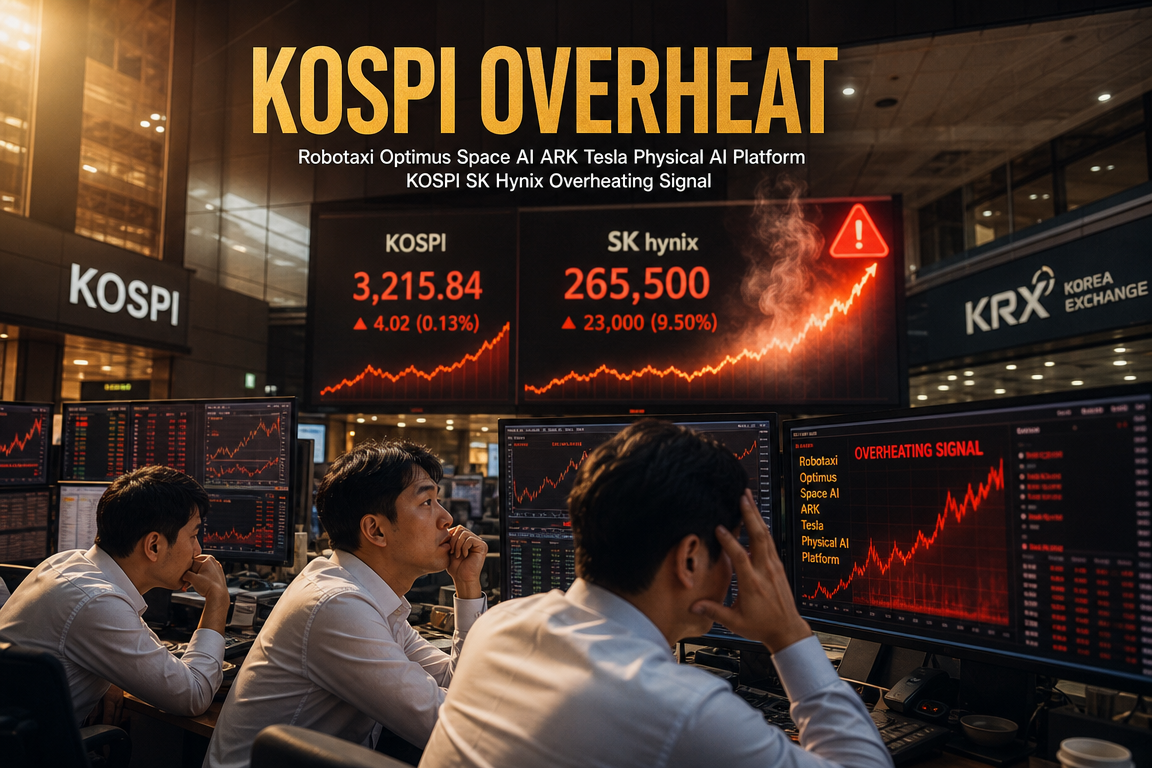
● Boom, SK Hynix Overheats, KOSPI Wobbles, US Stocks Take Over
After the SK Hynix overheating signal, where does the Korean market go? Key takeaways on the KOSPI outlook and the shift in U.S. market leadership
The key issue here is not simply that SK Hynix rose sharply.
The more important question is why the market interpreted the reversal in market capitalization between SK Hynix and Samsung Electronics as an overheating signal for Korean equities, whether the KOSPI can rebound strongly, and why the investment center may increasingly shift from Korean equities to U.S. equities.
In particular, when viewed through semiconductors, AI investment, the cloud industry, the S&P 500, and defense stocks, the market appears to be entering a phase in which the composition of market leadership is changing rather than merely undergoing a correction.
While other reports focus mainly on index movements, this article summarizes the gap between market capitalization and earnings scale, the pension fund flow effect, the impact of leveraged ETFs, and the transition of U.S. megacap technology firms toward AI monetization.
1. Why the SK Hynix overheating signal mattered
The starting point of this debate was SK Hynix surpassing Samsung Electronics in market capitalization.
SK Hynix is clearly a strong semiconductor company and a major beneficiary of rising AI semiconductor demand.
Its earnings growth rate was also very strong, supported by HBM, data centers, and the Nvidia value chain.
However, earnings growth rate and earnings scale are not the same.
SK Hynix has grown rapidly, but its absolute earnings scale is still difficult to characterize as larger than Samsung Electronics.
If its market capitalization exceeds Samsung Electronics, the market may be pricing in future expectations too aggressively.
This is the core of the overheating argument highlighted by Lee Jae-man.
For a company ranked first in market capitalization, earnings scale is generally close to first place as well.
In U.S. equities, Nvidia occupies the top tier in market capitalization because earnings scale and growth are moving together.
The same applies to TSMC in Taiwan.
However, if a company that is not number one in earnings scale becomes number one in market capitalization in Korea, it suggests that future expectations may have been priced in too early.
This is the central point of the SK Hynix overheating debate.
2. Which is real: earnings or price?
An important point in the discussion was the distinction between actual earnings and stock price.
Lee Jae-man explained from a perspective close to the idea that price reflects all available information.
Professor Kim Kwang-seok emphasized that earnings are actual numbers, while stock prices reflect expectations regarding those earnings.
Both views are important in investing.
Earnings represent the cash a company actually generates.
Revenue, operating profit, and net income are key indicators of fundamentals, independent of market expectations.
By contrast, stock prices do not reflect only current earnings.
They also incorporate expectations for next quarter, next year, and even several years ahead.
As a result, stock prices tend to move before earnings and can rise or fall excessively.
The same was true for SK Hynix.
Its share price reflected strong expectations for AI investment and HBM demand, but after some earnings estimates were revised lower, the stock corrected sharply.
In other words, the decline was not merely a sentiment-driven move but also a repricing of earnings forecasts.
3. The KOSPI correction after the rally was not a simple bear market
The original discussion noted that the KOSPI underwent a significant correction after reaching its peak.
In a typical bull market, price corrections do occur.
As a rule, corrections in a bull market often end around 20% from the peak.
However, this correction felt much sharper to market participants.
That suggests the issue was not simply a pause in semiconductor stocks, but a confirmation that Korean equities were overly dependent on a narrow set of sectors and companies.
Samsung Electronics and SK Hynix carry major symbolic weight in the Korean market.
Their stock performance can effectively determine the outlook for the entire KOSPI.
The problem is that the Korean market is too concentrated in semiconductors.
When semiconductors are strong, the KOSPI can rise sharply; when they weaken, the entire index can lose momentum quickly.
This correction highlighted that structural vulnerability once again.
4. Is this a time to worry about overheating, or to assess rebound conditions?
Lee Jae-man argued that the focus should now be on rebound conditions rather than overheating signals.
That is because share prices have already corrected significantly relative to earnings.
When markets are near a high, investors should watch for valuation overheating, market-cap ranking distortions, and concentrated flows.
But after a major decline, a different question matters more.
The question becomes what can drive the index higher again.
For the Korean market, three rebound conditions are critical.
First, semiconductor earnings estimates must be revised upward again.
Second, foreign and institutional demand must return.
Third, investor confidence in Korean equities must recover.
The third point is especially important.
Simply becoming cheaper is not enough to trigger a strong new rally.
If the dominant mindset is that gains should be sold quickly, then rebounds may occur without developing into sustained trends.
5. The possibility of KOSPI 10,000: the issue is pace, not direction
The discussion also addressed the possibility of the KOSPI reaching 10,000 points.
Lee Jae-man noted that since the KOSPI has already formed a high near that level, the real question is less whether it can rise there and more whether it can recover.
If earnings continue to improve, recovery toward prior highs is possible.
However, a sharp rally like the one seen from April to June is unlikely to repeat easily.
The reason is that volatility is declining.
High volatility can produce rapid gains or losses over a short period.
Lower volatility typically leads to more moderate advances and declines.
Accordingly, the KOSPI outlook is more likely to involve range recovery, sector differentiation, and a confirmation process for semiconductor earnings rather than a rapid breakout.
6. Why a strong renewed rally in Korean equities is difficult
Professor Kim stated that it is unlikely for Korean equities to re-emerge as a strong market leader by year-end.
The reason comes down to three factors.
First, investor confidence weakened after the sharp rally and subsequent decline.
Investors who experienced losses at the peak tend to think first about taking profits when prices recover.
When that mindset becomes widespread, selling pressure tends to appear on every rebound.
Second, much of the positive effect from the National Pension Service increasing domestic equity allocations may already be reflected in prices.
The National Pension Service’s capital flow is a critical signal for Korean equities.
When it raises domestic equity exposure, it sends a positive signal to foreign and retail investors as well.
But if that effect is already priced in, the incremental upside may be limited.
Third, the impact of leveraged ETFs is likely fading.
Leveraged ETFs can amplify index gains in a rising market.
However, when volatility increases or corrections begin, they can also intensify market unease.
The strong rally in May and June was partly supported by leveraged product flows, but that dependence appears to be diminishing.
7. Why U.S. equities have become relatively more attractive
Unlike Korean equities, U.S. equities are more diversified by sector.
Even though semiconductors have a significant weight in the S&P 500, they do not drive the entire market alone.
The original discussion noted that semiconductors account for roughly 16% of the S&P 500.
However, software, cloud, and platform companies also carry substantial weight.
Companies such as Alphabet, Amazon, Microsoft, and Meta initially appeared to be spending heavily on AI.
Now they are moving into a phase where AI is being used to generate actual profits.
This shift matters.
AI investment is no longer limited to capital expenditure or GPU purchases; it is beginning to translate into cloud revenue, enterprise software, advertising efficiency, and data analytics services.
In other words, U.S. equities have software and cloud sectors that can support the index even when semiconductors pause.
This is the main difference between the Korean and U.S. markets.
8. The AI investment cycle is shifting from semiconductors to software
From 2023 to 2025, the center of the AI investment cycle was semiconductors.
The market focused on Nvidia GPUs, HBM, data center servers, and power infrastructure.
That is why high-performance memory companies such as SK Hynix drew strong attention.
Going forward, however, the center of the AI investment cycle may gradually shift.
At the beginning, the key question was who supplies the AI infrastructure.
Now the key question is who monetizes AI.
In that respect, U.S. megacap technology companies have an advantage.
Microsoft is integrating AI into cloud services and productivity software.
Amazon is providing enterprise AI infrastructure and services through AWS.
Alphabet is combining search, advertising, cloud, and generative AI models.
Meta is pursuing AI monetization through improved ad efficiency and recommendation systems.
By contrast, Korean equities are more concentrated in companies that supply AI infrastructure rather than monetize AI directly.
As a result, even if the AI theme continues, the nature of the beneficiaries may change.
9. Another pillar of the U.S. market: pharmaceuticals and biotech
Another notable point in the discussion was U.S. pharmaceuticals and biotech.
The sector was mentioned as one of the next year’s stronger earnings-growth areas after semiconductors.
In Korea, biotech stocks often move on expectations.
Share prices can be highly volatile depending on trial results, technology transfers, and drug-development prospects.
By contrast, many large U.S. pharmaceutical and biotech firms are already highly profitable.
They tend to have stable revenue, cash flow, and margins.
If such companies also deliver earnings growth, the U.S. market gains an additional support pillar beyond semiconductors and software.
That is one of the strengths of the S&P 500.
Even if one sector weakens, another can help stabilize the index.
10. Structural differences between Korean and U.S. equities
Korean equities are highly dependent on semiconductors.
When Samsung Electronics and SK Hynix perform well, market sentiment improves across the board.
But when those two companies weaken, the KOSPI tends to lose momentum quickly.
By contrast, U.S. equities have multiple pillars, including semiconductors, software, cloud, pharmaceuticals and biotech, financials, and consumer sectors.
This difference is critical for market outlook.
The Korean market is tightly linked to the cycle of a narrow set of industries.
The U.S. market, with more diversified earnings growth across sectors, is better positioned to sustain a relatively stable upward trend.
In particular, the discussion noted that U.S. companies are expected to post roughly 13% to 15% earnings growth next year.
If that level of growth is sustained, the U.S. market is more likely to continue a steady advance rather than a sharp rally.
11. Why defense stocks keep coming up
Defense stocks were briefly mentioned at the beginning of the discussion.
While introduced casually, the sector is a meaningful area of interest in Korean equities.
Lee Jae-man expressed a constructive view on Korean defense names.
The reason is that they offer a degree of visibility in revenue and earnings growth.
Defense tends to move differently from the consumer cycle.
Government budgets, geopolitical risk, export contracts, and long-term supply agreements drive results.
In particular, when global security conditions remain unstable, order expectations for defense firms may remain firm.
That said, many defense stocks have already risen substantially, so investors should focus on order backlog, operating margin, and the durability of overseas contracts rather than on the theme alone.
12. Key checkpoints for investors now
The most important question now is not which market is cheaper.
The key question is which market has more visible earnings growth.
For Korean equities, the first item to monitor is whether semiconductor earnings estimates are being revised higher again.
In particular, investors should watch SK Hynix and Samsung Electronics earnings outlooks, HBM demand, memory prices, and changes in the Nvidia supply chain.
For U.S. equities, the key issue is whether AI investment is translating into actual revenue and earnings.
Cloud revenue growth, monetization of AI services by megacap technology firms, and data-center investment efficiency are the main variables.
It is also important to see whether the S&P 500 can maintain earnings growth in the 13% to 15% range.
On the flow side, domestic pension allocations, foreign net buying, and leveraged ETF trading volumes are important for Korea.
For the U.S., the main variables are rate expectations, the dollar trend, megacap earnings releases, and pharmaceutical and biotech earnings forecasts.
13. The core point that is often overlooked in other coverage
The first key point is that SK Hynix’s correction was not merely a simple pullback from an overbought level, but reflected a mismatch between earnings scale and market capitalization.
Many reports explain the move as a result of the stock having risen too much.
But the more important issue is the basic market principle that a company ranked first in market capitalization should generally have earnings scale consistent with that position.
The second key point is that the problem in Korean equities is not only valuation, but confidence.
A market in which investors believe gains should be sold quickly struggles to sustain a strong trend.
Without a recovery in that mindset, the KOSPI outlook may remain constrained.
The third key point is that the AI investment cycle is shifting from semiconductors to software.
This transition is more favorable to U.S. equities than to Korean equities.
The Korean market is concentrated in the AI infrastructure supply chain, while the U.S. market includes many firms that are converting AI into services and earnings.
The fourth key point is that U.S. equities can remain resilient even if semiconductors pause.
The S&P 500 is supported by semiconductors, software, cloud, and pharmaceuticals and biotech.
By contrast, Korean equities are more vulnerable when semiconductors weaken.
The fifth key point is that the market’s next battleground is shifting from expectations to actual earnings.
In semiconductors, AI, defense, and biotech alike, stories alone will be less effective.
Companies with rising earnings estimates and verifiable profits are more likely to outperform.
14. Investment implications
Korean equities should not be viewed pessimistically in absolute terms.
However, it is now difficult to expect a strong index-level rally based only on semiconductors.
For KOSPI exposure, investors should prioritize earnings estimates for Samsung Electronics and SK Hynix.
It is also necessary to consider sectors with clearer earnings visibility, such as defense.
U.S. equities remain relatively favorable.
In particular, as AI benefits expand from semiconductors into cloud and software, earnings releases from megacap technology companies become increasingly important.
Broad exposure through the S&P 500 may also be effective from a diversification perspective.
That said, U.S. equities can still see short-term corrections from rates, valuation, and earnings releases after strong gains.
Ultimately, rather than making a one-sided allocation, a more practical approach is to focus on semiconductors and defense in Korea, and on AI monetization and earnings growth in the U.S.
< Summary >
SK Hynix’s rise above Samsung Electronics in market capitalization can be interpreted as more than a ranking change; it may indicate overheating in Korean equities.
When a company that is not number one in earnings scale becomes number one in market capitalization, it can signal that future expectations have been priced in too aggressively.
The KOSPI is now in a phase where rebound conditions matter more than overheating concerns.
However, because Korean equities are highly dependent on semiconductors and investor confidence needs to recover, a strong renewed rally is unlikely to resume immediately.
U.S. equities have multiple earnings-growth pillars, including semiconductors, software, cloud, and pharmaceuticals and biotech.
The AI investment cycle is moving from infrastructure spending toward monetization, which favors U.S. megacap technology firms.
Going forward, market direction is likely to be determined more by actual earnings growth than by expectations.
[Related Articles…]
AI Investment Cycle and U.S. Big Tech Monetization Outlook
Semiconductor Stocks and KOSPI Outlook Analysis
*Source: [ 경제 읽어주는 남자(김광석TV) ]
– SK하이닉스 과열 시그널 적중… 지금 한국 증시는 어디로 갈까? | 경읽남과 토론합시다 | 이재만 실장 [1편]