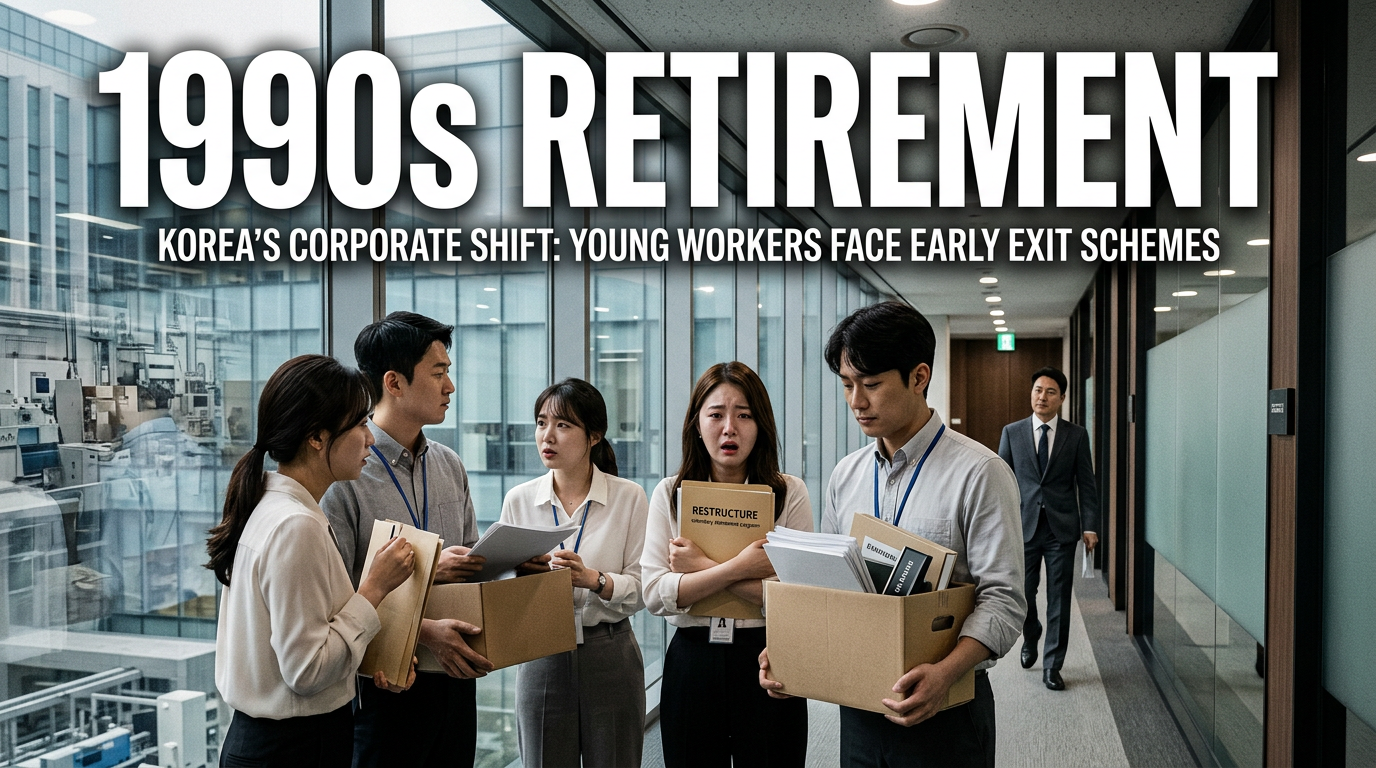

● Samsung Hopeful Exit Shock
Samsung Electronics Voluntary Retirement: Even Employees Born in the 1990s Are Moving… Weak Finished-Product Performance, Large Compensation Packages, and the Race for Organizational Speed
The core point of this issue is not simply voluntary retirement.
It must be viewed together with changes in the performance of Samsung Electronics’ MX Division and DX Division, the compensation gap with the semiconductor division, and signs of workforce restructuring aligned with the era of the Fourth Industrial Revolution.
In particular, recent cases of employees born in the 1990s directly inquiring about and choosing voluntary retirement, which had previously centered on senior employees, carry major implications for personnel strategies at large Korean corporations and the global economic outlook.
1. First, a News Summary: What Is Happening at Samsung Electronics?
It has been confirmed that some employees born in the 1990s at Samsung Electronics recently chose voluntary retirement and left the company.
Previously, voluntary retirement was mainly carried out among senior employees, especially those at the department-head level and above. This time, however, what stands out is that younger employees first asked about the conditions and voluntarily went through the retirement process.
There are three major factors behind this.
First, weak performance in finished-product businesses such as smartphones, TVs, and home appliances.
Second, voluntary retirement compensation worth hundreds of millions of won, depending on years of service and rank.
Third, the perceived internal gap created by the difference in compensation compared with the semiconductor division.
2. Why Are Even Employees Born in the 1990s Choosing Voluntary Retirement?
The important point in this case is that it is not a structure where “the company pushes employees out,” but rather one where “employees calculate the terms first and then leave.”
Main Point to Convey
Younger employees do not appear to be simply leaving the company. Instead, they seem to be weighing whether this is a financially favorable timing and whether it is an acceptable moment to make a career transition.
Key Background 1: Larger Compensation Packages
Voluntary retirement payments are calculated differently depending on each individual’s years of service, rank, and performance evaluation.
For CL2, which corresponds to staff and assistant-manager levels, the amount is known to be around 400 million won, including performance-based restricted stock and other components. For the manager-level CL, figures of up to around 800 million won have been discussed.
For younger employees, this amount may have felt like “a level that makes it possible to start over even after leaving now.”
Key Background 2: Declining Profitability in the Finished-Product Business
Samsung Electronics’ MX Division is a core organization responsible for Galaxy smartphones, but its recent performance has not been as strong as expected.
Even if sales have held up, rising component prices, including memory, have increased cost burdens, intensifying internal profitability pressure.
Key Background 3: Changing Career Expectations
Today’s younger employees tend to prefer a strategy of reading AI trends and changes in industrial structure and moving quickly, rather than staying at one company for a long time.
In this environment, “when to exit” can become a more important decision criterion than simply having experience at a large corporation.
3. What Is Different Between Samsung Electronics’ Voluntary Retirement in the Past and Now?
Samsung Electronics has operated a voluntary retirement system on an ongoing basis for several years.
In the past, however, it was common for the HR department to first sound out senior employees about their intentions.
Now the atmosphere has changed.
There are cases in which younger employees first check whether voluntary retirement is possible, review the conditions, and then choose to leave on their own.
Main Point to Convey
This change can be seen not as a simple HR event, but as a sign that the sense of job security inside large corporations is weakening.
Especially in business divisions under strong performance pressure, “leaving” may appear to be a more rational choice than “staying.”
4. Why Do the Performances of the MX Division and DX Division Matter?
To understand this issue, it is necessary to look at Samsung Electronics’ business structure as well.
The MX Division is the mobile experience business centered on Galaxy smartphones.
The DX Division is the division that brings together finished-product businesses such as smartphones, TVs, and home appliances.
If the performance of this division declines, it is not simply a problem for one team; it also affects Samsung Electronics’ overall global competitiveness and the economic outlook.
According to the article, the MX and Networks Business Division recorded second-quarter revenue of 33.2 trillion won and an operating loss of 700 billion won this year.
Sales of the Galaxy S26 and A series were relatively solid, but rising component costs are believed to have increased the burden.
Combined with weak TV and home appliance performance, the overall DX Division recorded an operating loss of 800 billion won, marking its first quarterly loss since the division was launched.
Main Point to Convey
A loss in the finished-product business is not merely a matter of numbers; it directly leads to organizational restructuring and workforce adjustment.
In other words, a flow may continue from weak performance to cost reduction, workforce efficiency, and expanded voluntary retirement.
5. Internal Tension Created by the Compensation Gap with the Semiconductor DS Division
There is one part of this issue that is highly important but relatively less covered in other news reports.
It is the compensation gap between divisions.
During wage negotiations in May, a special management performance bonus was newly established only for the semiconductor DS Division.
After this measure, employees in the DX Division expressed growing feelings of relative deprivation and exclusion.
TM Roh, head of the DX Division, also personally stepped forward to reassure employees, acknowledging that they may have felt excluded.
Main Point to Convey
Employees do not simply compare monthly salaries.
They also look at bonuses, future growth potential, and where the company is spending more money.
As a result, even within Samsung Electronics, there may be stronger internal movement psychology as employees ask themselves, “Where is it more advantageous to remain?”
6. What This Case Means for the Korean Economy and Global Industry
This news may look like a personnel issue at a single company, Samsung Electronics, but in reality, it shows changes in the structure of the Korean economy.
First, employment stability at large corporations is weaker than before.
In the past, joining a large corporation meant long-term stability, but now career strategies change depending on business-division performance and organizational restructuring.
Second, manufacturing-centered companies are also under pressure to digitally transform their workforces.
As AI, automation, and supply-chain restructuring accelerate, planning, data, and software capabilities are becoming more important than simple production.
Third, the more uncertain the global economic outlook becomes, the more sensitive large corporations become to cost control.
When interest rates, exchange rates, raw materials, semiconductor cycles, and slowing consumption overlap, finished-product businesses are likely to come under pressure first.
Main Point to Convey
This Samsung Electronics case clearly shows that “even large corporations are no longer safe zones.”
Especially during a global economic slowdown, companies are more likely to defend profitability by reducing labor costs.
7. Key Takeaways That Other News Reports Often Miss
The first key takeaway is that voluntary retirement among younger employees is not a simple resignation, but the result of calculating “salary, compensation, and career” all at once.
This may look like an individual choice, but in reality, it is the result of a company’s HR system and industrial outlook working together.
The second key takeaway is that the perceived climate inside Samsung Electronics differs sharply between DX and DS.
If this gap continues to widen, it could lead not only to lower morale but also to the movement of talented employees and reduced organizational flexibility.
The third key takeaway is that voluntary retirement is not merely a softer expression for “restructuring.”
In reality, it should be seen as a management signal that reflects business competitiveness, cost structure, and organizational redeployment all at once.
The fourth key takeaway is that in the AI era, job survivability inside large corporations is changing completely.
It is necessary to recalculate which positions will become stronger in the future among manufacturing, sales, marketing, planning, data analysis, and software capabilities.
8. Points That Markets and Investors Should Watch Going Forward
Going forward, what matters is not the size of Samsung Electronics’ voluntary retirement itself, but how far this trend spreads.
It will be important to watch the pace of recovery in MX and DX performance, whether component costs stabilize, and how the compensation system between the semiconductor and finished-product divisions is adjusted.
It is also a key point to observe whether talent outflow from Samsung Electronics is a temporary phenomenon or the beginning of full-scale organizational restructuring.
Main Point to Convey
For investors, this is not simply personnel news, but a structural change that could affect the future stock market and corporate valuations.
For employees, this news is a signal that makes them rethink “which industry should I bet my career on?”
Summary
The fact that even employees born in the 1990s at Samsung Electronics are choosing voluntary retirement is the result of large compensation packages, weak finished-product business performance, and the compensation gap with the semiconductor division all working together.
The deteriorating performance of the MX Division and DX Division is increasing the possibility of organizational restructuring, while also showing that employment stability at large corporations is not what it used to be amid AI and the global economic slowdown.
The core point is not that “voluntary retirement has increased,” but that the industrial, compensation, and career structures inside Samsung Electronics are changing together.
[Related Articles…]
How Semiconductor Performance and Compensation Gaps Affect Samsung’s Organization
How AI Transformation Is Reshaping Large-Company Workforce Structures and Career Survival
*Source: SBS 뉴스