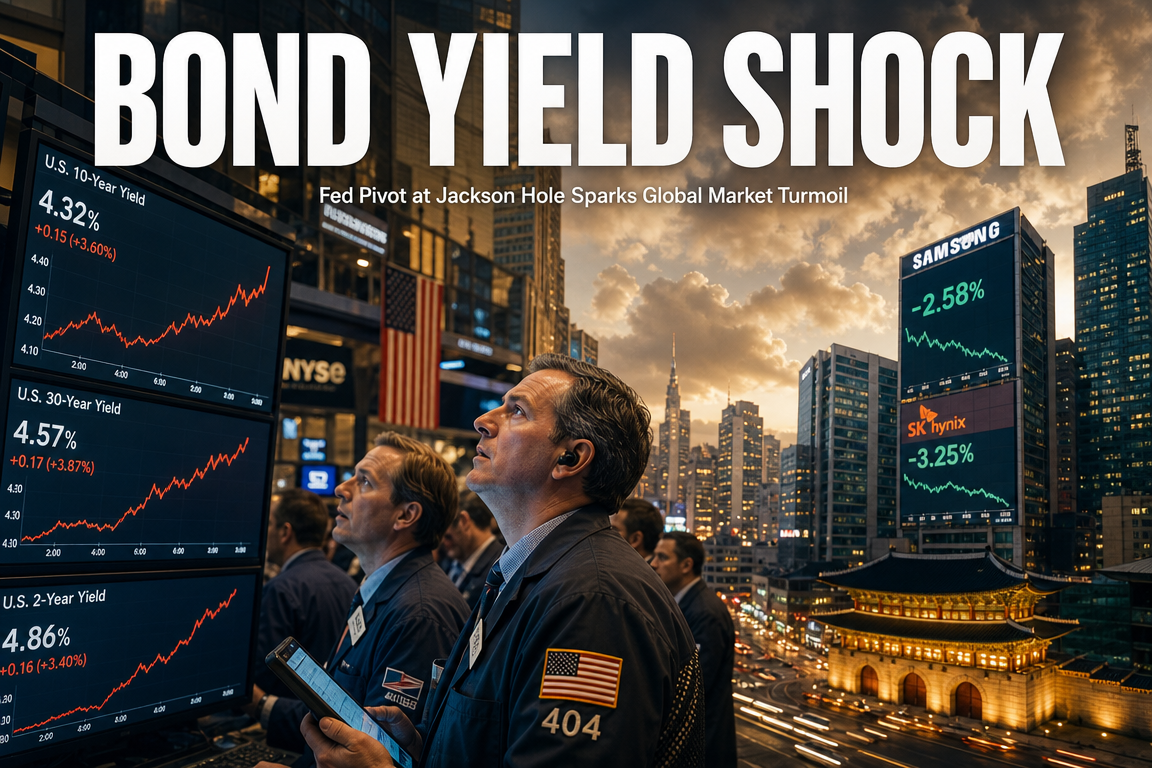
● Bond-Yield Shock Hits Samsung-SK Hynix Rally
Why the Rally in Samsung Electronics and SK Hynix Lost Momentum: Bond Yield Risk Is Stronger Than Semiconductor Tailwinds
Today’s key issue is not simply why Samsung Electronics and SK Hynix declined.
Although U.S. semiconductor stocks rose sharply and expectations for the memory cycle improved, the more important question is why large-cap Korean chipmakers failed to sustain their gains.
The conclusion is that the issue is less about Samsung Electronics and SK Hynix specifically, and more about the combined pressure from global bond yields, international oil prices, and inflation concerns on equity valuations.
At present, markets are reacting more sensitively to how long high interest rates will remain elevated than to improving semiconductor earnings.
This report summarizes the intraday weakness in Samsung Electronics and SK Hynix, the catalysts behind Micron and SanDisk in the U.S., the impact of Middle East risk and oil prices, and the key point often missed in other coverage.
1. Why Samsung Electronics and SK Hynix Initially Strengthened
At the open, Samsung Electronics and SK Hynix were positioned for a stronger session.
U.S. semiconductor names had performed well the previous day.
In particular, Micron and SanDisk were strong, supporting sentiment toward Korean large-cap chipmakers.
Expectations for a recovery in the memory semiconductor cycle re-emerged, and investors viewed Samsung Electronics and SK Hynix as likely participants in that move.
In other words, the initial setup was constructive.
2. The Main Driver of U.S. Semiconductor Strength: Micron and SanDisk Catalysts
Micron and SanDisk were the most notable names in the U.S. market.
Micron is a key proxy for improving memory semiconductor conditions.
SanDisk is directly linked to the NAND flash market.
Their strong performance indicated renewed market interest in the memory cycle.
In particular, news surrounding SanDisk changed market tone.
SanDisk announced that it would return 100% of the cash it generates to shareholders.
This was interpreted as a strong signal of confidence in future cash flow.
The announcement also reinforced expectations that the memory sector may be moving beyond its cyclical bottom.
3. Why SanDisk’s 100% Capital Return Matters
SanDisk’s decision to return 100% of earnings to shareholders carried a strong message for the market.
When a company announces aggressive capital returns, it is generally read as a sign of confidence in cash generation rather than balance sheet stress.
This is especially relevant in the semiconductor sector, which is cyclical.
When conditions are weak, capital preservation matters; when conditions improve, investment and shareholder returns both become more visible.
SanDisk’s announcement signaled that NAND conditions may be less weak than expected.
That interpretation could naturally extend to memory names such as Micron, Samsung Electronics, and SK Hynix.
As a result, early trading in Korean semiconductor stocks reflected that improved sentiment.
4. Hedge Fund Margin Call Issues Also Supported the Rebound
Another noteworthy point was the recent margin call involving a hedge fund.
Because the fund reportedly held significant positions in Micron and SanDisk, the market drew additional conclusions.
A margin call occurs when losses become large enough that an investor using borrowed funds must add collateral.
In some cases, this can force the sale of holdings.
If the market believes the forced selling pressure has largely passed, the affected names may stage a technical rebound.
This likely contributed to the strength in Micron and SanDisk alongside the broader memory recovery narrative.
In other words, the move was driven not only by industry expectations but also by a possible normalization in supply and demand dynamics after forced liquidations.
5. Why Samsung Electronics and SK Hynix Still Fell
The problem was that a larger macro factor outweighed the semiconductor-specific catalysts.
That factor was bond yields.
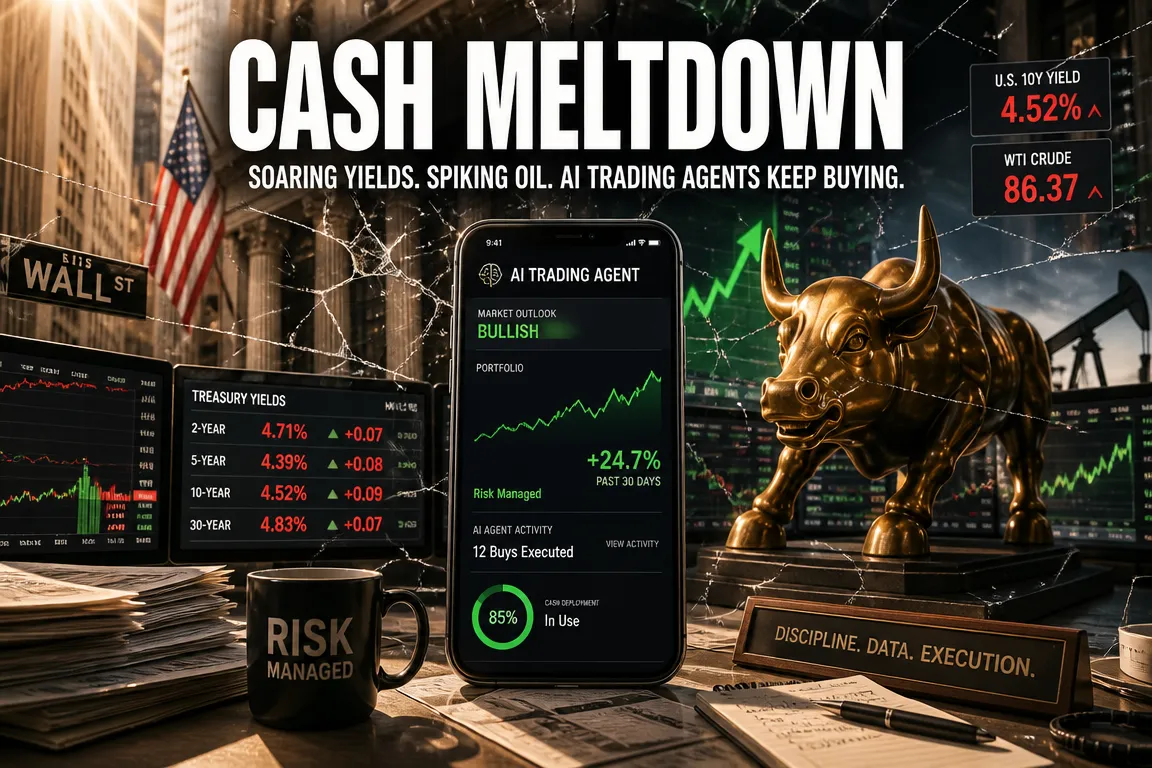
Recent increases in U.S. and global long-term yields have pressured equities broadly.
Stocks are valued by discounting future earnings into present value.
When rates rise, the present value of those future earnings falls.
This effect is especially pronounced for growth and technology stocks.
Although Samsung Electronics and SK Hynix are often viewed as industrial companies, the market also values them as technology-related growth names tied to AI semiconductors, HBM, and the memory cycle.
As a result, rising bond yields can weigh heavily on these stocks.
6. Unresolved Middle East Risk Added to the Pressure
Another important background factor was Middle East risk.
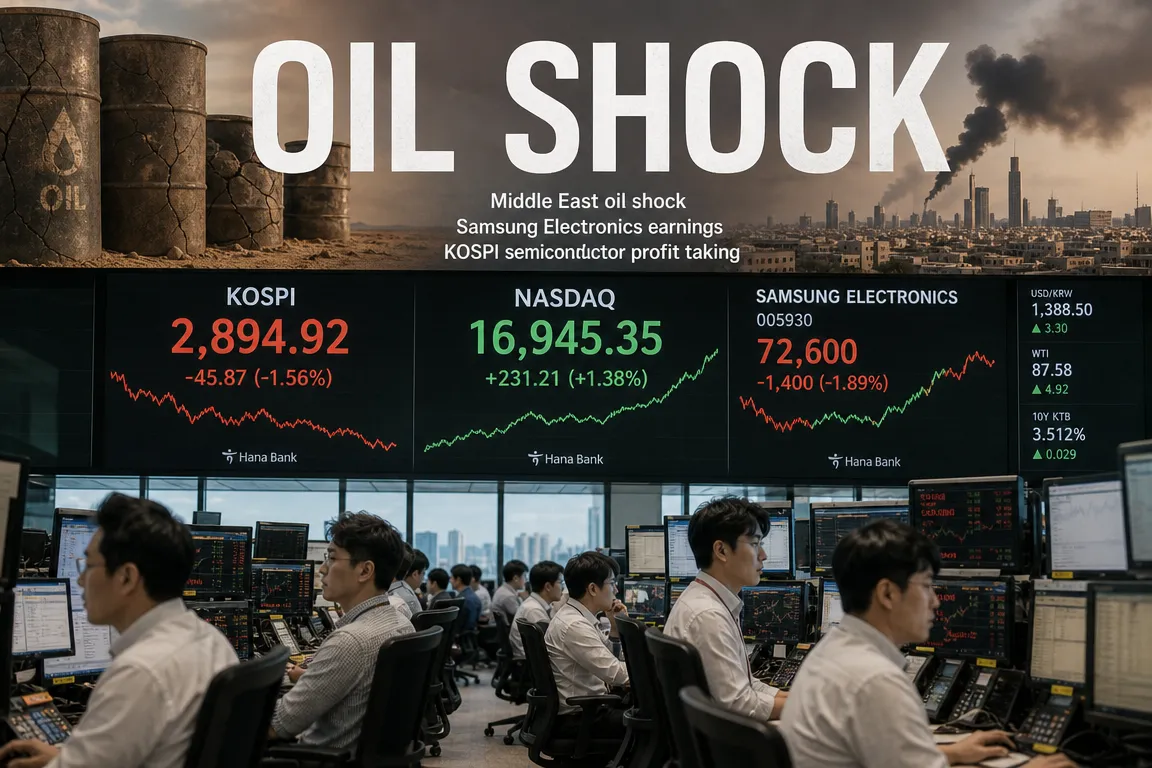
As long as geopolitical tensions remain unresolved, crude oil prices are unlikely to fall meaningfully.
Higher oil prices increase inflation pressure.
Greater inflation pressure makes it harder for central banks to cut rates.
In practice, higher oil prices feed into inflation concerns, which then reinforce upward pressure on bond yields.
That linkage is particularly uncomfortable for markets.
Even if semiconductor earnings improve, investors tend to reduce risk exposure when rates continue to climb.
7. The Oil-Inflation-Rate Transmission Channel
To understand this move, it is necessary to follow the chain from oil to inflation to interest rates.
When crude oil rises, energy costs increase.
Higher energy costs affect transportation expenses, manufacturing input costs, and consumer prices.
When inflation rises again, central banks are more likely to delay rate cuts or maintain restrictive policy.
Long-term bond yields can then move higher as markets price in future inflation, fiscal burdens, and the rate path.
Higher long-term yields raise the market discount rate.
As a result, risk assets such as the KOSPI, the Nasdaq, and semiconductor stocks come under pressure.
That is the key reason Samsung Electronics and SK Hynix did not fully follow the U.S. semiconductor rally.
8. What the Market Fears Most: Delayed Rate Cuts
Investors are not mainly concerned with a one-day move in yields.
The real concern is a scenario in which rate cuts are pushed further out.
Expectations for a semiconductor recovery, stronger AI spending, and higher HBM demand remain supportive.
However, if rate-cut expectations weaken, overall equity valuations may compress.
Foreign investors in Korea also monitor exchange rates, interest rates, and global liquidity conditions.
When U.S. long-term rates rise, the dollar can strengthen, which may also weigh on foreign flows into Korean equities.
Therefore, even if fundamentals improve for Samsung Electronics and SK Hynix, stock prices can remain volatile in the short term if global capital flows become less supportive.
9. The Trump-Iran Variable: What Markets Want Is Reduced Geopolitical Risk
The original text refers to the need for Trump to resolve issues with Iran quickly.
The core point is that political resolution matters for market stability.
If Middle East risk eases, upward pressure on oil prices could diminish.
If oil stabilizes, inflation concerns may also moderate.
If inflation concerns ease, bond yields may stabilize as well.
In that case, the market could refocus on earnings improvement in the semiconductor sector.
In other words, the next upside driver for Samsung Electronics and SK Hynix may come not only from semiconductor news, but also from easing Middle East risk and stabilizing bond yields.
10. The Most Important Point Missing From Many Reports
The most important point in this session is that the decline was not caused by weak semiconductor news.
In fact, semiconductor-related news was relatively positive.
Micron and SanDisk were strong, and expectations for the memory cycle improved.
However, the market assigned greater weight to macro risk than to industry-specific catalysts.
That is the key issue.
Many investors look only at Samsung Electronics or SK Hynix and conclude that the semiconductor trend has weakened.
In reality, rising bond yields lifted the market discount rate and created the larger headwind.
This is especially relevant for names that had already rallied on expectations tied to AI semiconductors and HBM.
When rate pressure rises, stocks with stronger expectations can also see faster profit taking.
Another important point is SanDisk’s capital return announcement.
This should not be viewed only as a short-term stock catalyst, but also as a signal of confidence in cash flow across the memory industry.
If NAND and DRAM prices continue to recover, this could also support the medium-term outlook for Samsung Electronics and SK Hynix.
However, for that positive industry trend to be reflected in share prices, bond yields need to stabilize first.
11. Key Watchpoints for Samsung Electronics Investors
Samsung Electronics has a broad business portfolio that includes memory semiconductors, foundry, smartphones, and consumer electronics.
However, recent share performance has been driven mainly by expectations for memory recovery and AI semiconductor competitiveness.
Investors should monitor DRAM price recovery, NAND price trends, and HBM supply expansion.
Because Samsung Electronics is a benchmark KOSPI name, it is also sensitive to foreign flows and exchange rates.
If U.S. bond yields remain elevated, foreign investors may stay defensive toward Korean equities.
Accordingly, investors should track not only semiconductor news but also the U.S. 10-year Treasury yield, the dollar index, and international oil prices.
12. Key Watchpoints for SK Hynix Investors
SK Hynix is currently a leading beneficiary of AI semiconductor and HBM expectations.
Strong HBM demand and continued investment in AI infrastructure by global tech firms remain supportive.
However, the higher the expectation, the more sensitive valuation becomes to rising interest rates.
If SK Hynix weakens in the short term, investors should distinguish whether the driver is a deterioration in HBM competitiveness or a broader market adjustment linked to higher rates.
Current price action is more consistent with the latter.
In other words, the market is in a phase where global liquidity and risk appetite are more important than company fundamentals in determining short-term stock direction.
13. What This Means for the KOSPI as a Whole
The KOSPI has a very large weighting in Samsung Electronics and SK Hynix.
When these two names weaken, the index loses momentum quickly.
If U.S. semiconductor stocks are strong but Korean equities remain weak, the issue is not limited to domestic companies.
It is a sign that the global macro environment remains unstable.
When bond yields, oil prices, and geopolitical risk rise simultaneously, foreign investors are likely to become more defensive.
In that setting, the KOSPI tends to react more to exchange rates and interest rates than to earnings expectations.
For now, investors in Korean equities need to watch U.S. long-term yields together with the semiconductor cycle.
14. Conditions for a Market Rebound
Several conditions would be needed for Samsung Electronics and SK Hynix to resume a stronger uptrend.
First, U.S. long-term bond yields need to stabilize.
Rate stability would reduce valuation pressure on growth and technology stocks.
Second, international oil prices need to ease.
Lower oil prices would reduce inflation concerns and relieve upward pressure on rates.
Third, Middle East geopolitical risk needs to moderate.
Reduced uncertainty would allow markets to refocus on earnings and cyclical recovery.
Fourth, strength in Micron and SanDisk must continue as evidence of a broader memory upturn rather than a one-off move.
If U.S. memory stocks continue to improve, Korean large-cap semiconductor names may also see renewed inflows.
15. Investor Conclusion
The recent weakness in Samsung Electronics and SK Hynix does not appear to signal a collapse in the semiconductor cycle.
On the contrary, the U.S. semiconductor market is still showing signs of a memory recovery.
The larger issue is that rising bond yields have created a more powerful headwind for equities.
In the current environment, investors need to focus not only on buying strong companies but also on waiting for a stable rate environment.
The medium-term semiconductor story remains intact.
However, in the short term, international oil prices, inflation, U.S. bond yields, and Middle East risk are likely to determine share-price direction.
Investors in Samsung Electronics and SK Hynix should therefore track corporate developments together with global macro indicators.
< Summary >
Samsung Electronics and SK Hynix weakened despite strength in U.S. semiconductor stocks because rising bond yields limited further upside.
Micron and SanDisk were supported by improving memory-cycle expectations and SanDisk’s announcement of 100% capital return to shareholders.
However, ongoing Middle East risk kept oil prices elevated and reinforced inflation concerns, which in turn supported higher long-term yields.
The key market driver is currently rates and liquidity rather than semiconductor earnings.
The medium-term outlook for Samsung Electronics and SK Hynix remains constructive, but short-term performance will depend primarily on U.S. bond yield stability.
Investors should monitor the semiconductor cycle, HBM demand, and the performance of Micron and SanDisk, along with crude oil, exchange rates, and the U.S. 10-year Treasury yield.
[Related Articles…]
AI Semiconductor Cycle and Memory Market Outlook
How Rising U.S. Bond Yields Affect Global Equities
*Source: [ 내일은 투자왕 – 김단테 ]
– 잘나가던 삼전닉스 암초를 만나다… #삼성전자 #하이닉스 #채권금리
● Jackson Hole Shock, Fed Pivot, Rate Hike Fear
Jackson Hole Meeting’s Key Variable: More Important Than Rate Hikes Is the Fed’s Inflation Assessment Framework
The three key points to watch in this article are as follows.
First, what the market is concerned about is not an actual rate hike, but the growing expectation of a rate hike.
Second, at the Jackson Hole meeting, what matters more than what Kevin Warsh says is which inflation indicator the Fed will use going forward.
Third, if the Fed begins to place greater emphasis on trimmed mean PCE, it could become a more significant policy shift signal for U.S. equities and global stock markets than expected.
The real issue is not whether rates will be raised or cut.
What matters more is whether the market continues to assume a prolonged high-rate environment, or begins to reprice rate-cut expectations.
This perspective connects directly to the economic outlook for the second half of 2026, U.S. equities, the KOSDAQ, and growth-stock strategy.
1. Jackson Hole Meeting Watchpoint: Kevin Warsh May Not Be a “Market-Friendly Fed Chair”
The first person to watch at this Jackson Hole meeting is Kevin Warsh.
In the original discussion, Warsh was described as a more reserved communicator.
Compared with Jerome Powell’s relatively market-friendly communication style, Warsh is viewed as someone who may provide fewer hints to the market.
This suggests that the Fed’s forward guidance, press-conference-style explanations, and detailed signaling of future FOMC direction could weaken.
The reason this matters is straightforward.
Market participants care less about the policy rate itself than about where the next move in rates will be.
If the Fed reduces its communication, investors are likely to price in greater uncertainty.
As a result, short-term volatility could rise across U.S. equities, the bond market, the KRW/USD exchange rate, and emerging markets.
2. Rate Hike Probability: “One or Two Hikes May Be Possible, but Not a 2022-Style Tightening Cycle”
In the discussion, the possibility of a U.S. rate hike was not ruled out entirely.
The reason is that the U.S. economy remains stronger than many expect.
In particular, if manufacturing, investment, and corporate activity remain resilient, the Fed may judge that the economy can absorb slightly higher rates.
However, one important condition applies.
This would not be a 2022-style aggressive sequence of hikes.
The original text suggested that, even if hikes occur, they would likely be limited to one or two moves.
In other words, the scenario is closer to a final precautionary hike than a renewed high-intensity tightening cycle.
- If the U.S. economy and investment cycle remain strong, the case for a hike becomes more plausible.
- However, inflation is not in a 2022-style explosive phase, limiting the scope for large-scale hikes.
- Even if rates rise once or twice, expectations for a pause or eventual cuts could re-emerge.
3. Counterview: No Immediate Hike or Cut, but the Market Trades on Expectations
Professor Kim Kwang-seok’s key counterpoint is that the U.S. is unlikely to move rates up or down immediately.
The reason lies in the current policy rate level.
The original text emphasized that benchmark rates in both the U.S. and the U.K. are already around 3.75%.
Although inflation temporarily accelerated due to the Middle East conflict and rising crude oil prices, this does not appear comparable to the 9.1% inflation episode in 2022 that required aggressive tightening.
In other words, if inflation has merely been distorted temporarily, there is less need for another hike.
If inflation peaks and stabilizes, markets may instead begin to price in renewed rate-cut potential.
The important point is that markets can move sharply even if the FOMC does not change rates.
Over the past 18 months, rates were mostly held unchanged, yet markets sold off when hike concerns increased and rallied when cut expectations improved.
For investors, expectations matter more than the policy rate itself.
4. The Middle East Conflict Created Distortion: Oil, Inflation, Treasury Yields, and the Pivot All Moved
The original text repeatedly used the term “distortion.”
The Middle East conflict is interpreted not merely as a geopolitical risk, but as a factor that has altered the global macro outlook.
Rising crude oil prices distort the inflation path.
Higher inflation pressures Treasury yields.
Rising Treasury yields affect central bank rate-cut paths.
Ultimately, the conflict has temporarily delayed the pivot in major central banks’ monetary policy.
- Higher oil prices push inflation higher in the near term.
- Higher inflation increases pressure on Treasury yields.
- Higher yields weigh on equity valuations.
- Central banks may delay rate cuts or briefly consider additional hikes.
South Korea, Australia, New Zealand, Japan, and the euro area are not insulated from this trend.
Although many major economies entered a gradual easing phase after peak rates in mid-2024, the Middle East conflict temporarily disrupted that path.
5. Long-Term View: Rates Eventually Return Toward Neutral
The long-term conclusion of the discussion is relatively clear.
While there may be near-term hike concerns, rates are likely to decline again over the medium to long term.
The reason is that, as growth and inflation stabilize over time, it becomes difficult to justify maintaining high policy rates indefinitely.
Each central bank has its own view of a neutral policy rate.
Temporary shocks such as the Middle East conflict or an oil spike can push policy rates above neutral for a time.
But once those shocks fade and inflation cools again, policy rates tend to move back toward neutral levels.
From this perspective, an investment strategy for the second half of 2026 cannot rely solely on high-rate defense.
It is more important to identify when markets will begin to anticipate rate cuts.
6. The Real Jackson Hole Catalyst: If Trimmed Mean PCE Becomes More Important, the Game Changes
The most important part of the original text is trimmed mean PCE.
Most headlines focus on whether Jackson Hole will produce a hike signal or a cut hint.
However, the deeper issue is which inflation metric the Fed will begin to prioritize officially.
Markets usually focus on headline PCE, core PCE, and CPI.
But if the Fed begins to treat trimmed mean PCE as a more important gauge, the situation changes.
Trimmed mean PCE excludes extreme price movements and is designed to capture the underlying inflation trend.
It is less sensitive to temporary oil spikes or sharp moves in individual components.
The original text noted that trimmed mean PCE inflation was running at roughly 2.2% year over year, very close to the Fed’s target.
If the Fed places greater emphasis on this measure, it could conclude that inflation is already stable.
That would weaken the case for keeping the policy rate at 3.75%.
In that case, markets could price in rate cuts much more aggressively.
7. The Hidden Point Missed by Many Headlines: The Fed’s Choice of Indicator Is Policy
The most important hidden point is not the rate decision, but the choice of indicator.
Depending on which inflation measure the Fed prioritizes, the same economic data can be interpreted very differently.
Core PCE may still appear elevated.
But trimmed mean PCE may suggest inflation is already near target.
The same U.S. economy can therefore produce either a case for hikes or a case for cuts, depending on the analytical lens.
That is why Jackson Hole matters.
If Kevin Warsh explicitly mentions trimmed mean PCE and says it will matter more in future policy decisions, markets are likely to react quickly.
This would be a stronger signal than a simple dovish remark.
It would provide a new logical basis for rate cuts.
For markets, it would imply that the Fed now sees inflation as more stable.
At that point, investors may shift from a high-rate strategy to a lower-rate strategy.
8. Impact on U.S. Equities: Rates Are the Gravity of the Stock Market
The original text’s key phrase was that the direction of rates is the direction of equities.
This is an important point.
Interest rates act like gravity for the stock market.
Higher rates reduce the present value of future earnings.
That creates pressure on growth stocks, technology names, biotech, and unprofitable growth companies.
Conversely, when lower rates are expected, the valuations of companies with high future growth potential can recover.
Once long-term U.S. yields start to fall, the effect extends beyond U.S. equities to Korean stocks as well.
In particular, the KOSDAQ, where future growth expectations matter more, may strengthen relative to other markets in a falling-rate environment.
- In a high-rate environment, companies with strong current earnings and cash flow are favored.
- In a lower-rate expectation environment, companies with higher future growth potential attract more attention.
- Declining long-term yields support growth stocks and KOSDAQ sentiment.
- U.S. monetary policy shifts have direct implications for the Korean equity market.
9. Investment Strategy: Prepare for Both High-Rate Defense and a Potential Rate-Downturn Shift
The base case for investors remains fundamentals.
In a high-rate environment, earnings, cash flow, balance-sheet strength, and earnings stability matter most.
Stock prices can deviate significantly from fundamentals, but over the long term they tend to realign.
That said, if rate-cut expectations strengthen, the market’s valuation framework can change.
Under high rates, the priority is companies that generate money now.
Under lower-rate expectations, the focus shifts to companies with higher future growth rates.
Accordingly, an investment strategy for the second half of 2026 should consider both of the following.
- First, can the company withstand a high-rate environment based on fundamentals?
- Second, can it benefit from a growth premium when rate-cut expectations return?
Companies that satisfy both conditions may receive higher valuations in the next phase of the market.
10. Market Reaction by Scenario
| Scenario | Fed Message | Market Interpretation | Investment Impact |
|---|---|---|---|
| Hawkish scenario | Rate hike possibility is mentioned | Concerns over prolonged high rates | Pressure on growth stocks, possible dollar strength |
| Neutral scenario | Rate hold with data dependence emphasized | Limited market direction | Market led by earnings and fundamentals |
| Dovish scenario | Stable inflation measures such as trimmed mean PCE are emphasized | Rising rate-cut expectations | U.S. equities may rise; growth stocks and KOSDAQ could outperform |
11. Key Indicators Investors Should Monitor
After Jackson Hole, investors should look beyond headline news.
They need to examine the language the Fed uses, the indicators it emphasizes, and whether forward guidance becomes less detailed.
- Whether Kevin Warsh mentions trimmed mean PCE.
- The gap between core PCE and trimmed mean PCE.
- The direction of the U.S. 10-year Treasury yield.
- Changes in the FOMC dot plot and Fed officials’ remarks.
- Whether crude oil prices again pressure inflation.
- Whether U.S. manufacturing and investment indicators remain firm.
- Whether the KOSDAQ and growth stocks respond to lower long-term yields.
12. Core Conclusion: The Rebound in Rate-Cut Expectations Matters More Than the Rate Hike Decision
In one sentence, the discussion can be summarized as follows.
The key issue for the second half of 2026 is not the actual policy-rate decision, but the Fed’s shift in inflation assessment and the revival of rate-cut expectations.
The possibility of one or two hikes remains open.
However, a return to a 2022-style aggressive tightening cycle appears unlikely.
Over time, markets are more likely to move toward the view that the Fed will eventually have to cut rates.
If trimmed mean PCE is formally emphasized, it could mark a major turning point in U.S. monetary policy.
Investors should therefore prepare not only for a high-rate defense strategy, but also for assets and sectors that benefit when the rate-cut cycle begins.
Ultimately, rates are the gravity of equities, and when that gravity weakens, market leadership can change.
< Summary >
The key issue at Jackson Hole is not whether rates will be raised, but whether the Fed changes its inflation assessment framework.
Kevin Warsh is likely to be less communicative with markets, making reduced forward guidance an important variable.
A one- or two-hike scenario remains possible given the strength of the U.S. economy, but a 2022-style tightening cycle is unlikely.
The Middle East conflict has temporarily distorted oil prices, inflation, Treasury yields, and the timing of the policy pivot.
The most important hidden point is trimmed mean PCE.
If the Fed begins to place greater emphasis on this measure, inflation could be judged as more stable and the case for rate cuts could strengthen.
As rate-cut expectations recover, U.S. equities, growth stocks, and the KOSDAQ could benefit.
Investors should prepare for both high-rate defense and a potential shift toward lower rates.
[Related Articles…]
- Jackson Hole and the Outlook for U.S. Rates and Equities
- AI Semiconductor Cycle and Global Liquidity Strategy
*Source: [ 경제 읽어주는 남자(김광석TV) ]
– 금리 인상일까? 인하 기대일까? 잭슨홀 최대 관전포인트 | 경읽남과 토론합시다 | 이재만 실장 [3편]