● Bond Shock, AI Blowup, Chip Rout
The Real Reason the Long-Dated Bond Market Broke Down: Structural Drivers Behind U.S. Rates, AI Spending, and Semiconductor Stocks Moving Together
The key driver of this market decline is not simply that interest rates rose.
The more important point is that the surge in long-term Treasury yields is raising the cost of capital for large-cap tech companies’ AI investments, and that effect is feeding directly into memory semiconductors and the Korean equity market.
The Nasdaq decline, Micron’s sharp drop, weakness in the SK Hynix ADR, and the fall in KOSPI night futures should be viewed as part of the same market sequence, not as separate events.
The market is now in a renewed tug-of-war between expectations for AI earnings and the burden of higher bond yields.
What many reports treat as secondary, but is central here, is that rising Treasury supply, increasing AI-related corporate bond issuance, changing pension demand, and weaker buying from foreign central banks are together altering the structural balance of the long-duration bond market.
1. What Happened in the Market: Why Semiconductors Were Hit First
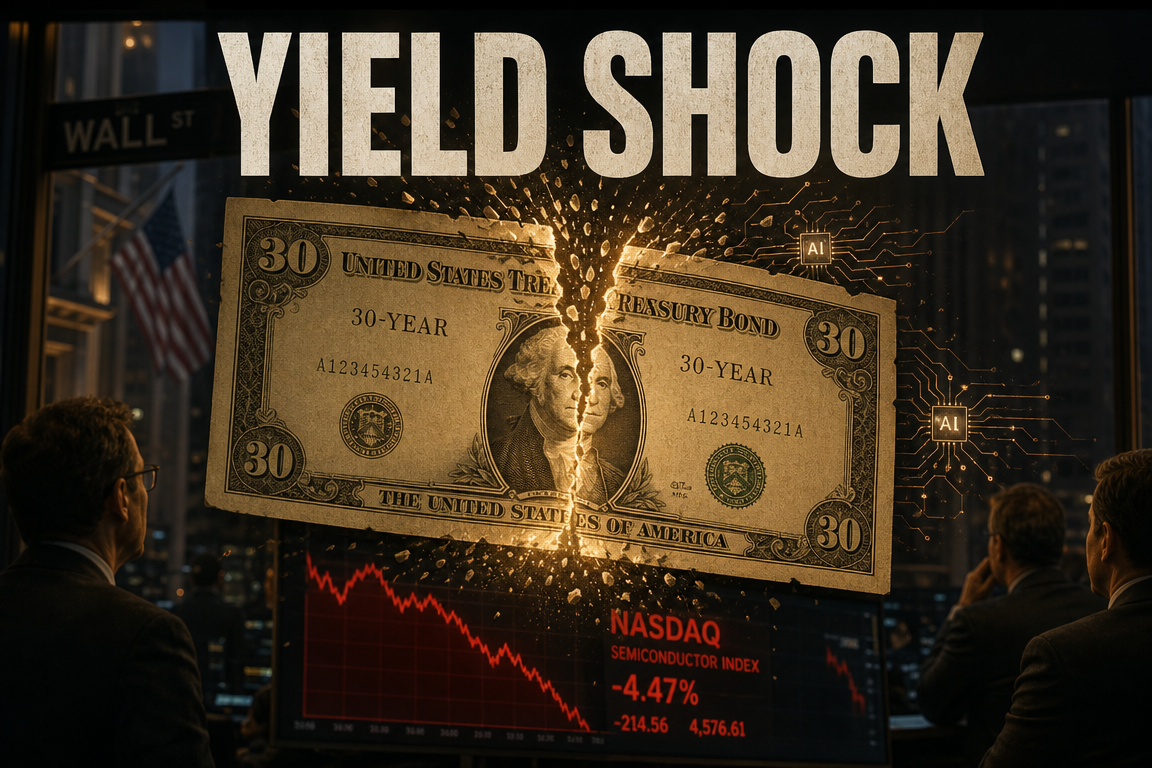
According to the source, the Nasdaq fell by about 1.3%, reflecting a broad deterioration in sentiment.
The weakest sector was semiconductors.
Micron fell about 7%, the SK Hynix ADR fell about 8%, and SanDisk dropped nearly 9%, indicating broad selling across memory-related names.
KOSPI night futures also fell about 3.76%, showing that Korean equities were not insulated from the move.
- The Nasdaq decline was driven primarily by long-term bond market stress.
- Persistently high long-dated Treasury yields pressured growth stock valuations.
- Semiconductor stocks tied to AI expectations were especially sensitive to higher rates.
- Memory semiconductors were hit harder because they are directly linked to big tech data center spending.
In simple terms, the market is now pricing the following sequence:
Higher U.S. rates raise funding costs for large tech firms, which can slow AI data center investment, which in turn may soften semiconductor demand.
2. Why Bond Yields and Semiconductor Stocks Are Connected
Higher bond yields mean lower bond prices.
When long-term Treasury yields such as the 10-year and 30-year rise, corporate funding costs also increase.
Large technology firms require substantial capital expenditures for AI data centers, GPUs, servers, and memory semiconductors.
This capital spending is commonly referred to as CAPEX.
The issue is that the scale of AI investment has become too large to be financed entirely through internal cash flow.
As a result, companies issue bonds to raise long-term funding.
When long-term yields rise, corporate borrowing costs rise as well.
Higher interest expense forces firms to reassess the pace of investment.
- Long-term Treasury yields rise
- Corporate bond yields rise
- Funding costs for large tech companies increase
- AI data center CAPEX becomes more expensive
- Expectations for memory semiconductor demand weaken
- Concerns over semiconductor earnings increase
This chain is the central reason behind the recent sell-off in semiconductor equities.
Companies such as Nvidia, Micron, SK Hynix, and Samsung Electronics are now being driven not only by industry fundamentals but also by global bond yields.
3. How Stressed Is the Long-Dated Bond Market?
The source notes that the U.S. 30-year yield rose to around 5.302%.
In some sessions, it touched 5.33%, a level described as the highest since 2007.
The U.S. 10-year yield is also trading near its highest range in several years.
This is not only a U.S. issue.
France’s 30-year government bond yield has climbed to its highest level since 2008.
Germany’s long-term bond yields have risen to levels not seen since 2011.
U.K. 30-year gilt yields are approaching 6%.
Japan’s super-long sovereign yields are also near record highs.
In other words, the entire global long-duration bond market is under pressure.
Investors worldwide are no longer absorbing long-term government debt as easily as before.
4. The Structural Reasons the Long Bond Market Is Weakening
This yield increase is not simply a consequence of the Federal Reserve keeping policy rates elevated.
It reflects a broader combination of fiscal expansion, demographics, geopolitics, corporate funding needs, and changes in pension demand.
4-1. Aging and Rising Social Spending
Most developed economies are aging rapidly.
As populations age, spending on pensions, health care, and welfare rises.
Governments have limited room to reduce these outlays, and politically, spending cuts are difficult.
The result is increased sovereign borrowing.
When Treasury issuance rises, bond supply increases.
If demand does not keep pace, bond prices fall.
Lower bond prices mean higher yields.
4-2. Higher Fiscal Spending Even Without a Deep Recession
In the past, fiscal deficits often widened during recessions.
As growth weakened, tax receipts fell and spending on unemployment support increased.
At the same time, central banks typically cut rates to cushion the shock.
The historical pattern was:
- Growth weakens
- Fiscal deficits widen
- Government bond issuance rises
- Central banks cut rates
- Bond market stress eases
That pattern is different now.
Even without a severe global downturn, government spending remains elevated.
Defense, industrial policy, tax cuts, subsidies, and infrastructure programs are all expanding at once.
This can be viewed as pro-cyclical fiscal expansion.
When growth remains resilient but fiscal spending increases, central banks have less room to cut rates.
Inflationary pressure remains.
The result is rising Treasury supply without the usual offset from monetary easing.
4-3. Middle East Conflict and Energy Costs
Geopolitical risk is also pressuring long-term bond markets.
If the conflict in the Middle East intensifies, energy prices could rise.
Higher energy prices can reaccelerate inflation.
That would make the Federal Reserve more cautious about rate cuts.
For markets, this is an unfavorable combination.
Growth may slow while inflation remains sticky.
In that environment, investors demand a higher risk premium for long-dated government debt.
4-4. The AI Investment Boom Is Increasing Corporate Bond Supply
One of the most important changes in this cycle is AI investment.
Large technology firms are spending heavily on data centers and AI infrastructure.
This is increasing corporate bond issuance.
Alphabet, for example, has reportedly issued bonds not only in U.S. dollars but also in Australian dollars.
The issue is that sovereign bonds and corporate bonds compete for the same pool of capital.
When governments continue to issue more debt and large tech firms also increase bond issuance, overall supply rises further.
Investors then demand higher yields.
AI is therefore acting as a supply-side burden in the bond market.
It is bullish for equities in the context of AI adoption, but it can be a source of upward pressure on financing costs.
4-5. Pension Structure Changes Have Reduced Structural Demand for Long Bonds
In the past, defined benefit pension plans were more common.
DB plans had fixed future liabilities, which created strong demand for long-duration bonds.
Asset managers needed to match long-term assets with long-term liabilities.
Over time, defined contribution plans have grown in importance.
DC plans place more responsibility on individuals.
That tends to increase preference for equity exposure and reduce structural demand for long-duration bonds.
This is a gradual but important shift.
If one focuses only on the Federal Reserve, this structural decline in demand is often overlooked.
4-6. The Main Buyers of Sovereign Debt Have Changed
In the past, foreign central banks were major buyers of U.S. Treasuries.
They were less sensitive to price and more focused on reserve management, dollar liquidity, and financial system stability.
They were therefore non-price-sensitive buyers.
More recently, private investors have become more important.
Private investors are much more yield-sensitive.
If yields are unattractive, they delay purchases; if losses rise, they may sell.
This shift increases volatility in long-term bond markets.
When non-sensitive buyers decline and price-sensitive buyers dominate, yields can move more sharply.
5. The Key Point That Is Often Missed
First, the problem in the long bond market cannot be explained by short-term policy rates alone.
The current stress reflects Treasury supply, corporate bond supply, pension demand, foreign central bank demand, and inflation risk premiums moving at the same time.
Second, large AI companies have become major participants in the bond market.
As AI investment grows, these firms require more funding.
Their corporate debt issuance now competes with Treasury issuance.
What is supportive for equities can simultaneously be a supply burden for bonds.
Third, semiconductor stocks have become rate-sensitive growth equities, not just cyclical hardware names.
Memory semiconductor demand depends on AI data center CAPEX.
AI CAPEX depends on large tech firms’ financing conditions.
As a result, higher U.S. rates affect Korean semiconductor stocks directly.
Fourth, a recession would likely support bonds but could be negative for equities.
Rate declines driven by recession are not necessarily positive overall.
Even if Treasury prices recover, corporate earnings expectations would weaken.
6. What Could Stabilize the Situation?
6-1. Shifting Issuance Toward Short-Term Debt
If governments reduce long-dated issuance and increase short-term issuance, long-end yield pressure could ease temporarily.
This may help stabilize markets in the near term.
However, it is not a structural solution.
Shorter maturities eventually need refinancing, which shifts the burden forward.
6-2. Yields Rise Enough to Re-Attract Buyers
If bond prices fall enough and yields become sufficiently attractive, investors may return.
Long-term demand can recover once expected returns become compelling.
However, this process usually involves market pain.
Stocks and bonds can both remain volatile during that adjustment.
6-3. Recession or External Shock
A recession would likely push investors toward safe-haven assets.
That could increase demand for long-term Treasuries and lower yields.
However, recession would also weaken corporate earnings.
That would be a negative for semiconductor stocks and growth equities.
Lower yields do not automatically imply a favorable equity environment.
6-4. A Slowdown in AI Corporate Bond Issuance
If large tech companies slow the pace of AI investment, corporate bond supply pressure would ease.
That would be supportive for the bond market.
However, it could also weigh on memory semiconductor demand expectations.
Lower AI data center spending would reduce expectations for HBM, DRAM, and NAND demand.
6-5. Easing Middle East Tensions and Stabilizing Energy Prices
If geopolitical risks ease, upward pressure on energy prices could diminish.
Lower inflation risk would improve expectations for rate cuts by the Federal Reserve.
That would likely support both bond and equity markets.
Geopolitical de-escalation is one of the fastest ways to improve market sentiment.
6-6. AI Companies Demonstrate Sustainable Monetization
Even with high rates, the market may stabilize if AI companies generate sufficient cash flow.
Investors’ main concern is whether AI investment scale is being matched by monetization.
If large tech firms show they can fund AI spending without excessive reliance on debt, that would be positive for semiconductor stocks.
In the end, the sustainability of the AI cycle must be proven through revenue growth and margins.
7. A Key Variable for Korea: Trump, Trade Pressure, and Semiconductor Investment
The source also refers to Bloomberg reporting on Trump-related pressure on Korea.
The discussion includes the use of North Korea and Kim Jong Un as leverage in trade negotiations.
Comments about reducing U.S.-South Korea military exercises and describing Kim Jong Un as a good friend are interpreted as part of a broader bargaining strategy.
The main issue is Korea’s investment package for the United States.
Korea is said to have pledged $350 billion in U.S. investment.
However, the pace and specificity of implementation appear to fall short of Trump’s expectations.
Trump also appears to want Samsung Electronics and SK Hynix to be more aggressive in building factories in the United States.
That links to U.S. manufacturing reshoring, semiconductor supply chain security, and job creation.
For Korean policymakers and companies, the issue is not simple because it involves cost, profitability, supply chain efficiency, and the balance of domestic investment.
Added to this are tensions involving Coupang, making the Korea-U.S. economic relationship less straightforward than a purely cooperative one.
As a result, Korean semiconductor firms may face stronger pressure to increase U.S. investment.
8. Key Items for Investors to Monitor
- Whether U.S. 10-year and 30-year yields continue to rise
- Whether demand in Treasury auctions remains weak or improves
- Whether large tech bond issuance keeps expanding
- Whether AI data center CAPEX guidance is maintained
- Changes in earnings expectations for Micron, SK Hynix, Samsung Electronics, and other memory names
- Whether Middle East tensions and energy prices reignite inflation expectations
- The Federal Reserve’s messaging on potential rate cuts
- Whether pressure on Korean semiconductor investment in the U.S. translates into actual capex
The market is no longer in a phase where “AI is positive” is sufficient on its own.
For the AI cycle to continue, financing conditions must remain manageable.
As a result, investors in semiconductor stocks should monitor not only earnings but also U.S. yields, corporate bond spreads, and Treasury market supply-demand conditions.
9. In One Line
The current long-bond market stress reflects a combined shock from rising government debt and the AI investment boom.
That shock is increasing funding costs for large tech companies, raising concerns about AI CAPEX, and pressuring memory semiconductors and Korean equities.
The market wants to believe in the future of AI, while the bond market continues to increase the price of the capital needed to fund that growth.
< Summary >
The core drivers of the long bond market sell-off are rising Treasury supply, higher fiscal spending, aging demographics, inflation concerns, and increased AI-related corporate bond issuance.
When long-term Treasury yields rise, funding costs for large tech companies increase, adding pressure to AI data center investment.
This then feeds into concerns over memory semiconductor demand and weighs on semiconductor stocks such as Micron, SK Hynix, and Samsung Electronics.
The market is currently balancing expectations for AI earnings growth against the burden of higher U.S. rates.
Possible stabilizers include lower yields, easing Middle East tensions, proof of AI monetization, and a recovery in bond demand, though none of these factors is likely to resolve quickly.
[Related Articles…]
- How Rising Long-Term Bond Yields Affect Global Equities
- AI Investment Cycles and the Outlook for Semiconductor Stocks
*Source: [ 내일은 투자왕 – 김단테 ]
– 장기 채권 시장이 개박살난 진짜 이유
● Nasdaq Shock, Long Bond Yield Spike, Oil Surge, AI Stocks Hit
Nasdaq Declines and U.S. 30-Year Yield Breaks Above 5.3%: The Market Is Focused Less on Earnings and More on Long-Term Rates
The most important point in this New York market move is not simply that the Nasdaq fell more than 1%.
The key issue is that the U.S. 30-year Treasury yield rose to 5.3%, bringing renewed pressure on the valuation of growth stocks that had been lifted by the AI investment boom.
Home Depot earnings are also an important barometer for U.S. consumer demand and the housing market slowdown, while Baidu earnings are a key signal for the recovery of China’s AI, cloud, and advertising cycle.
At the same time, sustained high oil prices are increasing the appeal of Big Oil dividend stocks, but they also remain a double-edged factor for the broader market because they can reaccelerate inflation and Treasury yields.
In short, this episode ties together the Nasdaq decline, the rise in U.S. long-term yields, Home Depot earnings, Baidu’s AI strategy, and high oil prices with Big Oil dividends.
1. Core New York market trend: Nasdaq falls more than 1%, and why technology stocks weakened first
The Nasdaq’s decline of more than 1% signals a rapid deterioration in risk appetite.
Because the Nasdaq has a high weighting in AI semiconductors, cloud, software, and platform companies, it is highly sensitive to rising interest rates.
When long-term yields rise, the present value of future earnings falls, directly increasing valuation pressure on high-growth technology and AI-related stocks.
U.S. equities had risen sharply on earnings expectations and AI investment momentum, but once Treasury yields move higher again, investors begin to question whether current valuations remain justified.
- The Nasdaq decline reflects rate repricing more than simple profit-taking.
- The AI investment theme remains intact, but higher rates can increase volatility.
- Semiconductors, cloud companies, and high-growth software names are typically the first to face pressure during periods of rising long-term yields.
2. What the U.S. 30-year Treasury yield at 5.3% means: why markets fear long-term rates
The rise in the U.S. 30-year Treasury yield to 5.3% is meaningful beyond the headline number.
The 30-year yield reflects expectations for long-term growth, inflation, fiscal risk, and Treasury supply dynamics.
In other words, higher long-term yields suggest that markets are pricing in a world in which rates will remain elevated for longer.
The 30-year yield also directly affects mortgage rates, corporate long-term funding costs, infrastructure investment, housing prices, and growth-stock valuations.
Even if the Federal Reserve lowers short-term policy rates, the broader financial environment may still remain restrictive if Treasury yields stay elevated.
3. Five reasons U.S. long-term yields are rising
First, renewed inflation concerns.
If high oil prices continue and services inflation remains sticky, markets will continue to price in higher long-term inflation expectations.
Even if the Fed adjusts short-term rates, long-term yields can move independently if inflation expectations remain elevated.
Second, the U.S. fiscal deficit and Treasury issuance burden.
As government spending rises and Treasury issuance increases, markets demand higher yields.
When supply grows and buyer demand is insufficient, yields rise naturally.
Third, higher term premium.
The term premium is the additional return investors require for holding long-dated bonds.
It rises when long-term inflation, fiscal risk, political risk, and monetary policy uncertainty increase.
The recent move in long-term yields reflects not only Fed rate expectations but also a repricing of the term premium.
Fourth, weaker expectations for Fed rate cuts.
The market previously expected the Fed to cut rates quickly, but if inflation and labor market conditions do not soften, the pace of cuts is likely to slow.
As rate-cut expectations fade, the appeal of long-duration bonds declines and yields move higher again.
Fifth, global bond market synchronization.
The move is not limited to the United States.
If long-term yields in Japan, Europe, and other major economies also rise, global investors require higher returns on U.S. Treasuries as well.
U.S. long-term yield increases are therefore both a domestic and global capital-flow issue.
4. Why Home Depot earnings matter: a barometer for U.S. consumer spending and housing demand
Home Depot earnings are more than a retail result.
They provide insight into U.S. household spending on home repairs, remodeling, building materials, housing activity, and middle-class purchasing power.
Higher rates tend to reduce home sales, and weaker home sales reduce demand for moving, repair, and remodeling.
For that reason, Home Depot’s results are important for assessing whether U.S. consumers are still holding up or gradually weakening under rate pressure.
- Weak same-store sales indicate greater consumer fatigue.
- Lower average ticket size suggests softer demand for higher-value remodeling projects.
- Slower demand from professional contractors points to weaker housing-market sentiment.
- More conservative guidance may increase concern about a slowdown in U.S. consumer activity in the second half of the year.
Even if Home Depot meets market expectations, weak forward guidance may still pressure the stock.
Conversely, if results are softer but inventory control and cost discipline remain strong, the company may be viewed as a defensive name within a slowing economy.
5. Why Baidu earnings matter: a reality check on China AI and advertising demand
Baidu earnings are an important indicator for Chinese technology stocks.
The company has multiple growth drivers, including search advertising, AI cloud, autonomous driving, and generative AI services.
The key question is whether Baidu’s AI initiatives are translating into actual revenue and earnings.
China’s AI strategy differs structurally from that of U.S. mega-cap tech companies.
While the U.S. model is centered on cloud infrastructure and semiconductors, China’s focus is more on advertising, search, enterprise AI, smart-city applications, and autonomous driving.
- Recovery in advertising revenue would point to improving domestic demand in China.
- Growth in AI cloud revenue would support a revaluation of Baidu’s long-term growth profile.
- Lower losses in autonomous driving could strengthen investor confidence in future businesses.
- Reduced regulatory pressure would likely improve sentiment across Chinese technology stocks.
However, China’s economic slowdown, U.S.-China technology tensions, and semiconductor export controls remain major headwinds for Baidu and other Chinese AI companies.
Baidu’s earnings are therefore not only a company-level result, but also a test of the pace of recovery in China’s economy and AI industry.
6. High oil prices and Big Oil dividends: attractive for dividend investors, but a market-wide risk
When oil prices remain elevated, energy companies generate stronger cash flow.
Companies such as Exxon Mobil and Chevron can create significant free cash flow in high-price environments and return it to shareholders through dividends and share repurchases.
As a result, Big Oil dividend stocks tend to regain attention during periods of high oil prices.
When rate volatility rises and technology stocks weaken, energy stocks with stable cash flow and shareholder returns can serve as a portfolio defense.
- Higher oil prices support earnings for Big Oil.
- Dividend growth and buybacks can support share prices.
- Energy stocks may also function as an inflation hedge.
- However, persistently high oil prices can weaken consumption and raise inflation.
The problem is that prolonged high oil prices can reduce the case for Fed easing.
In that sense, they are positive for Big Oil but negative for Nasdaq and growth stocks.
7. Semiconductor stocks and AI investment: as rates rise, only companies with real earnings will hold up
The AI investment theme remains central to the market.
Memory semiconductor companies such as Micron and SanDisk can benefit from rising demand for AI servers and data centers.
As AI data centers expand, demand also increases for HBM, DRAM, NAND, storage, and networking equipment.
However, in a higher-rate environment, the market becomes less willing to reward growth narratives alone.
Investors are increasingly focused on whether AI can translate into higher revenue and margin improvement.
- Companies that show AI-related demand in earnings are more likely to maintain valuation premiums.
- Companies with losses and only future expectations remain vulnerable when long-term rates rise.
- If the data center investment cycle slows, AI-related stocks may become more volatile.
- Memory semiconductors remain exposed to both recovery expectations and supply growth.
AI investment strategy is therefore shifting from broad thematic exposure to selective investment in companies with verified earnings.
8. The key linkages driving the market now
These developments may appear separate, but they are connected by one broader pattern.
High oil prices are driving inflation concerns.
Inflation concerns are pushing U.S. Treasury yields higher.
Higher long-term yields are pressuring Nasdaq and growth-stock valuations.
Rate pressure is weakening housing and consumer demand, which is reflected in Home Depot earnings.
Global growth uncertainty is also affecting the pace of earnings recovery at Chinese technology companies such as Baidu.
In other words, this is not simply a technology selloff, but a broader repricing of rates, oil, consumption, and AI earnings.
9. The most important point often missed in other coverage
The most important issue is that the 30-year Treasury yield is beginning to act as an effective ceiling on equity valuations.
Many reports focus on the Nasdaq decline or on specific company earnings, but the real issue is that long-term yields are now limiting overall equity valuations again.
When the 30-year yield is above 5%, investors have less reason to pay high prices for risky growth stocks.
If safe bonds offer attractive returns, equities must demonstrate significantly stronger growth and earnings stability to justify their valuations.
This suggests that U.S. equities may be moving into a more earnings-driven phase rather than a liquidity-driven one.
AI companies are not exempt.
The phase in which stocks rose simply because they were labeled AI-oriented is fading, and the market is shifting toward companies that can demonstrate revenue growth, margin improvement, cash flow, and capital efficiency.
Another important point is that Home Depot and Baidu act as mirrors of the real economies in the U.S. and China, respectively.
Home Depot reflects the health of U.S. households and housing demand, while Baidu reflects Chinese domestic demand and the pace of AI commercialization.
Viewed together, the two companies provide a useful check on the twin engines of global growth: U.S. consumption and Chinese technology demand.
10. What investors should monitor now
First, whether the U.S. 30-year Treasury yield extends its move above 5.3%.
Additional upside in long-term yields could increase pressure on the Nasdaq and high-valuation growth stocks.
Second, whether oil prices continue to reintroduce inflation concerns.
If the rise in oil prices proves temporary, the market impact may remain limited. If it persists, expectations for Fed easing could weaken further.
Third, whether Home Depot shows signs of consumer slowdown.
Weakness in housing-related spending would increase concern about the broader U.S. consumer backdrop.
Fourth, whether Baidu can demonstrate AI monetization.
This is a key indicator of whether the AI investment boom is translating into real profitability.
Fifth, whether Big Oil dividend stocks can remain a defensive allocation without additional oil-price risk.
Energy stocks offer income support, but they can also correct if recession concerns rise along with oil-price volatility.
11. Portfolio implications
In the current market, investors should manage rate sensitivity rather than simply increase exposure to high-growth stocks.
AI semiconductors and technology stocks still have long-term growth potential, but they may remain volatile as U.S. Treasury yields rise.
By contrast, energy stocks, dividend stocks, and large-cap companies with stable cash flow can help reduce portfolio volatility.
- Growth exposure should be concentrated in AI infrastructure companies with proven earnings.
- Dividend stocks should be evaluated not only on yield, but also on cash flow durability.
- Bond allocations should be diversified by maturity to manage rate volatility.
- Chinese technology exposure should be assessed alongside Baidu earnings and policy signals.
- U.S. consumer exposure should be monitored through Home Depot’s results and housing-market indicators.
The focus should be less on what may rise next and more on what can withstand a higher-rate environment.
< Summary >
The main driver behind the Nasdaq decline is the pressure from rising long-term U.S. yields.
The U.S. 30-year Treasury yield above 5.3% is a meaningful signal of valuation pressure on growth and AI-related stocks.
Home Depot earnings are a useful indicator of U.S. consumer and housing-market softness.
Baidu earnings will help assess the recovery in China’s AI, advertising, and cloud businesses.
High oil prices support Big Oil dividend stocks, but they may also intensify inflation and yield pressure, creating a broader market headwind.
The key investment approach now is not to follow the AI theme indiscriminately, but to focus on companies that can demonstrate earnings and cash flow in a higher-rate environment.
[Related Articles…]
- Nasdaq Decline and U.S. Equity Strategy Review
- AI Investment Trends and Semiconductor Stock Analysis
*Source: [ Maeil Business Newspaper ]
– 나스닥 1% 넘게 급락·美30년물 5.3%ㅣ美장기금리 왜 뛰나ㅣ홈디포·바이두 실적 발표ㅣ고유가에 빅오일 배당 주목ㅣ홍혜진의 뉴욕브리핑