● Tesla Semi Shockwave, 500-Unit Order, Autonomous Freight Boom
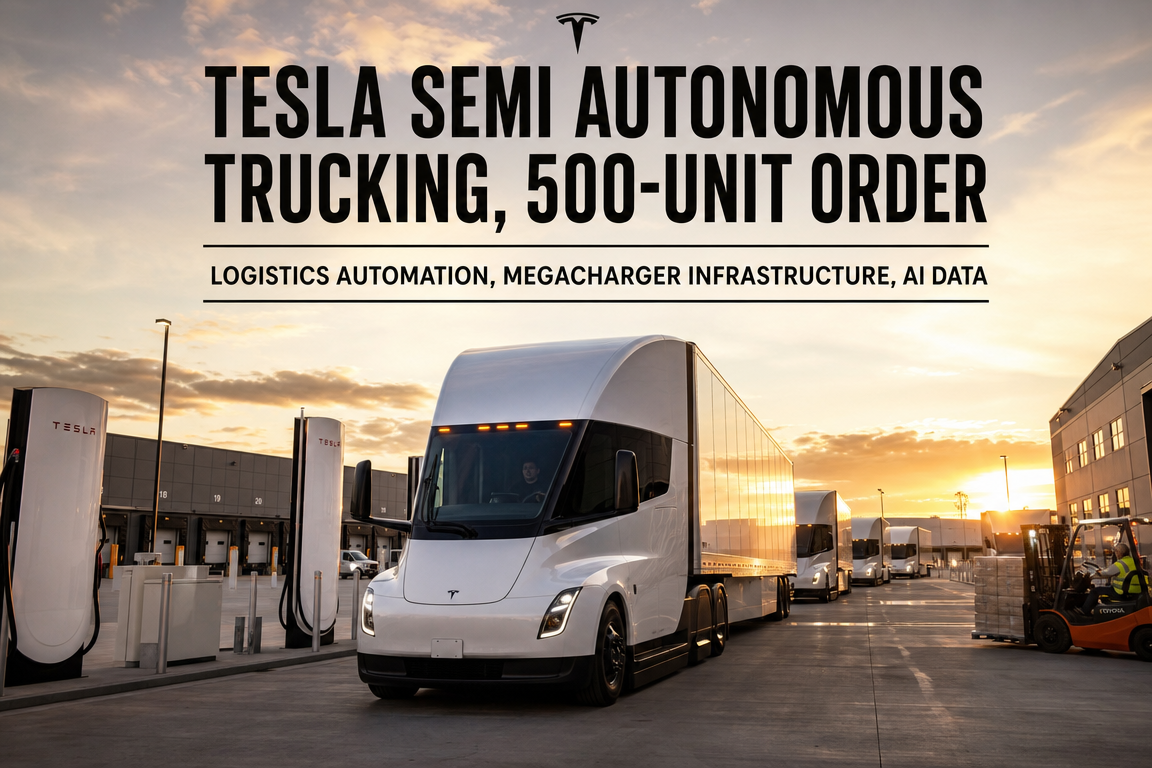
Tesla Semi 500-Unit Order Signals a Shift Toward Autonomous Logistics, Not Just Fuel Savings
The key takeaway from this development is not simply that Tesla Semi has secured a 500-unit order.
The more important point is that Tesla is positioning the Semi not merely as an electric truck, but as an autonomous logistics platform.
Higher fuel prices have improved the economics of electric trucking, and when combined with autonomy, Megachargers, logistics software, and, over time, Optimus robots, the potential impact extends to the cost structure of global supply chains.
For investors, the central question is not Tesla’s short-term share price volatility around the $336 level, but whether this truck can help reduce logistics, labor, and inflationary pressure over time.
1. Market backdrop: Tesla was not the only stock under pressure
According to the source material, Tesla closed at $336.87, down 0.72% on the day.
Broader markets were also weak.
The S&P 500 fell roughly 0.9%, the Nasdaq declined about 1.33%, and the Dow dropped around 0.22%.
Tesla’s decline should therefore be viewed in the context of a broader risk-off market environment rather than as a company-specific event.
The main macro factor cited was geopolitical risk in the Middle East and its effect on energy prices.
Tensions involving Iran and concerns over the Strait of Hormuz were said to be supporting crude oil and diesel prices.
Brent crude remained elevated, and U.S. diesel prices strengthened, putting renewed pressure on logistics operators’ fuel costs.
This is the backdrop for Tesla Semi’s 500-unit order.
2. Tesla Semi 500-unit order: why it matters
The most important news is that Tesla Semi reportedly received the largest single order in company history.
According to the source, one company ordered 500 units at once.
Since the previous largest order was cited at about 370 units, this marks a clear new high.
The significance is not just higher vehicle volume.
It signals that a major logistics operator has concluded that electric trucking can deliver a superior operating cost profile versus diesel.
Passenger EV competition is already intense, but the heavy-duty commercial vehicle market remains in an early transition phase.
A large order of this size suggests that the electric truck market could begin to scale more meaningfully.
3. Why Tesla updated the Semi website: the message is now about economics
Another detail worth noting is Tesla’s update to the Semi product page.
At first glance this may look like a simple website refresh, but the messaging has changed materially.
Earlier descriptions emphasized range, battery performance, and output.
The updated page highlights lower operating costs versus diesel.
Tesla is emphasizing lower energy costs, fewer moving parts, and the ability to recover the higher upfront purchase price over the vehicle’s lifetime.
The company also highlights fleet management software and route planning features as standard capabilities.
This indicates that Tesla is positioning Semi as a cost-reduction solution for logistics operators, not just as a truck.
The message has shifted from “this truck is fast” to “this truck improves economics.”
4. Rising U.S. diesel prices: why Tesla Semi is suddenly more attractive
The source cites U.S. highway diesel prices at $5.34 per gallon.
One gallon is approximately 3.785 liters.
That translates to about $1.41 per liter.
Using the cited exchange rate of KRW 1,412 per dollar, that equals roughly KRW 1,996 per liter, or close to KRW 2,000.
For trucking companies, that difference is substantial.
Passenger vehicles may travel 10,000 to 20,000 km per year, but long-haul U.S. trucks often run about 100,000 miles, or roughly 160,000 km, annually.
That is comparable to driving between Seoul and Busan about 200 times in a year.
At that scale, even small differences in fuel cost become highly material on an annual basis.
5. Tesla Semi economics in numbers: annual savings can approach KRW 100 million per truck
According to the source, a typical U.S. Class 8 diesel truck achieves around 2.6 km per liter when fully loaded.
At KRW 2,000 per liter, that implies fuel costs of about KRW 780 per km for diesel.
Tesla Semi’s official efficiency is cited at about 1.7 kWh per mile.
Converted to kilometers, that is roughly 1.06 kWh per km.
If a logistics operator charges overnight at a depot and pays $0.12 per kWh, electricity costs would be around KRW 180 per km.
Even using a conservative $0.18 per kWh, the cost would still be about KRW 270 per km.
In other words, diesel trucking costs about KRW 780 per km, while Tesla Semi costs roughly KRW 180 to KRW 270 per km in electricity.
Put differently, one km of diesel operation could fund 3 to 4 km of Tesla Semi driving.
At 160,000 km per year, fuel expense for a diesel truck would be about KRW 126 million.
Tesla Semi would require about KRW 28.8 million in electricity costs.
That implies annual savings of roughly KRW 97 million per truck.
Rounded, one Tesla Semi could save close to KRW 100 million per year in fuel costs alone.
For 500 units, the annual savings potential rises to roughly KRW 48.6 billion, or about KRW 50 billion.
This explains why a logistics company would commit to a 500-unit order.
6. Maintenance savings widen the gap further
Diesel trucks rely on engines, transmissions, exhaust after-treatment systems, and urea systems, all of which add complexity.
More complexity means higher failure risk and higher maintenance expense.
Electric trucks have a much simpler mechanical structure.
The source estimates diesel maintenance costs at about KRW 160 per km, versus about KRW 53 per km for Tesla Semi.
At 160,000 km per year, that difference could amount to roughly KRW 17 million per truck annually.
When maintenance savings are added to fuel savings, Tesla Semi’s total cost of ownership becomes even more competitive.
Elon Musk stated when Semi was first unveiled in 2017 that the total cost of ownership for diesel trucks could be about 20% higher than Tesla Semi.
That earlier estimate assumed diesel prices of around $2.50 per gallon.
With diesel now cited at $5.34 per gallon, the economic case for electric trucking appears materially stronger than in 2017.
7. Why Tesla Semi specifically: price, weight, and charging time
Higher diesel prices do not automatically make every electric truck a viable solution.
For large fleet operators, three factors matter most: price, payload, and charging time.
① Price: relatively lower within the electric truck segment
The source says the Tesla Semi Long Range is priced at about $290,000.
That is roughly KRW 410 million.
The absolute price is still high.
However, it is relatively competitive versus other electric heavy-duty trucks.
Competitors such as Freightliner and Volvo are cited above $300,000, and the average electric heavy-duty truck price in 2024 is described as about $435,000.
On that basis, Tesla Semi is comparatively inexpensive within the electric truck category.
It remains more expensive than diesel, however.
If a new diesel Class 8 truck costs about $180,000, Tesla Semi is still about $110,000 more expensive upfront.
The key issue is therefore how quickly the higher initial cost can be recovered through fuel and maintenance savings.
That is why Tesla emphasizes payback period on the product page.
② Weight: Tesla has reduced one of the main disadvantages of electric trucks
In trucking, weight directly affects economics.
A heavier tractor means less payload capacity.
Electric trucks can be disadvantaged because batteries add significant weight.
However, the U.S. allows an additional 2,000 pounds of gross weight for electric trucks.
The source also says Tesla reduced the Semi’s weight by about 1,000 pounds through a redesign.
Together, these factors bring Tesla Semi closer to diesel-level payload capability.
③ Charging time: aligned with mandatory driver rest periods
U.S. federal regulations require truck drivers to take a mandatory 30-minute break after a certain amount of driving.
The source links this to the 8-hour continuous driving rule.
Tesla Semi is described as capable of recovering substantial range in about 30 minutes using 1.2 MW Megacharging.
The key point is that the charging window aligns with a required rest period.
This reduces one of the biggest operational drawbacks of electric trucking by making charging part of the logistics workflow.
8. The real story: Tesla Semi is a step toward autonomous trucking
Many reports frame the 500-unit order simply as an electric truck sale.
The more important point is that these vehicles can generate autonomous driving data over time.
In trucking, fuel is a major cost, but labor is often even larger.
Truck assets are capital-intensive, yet a driver requirement limits utilization.
If a truck can operate 24 hours a day but must remain parked for much of that time because of labor constraints, asset efficiency is reduced.
That is why autonomous trucking is not just a technology story; it is a core profitability lever for logistics.
Chinese company Pony.ai is reportedly testing a “1+4” model in which one human-driven truck leads four autonomous trucks.
This structure allows one driver to manage five trucks.
The source says this could reduce freight costs per km by about 29% and significantly improve operating margins.
Removing the driver entirely would improve the economics further.
The challenge is technology and regulation.
Fully driverless trucks already exist in ports, logistics hubs, and controlled environments.
Operating on public highways and complex roads is a different challenge.
9. Why Einride buying Tesla Semi is notable
The buyer in the source is Einride.
Einride is known for its concept of driverless electric autonomous trucks.
That company purchasing 500 Tesla Semis is notable.
Einride’s fully autonomous trucks are well suited to controlled environments, but they remain constrained in long-haul public road operations.
Moving freight from California to Texas or from New Jersey to Illinois requires operation beyond controlled sites.
That is where Tesla Semi becomes relevant.
Tesla already has extensive data from its passenger vehicle autonomy stack and is publicly pushing toward driverless vehicle operation through Robotaxi and Cybercab.
Semi is also described as being designed with autonomy in mind.
The vehicle is said to include 10 exterior cameras, one interior camera, and a hardware architecture related to Tesla’s passenger vehicle autonomy systems.
It is currently driven by a person, but the platform appears to have been built for a future transition to driverless operation.
10. The most important point often missed by other coverage
The most important point is that the 500 Tesla Semis may function as data-collection assets, not just vehicles.
If Tesla operates 500 Semis, the company is not only generating revenue.
It is collecting long-haul highway driving data, payload-specific efficiency data, charging patterns, route-optimization data, and maintenance data.
That data is highly relevant for future autonomous trucking deployment.
Autonomous systems in trucks face different technical, regulatory, and safety challenges than passenger vehicles.
Because trucks are heavier, stop distances are longer and accident consequences are more severe.
As a result, data gathered in real logistics operations is more valuable than simulation alone.
Charging infrastructure is another critical factor.
Operating 500 Semis requires Megacharger networks, depot charging, power supply coordination, and route scheduling.
That infrastructure could become a barrier to entry that competitors may find difficult to replicate later.
In this sense, the order is better understood as the initial build-out of an electric autonomous logistics network rather than as a simple truck sale.
11. Why Optimus could expand the logistics opportunity
In trucking, human labor is required not only for driving but also for loading and unloading freight.
If Tesla’s Optimus robot is deployed in warehouses and handling operations, cost reduction could occur across three layers.
First, Tesla Semi reduces fuel expense.
Second, autonomy reduces driver labor expense.
Third, Optimus could reduce warehouse and loading labor expense.
Few companies can connect all three layers in one ecosystem.
That is what makes Tesla more than a conventional EV manufacturer.
Tesla is attempting to integrate electric vehicles, batteries, charging infrastructure, autonomy, robotics, and energy software into a single economic system.
If this model scales, logistics costs could fall and supply-chain-related inflationary pressure could ease over time.
12. Key monitoring points for Tesla investors
Tesla’s share price volatility around $336 can obscure the significance of this development.
Investors should focus on four areas.
① How quickly Semi production scales
Orders are encouraging, but deliveries matter more.
The key issue is how quickly Tesla can expand production capacity and secure battery supply.
② How rapidly Megacharger infrastructure expands
Electric trucking requires more than vehicles.
Long-haul operations depend on charging infrastructure.
Investors should watch whether Megachargers are built around logistics hubs and highway corridors.
③ Regulatory progress for autonomy
For Semi to evolve into a driverless truck, the obstacle is not only technology but also regulation.
State approvals, insurance, liability, and freight rules all matter.
④ Whether Semi becomes a software revenue platform
If Tesla can monetize vehicle monitoring, route optimization, charging scheduling, and autonomy features through software or subscriptions, margins could improve materially beyond vehicle sales alone.
That could help support Tesla’s valuation over the long term.
13. The risks remain clear
The positive narrative does not eliminate risk.
First, if diesel prices normalize, the economic advantage of electric trucking could narrow.
Second, Semi production ramp-up could be slower than expected.
Third, battery supply and cost management remain critical.
Fourth, charging infrastructure requires significant capital investment.
Fifth, full autonomous trucking may face greater regulatory and social acceptance hurdles than passenger robotaxis.
In short, the 500-unit order is a strong directional signal, but execution must still clear production, infrastructure, and regulatory hurdles.
14. Why the SpaceX update also matters
The source also referenced a SpaceX Starship update.
Starship was reportedly retrieved near Christmas Island about 24 days after its ocean splashdown, and an engineering team is expected to conduct detailed analysis.
The vehicle is described as having deployed 20 Starlink Version 3 satellites, survived in-space engine relight and reentry, and landed in the ocean relatively intact.
The important point is that the vehicle remained largely intact, allowing engineers to study heat-shield tiles, reentry damage, and structural changes on a real vehicle.
This should improve SpaceX’s ability to gather more precise data for future flights.
While the direct earnings link to Tesla is limited, the broader Musk ecosystem spanning AI, robotics, space, and energy continues to influence investor sentiment.
15. Conclusion: Tesla Semi’s 500-unit order is the beginning of a logistics cost war
This 500-unit Tesla Semi order is not simply an electric truck sales headline.
Rising fuel prices are making the economics of electric trucking more visible, and Tesla has responded by shifting Semi messaging toward total cost of ownership.
Fuel and maintenance savings alone already make Semi a compelling cost-reduction tool.
The larger transformation begins when the driver is eventually removed.
If Tesla Semi accumulates autonomy data, if Megacharger infrastructure expands, and if Optimus eventually enters logistics operations, the cost structure of trucking could change materially.
Logistics costs are embedded in the price of most goods.
As a result, this is not only a Tesla-specific development but also a broader economic issue with implications for supply chains and inflation.
Markets are currently focused on Tesla’s daily share-price movement, but the more important question is different:
When will the driver disappear from Tesla Semi?
< Summary >
Tesla Semi reportedly received a 500-unit order, the largest single order in the company’s history.
The main backdrop is higher U.S. diesel prices and rising fuel costs for heavy-duty trucking.
On a per-truck basis, Tesla Semi could deliver close to KRW 100 million in annual fuel savings versus diesel.
At 500 units, that implies annual savings potential of roughly KRW 50 billion.
Tesla has shifted the Semi product page from specifications toward total cost of ownership, operating cost reduction, and logistics software.
The key strategic point is that Semi can generate autonomy data and evolve toward driverless trucking.
Over time, Tesla Semi, Megachargers, autonomy, and Optimus could reduce logistics and labor costs and help ease inflationary pressure.
[Related Articles…]
- Tesla Semi and the Cost Revolution in Electric Trucking
- How Autonomous Logistics Is Reshaping Global Supply Chains
*Source: [ 오늘의 테슬라 뉴스 ]
– 테슬라 세미 500대 싹쓸이, 역대 최대 — 근데 이 트럭엔 사람이 없어도 되는 장비가 이미 다 들어있습니다, $336 주주는?
● Bond Shock, AI Funding Crunch, Semiconductor Slump
The key factor behind the sharp declines in Samsung Electronics and SK Hynix is not semiconductor earnings, but bond yields and AI data center financing
Recent declines in the KOSPI should not be interpreted simply as a deterioration in the semiconductor cycle.
The market’s primary concern is not the earnings outlook for Samsung Electronics and SK Hynix itself, but the financing environment required to sustain AI data center investment.
In short, AI demand remains strong, but the cost of funding the infrastructure behind that demand has risen materially.
The main variables are bond yields, higher global sovereign issuance, increased corporate bond issuance by big tech firms, Middle East risk, and upward pressure on oil prices.
When these factors move together, the market reaction is straightforward.
“Higher rates raise data center costs → AI server expansion slows → expectations for HBM and DRAM demand weaken → Samsung Electronics and SK Hynix fall → the KOSPI weakens as well.”
This is the linkage currently driving the market.
1. The immediate driver of the KOSPI decline: a renewed rise in long-term bond yields
Subsection: Higher global long-term yields
Long-term government bond yields in major developed markets have remained elevated.
When U.S. and other major sovereign yields rise, the discount rate applied to global risk assets increases.
A higher discount rate means the present value of future earnings declines.
This is particularly relevant for growth stocks, technology stocks, and semiconductors, where valuations are tied to expected future profits.
As a result, higher rates also pressure large semiconductor names such as Samsung Electronics and SK Hynix.
Main point
The current KOSPI weakness reflects not only domestic market conditions, but also the impact of rising global bond yields on Korean equity valuations.
Because semiconductors carry a large weight in Korea’s market, any disruption to AI semiconductor investment expectations can have an outsized impact on the index.
2. Why yields are rising: governments and big tech are borrowing at the same time
Subsection: Rising government bond issuance
Major governments have expanded fiscal spending significantly after the pandemic, while also facing higher spending on aging-related costs, defense, industrial subsidies, and infrastructure.
As tax revenue is often insufficient, governments must issue more debt.
When bond supply rises, bond prices fall and yields increase.
Bond prices and yields move inversely.
Greater supply of bonds forces investors to demand higher yields.
Subsection: Rising corporate bond issuance by big tech
A second major borrower has also emerged.
These are the big tech companies building AI data centers.
Microsoft, Google, Amazon, and Meta are maintaining large capital expenditure programs to remain competitive in AI infrastructure.
AI data centers require land, power, cooling systems, GPUs, servers, networking equipment, and memory semiconductors.
Because these investments are too large to fund entirely through operating cash flow, companies increasingly rely on bond issuance and external financing.
Main point
The bond market is being pressured simultaneously by sovereign borrowing and large-scale corporate borrowing from AI infrastructure builders.
As a result, financing costs are unlikely to decline easily.
This is a critical background factor behind the weakness in Samsung Electronics and SK Hynix.
3. Middle East risk and oil prices: a factor that keeps rates elevated
Subsection: Geopolitical risk and crude oil prices
When tensions rise in the Middle East, the market’s first focus is oil.
Supply disruptions tend to push international crude prices higher.
Higher oil prices increase transportation, production, electricity, and chemical input costs across the economy.
This can slow disinflation.
If inflation remains sticky, central banks are less able to cut policy rates quickly.
As a result, long-term bond yields may remain elevated.
Subsection: Trump comments and the Iran issue
Markets also react sensitively to political comments in the United States.
Statements suggesting that dialogue with Iran is not progressing are typically interpreted as sustaining rather than reducing Middle East risk.
Geopolitical headlines can change quickly.
Still, when uncertainty rises, investors generally reduce exposure to risk assets.
Main point
Middle East risk is not only an issue for oil-related sectors.
Higher oil prices affect inflation expectations, inflation affects bond yields, and bond yields affect AI semiconductor equities.
4. AI data centers now depend more on financing conditions than on simple necessity
Subsection: AI demand remains strong, but funding costs matter more
The long-term growth story for AI remains intact.
Demand from generative AI, cloud AI, enterprise AI solutions, autonomous driving, robotics, and defense applications remains strong.
The issue is the cost of building the infrastructure.
AI data centers consume far more power than conventional data centers and require high-performance GPUs, high-bandwidth memory, and advanced cooling systems.
The larger the investment, the more sensitive it becomes to interest rates.
When rates are low, firms can invest aggressively on the basis of future returns.
When rates are high, payback periods lengthen and balance sheet pressure increases.
Subsection: What is important and what is monetizable are not the same
It is correct that memory semiconductors are essential to AI.
HBM, DDR5, server DRAM, and NAND storage are core components of AI infrastructure.
However, strategic importance does not automatically translate into near-term demand.
If customers slow data center investment, semiconductor orders can be adjusted as well.
In other words, AI memory demand is driven not only by technical need, but also by the capital capacity of big tech and its financing costs.
Main point
The market is now asking not whether AI is attractive, but whether AI investment remains viable at current interest rates.
That question is central to the short-term direction of Samsung Electronics and SK Hynix.
5. Why Samsung Electronics and SK Hynix are under greater pressure
Subsection: SK Hynix is highly rate-sensitive due to HBM expectations
SK Hynix has posted strong share-price performance on HBM competitiveness and expectations for AI supply-chain growth.
HBM is a core memory component used in AI servers alongside Nvidia GPUs.
Accordingly, expectations for AI data center expansion have supported SK Hynix shares.
However, if the pace of AI data center investment comes into question, profit-taking pressure can increase.
Stocks with elevated expectations are more vulnerable to disappointment.
Subsection: Samsung Electronics faces both recovery expectations and valuation pressure
Samsung Electronics is supported by expectations for a recovery in memory semiconductors, improved HBM competitiveness, and better foundry performance.
However, the market is still waiting to see how quickly AI memory competitiveness translates into earnings.
In a rising-rate environment, investors tend to prioritize confirmed earnings over expectations.
For that reason, Samsung Electronics is also unlikely to be immune to higher rates and weaker KOSPI sentiment.
Main point
The decline in Samsung Electronics and SK Hynix is not simply company-specific.
It reflects a broader adjustment in pricing across the AI data center cycle, global bond yields, oil prices, and big tech capital expenditure expectations.
6. The current market narrative: financing conditions are dominating semiconductor valuations
Subsection: The message driving the market
The core narrative among investors is relatively clear.
“When rates are high, borrowing becomes more difficult.”
“When borrowing becomes more difficult, data center expansion slows.”
“When data center expansion slows, memory semiconductor orders may also slow.”
“Then the earnings outlook for Samsung Electronics and SK Hynix weakens.”
This narrative is exerting strong pressure on the market.
Subsection: Why AI growth stocks are sensitive to rates
AI-related stocks already price in substantial long-term growth expectations.
The greater the long-term growth assumptions, the more vulnerable valuations become to higher interest rates.
Higher rates reduce the present value of future earnings.
As a result, stocks may correct before earnings actually deteriorate.
This is increasingly visible in semiconductor shares.
7. The key point not emphasized enough in other coverage
1) Big tech corporate bond issuance can serve as a leading indicator for AI semiconductor demand
Much of the market commentary focuses on Nvidia earnings, HBM pricing, and DRAM contract prices.
However, investors should also track the scale and pricing of big tech bond issuance.
AI data centers are ultimately infrastructure projects financed through debt.
If big tech continues to borrow even at high rates, the AI investment cycle is likely to continue.
If bond financing becomes more expensive and investment plans are revised, semiconductor demand expectations may weaken.
2) Memory semiconductor demand is becoming more sensitive to the financial cycle than the technology cycle
Historically, memory semiconductors were driven mainly by PC, smartphone, and server replacement cycles.
Today, the dominant driver is the AI data center investment cycle.
Because AI data centers are large-scale capital expenditure projects, memory demand now needs to be assessed alongside interest rates, corporate bond markets, power infrastructure, and oil prices.
Semiconductor analysis has effectively become part of macro analysis.
3) Oil price increases affect data center economics more than semiconductor manufacturers’ direct costs
Higher oil prices do more than raise manufacturing costs.
They also affect electricity pricing and the economics of energy infrastructure.
Because AI data centers consume significant power, energy cost expectations are important.
Accordingly, Middle East risk may matter more for the economics of big tech data centers than for the direct costs of Samsung Electronics or SK Hynix.
4) The KOSPI is highly exposed to global rate shocks because it is effectively a semiconductor-heavy index
Samsung Electronics and SK Hynix represent a large share of the Korean equity market.
When both names weaken, sentiment across the KOSPI also deteriorates.
Foreign investors often treat Korea as a proxy for the global semiconductor cycle.
As a result, if AI semiconductor expectations weaken, foreign investors may reduce exposure in Korea first.
8. Key indicators investors should monitor going forward
Subsection: Priority 1 is U.S. long-term Treasury yields
Investors should watch whether the U.S. 10-year Treasury yield stabilizes.
If long-term yields continue to rise, valuation pressure on growth stocks and semiconductors may persist.
If long-term yields stabilize or decline, the recovery potential for Samsung Electronics and SK Hynix improves.
Subsection: Priority 2 is big tech capital expenditure guidance
Investors should monitor AI data center spending plans in earnings releases from Microsoft, Google, Amazon, and Meta.
Messages indicating continued spending growth would support memory semiconductor demand expectations.
By contrast, terms such as “efficiency,” “spending moderation,” or “cost control” may be interpreted negatively by the market.
Subsection: Priority 3 is crude oil and Middle East risk
If crude oil stabilizes, inflation concerns may ease and rate pressure may moderate.
If oil prices spike again, expectations for rate cuts could weaken and risk appetite may decline.
Subsection: Priority 4 is HBM supply contracts and pricing trends
The key drivers for Samsung Electronics and SK Hynix remain AI memory.
HBM supply contracts, yield improvements, customer expansion, and pricing power are important checkpoints.
However, these factors matter more when supported by a favorable rate environment and continued data center investment.
9. Conclusion: semiconductor valuations are now being driven more by capital flows than by earnings alone
The weakness in Samsung Electronics and SK Hynix does not imply that the long-term growth story for memory semiconductors has ended.
On the contrary, memory semiconductors remain increasingly important in the AI era.
However, the market is currently focused less on importance and more on affordability under current financing conditions.
Rising sovereign issuance, big tech corporate borrowing, Middle East risk, higher oil prices, and elevated long-term bond yields are all connected.
Unless this linkage eases, volatility in the KOSPI and leading semiconductor stocks may remain elevated.
Conversely, if bond yields stabilize and big tech maintains its AI data center investment plans, Samsung Electronics and SK Hynix could reassert themselves as market leaders.
At present, investors need to monitor not only semiconductors, but also the bond market, energy prices, and big tech financing flows.
< Summary >
The main driver behind the declines in the KOSPI, Samsung Electronics, and SK Hynix is rising global bond yields.
At the same time, increased sovereign issuance and corporate bond issuance by big tech for AI data center investment are keeping market rates elevated.
Middle East risk and higher oil prices are adding to inflation concerns and reinforcing rate pressure.
Higher rates increase AI data center financing costs and may weaken memory semiconductor demand expectations.
In the near term, the share prices of Samsung Electronics and SK Hynix are likely to remain sensitive not only to semiconductor fundamentals, but also to U.S. long-term Treasury yields, big tech capital expenditure, and crude oil trends.
[Related Articles…]
*Source: [ 내일은 투자왕 – 김단테 ]
– 삼전닉스 개박살 나는 진짜 이유 #삼성전자 #하이닉스 #코스피