● Google AI Revenue Shift, Not Gemini Collapse
Google’s AI Strategy Shift: Is Gemini Falling Behind, or Changing the Rules of AI Monetization?
When looking at Google AI right now, the core point is not “what rank Gemini is in.”
What really matters is that Google is building an AI monetization structure in a completely different way from OpenAI and Anthropic.
OpenAI and Anthropic are closer to structures where costs rise the longer the answer gets.
By contrast, Google is moving toward a structure where ads are attached to AI answers, so revenue can be generated even when the same number of tokens is used.
In this article, we’ll take a single look at why Gemini has slipped in benchmark rankings, the background behind Google’s weakening position in the coding AI market, DeepMind talent outflows, the TPU and Flash model strategy, and how AI search ads could affect the global economic outlook and Big Tech earnings.
1. Google Gemini: Is It Really Falling Behind in AI Model Competition?
The most common discussion in the AI industry lately is that Google Gemini is not showing the same presence as before in the competition among top-tier models.
In particular, in the coding AI market, OpenAI’s Codex and Anthropic’s Claude Code are mentioned more often.
The same trend appears in the market where developers actually spend money.
According to the VC survey mentioned in the original, Anthropic ranked first with 42% of coding-related spending, OpenAI ranked second with 21%, and Google remained lower than that.
Even in OpenRouter usage, where developers choose among multiple AI models, Gemini is seen as having weaker visibility near the top.
The same atmosphere appears in performance benchmarks.
Based on Artificial Analysis, Google’s latest Flash model was said to lag behind Anthropic, OpenAI, xAI, Meta, and leading Chinese models.
Based on this trend alone, it is natural to interpret that Google is falling behind in AI competition, especially in large language model competition.
2. Why Falling Behind in Coding AI Is Not Just a Developer Market Problem
Many people see coding AI only as a developer-specific market.
But in reality, coding AI is close to the key training ground for the next-generation AI agent market.
An AI that is good at coding is not simply a model that writes code well.
It is a model that can break problems into steps, choose the necessary tools, and fix errors on its own when it finds them.
This ability carries directly into workflow automation, AI assistants, enterprise agents, data analysis, and software operations automation.
So falling behind in coding AI is not just about losing developer customers.
It means potentially losing influence in the AI workflow automation market, where companies will actually pay real money in the future.
From an AI investment perspective, this part is extremely important.
That is because coding AI and agent AI are more likely than simple chatbots to create higher pricing power and repeated usage.
3. The Change in Google DeepMind: Moving from Research-Centered to Product-Centered
One especially noticeable part of the original is the organizational change at Google DeepMind.
When Google acquired DeepMind, it had long protected a significant degree of research independence.
But recent trends are interpreted as DeepMind being more deeply absorbed into Google’s core product organization.
Talent outflows are also mentioned.
Noam Shazeer, a co-leader of Gemini, moved to OpenAI, and John Jumper, a co-developer of AlphaFold and mentioned as a Nobel Prize in Chemistry laureate, moved to Anthropic.
The change involving Jeff Dean, regarded as a central Google engineering figure, was also covered as a major scene in the original.
The core of this trend can be summed up in one sentence.
Google AI’s center of gravity is shifting from “papers and research” to “products and commercialization.”
In the short term, this shift may be favorable for Google’s AI monetization.
But in the long term, there is also the risk that top research talent will lose confidence that “the world’s best model can be built here.”
4. Why Google Is Less Obsessed with Winning the Top Model Race
To see whether Google is truly falling behind or simply choosing a different strategy on purpose, you need to look at Google’s scale.
According to the original, the Gemini app has surpassed 1 billion monthly users.
Search handles trillions of queries per year.
The amount processed by Google model APIs is also said to be in the tens of billions of tokens per minute.
At that scale, attaching the most expensive top-tier model to every user makes costs literally astronomical.
The important cost in AI services is inference cost, not training cost.
Every time a user asks a question, the model performs computation, and GPU or TPU resources are used each time.
For OpenAI and Anthropic, the model itself is the core of the business.
So if they fall behind in top model competition, their reason for existence can weaken.
But Google already has a massive distribution network through Android, Chrome, Gmail, Google Maps, YouTube, Search, and Cloud.
For Google, building the world’s No. 1 model matters, but delivering something cheap and fast to more than 1 billion users every day is an even bigger business challenge.
This is the core point for understanding Google’s AI strategy.
5. Google’s New Strategy ① Flash Models Instead of Giant Models
Recently, Google has been putting small, fast Flash models at the forefront rather than top-tier large models.
Flash models may rank below top models in pure performance.
But in terms of speed and cost, they are far more advantageous.
The original explains that Gemini Flash showed better performance in coding and agent tasks than the previous top model, and that speed improved significantly.
The core of this strategy is not to use the highest-end model for every task.
Use a cheaper model for simple questions and a stronger model for complex reasoning.
From a corporate perspective, this approach is much more realistic.
Recently, companies have been expanding AI adoption while also feeling a heavy burden from AI costs.
Even if expectations for rate cuts rise, companies cannot endlessly increase AI spending.
Ultimately, the market wants not only the “smartest model” but also the “smart enough and cheaper model.”
6. Google’s New Strategy ② Why TPU Is Being Split into Training and Inference
Google has been developing its own AI chip, TPU, for a long time.
The original mentions that the eighth-generation TPU will be designed separately for training and inference.
This part is extremely important.
It shows where the money is actually leaking in the AI competition.
Training costs for initially teaching a model are large, but in large-scale services, inference costs from processing user requests happen much more repeatedly.
When AI is attached to Search, YouTube, Gmail, and Chrome, inference can happen billions of times a day.
That is why Google is also pursuing a semiconductor strategy aimed at lowering inference costs.
This can be seen as a move to reduce dependence on Nvidia GPUs and lower the long-term cost base of AI infrastructure.
From a semiconductor market perspective as well, Google’s TPU strategy is an important variable.
That is because the profit structure of the AI infrastructure supply chain could change as Big Tech companies strengthen their own chips.
7. Google’s New Strategy ③ Gemini Spark and AI Agents
The future of AI that Google is looking at is not just a simple chatbot.
Gemini Spark, mentioned in the original, is described as an agent-like AI that operates 24 hours a day and handles long tasks.
The key is its connection to Google services.
When connected to Gmail, Drive, Calendar, YouTube, and Chrome, AI is no longer just a tool that answers questions.
It becomes a work partner that finds emails, adjusts schedules, summarizes documents, analyzes videos, and continues tasks in the browser.
Here is where Google’s strength appears.
OpenAI and Anthropic can build strong models, but they do not already control the everyday work tools of users around the world the way Google does.
In the AI agent market, data access, user touchpoints, and app ecosystems matter as much as model performance.
On that front, Google remains in a strong position.
8. Google’s New Strategy ④ The Structure of Attaching Ads to AI Answers
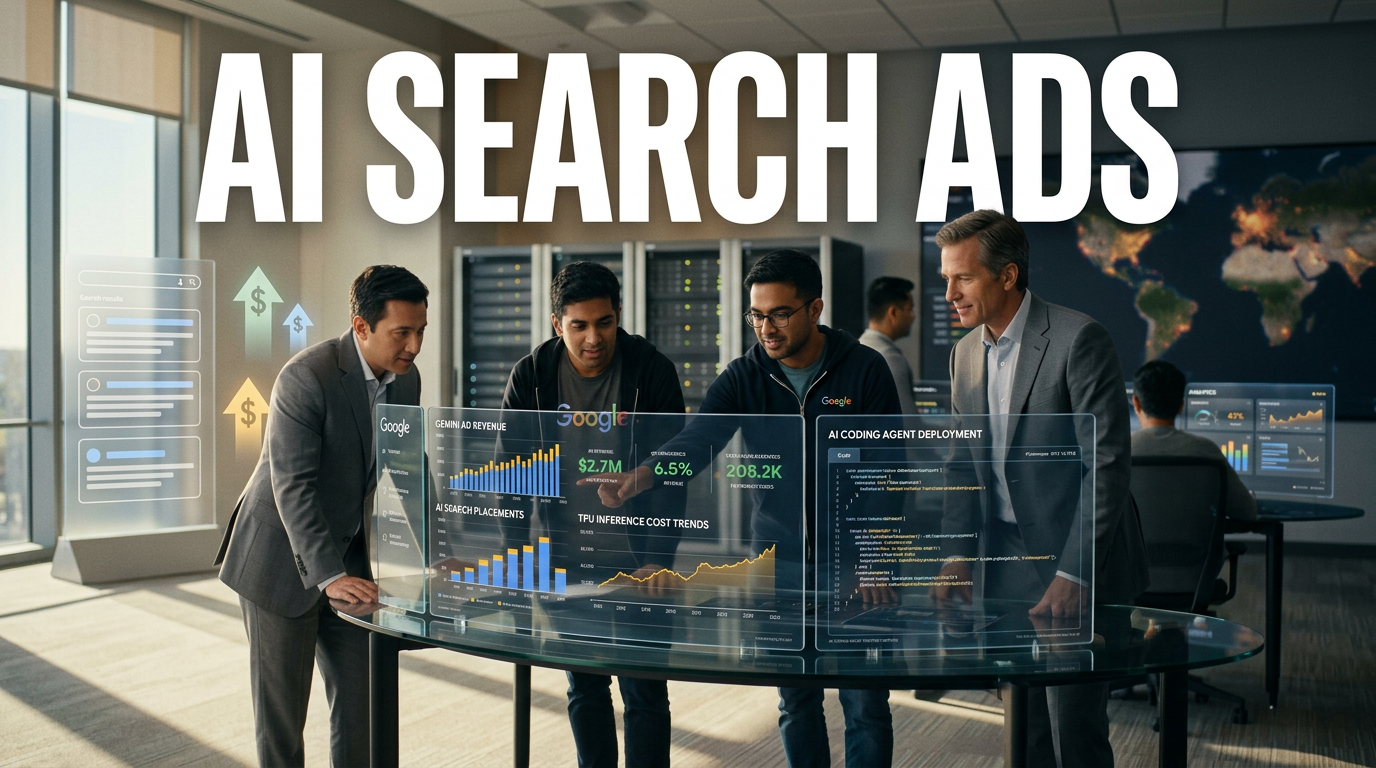
The most important part of this issue is AI search ads.
Google Search has an AI mode that directly writes answers.
According to the original, when 50,000 search terms with purchase intent were examined, ads were shown alongside about 29% of AI answers.
In particular, for keywords like insurance and loans, where cost-per-click ads are expensive, the ad display ratio reportedly exceeded half.
Why does this matter?
For OpenAI and Anthropic, the cost increases as users ask longer questions and answers get longer.
By contrast, the more Google’s AI generates answers, the more space it creates to attach ads.
In other words, using the same tokens makes OpenAI and Anthropic cost-centered structures, while Google becomes a structure with revenue conversion potential.
This difference could change the rules of the AI industry game.
When looking at Big Tech earnings going forward, we should not just look at AI model rankings; we should also look at how much AI is actually connected to ad revenue and cloud revenue.
9. The Interpretation as Strategy: Google Is Aiming for Profitability No. 1 Rather Than Model No. 1
The argument that Google intentionally chose a different path is quite persuasive.
First, ordinary users are not deeply interested in benchmark scores.
What matters to users is whether what they want gets done well, whether it is fast, and whether the cost is reasonable.
Second, Google already has one of the largest service distribution networks in the world.
Chrome, Gmail, YouTube, Maps, Android, Search, and Cloud make Google almost unique.
Third, as token unit prices fall, the winners are not just companies that have models, but companies that have services.
That is because AI can be added to existing services to increase user engagement time, ad click-through rates, subscription conversion rates, and cloud usage.
Ultimately, Google appears to be aiming not for the “smartest AI” but for the “AI used daily by the most people.”
From this perspective, Google is not stepping down from the throne; it is trying to change the definition of the throne itself.
10. The Interpretation as a Mistake: Losing Coding AI and Top Models Could Let the Ecosystem Slip Away
On the other hand, it is hard to ignore the interpretation that Google is actually falling behind.
First, if it misses the coding AI market, it may also lose its model distribution channel.
If developers start using Anthropic or OpenAI as their default models, there is a strong chance that future enterprise software ecosystems will be built on top of them.
Second, a cheap model strategy is powerful only when performance is similar.
If performance is similar and the model is cheaper, that becomes an overwhelming weapon.
But if performance clearly lags and it is only cheap, it can be perceived as a low-cost model with no more than that advantage.
Third, top researchers gravitate toward organizations that build top models.
If a company is seen as being satisfied with a second-place model, talent acquisition may become difficult in the long run.
AI is ultimately a talent industry.
That is because one or two key researchers can significantly change model architecture, training methods, and product direction.
11. The Core Point Not Often Explained in Other News: AI Competition Is Now a Profit-and-Loss Battle
Many news reports focus on AI model rankings and benchmark scores.
But what really matters is each company’s AI profit structure.
For OpenAI and Anthropic, the better the model they build, the more GPUs, data centers, and power costs they need.
Even if subscription and API revenue grow rapidly, inference costs grow as well.
By contrast, Google can attach AI to Search ads, YouTube ads, Google Cloud, Workspace subscriptions, and the Android ecosystem.
This means that even if Google temporarily loses No. 1 in the model race, it may actually be more advantaged when it comes to turning AI into money.
Especially during periods of uncertain global economic outlook and when companies place importance on cost efficiency, “profitable AI” may be valued more highly than “highest performance.”
The next winner in the AI industry is likely not the benchmark No. 1, but the company whose revenue per token consistently exceeds its cost per token.
That is the most important point of Google’s strategy.
12. Checkpoints to Watch from an Investment Perspective
First, we need to see whether AI answers in Google Search actually raise ad pricing.
If AI answers increase search dwell time and improve purchase conversion rates, Google’s ad business could regain a strong growth driver.
Second, we should check how quickly Gemini API usage is increasing in Google Cloud.
If enterprise customers prefer cost-effective AI models, that could be positive for Google Cloud’s growth rate.
Third, we need to see how much TPU reduces dependence on Nvidia GPUs.
If its own chips lower inference costs, Google’s ability to defend AI margins will strengthen.
Fourth, it is important to see whether Google can counterattack in the coding AI market.
Coding AI is not just a developer tool; it is the gateway to the next-generation AI agent market.
Fifth, we should watch whether core talent outflows continue.
If talent leakage repeats, short-term productization may still be possible, but long-term technological leadership could weaken.
13. Conclusion: Google Has Not Stepped Down from the AI Throne; It Is Changing the Definition of the Throne
It is certainly a burdening signal that Google Gemini is not showing the same strong presence in top benchmark rankings as before.
In particular, the trend of Anthropic and OpenAI pulling ahead in the coding AI market is not something Google can take lightly.
But it is also insufficient to view Google simply as “a company that fell behind in AI competition.”
Google already has the world’s largest user touchpoints and advertising monetization system.
So Google’s goal may not be to provide the most expensive top-tier model to everyone.
Rather, it seems closer to providing a good-enough model at the lowest cost, the fastest speed, and to the most people, while attaching ads and cloud revenue on top of that.
Going forward, the 기준 of AI competition is likely to shift from “who built the smartest model” to “who operates AI most profitably.”
Google is at the center of that change.
< Summary >
Google Gemini is currently being seen as weaker than OpenAI and Anthropic in AI model benchmarks and the coding AI market.
But Google is moving toward a strategy focused on AI monetization and large-scale service deployment rather than the top-model race.
The core points are Flash models, lowering TPU inference costs, Gemini agents, and AI search ads.
OpenAI and Anthropic face growing cost burdens as AI answers get longer, while Google can attach ads to AI answers and generate revenue.
The next competition in the AI industry is likely to be driven less by benchmark No. 1 and more by profitability per token, user touchpoints, and the service ecosystem.
Google is not stepping down from the AI throne; it is trying to change the definition of the throne from “performance” to “profitability and scalability.”
[Related Articles…]
Google AI strategy shift and Big Tech monetization outlook
AI agent market and coding AI competition analysis
*Source: [ 티타임즈TV ]
– 대답할 때마다 돈 나가는 오픈AI · 앤스로픽 돈 들어오는 구글