● Thiel Bets Big on Amazon and Power Grid for AI Boom
Peter Thiel 13F Portfolio Analysis: Why He Allocated 28% to Amazon and Bet on Power Infrastructure
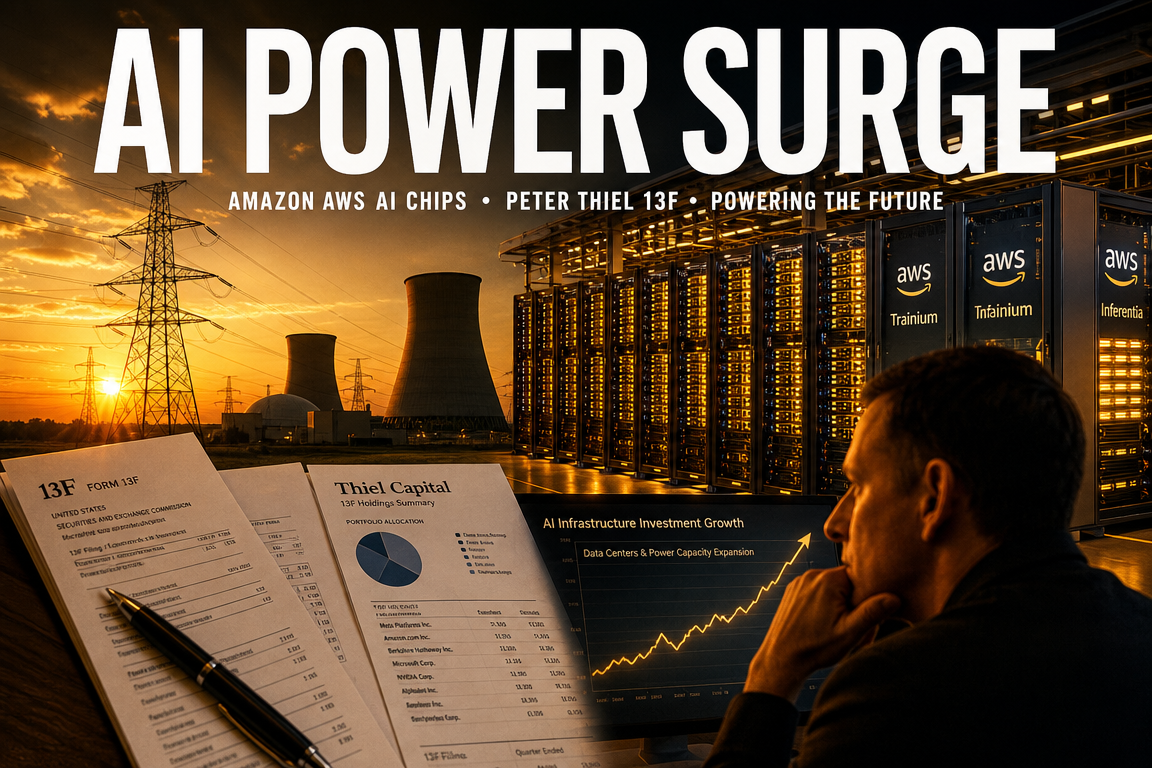
The key takeaway from Peter Thiel’s latest 13F is not simply that he bought Amazon.
The more important signal is that the AI investment cycle is expanding from semiconductors into cloud computing, data centers, power grids, and regional utilities.
Thiel is not just positioning for broad Big Tech upside; he is allocating capital across the full energy infrastructure value chain that becomes constrained as AI scales.
Viewed together with Amazon, AWS, in-house AI chips, potential U.S. Midwest data center locations, and regulated utilities, the portfolio offers a clear read-through on both the global macro outlook and the next phase of the U.S. equity market.
1. News Summary: Peter Thiel Resumes Public Equity Investing After Six Months
The 13F filing for Thiel Macro LLC, Peter Thiel’s investment vehicle, has been released, revealing his listed equity portfolio.
A 13F is a quarterly filing through which U.S. institutional investors disclose their holdings of U.S.-listed equities as of the end of the quarter.
This filing reflects the portfolio as of the end of the second quarter, so it may differ from current holdings.
Even so, market attention increased because Thiel resumed public equity investing after roughly six months and significantly expanded his portfolio.
The disclosed total invested assets were approximately $418 million.
That equates to roughly KRW 500 billion.
The portfolio reportedly consists of 8 holdings, with a highly concentrated structure.
In short, it is best described as an “AI portfolio concentrated in Amazon and power infrastructure.”
2. Portfolio Structure: Amazon Plus the Energy Value Chain
The standout position in the portfolio is Amazon.
Amazon accounts for roughly 28% of the portfolio, making it the largest holding.
Among technology names, the portfolio is essentially a concentrated bet on Amazon alone.
The remaining positions are largely tied to power generation, transmission, and regulated utilities.
| Category | Core Role | Representative Names | Investment Implication |
|---|---|---|---|
| AI demand end-market | Cloud, data centers, AI services | Amazon | Growth in AWS and AI compute demand |
| Power generation | Electricity production | Vistra, NRG Energy, etc. | Benefit from rising data center power demand |
| Regulated utilities | Transmission, distribution, regional grids | AEP, FirstEnergy, DTE, CMS, etc. | Bet on U.S. Midwest data center locations |
| Energy infrastructure | Grid expansion and capital investment | Regional utilities | Address the physical bottlenecks of the AI era |
This portfolio suggests that Thiel is betting strongly on the scenario in which AI growth leads to tighter electricity supply.
In other words, he is not only focused on AI semiconductors such as Nvidia, but also on the power infrastructure required to support AI workloads.
3. Why Amazon: The Only Large-Cap Tech Name He Chose
Amazon matters not only as an e-commerce company.
Its core growth engine is now AWS.
AWS is one of the most important players in global cloud computing alongside Microsoft Azure and Google Cloud.
In the AI era, model training and inference require substantial computing resources.
This is helping reaccelerate demand for AWS.
Based on the source material, AWS has moved through a trough in growth and is showing signs of renewed acceleration.
Markets tend to reward companies with reaccelerating growth more than those that are simply large.
From that perspective, Amazon may again be viewed as a leading AI investment name.
4. Amazon’s Core Advantages: AWS, Bedrock, Trainium, and Graviton
A key part of Amazon’s AI strategy is its in-house silicon.
Amazon is developing its own AI chips and CPUs, including Trainium and Graviton.
Trainium is used for AI training and inference, while Graviton is Amazon’s proprietary CPU optimized for AWS environments.
The source referenced annual revenue from Amazon’s proprietary chip business at a run rate of about $25 billion.
That scale is comparable to, or larger than, many mid-sized semiconductor companies.
The important point is that Amazon is not simply a chip manufacturer.
It already controls a massive distribution channel through AWS.
In practical terms, Amazon can offer its in-house AI chips directly to AWS customers in the same way a retailer promotes its private-label products.
For customers, if Nvidia GPU costs become burdensome, AWS can offer Trainium as a lower-cost alternative for AI workloads.
That is Amazon’s advantage.
Its enterprise customer base, cloud infrastructure, AI model deployment platform, and proprietary chips are all integrated.
5. Why the Anthropic and OpenAI Contracts Matter
Amazon has a deep relationship with Anthropic.
Anthropic’s Claude is widely offered to enterprise customers through AWS Bedrock.
The source also noted that Samsung Electronics used AWS Bedrock in its Claude adoption process.
This structure is favorable to Amazon.
Enterprise customers already use AWS and can access AI models such as Claude directly within the AWS environment.
That reduces the need to source separate vendors or build standalone infrastructure.
The source also indicated that Anthropic and OpenAI signed large-scale compute contracts with Amazon.
The significance of these contracts is not limited to revenue.
If AI models are optimized to run more efficiently on Trainium and Graviton, customers become increasingly embedded in the AWS ecosystem.
When hardware design, software optimization, and cloud deployment move in tandem, switching costs rise.
Amazon may therefore evolve from a cloud provider into something closer to an operating platform for AI.
6. Amazon’s Backlog and Cash Flow: Growth and Capex Pressure Rise Together
The source stated that Amazon’s RPO, or remaining performance obligations, increased to roughly $496 billion.
RPO represents contracted revenue that is expected to be recognized in the future.
Rapid growth in backlog indicates that customers are signing more AWS and AI compute contracts.
However, this trend has two sides.
As demand rises, Amazon must invest more in data centers, servers, networks, and power capacity.
As a result, free cash flow may come under pressure in the near term.
But if the backlog converts into realized revenue, current CapEx can be interpreted as upfront investment for future growth.
In U.S. equity markets, the key question for large-cap technology names is now less about current earnings and more about how efficiently AI CapEx converts into future revenue.
7. Why Power Stocks: The Biggest Bottleneck for AI Data Centers Is Electricity
AI appears to be software, but in practice it is an extremely power-intensive industry.
Training and inference for large language models require GPU servers.
GPU servers consume large amounts of electricity and generate substantial heat.
As a result, data centers depend on power, cooling, land, and transmission capacity.
That is why Thiel included energy companies in the portfolio.
If AI continues to expand, more data centers will need to be built.
More data centers will increase electricity demand.
Higher electricity demand increases the strategic importance of generators, transmission networks, distribution systems, and regional utilities.
In that sense, the hidden beneficiaries of AI may include not only semiconductor companies, but also power infrastructure providers.
8. Why Regulated Utilities Matter
Thiel’s portfolio reportedly includes regulated utilities such as AEP, FirstEnergy, DTE, and CMS.
In the U.S., regulated utilities are comparable to regional electricity providers with quasi-monopoly characteristics.
Because electricity is a public-interest service, rates must be approved by state regulators.
These companies have exclusive service territories, but they cannot freely raise prices.
In exchange, regulators generally allow a stable level of returns so that utilities remain financially viable.
The earnings framework for regulated utilities is often described as Rate Base × Allowed Return.
Rate Base refers to the book value of regulated assets such as power plants, transmission towers, substations, and grid equipment.
As electricity demand rises and capital investment increases, Rate Base can expand.
When Rate Base increases, the regulated earnings base can also increase.
In other words, rising data center demand can support long-term growth for regulated utilities.
9. Why Ohio and Michigan: Potential Next Data Center Locations
Another notable feature of the portfolio is its regional tilt.
The regulated utilities included by Thiel are connected to the U.S. Midwest, including Ohio and Michigan.
These regions offer several advantages as data center locations.
- Land is relatively inexpensive.
- Population density is lower, making large-scale site acquisition easier.
- Water resources are relatively abundant.
- The climate is cooler than in many other regions.
- Cooling costs may therefore be lower.
The traditional center of U.S. data centers has been Northern Virginia.
However, Northern Virginia is approaching saturation.
Hyperscale operators are therefore looking for the next wave of data center locations.
Ohio and Michigan are emerging as alternatives.
Thiel’s portfolio can also be interpreted as a bet on where the next phase of AI data center expansion may occur.
10. The Most Important Point Often Missed in Mainstream Coverage
The first key point is that Thiel is not merely buying AI beneficiaries; he is buying AI bottlenecks.
Most market commentary stops at the fact that Amazon is the largest holding.
But the more important signal is the combination of Amazon and power companies.
This suggests a view that as AI demand grows, both cloud demand and electricity demand will rise in parallel.
The second key point is that utility earnings are driven not just by electricity sales, but by expansion in Rate Base.
When data centers arrive, utilities gain a rationale to expand transmission lines and substations.
If regulators approve these investments, the long-term earnings base can expand.
This is a more important thesis than the simple idea that rising electricity demand equals higher utility stock prices.
The third key point is that Amazon’s in-house chip strategy is not necessarily an effort to replace Nvidia, but a cost-optimization and lock-in strategy.
Trainium and Graviton may be less about beating Nvidia and more about offering AWS customers a lower-cost option that keeps them within Amazon’s ecosystem.
The fourth key point is that competition for data center locations may translate into investment opportunities in regional utilities.
Future AI data centers will require more than available land.
They will need grid access, cooling water, regulatory approvals, transmission capacity, and local political support.
As a result, the next phase of the AI cycle may be more physical and regional than the last.
11. Investment Risks: What to Consider Before Following Thiel
This portfolio is interesting, but it is not without risk.
First, a 13F is historical data.
It reflects positions as of quarter-end, and there is a reporting lag, so Thiel may have already sold some holdings.
Second, 13F filings do not show private investments, derivatives, commodities, or short positions.
We are only seeing part of Thiel’s overall portfolio.
Third, the listed equity portfolio at Thiel Macro is small relative to Thiel’s total net worth.
With Forbes estimating his net worth in the tens of billions, a $418 million 13F portfolio should not be viewed as representing his full strategy.
Fourth, if AI fails to monetize as expected, the portfolio could face pressure.
If AI spending proves to be a bubble or large AI firms struggle to absorb costs, expectations for cloud and power demand could weaken.
Fifth, if data center expansion shifts away from Ohio and Michigan, the utility investment thesis could weaken.
Sixth, grid expansion depends heavily on regulatory approvals and local politics.
Public resistance to electricity rate increases may also constrain utility profitability.
12. Implications for the Global Economic Outlook
This portfolio is also meaningful from a global macro perspective.
The AI investment cycle is expanding beyond software into physical infrastructure.
In the internet era, networks and servers were critical.
In the mobile era, semiconductors and platforms were central.
In the AI era, GPU capacity, cloud infrastructure, data centers, power grids, cooling systems, and related infrastructure are all becoming important.
This also implies that market leadership in U.S. equities may continue to rotate.
Initially, AI semiconductor companies such as Nvidia led the market.
The next phase elevated cloud providers such as Amazon, Microsoft, and Google.
Attention is now expanding to power companies, generators, transmission networks, nuclear power, natural gas, and cooling technology.
Thiel’s portfolio compresses this shift into a single investment framework.
13. Key Watchpoints for Individual Investors
- Monitor whether AWS growth reaccelerates.
- Track whether AWS backlog converts into actual revenue.
- Watch for rising adoption of Trainium and Graviton.
- Check whether major AI contracts with Anthropic and OpenAI remain in place.
- Watch for more data center construction announcements in the U.S. Midwest.
- Monitor Rate Base growth expectations for utilities in Ohio and Michigan.
- Track grid investment approvals and electricity rate regulation issues.
- Assess whether AI CapEx is translating into revenue and earnings.
14. Conclusion: Thiel’s Message Is That AI Runs on Electricity
In one sentence, Peter Thiel’s latest 13F suggests that AI is not only a software theme; it is also a power infrastructure industry.
Thiel is positioning through Amazon for cloud-based AI demand.
At the same time, he is positioning through power companies and regulated utilities for rising electricity demand from data centers.
The regional emphasis on the U.S. Midwest, particularly Ohio and Michigan, is also notable.
Going forward, the key questions in AI investing will not be limited to which model is best.
Investors will also need to consider where the electricity comes from, where data centers are built, and who funds the transmission network.
For that reason, this portfolio should be viewed not only as a list of holdings, but as a case study in how the economic structure of the AI era is changing.
This is not an investment recommendation, but an interpretation based on publicly available 13F data and the source material.
Investment decisions should be made carefully based on each investor’s risk tolerance, time horizon, and portfolio context.
< Summary >
Peter Thiel resumed public equity investing after six months and disclosed a portfolio of approximately $418 million.
The core of the portfolio is a roughly 28% position in Amazon and concentrated exposure to power and utility names.
Amazon is strengthening its AI cloud and proprietary chip ecosystem through AWS, Bedrock, Trainium, and Graviton.
The power positions appear designed to capture rising electricity demand and transmission investment tied to AI data center growth.
Ohio and Michigan are attracting attention as next-generation data center locations due to low land costs, abundant water, and cooler weather.
The most important point is that Thiel appears to be betting not on AI semiconductors, but on the power infrastructure bottleneck behind AI expansion.
Because 13F data is backward-looking and only shows part of the portfolio, it should not be followed mechanically.
[Related Articles…]
- Amazon AWS and AI Cloud Growth Strategy Analysis
- AI Data Centers and Power Infrastructure Investment Trends
*Source: [ 내일은 투자왕 – 김단테 ]
– 6개월만에 움직이기 시작한 피터틸. 여기에 몰빵했네요.
● Gold-Bitcoin Surge, Nvidia Earnings Shock, Dollar Trust Crisis
Gold and Bitcoin Rally in Tandem, Nvidia Earnings D-1: Key Takeaways for U.S. Equities
The key issue in this New York market briefing is not simply that the Nasdaq advanced.
The simultaneous rise in gold and Bitcoin is increasingly being linked to concerns over U.S. federal debt and confidence in the dollar, while equities are showing concentrated buying in semiconductors ahead of Nvidia’s earnings release.
At the same time, the market is contending with the 7월 PCE inflation release, 2Q GDP revisions, the Jackson Hole meeting, the breakdown in U.S.-Canada tariff talks, and renewed U.S. sanctions on Iran and pressure on China.
One point that may be overlooked in other coverage is that efforts by the U.S. government to suppress Treasury yields can itself undermine market confidence.
This is a critical setup for investors tracking U.S. stocks, rates, inflation, Bitcoin, and Nvidia earnings.
1. Early New York trading: lower yields and semiconductor strength
On August 25, U.S. equities were set to open higher as long-term Treasury yields declined for a second consecutive session.
Lower yields are generally supportive for technology and semiconductor stocks, whose valuations depend heavily on future growth expectations.
This session was marked less by broad-based strength in technology and more by concentrated buying in AI semiconductors and hardware ahead of Nvidia earnings.
- Dow futures: up about 0.43% at the open, then eased
- S&P 500 futures: up about 0.36%
- Nasdaq 100 futures: up about 0.73%, with relative strength maintained intraday
- Russell 2000 futures: up about 0.5%
In the Treasury market, prices rose in the 10-year and 30-year maturities, pushing yields lower.
As yields stabilized, semiconductors responded immediately, with Nvidia earnings expectations helping lift broader sentiment.
2. Key asset moves: oil falls sharply, dollar softens, gold and Bitcoin draw attention
Crude oil prices fell sharply.
WTI declined to the low $82 per barrel range, while Brent traded around $89.
Lower oil prices weighed on energy stocks, but also helped ease inflation pressure, which can be constructive for markets.
- WTI: down roughly 3%
- Brent: down roughly 3%
- Dollar index: flat near 98.9
- Gold: consolidating after a sharp rally, in the mid-$4,600 per ounce range
- Bitcoin: holding firm near $79,000
- VIX: easing to around 17
At face value, the market appears to be in a risk-on mode.
However, the simultaneous rise in gold and Bitcoin suggests less a simple optimism trade than a hedge against dollar weakness.
3. Why gold and Bitcoin are rising together: the debasement trade
The most important market theme recently has been the “debasement trade.”
In practical terms, this is a bet against currency value.
Concerns are rising that U.S. sovereign debt, now above $40 trillion, could weaken confidence in the dollar and Treasury markets.
When the 30-year Treasury yield briefly surged to 5.34%, the Treasury Department intervened to stabilize the bond market.
The Treasury expanded the cap on long-dated bond buybacks more than twofold and said it could also use up to about $1 trillion in TGA funds if necessary.
When the Treasury buys back bonds, prices rise and yields fall.
Long yields did ease as a result.
But the market does not view this as a structural solution.
The concern is that this may be seen not as debt reduction, but as a way to suppress yields through government balance-sheet usage.
That is prompting renewed concern about dollar depreciation, and capital is moving into gold and Bitcoin.
In other words, the rally in gold and Bitcoin is not just speculative behavior; it reflects market skepticism about U.S. fiscal credibility.
4. Nvidia earnings D-1: why semiconductors are leading
Semiconductors were the strongest sector in this session.
The catalyst is Nvidia’s earnings release scheduled for the following day after the U.S. close.
The market is looking for confirmation that demand for AI chips and forward guidance still support the broader AI investment cycle.
- Nvidia: up about 1% premarket and around 2% intraday
- AMD: up about 4% intraday
- TSMC: up about 2%
- SK Hynix: up about 2% to 3%
- Micron: up about 2%
- Intel: up around 3%
Importantly, gains were not broad across all technology names.
Microsoft, Salesforce, and ServiceNow were weak early in the session.
Although some of these stocks later recovered, buying remained concentrated in AI hardware and the semiconductor supply chain.
This indicates that investors are prioritizing the durability of AI infrastructure spending over AI software monetization.
Strong Nvidia results could extend the rally across semiconductors, while a disappointing guide may increase volatility across the Nasdaq.
5. Sector performance: semiconductors strong, energy weak, defensives pause
Industrials and some financials were constructive early in the session.
GE and Boeing were up about 1%, and JPMorgan, Goldman Sachs, and Morgan Stanley were initially firm.
However, financials later lost momentum and some moved into negative territory.
Amazon, Meta, and Tesla also advanced.
By contrast, recent outperformers such as Walmart and Costco softened.
Energy stocks, including Exxon Mobil, Chevron, ConocoPhillips, and Devon Energy, declined broadly on the oil selloff.
Overall, the session was defined by lower yields, semiconductor strength, energy कमजोरी, and profit-taking in defensives.
6. Street views: positive bias toward semiconductors and crypto-related names
Recent Wall Street commentary highlights where investor attention is shifting.
These should be read as directional signals rather than direct buy recommendations.
- Raymond James: upgraded AMD to Strong Buy, raising its target price from $565 to $641
- Bank of America: maintained Buy ratings on Nvidia, Micron, and Marvell
- JPMorgan: maintained Overweight on SpaceX-related exposure, citing potential AI monetization through Grok
- Wolfe Research: maintained Outperform on Netflix, raising its target price from $84 to $95
- Goldman Sachs: maintained Buy on Coinbase, raising its target price from $173 to $196
- Canaccord: maintained Buy on Strategy, raising its target price from $130 to $175
- Wolfe Research: upgraded Moderna from Underperform to Peer Perform
The positive view on AMD reflects expectations that it can continue gaining share in server CPUs.
Upward revisions for Coinbase and Strategy reflect improving sentiment toward Bitcoin and digital assets.
One important caveat is that SpaceX is not a publicly traded common stock in the conventional sense, so such comments are better interpreted as sentiment toward AI, space, and infrastructure themes rather than as a direct equity call.
7. This week’s key events: PCE, GDP revisions, Nvidia earnings, and Jackson Hole
This week includes several market-moving events.
In particular, the July PCE report, Nvidia earnings, and Jackson Hole could shape the outlook for U.S. rates and equities.
7-1. July PCE inflation
The July PCE report will be released Wednesday at 8:30 a.m. New York time, or 9:30 p.m. Korea time.
PCE is the Fed’s preferred inflation gauge.
Unlike CPI, PCE better captures changes in actual consumer spending patterns.
For example, if beef prices rise and consumers shift toward chicken, PCE reflects that substitution.
That is why the Fed places greater weight on PCE in its inflation assessment.
- Core PCE expected: up 0.2% month over month
- Core PCE expected: up 3.43% year over year
- Fed target: 2%
If the data meets expectations, it would not signal further deterioration in inflation.
However, inflation would still remain well above the Fed’s 2% target, limiting room for aggressive rate-cut expectations.
7-2. 2Q GDP revision and durable goods orders
The 2Q GDP revision and durable goods orders will also be released at the same time.
The initial 2Q GDP estimate was 1.5% annualized.
A meaningful downgrade would increase recession concerns, while an upward revision would weaken the case for near-term easing.
7-3. Nvidia earnings release
Nvidia’s earnings will be the week’s most important event.
The release is expected around 4:20 p.m. New York time, or 5:20 a.m. Thursday in Korea, with the conference call scheduled for 6:00 a.m. Korea time.
The market will focus on AI chip demand, data center revenue, and forward guidance.
Nvidia’s report is not just a single-company event; it is a key gauge of the strength of the AI semiconductor investment cycle.
7-4. Jackson Hole and Kevin Warsh’s speech
The Jackson Hole symposium runs from August 27 to 29.
It is an annual gathering of central bankers and economists to discuss the economy and monetary policy.
The key event will be the keynote speech by Fed Chair Kevin Warsh.
- New York time: Friday at 10:00 a.m.
- Korea time: Friday at 11:00 p.m.
The market is looking for any clue on the rate path.
However, the more important issue is how much the Fed explains rather than whether it signals a specific move.
8. The real test for Chair Warsh: credibility of communication, not just rates
Since taking office, Warsh has indicated that the Fed should reduce the extent to which it pre-commits markets to future policy moves.
In other words, he has argued for less forward guidance.
The issue is that his July press conference was criticized for being too vague.
The Fed held rates steady, but did not explain clearly why.
It also avoided giving a firm answer on whether it would raise rates if inflation reaccelerated.
As a result, the market began to question whether the Fed’s commitment to inflation control had weakened.
That uncertainty contributed to a surge in the 30-year Treasury yield toward levels not seen since 2007.
Warsh’s team argued that markets were overreacting, but investors interpreted the silence as uncertainty.
The key issue at Jackson Hole is not the rate signal itself.
The question is whether the Fed can explain its view of growth and inflation clearly enough to restore confidence.
9. U.S.-Canada trade talks collapse: steel and aluminum push back at the margin
Trade negotiations between the U.S. and Canada were close to completion but ultimately broke down.
The main reason was resistance from the U.S. steel and aluminum industries.
The proposal reportedly included lowering tariffs on a certain volume of Canadian steel and aluminum from 50% to 25%.
U.S. industry groups argued that this would hurt margins and opposed the deal.
Commerce Secretary Howard Lutnick reportedly tightened the terms late in the process, and Canada rejected the revised conditions.
There was also a disagreement over automobile tariffs.
Canada believed auto tariffs would be reduced from 25% to 15%, while the U.S. said the reduction would apply only to passenger cars and small vehicles, excluding medium and heavy trucks.
This could directly affect GM and Ford operations in Ontario.
This has implications for Korea as well.
Even if a broad framework is announced in U.S. trade and investment negotiations, the final terms may still change materially.
In sectors such as steel, autos, batteries, and semiconductors, U.S. industry lobbying can alter the outcome at the last minute.
In other words, the real risk in trade negotiations often lies in the details after the headline agreement.
10. U.S. sanctions on Iran: superficially limited, but aimed at China
The U.S. added roughly 60 entities, individuals, and vessels linked to Iran to its sanctions list.
The measures also included firms in China and Hong Kong.
- Hong Kong’s Sweet Ocean: accused of procuring laser optics that could be used for nuclear and missile research
- Shenzhen Huamei Logistics: accused of supporting the transport of goods tied to Iran’s defense ministry
- Shipping companies and tankers involved in transporting Iranian crude to China
Even so, the sanctions were less severe than expected.
Rather than targeting all Chinese and Indian firms that do business with Iran, the U.S. focused on a narrower set directly linked to nuclear, missile, and oil transport activity.
However, Iran’s domestic situation is already highly unstable.
The rial has fallen to around 2.02 million per dollar, marking a historic low.
People are rushing to exchange rial holdings for dollars before the currency weakens further.
Fuel shortages are also emerging despite Iran being an oil producer.
Refining capacity is outdated, and war and sanctions have damaged energy infrastructure, leaving the country short of domestic supply.
The reported shortage is around 15 million liters of gasoline per day.
The U.S. is exploiting Iran’s economic fragility to increase pressure.
The objective is either to bring Iran back to the negotiating table or deepen internal instability.
11. The real focus of Iran sanctions: major Chinese banks and refiners
The U.S. still has a more consequential card available.
That is direct sanctions on major Chinese banks and large refiners.
China is the largest buyer of Iranian crude, accounting for roughly 90% of exports.
In particular, Chinese teapot refiners import large volumes of Iranian oil.
The current sanctions include Chinese and Hong Kong entities, but they stop short of the major Chinese banks and core refiners at the center of this trade.
If the U.S. were to target them, the confrontation would expand beyond Iran and into China.
Most global crude transactions are denominated in dollars.
Excluding Chinese financial institutions from the U.S. dollar system would have significant consequences.
By striking peripheral actors first, Washington is effectively signaling to China that it must choose between continued trade with Iran and access to the dollar-based financial system.
At the same time, the U.S. is unlikely to move quickly against large Chinese banks.
Such a step could trigger retaliation, disrupt Treasury markets, and destabilize global finance.
It could also further reduce Iranian crude supply, raising oil prices and rekindling inflation risks.
12. The most important point that is often understated
The key hidden theme in this market is the cost of trust for the United States.
The rise in gold and Bitcoin is not simply a risk-on rally.
It reflects concerns over U.S. debt, higher long-term yields, Treasury buybacks, and the risk of dollar weakness.
Treasury bond purchases may stabilize markets in the short term.
But if investors interpret them as an attempt to suppress yields rather than solve the debt problem, confidence in the dollar could weaken further.
The second hidden point is trade negotiation risk.
The U.S.-Canada example shows that even near-final agreements can be changed by domestic lobbying.
The same risk applies to Korea in autos, steel, batteries, and semiconductors.
The third hidden point is that Iran sanctions are really about China.
The current measures may look limited, but they function as a warning shot that could later extend to major Chinese banks and refiners.
That would have much larger implications for global finance and oil markets.
The fourth hidden point is how to read Jackson Hole.
Markets are looking for rate-cut clues, but the real question is whether the Fed can communicate its policy framework clearly enough to restore trust.
This week will show whether Warsh’s effort to reduce policy signaling strengthens the Fed’s credibility or weakens it further.
13. Key checkpoints for investors this week
- Watch whether Nvidia’s data center revenue and forward guidance exceed expectations.
- Monitor whether July PCE confirms continued disinflation.
- Track whether long-dated Treasury yields reaccelerate and whether Treasury buybacks remain effective.
- If gold and Bitcoin continue to rally, treat it as a signal of weakening confidence in the dollar.
- Factor in the possibility that the U.S.-Canada setback could foreshadow more difficult trade talks for Korea.
- Watch for any expansion of Iran sanctions toward major Chinese financial institutions.
- At Jackson Hole, focus less on rate hints and more on how clearly Warsh explains the Fed’s policy rationale.
< Summary >
U.S. equities were supported by lower long-term yields and expectations for Nvidia earnings, with semiconductors leading the advance.
The concurrent rise in gold and Bitcoin reflects a debasement trade driven by concerns over U.S. federal debt and dollar weakness.
This week’s key events are July PCE inflation, 2Q GDP revisions, Nvidia earnings, and the Jackson Hole speech by Warsh.
The breakdown in U.S.-Canada trade talks showed how domestic industry pressure can alter final terms, with implications for Korea as well.
U.S. sanctions on Iran appear limited on the surface, but they function as leverage against China’s oil trade and access to the dollar system.
The main market focus this week is the interaction between AI semiconductor earnings, U.S. rate expectations, dollar credibility, and global trade risk.
[Related Articles…]
*Source: [ Maeil Business Newspaper ]
– 금·비트코인 ‘화폐가치 하락’ 베팅ㅣ워시 잭슨홀 데뷔, 금리 힌트ㅣ미·캐나다, 러트닉 철강 요구에 결렬ㅣ美 이란 제재, 中 겨냥ㅣ엔비디아 D-1·나스닥 상승ㅣ홍혜진의 뉴욕브리핑