● KOSPI Tumbles, Hormuz Shock, Oil Spike, AI Rout
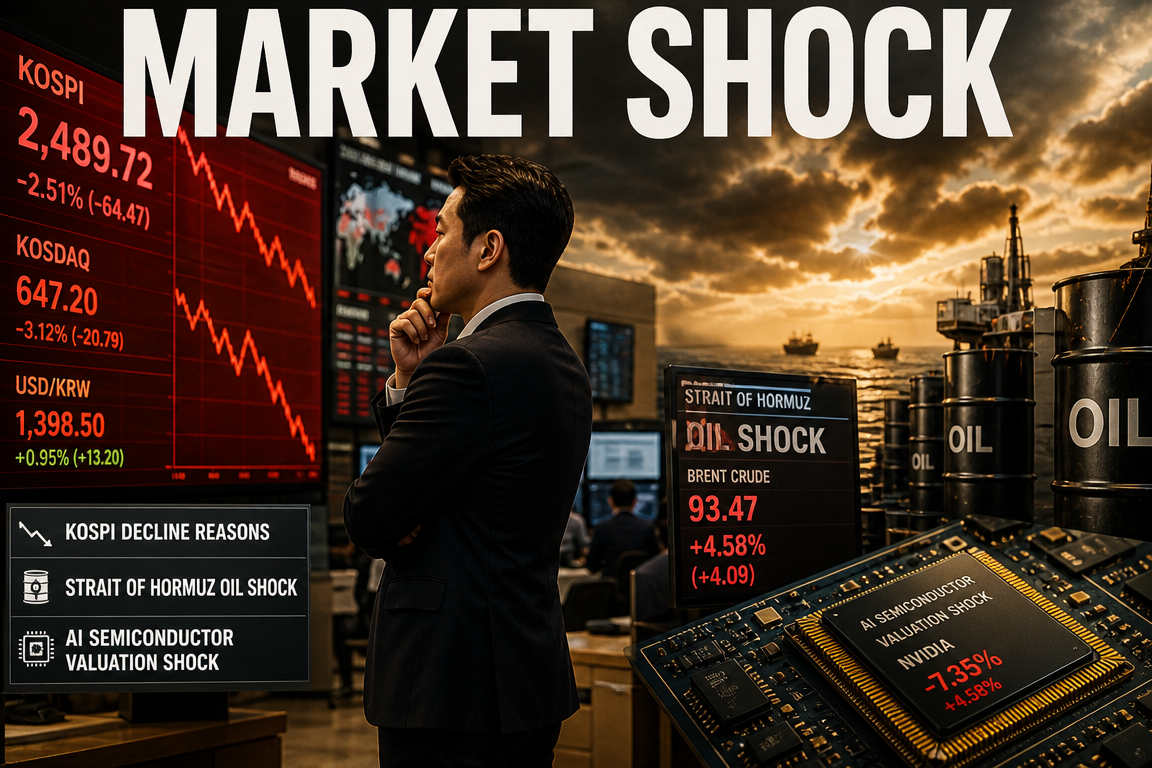
KOSPI Decline Explained: Hormuz Risk, Surge in Global Oil Prices, Rate Pressure, and AI Semiconductor Correction Hit Simultaneously
The key driver of today’s KOSPI decline is not simply that “an event occurred in the Middle East.”
The chain reaction from heightened tensions in the Strait of Hormuz to higher global oil prices, renewed inflation concerns, rate 부담, slower Big Tech AI investment expectations, and corrections in Samsung Electronics and SK Hynix weighed on the market at the same time.
With KOSPI trading value also lower, even relatively small negatives are being amplified more than usual.
In particular, this decline is significant because positive factors such as “AI server earnings are strong,” “the semiconductor cycle is recovering,” and “share buybacks are under way” are having little market impact.
Investors are currently focusing less on earnings and more on geopolitical risk, global oil prices, U.S. rates, dollar strength, and foreign investor flows.
1. Direct trigger for the KOSPI decline: Escalation of tensions in the Strait of Hormuz
The immediate trigger for the latest KOSPI selloff is geopolitical risk in the Middle East.
Although some easing in U.S.-Iran relations had recently been perceived, the mood shifted sharply after reports of an oil tanker attack near the Strait of Hormuz.
Market participants increasingly suspected involvement by Iran-linked forces, and the U.S. was interpreted as having taken retaliatory measures against the Islamic Revolutionary Guard Corps.
Market anxiety rose further after Trump referred to Kharq Island, a key node in Iran’s crude export infrastructure.
The main issue is not the extent of actual military conflict, but the fact that the market has begun pricing in the possibility of disruptions to crude supply.
Financial markets discount probabilities before outcomes are confirmed.
As a result, when terms such as oil tanker attack, Strait of Hormuz, Iran, U.S. retaliation, and Kharq Island appear together, global equities quickly shift into risk-off mode.
2. Why the Strait of Hormuz matters: A critical corridor for global crude flows
The Strait of Hormuz is a key route for global maritime oil transportation.
Because crude from Middle Eastern producers passes through this corridor into the global market, military tension in the area immediately affects international oil prices.
The impact is even more pronounced for Korea.
Korea is highly dependent on imported energy.
As a result, higher oil prices increase input costs for companies, add pressure to the trade balance, and can also affect the exchange rate.
While KOSPI has a large weighting in semiconductors and export-oriented companies, it is also highly sensitive to energy prices and foreign exchange movements.
For that reason, Strait of Hormuz risk is not just an overseas headline but a direct cost shock for the Korean equity market.
3. Why higher oil prices pressure KOSPI: Inflation and rates
Rising global oil prices primarily raise concerns about inflation.
Higher crude prices feed into gasoline, diesel, jet fuel, and petrochemical feedstock costs.
Transportation and production costs rise, and corporate margins come under pressure.
When inflation risks increase again, central banks are less likely to cut policy rates.
Market expectations for the timing of rate cuts may be pushed back.
The two main supports for global equities recently have been expectations of rate cuts and the AI investment cycle.
However, higher oil prices weaken both expectations at once.
When oil rises, inflation pressures build; when inflation rises, rate cuts become harder; and when rates stay elevated, valuations of growth and technology stocks come under pressure.
That creates a burden for KOSPI large caps, especially AI semiconductor stocks.
4. Why this is also negative for AI investment: Big Tech’s cost of capital rises
The most important link in this episode is AI investment.
Samsung Electronics and SK Hynix are currently being driven not only by memory semiconductors, but by HBM, AI servers, and data center investment.
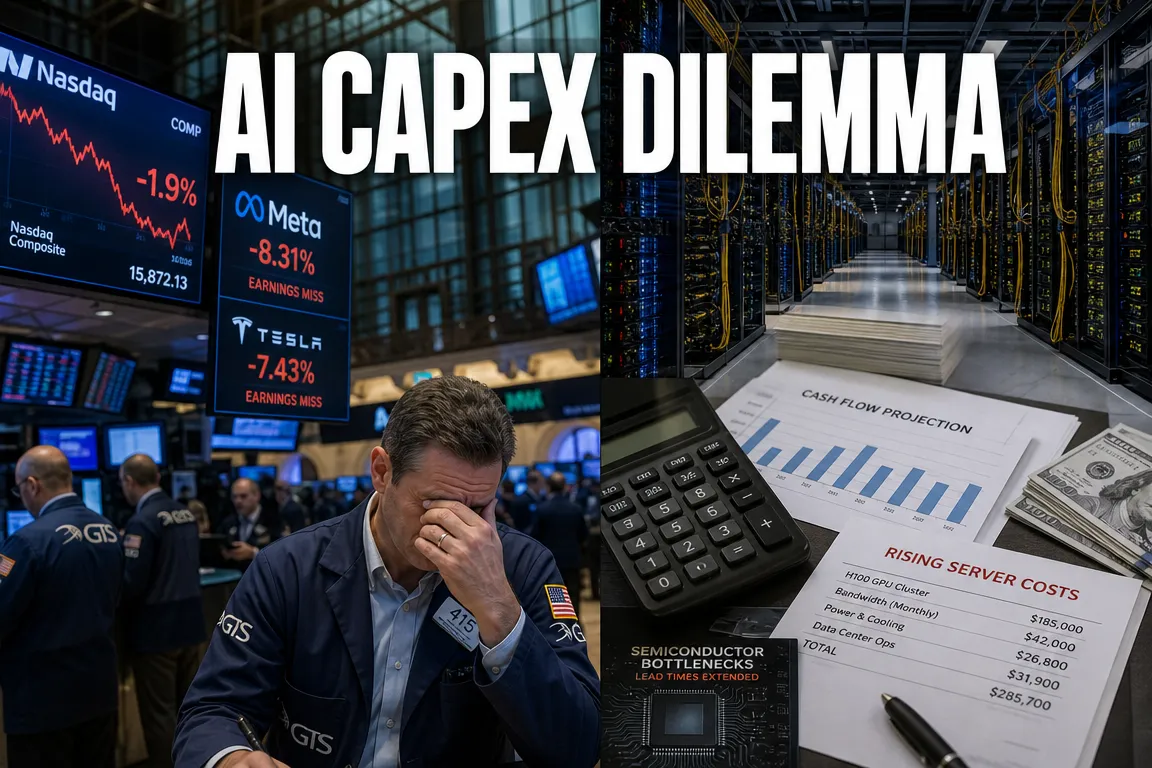
Because Big Tech companies such as Nvidia, Microsoft, Amazon, Google, and Meta are spending heavily on AI infrastructure, Korean semiconductor firms have also benefited.
However, when rates remain high or expectations for rate cuts weaken, Big Tech’s investment burden increases.
AI data centers require substantial capital for power, servers, GPUs, memory, and cooling systems.
Higher rates reduce the present value of future growth and lead to stricter scrutiny of long-payback AI infrastructure projects.
Accordingly, higher oil prices are not only a factor for refining stocks.
They are also a macro variable that can affect the entire AI semiconductor investment cycle.
5. Why Samsung Electronics and SK Hynix are weakening: Macro risk now outweighs AI optimism
Samsung Electronics and SK Hynix have an outsized influence on KOSPI.
When these two names move lower, the entire index tends to weaken materially.
Recently, the market had been optimistic about HBM supply, AI server demand, a rebound in memory prices, and expanded data center investment.
However, when Middle East risk pushes oil prices higher and U.S. rate pressure increases, investors tend to take profits first.
Foreign investors, in particular, view Korean semiconductors as part of the global technology cycle.
If U.S. rates rise or the dollar strengthens, foreign investors are more likely to reduce KOSPI exposure.
In that process, Samsung Electronics and SK Hynix are often the first targets for selling.
Even if share buybacks provide a defensive support, their effect is limited when the broader market shifts into a risk-off mode.
In short, the market is currently giving more weight to global macro risk than to company-specific positives.
6. Why lower trading value amplifies the decline: The risk of a thin market
Lower KOSPI trading value is also important.
Lower trading value means that buy-side liquidity is not deep.
In such a market, negative headlines push prices down more easily.
Orders that might otherwise be absorbed by dip buyers in a normal market require much lower prices to execute when trading is thin.
As a result, the same negative event may look like a modest correction in a high-liquidity market, but a sharp decline in a thin one.
This KOSPI decline is therefore not only about the Middle East risk itself, but also about the weak liquidity backdrop in which it occurred.
7. Why the market has entered an “ignore good news” phase
The current market can be described as one that is ignoring positive catalysts.
Strong earnings from AI server companies, signs of semiconductor recovery, and share buyback announcements are failing to move prices meaningfully.
The reason is that market priorities have changed.
Under normal conditions, earnings are the main driver.
But when concerns such as war risk, oil supply disruption, renewed inflation, and delayed rate cuts emerge, earnings temporarily move to the background.
Investors begin to ask not whether a company is profitable, but whether the market could decline further.
That is why company-specific positives are not being reflected.
In this type of environment, stocks that look cheap may not rebound immediately.
8. The key point often missed in other reports: This is not just an oil shock, but an AI valuation shock
Many reports describe the current event mainly as a Middle East risk and a spike in oil prices.
That is correct, but incomplete.
The more important issue is that higher oil prices are pressuring AI investment valuations.
Global equities have recently been led by AI.
AI semiconductors, data centers, cloud services, power infrastructure, and cooling equipment have all risen on expectations of future growth.
These stocks are highly sensitive to interest rates.
When rates rise, the present value of future earnings falls.
In other words, Middle East risk is not only affecting refiners and airlines; it is also increasing the discount rate applied to the broader AI growth complex.
In Korea, this shock is being transmitted through Samsung Electronics and SK Hynix into the KOSPI index.
Therefore, this KOSPI decline is better understood not simply as a reaction to war risk, but as a repricing of AI semiconductor valuations driven by higher oil and rate expectations.
9. Why the Korean market is especially vulnerable: An energy importer and semiconductor exporter
Korea is structurally vulnerable to higher oil prices.
Because it imports most of its energy, higher oil prices directly translate into higher costs.
At the same time, the Korean equity market has a large exposure to semiconductor exporters.
Semiconductors are highly sensitive to global growth, U.S. technology stocks, the AI investment cycle, and the dollar exchange rate.
As a result, Korea is exposed both to the cost shock from higher oil and to the valuation shock from global technology stock corrections.
This creates a double burden.
That is also why KOSPI tends to react more sharply than other markets when Middle East risk intensifies.
10. The Trump factor: Markets dislike unpredictability
Trump’s comments also contributed to the rise in market anxiety.
Trump has often used strong messaging to increase negotiating leverage.
However, financial markets dislike this type of unpredictability.
When a key node in Iran’s oil export system, such as Kharq Island, is mentioned, the market interprets it as a possible threat to supply chains.
Whether any attack actually occurs is a separate issue.
But markets move on possibility before certainty.
Accordingly, the near-term recovery of KOSPI will depend on whether the U.S. and Trump administration send de-escalation signals, whether Iran refrains from further retaliation, and whether shipping through the Strait of Hormuz remains normal.
11. Key indicators to monitor
First, global oil prices.
Monitor whether Brent and WTI continue to rise.
If oil stabilizes, inflation fears and rate pressure may ease somewhat.
Second, shipping conditions in the Strait of Hormuz.
Watch whether tanker traffic remains normal and whether insurance and freight costs surge.
Any operational disruption would intensify market stress.
Third, U.S. Treasury yields.
Higher U.S. 10-year yields would be negative for technology stocks and AI semiconductors.
KOSPI large-cap growth stocks need rate stability to recover.
Fourth, the KRW/USD exchange rate.
Dollar strength can increase pressure for foreign capital outflows.
Because KOSPI is highly sensitive to foreign flows, the exchange rate trend is critical.
Fifth, foreign investor flows in Samsung Electronics and SK Hynix.
If foreign investors continue to sell these large-cap semiconductor names, index recovery will remain limited.
If selling stops, KOSPI could stabilize more quickly.
Sixth, AI server and HBM demand outlook.
Macro risk is dominant in the short term, but the medium- to long-term AI investment cycle remains the key fundamental driver.
If Big Tech capex plans remain intact, the semiconductor correction may eventually be viewed as an opportunity.
12. Investment view: Risk management matters more than earnings at this stage
In the current environment, risk management is more important than aggressive dip buying.
In particular, leveraged positions and concentrated short-term purchases may face elevated volatility.
Middle East risk may be resolved quickly, but it could also worsen over several days.
For KOSPI to recover, at least three conditions are needed.
Global oil prices need to stabilize.
U.S. rates need to settle.
Foreign selling in semiconductors needs to slow.
If these three factors improve together, KOSPI could rebound led by Samsung Electronics and SK Hynix.
Conversely, if oil continues to rise, the KRW/USD exchange rate weakens, and U.S. technology stocks come under pressure, KOSPI could remain under pressure for longer.
13. Core conclusion: The KOSPI decline is a rates and AI investment cycle issue, not only a Middle East headline
This KOSPI selloff is superficially driven by the Strait of Hormuz and Iran risk.
But the underlying issue is that higher oil prices are reshaping inflation and rate expectations, which in turn are pressuring AI semiconductor investment sentiment.
Samsung Electronics and SK Hynix rose on AI semiconductor expectations, but that also made them more sensitive to global rates and Big Tech investment sentiment.
As a result, the market cannot recover on the basis of “semiconductor earnings are strong” alone.
De-escalation in the Strait of Hormuz, stabilization in global oil prices, lower U.S. rates, and a recovery in foreign flows all need to occur together.
In the near term, KOSPI is likely to be driven more by Middle East risk and global macro conditions than by semiconductor earnings alone.
< Summary >
The KOSPI decline began with tensions in the Strait of Hormuz and Iran-related risk.
Reports of an oil tanker attack, U.S. responses, and Trump’s hawkish remarks increased concerns about higher global oil prices.
Higher oil prices raise inflation concerns and weaken expectations for rate cuts.
Rate pressure is negative for Big Tech AI investment and growth-stock valuations.
That impact was reflected in Samsung Electronics and SK Hynix, causing KOSPI to weaken materially.
Lower trading value also amplified the market impact of the negative news.
Going forward, investors should monitor global oil prices, U.S. Treasury yields, the KRW/USD exchange rate, foreign flows into semiconductors, and the outlook for AI server investment.
The key issue in this decline is not only Middle East headlines, but also the pressure of higher oil and rates on the AI semiconductor investment cycle.
[Related Articles…]
- AI Semiconductor Cycle and Global Equity Outlook
- How Higher Oil Prices Affect Inflation and Interest Rates
*Source: [ 내일은 투자왕 – 김단테 ]
– 코스피 개박살나는 이유 #코스피 #호르무즈 #트럼프
● AI Boom, 2027 Semiconductor Supercycle, Korea Soars
Why the AI Bubble Debate Matters Less Than This: Why the 2027 Semiconductor Supercycle Could Intensify Further
The core point is straightforward.
More important than whether AI stocks have risen too far is the fact that companies are already spending and signing long-term contracts to secure semiconductors.
In the 2027 economic outlook, the key issue is not whether the AI bubble will burst, but how far AI data center investment, HBM demand, physical AI adoption, and changes in Korea’s export structure can lift the real economy.
For Korea, the economy faces downside pressure from the Middle East conflict and the global slowdown, but semiconductor exports are creating a powerful offsetting force.
One important point is that not everyone feels this upswing.
This is also why macro indicators can improve while household finances remain unchanged.
1. The key theme for the 2027 outlook: crosscurrents, with two opposing waves
The defining concept for the 2027 economy is crosscurrents.
One wave is pulling the global economy lower through war and energy shocks.
The other is lifting it through AI investment and semiconductor demand.
The Middle East conflict that emerged in 2026 is a clear downside factor for the global outlook.
Gulf economies are likely to face slower growth as damage to oil facilities and key infrastructure disrupts production.
Advanced economies that import energy are also affected by higher crude prices and cost pressures.
By contrast, energy-exporting emerging markets may benefit from higher oil prices through stronger current accounts and growth.
A different group, however, is now becoming increasingly relevant.
That group is AI hardware exporters.
Korea is part of this group.
Korea supplies core components for AI infrastructure, including memory semiconductors, DRAM, HBM, and NAND flash.
As a result, even with global economic headwinds from war, Korea may follow a different trajectory thanks to AI-related export demand.
2. Why Korea is an AI beneficiary: semiconductors are driving exports
The share of AI-related products in global trade is rising rapidly.
AI services require data centers, and data centers require high-performance semiconductors.
Semiconductor production also requires equipment, materials, and components.
In effect, AI is not only a software industry; it is an industry that is reshaping global manufacturing and trade.
This shift is already visible in Korea’s economic data.
In 2011, semiconductors accounted for about 9% of Korea’s total exports.
By 2025, that share is projected to rise to about 24%.
As of the first half of 2026, it had increased to 38.7%.
At this level, it is reasonable to say that Korea’s export performance is being led by semiconductors.
More broadly, Korea’s growth is being lifted by the semiconductor sector.
Despite war in the Middle East, higher energy costs, and slower global growth, AI and semiconductors have offset a significant portion of the negative shock.
3. Why the public may not feel the boom
This raises an important issue.
Macro indicators may be improving, but many households do not feel a recovery.
The reason is that growth is highly concentrated in semiconductors and the AI value chain.
Korea’s total employment is around 29.5 million.
The combined workforce at Samsung Electronics and SK hynix is estimated at about 170,000.
Employees in semiconductor firms and related suppliers of materials, parts, and equipment can directly benefit from the upcycle.
However, most workers at small and medium-sized firms, as well as self-employed business owners, do not experience the semiconductor supercycle directly.
For example, convenience stores near Samsung Electronics or SK hynix sites may see strong sales growth.
But convenience store owners in ordinary commercial districts may see little sign of recovery.
This is the current pattern of uneven recovery in Korea.
For that reason, the situation is not best described as stagflation.
However, it can feel like stagflation in practical terms.
Prices remain elevated while income growth is limited, yet news flow continues to emphasize growth and export strength.
4. To assess the AI bubble debate, the semiconductor value chain must be understood
To judge whether an AI bubble is real, the full value chain from AI services to semiconductors must be examined.
The products used in daily life are AI services.
These include chatbots, translation tools, medical AI, educational AI, and workflow automation.
But AI services depend on AI models.
Even that is not sufficient.
Operating AI models as real services requires large-scale infrastructure.
AI infrastructure can be divided into three main categories.
First, AI data centers.
These require high-performance GPUs, HBM, servers, storage, and networking equipment.
Second, power infrastructure.
AI data centers consume substantial electricity, so stable power supply is essential.
Third, communications infrastructure.
Fast data transmission and network stability are critical for AI service performance.
Among these, AI data centers generate the most direct semiconductor demand.
Therefore, increased investment in AI data centers translates into higher demand for HBM and high-performance memory semiconductors.
5. Why are the big tech firms still buying semiconductors?
In the past, Microsoft, Amazon, Google, and Meta were referred to as big tech or platform companies.
They are now often described as hyperscalers.
The reason is that they own or operate massive AI data centers on a large scale.
Hyperscalers are building more data centers to deliver stronger AI services.
This is a competition to create a fundamentally more advanced AI model and to offer fundamentally more advanced AI services.
Semiconductors are central to that process.
For Samsung Electronics and SK hynix, Microsoft, Google, Amazon, and Meta are key customers.
These firms continue to demand larger chip volumes.
That demand supports Korea’s semiconductor exports and corporate earnings.
Global data centers are estimated at about 12,000.
The United States alone is said to have about 4,600 data centers.
In other words, roughly one-third of global data centers are concentrated in the US.
This is why the scale of AI investment by US big tech drives the global semiconductor market.
6. Why the AI bubble is not easy to deflate in the real economy
Many discussions of the AI bubble focus on stock prices.
But in the real economy, contracts, capital spending, factory utilization, and data center construction plans are already in motion.
Semiconductor demand does not appear and disappear overnight.
Building a data center requires design, investment decisions, permits, equipment orders, power procurement, and server deployment.
Even residential construction, from permits to completion and occupancy, can take nearly two years.
AI data centers are similarly not assets that can be built instantly.
Semiconductor supply contracts are also typically signed well in advance.
The original discussion emphasized that supply contracts are often secured at least 1.5 years ahead.
That means semiconductors being exported now were likely contracted long before shipment.
Future earnings are therefore already visible to a significant extent.
The aircraft manufacturing analogy is also useful.
Building an aircraft requires sourcing a large number of parts, and parts procurement can take years.
Similarly, data centers require sequential sourcing of semiconductors, power equipment, cooling systems, servers, and network devices.
For that reason, AI investment should be viewed as a long-duration capital expenditure cycle rather than a short-term theme.
7. The second engine of the 2027 semiconductor supercycle: physical AI
Through 2025, AI has been centered mainly on services.
Examples include generative AI services such as ChatGPT, workflow automation, educational AI, and medical AI.
From 2026 onward, a new trend is expected to accelerate.
That trend is physical AI.
Physical AI refers to AI moving beyond internet services and into physical products.
This includes AI vehicles, AI robots, AI refrigerators, AI TVs, AI PCs, and AI smartphones.
The shift is from using AI services through a smartphone to smartphones themselves delivering AI services.
Cars become AI vehicles, and appliances become AI-enabled products.
This matters because it increases semiconductor demand at another level.
Conventional internal combustion vehicles are described as containing about 200 to 300 semiconductors.
Electric vehicles may require around 700 semiconductors.
Autonomous electric vehicles may require roughly 2,000 to 3,000 semiconductors.
In other words, demand is no longer driven only by AI data centers.
Cars, robots, appliances, PCs, and mobile devices could all contribute to a sharp increase in semiconductor demand.
That is why the 2027 semiconductor supercycle may last longer and become stronger than previously expected.
8. A timeline for the 2025, 2026, and 2027 AI cycle
2025 can be viewed as the planning phase for physical AI.
Companies are deciding which products will incorporate AI and assessing market potential.
2026 is the execution and planning phase for physical AI.
This is when product design, supply chain arrangements, semiconductor orders, and production planning become concrete.
2027 can be viewed as the commercialization phase for physical AI.
Products are launched, revenue is generated, and the effects begin to appear in export data.
If this timeline holds, semiconductors in the 2027 outlook should not be seen as a conventional cyclical sector.
They would instead represent a structural growth industry driven by both AI data center demand and physical AI demand.
9. Will the AI bubble burst? Real economy and capital markets should be analyzed separately
The most important conclusion is the following.
From the perspective of the real economy, the AI bubble is not easy to deflate.
This is because big tech capital expenditure, data center construction, long-term semiconductor contracts, and productization of physical AI are all already underway.
At the same time, capital markets can still generate AI bubble concerns at any time.
Stock prices are not driven by earnings alone.
They move through cycles of expectation, disappointment, excess, and correction.
Even when earnings improve steadily, prices can correct if valuations move too far ahead.
Conversely, excessive corrections can create renewed undervaluation concerns and attract capital inflows.
In the long run, stocks follow earnings, but in the short run they can fluctuate sharply with sentiment.
The original discussion describes early June 2026 as a stage just before overheating, with a correction phase from June into July and early August.
Such a correction does not necessarily mean the AI bubble has burst.
It reflects a rise in negative expectations around the AI bubble debate, which then leads to a market-price adjustment.
10. The key points that are often missed in other coverage
First, the essence of the AI bubble debate is a valuation debate.
Much of the coverage focuses on whether AI stocks are too expensive, whether Nvidia and big tech are overheated, or whether semiconductor stocks have risen too far.
But in the real economy, data center investment and semiconductor supply contracts are already progressing.
Stock prices can correct, but real demand does not disappear overnight.
Second, Korea’s recovery is not broad-based.
Exports and growth can improve.
However, if the center of that improvement is concentrated in semiconductors, domestic demand, small businesses, and self-employed operators may not feel the recovery.
When assessing Korea, it is therefore necessary to examine sector-level divergence, not just headline growth.
Third, the 2027 semiconductor cycle cannot be explained by data centers alone.
AI data centers are the first source of demand.
Physical AI is the second.
If AI enters automobiles, robots, appliances, PCs, and mobile devices, semiconductor demand could expand again.
Fourth, power infrastructure may become the new bottleneck.
AI data centers require more than semiconductors.
They also require electricity, cooling, communications networks, land, and permits.
Future interest rate trends, energy prices, and power-grid investment could determine the pace of the AI industry.
Fifth, semiconductor earnings and stock prices should be assessed separately.
Earnings can improve through long-term contracts and rising demand.
But share prices may still correct if expectations move too far ahead.
From an investment perspective, the more important question is not whether AI is over, but how far prices have moved ahead of earnings.
11. Variables that could renew AI bubble concerns
Even if real-economy demand remains solid, capital markets could revive bubble concerns due to several factors.
First, there is concern over the return on big tech AI investment.
Microsoft, Google, Amazon, and Meta are making large capital expenditures, and the key issue is how quickly those investments translate into profits.
If costs rise faster than revenue, investors may become disappointed.
Second, there is the issue of data center power constraints.
As more AI data centers are added, pressure on the power grid increases.
If power procurement is delayed, data center construction could slow, affecting expectations for semiconductor orders.
Third, there is concern about semiconductor oversupply.
When demand is strong, companies increase investment.
But if supply expands too quickly, the market may once again worry about oversupply.
That said, high-value products such as HBM should be assessed differently because they require greater technological complexity.
Fourth, global slowdown and geopolitical risk remain relevant.
The Middle East conflict, higher energy prices, and US-China technology tensions are still important variables.
AI remains a powerful force for global growth, but external shocks can still weaken investor sentiment.
Fifth, interest rates and liquidity conditions matter.
AI and semiconductor equities are sectors with high future growth expectations.
If interest rates rise or liquidity tightens, valuation pressure can increase.
Accordingly, the outlook should consider both semiconductor demand and the interest-rate environment.
12. What investors and employees should focus on in practical terms
Growth in the AI industry does not mean every AI company will succeed.
A semiconductor supercycle does not mean every semiconductor stock will keep rising.
The key is to identify who is actually capturing profits within the value chain.
The first item to monitor is HBM and high-performance memory supply capacity.
Companies that can reliably supply core components for AI data centers are better positioned.
The second is big tech capital expenditure plans.
It is important to see whether hyperscalers continue increasing data center investment or begin slowing the pace.
The third is the pace of physical AI product launches.
Investors should monitor whether AI PCs, AI smartphones, AI vehicles, and AI robots are generating meaningful revenue.
The fourth is whether semiconductors account for a larger share of Korea’s exports.
The greater the share of semiconductors, the more sensitive the Korean economy becomes to the AI cycle.
The fifth is whether domestic demand and employment broaden.
If the semiconductor boom remains concentrated among large firms and suppliers, the improvement in household sentiment may remain limited.
Ultimately, the main challenge for Korea in 2027 will be how effectively semiconductor export strength is transmitted into domestic demand and employment.
< Summary >
The core of the 2027 outlook is the crosscurrent created by war and AI.
The Middle East conflict is a drag on the global economy, while AI and semiconductors are an upward force for Korea.
Semiconductors increased from about 9% of Korea’s exports in 2011 to 38.7% in the first half of 2026.
The AI bubble is primarily a capital-market debate rather than a real-economy collapse story.
Data center investment, long-term semiconductor contracts, and physical AI adoption suggest that underlying demand is unlikely to fade quickly.
However, share prices can still correct if expectations run too far ahead.
The 2027 semiconductor supercycle should be viewed as a structural cycle driven by both AI data centers and physical AI.
[Related Articles…]
2027 Semiconductor Supercycle and Korea Export Outlook
Key Variables in AI Data Center Investment and the Global Outlook
*Source: [ 경제 읽어주는 남자(김광석TV) ]
– “AI 거품? 실물경제는 안 꺼집니다” 2027년 반도체 슈퍼사이클이 더 강해지는 이유 | 클로즈업 | 2027 경제전망 강의 [4편]