● KOSPI Whipsaw, Hanwha Ocean Surge, Foreign Selling, Iran Shock
KOSPI Rebounded After an Intraday Drop: Hanwha Ocean Order, Financial Sector Strength, Foreign Futures Selling, and Iran Risk
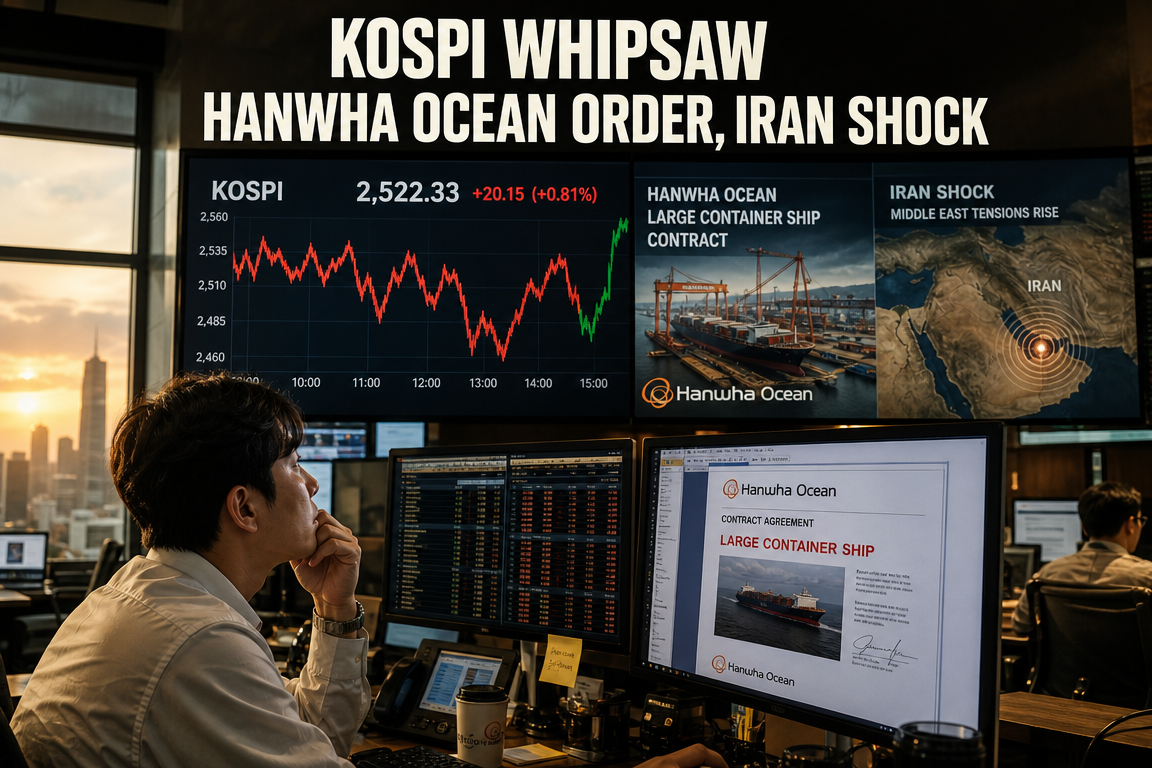
Today’s KOSPI session was highly volatile.
Early in the day, shipbuilders and financials lifted the market. Around 2 p.m., foreign futures selling sharply reversed sentiment.
Even so, the market did not collapse after the drop and recovered on bargain buying.
This move reflected several key factors at once: a large Hanwha Ocean order, expectations of benefit from rising rates, geopolitical risk, concerns over carry-trade unwinding, and a shift in KOSPI leadership.
1. Shipbuilders and financials led the market higher in early trading
KOSPI started the session on a relatively firm note.
The main sectors supporting the market were shipbuilders and financials, rather than semiconductors.
① Hanwha Ocean gained on a KRW 1.6 trillion order
Hanwha Ocean was one of the most notable names in the session.
Sentiment improved quickly after reports that the company secured an order worth approximately KRW 1.6 trillion.
In shipbuilding, large order wins have a direct impact on share prices.
Backlog growth, LNG carriers, offshore projects, and defense-related expectations can all reinforce longer-term earnings visibility.
The order announcement supported not only Hanwha Ocean but also the broader shipbuilding complex.
② KB Financial and insurers benefited from higher-rate expectations
Financial stocks also performed well early in the day.
KB Financial rose, and insurers moved in tandem.
The key driver was interest rates.
When market rates rise, banks and insurers are often viewed more favorably.
Banks may benefit from improved net interest margin expectations, while insurers may see higher returns on invested assets.
With global rate conditions again becoming a focus, financials are being reassessed as both defensive stocks and rate beneficiaries.
2. Why sentiment reversed sharply around 2 p.m.
The positive tone changed quickly around 2 p.m.
The main catalyst was foreign selling in KOSPI 200 futures.
When foreign investors sell futures aggressively, the cash market can weaken rapidly.
Because foreign participation has a significant influence on Korean equities, futures selling can trigger program selling, institutional de-risking, and weaker retail sentiment.
① The exact reason for foreign futures selling remains unclear
The key point in this decline is that the reason for the selling was not clearly identified.
Market participants considered several possibilities.
However, no specific negative catalyst was confirmed.
In such cases, markets often react more sensitively in the short term.
Unexplained selling tends to amplify investor caution.
② News flow about an Iranian attack on a U.S. military base in Kuwait
Around the same time, reports circulated that Iran had attacked a U.S. military base in Kuwait.
If tensions in the Middle East escalate, global markets typically face a higher geopolitical risk premium.
When geopolitical risk rises, investors generally reduce exposure to risk assets and increase demand for safe havens.
Equities can weaken, while the U.S. dollar, gold, government bonds, and energy prices may react more sharply.
Based on the source material, it was not confirmed that this news was the direct cause of the foreign futures selling.
The important point is that the market was already vulnerable to such headlines.
③ Concerns over carry-trade unwinding were another possible factor
Another possible explanation was concern over carry-trade unwinding.
A carry trade involves borrowing in low-yielding yen and investing in higher-yielding assets.
However, if Japanese rates rise or the yen strengthens, such positions may be unwound.
Unwinding can prompt global capital to move out of risk assets quickly.
Korean equities, which are sensitive to foreign flows, are not insulated from this type of shift.
3. Why KOSPI recovered after the drop
Although the index fell sharply intraday, it did not continue to break down.
Bargain buying entered the market and reduced the losses.
As a result, KOSPI recovered to near flat by the close.
① Buying returned because the cause of the decline was not clearly established
The main reason for the rebound was that the trigger for the decline was not clear.
When a market falls on a confirmed negative catalyst, investors are less willing to buy.
Examples include earnings shocks, a sharp rate spike, currency volatility, or a clear geopolitical escalation.
In this case, foreign futures selling came first, while the background remained speculative.
Some investors likely viewed the decline as an opportunity rather than a confirmed deterioration in fundamentals.
② The market’s underlying tone did not fully break down
KOSPI’s recovery after an intraday drop suggests that demand remained in the market.
This does not indicate a strong uptrend, but it does show that the market did not lose its internal support entirely.
For now, that is a constructive signal.
It is also notable that buying was not limited to one sector and rotated into shipbuilders, financials, and insurers.
4. The most important shift: KOSPI is no longer driven only by semiconductors
Investors still focus heavily on semiconductors when assessing KOSPI.
Samsung Electronics, SK hynix, AI chips, HBM, and the memory cycle remain central to the index.
However, the key feature of this session was that sectors other than semiconductors led the market.
① Shipbuilders are emerging again as a leading sector
Shipbuilders are tied to global growth, energy transport, defense, and LNG infrastructure investment.
Large order news from Hanwha Ocean strengthened expectations for an improved industry cycle.
If orders translate into earnings, shipbuilders may be viewed as a medium- to long-term industrial cycle story rather than a short-term theme.
② Financials are being reassessed on rates and dividend appeal
Financials are less flashy than growth sectors, but they can strengthen when rates and dividends become more attractive.
Large banks such as KB Financial also tend to provide relative stability when KOSPI is volatile.
Insurers can benefit from higher investment returns in a rising-rate environment.
③ Sector rotation is a constructive sign for KOSPI
A market led by only one sector may appear strong, but it can become fatigued quickly.
In contrast, a market supported by multiple sectors has a better chance of sustaining momentum.
In this session, buying broadened from semiconductors into shipbuilders, financials, and insurers.
That is an important condition for a stronger KOSPI trend.
5. Key points that are easy to miss in this session
This move should not be interpreted simply as a decline triggered by Middle East headlines followed by a rebound.
The more important issue is how the market responded after foreign futures selling appeared.
① The market did not fully break despite foreign selling
Korean equities are highly sensitive to foreign flows.
Even so, KOSPI recovered by the close, which is meaningful.
It suggests that domestic investors, institutions, or some foreign cash-market participants were willing to buy the dip.
② Market interpretation mattered more than the headline itself
The market initially reacted to uncertainty rather than to a confirmed negative event.
Later, the prevailing view shifted back toward the absence of verified damage.
Equities often move more on interpretation than on the headline itself.
The recovery in KOSPI reflected that change in interpretation.
③ KOSPI needs broader leadership to sustain upside
For KOSPI to rise more decisively, semiconductor strength alone is not enough.
Buying needs to expand into shipbuilders, financials, autos, batteries, defense, and AI infrastructure.
The fact that shipbuilders and financials led the day may be an early sign of broader participation.
At this stage, however, the market looks more like it confirmed a recovery path than a full-fledged rally.
6. Variables KOSPI investors should monitor
① Foreign futures flow
The most important short-term indicator is foreign futures positioning.
Continued selling would limit upside for the index.
If selling stops and turns into buying, KOSPI’s rebound potential improves.
② Geopolitical risk in the Middle East
News involving Iran, Kuwait, and U.S. military assets remains important.
Escalation in the Middle East could affect oil prices, exchange rates, and global equities simultaneously.
A sharp rise in the won-dollar exchange rate would also pressure foreign flows.
③ The pace of carry-trade unwinding
Japanese rate changes and yen strength also matter.
If carry-trade unwinding accelerates, it could pressure global risk assets.
Korean equities would not be exempt from that process.
④ Whether higher rates continue to support financials
Rising rates can help financials, but a rapid increase can weigh on the broader market.
For financials to remain supported, rates need to rise gradually and recession risks must remain contained.
⑤ Whether Hanwha Ocean’s order momentum translates into earnings
The Hanwha Ocean order is a strong near-term catalyst for the stock.
For the move to last, backlog, margins, delivery schedules, and cost control must also improve.
In shipbuilding, profitability ultimately determines the durability of valuation support.
7. One-sentence summary of today’s KOSPI session
Today’s KOSPI was lifted by shipbuilders and financials, shaken by foreign futures selling and geopolitical risk, and then stabilized by investors who treated the decline as a buying opportunity in the absence of a confirmed negative catalyst.
KOSPI is not yet in a strong trend.
However, the broadening of buying beyond semiconductors is a constructive development.
For a more durable advance, foreign flows, the exchange rate, rate pressure, and sector rotation all need to improve together.
< Summary >
KOSPI opened higher on strength in shipbuilders and financials.
Hanwha Ocean rose on news of an order worth about KRW 1.6 trillion.
KB Financial and insurers advanced on higher-rate expectations.
Around 2 p.m., foreign futures selling triggered a sharp intraday decline.
Market participants linked the move to geopolitical risk involving Iran and concerns about carry-trade unwinding.
Because the cause of the decline was not clear, bargain buying emerged and KOSPI recovered to near flat.
The most important change is that market leadership is broadening beyond semiconductors into shipbuilders and financials.
[Related Articles…]
- KOSPI Recovery Drivers and Key Market Variables
- Financial and Insurance Stock Strategies in a Rising-Rate Environment
*Source: [ 내일은 투자왕 – 김단테 ]
– 코스피 죽다 살아난 이유 #코스피 #한화오션 #이란
● Liquidity-Shift, AI-Semiconductor-Selloff, Fiscal-Driven-Rally
September Market Outlook: Will Liquidity Return, or Will the AI Semiconductor Correction Deepen?
The key issue in this debate is not simply whether the Federal Reserve cuts rates.
The real question is where the money comes from.
Team Lead Moon Hong-cheol viewed a post-midterm liquidity cycle, while author Seong Sang-hyun emphasized liquidity expansion through commercial banks and private finance.
Professor Kim Kwang-seok went further, stressing a fiscal-dominant era in which government policy, rather than the Fed, supports markets.
In other words, the September market outlook should be assessed as a complex mix of fiscal policy, private credit, AI semiconductor stock flows, oil prices, and the midterm election schedule, rather than as a simple question of rate cuts.
One point often overlooked in other coverage is this:
Markets can receive liquidity even when the Fed remains restrictive, and AI and semiconductor stocks may not rebound immediately even if liquidity expands.
1. How the Three Experts Differed on the September Market Outlook
| Category | Core View | Source of Liquidity | Timing | Main Variables |
|---|---|---|---|---|
| Moon Hong-cheol | September-October seen as a consolidation phase; improvement possible after the midterms | Shift in Fed stance, oil stabilization | Late October to post-midterm | AI stock correction, semiconductor shock, hawkish Fed, war and oil |
| Seong Sang-hyun | Liquidity can expand outside the Fed | Commercial banks, private credit, private lending | Possible before the midterms | Bank lending, private credit, AI corporate funding |
| Kim Kwang-seok | Liquidity-driven market strength possible in September-October | Fiscal policy | September-October | Trump-style fiscal expansion, fiscal dominance, policy hold |
Their conclusions appear similar, but the underlying assumptions differ materially.
Moon Hong-cheol argued that sentiment and positioning need time to recover.
Seong Sang-hyun argued that the liquidity regime is no longer centered solely on the Fed and can extend into private finance.
Kim Kwang-seok argued that government fiscal spending may become the primary engine of market liquidity.
Understanding these distinctions is necessary for a more complete view of U.S. rates and equity market direction.
2. Core Question: Must Liquidity Come Only From the Fed?
Many investors think of liquidity primarily through the lens of the Fed.
Rate cuts, quantitative easing, and quantitative tightening are the standard reference points.
However, the most important point in this discussion is that liquidity has three sources.
- Monetary-policy liquidity: Fed rate cuts, quantitative easing, QT suspension
- Fiscal-policy liquidity: government spending, tax cuts, subsidies, and fiscal injection via bond issuance
- Private liquidity: commercial bank lending, private credit, corporate bonds, and direct corporate financing
Since the post-financial crisis period, markets have focused mainly on the Fed.
However, the environment is now different.
Even if the Fed does not ease, markets can still receive liquidity if the government expands fiscal spending or if private finance increases lending.
This is the most important dividing line in the September outlook.
Liquidity can still emerge even without Fed easing if the government and private sector are supplying capital.
3. Moon Hong-cheol’s View: “September-October Requires Time for Recovery”
Moon Hong-cheol did not view September and October as an immediate strong uptrend.
The reason is straightforward.
AI and semiconductor stocks have already suffered a psychological shock.
Semiconductor stocks in Korea weakened sharply, and U.S. mega-cap tech and AI-related names underperformed the S&P 500.
Once positioning breaks down, it takes time to rebuild.
He compared this to a relationship.
Just as recovery after a breakup takes time, markets also need time to restore sentiment after a major shock.
Drivers of the Correction According to Moon Hong-cheol
- Reduced enthusiasm around AI stocks
- Foreign selling and positioning shock in semiconductor stocks
- Rate concerns pressuring growth-stock valuations
- Rising criticism of free cash flow and leverage
- Potential short positioning by Wall Street hedge funds
One notable point is the interpretation that the decline in AI stocks may not be solely a fundamental issue.
The argument was that some leveraged funds had taken aggressive bets on memory and semiconductors, and once Wall Street players identified those positions, they may have moved quickly to short the sector.
In other words, the AI and semiconductor correction may reflect not only earnings concerns but also positioning and forced liquidation.
Conditions for a Recovery, According to Moon Hong-cheol
- Reduced political uncertainty around the midterms
- A shift in the Fed’s hawkish tone
- Oil stabilization
- Lower war risk or calmer conditions in the Strait of Hormuz
- A cooling of negative news flow around AI stocks
His conclusion is clear.
The long-term AI and semiconductor story remains intact, but September-October may require a period of consolidation.
4. Seong Sang-hyun’s View: “Liquidity Can Come From Private Finance, Not Just the Fed”
Seong Sang-hyun presented a different view.
He argued that markets have relied too heavily on the Fed as the sole source of liquidity.
Since the 2008 financial crisis, investors have framed liquidity primarily through quantitative easing and tightening.
But in this cycle, liquidity provision may broaden from the central bank to private finance.
The key terms here are commercial banks and private credit.
Why Private Liquidity Matters
- Bank lending can expand market liquidity even if the central bank maintains QT
- AI firms continue to raise capital for large-scale capex and infrastructure investment
- Private credit and private lending markets are expanding alongside traditional banking
- Funding needs from major technology and AI infrastructure firms may drive private credit growth
This view is important.
Markets often assume that if the Fed is not cutting rates, liquidity cannot expand.
But AI data centers, power infrastructure, semiconductor equipment, and cloud infrastructure require substantial capital.
If that capital is supplied through banks, private credit funds, or bond markets, sector-specific liquidity can expand even under a restrictive Fed.
Seong’s core argument is this:
This cycle’s liquidity may be driven by private credit rather than the Fed.
5. Kim Kwang-seok’s View: “A Liquidity Cycle Can Emerge in September-October, and Fiscal Policy Is Central”
Kim Kwang-seok was the most optimistic on the timing of a liquidity-driven market phase.
He said a liquidity cycle could emerge in September and October.
However, the source would not be Fed rate cuts.
The source would be fiscal policy.
He described this as a fiscal-dominant era.
Fiscal dominance refers to a regime in which government fiscal policy exerts greater influence on the economy and markets than monetary policy.
How Fiscal Dominance Affects Markets
- Higher government spending can support corporate revenue and employment
- Fiscal support may flow into infrastructure, defense, energy, and AI sectors
- Even with high rates, fiscal expansion can reduce recession risk
- Rising Treasury issuance may increase long-end rate volatility
- Fiscal winners and non-winners may diverge sharply by sector
This framework is easy to understand through the Korean example.
Even if the Bank of Korea raises rates, a large government budget can still inject money into the economy.
The same logic applies in the U.S.
Even without Fed cuts, large pre-election fiscal spending can provide liquidity to markets.
Kim’s conclusion is direct.
The key to the September-October outlook lies more in fiscal policy than in the Fed.
6. AI Semiconductor Stocks: End of Cycle or Temporary Pause?
AI and semiconductor stocks were central to the discussion.
Recently, AI-related names have faced criticism for being overextended, generating insufficient free cash flow, carrying too much debt, and facing high funding costs in a high-rate environment.
However, Moon Hong-cheol argued that it is too early to say the AI cycle is over.
He viewed the current period as a collision between long-term AI growth and short-term positioning stress.
Why AI Stocks Are Under Pressure
- Higher valuation pressure in a high-rate environment
- Rising capex and infrastructure costs, raising concerns about cash flow
- Potential de-leveraging in the semiconductor sector
- Foreign selling and short positioning weakening near-term flows
- Negative narratives expanding in media and Wall Street research
The key distinction is between the AI industry and AI stock prices.
The AI industry may continue to grow.
But AI stocks can still weaken in the near term due to valuation concerns, funding costs, and positioning shocks.
For that reason, it is more reasonable to view AI semiconductor stocks as being in a re-rating phase after overheating rather than as a failed cycle.
7. Fed and U.S. Rates: Would a Rate Hike Be a Policy Mistake?
Moon Hong-cheol argued that if the Fed were to raise rates, it could be a policy mistake.
With growth slowing and inflation pressure not materially elevated, further hikes could increase the risk to the economy.
One interesting point is that a rate hike could still lead to lower long-term yields.
That is because markets may conclude that if the Fed tightens too aggressively, it will have to reverse course later.
How Long-Term Yields Could Fall Even After a Rate Hike
- The Fed raises short-term rates
- The market sees the move as a policy error
- Expectations of slower growth and weaker employment rise
- Expectations for future rate cuts increase
- Long-term yields decline
This scenario has mixed implications for equities.
In the short term, rates may trigger a correction.
But if long-term yields fall, growth stocks and AI names could regain support.
U.S. rate outlooks should therefore not be reduced to a simple “hike is bad, cut is good” framework.
What matters more is whether the market views the Fed’s action as a policy mistake or an appropriate inflation response.
8. Oil and Geopolitical Risk: A Hidden Liquidity Variable
Oil prices were also treated as an important variable.
Lower oil prices reduce cost pressure for consumers and companies.
That creates a liquidity-like effect.
When fuel costs fall, households have more room to spend and companies face lower operating costs.
Moon Hong-cheol said oil stabilization and reduced war risk could be conditions for a post-midterm liquidity cycle.
Why the Strait of Hormuz Matters
- A key route for Middle Eastern crude shipments
- Rising tensions can push oil prices higher
- Stable transit conditions can reduce oil price pressure
- Lower oil prices ease consumer and corporate cost burdens
- Political leaders can also use oil stability as a policy achievement
Kim Kwang-seok said the war may not end decisively, but instead drift into a prolonged stalemate.
From Trump’s perspective, declaring an end without a clear win could be politically costly.
If the Middle East cannot deliver a major result, an external diplomatic event with North Korea could become an alternative.
Geopolitical risk is therefore not just a foreign policy issue.
It is a key variable that affects oil, inflation, rates, and equity-market liquidity at the same time.
9. A Key Point Often Missed: “Even When Liquidity Expands, Not All Stocks Rise”
One of the most important but often overlooked points in the discussion is this:
More liquidity does not mean all stocks rise together.
In past liquidity cycles, the Fed injected money and risk assets generally rose in broad fashion.
But this cycle may be different.
If fiscal policy and private credit are the main drivers, capital may concentrate in specific sectors and companies.
Why This Liquidity Cycle May Differ From the Past
- The driver may be fiscal spending and private credit rather than Fed QE
- Policy-sensitive sectors such as AI, defense, energy, and infrastructure may attract capital
- Companies with high debt and weak cash flow may lag even in a liquidity phase
- High-rate conditions may make funding capacity a key driver of equity performance
- Private credit expansion can be both an opportunity and a financial risk
In particular, if AI companies increasingly rely on private lending and private capital, investors will need to monitor financing structure as well as earnings.
Even if revenue grows, shares can remain under pressure if funding costs are high and cash flow is weak.
By contrast, companies with strong cash flow and fiscal support may remain resilient despite rate pressure.
The central question for this cycle is therefore different.
Rather than asking “Will liquidity return?”, investors should ask “Where will that liquidity go?”
10. Key Watchpoints for September-October
To assess the September and October market outlook, the following variables should be monitored together.
First, the market’s interpretation of the Fed matters more than the Fed’s action alone
Whether the Fed holds or hikes is less important than how markets interpret the move.
If a hike is seen as a policy mistake, long-term yields may fall and growth stocks may regain support.
Second, the scale of U.S. fiscal policy
Expanded government spending could reduce recession risk and direct capital toward specific industries.
This effect can become more pronounced ahead of an election.
Third, private credit and bank lending
If commercial banks and private credit markets continue to provide capital, liquidity can expand even under a restrictive Fed.
This is less visible in mainstream economic coverage but highly relevant.
Fourth, the recovery in AI semiconductor stock flows
Even if the AI semiconductor theme remains intact structurally, a breakdown in near-term positioning can require time to heal.
Foreign selling, short positioning, and leverage unwinding should all be monitored.
Fifth, oil prices and geopolitical risk
Oil stabilization would ease inflation pressure and support consumer spending.
That can function similarly to a liquidity boost.
11. Scenario-Based Market Outlook
Scenario A: Liquidity-driven market strength arrives in September-October
- Fiscal expansion is quickly reflected in markets
- The Fed remains on hold
- Oil stabilization reduces inflation pressure
- AI and semiconductor stocks rebound after correction
- Risk appetite improves
This scenario is closest to Kim Kwang-seok’s view.
The market outlook would improve, and fiscal beneficiaries and growth stocks could rebound together.
Scenario B: September-October is a consolidation phase, with recovery after the midterms
- AI stock positioning shock has not fully healed
- Hawkish Fed messaging continues
- War and oil uncertainty remain
- Policy direction becomes clearer after the midterms
- Liquidity expectations return in late October
This scenario is closer to Moon Hong-cheol’s view.
Rather than a strong immediate rally, the market would move through consolidation before rebounding.
Scenario C: The Fed remains restrictive, but private liquidity supports the market
- Capital supply expands through banks and private credit
- AI infrastructure and data center investment continues
- Private credit supports select sectors
- Sector dispersion becomes more pronounced than index-level strength
- Companies with stronger financing capacity outperform
This scenario is closest to Seong Sang-hyun’s view.
Even without Fed liquidity, private finance can support parts of the market.
12. Conclusion: For September, the Key Issue Is the Path of Money, Not Simply Direction
The most important point in the September market outlook is not predicting a single market direction.
It is identifying where the money comes from and where it goes.
Looking only at the Fed is insufficient.
Focusing only on fiscal policy is also incomplete.
Private credit and AI semiconductor stock flows must also be considered.
If a liquidity cycle does emerge, it may not resemble past episodes in which all stocks rose together.
Fiscal beneficiaries, private financing winners, AI infrastructure, and oil-stable sectors may move first.
By contrast, companies with heavy debt and weak cash flow may remain out of favor even in a more liquid environment.
The central question for September and October is therefore this:
It is not whether the Fed prints money, but where government and private-sector capital flows.
< Summary >
The three experts offered different views on the September market outlook.
Moon Hong-cheol said AI semiconductor positioning shocks suggest September-October could be a consolidation phase, with a liquidity cycle possible after the midterms.
Seong Sang-hyun argued that liquidity can come from private credit and commercial banks rather than the Fed.
Kim Kwang-seok said a fiscal-policy-led liquidity cycle could begin in September-October.
The key takeaway is that investors should track not only Fed rate policy but also fiscal spending, private liquidity, AI semiconductor stock flows, oil, and geopolitical risk.
This cycle may be characterized less by a broad-based rally and more by a selective advance in sectors where money flows.
[Related Articles…]
*Source: [ 경제 읽어주는 남자(김광석TV) ]
– 9월 주식시장, 돈이 풀릴까 더 빠질까? 세 전문가의 전망이 갈렸습니다 | 경읽남과 토론합시다 | 3자토론 문홍철x성상현x김광석 [1편]