● Office Jobs, Shaken by AI Shock
Core Message from GPT-6 Astra: AI Is Now Targeting Office Work, Not Just Developers
The key point in this issue is not simply that a new AI model has become smarter.
The real direction of GPT-6 Astra is a shift beyond coding automation toward office work automation, including email handling, website operation, PowerPoint creation, research, shopping, subscription cancellation, and report writing.
Based on the initial reaction described in the source, OpenAI is effectively signaling the full launch of the AI agent era through GPT-6 Astra.
In particular, Sam Altman’s statement that “computer use has reached human-level capability” carries significant implications for the generative AI market.
Until now, AI has been a tool for answering questions well. Astra is being evaluated as an execution-oriented AI that can directly operate computers, retry when it fails, and continue working over multiple days.
This article summarizes GPT-6 Astra’s performance, benchmarks, office automation impact, competition with Anthropic and Claude, the Cursor restriction issue, AI browser examples, and the industries most likely to be affected from a global economic perspective.
1. Why the GPT-6 Astra announcement disrupted the AI industry
In recent months, the AI industry has seen less market reaction to new model releases than before.
Performance has improved incrementally, but users often have difficulty judging how much of that improvement is meaningful in practice.
GPT-6 Astra is different.
The source describes its release as having caused a level of shock comparable to the first appearance of major reasoning models.
The central issue is not just better conversational performance, but AI’s ability to use computers like a human.
Earlier AI agents often failed when opening websites, clicking buttons, logging in, or changing payment and settings options.
Browser operation was awkward, screen understanding was unstable, and self-recovery after errors was limited.
Astra is being credited with clear progress in these areas.
The reason this matters is straightforward.
A substantial share of office work consists of repetitive judgment and manipulation on computer screens.
2. GPT-6 Astra’s key capability: sustained execution matters more than benchmark rank
The source states that GPT-6 Astra scored higher than prior GPT models, Claude Fable 5.1, and Gemini-family models on most major benchmarks.
It is described as leading in areas including mathematics, scientific research, computer operation, reasoning, and cost efficiency.
However, the more important issue is not the score itself, but how the model works.
Traditional AI systems often produce a result once and stop.
By contrast, Astra is described as identifying the cause of failure, trying alternative methods, retesting, and revising its work.
This distinction is critical in office automation.
Real work rarely succeeds on the first attempt. It often encounters permission issues, file-format mismatches, changing website structures, and other exceptions.
For AI to replace work, the ability to recover from failure may be more important than simply providing a correct answer.
That is why Astra is attracting attention.
3. The significance of the 99-point ARC-AGI score: solving unfamiliar problems rather than memorized knowledge
One of the most notable benchmarks in the source is ARC-AGI.
ARC-AGI is known as a test developed by François Chollet, a former Google researcher.
The test is designed to determine whether AI can identify rules in a new environment and solve problems without relying on memorized internet knowledge.
In simple terms, it presents puzzles that are intuitive for humans but unfamiliar to AI.
The source says Claude Opus 3.5 scored 30 points, while GPT-6 Astra scored 99 points.
It also cites the ARC Prize Foundation as evaluating Astra at more than 96% of human behavioral efficiency, effectively at human level.
If accurate, this would indicate a substantial improvement in AI’s ability to learn and adapt to new environments.
This is also an important signal for the global economy.
If companies can use AI not only for predefined procedures but also for interpreting and handling unfamiliar problems on its own, labor cost structures and workflows could change materially.
4. Practical examples of GPT-6 Astra: 3D modeling, game creation, and mathematics
The source also provides several practical examples of Astra in use.
The first is 3D modeling in Blender.
When Claude Fable 5.1 and GPT-6 Astra were asked to create a villa or mansion, Astra reportedly produced the more refined result.
This suggests that AI can do more than generate text; it can understand complex software interfaces and produce output within them.
The second example is game development.
Astra is said to have created a kart-racing-style game.
The described output included core game elements such as boosters, turbo features, maps, and obstacles.
Another example says a user requested a direct clone of SimCity, and Astra continued working for five days to build a city-building game-like structure.
The key point is not the game quality alone, but the fact that the system maintained a long-duration task for five days.
Earlier AI agents often lost context or stopped working after only a few hours.
If Astra can sustain multi-day work, the scope of enterprise automation expands significantly.
The third example is mathematics.
The source says Astra solved some of the unsolved problems associated with mathematician Paul Erdős.
It also says several mathematicians were impressed by Astra’s reasoning ability.
If AI enters mathematical research in a meaningful way, productivity gains could accelerate in scientific research, financial modeling, drug discovery, and semiconductor design.
5. The most important change: AI is becoming a direct computer user
The essence of this announcement is not simply that the model is more intelligent.
OpenAI’s direction is the era in which AI directly operates computers.
According to the source, demonstrations showed users saying things such as “draw a yellow ball,” “make a rocket,” “create a PowerPoint deck,” and “do shopping,” after which the AI directly manipulated the computer.
Without human intervention on keyboard or mouse, the AI opens applications, performs tasks, and produces results.
This is effectively close to a personal JARVIS concept.
Until now, AI has most rapidly replaced coding-related work.
Tools such as Claude Code, GPT Codex, and Cursor have already automated part of developer workflows.
Office work, however, has been slower to automate.
The reason is simple.
Office tasks are far messier than writing code.
They include reading emails, checking attachments, logging into websites, extracting data from internal systems, organizing spreadsheets, building presentations, and sharing outputs by email.
This process involves many applications, screens, and exceptions.
If Astra can handle this area effectively, office automation could accelerate significantly.
6. Why office work is exposed: a large share of white-collar labor is repetitive screen-based work
The key point in office automation is not that entire occupations disappear.
Rather, individual tasks are broken apart, and repetitive, rule-based work is transferred to AI agents.
For example, marketing staff can delegate ad copy generation, competitor research, report drafts, and performance summaries to AI.
Finance staff can automate revenue data organization, expense classification, and monthly report drafting.
HR staff can automate applicant summaries, interview scheduling, and internal document updates.
Sales staff can delegate CRM entry, customer email drafts, meeting summaries, and follow-up list creation.
Planners can use AI for market research, data collection, presentation drafts, meeting notes, and action-item tracking.
This would likely allow companies either to do more with the same headcount or to complete the same work with fewer people.
That would affect labor markets, wages, productivity, and enterprise software spending.
7. Why cost efficiency matters: AI adoption is ultimately an economic decision
The source notes that GPT-6 Astra has strengths not only in performance but also in API cost.
Even highly capable AI is difficult to deploy at scale if it is too expensive.
Conversely, if performance improves while cost falls, adoption can accelerate quickly.
This is important for the global economic outlook.
As AI costs decline, not only large enterprises but also small businesses, startups, and individual operators can adopt automation tools more aggressively.
Generative AI then shifts from a limited big-tech experiment to a core productivity infrastructure across industries.
If cost efficiency improves, sectors such as BPO, call centers, accounting support, research, document processing, legal assistance, and software testing are likely to face early pressure.
8. Pressure on Anthropic and Claude: model competition is now influencing even IPO strategy
The source also highlights the timing of OpenAI’s Astra release.
The interpretation is that OpenAI appears to have overshadowed Claude Fable 5.1 by launching a stronger model shortly after Anthropic’s release.
Anthropic is a major competitor to OpenAI and is widely expected to pursue an IPO.
If a competitor releases a materially stronger model before an offering, investor sentiment can shift.
In AI, model performance is not only a technical issue. It is directly tied to enterprise value, investment sentiment, and equity-market expectations.
The source also mentions rumors that Anthropic has a more powerful model than the publicly released Claude version.
If true, competition between OpenAI and Anthropic is likely to intensify further.
For investors, the key takeaway is that one company’s product announcement can materially affect another company’s valuation and IPO prospects.
9. Cursor restrictions and the Musk-Altman conflict: the AI ecosystem may become more closed
The source also describes another notable conflict involving Elon Musk and Sam Altman.
It refers to SpaceX’s acquisition of Cursor and to OpenAI reportedly blocking access to new GPT models within Cursor.
It also suggests that after a certain period, other GPT models may become inaccessible in Cursor as well.
This matters because it indicates that the AI ecosystem may be shifting from open integration toward more closed strategies.
Until now, many AI products have grown by allowing users to combine OpenAI, Anthropic, Google, and xAI models freely.
As competition intensifies, however, providers may increasingly refuse to make core models available to rival platforms or tools.
That creates meaningful risk for AI startups.
Services dependent on model APIs may face sudden access restrictions, price increases, or differentiated treatment.
Conversely, companies with their own models, data, and workflows may gain relative value.
10. The Korean AI browser Asid case: the real change is already visible in user experience
One of the most practical examples in the source is the use of the Korean AI browser Asid, or Asider.
The speaker tried to cancel an Oura Ring subscription by searching the website manually, but could not find the cancellation page.
After installing Asid and connecting Claude Opus 3, the user instructed it to go to the Oura Ring website and cancel the subscription.
The AI browser reportedly completed the cancellation in about 2 minutes and 45 seconds.
The workflow is described as follows.
The AI accessed the website, understood the login process, handled email OTP verification, navigated to the membership page, clicked the cancellation button, and confirmed the popup.
It also closed the cancellation survey rather than guessing an answer.
This example is important because it highlights the role of the execution environment, not only the model itself.
A strong model is not enough if the browser interface is difficult to use.
Conversely, even with current model quality, a better browser execution environment can materially change the user experience.
In the AI agent market, the key competitive factors are likely to include not only model performance but also how naturally the system connects browsers, operating systems, workplace tools, permissions, and authentication.
11. The most overlooked point: the bottleneck is no longer AI, but people who cannot structure work for AI
The most important point that many media outlets underemphasize is this:
The bottleneck is increasingly not AI capability, but the user’s ability to break down work into tasks that AI can handle.
Even if AI improves substantially, productivity will remain limited if users do not know what to delegate.
By contrast, people who can break work into smaller parts, identify repetitive patterns, and delegate clearly to AI can produce far more in the same amount of time.
Future white-collar competitiveness will not be limited to Excel proficiency or presentation design.
More important will be the ability to design delegation workflows, verify results, and structure automation processes.
In other words, the gap between users who leverage AI and those replaced by it may widen quickly.
12. The first office tasks likely to be automated in enterprises
If models like GPT-6 Astra become widely available, the first areas to be affected are likely to include the following:
First, email-based workflows.
Email summarization, draft replies, scheduling, attachment checks, and follow-up task management are likely to be automated.
Second, research and report drafting.
Market data collection, competitor comparison, news summaries, and industry trend analysis may shift to AI agents.
Third, website operation tasks.
Booking, cancellation, application processing, data downloads, and account-setting changes are likely automation candidates.
Fourth, presentation and document production.
Meeting decks, proposal outlines, and executive summary slides can be produced more quickly.
Fifth, data organization.
Spreadsheet cleanup, CSV conversion, CRM entry, and monthly data consolidation are strong candidates for automation.
Sixth, customer support and internal helpdesk functions.
Repeated inquiries, account issues, policy guidance, and simple troubleshooting may increasingly move to AI.
13. Industry impact: markets most exposed to AI agents
The software industry faces both opportunity and disruption.
Demand is likely to increase for workflow automation tools, AI browsers, AI office suites, AI CRM, and AI ERP systems.
At the same time, companies offering only basic SaaS functionality may face weaker differentiation if AI agents can operate interfaces directly.
Consulting and research businesses may face pressure from automation of first-draft writing and data collection.
High-level judgment and client communication remain important, but many junior tasks may be automated.
The financial sector may see faster automation of report summaries, portfolio monitoring, risk checks, and customer document preparation.
If AI begins to operate internal systems directly in addition to reading market data, productivity gains could increase further.
The gaming and content industries may benefit from lower production costs.
Simple game prototypes, 3D assets, scripts, and testing could be accelerated significantly.
The cybersecurity industry presents a dual effect.
The source also notes that Astra’s cybersecurity capability increased enough to place it in a higher-risk category for the first time.
That implies value for defense automation, but also potential for misuse in offensive automation.
14. Investment perspective: the key theme is the AI workflow value chain, not just model competition
For investors, this issue should not be viewed only as OpenAI outperforming Anthropic.
The more important question is where value will accumulate as AI agents enter real workflows.
The first area is AI infrastructure.
As long-duration agents become more common, demand for GPUs, memory, data centers, and power is likely to remain elevated.
The second area is workflow automation software.
To allow AI to operate browsers and internal systems, enterprises need security permissions, access control, log management, and approval workflows.
The third area is data security and compliance.
As AI gains access to email, calendars, internal documents, and customer data, companies will need to redesign their security frameworks.
The fourth area is AI-native office tools.
PowerPoint, documents, spreadsheets, email, and messaging may be reorganized around AI-first workflows.
The fifth area is training for human-AI collaboration.
Companies will need to train staff on how to delegate work to AI, verify results, and reduce operational risk.
15. Key risks: benchmarks and demonstrations should not be taken at face value
There are also clear reasons for caution.
The source is based on early reactions and limited user experience.
It is not yet a stage where all users have independently tested and validated the system.
AI launches are often accompanied by benchmark scores and demonstrations that prove more impressive in presentation than in real-world use.
In enterprise environments, login constraints, security policies, internal networks, privacy rules, file permissions, and approval procedures may prevent performance from matching the demo.
In addition, direct computer control by AI improves convenience but also raises the cost of errors.
Incorrect emails, mistaken payments, sensitive data leaks, and authorization misuse are all possible failure modes.
For companies, the central issue will be how much authority to grant AI systems.
16. What to watch next
First, when GPT-6 Astra becomes available to general users.
Based on the source, access appears to be limited to selected users and those associated with OpenAI.
Second, actual pricing.
Even if multi-day agent runs are technically possible, widespread adoption will be difficult if costs are too high.
Third, whether Anthropic responds with a stronger model.
A renewed lead by Claude could shift the competitive landscape again.
Fourth, AI browser and operating-system integration.
In the next phase, competitive advantage may depend as much on browser and OS integration as on the models themselves.
Fifth, the pace of change in white-collar labor markets.
If enterprises begin deploying AI agents into real workflows, hiring, training, compensation, and organizational structure may all change.
17. What office workers should prepare for now
The most practical step is to move beyond using AI as a simple search tool.
Start by identifying repetitive tasks in your own work.
Weekly reports, daily email checks, recurring data entry, and frequently used document formats are the first areas to test for AI delegation.
Second, practice describing work as a process rather than a prompt.
Instead of saying, “Summarize this,” specify the output in detail, such as: “From this material, organize revenue trends, expense drivers, and next actions in a table, then produce a five-line executive summary.”
Third, establish a review standard for AI-generated output.
Even if AI completes the work quickly, accountability remains with the human user.
Fourth, strengthen security awareness.
Users should understand the risks involved when granting AI access to company documents, customer information, or email accounts.
Fifth, treat AI as a productivity lever rather than a competitor.
In the coming environment, one person who uses AI well may outperform several people who do not.
18. Conclusion: the real impact of GPT-6 Astra is that it changes how AI works
If GPT-6 Astra can sustain the level of performance described in the source, it may become an important inflection point for the AI industry.
The center of generative AI has so far been text generation, image generation, and coding assistance. Going forward, computer operation and long-duration task execution may become the core focus.
This is not simply a technology trend.
It has implications for enterprise productivity, office employment, software markets, global economic outlook, and AI investment strategy.
For office workers, the message is clear.
Before worrying about whether AI will replace your job, identify which parts of your work can be delegated to AI.
That difference is likely to shape career outcomes.
< Summary >
The key point of GPT-6 Astra is not a better chatbot, but an AI agent capable of directly controlling computers.
According to the source, Astra showed strong performance in ARC-AGI, mathematics, science, and computer operation benchmarks, and its ability to sustain long-duration tasks was also emphasized.
OpenAI’s direction extends beyond coding automation to office workflows such as email, PowerPoint, web browsing, research, and subscription cancellation.
Competition involving Anthropic, Claude, Cursor, and Elon Musk is also an important factor in the AI sector.
The most important change is that productivity gaps are now increasingly determined by the ability to connect AI to work processes.
As enterprises adopt AI agents, they are likely to pursue productivity gains while facing risks related to security, permissions, cost, and oversight.
[Related Articles…]
AI Agent Automation and the Reshaping of Office Work
AI Semiconductor Investment Cycle and Global Economic Outlook
*Source: [ 내일은 투자왕 – 김단테 ]
– GPT-6 아스트라의 진짜 목표는 바로 사무직ㄷㄷㄷ
● AI, Liquidity, Power, War
Trump’s Real Reason for Pressuring U.S. Treasury Yields Lies in the AI Power Race and Liquidity Conditions
The core of this discussion is not simply that “lower rates lift stocks.”
The issue connects the need to suppress long-term U.S. Treasury yields, hyperscaler AI CAPEX investment, stablecoins and demand for short-term Treasuries, a pre-midterm liquidity backdrop, and the U.S.-China AI power race.
On the surface, this appears to be a debate about inflation and policy rates. In practice, it reflects an effort by the United States to shape financial markets in support of AI industrial leadership.
1. The key conclusion: lower U.S. Treasury yields are a mechanism to sustain the AI investment cycle
The most important statement in the discussion is this:
“Long-term Treasury yields must come down for CAPEX investment to continue.”
CAPEX refers to capital expenditure.
In the current U.S. economy, the key areas are data centers, AI semiconductors, power infrastructure, cloud servers, and networking equipment.
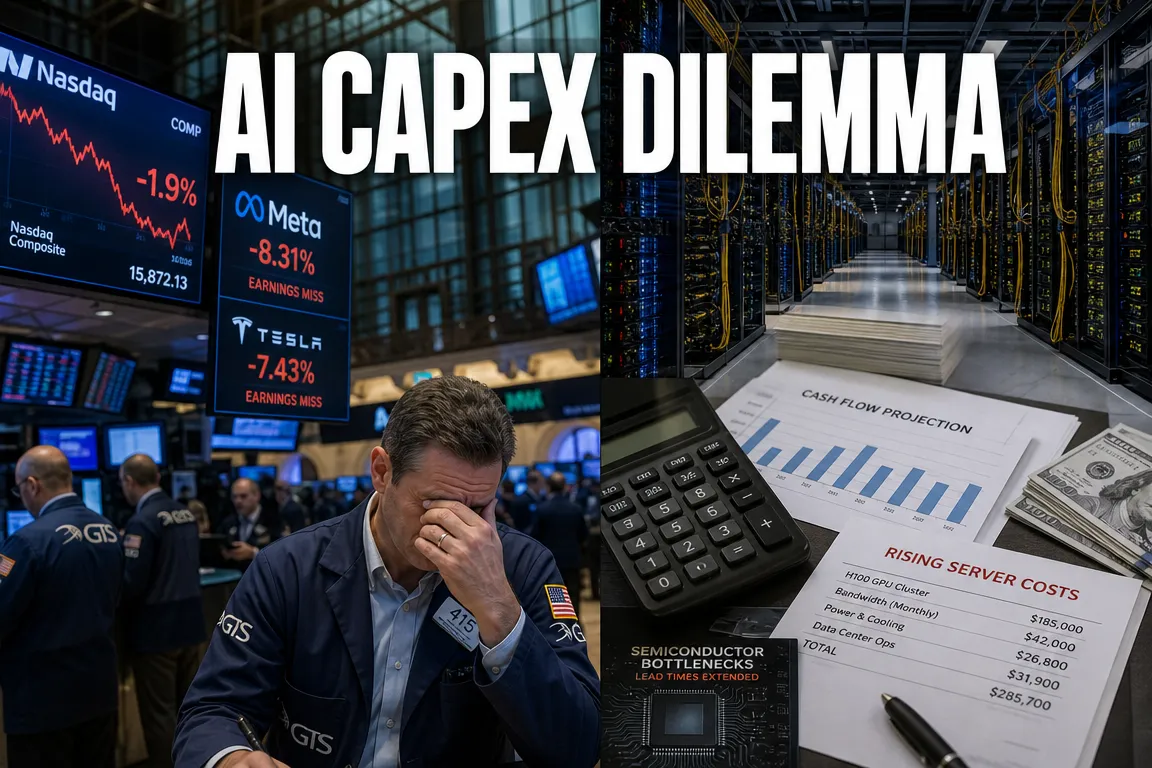
The challenge is that free cash flow at hyperscalers is no longer as abundant as before.
Microsoft, Amazon, Google, and Meta are spending heavily on AI data centers and GPU procurement.
When investment requirements become too large, internal cash flow alone is no longer sufficient.
At that point, corporate bond issuance becomes necessary.
Companies borrow through bond markets and use the funds to continue AI CAPEX investment.
Corporate borrowing costs are determined by Treasury yields plus credit spreads.
As a result, higher long-term U.S. Treasury yields increase corporate funding costs, while lower yields reduce the burden and support continued investment.
In this context, suppressing long-term Treasury yields is not just a growth policy.
It is also an industrial and financial strategy linked to the AI competition with China.
2. Policy rates may remain unchanged, but market direction is driven by expectations
The discussion assumes that the Federal Reserve is likely to keep policy rates unchanged in September and October.
This reflects deep division within the Fed.
Some officials still favor further tightening.
Others are open to eventual easing.
When internal views are highly split, the final outcome often defaults to a hold.
The key point is that markets respond more to expectations for future rate moves than to the current policy rate itself.
Financial markets are sensitive to where rates are expected to go next.
After Jackson Hole, markets began to reassess the risk of additional hikes.
If August CPI and PPI data released in mid-September confirm a cooling trend, concerns about further tightening could fade quickly.
In that case, markets may shift to a view that tightening fears were overstated.
This shift could mark the start of a liquidity-driven market phase.
3. The inflation data framework: how to read CPI, PPI, and PCE
The discussion places significant emphasis on inflation indicators.
The key question is whether CPI, PPI, and PCE are all pointing in the same direction.
-
CPI is the Consumer Price Index.
It reflects the price trend faced by end consumers.
-
PPI is the Producer Price Index.
It reflects corporate input cost pressure and often serves as an early indicator for CPI.
-
PCE is the Personal Consumption Expenditures price index.
It is the inflation gauge the Fed places greater formal weight on.
One view in the discussion is that the inflation data for May, June, and July showed broad cooling.
In particular, weakness in PPI is cited as evidence that CPI may also ease later.
However, there is a counterargument.
Core CPI has declined, but core PCE remains sticky.
Hawkish Fed officials can use that as a basis to argue that rate cuts remain premature and that further hikes may still be warranted.
That is why mid-September CPI and PPI releases are important.
If inflation continues to moderate, long-term yields could fall and liquidity conditions could improve.
If inflation reaccelerates, tightening fears could return and pressure both equities and bonds.
4. If employment is strong, should rates be raised further?
The discussion also covers the hawkish Fed argument.
Hawks argue that unemployment is below the natural rate, which implies lingering inflation pressure.
In other words, a labor market that is too strong could generate wage pressure and revive inflation.
However, the opposing view is clear.
Strong employment alone does not justify preemptively raising rates and creating unemployment.
The Fed’s mandate is price stability and maximum employment.
It is reasonable to cut rates when employment weakens.
It is less defensible to deliberately slow the economy simply because the labor market remains strong.
If employment is stable while inflation is easing, the case for further hikes weakens.
The key variable for markets is therefore not employment alone, but whether inflation cooling continues.
5. The broader U.S. fiscal strategy: grow GDP rather than reduce debt
A major fiscal point in the discussion is that the U.S. government is not trying to reduce debt in absolute terms.
Instead, it is likely focused on managing debt relative to GDP.
Put simply, the strategy is not to reduce the numerator.
It is to expand the denominator by increasing nominal GDP.
This is an important point for the U.S. outlook.
Even if federal debt rises, the debt-to-GDP ratio can remain manageable if nominal GDP grows faster.
Nominal GDP combines real growth and inflation.
As a result, moderate inflation may be tolerated because it helps dilute the debt burden.
The discussion suggests that returning fully to a 2% inflation regime may be difficult, and that inflation around 3% could be accepted to some degree.
The crucial issue is that inflation expectations must remain anchored.
If inflation is 3% but expected inflation rises to 4% or 5%, long-term Treasury yields could spike.
6. Why liquidity may be needed before the midterm elections
The discussion also emphasizes Trump’s political incentives.
It notes that losing the midterm elections could raise impeachment risk.
For that reason, Trump has a strong incentive to make the economy and financial markets look favorable before the midterms.
One tool is fiscal policy.
Raising the debt ceiling creates borrowing capacity similar to an overdraft facility.
The question is when and how that capacity is used.
The discussion suggests that after September, fiscal spending could rise, while issuance may shift away from long-term debt toward shorter maturities.
Buybacks, TGA balance usage, and increased short-term Treasury supply are all presented as ways to lower long-term yields.
In short, the pre-midterm period may feature stronger liquidity support, lower long-term yields, and a more favorable setup for equities and growth indicators.
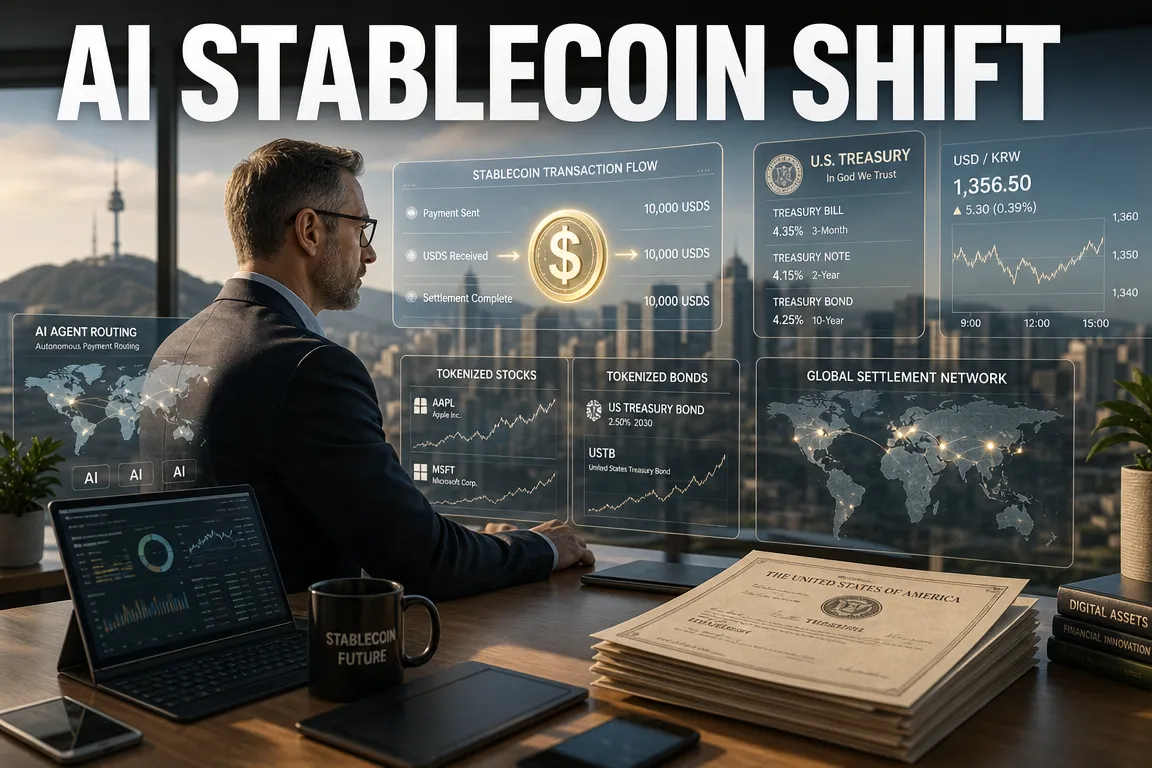
7. Why stablecoins are linked to U.S. Treasury yields
Another notable point is stablecoins.
Stablecoins are not only a crypto-market issue; they are also linked to demand for short-term U.S. Treasuries.
Issuers such as Tether and Circle hold substantial amounts of short-term Treasuries as reserve assets.
As the stablecoin market expands, structural demand for short-term government debt can increase.
For the U.S. government, this matters because short-term Treasury issuance requires reliable buyers.
A larger stablecoin market can absorb more short-term Treasury supply.
In that sense, stablecoins are part of Treasury funding infrastructure, not just a crypto product.
The Clarity Act and expectations for broader stablecoin regulation should be understood in this context.
Stablecoin competition is therefore tied to digital dollar leadership, short-term Treasury demand, and global liquidity distribution.
8. Easing geopolitical tension may also support a liquidity phase
The discussion also treats reduced geopolitical tension as a liquidity-supportive factor.
It specifically references potential U.S.-China leader meetings and APEC-related diplomacy.
The U.S. and China are structurally in competition.
AI semiconductors, advanced manufacturing, data infrastructure, and supply chains are natural points of conflict.
However, ahead of elections, policymakers may prefer to project stability and negotiation rather than escalation.
If geopolitical risk eases, risk appetite may improve and equities may benefit.
This is not just an外交 event.
It can function as a psychological stabilizer for a liquidity-driven market phase.
9. U.S.-China trade flows and their link to inflation cooling
The discussion also suggests that higher imports from China may be one reason U.S. inflation is cooling.
If transport traffic and trade flows between the U.S. and China improve, that can lower goods inflation in the U.S.
In practical terms, renewed imports of lower-cost Chinese goods can create downward pressure on consumer prices.
On a year-over-year basis, a larger share of cheaper imports compared with the prior year can mechanically reduce inflation rates.
This is especially plausible if trade frictions ease, or at least do not intensify in the near term.
If the U.S. wants to reduce inflation pressure before the election, increased imports from China may be a practical channel.
10. M2 growth and liquidity expansion: the return of money supply support
The discussion also highlights U.S. M2 growth.
M2 is a broad measure of money supply.
In simple terms, it reflects how much liquidity is circulating in the economy.
During the 2020 pandemic period, U.S. M2 growth surged to roughly 25%.
By contrast, during the tightening cycle in 2022 and 2023, M2 growth even turned negative at times.
The discussion suggests that M2 growth has moved back to around 5% to 6%, with room for further expansion in September and October.
Some scenarios point to liquidity growth approaching 15%.
If M2 growth accelerates materially, equities and other risk assets could see strong liquidity support.
At the same time, liquidity expansion can eventually feed back into inflation.
The discussion suggests a lag of about three months.
In other words, liquidity may support markets before the midterms, but inflation pressure could reemerge later.
11. Why the Q3 GDP advance estimate matters
The discussion also identifies the October release of the Q3 GDP advance estimate as a key variable.
For an administration facing an election, growth needs to look strong.
AI-related capital spending and private CAPEX are becoming increasingly important components of U.S. GDP.
If hyperscalers continue investing through September and October, Q3 growth could remain firm.
This again links back to Treasury yields.
AI companies need bond issuance to fund continued investment.
Lower long-term Treasury yields reduce borrowing costs.
That is why Treasury yields, bond issuance, AI CAPEX, GDP growth, and the midterm strategy form one integrated framework.
12. The central point that is often missed in market coverage
Many reports only say that Trump wants lower rates.
But the more important issue is not the policy rate itself.
-
First, the U.S. is more focused on long-term Treasury yields and corporate bond yields than on the policy rate alone.
AI infrastructure investment depends on long-duration funding.
-
Second, the AI power race is not only a technology contest but also a capital formation contest.
The winner may be the side that can invest more, for longer, at lower cost.
-
Third, stablecoins may evolve beyond a crypto issue into an infrastructure layer that absorbs short-term Treasuries.
This also supports dollar-system leadership.
-
Fourth, the U.S. may prefer to grow nominal GDP rather than reduce debt outright.
In that case, moderate inflation may be tolerated as policy.
-
Fifth, liquidity support before the midterms may create inflation pressure later.
That means the near-term market backdrop may be supportive, but medium-term volatility risks remain.
13. Key indicators investors should monitor
To assess whether this scenario is unfolding, several indicators should be monitored.
-
Track the U.S. 10-year Treasury yield.
A stable decline would support corporate issuance and AI CAPEX.
-
Track CPI, PPI, and PCE.
Particular attention should be paid to whether PPI remains weak and whether core PCE reaccelerates.
-
Monitor hyperscaler bond issuance and capital expenditure plans.
If AI data center investment continues, that would support U.S. growth.
-
Track M2 growth and liquidity measures.
Stronger money supply growth may provide near-term support for equities.
-
Monitor U.S.-China summit meetings and trade data.
Greater Chinese imports and reduced geopolitical tension can affect both inflation and risk sentiment.
-
Track stablecoin regulation and short-term Treasury demand.
Stablecoin growth may become part of the U.S. funding structure.
14. Market scenarios ahead
The most constructive scenario is one in which inflation continues to cool, long-term Treasury yields decline, and liquidity expands.
In that case, AI-related equities, semiconductors, data centers, power infrastructure, and cloud companies could benefit.
A neutral scenario would involve unchanged policy rates, sticky but not reaccelerating inflation, and limited movement in Treasury yields.
In that case, markets may remain volatile around data releases without establishing a clear trend.
A negative scenario would involve a rebound in core PCE, rising inflation expectations, and renewed upward pressure on the U.S. 10-year yield.
That would weaken the liquidity narrative and increase valuation pressure on growth and AI-related equities.
After the midterms, the side effects of liquidity support may become more visible.
Market gains driven by easier money can eventually face renewed pressure from inflation and interest rates.
< Summary >
Trump’s push to suppress U.S. Treasury yields is not simply a growth-oriented policy stance; it is linked to the AI power race.
Hyperscalers need continued AI CAPEX, which requires bond financing, and lower long-term Treasury yields help reduce those financing costs.
The Fed may keep policy rates unchanged, but markets can shift toward a liquidity phase once tightening fears fade.
The key variables are whether CPI, PPI, and PCE continue to cool.
The U.S. may prefer to manage debt by expanding nominal GDP rather than reducing debt outright.
Stablecoins could become a structural source of demand for short-term Treasuries.
Before the midterms, policymakers may favor liquidity support and lower long-term yields, but after the election, inflation reacceleration and higher volatility remain material risks.
[Related Articles…]
- AI Power Race and Global Investment Trends
- Why U.S. Treasury Yields Shape Equities and the Economic Outlook
*Source: [ 경제 읽어주는 남자(김광석TV) ]
– 트럼프가 국채금리를 찍어누르는 진짜 이유… 결국 ‘AI 패권전쟁’ 때문입니다 | 경읽남과 토론합시다 | 3자토론 문홍철x성상현x김광석 [3편]