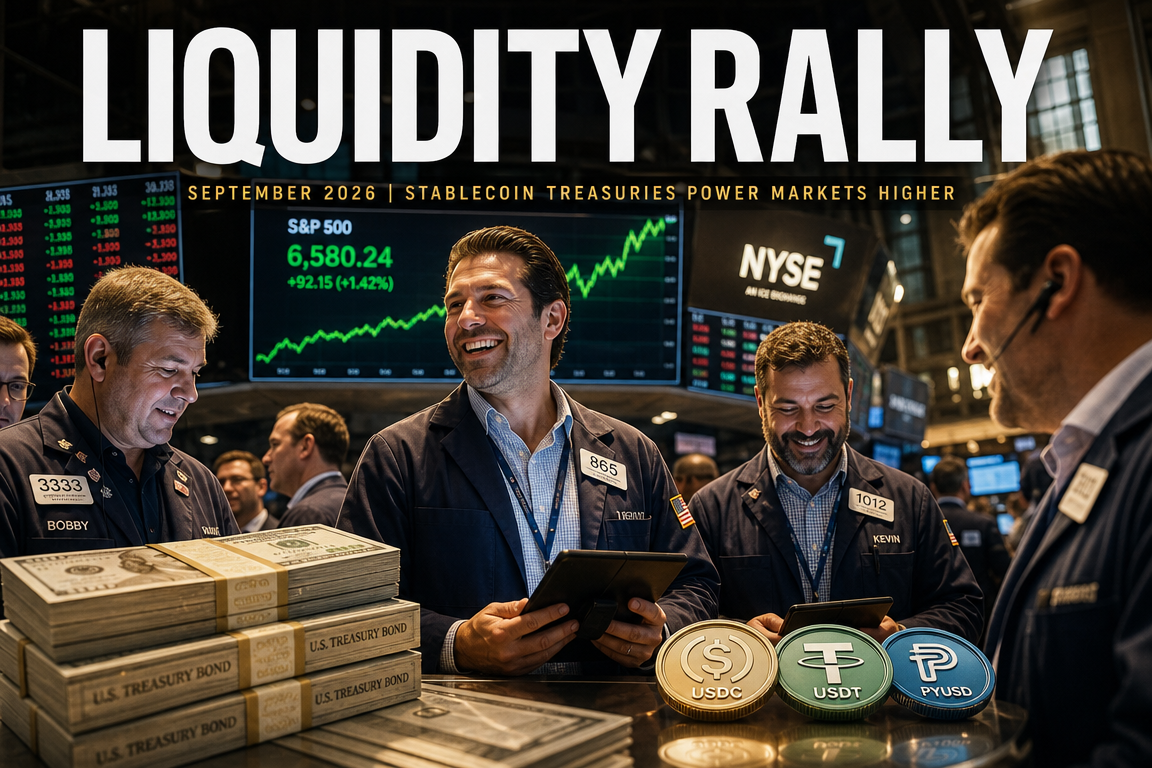
● Liquidity-Driven Rally
September Equity Market Outlook: A Liquidity Cycle May Start Not from the Fed, but from the Treasury, Private Banks, and AI Investment
The key issue for the September stock market is not simply whether the Fed will hike or cut rates.
The real question is where liquidity will come from.
The views of three experts diverged meaningfully.
Team Leader Moon Hong-cheol said September and October may be a period of consolidation, with a liquidity-driven rally possible after the U.S. midterm elections.
Writer Sung Sang-hyun argued that liquidity may increasingly come from commercial banks and private credit creation rather than the Fed.
Professor Kim Gwang-seok said fiscal policy could drive a liquidity-led market as early as September and October.
Although these views differ on timing and mechanism, they share one conclusion.
The U.S. economy is entering a phase in which fiscal policy, Treasury issuance structure, AI investment, and private liquidity matter far more than interest rates alone.
1. Why the three experts differed on the September market outlook
The main question in the discussion was this:
“Will a Trump-led liquidity rally emerge in September 2026?”
In this context, a liquidity rally does not mean a simple rate-cut-driven market.
It refers to a broader flow of money, including fiscal policy, Treasury issuance, bank lending, stablecoins, and AI data center investment.
-
Moon Hong-cheol: September and October may be volatile and range-bound, with a stronger liquidity phase possible after the midterm elections.
-
Sung Sang-hyun: Liquidity can be created by commercial banks and private financial institutions even without Fed quantitative easing.
-
Kim Gwang-seok: A liquidity cycle driven by fiscal policy may begin as early as September and October.
In other words, none of the three denied the possibility of renewed liquidity.
The difference was the timing and source.
That distinction is essential for assessing U.S. and Korean equity markets in September.
2. Moon Hong-cheol’s view: September and October may be a pause, with the real opportunity after the midterms
Moon Hong-cheol was relatively cautious on the September and October stock market.
His main reason was that AI and semiconductor stocks had already suffered a significant correction.
Once market positioning breaks down, recovery is rarely immediate.
Investor sentiment typically needs time to heal.
He used a relationship analogy to explain the point.
Just as recovery after a breakup takes time, stocks also need a recovery period after a major drawdown.
In particular, U.S. mega-cap tech and AI semiconductor names have been underperforming the S&P 500.
Korean semiconductor stocks are not insulated from the same trend.
3. The AI stock correction may reflect positioning adjustment, not the end of the cycle
Moon Hong-cheol did not view AI as finished.
He argued that the AI cycle is still at an early stage.
However, he noted that negative news flow around AI stocks has become excessive.
-
Higher rates make AI growth stocks less attractive.
-
Free cash flow is deteriorating.
-
AI companies are relying more on debt financing.
-
Data center investment may be overheating.
He suggested that some of this news flow may be linked to market positioning rather than purely fundamental analysis.
In particular, some hedge funds may have built short positions in AI and semiconductor names and used negative headlines to pressure sentiment.
From this perspective, the recent correction in AI semiconductors may reflect leverage unwinding and positioning reallocation rather than the end of the industry cycle.
4. Moon Hong-cheol’s key timing view: after Halloween, and after the midterms
Moon Hong-cheol said the tone could shift after late October, around Halloween.
He cited two reasons.
-
The Fed may soften its hawkish stance as data weakens.
-
War-related and oil-related uncertainty may ease.
He argued that the Fed is currently leaning hawkish and politically biased against Trump.
However, if employment weakens further and inflation stabilizes, the Fed would eventually have to adjust.
He also said that if the Fed were to raise rates in September or October, it would likely be a policy mistake.
Interestingly, such a rate hike could lower long-term yields if the market concludes that the Fed will need to cut more aggressively later.
5. Oil and the Strait of Hormuz: actual traffic may be higher than market estimates
Moon Hong-cheol highlighted an interesting point regarding the Strait of Hormuz.
Markets usually rely on private data providers tracking vessel traffic.
However, many ships pass with their transponders turned off.
Private data vendors may not capture such traffic accurately.
The U.S. government, by contrast, can monitor it more precisely through satellites and intelligence assets.
Under this interpretation, traffic through the Strait of Hormuz may be more normalized than markets assume.
If oil prices stabilize, consumer inflation pressures ease, which functions as a form of liquidity support.
Lower fuel prices improve real purchasing power for households and companies.
6. Sung Sang-hyun’s view: this liquidity cycle may come from commercial banks, not the Fed
Sung Sang-hyun focused on private-sector liquidity rather than the Fed.
Since 2008, markets have largely interpreted liquidity through the lens of Fed QE and QT.
He argued that this cycle may be different.
Even if the Fed reduces its balance sheet, liquidity can still expand if commercial banks and private financial institutions increase credit creation.
He placed particular emphasis on the U.S. Treasury’s debt issuance strategy.
Reducing long-duration issuance while increasing short-duration issuance could create a more accommodative market environment.
This is not merely a technical adjustment.
It can help suppress long-term yields and support risk asset appetite.
7. The U.S. Treasury’s strategy: fewer long bonds, more short bonds
Sung Sang-hyun noted that although U.S. federal debt has exceeded $40 trillion, the government is not trying to reduce debt materially.
The key issue is not debt reduction, but sustaining growth and securing demand for the debt.
The Treasury may reduce long-term issuance and increase short-term issuance.
If long-bond supply falls, upward pressure on 10-year and 30-year yields may ease.
Stable long-term yields would support equities, real estate, credit, and AI growth stocks.
Short-term Treasuries, meanwhile, have a broad investor base.
Money market funds, stablecoin issuers, central banks, and banks can all absorb short-duration issuance.
Stablecoins in particular may become a major new source of demand for short-term U.S. Treasuries.
8. Stablecoins and short-term Treasuries: a new liquidity engine
Stablecoin issuers must invest customer dollars in safe assets.
Short-term U.S. Treasuries are a primary destination.
As the stablecoin market expands, demand for short-dated Treasuries should also rise.
For the Treasury, this means greater capacity to issue more short-term debt.
This structure matters because increased short-term issuance can coexist with lower long-term yields.
Lower long-term yields reduce valuation pressure on growth stocks.
This is particularly favorable for AI semiconductors, data centers, and cloud infrastructure.
9. Bank deregulation and credit creation: M2 could expand again
Sung Sang-hyun also stressed the role of commercial banks.
When banks reduce cash reserves and expand lending, deposits are created again.
This is credit creation.
Even if the central bank does not print money directly, private banks can still expand broad money supply through lending.
He cited JPMorgan as an example.
While banks typically maintain high cash buffers, JPMorgan has recently been reducing its cash share significantly.
If banks lower cash holdings and expand lending, liquidity flows into markets.
This can affect asset prices independently of the Fed’s policy rate.
10. More important than “don’t fight the Fed”: “don’t fight the Treasury”
A common point emphasized by Sung Sang-hyun and Moon Hong-cheol was the power of the Treasury.
Markets often assume that long-term yields are determined mainly by the market itself.
But the government can adjust the amount and maturity structure of issuance.
If 30-year yields become problematic, the Treasury can issue fewer 30-year bonds.
This may sound counterintuitive.
But households and governments are not the same.
Households need fixed-rate long-term debt for stability.
Governments operate the monetary and sovereign debt system.
As a result, they can influence the yield structure through issuance and demand management.
This is financial repression.
Rather than allowing market rates to rise freely, the government uses issuance structure and demand channels to suppress long-term yields.
11. The 1992 pound and the current U.S. dollar are not the same
The discussion also referenced George Soros’ attack on the British pound.
In 1992, markets defeated the U.K. government.
That raises the question of whether markets can also overpower the U.S. government.
Sung Sang-hyun argued that the British pound in 1992 and the U.S. dollar today are fundamentally different.
The dollar remains the global reserve currency.
U.S. Treasuries remain core collateral in the global financial system.
As a result, it may be too aggressive to assume that markets can easily pressure the Treasury.
The key indicators are not the absolute debt level.
They are the fiscal deficit-to-GDP ratio and the government debt-to-GDP ratio.
Even if debt rises, the ratio can remain stable if nominal GDP grows faster.
12. Kim Gwang-seok’s view: a liquidity cycle driven by fiscal policy may begin in September and October
Kim Gwang-seok argued that a liquidity-driven market could begin as early as September and October.
His core logic centers on fiscal policy rather than monetary policy.
Even if the Fed does not cut rates, fiscal expansion by the Treasury can inject liquidity into markets.
This can be described as an era of fiscal dominance.
He said the Fed is most likely to keep rates unchanged in September and October.
There are both hawkish and dovish factions, but in a divided Fed, a hold is the most realistic outcome.
The key issue is not the rate decision itself, but the balance between rate-hike fears and rate-cut expectations.
13. Mid-September CPI and PPI could shift market sentiment
Kim Gwang-seok identified the mid-September inflation releases as a major turning point.
CPI and PPI data for May, June, and July generally showed moderation.
If the August data also confirms easing inflation, the market may conclude that rate-hike concerns were overstated.
In that case, fears of a Fed hike would decline.
Even a reduction in those fears can create a liquidity effect for equities.
This would be especially supportive for growth stocks, AI names, and semiconductors.
That does not mean inflation has fully normalized.
The key question is whether the economy is clearly on a disinflation path.
If lower inflation is confirmed, markets regain the rationale to allocate to risk assets.
14. The OBBA bill and the debt ceiling: Trump’s “credit line”
Kim Gwang-seok said the Trump administration may fully deploy fiscal policy ahead of the midterms.
The expanded debt ceiling under the OBBA bill is comparable to establishing a credit line.
The issue is when to use it.
He argued that this fiscal capacity could begin to be used more actively from September.
The Treasury may reduce long-bond issuance and increase short-term issuance.
It may also use the TGA balance or conduct buybacks.
The objective is to keep long-term Treasury yields low while expanding fiscal spending.
15. The midterms and liquidity: politics as a market driver
For President Trump, the midterm elections are highly important.
He has repeatedly indicated that losing the midterms would create significant political risk.
That gives him a strong incentive to keep the economy and stock market strong ahead of the election.
When stocks are strong, consumer sentiment improves.
When consumer sentiment improves, the economy is perceived more favorably.
When economic perceptions improve, the political outlook improves.
As a result, the liquidity cycle in September and October is not only a financial event but also a political one.
16. Easing geopolitical risk can also act as a liquidity support
Kim Gwang-seok also viewed de-escalation in geopolitical tension as a liquidity-positive factor.
A U.S.-China summit is scheduled for September 24, and the APEC summit will follow in late November.
There is a possibility that President Xi will visit the U.S., followed by further summit diplomacy involving President Trump and China.
From this perspective, a sharp escalation in U.S.-China tensions appears less likely.
Even if strategic rivalry remains, both sides have incentives to project stability and negotiation.
Lower geopolitical volatility can reduce oil, dollar, and rate volatility.
That, in turn, is supportive for global financial markets.
17. The core of the AI competition: hyperscalers must not stop CAPEX
One of Kim Gwang-seok’s main points was AI investment.
AI data centers, semiconductor equipment, and cloud infrastructure now account for a growing share of U.S. growth.
If hyperscalers stop CAPEX spending, the U.S. AI strategy weakens.
The issue is that free cash flow at large tech firms is declining.
If cash flow alone cannot sustain large-scale AI investment, companies must issue debt.
To keep corporate bond issuance functioning smoothly, Treasury yields need to remain low.
This gives the Treasury an incentive to keep long-term yields subdued.
In other words, stable Treasury yields are not just a support for equities.
They are part of the financing infrastructure behind U.S. AI leadership.
18. Why the preliminary Q3 GDP reading matters
The initial estimate for third-quarter U.S. GDP will be released in October.
It will reflect economic activity from July through September.
With the midterms approaching, a strong Q3 growth reading would be politically important.
To support growth, both consumption and investment must remain firm.
AI data center spending and hyperscaler CAPEX are particularly important.
For those investments to continue, interest rates and the corporate bond market must remain stable.
Liquidity, Treasury yields, AI investment, GDP growth, and the midterms are therefore linked in one chain.
19. The key point underreported elsewhere: the source of liquidity is changing
The most important message from the discussion is not whether the Fed is printing money.
The real point is that the source of liquidity is changing.
-
In the past, Fed quantitative easing was the central source of liquidity.
-
This time, the U.S. Treasury’s issuance strategy may be the key driver.
-
Commercial bank lending and credit creation may generate liquidity.
-
Stablecoins may create demand for short-term Treasuries and support Treasury strategy.
-
AI data center investment may connect corporate bond markets with Treasury yield policy.
Many investors still view markets through the simple formula of “rates down equals rally, rates up equals decline.”
But the current environment is more complex.
Even if the Fed holds rates steady, the Treasury can still ease financial conditions.
Even if the Fed reduces its balance sheet, banks can expand lending.
Even if long-term yields try to rise, the Treasury can reduce long-duration supply.
Understanding that structure is essential for assessing the September market outlook.
20. Key risk: post-midterm inflation and liquidity headwinds
However, a liquidity rally does not mean the environment is risk-free.
Kim Gwang-seok noted that problems could emerge after the midterms.
If liquidity is injected aggressively in September and October, the effects may appear in inflation several months later.
There is a lag between money growth and inflation.
Before the election, the incentive to suppress Treasury yields and provide liquidity is strong.
After the election, that pressure may ease.
If inflation reaccelerates or long-term yields rebound, equities may come under pressure.
Investors therefore need to monitor both the potential for a September-October liquidity cycle and the post-election risks.
21. Key indicators investors should watch in September
When evaluating the September market, it is more important to track the following indicators than headline news.
-
CPI and PPI: Whether August inflation data continues the disinflation trend.
-
Employment data and revisions: Weaker labor market data could reduce the Fed’s hawkish bias.
-
10-year and 30-year U.S. Treasury yields: Whether long-term yields remain stable.
-
U.S. Treasury QRA and buybacks: The balance between long-duration and short-duration issuance.
-
TGA balance: How much cash the Treasury is injecting into the market.
-
M2 growth: Whether broad money supply is expanding again.
-
Stablecoin issuance: A proxy for demand for short-term Treasuries.
-
Hyperscaler CAPEX: The sustainability of AI and data center investment.
-
Corporate bond spreads: A measure of financing conditions for AI firms and mega-cap tech.
-
Oil prices and the Strait of Hormuz: Oil stability is important for both consumption and inflation.
22. September market scenarios
Scenario 1: Inflation moderation + Fed hold + Treasury liquidity expansion
This would likely produce the strongest liquidity-led rally.
In U.S. equities, AI stocks, semiconductors, and growth names could rebound.
In Korean equities, semiconductors, power equipment, and AI infrastructure-related names may attract interest.
Scenario 2: The Fed proceeds with a rate hike
Equities would likely face an immediate shock.
However, if markets interpret it as a policy mistake, long-term yields could decline.
That would create volatility, but also room for a later rebound.
Scenario 3: Oil rises again and geopolitical risk intensifies
This is the most unfavorable scenario.
Inflation concerns would return, and the Fed’s hawkish tone could strengthen.
In this case, expectations for a liquidity rally would likely be delayed.
Scenario 4: AI investment slows and credit markets tighten
This is the biggest risk for AI semiconductor stocks.
If hyperscaler CAPEX declines, semiconductor demand expectations may weaken.
Investors should therefore monitor Treasury yields and corporate bond spreads together.
23. Conclusion: September markets should be viewed through the path of money, not just the Fed rate
The most important issue in the September stock market outlook is not the policy rate alone.
The key question is where money comes from, how it is deployed, and through which channels it flows.
The U.S. Treasury can influence long-term yields through its issuance structure.
Commercial banks can expand broad money through lending and credit creation.
Stablecoins can create demand for short-term Treasuries and support Treasury strategy.
AI data center investment can move U.S. growth and equity market direction simultaneously.
For that reason, the September and October market should not be reduced to a simple “rate hikes are bad” or “rate cuts are good” framework.
Fiscal dominance, private liquidity, AI CAPEX, stablecoins, and long-term yield suppression are the five key themes that must be assessed together.
If these forces align, the September stock market could stage a stronger liquidity-driven rally than many expect.
However, investors must also watch for post-rally inflation pressure and a rebound in long-term yields.
< Summary >
The key issue for the September stock market is liquidity source, not only Fed rates.
Moon Hong-cheol expects a volatile September and October, with a stronger liquidity phase after the midterms.
Sung Sang-hyun sees commercial banks, short-term Treasuries, and stablecoins as potential new liquidity sources.
Kim Gwang-seok sees a fiscal-policy-led liquidity cycle potentially starting in September and October.
The U.S. Treasury may reduce long-bond issuance and increase short-bond issuance to suppress long-term yields.
AI data centers and hyperscaler CAPEX remain key variables for U.S. growth and semiconductor stocks.
Investors should focus on September CPI, PPI, Treasury yields, M2 growth, stablecoin issuance, and corporate bond spreads.
There may be a liquidity rally before the midterms, but post-election inflation and yield risks should also be monitored.
[Related Articles…]
*Source: [ 경제 읽어주는 남자(김광석TV) ]
– [풀버전 1~3편] 9월 주식시장, 돈이 풀릴까 더 빠질까? 세 전문가의 전망이 갈렸습니다 | 경읽남과 토론합시다 | 3자토론 문홍철x성상현x김광석