● KOSPI Rally, Oil Shock, AI Boom, Hynix Surge
Why the KOSPI Rally Is Not Entirely Comfortable: International Oil and the U.S. Market as Variables Behind the SK Hynix and Memory Semiconductor Surge
The core driver of the current KOSPI advance is not simply that semiconductors are performing well.
The rally is being shaped by strength in memory semiconductors led by SK Hynix, competition among AI models represented by GPT-6 Astra, international oil prices approaching $100, and the absence of confirmation from the U.S. market due to holiday closure.
At first glance, the move appears to be a healthy AI-led rally. However, a closer look suggests several factors that could destabilize the KOSPI outlook.
The key point is that while AI is supporting memory demand, the sustainability of the rally remains uncertain until oil and U.S. market reactions are confirmed.
1. The KOSPI Rally Is Still Led by SK Hynix and Memory Semiconductors
The recent rise in the KOSPI has been driven by large-cap semiconductor names such as Samsung Electronics and SK Hynix.
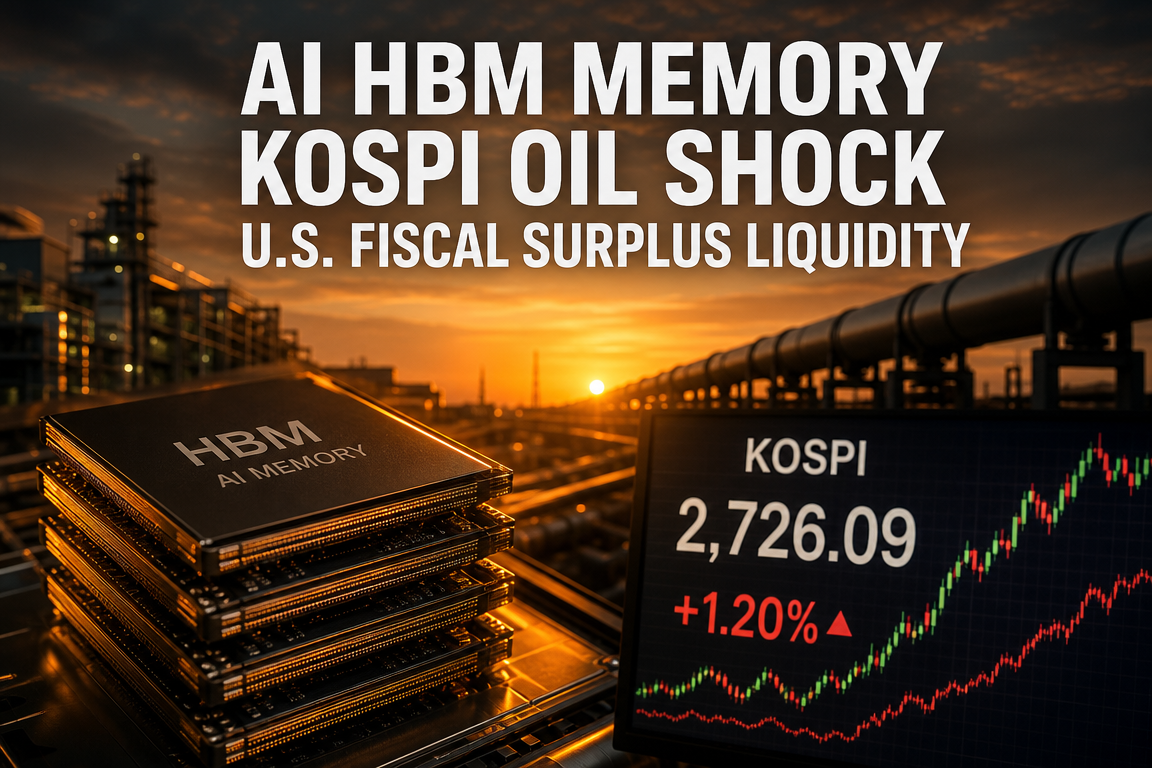
Investor attention is focused not only on DRAM and NAND, but especially on high-bandwidth memory, or HBM, used in AI servers.
As AI models become more advanced, they require greater computing power, faster data processing, and higher memory bandwidth.
In this structure, not only GPUs but also memory semiconductors that support rapid data transfer gain value.
As a result, investors are buying semiconductor stocks again on the assumption that AI growth will ultimately support SK Hynix earnings.
The issue begins here.
If share prices already reflect much of the expected future growth, expectations become more important than actual results.
Even if earnings improve, stocks can fall if results are below consensus.
Conversely, if AI demand expectations continue to rise without confirmation in earnings, short-term overheating may develop.
2. GPT-6 Astra Effect: Why AI Model Competition Is Supporting Memory Demand
The main point in the original text is the market reaction to GPT-6 Astra.
It notes growing user feedback and a widening view that it outperforms Claude’s latest model, Fable.
It also highlights a market view that while some recent Chinese AI models have been praised as inexpensive and capable, actual testing shows they consume more tokens and take longer to process, making GPT-6 effectively cheaper in total cost.
This is not simply a comparison of AI model performance.
What matters in AI is the total cost of producing an answer.
Even if a model appears cheaper on paper, higher token usage and longer processing times can raise total cost for companies.
By contrast, a model with a higher unit price can still be more cost-efficient if it delivers more accurate results faster.
The metaphor that “one high-value expert is better than ten underperforming workers” captures this structure well.
From an investment perspective, the market is beginning to value not just “cheap AI” but “efficient AI.”
If efficient AI spreads, corporate adoption should accelerate. Faster adoption should lift data center investment, and that in turn should increase demand for HBM and server DRAM.
In this sense, positive market reaction to a high-performance AI model such as GPT-6 Astra is constructive for SK Hynix and the broader memory semiconductor cycle.
3. Why the KOSPI Rally Remains Fragile
The rally is still uneasy because several macro variables are moving in the opposite direction.
The first is international oil prices.
The second is the lack of confirmation from the U.S. market.
The third is the concentration of KOSPI gains in a small number of large semiconductor names.
In other words, the market currently has a strong engine in AI-related semiconductor optimism, but also a brake in the form of rising oil and limited global confirmation.
4. The Largest Risk Is Oil Near $100
The original text places the strongest emphasis on oil.
As tensions between the United States and Iran show no clear sign of resolution, international oil prices have moved close to $100.
The market already reacted once when oil crossed $90.
If $100 is tested again, the situation becomes more complicated.
Rising oil prices are not only a burden on fuel costs.
Higher oil prices raise logistics costs, airfares, chemical input costs, electricity costs, and manufacturing expenses.
For countries such as South Korea, which rely heavily on energy imports, the pressure is especially significant.
Higher import prices can increase domestic inflation pressure and weaken expectations for rate cuts by the Bank of Korea.
The same applies to the United States.
If oil remains near $100, the disinflation trend in the U.S. could slow.
That could make the Federal Reserve’s rate outlook more hawkish again.
Ultimately, rising oil prices create three major headwinds for equities.
-
First, they raise renewed inflation concerns.
-
Second, they reduce expectations for rate cuts.
-
Third, they pressure corporate profit margins.
KOSPI is particularly sensitive because of Korea’s high exposure to exports and manufacturing.
Even if semiconductor fundamentals improve, broader index momentum can weaken if oil-driven macro pressure increases.
5. U.S. Market Closure: Global Investor Confirmation Has Not Yet Arrived
The second source of uncertainty is the closure of the U.S. stock market.
Asian markets have shown optimism about memory semiconductors, but it remains unclear whether global capital, especially U.S. investors, will confirm the same view.
Even if SK Hynix and Samsung Electronics move sharply higher in Korea, there is no guarantee that Nvidia, AMD, Micron, Broadcom, TSMC-related names, and other U.S. semiconductor stocks will move in the same direction.
If the U.S. market opens and AI semiconductor names also rise, the KOSPI move can be interpreted as part of a stronger global trend.
However, if U.S. semiconductor stocks take profits or if technology shares weaken on oil-related concerns, the KOSPI rally may face short-term pressure.
That is why the question of whether “U.S. investors will also endorse the memory story” is important.
Although the phrase is informal, the underlying investment question is whether global institutions and capital will validate Korea’s semiconductor rally.
6. The Current Market Structure: AI Tailwind vs. Oil Headwind
The market is currently shaped by two competing forces.
One is rising demand expectations driven by AI model advancement.
The other is inflation and rate pressure caused by higher oil prices.
The AI tailwind supports growth stocks and semiconductor names.
By contrast, the oil headwind can compress valuation multiples across the equity market.
If rates rise or expectations for easing are delayed, AI-related stocks that already reflect strong future growth may become even more sensitive.
In short, even if AI remains structurally positive, equities may need to slow if oil and rates become a burden.
That is why the KOSPI rally is not easy to treat as fully sustainable at this stage.
7. The Most Important Point Often Overlooked in Other Coverage
The most important point that is often underemphasized is that stronger AI models do not automatically translate into higher semiconductor demand.
Many investors simplify the sequence as follows: GPT-6 Astra is strong, therefore AI grows, therefore more HBM is needed, therefore SK Hynix rises.
The direction is reasonable, but there are necessary checkpoints in between.
-
First, whether advanced AI models are being adopted quickly in enterprise workflows must be confirmed.
-
Second, whether higher AI usage translates into greater data center investment must be verified.
-
Third, whether that investment leads to more GPU, HBM, and server DRAM orders must be checked.
-
Fourth, whether semiconductor supply is expanding faster than demand must be monitored.
The real issue is not the popularity of AI models, but how that popularity translates into memory prices, shipment volumes, long-term supply agreements, and corporate earnings.
Share prices move on expectations first, but corrections follow if earnings do not catch up.
For that reason, investors should focus less on performance comparisons of GPT-6 Astra and more on SK Hynix’s HBM capacity, customer demand, average selling prices, and margin improvement.
8. Key Checkpoints for SK Hynix Investors
SK Hynix is viewed as a leading AI memory stock.
Its strength in the HBM market positions it as a direct beneficiary of the global AI investment cycle.
However, this phase is increasingly about numbers rather than expectations.
-
Investors should confirm whether HBM supply contracts are becoming more long-term.
-
They should check whether volumes to major customers such as Nvidia remain stable.
-
They should monitor whether the recovery in DRAM prices expands from server applications to PC and mobile use cases.
-
They should assess whether NAND market improvement is reducing pressure on overall earnings.
-
They should also determine whether stock price gains are outpacing earnings improvement.
Semiconductor stocks often move ahead of the cycle, with earnings following later.
But if expectations are priced in too quickly, even good news can lead to consolidation.
9. For the KOSPI as a Whole, the Quality of the Rally Matters
More important than whether the index rises is which stocks are rising.
If the KOSPI advance is concentrated mainly in a few large-cap names such as SK Hynix and Samsung Electronics, market breadth may remain weak.
By contrast, if the rally broadens from semiconductors into sectors such as batteries, autos, shipbuilding, financials, and consumer stocks, the move becomes healthier.
At present, the market still appears heavily concentrated in semiconductors.
In such a market, the index can rise while individual investors experience limited gains.
That is because a small number of large-cap names are doing most of the work.
Accordingly, investors should examine market breadth, trading value, foreign buying, and sector rotation rather than relying only on the index level.
10. What to Watch in the U.S. Market Tonight
When the U.S. market reopens, the first area to watch is the reaction in semiconductor stocks.
Strong moves in Nvidia, Micron, AMD, Broadcom, and TSMC ADR would increase confidence in the Korean semiconductor rally.
Micron’s share price is especially important as an indicator of the global market view on memory demand.
The second key variable is U.S. Treasury yields.
If oil-driven inflation concerns increase, yields may rise.
Higher yields would pressure technology and AI-related stocks.
The third is the dollar-won exchange rate.
If higher oil and risk aversion strengthen the dollar, the won may weaken.
While won weakness can support exporters, it can also raise concerns about foreign capital outflows.
The fourth is whether oil prices continue to rise.
If oil breaks above $100 or geopolitical risks intensify, markets may price inflation concerns more heavily than AI optimism.
11. Investment Approach: This Is a Stage for Confirmation, Not Aggressive Chasing
The KOSPI rally is clearly strong.
AI model competition and expectations for memory demand are not temporary themes.
However, in the short term, oil, the U.S. market response, and interest rate expectations remain key variables.
Accordingly, a more prudent approach is to wait for confirmation and build positions gradually rather than chase the move aggressively.
Investors already heavily exposed to semiconductor stocks should consider risk management based on U.S. market signals and oil trends.
Those with lower exposure may find it more practical to add on pullbacks in core names.
Because the AI investment cycle is a long-term theme, earnings trajectory and sustained demand matter more than short-term price swings.
12. Conclusion: The KOSPI Is Rising, but It Is Not Yet a Comfortable Environment
This KOSPI rally is based on a strong growth narrative centered on AI and memory semiconductors.
Positive market reaction to GPT-6 Astra and the belief that high-performance AI models improve enterprise productivity are increasing expectations for HBM and server DRAM demand.
That is clearly supportive for SK Hynix and the Korean semiconductor sector.
However, international oil prices are approaching $100, and the lack of confirmation from the U.S. market cannot be ignored.
The key point is that while semiconductors are driving the move, it remains to be seen whether the rally will be validated by global capital.
The KOSPI outlook remains constructive, but in the short term, oil and U.S. market performance are likely to determine direction.
< Summary >
The KOSPI advance is being led by SK Hynix and memory semiconductors.
GPT-6 Astra has reinforced expectations for higher HBM and server DRAM demand as efficient AI models gain traction.
However, if international oil prices rise toward $100, inflation and rate pressure may re-emerge.
Because the U.S. market was closed, global investor validation of the Korean semiconductor rally has not yet been confirmed.
At this stage, investors should not chase AI optimism alone and should also monitor U.S. semiconductor stocks, oil prices, Treasury yields, and the won exchange rate.
[Related Articles…]
- AI Semiconductor Supercycle and Memory Market Outlook
- How Rising Oil Prices Affect Global Equities and Inflation
*Source: [ 내일은 투자왕 – 김단테 ]
– 코스피 상승 불안한 이유 #하이닉스 #코스피 #gpt6
● U.S. debt shock, hidden surplus threat, AI bubble risk
The Variable More Concerning Than the U.S. $40 Trillion Debt May Be Not a Fiscal Deficit, but a Fiscal Surplus
The key issue is not simply that U.S. federal debt has reached $40 trillion.
The more important question is whether the U.S. government continues to inject liquidity into the economy or shifts toward absorbing liquidity from the private sector.
In practical terms, a U.S. fiscal deficit can support private liquidity, while a fiscal surplus can reduce it.
For U.S. equities, the AI bubble, dollar dominance, and the global economic outlook, the central issue is not debt size alone, but whether the government retains the willingness to support asset markets and the AI industry.
This report summarizes why U.S. debt concern narratives keep recurring, why the AI investment cycle has become a national security issue, and how the dot-com bust differs from the current AI rally.
1. U.S. Debt Risk Narratives: The Frame Often Moves Before the Data
Recent headlines have continued to highlight U.S. federal debt approaching $40 trillion.
On the surface, this is a large and concerning number.
However, the key point from the discussion is that absolute debt figures can be misleading.
U.S. debt has increased, but GDP has also expanded.
Accordingly, the more relevant metrics are the debt-to-GDP ratio and the deficit-to-GDP ratio.
The view presented by Moon Hong-cheol is that a U.S. debt crisis is unlikely.
The reason is that the deficit ratio should be assessed relative to the size of the economy rather than in isolation.
Japan was also cited for comparison.
Although Japan is widely perceived as highly indebted, its fiscal deficit as a share of GDP is estimated at below 2% as of 2025.
This suggests that headline debt levels alone can create an exaggerated risk perception, even when fiscal conditions appear comparatively stable.
In other words, debt-risk narratives can be amplified more by political messaging and market positioning than by underlying data.
For investors positioned short AI stocks, higher rates are favorable, and one of the simplest arguments for higher rates is the claim that U.S. debt has become unsustainable.
The debt issue is easy to communicate to the public.
Most people do not directly review fiscal data or GDP ratios.
As a result, the message that “this level of borrowing will break the United States” has strong influence both politically and in market sentiment.
2. The Core Problem Is Not Debt Itself, but Growth Financed by Debt
Seo Sang-hyun’s view is more nuanced.
U.S. debt itself is not an imminent systemic threat, but the real concern is whether GDP grows at a pace that matches debt accumulation.
The purpose of government borrowing is ultimately to support economic growth.
If debt rises but growth does not keep pace, debt can become a sign of policy failure rather than stimulus.
The United States is especially focused on China rather than Europe.
China’s share of global GDP rose from roughly 3% in the early 2000s to around 19% by 2025, while the U.S. still remains the world’s largest economy, with a global GDP share in the 25% to 30% range.
The narrowing gap is a strategic concern for the U.S.
This is interpreted as “China Shock 2.0.”
If China Shock 1.0 displaced low-value-added manufacturing, China Shock 2.0 targets higher-value industries such as semiconductors, HBM, EVs, batteries, and AI infrastructure.
From this perspective, U.S. AI investment is not simply a thematic trade.
It is closer to a national security strategy that will shape the next 40 years of economic leadership.
For that reason, the U.S. government is likely to support continued investment in AI data centers, GPUs, semiconductors, and power infrastructure through regulatory easing and policy support.
Even if the payoff period for AI investment is not one or two years, the U.S. cannot easily stop this spending.
The objective is to secure the ecosystem before China does, even if productivity gains are delayed.
3. U.S. Federal Debt Functions as Private-Sector Liquidity
The most important statement in the discussion is this:
“U.S. federal debt is private-sector liquidity.”
Understanding this point changes the way one views U.S. fiscal deficits and U.S. equities.
When the government runs a deficit, it is spending money into the private sector.
In other words, a government deficit becomes income for someone, revenue for businesses, and potentially liquidity flowing into financial markets.
By contrast, a fiscal surplus means the government is withdrawing money from the private sector through taxation and reduced spending.
In that case, private liquidity declines.
For investors, a fiscal surplus can therefore be a warning sign.
Ordinarily, a surplus is viewed positively.
That is generally true for households or corporations.
However, U.S. federal fiscal policy should not be evaluated in the same way as a household budget.
The United States issues the world’s reserve currency, and U.S. Treasuries are core collateral assets in the global financial system.
As a result, a U.S. fiscal deficit is not merely debt accumulation; it also functions as a mechanism for supplying global dollar liquidity.
This does not mean unlimited deficits are harmless.
The key question is whether debt growth is accompanied by faster productivity gains and GDP growth.
4. A Reinterpretation of the Dot-Com Bubble: The Trigger Was Not Valuation Alone, but Fiscal Surplus
One of the most notable points in the original discussion is the reinterpretation of the dot-com bust.
The conventional explanation is that internet stocks were simply too expensive.
That was certainly part of the story.
However, bubbles do not burst solely because prices are high.
They require a catalyst.
Moon Hong-cheol argues that the catalyst was the U.S. fiscal surplus in 1998-1999.
As the U.S. government moved into surplus, liquidity was absorbed from the private sector, and after the strong rally through 1999, the Nasdaq began to fall in March 2000.
An important detail is that productivity was still improving at the time.
Economists argued that higher productivity justified further equity gains.
However, from a liquidity perspective, money was already leaving the system.
As a result, even when productivity improves, asset prices can fall if market liquidity contracts.
This logic also applies to the current AI debate.
Even if AI companies continue to report strong earnings and productivity expectations remain favorable, a shift by the U.S. government toward fiscal surplus or tightening could change market direction.
In that sense, the true trigger for an AI bubble correction may be fiscal policy rather than interest rates alone.
5. AI Is Not a Theme; It Is Part of the U.S. Strategic Position
When assessing whether AI is a bubble, many investors focus on charts and valuation multiples.
However, in the current cycle, AI is not just a growth stock theme.
For the United States, AI connects semiconductors, data centers, cloud infrastructure, power grids, cybersecurity, robotics, and defense.
For that reason, the U.S. government is unlikely to reverse AI investment easily.
If major technology firms say they must reduce AI spending because of weak cash generation, policy and financial support are likely to be used to sustain investment.
The companies best positioned to survive the current high-rate environment share common traits.
They can generate strong operating margins, have pricing power, and produce robust cash flow.
These firms are largely linked to the AI value chain.
By contrast, firms that depend on lower rates and excess liquidity are more vulnerable.
Companies that required a zero-rate environment to grow are unlikely to perform well in a higher-rate setting.
As a result, the next phase of U.S. equity markets is more likely to be a selective market rather than a broad-based rally.
For investors, the key issue is not revenue growth alone.
They should assess whether operating margins remain stable, whether ROE stays high, and whether AI investment is translating into improved profitability.
The memory semiconductor cycle will also depend less on whether prices fall and more on whether next year’s operating margin begins to compress.
6. Exchange Rates Are Also Part of the U.S. Liquidity Strategy
Professor Kim Kwang-seok highlighted the exchange rate as an important variable in a one-year outlook.
In the original discussion, the KRW/USD exchange rate was expected to potentially peak near 1,500 and then move toward 1,300.
One reason is that the United States may prefer a weaker dollar.
The U.S. uses not only fiscal and monetary liquidity, but also real-economy liquidity.
In this context, real-economy liquidity means export expansion.
The U.S. is often viewed as a weak exporter because of its trade deficit, but U.S. exports have also grown significantly.
The issue is that imports remain larger.
A weaker dollar can improve the translated value of overseas revenue for U.S. firms and enhance export competitiveness.
This would be beneficial for U.S. megacap technology companies, automakers, and advanced manufacturers.
This can also be understood as another form of liquidity support.
If the government maintains fiscal support, the private sector continues AI investment, and exchange rates improve export competitiveness, the U.S. economy may absorb debt through growth rather than constraint.
7. The Most Important Scenario Ahead: Deficits Are Manageable; Surpluses Are the Risk
The most favorable scenario for the United States is straightforward.
A fiscal deficit can remain in place, while GDP grows faster and the deficit-to-GDP ratio declines.
In that case, the government continues to supply money to the economy, while the scale of the economy expands faster than the debt burden.
This would allow the U.S. to manage debt through AI investment and productivity gains.
The more dangerous scenario is a shift toward fiscal surplus through aggressive tightening.
A surplus implies higher taxes or lower spending.
This reduces private liquidity and can weigh on asset markets.
As in the dot-com period, strong productivity alone may not prevent a decline if liquidity is withdrawn.
Accordingly, investors assessing an AI correction should monitor fiscal policy direction, not only valuation metrics.
8. 2026-2028 Risk: If Debt Rises Before Productivity, Inflation May Reaccelerate
There are also risks to the optimistic view.
If debt keeps rising while AI productivity arrives later than expected, inflationary pressure can build in the interim.
Liquidity may be created first, while actual productivity gains arrive only afterward.
In that case, the U.S. may use financial-system management or restraint to buy time.
This can be understood through the lens of fiscal dominance or financial repression.
Rather than allowing markets to fully reprice interest rates, the government and the central bank may support fiscal policy through coordinated action.
The discussion also emphasized that fiscal policy has become more important than monetary policy in the current era.
Although the Federal Reserve remains independent, it may increasingly function as a partner to fiscal policy within the broader macro framework.
Ultimately, the key market question is not only how many times the Fed cuts rates.
The more important question is whether the U.S. government remains committed to supplying liquidity to the AI sector and asset markets.
9. The Key Point Rarely Stated in Other Coverage: The Real Risk Is a Shift Toward Tightening
Most coverage focuses on the headline number of $40 trillion in U.S. debt.
However, the real issue is not the scale of debt, but the direction of money flows.
When the U.S. government runs a deficit, money enters the private sector.
When it runs a surplus, money is withdrawn from the private sector.
If investors fail to understand this distinction, they may misread the U.S. equity and AI investment cycles.
An AI bubble may eventually correct.
However, the trigger may not simply be that valuations are too high or that rates are too elevated.
The real catalyst may be the moment the U.S. government decides it no longer needs to support the AI ecosystem.
Put differently, as long as the government maintains deficits and continues supporting AI investment, the rally may remain intact longer than expected.
By contrast, if the government concludes that the AI ecosystem is sufficiently established and turns toward surplus or aggressive tightening, that may mark the turning point for the technology cycle.
Accordingly, investors should focus on four points rather than the absolute debt figure.
First, how the deficit-to-GDP ratio evolves.
Second, whether AI firms maintain operating margins and cash flow.
Third, whether the U.S. government continues to ease regulation and support AI investment.
Fourth, how much weaker dollar conditions and export growth support U.S. growth.
10. Investment Implication: Focus on AI Productivity Leaders, Not the Market as a Whole
The current market is not a broad liquidity-driven rally.
The gap between firms that can withstand high rates and those that cannot is widening.
AI infrastructure, semiconductors, cloud services, data centers, power equipment, and cybersecurity remain key areas of focus because actual investment is concentrated there.
At the same time, companies that merely attach an AI label to their business should be treated cautiously.
The key is whether AI exposure translates into revenue and margin expansion.
For the U.S. economy to absorb debt through growth, AI productivity must be visible in the data.
Based on the original discussion, the second half of 2026 through around 2027 may be the critical turning point.
If AI investment translates into real productivity gains and export competitiveness, U.S. debt concerns may ease again.
If productivity is delayed while debt and inflation rise first, markets may reprice rates and fiscal-dominance risk.
< Summary >
The more important issue than the U.S. $40 trillion debt figure is the debt-to-GDP ratio and the deficit-to-GDP ratio.
A U.S. fiscal deficit can support private-sector liquidity.
By contrast, a fiscal surplus can absorb private liquidity and pressure asset markets.
The trigger for the dot-com bust may have been less about valuation alone and more about the U.S. fiscal surplus in 1998-1999.
AI investment is not merely a theme; it is part of the U.S. strategy to preserve technological leadership and counter China.
The key questions ahead are whether the U.S. government continues to supply liquidity to the AI sector and whether AI productivity translates into actual growth.
Investors should monitor fiscal policy direction, AI operating margins, dollar trends, and U.S. export competitiveness rather than focusing only on total debt.
[Related Articles…]
U.S. Liquidity Cycle and Global Equity Trends
AI Investment Cycle and Big Tech Growth Outlook
*Source: [ 경제 읽어주는 남자(김광석TV) ]
– “미국 부채 40조 달러보다 더 무서운 것” 재정적자가 아니라 ‘재정흑자’를 봐야 하는 이유 | 경읽남과 토론합시다 | 3자토론 문홍철x성상현x김광석 [4편]