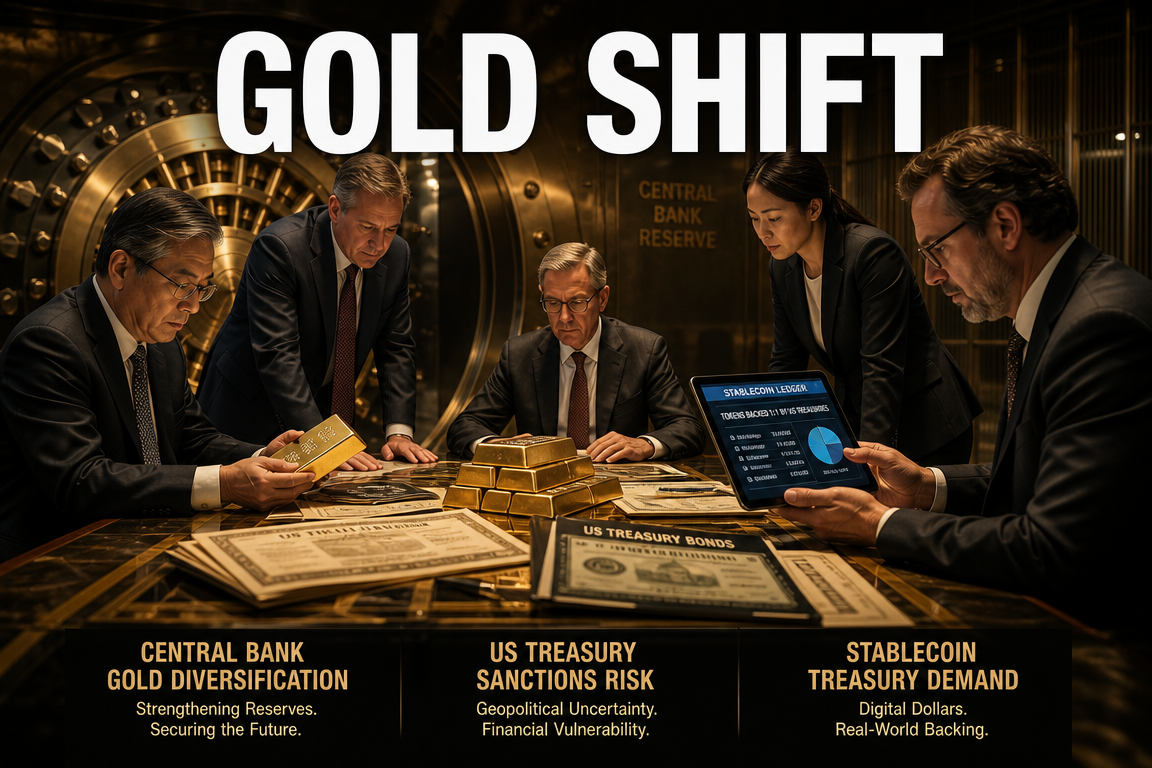
● Silent Capital Flight From US Assets
Why Investors Should Reassess Gold, U.S. Treasuries, the Dollar, and Crypto-Linked Equities as Capital Quietly Leaves the United States
The key issue here is not simply that “gold is rising” or that “U.S. Treasuries are becoming risky.”
The more important point is that major central banks and large pension funds have begun recalculating the custody risk of assets held in the United States.
Gold transfers by the Netherlands and France, discussions in Germany about repatriating gold, and reductions in U.S. Treasury exposure by Norway’s sovereign wealth fund and Dutch pension funds all point in the same direction.
The long-standing assumption that U.S. assets are always safe is gradually weakening, and in that gap, gold, dollar weakness, U.S. Treasury yields, crypto-linked equities, and global capital rotation are emerging as investment themes.
What is often overlooked in other coverage is this:
This is not a story about the United States collapsing. Rather, it reflects an inverse dynamic in which U.S. financial dominance has become so strong that other countries are trying to reduce dependence on it.
1. The Netherlands’ Transfer of 86 Tons of Gold: A Signal of Reassessed Trust, Not a Logistics Decision
The first development that drew market attention was the Dutch central bank’s gold transfer.
The bank moved part of its gold previously stored in the United States to London.
The original report cited a volume of approximately 86 tons, with the Dutch central bank describing the move as a precaution against geopolitical risk.
The key issue is that gold storage location is not a simple logistical matter.
Central bank gold reserves are the country’s ultimate backstop.
Whether that gold is held in the United States, London, or domestically ultimately comes down to whether it can actually be accessed in a crisis.
- The Netherlands reduced the share of gold stored in the United States and increased the share held in London.
- France was described as having effectively reduced its U.S.-stored gold to nearly zero.
- Germany continues to debate the repatriation of a large portion of its gold held in the United States.
On the surface, this may look like “storage diversification,” but from an investor’s perspective, it signals that confidence in a U.S.-centered financial order is no longer unconditional.
London has also become more attractive for practical reasons.
It is a global gold trading hub, offers deep liquidity, and is politically more accessible for Europe than the United States.
In that sense, this gold movement is both a reallocation of central bank reserves and an insurance measure against geopolitical risk.
2. Why Gold Is Being Moved Out of the United States Now: The Weaponization of Financial Sanctions
The main reason major countries are rethinking U.S.-held assets is that U.S. Treasury financial sanctions have become increasingly powerful.
Following the Russia-Ukraine war, the United States and its allies froze assets held by the Russian central bank and major Russian banks.
That episode sent a clear signal to policymakers worldwide.
It showed that “even if the money is yours, it may not remain yours if you conflict with the United States.”
Sanctions on Iran have also intensified.
The key point is not only sanctions against Iran, but the fact that financial institutions that transact with or support Iran can also become targets.
- Banks in third countries may be excluded from the dollar system because of Iran-related transactions.
- Asset freezes in the United States, trading restrictions, and payment network blocking are used as sanctions tools.
- Warfare is increasingly extending beyond weapons into accounts and payment infrastructure.
This is the weaponization of finance.
For the United States, it is a powerful foreign policy instrument. For other countries, it is a source of risk.
Even if they have no current conflict with the United States, they must consider the possibility that future tariff disputes, diplomatic tensions, or energy conflicts could trigger financial pressure.
That is why some European countries are quietly reducing gold holdings in the United States and exposure to U.S. Treasuries.
3. America First and Geopolitical Risk: The Issue Is Not Renaming, but Expanded Control
The original text also referenced Trump-era America First policies and efforts related to territorial or symbolic control.
Examples include disputes over the name of the Gulf of Mexico, U.S. interest in Greenland, statements about Canada as the 51st state, and remarks involving the Panama Canal and other major maritime chokepoints.
Some naming disputes may differ in legal effect and country-specific usage, so investors should focus less on political details and more on policy direction.
The broader trend is that the United States appears to be seeking greater influence over strategic hubs, shipping lanes, energy corridors, and Arctic resource regions.
This is not traditional warfare, but it represents a new form of pressure that combines economic security and geopolitical risk.
For Europe in particular, Greenland is a sensitive issue.
It is linked to Arctic shipping routes, rare earths, military access, and energy resources.
If the United States continues to show interest in the region, Europe will naturally ask whether it should continue placing strategic assets under U.S. custody.
4. Norway’s Sovereign Wealth Fund Reduces Bond Exposure: A Small Crack in U.S. Treasury Demand
The second major issue is the portfolio adjustment by Norway’s sovereign wealth fund.
It is one of the world’s largest sovereign wealth funds.
With significant influence across global equity and fixed income markets, it announced a bond allocation adjustment that the market interpreted as a reduction in U.S. Treasury exposure.
Officially, this is presented as a rebalancing decision.
However, when a major institution reduces U.S. Treasury exposure and shifts toward other bonds, corporate credit, or alternative assets, the market reads it differently.
It raises the question of whether the era in which U.S. Treasuries were bought indiscriminately as a global safe asset is beginning to change.
- The United States must continue issuing Treasuries to finance persistent fiscal deficits.
- If fewer large buyers absorb those Treasuries, upward pressure on yields increases.
- Higher long-term yields can weigh on equity valuations, real estate, and corporate funding costs.
The important point is not that the U.S. Treasury market is about to break down.
It remains the largest and most liquid bond market in the world.
But major foreign buyers are becoming more selective about U.S. Treasuries than before.
5. Dutch Pension Fund Reduces U.S. Treasury Holdings: Europe’s Quiet Decision to Scale Back Exposure
The original text also noted that one of Europe’s largest pension funds, the Dutch pension fund, reduced its U.S. Treasury holdings.
It reportedly held a substantial amount of U.S. Treasuries last year, but reduced that exposure significantly within a year.
Again, the official rationale is rebalancing.
Institutional investors rarely say openly that they are reducing exposure because of U.S. instability.
However, market participants and Wall Street interpret such moves as reductions in U.S. Treasury exposure.
There are three main reasons European capital is trimming U.S. Treasury positions.
- First, rate volatility. Rising fiscal deficits and growing Treasury issuance may destabilize long-term yields.
- Second, dollar weakness risk. A weaker dollar increases foreign investors’ currency losses.
- Third, political risk. Financial sanctions and tariff disputes are increasingly viewed as asset-holding risks.
This process unfolds quietly.
Large institutions avoid abrupt selling because it would create market disruption and diplomatic friction with the United States.
Instead, they gradually adjust allocations over time.
That is the more important signal for investors.
Capital flows, not headlines, move markets.
6. Ray Dalio’s Warning: Who Will Continue Buying U.S. Treasuries?
Ray Dalio has long warned about the U.S. fiscal deficit and Treasury demand.
The issue is straightforward.
The U.S. government must keep borrowing, but if there are fewer buyers for its debt, it must offer higher yields.
That raises interest expense, which can in turn widen the fiscal deficit, creating a feedback loop.
This structure is directly tied to rate expectations.
If demand for U.S. Treasuries weakens, upward pressure on long-term yields increases.
Higher long-term yields can be negative for growth stocks and technology shares.
By contrast, if confidence in the dollar weakens and fiscal concerns rise, gold and Bitcoin may attract interest as alternative assets.
That is why investors are increasingly debating whether the traditional 60/40 portfolio remains sufficient.
When equities and bonds no longer provide enough protection, asset allocation across gold, silver, cryptocurrencies, commodities, and cash-like assets becomes more important.
7. The First Beneficiaries: Why Gold and Silver Are Regaining Attention
The most direct beneficiary of this global capital shift is gold.
Gold is not a liability issued by any country.
It cannot be created by central banks at will.
As a result, it typically becomes a safe haven when dollar weakness and fiscal concerns rise.
From an investment perspective, four factors matter most for gold:
- Central bank buying: Not only emerging markets but also developed-market central banks are reviewing their gold strategies.
- Dollar weakness: A weaker dollar is supportive of gold prices.
- Geopolitical risk: War, sanctions, and tariff disputes tend to boost gold demand.
- Real rates: Since gold pays no yield, it becomes more attractive when real rates decline or stabilize.
Silver also deserves attention.
It combines precious metal characteristics with strong industrial demand.
It is tied to solar power, electric vehicles, semiconductors, and power infrastructure.
However, silver is much more volatile than gold.
For that reason, a gold-centered approach is more suitable for conservative positioning, while silver and related equities may be considered for more aggressive exposure.
8. The Second Beneficiaries: Cryptocurrencies and Related Equities Are Also Supported by Policy Dynamics
Cryptocurrencies are also part of this trend.
Bitcoin is widely framed as digital gold.
It is not issued by a sovereign government, and its supply is limited, which makes it attractive when confidence in the dollar weakens.
Volatility remains very high.
But the United States also cannot easily ignore the crypto market.
As the stablecoin market grows, stablecoin issuers must hold U.S. Treasuries as reserve assets.
In other words, a larger crypto ecosystem may actually generate additional Treasury demand.
This is a key point that is often missed in other coverage.
The United States may view crypto not merely as a speculative asset class, but as a digital mechanism for extending dollar dominance.
That is why regulatory easing and broader institutional integration continue to be discussed at the SEC, in Congress, and within the administration.
The related stocks mentioned in the original text are as follows:
- Robinhood: Potential upside from growth in equities, crypto trading, and prediction markets.
- Coinbase: The leading U.S. crypto exchange and a direct beneficiary of regulatory easing.
- Strategy: A company with large Bitcoin holdings and high sensitivity to Bitcoin prices.
- BitMine: A company highlighted for its Ethereum accumulation strategy.
However, crypto-related equities are highly volatile.
They should not be treated as defensive assets in the same way as gold.
They can move sharply on policy expectations, liquidity conditions, interest rates, Bitcoin prices, and regulatory developments.
For that reason, partial allocation is more practical than concentration.
9. Near-Term Catalysts: Liquidity, Treasury Buybacks, Crypto Legislation, and AI Infrastructure
There are also near-term events that investors should monitor.
The original text referred to a possible expansion of Treasury buybacks and liquidity support on September 9.
If the Treasury strengthens market-stabilization measures, long-term yields may stabilize temporarily and risk sentiment could improve.
In that scenario, gold, silver, cryptocurrencies, and growth equities could all react positively.
In addition, if crypto-related legislation or SEC-driven regulatory easing is announced in mid-September, crypto-linked equities could receive a policy tailwind.
AI infrastructure remains another major theme.
Data centers, power grids, memory semiconductors, high-bandwidth memory, and server demand continue to anchor market attention.
If AI infrastructure optimism returns, a short-term rebound in semiconductor and memory stocks may follow.
Markets do not move in a single direction.
One side is concerned about confidence in U.S. Treasuries and the dollar, while the other is being supported by AI investment and liquidity expectations.
For that reason, a diversified approach across AI growth stocks, gold, silver, cryptocurrencies, cash equivalents, and high-quality equities is more appropriate than concentration in a single asset.
10. The Real Core Issue: Not “Leaving the United States,” but Reducing Dependence on It
Interpreting this trend as a collapse of the United States would be excessive.
The United States remains the world’s largest economy, the dollar is still the reserve currency, and U.S. Treasuries remain the deepest bond market.
However, the previous model in which countries automatically placed assets in the United States, bought U.S. Treasuries, and relied exclusively on the dollar is gradually changing.
The key point is not de-Americanization, but reduced dependence on the United States.
Central banks are diversifying gold storage.
Pension funds are adjusting U.S. Treasury allocations.
Sovereign wealth funds are recalibrating their bond and alternative-asset exposure.
The United States is seeking to create new Treasury demand through crypto and stablecoins.
All of these dynamics are unfolding at once.
Investors should not view this only as a political story.
It is a global capital rotation that could reshape asset prices over the long term.
11. Investment Takeaway: Assets and Risks to Watch Now
| Category | Key Point | Investment View |
|---|---|---|
| Gold | Central bank buying, geopolitical risk, dollar weakness support | Core defensive allocation |
| Silver | Precious metal and industrial metal characteristics | More aggressive alternative to gold |
| U.S. Treasuries | Potentially softer foreign demand | Monitor long-term yield risk |
| Dollar | Concerns over fiscal deficits and liquidity expansion | Prepare for possible dollar weakness |
| Cryptocurrencies | Digital gold, policy support, and linkage to stablecoin-driven Treasury demand | High-volatility diversification candidate |
| AI Semiconductors | Ongoing data center and infrastructure investment | Monitor for growth-stock recovery |
The main risk is extreme interpretation.
It is not accurate to say that U.S. Treasuries are finished, nor that investors should buy only gold and Bitcoin.
This is not a period in which the existing order is collapsing. It is a period in which the cost of maintaining the existing order is rising.
The cost of holding U.S. assets, relying on the dollar, and placing gold in a single jurisdiction is being repriced.
Accordingly, investors should monitor rate outlooks, U.S. fiscal deficits, central bank gold purchases, crypto regulation, and AI infrastructure investment together.
< Summary >
Major central banks and large pension funds are quietly reducing their exposure to gold and U.S. Treasuries held in the United States.
The Dutch transfer of 86 tons of gold to London, France’s reduction of U.S.-stored gold, and Germany’s discussion of gold repatriation all reflect a reassessment of dependence on the U.S. financial system.
U.S. Treasury sanctions and asset-freeze practices have prompted countries to reconsider custody risk.
Reductions in U.S. Treasury exposure by Norway’s sovereign wealth fund and Dutch pension funds may add upward pressure to long-term U.S. yields.
Potential beneficiaries include gold, silver, cryptocurrencies, and selected crypto-related equities.
The appropriate framework is not a view of U.S. collapse, but rather one of reduced dependence on the United States.
A practical strategy is to include gold and alternative assets while also monitoring AI infrastructure and semiconductor growth stocks.
[Related Articles…]
*Source: [ 소수몽키 ]
– 조용히 미국에서 돈 빼기 시작한 주요국들, 거대한 자금 이동에 주목 받는 수혜주들
● Fed Shock, Inflation Fear, AI Boom, Liquidity Shift
“Interest Rate Hike Fear” Whipsawed Markets, but the Real Message Was the Opposite: Fed Remarks, Disinflation, AI Productivity, and Asset Allocation Strategy
The core issue here is not simply whether the Fed will raise or cut rates.
What matters is that remarks interpreted by the market as hawkish contained a larger message around rate-cut logic, disinflation, AI-driven productivity gains, and the expansion of the digital asset ecosystem.
The most important point is that the market focused on a different signal than the one relevant to policy direction.
On the surface, the message was that rates could remain restrictive if inflation persists. However, the underlying signals were more closely tied to real-time inflation data, anchored inflation expectations, productivity gains, and a change in liquidity management.
In other words, the market heard a warning about rate hikes, while the actual context was closer to strategic tightening communication designed to avoid derailing the cycle.
1. Why the Market Interpreted the Remarks as Hawkish
The market reaction was straightforward.
Recent U.S. labor data showed signs of softening, and prior payroll figures were revised down.
At the same time, CPI and PPI trends were more stable than expected, leading markets to assume that rate hikes were over and that rate-cut discussions could begin.
However, the Jackson Hole remarks did not provide the clear dovish signal markets were hoping for.
“If inflation remains elevated, policy can stay tight.”
“Further rate hikes cannot be ruled out.”
“Forward guidance will be reduced.”
These comments immediately pressured U.S. equities and bonds.
-
The market had been building expectations for rate cuts based on softer labor data and stable inflation.
-
The Fed remarks did not provide a clear easing signal.
-
As a result, the market interpreted the comments as leaving open the possibility of renewed rate hikes.
-
The more accurate reading is that the market took the remarks too literally.
A key point is that a central bank president cannot freely state a personal view that diverges from broader committee sentiment.
If policy-making sentiment leans in one direction, even a more dovish individual may have to reflect that balance publicly.
Accordingly, remarks that sounded hawkish may have been intended as strategic communication to anchor inflation expectations.
2. What Looked Like Hawkish Communication Was Largely a Principle-Based Message
The repeated emphasis in the remarks was on principles rather than decisions.
The market wanted a direct answer on whether rates would be raised or lowered.
Instead, the message was closer to: “I am not here to announce a rate decision.”
That distinction matters.
The Fed’s core mandate is price stability.
More important than current inflation readings is the control of inflation expectations.
If expected inflation remains anchored in the mid-2% range, the case for additional tightening is weaker than before.
At the same time, the Fed remains concerned that markets may ease financial conditions too quickly.
-
Surface message: If inflation remains elevated, further rate hikes remain possible.
-
Underlying message: Maintain discipline to keep inflation expectations anchored.
-
Market reaction: Interpreted the remarks as a rate-hike warning.
-
Policy reading: The intention is not to tighten to the point of breaking the cycle.
From this perspective, hawkish communication and hawkish policy should not be conflated.
Language can be firm even when policy action remains data-dependent and flexible.
3. The Key Data Point Is Not CPI Alone, but Real-Time Inflation and Trimmed Mean Measures
One of the most important points in the discussion is the way inflation is being assessed.
Markets typically focus on official CPI, PPI, and PCE data.
However, these releases arrive with a lag.
For example, data observed by markets in September often reflects July or August conditions.
Policymakers need to assess the current economy, while markets often react to delayed data.
That is why real-time data has become more important.
Examples include private real-time inflation measures such as Truflation.
These models use AI-based data collection across online prices, housing, services, and healthcare to provide a daily view of inflation trends.
According to the discussion, these indicators have shown materially lower inflation than official data.
-
Official CPI and PPI remain important, but they are lagging indicators.
-
Real-time inflation data can capture disinflation trends earlier.
-
Trimmed Mean measures, which remove extreme values, are useful for identifying underlying inflation.
-
The reference to roughly 190 price categories appears to be an indirect way of describing a Trimmed Mean approach.
The implication is clear.
If real-time data and underlying inflation measures are both declining, the rationale for additional rate hikes weakens materially.
That supports the case for rate cuts rather than renewed tightening.
4. Disinflation May Still Be Ongoing Rather Than Finished
The discussion emphasized that U.S. inflation should be viewed as a long-term trend.
Inflation peaked in June 2022 and has since declined significantly.
There have been intermittent rebounds, driven by geopolitical risk, energy prices, and temporary service-sector firmness.
However, the broader trend remains one of disinflation.
The key is that inflation does not fall in a straight line.
Disinflation tends to unfold in steps.
Prices fall, then rebound, then resume a lower trend.
Markets often react to short-term rebounds as if they represent a structural reversal, but policy makers focus on the trend.
-
Since mid-2022, U.S. inflation has been trending lower in the broader sense.
-
Recent rebounds do not by themselves confirm a renewed inflation cycle.
-
If real-time indicators continue to weaken, upcoming CPI and PPI releases may confirm further stabilization.
-
That would reduce rate-hike expectations and revive rate-cut expectations.
The key catalysts remain the next CPI, PPI, and PCE releases.
If inflation stabilization is confirmed, market anxiety could ease quickly.
5. Why Reducing Forward Guidance Matters
Another important point was the intention to reduce forward guidance.
Forward guidance is the practice of signaling future policy moves to markets in advance.
It became widely used after the 2008 financial crisis under Ben Bernanke and played a major role in sustaining a prolonged low-rate environment.
However, the approach now faces limitations.
The economy is changing too quickly, with AI, digital assets, global supply-chain shifts, and fiscal changes making long-dated policy promises less practical.
-
Forward guidance supports market stability.
-
But in a rapidly changing economy, it can reduce policy flexibility.
-
Reducing guidance may increase volatility.
-
It also gives policymakers more room to respond to incoming data.
This is highly relevant for investors.
The Fed may be less willing to provide detailed guidance going forward.
As a result, investors will need to interpret CPI, PPI, payrolls, real-time inflation, and liquidity conditions more directly.
6. The Real Internal Fed Tension May Be Less About Hawk vs. Dove and More About Political Independence
One of the more important interpretations is that the Fed’s internal dynamic cannot be reduced to a simple hawk-versus-dove framework.
Some officials may sound hawkish not only because of the data, but also to protect central bank independence from political pressure for easier policy.
Central bank independence is a sensitive issue.
If markets conclude that rate cuts are being driven by political pressure rather than data, the Fed’s credibility could be damaged.
For that reason, officials may speak more firmly than their actual policy intent would suggest.
If cuts are eventually delivered, the justification must be data-driven rather than politically motivated.
-
The Fed must preserve its independence.
-
Stronger rhetoric can be used when political pressure for easier policy is high.
-
This can make remarks sound hawkish even if policy remains data-dependent.
-
Investors should distinguish political context from economic data.
The important question is not just whether the Fed sounded hawkish.
It is why such language was necessary in the first place.
7. AI Productivity Is Reshaping the U.S. Economic Outlook
AI productivity was another major theme.
In traditional economics, the main inputs are labor, land, and capital.
AI is increasingly functioning as a fourth productive input.
It is changing cost structures, productivity, decision-making speed, software development, and industrial automation.
This also changes the policy backdrop.
If AI raises productivity materially, stronger growth may no longer translate into the same level of inflation pressure.
In other words, the economy may grow without creating the same degree of price inflation seen in prior cycles.
-
AI can reduce corporate operating costs.
-
AI can ease labor shortages.
-
AI can improve productivity in both services and manufacturing.
-
Higher productivity can create a structural disinflationary force.
This is one of the most important changes in the U.S. outlook.
The key issue is no longer simply whether rates are high or low, but whether AI is changing the relationship between growth and inflation.
8. Digital Assets, Stablecoins, and Blockchain Are Becoming Relevant to Monetary Policy
The discussion also highlighted digital assets and stablecoins.
This is not just a crypto market story.
The digital asset ecosystem is linked to payments, remittances, liquidity, Treasury demand, and financial infrastructure.
Stablecoins, in particular, may increase demand for short-dated U.S. Treasuries.
If stablecoin issuers hold Treasuries as reserve assets, the expansion of the digital financial ecosystem could affect Treasury demand and liquidity conditions.
That would change the way monetary and fiscal policy interact over time.
-
Stablecoins may become a core part of digital payments infrastructure.
-
They can create demand for short-term U.S. Treasury securities.
-
Blockchain infrastructure can lower transaction costs.
-
AI agents, humanoid robots, and on-chain payment systems may form a new productivity cycle.
From this perspective, digital assets should be viewed as part of the broader productivity infrastructure rather than only as a speculative asset class.
Volatility remains high.
But over time, the sector may become more relevant to rates, Treasury markets, liquidity, and the AI economy.
9. The More Important Issue Than QT Is Whether Actual Liquidity Is Declining
Markets often treat balance-sheet reduction as synonymous with liquidity tightening.
However, the discussion suggested a more nuanced view.
Balance-sheet reduction does not necessarily mean actual market liquidity is falling.
For example, if the Treasury issues large amounts of short-term debt and the market or specific institutions absorb it while liquidity remains functional, financial conditions may not tighten as much as the label suggests.
Some comparisons were drawn to the interaction between the Treasury and the Fed in earlier periods, when policy coordination mattered more than the headline category of tightening or easing.
-
The term QT matters less than actual liquidity trends.
-
Short-term Treasury issuance, money market funds, reserve balances, and reverse repo balances all need to be monitored together.
-
Conditions can appear tight while actual liquidity remains adequate.
-
Asset markets should focus more on liquidity data than on policy language alone.
This is one of the least discussed but most important points.
Even if the Fed uses restrictive language, risk assets can recover if the underlying money flow does not contract materially.
10. U.S. Equity Strategy: From Big Tech Concentration to Sector Rotation
The investment takeaway is not that risk exposure must be cut aggressively.
Rather, the market may no longer be a simple buy-Big-Tech environment.
Last year, Big Tech was the central driver.
This year, memory semiconductors led for part of the cycle.
Looking ahead, AI productivity benefits may spread across a wider range of industries.
-
Last year, the key theme was Big Tech.
-
In the first half of this year, memory semiconductors were central.
-
AI productivity gains may broaden across additional sectors.
-
Sector rotation could accelerate.
For U.S. and global equities, investors may need to look beyond large-cap Nasdaq names.
Potential beneficiaries include AI infrastructure, semiconductors, power equipment, data centers, industrial automation, robotics, financial infrastructure, and blockchain payments.
11. Has the Memory Semiconductor Cycle Peaked? It May Still Be a Structural Pillar of the AI Ecosystem
The discussion also addressed companies such as Samsung Electronics and SK Hynix.
As markets began to worry that the memory cycle could weaken next year, share prices became volatile.
However, the view presented was that these concerns may be overstated.
AI agents, stablecoin infrastructure, blockchain systems, and humanoid robotics all require storage and compute infrastructure.
Memory semiconductors sit at the center of that demand.
Demand could extend beyond HBM into server DRAM, high-performance NAND, and on-device AI memory.
-
AI adoption can structurally increase memory demand.
-
Humanoid robots and AI agents may further increase memory usage.
-
Blockchain and digital finance also create data-processing demand.
-
Even with short-term corrections, the medium-term strategic role of memory may remain intact.
That said, valuation discipline still matters.
Even strong sectors should not be bought indiscriminately.
As a cyclical industry, memory must be analyzed through inventory, pricing, capex, and end-demand trends.
12. Leverage Risk: Even Good Ideas Can Fail When Position Sizing Is Excessive
A key investment lesson from the discussion was leverage.
Even when an investor is correct on the underlying thesis, excessive leverage can turn a temporary move into a damaging loss.
Large investors and hedge funds can also become vulnerable if leverage is too high.
-
Good ideas and good risk management are different things.
-
Even correct calls can fail if leverage is excessive.
-
In volatile markets, cash allocation and loss control matter more.
-
That is especially true in themes such as AI, semiconductors, and digital assets.
This environment offers opportunities, but volatility remains elevated.
A disciplined approach focused on productivity beneficiaries, with limited leverage, is more practical.
13. The Most Important Point Rarely Emphasized in Other Media
The main takeaway is not simply whether the Fed is hawkish or dovish.
The real issue is that investors must separate Fed rhetoric, actual liquidity conditions, inflation data, and the productivity cycle.
-
First, hawkish language does not necessarily imply hawkish policy.
-
Second, real-time inflation data can turn before official CPI releases.
-
Third, AI productivity may support growth while limiting inflation.
-
Fourth, stablecoins and short-term Treasury demand could become major liquidity variables.
-
Fifth, market leadership may broaden beyond Big Tech into productivity-linked sectors.
Many reports reduce the story to “rate-hike fears hit markets.”
But the more important questions are different.
Is inflation actually declining?
Is the Fed truly tightening liquidity?
How far is AI spreading earnings growth across industries?
Where is capital rotating after Big Tech?
Those are the questions that matter for the next stage of the market.
14. Key Indicators to Watch
-
CPI: Focus on core CPI and services inflation, not just the headline figure.
-
PPI: Track whether corporate input cost pressure is easing.
-
PCE: The Fed’s preferred inflation measure and a direct input into policy decisions.
-
Labor data: New payrolls, unemployment, wage growth, and revisions to prior data.
-
Inflation expectations: A key variable for the Fed.
-
Real-time inflation data: A faster read on current price trends than official releases.
-
Liquidity indicators: Reverse repo, reserve balances, short-term Treasury issuance, and dollar liquidity.
-
AI investment cycle: Big Tech capex, semiconductor demand, and data-center power demand.
15. Investment Conclusion
The market is reacting too strongly to individual Fed remarks.
Investment decisions should instead be based on the broader data set.
U.S. rate direction will ultimately be determined by inflation and labor data.
If inflation stabilization is confirmed, rate-cut expectations can recover.
At the same time, the AI productivity cycle appears to remain intact.
The market may move beyond a narrow concentration in Big Tech.
Potential flows could extend into memory semiconductors, power infrastructure, robotics, automation, digital asset infrastructure, and stablecoin-related systems.
For investors, the current environment may be better approached as one in which data and liquidity need to be monitored closely while preparing for sector rotation.
Leverage should remain limited.
Even strong cycles do not protect against excessive risk-taking.
< Summary >
The market interpreted the Fed remarks as a signal of potential rate hikes, but the underlying message was closer to principle-based communication aimed at anchoring inflation expectations.
Real-time inflation measures and underlying inflation trends are becoming more important than CPI and PPI alone.
If disinflation is confirmed, rate-hike fears should ease and rate-cut expectations may return.
AI productivity remains a key variable for growth and corporate earnings.
Stablecoins, digital assets, and short-term Treasury demand may become relevant to future liquidity conditions.
Investment strategy should move from concentrated Big Tech exposure toward a broader set of AI productivity beneficiaries.
Memory semiconductors may remain a core part of the AI infrastructure cycle despite short-term volatility.
The most important risk management constraint is limiting leverage.
[Related Articles…]
*Source: [ 경제 읽어주는 남자(김광석TV) ]
– “금리인상 겁먹은 시장이 틀렸습니다?” 케빈 워시 발언의 진짜 의미는 정반대였다 | 경읽남과 토론합시다 | 3자토론 문홍철x성상현x김광석 [5편]