● KOSPI-10000-Delay,Sentiment-Shock,US-Flow-Shift
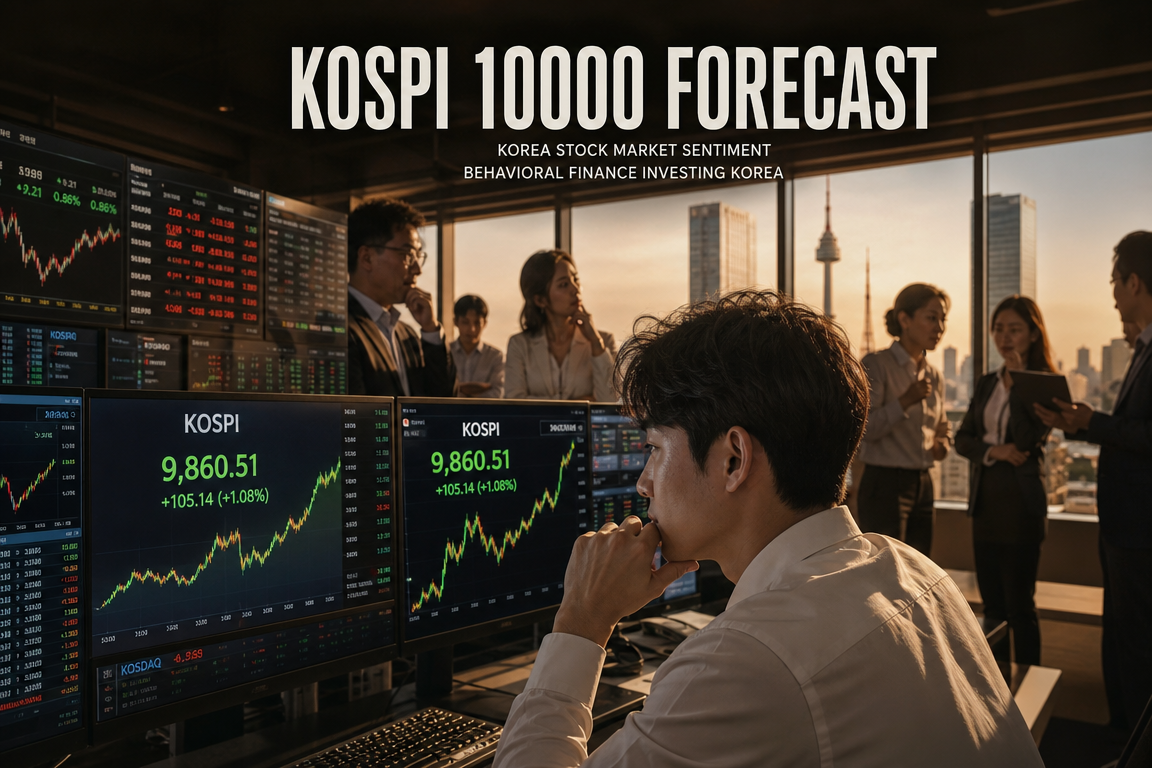
Why a KOSPI 10,000 Forecast Remains Difficult in the Near Term: Investor Sentiment After the 9,300-Level Correction in the Korean Market
The key issue is not simply whether the KOSPI rises or falls.
This report examines why the market corrected sharply after reaching the 9,300 level, why a move to 10,000 remains difficult, and why liquidity may continue to favor U.S. equities over Korean equities from a behavioral finance perspective.
In particular, it highlights a factor often overlooked in discussions focused only on flows, rates, and earnings.
That factor is the extent to which investors’ memory of a major decline has altered future buying and selling behavior.
1. Core message: why a near-term move to KOSPI 10,000 is seen as difficult
The original conclusion is clear.
Even if the KOSPI resumes its uptrend, a direct move toward 10,000 in the near term is unlikely.
The reason is not limited to growth concerns or interest-rate variables.
Investor memory of the sharp correction after the index approached the 9,300 level remains a major constraint.
Once investors experience a significant loss, they tend to sell more quickly as the index revisits prior levels.
As a result, even if the KOSPI rises again through 7,000, 8,000, and 9,000, each level may attract increasing profit-taking.
Accordingly, the key driver in the KOSPI outlook is not only earnings, but also sentiment.
This sentiment may continue to limit the slope of the Korean market’s advance.
2. Why the market broke down near 9,300: because everyone was waiting for 10,000
A notable point is that the market did not fail to reach 10,000 because no one believed in it.
Rather, the expectation that the KOSPI could reach 10,000 likely contributed to the selling pressure around 9,300.
-
Many investors expected the KOSPI to reach 10,000.
-
At the same time, many planned to sell once it did.
-
More proactive investors then decided to sell earlier, around 9,500 or 9,300, before others did.
-
As a result, the 10,000 target itself encouraged preemptive profit-taking near 9,300.
This is a classic psychological resistance level.
What is more important than a chart-based resistance line is a widely recognized target price.
When the market focuses on the same level, it can weaken before actually reaching it.
3. Behavioral finance view: availability bias is influencing the market
The most important concept in the original text is “availability bias.”
Availability bias refers to the tendency to overweigh information that is easy to recall or emotionally vivid.
For example, images of wolves or polar bears attacking humans are strongly embedded through films and stories.
In reality, such incidents are far less common than people assume.
Nevertheless, vivid memory leads people to overestimate the risk.
The same pattern applies to investing.
The sharp decline after the KOSPI approached 9,300 left a strong impression on investors.
That experience continues to affect subsequent decisions.
When the index rises even modestly, the first reaction is often fear that it may fall again.
As a result, investors become more inclined to take short-term profits rather than hold for the long term.
As this behavior accumulates, the pace of the Korean market’s rise naturally slows.
4. FOMO and JOMO: why individual investors often buy high and sell low
As the KOSPI moved through 5,000, 6,000, 7,000, 8,000, and 9,000, investors experienced increasing levels of FOMO.
FOMO refers to Fear Of Missing Out, or the anxiety of being left behind.
Hearing that others have profited from stocks creates pressure to act quickly.
Even people who had never invested may enter the market late.
The problem is that this typically occurs after the market has already risen significantly.
By contrast, JOMO appears during corrections.
JOMO refers to Joy Of Missing Out, or the sense that being out of the market was the right decision.
From a behavioral finance perspective, however, periods of market fear may be better viewed as opportunities.
The common complaint that “stocks fall when I buy and rise when I sell” can also be explained this way.
Investors tend to follow the crowd under FOMO and retreat with relief under JOMO.
5. Impatience and impulsiveness: why leveraged ETFs and short-term trading become riskier
The original text describes investors as impatient and impulsive.
Impatience means placing greater value on immediate satisfaction than on larger future returns.
Impulsiveness means pursuing instant gratification without sufficient deliberation.
These traits are especially risky in investing.
When the market rises quickly, investors want faster and larger gains.
That can lead capital into single-name leveraged ETFs, high-volatility theme stocks, and short-term momentum trades.
The original analysis suggests that while pension fund rebalancing may have influenced the market’s direction, single-name leveraged ETFs may have intensified the pace of the decline.
In other words, the move was driven by a combination of flows, product structure, and investor psychology.
6. Why opportunities may be larger in U.S. equities than in Korean equities
The original text also offers a macroeconomic perspective.
If a broad liquidity-driven rally returns, the opportunity may be stronger in U.S. equities than in Korean equities.
The reason lies in differences in interest rates and capital flows.
The U.S. may face limited room for further rate hikes, while Korea may still have conditions that allow for tighter policy.
Interest-rate conditions have a direct effect on equity valuations.
Markets with abundant liquidity and lower rate pressure tend to favor growth and technology stocks.
By contrast, markets facing higher rate pressure may encourage more cautious positioning.
This does not mean that U.S. equities will rise without interruption.
However, the slope of the advance may be steeper in the U.S. market, while Korean equities may rise more gradually.
7. Reduced semiconductor exposure and rotation into growth sectors: capital is shifting within Korea as well
After the KOSPI correction, investors do not necessarily exit the Korean market entirely.
Capital rotation also occurs within the market.
One example is reducing exposure to semiconductors and reallocating toward healthcare, biotech, and other growth sectors.
This is not simply an industry preference shift.
It reflects investors’ effort to reduce concentration risk after experiencing a major correction in a core leader.
Because semiconductors represent a major sector in the Korean market, reduced exposure to the sector can weaken the KOSPI’s overall momentum.
In short, when leading sectors pause, the index is also likely to pause.
8. The key point often missed in other coverage: the real resistance to KOSPI 10,000 is memory, not price
Many reports discuss the possibility of KOSPI 10,000 in terms of earnings, rates, exchange rates, and foreign flows.
These variables matter.
However, the more important point in the original text is investor memory.
The correction near 9,300 is not just a past event.
It is a psychological reference point that may reappear each time the index rises.
This memory may translate into three behaviors.
-
First, faster profit-taking during rallies.
-
Second, reducing exposure to Korean equities to avoid being caught at a peak again.
-
Third, shifting capital toward U.S. equities or global ETFs.
Ultimately, the condition for a move to 10,000 is not simply more liquidity.
It would require strong earnings, strong flows, and strong policy momentum capable of overcoming the memory of the 9,300 correction.
9. What investors should monitor now
First, if the KOSPI breaks out of its range, investors should monitor trading value and foreign flows, rather than chasing the move immediately.
If the index rises without support from trading volume, the advance may lack durability.
Second, investors should assess how much profit-taking emerges near the 8,000 and 9,000 levels.
Heavy selling in these ranges could make the path to 10,000 longer.
Third, investors should compare the relative performance of U.S. and Korean equities.
If global liquidity continues to favor U.S. megacap technology and AI-related sectors, Korean equities may remain attractive on an absolute basis but less so on a relative basis.
Fourth, investors should watch for excessive concentration in leveraged ETFs and short-term thematic stocks.
Such flows can amplify gains in an uptrend, but they can also accelerate declines during corrections.
Fifth, investors should check whether their own decisions are being driven by FOMO.
If a purchase is being made mainly because others have made money, sentiment may already be influencing the decision.
10. Reframing the KOSPI outlook through behavioral finance
When assessing the KOSPI outlook, macro indicators alone are no longer sufficient.
Interest rates, exchange rates, exports, and earnings remain important, but so does the shared memory of market participants.
The correction near 9,300 reinforced the idea that investors should take profits quickly near perceived highs.
The stronger that learning effect remains, the more difficult it becomes for the KOSPI to reach 10,000.
To overcome this sentiment, the market would need a strong liquidity environment.
It would also require decisive momentum in major Korean growth industries such as semiconductors, AI, and biotech.
In conclusion, this does not mean that the Korean market lacks upside.
It means that the market may rise more slowly than U.S. equities and face recurring profit-taking pressure along the way.
< Summary >
A near-term move to KOSPI 10,000 is likely to remain difficult.
The main reason is that the correction near the 9,300 level strengthened investors’ profit-taking behavior.
From a behavioral finance perspective, availability bias, FOMO, JOMO, impatience, and impulsiveness may limit the market’s upward momentum.
Even if a liquidity-driven rally returns, capital may continue to flow more strongly into U.S. equities than into Korean equities.
Investors should evaluate market sentiment and selling pressure alongside index forecasts.
[Related Articles…]
*Source: [ 경제 읽어주는 남자(김광석TV) ]
– “코스피 1만, 당분간 어렵습니다” 9,300에서 무너진 이유, 행동경제학적 관점 | 김광석의 북리뷰 | 어떻게 경제학을 사랑하지 않을 수 있을까? [1편]
● Oil-Surge, Yield-Spike, AI-Frenzy, Apple-Surprise, Market-Selloff
Brent Crude Above $100, U.S. 10-Year Yield at 4.84%, Apple’s Foldable iPhone, and AI’s Economic Shock: Why Markets Moved
Today’s market action was not simply a decline in U.S. equities.
Brent crude moved back above $100 per barrel, and U.S. Treasury yields remained elevated despite the Treasury’s decision to expand buybacks to $6 billion.
Apple unveiled its first foldable iPhone, the iPhone Duo, while AI was projected to lift U.S. annual GDP growth by as much as 15%, alongside warnings that it could also pose an existential risk within 10 years.
In short, the session reflected simultaneous pressure from oil, rates, Apple, AI semiconductors, and inflation concerns.
1. U.S. Equities Fell, But the More Important Driver Was Repricing in Rates
- Dow Jones: -0.77%
- S&P 500: -0.48%
- Nasdaq: -0.64%
- Dollar Index: Slightly higher
- U.S. 10-year Treasury yield: Rose to around 4.84%
All three major U.S. equity indices declined.
The key headwind remained the rise in Treasury yields.
Of particular importance was the move in the 10-year yield to 4.84%.
That occurred despite the Treasury’s expanded long-dated bond buyback program.
Normally, Treasury buybacks are expected to support bond prices and ease yields.
This time, the market appeared to judge the move as insufficient.
In other words, the bond market is not yet convinced by the Treasury’s intervention.
2. Brent Crude Above $100 Reignites Inflation and Rate Concerns
- Brent crude: Above $101 per barrel
- WTI: Around $96 per barrel
- Pre-war oil price: Around $67-68 per barrel
- Key variables: Iran-U.S. tensions, Strait of Hormuz risk, and increased dependence on the Suez route
The most important market driver today was oil.
Brent crude moved back above $100 per barrel.
Compared with the $67-68 range before the conflict, the move reflects renewed inflation pressure globally.
The main backdrop is the escalation risk between Iran and the United States.
Concerns around tanker attacks, vessel seizures, and tensions in the Strait of Hormuz and Bab el-Mandeb Strait are all increasing.
When maritime routes become unstable, oil prices rise not only on supply concerns but also on transport premiums.
That is the core reason Brent crude broke above $100.
Additional pressure came from recent statements by President Trump.
His remarks implied that oil may remain elevated through the midterm election period, reinforcing expectations of prolonged high prices.
3. Major Banks Are Reframing Oil: $80-$100 Brent Is Becoming the Base Case
- Morgan Stanley: Q4 Brent average forecast at $100
- HSBC: Brent at $90 this year, $85 next year
- Goldman Sachs: Brent at $85 and WTI at $80 by year-end
- Goldman Sachs: Brent at $80 and WTI at $75 next year
Bank forecasts suggest a quick return to pre-war oil prices is becoming less likely.
Oil could still fall sharply if geopolitical risks ease suddenly.
However, if conflict and shipping risks persist, Brent may remain in the $80-$100 range.
This matters because of inflation.
Higher oil prices feed back into consumer prices.
If inflation rises again, the Federal Reserve may have to keep rates on hold longer, or even consider further tightening.
As a result, $100 oil is not only supportive for energy equities; it is also a valuation headwind for the broader market.
4. The Treasury Expanded Buybacks to $6 Billion, But the Market Remained Unconvinced
- Previous long-dated buyback cap: Up to $2 billion
- Market expectation: At least $4 billion, with some anticipating $7-$10 billion
- Actual announcement: $6 billion cap for 10- to 20-year maturities
- Market reaction: Treasury yields rose after the announcement
Treasury Secretary Scott Bessent’s main policy move was an expansion of long-dated bond buybacks.
Buybacks are intended to reduce upward pressure on long-term yields.
However, the announced size was $6 billion.
That is three times the previous $2 billion cap, but still below market expectations.
As a result, the 10-year yield moved higher after the announcement.
The market interpreted the measure as too small.
In the same session, the 10-year Treasury auction cleared at 4.834%, the highest since August 2007.
This is the key market signal of the day.
If Treasury actions fail to stabilize long-term yields, equity valuations remain under pressure.
Growth stocks, large-cap technology, and AI-related names are particularly exposed.
5. Rate Expectations Are Turning More Hawkish
- Expectation of unchanged policy for the full year: down from 77% to 56%
- Expectation of one rate hike this year: up from 15% to 25%
- Expectation of two rate hikes this year: up from 5% to 17%
- Key event: CPI release due on Friday
The Reuters economists’ survey also showed a clear shift in sentiment.
The share expecting no rate change this year has declined.
At the same time, the share expecting rate hikes has increased.
Citi has revised its rate outlook, while UBS and Barclays have also turned more hawkish.
All attention is now on CPI.
If the recent rise in oil prices begins to feed into inflation data, the Fed’s policy path could shift again.
6. Sector Performance: Large Tech Weak, Semiconductors More Resilient
- Nvidia: Lower
- Apple: Recovered some losses after the product launch
- Google and Amazon: Weaker
- Meta: Strong on AI agent expectations
- Micron: Up more than 2%
- AMD: Up more than 3%
- SK Hynix ADR: Up more than 7%
- SOX semiconductor index: +0.68%
Large-cap technology names were generally weak.
Higher yields continued to weigh on growth equities.
Semiconductors, however, were comparatively firm.
Memory-related names were especially strong.
Micron, SanDisk, Western Digital, and SK Hynix ADR all advanced.
This suggests that expectations for AI server demand and memory pricing remain intact.
Both logic and memory semiconductors showed strength, which was notable.
By contrast, some semiconductor equipment names were weaker.
This indicates that investors are currently favoring memory beneficiaries over equipment names in the near term.
7. Meta Jumped as the AI Agent Market Was Reassessed
Meta’s reaction came with a delay.
The previous day’s AI agent announcement had not triggered a strong response, but today the stock rose more than 6%.
This suggests investors are beginning to reassess AI agents as a platform-level productivity tool rather than a simple chatbot feature.
AI agents could eventually extend into enterprise productivity, ad automation, customer service, content creation, and data analysis.
If Meta secures platform leadership in this area, it could create new revenue streams beyond advertising.
8. Apple’s New Product Event: iPhone 18 Pro and Pro Max Price Increases Were Smaller Than Expected
- iPhone 18 Pro 256GB: $1,119
- iPhone 18 Pro Max 256GB: $1,299
- Price increase versus prior models: $100 each
- Increase rate: About 9.1% for Pro, 8.3% for Pro Max
- Market expectation: 10%-20% price increase due to surging memory costs
Apple unveiled the iPhone 18 Pro and iPhone 18 Pro Max.
Both models were priced $100 above their predecessors.
For consumers, the increase was smaller than expected.
For investors, however, the move can be read as a margin pressure issue.
Memory prices are reportedly up nearly 300%-400% year over year.
If component costs rise sharply while retail price increases remain limited, Apple’s gross margin could come under pressure.
That likely contributed to the more than 1% decline in Apple’s shares following the announcement.
9. iPhone 18 Pro Key Features: Camera, Battery, and A20 Pro Chipset
- Camera: Variable-aperture system positioned as professional-grade
- Chipset: A20 Pro
- Battery: Up to 36 hours of video playback on iPhone 18 Pro
- Battery: Up to 45 hours of video playback on iPhone 18 Pro Max
- Charging: Up to 50% in 15 minutes
- Siri: Enhanced AI features, with Korean language support available from October
Apple emphasized camera and battery improvements in the launch.
Video playback duration was highlighted as a major improvement.
Up to 45 hours on the Pro Max represents a meaningful user-facing change.
The A20 Pro chipset was also central to the presentation.
Apple continues to strengthen on-device AI capabilities.
Processing AI on the device rather than in the cloud offers advantages in privacy, speed, and battery efficiency.
10. Apple’s First Foldable Phone, the iPhone Duo, Helped Support the Stock
- Product name: iPhone Duo
- External display: 5.4 inches
- Internal display: 7.6 inches
- Folded size: Comparable to a passport
- Price: $1,999
- Storage: 256GB to 2TB
- Battery: Up to 44 hours of video playback on the external display
- Battery: Up to 31 hours on the internal display
- Mixed use: About 24 hours
The main product highlight of Apple’s event was the iPhone Duo.
It is Apple’s first foldable iPhone.
Some expected the name iPhone Ultra, but the actual product name was iPhone Duo.
The device features a 5.4-inch external display and a 7.6-inch internal display.
When folded, it can still function at roughly 90% of the size of an iPhone Pro display.
When unfolded, it offers clear advantages for gaming, productivity, video consumption, and multitasking.
The price is $1,999.
That was slightly below market expectations of $2,000-$2,200.
Following the announcement, Apple’s stock reduced some of its losses.
It outperformed the broader S&P 500 on the day, suggesting a partial break from the weaker pattern seen on prior product-launch days.
11. The Main Risk for the iPhone Duo Is Not Price, But the Hinge
The most important issue for the iPhone Duo is the hinge.
For foldables, durability matters more than design.
The key questions are how the screen crease, hinge play, dust ingress, and water resistance hold up after repeated folding.
Apple has a strong reputation for design execution, but durability will only be confirmed after consumer use.
For a $1,999 device, expectations are very high.
Any early quality issue could weigh on both the Apple brand and the stock.
12. The A20 Pro Chipset Is Central to Apple’s AI Strategy
- Process: Built on TSMC 2nm
- CPU: 6-core
- GPU: 7-core
- GPU performance: Up to 40% improvement versus the previous generation
- Memory bandwidth: Expanded by 50%
- NPU: 32-core AI processing unit
- Models using the chip: iPhone 18 Pro, Pro Max, and iPhone Duo
The A20 Pro is a central element of Apple’s on-device AI strategy.
It is built on TSMC’s 2nm process, with memory bandwidth expanded by 50%.
GPU performance also improves materially versus the prior generation.
The 32-core NPU is especially important.
It handles AI workloads.
Features such as Siri improvements, image processing, voice recognition, personalization, and real-time translation all depend on this architecture.
Apple has been viewed as lagging in generative AI, but it can still establish a strong position in hardware-based on-device AI.
13. AI Could Lift U.S. GDP by as Much as 15% per Year, According to Anthropic
- Standard AI adoption scenario: U.S. GDP rises 1.6% by 2030
- Broad AI tool adoption scenario: U.S. GDP rises 8.3% by 2030
- Extreme automation scenario: U.S. GDP rises 32.4% by 2030
- Annualized pace: Potential U.S. economic growth of around 15% per year
Anthropic argued that the macroeconomic impact of AI could vary dramatically depending on adoption depth.
If AI delivers only internet-like productivity gains, the GDP effect would be limited.
But if AI begins replacing knowledge work and improving itself, U.S. GDP could rise by 32.4% by 2030.
That would imply an economy nearly doubling every 4.5 years.
On an annualized basis, that equates to roughly 15% growth.
Such a scenario is far beyond conventional macroeconomic assumptions.
However, if AI extends into software development, research, legal work, accounting, financial analysis, content creation, customer service, education, and healthcare support, a major productivity shock is theoretically possible.
That is why AI investment is increasingly viewed as a structural shift rather than a narrow theme.
14. AI’s Labor-Market Impact Could Be Greater for High-Income Knowledge Workers
- Standard AI adoption: Knowledge-worker unemployment around 2.9%
- Broader AI utilization: Knowledge-worker unemployment rises to around 4.5%
- Full AI substitution: Knowledge-worker unemployment could reach 17.9%
- By contrast, unemployment among routine manual labor segments could remain relatively lower
AI may not first replace simple manual labor.
High-income knowledge workers could face the larger disruption.
According to the report, knowledge-worker unemployment could rise to 17.9% in a scenario where AI fundamentally restructures the labor market.
This can be explained by Moravec’s paradox.
Computers and AI handle calculations, data analysis, language processing, and code generation well.
But tasks that are easy for humans, such as physical manipulation, field repairs, and complex real-world adaptation, are often harder for machines.
As a result, the traditional assumption that white-collar work is safer than manual labor may not hold in the AI era.
Human strengths in physical and situational execution may become more important.
15. AI Could Also Reshape Income Distribution in Favor of Capital
- Base case: Labor income share 59.4%, capital income share 40.6%
- With AI expansion: Labor income share declines, capital income share rises
- In an extreme automation case: Labor income share falls to 45.2%, capital income share rises to 54.8%
Rapid AI adoption could also reshape income distribution.
The share of income going to wages may decline, while the share accruing to capital owners of AI infrastructure, robotics, data centers, and software platforms could increase.
In practical terms, companies could produce more with fewer workers.
That would support productivity and profit margins, but reduce labor bargaining power.
For investors, this may improve corporate earnings. For society, it could widen distributional tensions.
As a result, issues such as taxation, basic income, robot taxes, labor retraining, and data ownership may become more prominent.
16. “All Humans Could Die Within 10 Years”: A Stark Warning From an AI Insider
A former Anthropic researcher issued a severe warning about AI risk.
He argued that AI should not be underestimated and could threaten human survival within 10 years.
Drawing on experience at both OpenAI and Anthropic, he criticized what he described as irresponsible behavior by AI companies.
The significance of this statement lies in the fact that it came from a former insider at the frontier of AI development.
It is likely to intensify discussion around AI regulation, model safety, open-source release boundaries, military applications, and control of autonomous agents.
17. The Most Important Points Often Missed in Other Coverage
First, $100 oil should be viewed primarily as a rate risk, not just an energy-sector tailwind.
Higher crude prices may support energy equities in the short term.
But for the broader market, they are a negative because they increase inflation and rate-hike risk.
Second, the Treasury’s expanded buyback program has not yet won market confidence.
$6 billion sounds large, but it fell short of market expectations.
If Treasury yields continue to rise, growth valuations may remain under pressure.
Third, the iPhone Duo is as much about margin structure as product innovation.
The foldable iPhone generated interest.
But with memory prices surging, Apple’s limited price increase may raise questions about profitability.
Fourth, semiconductor strength is tied not only to AI demand but also to the memory cycle.
AI semiconductor demand is not only about GPUs.
HBM, DRAM, NAND, and server memory are also part of the cycle, supporting companies such as Micron and SK Hynix.
Fifth, the more AI is expected to boost GDP, the greater the potential labor-market disruption.
Projections of stronger AI-driven growth are positive.
But they also imply meaningful disruption to knowledge workers and the distribution of income.
18. Key Points for Investors to Monitor
- Whether Brent crude remains above $100 and for how long
- Whether the U.S. 10-year yield stabilizes around 4.8% or retests 5%
- How CPI influences expectations for Fed policy
- Initial iPhone Duo sales and hinge durability assessments
- Memory-semiconductor names that may benefit from rising pricing trends
- Platform competition among Meta, Microsoft, Google, and Amazon in AI agents
- Potential volatility if AI regulation intensifies
This is no longer a simple question of whether to buy technology stocks.
Oil, rates, AI productivity, the semiconductor cycle, and Apple’s hardware strategy are moving at the same time.
Investors therefore need to track macro trends and industry structure, not only short-term stock moves.
< Summary >
Brent crude moved above $100, reviving inflation and rate-hike concerns.
The U.S. Treasury expanded its long-dated bond buyback program to $6 billion, but the move fell short of market expectations and the 10-year Treasury yield rose to 4.84%.
Apple unveiled the iPhone 18 Pro and its first foldable phone, the iPhone Duo, with the $1,999 price point helping support sentiment.
Semiconductors were relatively strong, led by memory-related names, despite weakness in large-cap technology.
Anthropic projected that AI could lift U.S. GDP growth to an annualized 15% level, while also highlighting labor displacement, distributional pressure, and AI safety risks.
The key takeaway is not simply that U.S. equities fell, but that oil, rates, AI productivity, Apple innovation, and the semiconductor cycle are all colliding at once.
[Related Articles…]
- AI Agents and the Next Phase of Global Economic Restructuring
- The AI Semiconductor Supercycle and Memory Market Outlook
*Source: [ Maeil Business Newspaper ]
– [문지웅의 빅머니 LIVE] 채권시장 ‘베선트 매직’ 통할까 | 애플 첫 폴더블 ‘아이폰듀오’ 1999불 | “AI로 미국경제 15%씩 성장” vs “10년안에 인류멸망”