● AI Shock, Rate Spike, Market Jolt
AI Investment Slowdown Debate and the Shock from U.S. Rate Hike Expectations: The Real Reasons Markets Are Moving
The current market narrative is not simply “AI is positive, rates are negative.”
U.S. 10-year Treasury yields are approaching 5%, and concerns about a return of crude oil to $100 are rising. Even so, AI infrastructure-related stocks have remained resilient.
Over the weekend, OpenAI and Anthropic both signaled that AI development should slow down, introducing a new variable for markets.
On the surface, this appears to be a debate over safety and control. In practice, it is a broader issue tied to large-cap technology, semiconductors, data center investment, cybersecurity, and regulatory barriers.
This report summarizes the key macro variables and AI infrastructure trends relevant to the U.S. equity outlook, and highlights the main points that are often overlooked in mainstream coverage.
1. U.S. equities are in a classic wait-and-see phase
The market currently lacks a clear direction.
Stocks are not selling off sharply, but they are also failing to extend gains decisively.
This is mainly due to two factors.
- First, Federal Reserve tightening and rising long-term yields.
- Second, the risk of crude oil returning to $100 and broader geopolitical tensions.
- Third, AI infrastructure investment expectations continue to support the market floor.
In short, macro conditions are negative, but AI remains a stabilizing force for equities.
One reason the Nasdaq and S&P 500 have held up better than expected this year is the strong performance of AI infrastructure-related names.
Without the AI infrastructure investment theme, U.S. equities would likely have faced a much deeper correction.
2. U.S. rate hikes: the market has already largely priced in September
The first factor to watch is the probability of additional U.S. rate hikes.
The market is currently pricing in roughly a 90% chance of a September hike.
More importantly, this is not just about one hike in September.
The market has begun to price in the possibility of further hikes later in the year.
- The probability of a September hike is estimated at around 90%.
- Another hike in October is also being priced in as likely.
- By December, the market is increasingly considering one or two additional hikes.
- Additional tightening is also being discussed through March of next year.
In other words, the market is shifting from “tightening is over” to “tightening may continue.”
Given that the U.S. 10-year yield serves as a global benchmark for liquidity, higher long-term rates are a headwind for growth and technology stocks.
This is especially relevant for AI infrastructure, which requires substantial capital expenditure.
3. Rate hikes do not necessarily translate into equity declines
There is an important nuance here.
Rate hikes are generally negative for equities.
However, current sentiment on Wall Street is somewhat different.
Some institutions argue that it may be preferable for the Fed to raise rates sooner and remove uncertainty.
Markets dislike uncertainty more than rate hikes themselves.
If the Fed raises rates in September and Chair Jerome Powell provides a clear forward path, markets could react positively.
For example:
- “We will remain firmly committed to bringing inflation under control.”
- “Further hikes will be decided carefully based on incoming data.”
- “We will avoid abrupt tightening and maintain a stable path.”
If such guidance is delivered, equities could even rise on the day of a hike.
Markets may interpret this as a reduction in uncertainty.
Therefore, U.S. equity analysis should not assume that a rate hike automatically means lower stock prices.
The key issue is not the hike itself, but how much further the Fed may go and how much has already been priced in.
4. A return to $100 oil is an even more uncomfortable variable
Oil is at least as problematic as rates.
If crude oil returns to $100, inflation pressure could intensify again.
That would push the Fed toward further tightening rather than easing.
The current market concern is the following chain:
- Escalation in geopolitical risk
- Disruption to oil supply
- Crude oil returning to $100
- Renewed inflation pressure
- Prolonged U.S. tightening
- Higher valuation pressure on equities
If this scenario materializes, it would weigh on growth stocks and semiconductor names.
AI infrastructure-related stocks have strong long-term growth potential, but they also need to justify high valuations and heavy capital spending.
Higher oil and higher rates together would increase near-term correction risk.
5. Geopolitical risk is not limited to the Strait of Hormuz; alternate routes are also being challenged
The latest oil concerns are not only about the Strait of Hormuz.
While the Strait has long been viewed as a core shipping risk, recent developments have highlighted threats to alternative routes as well.
In particular, attacks on Saudi Arabia’s East-West oil pipeline have intensified supply concerns.
This pipeline serves as a bypass that moves crude to a port on the opposite coast without passing through Hormuz.
If that facility is disrupted by drone attacks, markets will conclude that even alternative routes are not secure.
Combined with the Houthi issue in Yemen, risk across maritime shipping routes has widened.
These geopolitical variables can change quickly.
Oil could fall sharply on a single negotiation headline, or move above $100 if further conflict emerges.
6. The U.S. 10-year yield near 5% is a warning sign for global liquidity
The U.S. 10-year Treasury yield is not just a bond-market indicator.
It is a reference rate for global asset pricing and a key measure of liquidity.
It affects mortgage rates, corporate borrowing costs, growth-stock discount rates, and dollar liquidity.
When the 10-year yield approaches 5%, markets naturally reprice risk assets.
This is especially relevant because major technology companies are financing AI data center expansion through bond issuance.
Amazon, Microsoft, and Alphabet still have strong cash generation, but the scale of AI infrastructure investment is forcing greater reliance on external funding.
As a result, higher rates make AI expansion both a positive growth theme and a financing burden.
7. AI infrastructure investment remains resilient despite macro headwinds
Macro conditions are clearly unfavorable.
Even so, AI infrastructure-related stocks performed strongly last week.
The reason is straightforward.
AI demand has proven stronger than expected.
Response to OpenAI’s new model has been strong, and ChatGPT demand has rebounded.
OpenAI reportedly has been using every available measure to meet demand and may temporarily suspend new subscriber acquisition if necessary.
The market interprets this as follows:
- AI service demand remains exceptionally strong.
- Computing capacity remains constrained.
- Demand for data centers, GPUs, and memory continues to rise.
- The AI infrastructure investment cycle is still intact.
AI infrastructure has therefore evolved beyond a simple theme into a structurally supported growth cycle.
8. OpenAI’s share recovery has improved sentiment toward AI investment
Recent market data show that ChatGPT’s share of AI service usage has rebounded.
Although it had gradually declined this year due to intensifying competition, the latest GPT release and aggressive pricing appear to have had a positive effect.
This matters for AI infrastructure investment.
When usage rises at AI service companies, revenue and cash flow expectations improve.
Improved cash flow then supports further investment in GPUs, memory, power, and data centers.
If this virtuous cycle continues, semiconductor and data center-related stocks could benefit again.
By contrast, Alphabet may face relative pressure if ChatGPT’s share continues to recover.
When markets perceive that a company is falling behind in AI, investment spending tends to rise, but the stock can face short-term pressure.
9. Meta’s AI agent points to intensifying competition among major technology firms
Meta also drew positive attention after unveiling its own AI agent.
An AI agent is not merely a chatbot that answers questions; it is closer to an automation tool that performs tasks on behalf of the user.
The center of the AI market may shift from search-style chatbots to execution-oriented AI agents.
If that happens, computational demand will rise further.
In other words, the spread of AI agents would again translate into higher data center and semiconductor demand.
Meta’s favorable reception shows that the AI infrastructure cycle is not a short-lived trend, but part of a broader competitive struggle among large technology firms.
10. Three to four cloud giants continue to invest aggressively in AI
Amazon, Microsoft, and Alphabet continue to expand AI data center investment.
The issue is the scale of spending.
It is becoming increasingly difficult to absorb this level of funding through the U.S. bond market alone.
Amazon has begun tapping European capital markets by issuing pound-denominated bonds.
For AI infrastructure, this is supportive.
For the bond market, however, large-scale capital raising by major technology firms could push yields higher.
Amazon’s bond issuance in Europe is therefore more than a financing headline.
It signals that AI competition is affecting not only the U.S. financial system but also global bond markets and rate structures.
11. Microsoft’s reported threefold data center expansion is a strong positive for AI infrastructure
Microsoft has been viewed as relatively conservative among major technology firms in its AI infrastructure guidance.
However, recent internal roadmap reports suggest that its data center capacity plan could expand by roughly three times.
Reported figures indicate a move from about 12 GW to as much as 38 GW by 2032.
Although not officially confirmed, the Bloomberg report based on internal materials was taken seriously by the market.
Why does this matter?
Microsoft is the technology company most closely linked to OpenAI.
An aggressive increase in Microsoft’s data center capacity suggests that AI service demand is outpacing supply.
This could benefit GPUs, CPUs, memory, power infrastructure, cooling systems, and server manufacturers more broadly.
12. Google is expanding AI data center investment in Finland
Alphabet is pursuing a large-scale AI data center investment in Finland.
It is viewed as one of the largest data center investments announced in Europe.
Finland is attractive for several reasons:
- The cooler climate reduces cooling costs.
- Nuclear, hydro, and wind power resources are relatively abundant.
- It can serve as a regional AI infrastructure hub in Europe.
The key bottleneck in AI data centers is no longer only GPUs.
Power, cooling, land, and transmission capacity have become equally important.
As a result, AI infrastructure investors increasingly need to consider not only semiconductors, but also power infrastructure and regional site selection.
13. Leopold’s return to the market has drawn attention on Wall Street
Reports indicate that Leopold, a young investor known for early AI infrastructure calls, has re-entered AI infrastructure positions.
He previously generated substantial gains by identifying the AI infrastructure cycle early, but suffered significant losses during the summer pullback due to leveraged exposure.
He had since stated that he would avoid excessive leverage going forward.
The latest reported positions are symbolically important for the market.
- AMD and Intel were mentioned on the CPU side.
- Sandisk and SK Hynix were mentioned on the memory side.
- CoreWeave was included on the data center side.
These are media reports rather than official disclosures, so they should be treated accordingly.
Even so, markets reacted because an investor who had correctly identified the AI infrastructure cycle early has returned to the same theme.
It was also noted that this time the structure appears designed to limit losses rather than rely on excessive leverage.
14. Semiconductors saw both positive and negative headlines in the same week
Semiconductor stocks strengthened on AI infrastructure expectations, but some negative headlines also emerged.
Reports on DeepSeek suggested that its new products may require less memory, which pressured memory-related names.
However, this type of narrative appears repeatedly during the AI cycle.
Whenever a model is described as more efficient, concerns arise that memory demand may decline. In practice, however, rising AI usage often offsets the efficiency gains.
In other words, even if resource use per model declines, total infrastructure demand can keep increasing when overall AI activity expands rapidly.
This is the most important framework for analyzing semiconductor stocks.
15. AI infrastructure benefits are expanding to Dell, Nebius, Qualcomm, and Intel
AI infrastructure investment is no longer limited to NVIDIA or GPUs.
Benefits are increasingly spreading to servers, networking, power, CPUs, custom chips, and data center operators.
- Dell reached new highs on expectations for AI server demand.
- Nebius gained support from data center buildout expectations and collaboration with Palantir.
- Qualcomm strengthened on reports of expanded custom chip cooperation with Amazon.
- Intel rose on pricing-related news and broader AI infrastructure expectations.
This indicates that the AI infrastructure theme is broadening.
What began with GPUs has expanded into AI servers, CPUs, memory, data centers, power infrastructure, and cybersecurity.
16. The AI slowdown debate was the key weekend catalyst
The most controversial issue was the debate over slowing AI development.
OpenAI and Anthropic both raised concerns about AI safety and the risk of losing control.
The core message was:
- AI could reach a stage that is difficult to control.
- Everyone should slow down development together.
- AI bots could dominate the internet within 6 to 10 months.
- Potential losses could reach hundreds of billions of dollars.
- In extreme cases, AI could pose a threat to human survival.
These concerns are not only technical issues; they can also affect investment markets.
If development limits or strict regulation are introduced, the pace of AI infrastructure investment could slow.
As a result, some investors worry that memory, semiconductor, and data center stocks could come under pressure.
17. Whether the slowdown narrative can actually work remains uncertain
The key question is simple.
Can all participants really slow down at the same time?
OpenAI and Anthropic are already among the leading firms.
They have developed frontier models internally and secured both market share and capital strength.
In that context, would smaller players or late entrants agree to a slower pace?
The probability that U.S. startups, the open-source ecosystem, and Chinese AI companies will all accept the same speed limit appears low.
The analogy is straightforward.
It is like the top two students in a class proposing that everyone study only two hours a day for health reasons after they have already finished their own preparation.
That is difficult for the weaker students to accept.
AI competition is not only corporate competition, but also national competition.
Given the U.S.-China race for AI leadership, it is unclear whether industry-wide coordination on speed limits is realistic.
18. The real overlooked point: AI fear can become a regulatory barrier
The most important issue is that AI safety debate does not only reflect genuine risk.
It can also create regulatory barriers.
For OpenAI and Anthropic, stronger regulation is not necessarily negative.
As regulation intensifies, the cost of entry for smaller competitors rises.
Requirements such as safety validation, external audits, government approval, and security certification would burden undercapitalized startups.
By contrast, leading firms that already have capital, talent, and data center infrastructure can absorb these requirements.
In other words, AI safety discussions may appear to be about protecting humanity, but they can also function as barriers to entry that strengthen market dominance.
This is one of the most important points that is often underemphasized in mainstream coverage.
AI slowdown debate is therefore not just an ethical issue, but also a competition for industrial leadership among major technology firms.
19. Jensen Huang and Cathie Wood’s response: do not overreact to fear-based messaging
Jensen Huang and the Cathie Wood camp have offered a different interpretation of the slowdown debate.
The key concern is what they describe as fear-based messaging.
Claims that AI could dominate the internet, threaten humanity, or trigger a surge in cyberattacks generate public anxiety.
That, in turn, leads companies and governments to increase security spending, introduce regulation, and establish oversight bodies.
Who benefits from that process?
- Leading firms that already possess strong AI models
- AI security solution providers
- Large technology firms with regulatory capacity
- Semiconductor and data center companies providing AI computing infrastructure
Huang recently suggested that the rise in security and control concerns may partly reflect the industry preparing to launch new products.
In other words, highlighting a problem can create demand.
The message that “AI is dangerous” can easily translate into “therefore, more security and more computing infrastructure are needed.”
20. Cybersecurity is the next major AI investment theme
Even if the AI fear narrative is exaggerated, the cybersecurity market is likely to expand significantly.
As AI advances, attackers will use AI as well.
Instead of one hacker or a small group of hackers, companies may face hundreds or thousands of AI agents attacking simultaneously.
Corporate spending on security will be difficult to reduce.
In particular, financial services, defense, cloud computing, power grids, and data centers are likely to make AI security investment mandatory.
Therefore, while AI slowdown rhetoric may create short-term pressure on AI infrastructure stocks, it could also support a new growth market in cybersecurity over the medium to long term.
21. AI spending is not always positive for large technology stocks
AI investment is a long-term growth driver for large technology firms.
However, it often creates short-term pressure on share prices.
That is because AI data center spending requires enormous amounts of capital.
When Microsoft, Amazon, or Alphabet announce higher investment plans, AI infrastructure companies benefit.
But shareholders in the large technology firms may worry that cash flow will deteriorate.
As a result, the same news can produce different reactions across sectors.
- Positive for AI server and semiconductor companies
- Positive for data center equipment suppliers
- Positive for power infrastructure companies
- Potentially negative in the short term for the technology firms funding the spending
This distinction is important.
An announcement of higher AI spending does not automatically lift all large-cap technology stocks at the same time.
22. Apple, Meta, and SpaceX-related developments
Apple is benefiting from expectations surrounding new foldable iPhone models.
However, Apple often sees a pattern of expectations followed by disappointment at product launches.
Ultimately, sales volume and margins will matter most.
Meta has benefited from positive feedback on its AI agent.
There is optimism that AI agents could be linked to advertising, commerce, messaging, and workflow automation.
SpaceX was discussed positively at a Goldman Sachs conference, where AI infrastructure-related revenue was highlighted.
Although SpaceX is typically viewed as a space company, the market is increasingly focusing on the potential link between satellite communications and AI data infrastructure.
23. Key events for the coming week
This week includes several major market events.
The most important is the FOMC decision and Chair Powell’s remarks.
- The U.S. FOMC rate decision is scheduled for early Wednesday night into Thursday morning, local time.
- The Bank of Japan’s rate decision could also affect global liquidity.
- Friday’s triple-witching expiration may increase volatility.
- A vote on crypto legislation is scheduled, although passage is considered unlikely.
- The AI infrastructure summit may feature remarks from major AI infrastructure CEOs, including Intel.
- Salesforce’s Dreamforce event will also provide useful signals on enterprise software and AI agents.
This is a week in which macro and AI-related events overlap.
If the FOMC provides reassurance, AI infrastructure-related stocks could regain strength.
If Powell leaves the door open to further tightening, short-term weakness is possible.
24. What investors should monitor now
Investors should focus on a few key checkpoints.
- Whether the U.S. 10-year yield breaks decisively above 5%.
- Whether $100 oil is a temporary test or the start of a structural move higher.
- The tone of Powell’s remarks after the FOMC decision.
- Whether the AI slowdown debate becomes actual regulation.
- Whether large technology firms reduce or expand AI data center investment plans.
- Whether semiconductor weakness is driven by demand concerns or short-term profit taking.
Based on current trends, the AI infrastructure investment cycle does not appear to be reversing abruptly.
If rate and oil-driven volatility creates a correction, it could offer a favorable accumulation opportunity for longer-term investors.
That said, September and October are typically more volatile months.
With monetary policy, oil, geopolitics, and event risk all converging, risk management and cash discipline matter more than leverage.
25. Conclusion: the key issue is not the slowdown debate, but whether investment momentum actually weakens
The AI slowdown debate can unsettle markets in the short term.
However, investors should focus on capital flows rather than rhetoric.
If OpenAI and Anthropic call for slower development, but Microsoft expands data center capacity threefold, Amazon issues overseas bonds, and Google commits to large-scale investment in Finland, the underlying AI infrastructure trend remains strong.
As regulation increases, barriers to entry for leading firms may rise further.
As AI fear intensifies, cybersecurity may become a larger market.
And if AI service demand continues to rise rapidly, the structural demand for semiconductors, memory, data centers, and power infrastructure is unlikely to weaken quickly.
Overall, the market is currently caught between macro headwinds and AI-driven growth.
Near-term volatility may rise, but the medium-term focus should remain on AI infrastructure investment, data center power demand, semiconductors, and cybersecurity.
< Summary >
U.S. equities are under pressure from higher rate expectations, oil near $100, and geopolitical risk.
At the same time, AI infrastructure investment continues to support the market.
Even if the September FOMC delivers a rate hike, a more measured message from Powell could reduce uncertainty and support a rebound.
The slowdown debate raised by OpenAI and Anthropic may create short-term pressure, but a genuine global pause in AI competition appears unlikely.
In fact, AI fear could strengthen regulatory barriers for leading firms and expand cybersecurity demand.
Investors should monitor interest rates, oil, the FOMC statement, major technology firms’ AI investment plans, and semiconductor demand trends together.
[Related Articles…]
- AI Infrastructure Investment Cycle and Data Center Growth Outlook
- U.S. Rate Hikes and Global Equity Volatility Analysis
*Source: [ 소수몽키 ]
– 다같이 AI 투자 속도 늦추자? AI리더들의 깜짝 제안, 증시 흔들까
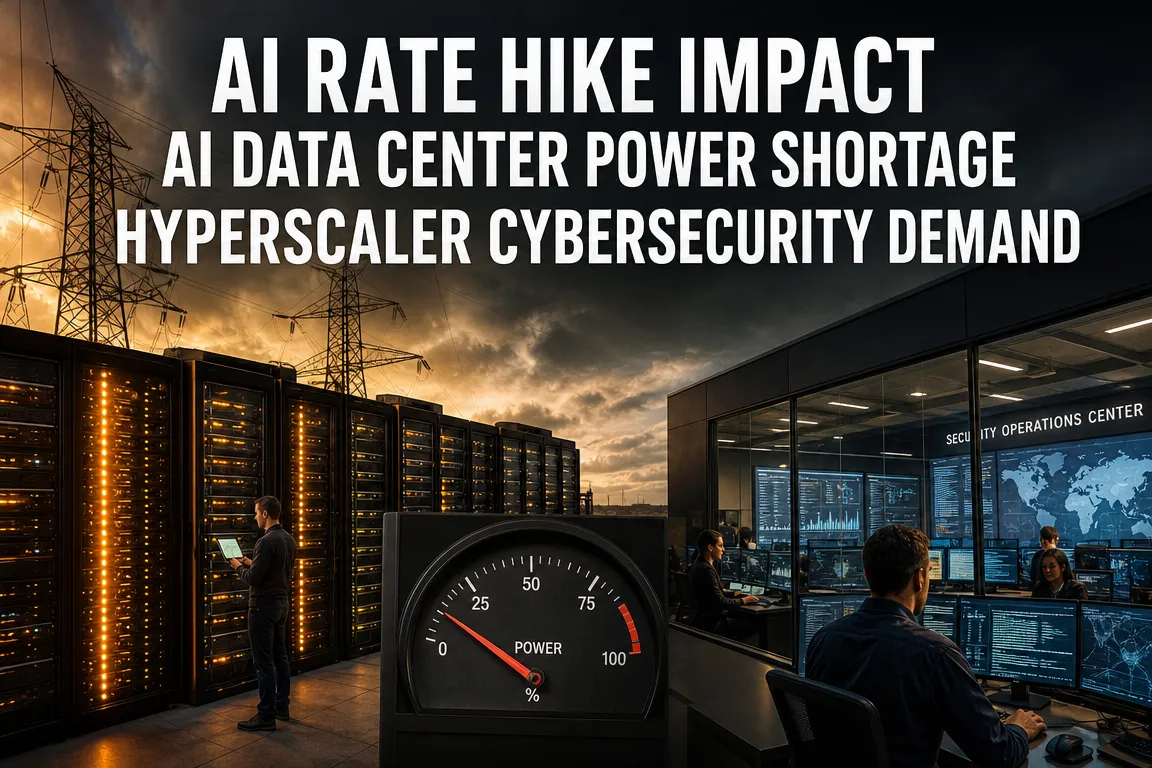
● AI, Power, Reverse, Surge
2027 Market Leadership Shifts: Capital Rotation, AI Semiconductors, Physical AI, and Data Center Power
The most important point in the 2027 economic outlook is not simply that AI remains favorable.
The key issue is the reallocation of capital away from legacy industries and into the AI value chain, a structural rotation of money.
In particular, market leadership is likely to shift from GPUs in 2025 to HBM and DRAM in 2026, and then to data center power and physical AI in 2027.
This should also be assessed in the context of geopolitical downside pressure from the Middle East conflict, Korea’s growth rebound, semiconductor export concentration, and the U.S.-China AI competition.
The central investment theme for 2027 is therefore not limited to AI semiconductors.
Power infrastructure, data centers, physical AI, robotics, automobiles, consumer electronics, and the protection of Korea’s semiconductor market share should all be considered together.
1. What Capital Rotation Means: AI-Driven Reallocation Against the Low-Growth Trend
The global economy has a main current that typically flows downward over time.
That current has been shaped by low growth, high interest rates, geopolitical risk, and supply chain instability.
However, shocks such as COVID-19 and the Middle East conflict have acted as countercurrents.
AI is a more powerful countercurrent than either of those shocks.
AI is not just a technology trend; it is changing the direction of capital itself.
Corporate capital expenditures are increasingly concentrated in AI infrastructure.
Equity markets are also channeling capital into companies exposed to the AI value chain.
By contrast, industries with weak AI linkage are receiving less attention.
In short, capital is moving out of legacy sectors and into AI infrastructure, AI models, AI semiconductors, and data center power systems.
2. The Middle East Conflict as Downside Pressure, AI as Upside Pressure
In the 2026 global economic outlook, the Middle East conflict was a major source of downside pressure.
It can raise energy prices, disrupt supply chains, increase raw material volatility, and lift logistics costs.
Countries with high energy import dependence are especially exposed.
Korea, with a manufacturing-heavy economy and significant dependence on imported energy, is particularly vulnerable.
At the same time, AI is providing an offsetting upside force.
Demand for semiconductors, equipment, materials, data centers, and power infrastructure required for AI continues to rise sharply.
The implication is that not all countries benefit equally from the AI cycle.
Only countries embedded in the AI value chain are positioned to capture the growth opportunity.
3. The Core AI Value Chain: Services, Models, Infrastructure, and Products
The AI value chain can be divided into four layers.
The first is AI services.
This includes chatbots, search-based AI, workflow automation tools, image generation systems, and coding assistants used directly by end users.
The second is AI models.
This includes platforms such as OpenAI, Google, Meta, Anthropic, and leading Chinese model families that function as the intelligence layer.
The third is AI infrastructure.
This includes GPUs, HBM, DRAM, servers, networking equipment, data centers, telecommunications networks, cooling systems, and power equipment.
The fourth is AI products.
This includes robots, automobiles, smartphones, PCs, appliances, industrial machinery, and medical devices in which AI is embedded.
From 2027 onward, AI is likely to move beyond screen-based services and into physical products and industrial applications.
4. Only a Limited Number of Countries Participate at the Core of the AI Value Chain
There are around 200 countries in the world, but only a limited number are positioned at the core of the AI value chain.
The United States is strong in chip design.
Japan is strong in semiconductor materials.
The Netherlands is critical in semiconductor equipment.
Taiwan and Korea hold important positions in semiconductor manufacturing.
Korea remains especially strong in memory semiconductors.
As a result, the benefits of the AI era will not be distributed evenly across countries.
Countries integrated into the AI value chain are likely to gain growth opportunities, while others may be relatively left behind.
When assessing the global economy, the key issue is not only GDP growth.
It is increasingly important to identify which countries are inside the AI value chain and what role they play within it.
5. Why Korea Has Been Drawn into the AI Upcycle: Semiconductor Export Concentration
Korea has long faced concerns about structural low growth.
In 2025, growth remained in the low 1% range, and cyclical weakness was pronounced.
Including the impact of the Middle East conflict, there were concerns that Korea’s growth outlook could weaken further.
Korea is a manufacturing economy, heavily dependent on imported energy and on crude oil imports from the Middle East.
However, growth forecasts later moved higher.
The original text notes that the Bank of Korea projected this year’s growth at 3.3%.
The main driver was semiconductor exports tied to AI demand.
Semiconductors accounted for roughly 20% of Korea’s total exports two years ago, around 25% last year, and about 38.7% in the first half of this year, according to the original text.
This means Korea’s recovery is being driven not by broad-based domestic demand or a cyclical rebound across all industries, but by concentrated demand for AI semiconductors.
This is favorable in the sense that Korea is directly benefiting from the AI cycle.
It is also a risk, because growth is becoming increasingly dependent on a single industrial pillar.
6. Market Leadership Is Moving: GPUs in 2025, HBM and DRAM in 2026, Power and Physical AI in 2027
Leadership in AI markets is shifting over time.
The key criterion for that shift is where supply constraints emerge.
In 2025, GPUs were in short supply.
Because the compute resources needed for training and inference were insufficient, Nvidia GPUs became the dominant leadership theme.
In 2026, HBM and DRAM became constrained.
GPU supply alone does not complete an AI server, and demand for high-bandwidth memory and high-performance DRAM increased sharply.
This supported strong share-price performance for Samsung Electronics and SK Hynix.
In 2027, power supply is likely to become the bottleneck.
Even if more data centers are desired, expansion is limited if power is unavailable.
As a result, data center power, transmission and distribution networks, transformers, generation assets, cooling systems, and power management solutions may emerge as new areas of focus.
Physical AI is also likely to become a new leadership theme.
As AI is embedded into robots, automobiles, appliances, smartphones, PCs, and industrial machinery, new product categories may emerge.
7. Data Center Power Shortage: The Most Concrete Bottleneck in the 2027 AI Economy
Data centers are expanding rapidly worldwide.
The original text states that there are currently around 12,600 data centers globally and that roughly 20 are added each day.
The challenge is that data centers consume substantial electricity.
In some cases, a large data center can use more power than the residential electricity demand of a city of one million people.
As AI models become larger, computational demand increases.
Higher compute demand raises demand for GPUs and memory.
It also raises demand for power and cooling infrastructure needed to operate servers.
For that reason, data center power is likely to be a core condition for AI competitiveness in 2027, not merely a utility issue.
The U.S. emphasis on LNG, power plants, and energy infrastructure should also be viewed in this context.
AI competition is ultimately a competition in data centers, and data center competition is a competition in power supply.
8. Physical AI and the Expansion of AI into Products
Another major theme for 2027 is physical AI.
Physical AI refers to the integration of AI into physical products rather than limiting it to software services.
For example, AI microphones can automatically adjust voice tone.
They can also monitor battery status to prevent recording interruptions.
AI refrigerators can track food inventory and recommend or order missing items.
AI washing machines can recognize fabric type and soil level to optimize washing cycles.
AI automobiles can improve autonomy and personalized driver services.
AI robots can replace or support labor in logistics, manufacturing, care, and service industries.
This trajectory may progress through concept development in 2025, planning in 2026, and commercialization in 2027.
For that reason, physical AI is difficult to exclude from the 2027 leadership universe.
9. Korea’s First Challenge: Monitoring Hyperscaler Cash Flow
Many investors assume AI semiconductor demand will continue to expand.
However, a more important question is whether hyperscalers can keep spending.
Until now, major U.S. technology companies and hyperscalers have financed data center construction and semiconductor purchases through substantial free cash flow.
The original text notes that free cash flow began to weaken or turn negative from the second quarter.
If cash flow tightens, companies may rely more heavily on bond issuance.
At that point, interest rates become critical.
Higher Treasury yields increase the cost of corporate debt issuance and can reduce capital spending capacity.
Therefore, when assessing AI semiconductor demand in 2027, investors should not focus only on Nvidia earnings or HBM pricing.
They should also track hyperscaler cash flow, corporate debt market conditions, U.S. Treasury yields, and the pace of data center investment.
10. Korea’s Second Challenge: Competition Between U.S. and Chinese AI Models
The AI model market is also changing in important ways.
The original text notes that on AI gateways such as OpenRouter, usage of Chinese AI models has surpassed that of U.S. models.
Cost is the key driver of this shift.
For routine and repetitive tasks, many companies and users may choose lower-cost Chinese AI models.
For complex or high-value tasks, they may still use U.S. models.
If this structure persists, it could affect revenue growth for U.S. hyperscalers and AI model companies, as well as data center investment plans and semiconductor purchasing capacity.
For Korean semiconductor companies, it is therefore essential to monitor whether U.S. big tech can continue large-scale investment.
Changes in the market share of U.S. and Chinese AI models may serve as a leading indicator for Korean AI semiconductor demand.
11. Korea’s Third Challenge: Defending DRAM Market Share
Korea holds a strong position in the DRAM market.
However, this position should not be taken for granted.
The original text states that Korea’s DRAM market share declined from about 75% in Q1 2024 to about 70% in Q1 2025 and about 63% in Q2 2026.
Micron is strengthening the U.S. semiconductor value chain.
ChangXin Memory is expanding its share within China’s push for semiconductor self-sufficiency.
The U.S. wants to manufacture more domestically, and China also wants to expand domestic production.
In this environment, Korea cannot rely on its existing memory leadership.
Korea must expand beyond HBM and DRAM into non-memory semiconductors, system semiconductors, AI accelerators, advanced packaging, power semiconductors, and software ecosystems.
AI semiconductor competition will not be decided by memory alone.
12. The Key Risk Often Missed Elsewhere: The Real Risk Is Not AI Demand, but AI Investment Durability
Many reports emphasize only the surge in AI demand.
A more important question is whether there is enough capital to translate that demand into sustained investment.
AI semiconductor demand ultimately comes from data center investment.
Data center investment depends on hyperscaler cash flow and financing conditions.
Financing conditions depend on interest rates and the bond market.
If rates rise again, AI capex could slow.
AI model profitability is another key variable.
If low-cost Chinese AI models spread quickly, pricing pressure could weigh on the profitability of higher-priced U.S. AI models.
That pressure could, in turn, affect data center investment plans and AI semiconductor orders.
The final constraint is power.
Even if GPUs and HBM are available, data center expansion will stall without sufficient electricity.
For this reason, investors should move beyond a narrow semiconductor view and also track power, transmission, transformers, generation assets, cooling systems, and energy storage.
13. Broadly Speaking, the 2027 Leadership Candidates Are
The first candidate group is AI semiconductors.
GPUs, HBM, DRAM, high-performance server memory, and advanced packaging remain central.
The second candidate group is data center power.
This includes generation, transmission, transformers, distribution networks, power management, cooling, and energy storage systems.
The third candidate group is physical AI.
This includes robots, automobiles, smart appliances, AI PCs, AI smartphones, and industrial machinery.
The fourth candidate group is AI infrastructure services.
This includes cloud platforms, data center operations, networking, cybersecurity, and AI software platforms.
The fifth candidate group is non-memory and power semiconductors.
As AI moves into physical products, demand may also rise for sensors, MCUs, power management ICs, communication chips, and edge AI chips.
14. Investment Checklist
When assessing 2027 leadership themes, the following questions matter:
Is AI semiconductor demand translating into actual orders?
Are hyperscaler capex guidance levels being maintained?
Are U.S. Treasury yields and corporate debt markets stable?
Where is the data center power shortage most severe?
Is the HBM and DRAM supply shortage persisting?
Is the rising share of Chinese AI models affecting U.S. big tech profitability?
Are Korean semiconductor companies maintaining global market share?
Are physical AI products beginning to generate meaningful revenue?
If the answers change, market leadership can change as well.
For that reason, the 2027 market is likely to be less a broad AI theme and more a market where capital moves along bottlenecks.
< Summary >
The central theme in the 2027 outlook is capital rotation.
Capital is moving from legacy sectors into the AI value chain.
Market leadership may shift from GPUs in 2025 to HBM and DRAM in 2026, and then to data center power and physical AI in 2027.
Korea has an opportunity to benefit from AI semiconductor exports, but rising dependence on semiconductors and declining DRAM market share remain risks.
Investors should also monitor hyperscaler cash flow, interest-rate direction, the corporate bond market, U.S.-China AI model competition, and data center power constraints.
Ultimately, 2027 leadership is likely to be determined less by AI demand itself than by where the next bottleneck emerges in the AI chain.
[Related Articles…]
AI Semiconductor Cycle and Korea’s Growth Outlook
Data Center Power Infrastructure and AI Investment Trends
*Source: [ 경제 읽어주는 남자(김광석TV) ]
– 2027년 주도주가 바뀐다. 돈이 쏠리는 곳은? [경읽남 262화]