● Treasury-Yield Shock, Fed Hike, Crypto Cliffhanger
U.S. 10-Year Yield Breaks 5%, FOMC Rate Hike Expectations, and the Crypto Bill’s 60-Vote Test
The key point in this New York briefing is not simply that U.S. equities were weak.
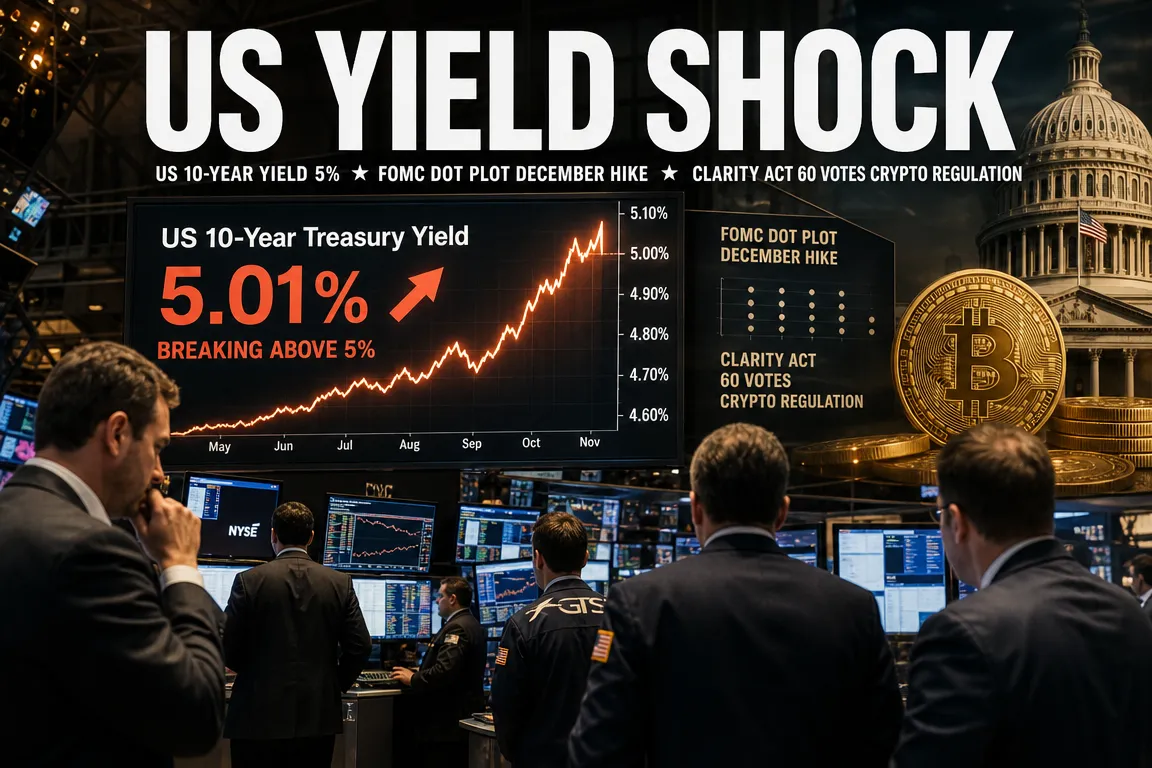
As the U.S. 10-year Treasury yield moved above 5%, equity valuations came under renewed pressure, while crude oil holding above $100 per barrel quickly increased expectations for additional Federal Reserve tightening.
At the same time, the market is being influenced by the FOMC voting structure, Chair Waller’s leadership test, the Senate’s 60-vote hurdle for the Clarity Act, reports of a possible Trump announcement on South Korea-related U.S. investment plans, and a downgrade in the S&P 500 target.
One of the most important points today is that the rise in yields may not be driven only by fears over fiscal deficits.
The market is now re-pricing the link between U.S. Treasury yields, crude oil, the FOMC, U.S. equities, and AI-related investment flows.
1. Pre-market and opening trends in New York: indices weak, semiconductors firm
-
S&P 500 futures traded slightly lower early in the session.
The Nasdaq 100 and the Dow Jones Industrial Average also declined modestly as investors remained cautious ahead of the FOMC meeting.
-
The VIX index eased slightly to the mid-16 range.
Market stress remains elevated, but conditions have not yet developed into a broad risk-off move.
-
Within sectors, semiconductor stocks were relatively strong.
NVIDIA, AMD, Micron, Intel, Broadcom, and Qualcomm all posted gains.
-
By contrast, large software and platform names such as Microsoft, Alphabet, and Apple were weaker.
U.S. equities increasingly appear to be trading in a rotation pattern rather than moving as a single unified technology complex.
2. U.S. 10-year Treasury yield above 5%: why the market is concerned
The U.S. 10-year Treasury yield has moved above the 5% level.
This is not just a bond-market indicator.
It is a key reference rate for corporate borrowing, mortgage costs, equity valuation, and global capital flows.
Higher yields increase the discount rate used to value future earnings.
That creates pressure on growth stocks and technology names, especially those supported by AI investment expectations and elevated multiples.
The latest move higher is a near-term headwind for U.S. equities.
However, the key issue is why yields are rising.
3. The main driver behind higher yields may be oil and the Fed path, not only fiscal concerns
Many explanations focus on U.S. fiscal deficits and rising Treasury supply.
Those are important long-term variables given the scale of U.S. debt.
But the more immediate driver of the recent move in the 10-year yield appears to be a change in expectations for further Fed tightening rather than fiscal concerns alone.
The key catalyst for that shift is crude oil.
Geopolitical tensions in the Middle East have pushed oil higher, lifting gasoline, freight, heating fuel, and diesel costs.
As a result, markets are pricing in a greater risk that inflation remains sticky and that the Fed may need to keep rates higher for longer.
One month ago, the probability of the Fed raising rates three or more times by next September was discussed at around 16%, but that probability has recently risen to the 80% range.
That shift has been a major factor pushing the 10-year yield toward 5%.
In other words, the key variable for long-term yields is not only fiscal deficits, but also the extent to which oil changes the Fed’s policy path.
4. The structure of the 10-year yield suggests the problem is the expected short-rate path, not the term premium alone
The 10-year yield can be divided into two components.
The first is the market’s expectation of the average path for short-term rates.
The second is the term premium associated with lending money over a longer period.
The recent rise in yields suggests that the expected short-rate path has moved higher, rather than a sharp jump in term premium alone.
That is important.
If oil prices retreat and the Fed’s additional tightening expectations ease, the 10-year yield could fall quickly even without an immediate cut in policy rates.
By contrast, if oil remains above $100 per barrel and expectations build toward $120 or even $150, the market may continue to price in further Fed tightening.
In that case, the 5% level on the U.S. 10-year yield could become a more persistent burden rather than a temporary event.
5. FOMC watchpoints: the dot plot and vote split matter more than the hike itself
The two-day FOMC meeting began on the 15th, U.S. time.
The policy decision is scheduled for the next day, around 3 a.m. Korea time.
The market is pricing in more than a 90% probability of a 0.25 percentage point hike.
In effect, a hold would likely be more disruptive than a hike.
The more important question is the possibility of another increase in December.
The market is already assigning a high probability to at least two hikes by year-end.
If the current target range is 3.50% to 3.75%, two additional hikes would take it above 4%.
6. Chair Waller’s vote count: a leadership test for the FOMC
At the July meeting, most members favored holding rates steady, while Logan, Harker, Kashkari, and two others were associated with the case for a hike.
This time, some of the existing holdouts would need to move toward a hike for a rate increase to pass.
Chair Waller’s support alone would not be sufficient.
Additional members from the hold camp would need to join the hike side.
Waller, Williams, Paulson, and Goolsbee are still viewed as more cautious or closer to the hold camp.
By contrast, Cook, Barr, Jefferson, Powell, and Bowman are being watched as swing voters.
The number of dissenting votes will matter.
A wide split could be read as evidence of internal division at the Fed.
By contrast, if dissents are limited to one or two votes, it would suggest that Chair Waller still retains effective leadership.
7. The dot plot and press conference: whether oil-driven inflation is seen as temporary or structural
Looking only at the rate decision would capture only part of the picture.
The key issue in this meeting is the dot plot.
The dot plot will show whether officials see just one more hike this year or another one by December.
If a majority of members signal two hikes by year-end, the market may begin to price a new tightening cycle.
The press conference will be important for how inflation is framed.
If Chair Waller describes higher oil prices as a temporary supply shock, the market may take that as a reassuring signal.
If he says energy prices are feeding into core inflation, long-term yields could move higher.
8. Changes from Morgan Stanley and Goldman Sachs: tightening may be driven by expectations more than necessity
Morgan Stanley has revised its view to expect a 0.25 percentage point rate hike in September, followed by another one in December.
The bank cites four reasons:
-
Inflation is not slowing quickly enough.
-
Crude oil above $100 has increased concerns about second-round inflation effects.
-
AI-related investment is supporting U.S. demand.
-
With the market already heavily positioned for hikes, inaction could raise concerns about Fed credibility.
Goldman Sachs has also moved in a similar direction.
However, an important point is that even within Goldman’s view, an additional hike may not be strictly necessary from a pure economic standpoint.
Part of the recent inflation pressure can still be explained by temporary factors such as tariffs and energy supply shocks.
Even so, because markets have already priced in a very high probability of action, the Fed may find it difficult to push back against those expectations.
In simple terms, the next hike may be less about an economy that is overheating and more about the Fed following market expectations.
9. The Clarity Act’s 60-vote hurdle: a gateway to institutional crypto regulation
The U.S. Senate is scheduled to hold a procedural vote on the Clarity Act.
The bill would define whether digital assets are securities or commodities and whether oversight falls under the SEC or the CFTC.
This vote is not final passage.
It is a procedural step needed to bring the bill to the Senate floor.
However, overcoming a filibuster requires 60 votes.
The Republican Party holds 53 seats in the 100-seat Senate.
Even if all Republicans support the measure, at least seven Democratic votes would still be needed.
If any Republicans defect, the number of Democratic votes required would increase.
There are two main points of contention:
-
First, conflict-of-interest rules involving the Trump family’s crypto business.
Democrats are seeking requirements such as divestment from digital asset holdings and placement into blind trusts.
-
Second, resistance from the banking sector.
There is concern that stablecoin rewards could drain bank deposits and reduce lending capacity.
Bitcoin weakened near $77,000 as investors priced in uncertainty around the vote.
During the session, it also fell to the mid-$76,000 range.
However, the market has already partly priced in the possibility of failure, so downside reaction may remain limited if the measure does not advance.
10. Trump’s reported September 18 Korea investment announcement: shipbuilding, LNG, nuclear power, and carbon capture
There are reports that President Trump could announce details of South Korea’s U.S. investment plan on the 18th.
The total investment amount is said to be around $350 billion.
Of that, $150 billion is reportedly already allocated to shipbuilding.
The key question is how the remaining $200 billion will be allocated.
The sectors currently being discussed include:
-
Texas gas projects
-
Eight nuclear reactors
-
Alaska LNG projects
-
Reprocessing of 4,000 tons of nuclear material
-
Carbon capture projects
The September 18 announcement has not been officially confirmed.
South Korea’s government and the White House are said to be in discussions.
If an announcement is made, it could provide a meaningful catalyst for companies linked to shipbuilding, LNG, nuclear power, energy infrastructure, and carbon capture.
11. Wells Fargo cuts its S&P 500 target: a momentum issue, not an earnings issue
Wells Fargo lowered its year-end S&P 500 target to 7,700 from 7,950.
At current index levels, that implies only about 1% upside into year-end.
Notably, the bank raised its EPS forecast.
Its earnings estimate was increased from $395 to $425 per share.
In other words, the target cut was not driven by weaker earnings.
Instead, Wells Fargo cited political uncertainty, the midterm election cycle, resistance to data center construction, concerns about AI momentum, and the burden of high rates as factors limiting further index gains.
The bank downgraded technology to neutral from overweight.
Healthcare was upgraded to overweight from neutral.
This does not mean the AI investment theme has ended.
Rather, it suggests that the pace of AI infrastructure expansion is facing pressure from political, community, power grid, and permitting constraints.
12. Treasury Secretary Bessent’s House testimony: the market wants yield stability, not just buybacks
Treasury Secretary Bessent is scheduled to testify before the House Financial Services Committee.
The formal topic is the annual testimony on the international financial system.
However, markets are focused on a different issue.
With the 10-year yield above 5%, investors want to know whether Treasury will announce any measures to stabilize long-term rates.
The Treasury has already been conducting buybacks and has expanded the program.
Even so, long yields have remained elevated.
As a result, the hearing may include questions about additional steps beyond buybacks, debt issuance strategy, and broader federal debt management.
If the testimony does not deliver the stabilization message the market is looking for, pressure on long-term yields may continue.
13. Key variables investors should track now
-
First, whether crude oil remains above $100 per barrel.
If oil declines, U.S. Treasury yields could fall faster than expected.
-
Second, the extent to which the FOMC dot plot reflects another hike in December.
A more hawkish dot plot would weigh on equities.
-
Third, the size of any dissents in the vote.
Internal division at the Fed could affect market confidence.
-
Fourth, whether the Clarity Act clears the 60-vote threshold.
Success would be positive for regulatory clarity in digital assets, while failure could delay further action this year.
-
Fifth, the sector allocation in the Korea-U.S. investment announcement.
Shipbuilding, LNG, nuclear power, carbon capture, and energy infrastructure could benefit.
-
Sixth, data center regulation and the pace of AI investment.
Semiconductors remain strong, but software and platform names may remain under pressure.
14. One-sentence summary of today’s market
The market is not in a broad selloff driven only by rate fear; instead, capital is rotating toward semiconductors, energy, and healthcare as investors reassess oil and the FOMC.
U.S. equities are broadly weak, but semiconductor hardware remains strong.
Software and platform stocks are weaker.
Rising crude oil prices and U.S. Treasury yields are putting pressure on growth valuations.
At the same time, if oil declines, yields could also fall quickly.
< Summary >
The U.S. 10-year Treasury yield has moved above 5%, weighing on U.S. equities.
The recent rise in yields appears to be driven more by crude oil and changing Fed rate expectations than by fiscal deficits alone.
The FOMC is likely to deliver a 0.25 percentage point hike, with the dot plot and vote split carrying greater significance.
The Clarity Act faces a 60-vote hurdle in the Senate and could shape the regulatory framework for digital assets.
Trump’s reported Korea investment announcement could affect shipbuilding, LNG, nuclear power, and carbon capture stocks.
Wells Fargo lowered its S&P 500 target but raised EPS estimates, reflecting weaker momentum rather than weaker earnings.
The AI investment theme remains intact, but data center opposition and slowdown concerns are emerging as constraints on further upside.
[Related Articles…]
*Source: [ Maeil Business Newspaper ]
– 베선트 하원 발언 주목ㅣ美 국채 5% 돌파ㅣ연준 ‘2회 인상’ 전망·워시의 표 계산ㅣ코인법 60표 승부ㅣ트럼프 18일 한국 투자안 발표설ㅣS&P500 목표 하향ㅣ홍혜진의 뉴욕브리핑