● Tesla Shock, Samsung Breakthrough, AI5 Surge
Samsung Taylor Fab Begins Tesla AI5 Chip Production, but the Chip Will Not Enter Tesla Vehicles Immediately
The core issue here is not simply that Samsung is manufacturing Tesla chips.
The key points are Samsung Electronics’ 2 nm foundry yield, Tesla’s AI semiconductor supply chain strategy, the actual vehicle deployment timing for the AI5 chip, Tesla’s in-house semiconductor plant, Terafab, and related litigation, and why Tesla’s stock did not react materially in the short term.
For Samsung Electronics shareholders, the Taylor fab development is a meaningful positive. For Tesla shareholders, however, it should be interpreted differently.
The reason is that the Tesla AI5 chips now being produced in Texas are not intended for the current Model 3, Model Y, or Cybertruck lineup. Instead, they are likely to be used more broadly after 2027 in Tesla’s next-generation AI semiconductors.
In other words, this is less of a short-term Tesla equity catalyst and more of a long-term supply chain development tied to autonomous driving, Optimus robotics, and AI data center strategy.
1. Tesla Stock Performance Today: Closed at $366, With the Advance Driven by the Broader Market, Not Tesla-Specific News
According to the source, Tesla shares closed at $366.2.
The daily gain was 2.27%.
The indicated private-market valuation for SpaceX was about $154.81, up roughly 2.6%.
That said, Tesla’s gain should not be interpreted solely as a company-specific positive.
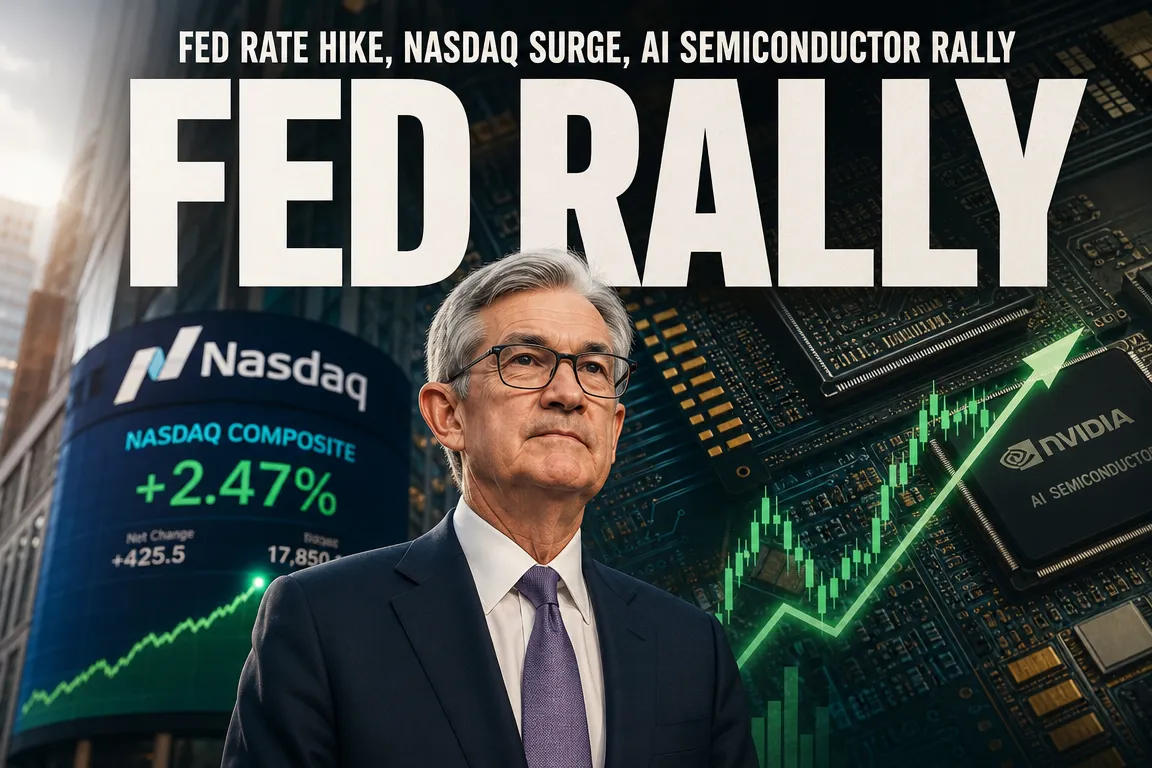
U.S. equities rose broadly as uncertainty around interest rates eased, and the Nasdaq, S&P 500, and Dow Jones all moved higher.
-
Nasdaq: up about 1.69%
-
S&P 500: up about 1.14%
-
Dow Jones: up about 0.16%
-
Tesla: up about 2.27%
The source states that the Federal Reserve raised the policy rate by 0.25 percentage points, bringing the target range to 3.75% to 4.00%.
Normally, higher rates weigh on growth and technology stocks.
In this case, however, the market appears to have interpreted the move as reducing uncertainty.
As a result, Tesla’s gain was primarily driven by a broader improvement in U.S. market sentiment rather than a direct operational catalyst.
2. Negative Tesla Headlines Also Emerged, Including Lower Delivery Expectations and a Cybercab Filing Issue
Notably, Tesla’s share price rose even though several company-specific developments on the same day were negative.
2-1. Goldman Sachs Lowered Its Q3 Delivery Forecast for Tesla
Goldman Sachs reduced its forecast for Tesla’s third-quarter deliveries to about 435,000 units.
That is below the market consensus of 456,000 units.
It is also about 9.4% lower than second-quarter deliveries of 480,016 units.
Goldman maintained a Neutral rating on Tesla.
Its target price was set at $360.
Given that Tesla is trading around $366, Goldman’s view suggests limited near-term upside from current levels.
2-2. NHTSA Special Order Issue Related to Cybercab
Washington also saw a filing issue related to Cybercab certification and audit documentation.
According to the source, the matter was escalated from a routine inquiry to a special order.
Tesla is now required to submit an official response.
The deadline is cited as September 30.
Importantly, this is not a defect investigation or a recall at this stage.
However, because Tesla must provide a detailed response to regulators regarding Cybercab, the issue remains relevant from a future autonomous-driving regulatory-risk perspective.
3. Samsung Taylor Fab Has Begun Trial Production of Tesla’s AI5 Chip
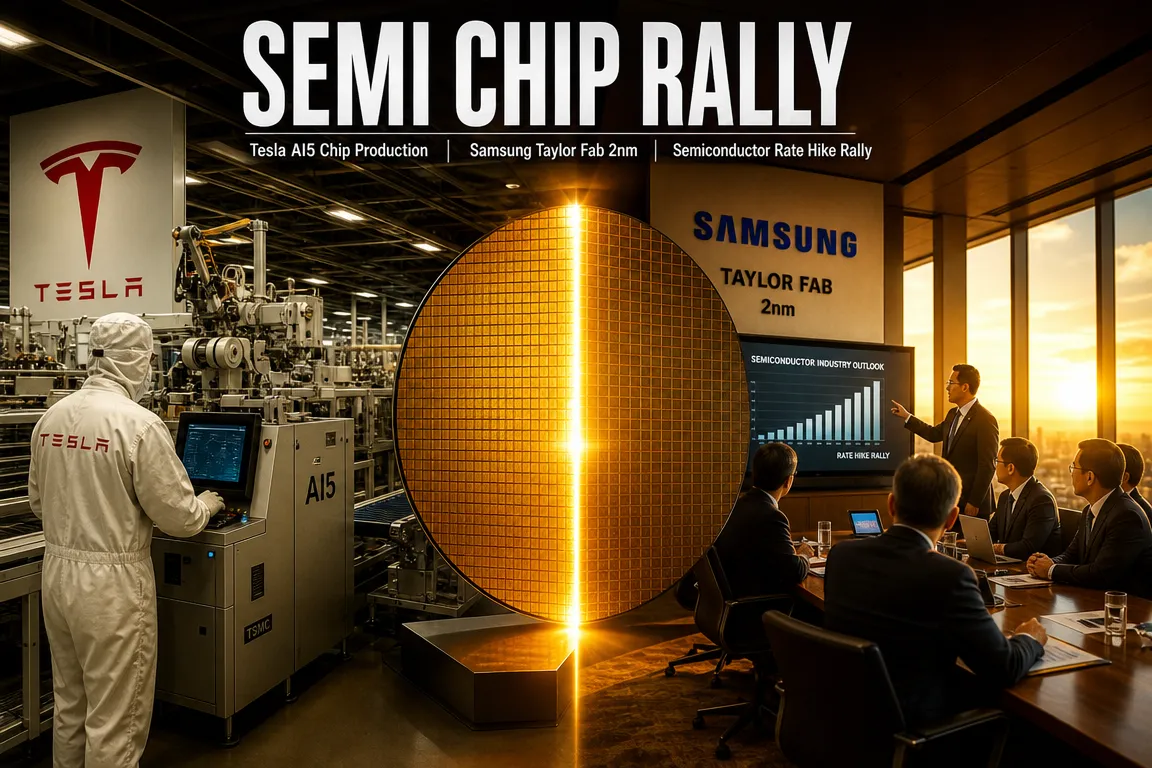
The main development in this report is that Samsung Electronics’ Taylor foundry fab in Texas has reportedly started producing Tesla’s AI5 chip.
The plant was originally expected to begin full operations in November.
However, the latest reports indicate that trial production began about two months earlier than planned.
The reports were cited by domestic Korean media and Taiwan’s DigiTimes.
The production target is Tesla’s next-generation AI semiconductor, the AI5 chip.
The process node is reported to be 2 nm.
This matters not only because chips are being produced, but because it links Samsung’s foundry business with Tesla’s AI infrastructure strategy.
4. Why This Matters for Samsung Electronics
4-1. A Chance to Narrow the Gap with TSMC
Foundry refers to the business of manufacturing chips designed by customers.
In the global foundry market, Taiwan’s TSMC holds a dominant position.
The source states that TSMC controls roughly 70% of the market.
For Samsung Electronics, securing major customers in advanced nodes is critical.
In particular, the 2 nm process is a key battleground for Samsung to demonstrate competitiveness.
Samsung’s foundry division reportedly posted an operating loss of about KRW 6.8 trillion last year.
Against this backdrop, producing Tesla’s AI semiconductor on 2 nm carries significance beyond a single contract.
4-2. Tesla’s Contract with Samsung Is Worth About $16.5 Billion
The source estimates the value of Samsung’s chip contract with Tesla at about $16.5 billion.
That is roughly KRW 22 trillion.
A long-term contract of this size can provide meaningful stability for Samsung’s foundry business.
In particular, as major technology companies increasingly develop custom AI chips, Tesla could become a reference customer that opens the door to additional demand from firms such as Meta, Anthropic, and potentially Nvidia-related automotive applications.
The source also states that Samsung’s foundry backlog has approached KRW 50 trillion.
Meta and Anthropic were also mentioned among the customer names.
This suggests that the AI semiconductor market is expanding beyond Nvidia GPUs into a broader race for custom application-specific chips.
5. Why This Production Development Is Even More Important: Timing, Node, and Location Were All Pulled Forward
5-1. The Fab Ramp-up Was Accelerated
Samsung’s Taylor fab was originally expected to begin full-scale operations around November.
However, trial production for Tesla’s AI5 chip appears to have started about two months earlier.
This likely reflects rapidly rising demand from Tesla and other large technology customers for custom AI chip production.
AI semiconductor demand has been growing so quickly that fabrication capacity cannot remain idle for long.
5-2. 2 nm May Apply to AI5, Not Only AI6
The industry had generally expected Samsung’s 2 nm process to be applied more fully starting with Tesla’s AI6.
If AI5 is now being produced on 2 nm, that would indicate Tesla and Samsung are moving faster than expected.
This is significant.
If Tesla can use a more advanced and power-efficient node starting with AI5, it could support more aggressive performance targets for autonomous driving and Optimus robotics.
5-3. From Korean Prototypes to Texas Production
In April, Elon Musk posted a photo of an AI5 prototype on X.
The lower-right corner reportedly included the marking KR 2613.
This was interpreted as indicating production in Korea during the 13th week of 2026.
That suggests the AI5 prototype came from a Korean line, with trial production or preproduction now shifting to Samsung’s Taylor fab in Texas.
6. The Geographic Advantage of Taylor: A Semiconductor Base Close to Giga Texas
Samsung’s Taylor fab is roughly an hour’s drive from Austin, Texas.
It is also located in the same state as Tesla’s Giga Texas plant in Austin.
This has practical significance.
Previously, chips produced in Taiwan or elsewhere in Asia had to be transported over long distances, creating more complicated logistics and slower issue resolution.
With chip production and vehicle manufacturing located close together in Texas, engineers can respond much faster if issues arise.
In a field such as autonomous-driving chips, where hardware and software are tightly integrated, shortening the distance between fabrication and vehicle assembly can itself become a competitive advantage.
This also has symbolic value in the context of U.S. semiconductor supply-chain reshoring.
7. The Most Important Variable Remains Yield
In semiconductor manufacturing, yield refers to the proportion of usable chips obtained from each wafer.
2 nm wafers are extremely expensive.
If yield is low, even a major customer contract can produce losses.
According to the source, industry views suggest that 2 nm yield above 60% is needed for profitability.
Samsung has not officially disclosed its 2 nm yield.
Earlier reports estimated Samsung’s advanced-node yield at around 50% or in the 50% range.
By contrast, TSMC’s 2 nm yield is reportedly in the 60% to 70% range.
If Samsung has now begun producing Tesla’s AI5 chip on 2 nm, the market will naturally infer that Samsung’s yield has improved.
That is why Samsung shareholders are paying close attention to this development.
In a period of surging AI semiconductor demand, yield stabilization at 2 nm could lead to a re-rating of Samsung’s foundry business.
8. However, This AI5 Chip Will Not Enter Tesla Vehicles Today
This is the most easily misunderstood point for Tesla shareholders.
A headline about Samsung starting AI5 chip production may suggest an immediate impact on Model 3 or Model Y performance.
That is not the case.
Current Tesla vehicles use AI4.
AI4 is also produced by Samsung Electronics, but reportedly at the Pyeongtaek line in Gyeonggi Province, not in Texas.
The process node is also 7 nm, not 2 nm.
Therefore, AI5 trial production at the Taylor fab does not directly affect current vehicle deliveries or near-term unit sales.
More precisely, it should be viewed as early production preparation for the next generation of chips that may be used in 2027 and beyond across Tesla vehicles, robots, and data centers.
9. Where AI5 Could Be Used: A Strategy Linking Vehicles, Robots, and Data Centers Through a Single Chip Platform
The AI5 chip is not limited to automobiles.
According to the source, possible applications include:
-
Model 3
-
Model Y
-
Cybercab
-
Optimus robots
-
AI data centers
This reflects Tesla’s broader approach.
Rather than designing entirely separate chips for vehicles, robots, and servers, Tesla appears to be pursuing a unified AI semiconductor platform.
That approach can improve software optimization, manufacturing scale, and supply chain management.
At the same time, it greatly increases total chip demand.
If the same chip family is used not only in vehicles but also in Optimus robots and AI data centers, demand will continue to expand even if vehicle sales slow.
Samsung’s decision to accelerate Taylor fab operations likely reflects this rising demand outlook for AI semiconductors.
10. Why AI5 Vehicle Deployment Is Seen Around Mid-2027
Elon Musk has said that a sufficiently large inventory of completed AI5 chips, measured in the hundreds of thousands, would be required before vehicles can transition to AI5.
This reflects practical production constraints.
Automotive plants produce vehicles at high volume every day.
If chip supply is interrupted, the entire assembly line can be disrupted.
Even if AI5 offers superior performance, Tesla cannot switch vehicles to the chip until supply is stable and inventories are adequate.
As a result, the market generally expects AI5 vehicle deployment around mid-2027.
In short, the AI5 chips currently being produced are primarily for future product lines rather than current vehicles.
11. Tesla’s Semiconductor Supply Chain Strategy Includes Samsung, TSMC, and Potential In-House Manufacturing
Tesla is not relying on a single foundry.
The source states that AI5 production is being split between Samsung and TSMC.
AI6 is expected to be handled by Samsung, while AI6.5 is assigned to TSMC.
Using multiple manufacturers may raise unit costs.
However, Tesla appears to prioritize supply stability.
During the 2021 global semiconductor shortage, automakers worldwide experienced production stoppages.
Tesla appears to be diversifying its supply base to avoid a repeat of that disruption.
This strategy is particularly important as Tesla expands into autonomous driving and robotics.
Going forward, Tesla’s competitive edge will depend less on EV output alone and more on how reliably it can secure AI chips and integrate them with software.
12. Tesla’s In-House Semiconductor Plant, Terafab, Is Now in Litigation Over the Name
Another important element of the report is the litigation involving Tesla’s planned in-house semiconductor plant, Terafab.
Tesla, SpaceX, and xAI filed suit against a small Illinois company called Teraprint.
Teraprint is known for manufacturing tabletop equipment used in laboratories.
The company reportedly uses the word tera in its product branding and claims to have used the name since 2017, with a trademark registration in March 2021.
The issue is that Tesla’s planned semiconductor plant is also named Terafab.
13. What Terafab Is Intended to Do: Design, Manufacturing, Packaging, and Testing Under One Roof
Tesla’s Terafab is expected to be built in Grimes County, Texas.
The investment size is estimated at about $16.8 billion.
That is roughly KRW 23 trillion.
In the semiconductor industry, design, fabrication, packaging, and testing are usually handled by separate companies.
Terafab is intended to bring these processes under one roof.
The project is also expected to handle both logic chips and memory, along with packaging and testing.
The chips may eventually be used in Tesla’s Optimus robots, Cybercab, and potentially the space-based data center initiative associated with SpaceX.
The word tera generally refers to one trillion, and fab refers to a semiconductor fabrication plant.
While the company has not formally explained the naming, the title appears to be symbolic of a large-scale, trillion-level manufacturing ambition.
14. Terafab Litigation Timeline: Why Tesla Went to Court First
According to the source, the timeline is as follows:
-
May 18: Tesla filed three trademark applications related to Tera and Tesla Tera.
-
Five days later: Teraprint sent a cease-and-desist letter alleging a likelihood of confusion.
-
June 10: Teraprint notified Tesla of possible litigation.
-
June to August: The parties attempted to negotiate.
-
September 2: Settlement discussions reportedly broke down.
-
After that, Tesla filed suit first in the federal court in Austin, Texas.
In trademark disputes, the defendant often prefers to wait and respond after the other side files.
Tesla’s decision to sue first suggests a strategy to control venue and timing.
Choosing the Austin court, where Tesla is headquartered, is also notable.
From Tesla’s perspective, the goal is likely to secure the Terafab name quickly and reduce uncertainty around the project.
15. Could This Lawsuit Materially Affect Tesla’s Business?
At present, the impact on Tesla’s core business appears limited.
If Tesla wins, it can continue using the Terafab name.
If it loses, it may need to change the name or settle financially.
The important point is that the project itself is unlikely to be halted over a naming dispute.
However, Tesla’s decision to initiate litigation first suggests the project is already beyond the exploratory phase and is moving toward execution.
Terafab remains a strategic project for Tesla’s effort to reduce dependence on Samsung and TSMC and eventually build its own AI semiconductor manufacturing capability.
16. Samsung Investors and Tesla Investors Are Looking at Different Timelines
16-1. A Meaningful Positive for Samsung Electronics Shareholders
For Samsung Electronics, Tesla AI5 production is an opportunity to demonstrate competitiveness in the 2 nm process.
If yield improves and stabilizes, Samsung’s foundry business could be re-rated based on large-scale AI semiconductor demand.
In particular, if customers such as Tesla, Meta, and Anthropic translate into actual production volume, Samsung’s earnings outlook would improve.
16-2. A Long-Term Strategic Development for Tesla Shareholders
For Tesla shareholders, AI5 trial production is not a near-term driver of vehicle sales or quarterly earnings.
Current vehicles use AI4, and AI5 is likely to be deployed more broadly only from 2027 onward.
Accordingly, Tesla’s share price would not be expected to move sharply on this news alone.
Instead, it matters as foundational infrastructure for Tesla’s long-term expansion into Optimus robots, Cybercab, AI data centers, and autonomous-driving platforms.
17. The Most Important Point Often Missed in Other Coverage
The real significance of this report is not simply that Tesla AI5 production has started, but that Tesla is building a physical supply chain for its transition from an automaker into an AI infrastructure company.
Much of the coverage focuses only on the Samsung-Tesla contract or the Terafab litigation.
However, the more important issue is that Tesla is no longer calculating chip demand solely on the basis of vehicle sales.
Tesla is treating AI5 as a common compute platform that can connect vehicles, robots, data centers, and even space-related infrastructure.
Under that framework, Tesla’s key bottleneck may shift from batteries to semiconductors.
In the past, the critical issue in the EV industry was battery supply chains.
Going forward, Tesla’s central constraint may be AI semiconductor supply.
Samsung’s Taylor fab, dual sourcing through TSMC, and Terafab are all designed to reduce that bottleneck.
In other words, the key issue is not which chip goes into Tesla vehicles today, but whether Tesla is building a production system capable of supporting future AI demand.
From that perspective, the report has significance well beyond the near-term stock move.
18. Investment Watchlist: Key Variables to Monitor
-
Samsung’s 2 nm yield
Official disclosure and the pace of stabilization will be critical.
-
AI5 mass production timing
Investors should watch the transition from trial production to full-scale output.
-
AI5 vehicle deployment timing
The market will monitor whether the expected mid-2027 timeline holds or moves earlier.
-
Tesla delivery trend
Goldman Sachs’ lowered Q3 delivery estimate should be checked against actual results.
-
Cybercab regulatory risk
Investors should watch whether the NHTSA response leads to further investigation or recall risk.
-
Terafab litigation outcome
The key question is whether the issue ends with a naming adjustment or affects the project timeline.
-
Tesla AI data center strategy
Whether AI5 demand extends beyond vehicles into data centers will be central to long-term valuation.
< Summary >
Samsung Electronics’ Taylor fab in Texas has reportedly begun trial production of Tesla’s AI5 chip.
The process node is said to be 2 nm, which is important for Samsung’s foundry competitiveness.
However, the chip will not enter Tesla vehicles immediately.
Current vehicles use AI4, and AI5 deployment in vehicles is expected more broadly only after 2027.
AI5 is a multi-purpose AI semiconductor that could be used across Model 3, Model Y, Cybercab, Optimus robots, and AI data centers.
Tesla is pursuing a semiconductor supply strategy that combines Samsung, TSMC, and its own Terafab project.
Terafab is currently subject to trademark litigation, but the likely business impact appears limited at this stage.
For Samsung investors, the key focus is 2 nm yield improvement and foundry recovery potential. For Tesla investors, the story is best viewed as a long-term AI infrastructure development.
[Related Articles…]
-
Tesla AI Chip Strategy and Autonomous Driving Supply Chain Outlook
-
Samsung Foundry Competitiveness and the 2 nm Semiconductor Race
*Source: [ 오늘의 테슬라 뉴스 ]
– 삼성이 테슬라 AI5 칩을 찍기 시작했습니다 — 근데 이 칩은 여러분 차에 안 들어갑니다, $366 테슬라 주주는?
● Rates Shock, Semis Surge, Korea Rallies
Why a Rate Hike Was Interpreted as Positive: The Real Drivers Behind Samsung Electronics, SK hynix, and the KOSPI Reaction
The key issue in today’s market was not simply, “Why did stocks rise despite a rate hike?”
The main point is that the U.S. rate hike was interpreted as a signal that longer-term inflation may be contained, which in turn pushed U.S. long-term Treasury yields lower.
In addition, expectations for stable oil prices, Nvidia CEO Jensen Huang’s comments on expanding semiconductor revenue, and rising AI chip demand all supported sentiment toward Samsung Electronics and SK hynix.
What appeared to be a single “rate hike” headline was in fact a simultaneous reassessment of rates, oil, inflation, AI semiconductors, and KOSPI market flows.
1. Today’s key market news: Why Samsung Electronics and SK hynix were strong
The main reasons behind the strength in Samsung Electronics and SK hynix can be summarized in three points.
- The U.S. rate hike was interpreted as a signal that inflation can be contained over the long term.
- Expectations increased that international oil prices could stabilize.
- Nvidia CEO Jensen Huang signaled stronger-than-expected semiconductor revenue growth potential.
Semiconductor stocks do not move based only on current earnings.
They also reflect future demand, long-term rates, the AI investment cycle, and global growth expectations.
Accordingly, although a rate hike typically appears negative at first glance, the market focused on whether it could help anchor long-term inflation.
2. Why a rate hike was not negative for equities in this case
In general, a rate hike is a headwind for equity markets.
It raises corporate funding costs and lowers the present value of future earnings.
Growth stocks and semiconductor names are especially sensitive because they discount long-term growth expectations.
This time, however, the market’s interpretation was different.
The rate hike was seen as a signal that long-term inflation could be brought under control more quickly.
As a result, U.S. long-term Treasury yields fell.
In equity markets, the policy rate is not the only variable that matters.
The more important factor is often the direction of long-term Treasury yields, such as the 10-year note.
When long-term yields decline, discount-rate pressure eases for growth and technology stocks.
That is why the KOSPI and semiconductor shares could react positively despite the rate hike headline.
3. Why stable oil prices matter for the KOSPI and semiconductors
The second key factor was oil price stability.
Although there were concerns related to Saudi Arabia’s East-West pipeline, reports suggested a faster-than-expected repair timeline.
Expectations also improved that risks to crude transport through the Strait of Hormuz could ease.
For Asian refiners, risks around the Strait of Hormuz are highly sensitive.
Any disruption in crude supply can push oil prices higher, which quickly translates into inflation pressure.
If inflation rises again, central banks are likely to keep rates elevated for longer.
That would weigh on equities.
By contrast, stable oil prices reduce inflation pressure.
They also ease upward pressure on long-term yields.
This is supportive for large-cap Korean equities and semiconductor stocks.
4. Jensen Huang’s comments reignited sentiment toward semiconductors
The third factor was Nvidia.
Jensen Huang suggested that semiconductor revenue could grow more strongly than previously expected.
The market had already been discussing around 70% growth through 2027, but his latest remarks raised expectations that revenue could potentially double.
This was not an official earnings guide.
However, markets are highly responsive to such remarks.
Nvidia sits at the center of the AI semiconductor market, and its growth outlook feeds directly into HBM, memory chips, server spending, and data center expansion.
SK hynix, in particular, is closely linked to Nvidia’s growth outlook because of its HBM competitiveness.
Samsung Electronics also benefits from expectations for a recovery in memory demand and a reconfiguration of the AI semiconductor supply chain.
In effect, Nvidia’s comments lifted sentiment across Korean semiconductor stocks.
5. The sequence the market actually priced in: Rates → Oil → Inflation → Semiconductors
This move should not be viewed simply as “stocks rose because of good news.”
The market reacted through the following chain:
- A short-term rate hike increased expectations that long-term inflation would be contained.
- Lower long-term inflation expectations pushed U.S. long-term Treasury yields down.
- Stable oil expectations reduced inflation concerns.
- Nvidia’s growth comments strengthened demand expectations for AI semiconductors.
- As a result, buying flowed into Samsung Electronics, SK hynix, and large-cap technology names on the KOSPI.
The central point is not the rate hike itself, but how the market interpreted it.
That distinction is important for understanding the next phase of the KOSPI.
6. The most important point often missed in other coverage
The key takeaway is not that semiconductor stocks rose despite a rate hike, but that they reacted to lower long-term yields.
Many reports summarize the move only as “semiconductors strengthened despite a rate hike.”
However, the actual market mechanism was more precise.
Semiconductors are both cyclical and growth-oriented.
They respond to both economic recovery expectations and changes in long-term rates.
This time, stable oil and Nvidia’s growth outlook supported the recovery narrative, while lower long-term Treasury yields reduced valuation pressure.
In other words, semiconductors received two positive inputs at once.
- First, stronger expectations for AI semiconductor demand.
- Second, lower valuation pressure from declining long-term yields.
When these two factors align, semiconductor stocks can move sharply in the short term.
If foreign buying also follows, the broader KOSPI can gain additional momentum.
7. Key indicators to watch next
To determine whether this move is only a short-term rebound or the start of a broader rally, several indicators should be monitored.
- Whether the U.S. 10-year Treasury yield rises again.
- Whether international oil prices remain stable.
- Nvidia’s earnings guidance and AI chip order trends.
- HBM pricing and the pace of memory market recovery.
- Whether foreign net buying into Samsung Electronics and SK hynix continues on the KOSPI.
The current market remains highly sensitive to both positive and negative headlines.
Even so, when liquidity and earnings expectations move in the same direction, rally conditions can build.
That is why semiconductors remain at the center of market attention.
8. Investment conclusion
This rebound appears less like a purely technical move and more like a convergence of macro conditions and AI semiconductor expectations.
Long-term inflation stabilization expectations mattered more than the headline rate hike.
Stable oil prices helped ease concerns about inflation and rates.
Nvidia’s stronger growth message revived expectations for a semiconductor super cycle.
That said, risks remain.
The market could weaken again if oil prices rise sharply, U.S. long-term Treasury yields rebound, or Nvidia’s expectations are not confirmed by actual results.
For now, however, Samsung Electronics and SK hynix appear to be receiving positive near-term support from both the macro backdrop and AI-related demand expectations.
< Summary >
Samsung Electronics and SK hynix strengthened despite a rate hike because the market interpreted the move as a signal that long-term inflation may be contained.
Lower U.S. long-term Treasury yields reduced pressure on growth and semiconductor stocks.
Stable oil expectations eased inflation concerns and supported KOSPI sentiment.
Nvidia CEO Jensen Huang’s stronger revenue-growth comments renewed expectations for AI semiconductors and HBM demand.
The key issue was not the rate hike itself, but the combination of lower long-term yields, stable oil prices, and stronger AI semiconductor growth expectations.
[Related Articles…]
- AI Semiconductor Supercycle and Memory Market Outlook
- U.S. Rate Outlook and KOSPI Investment Strategy
*Source: [ 내일은 투자왕 – 김단테 ]
– 금리인상? 오히려 좋아! #하이닉스 #금리인상 #코스피