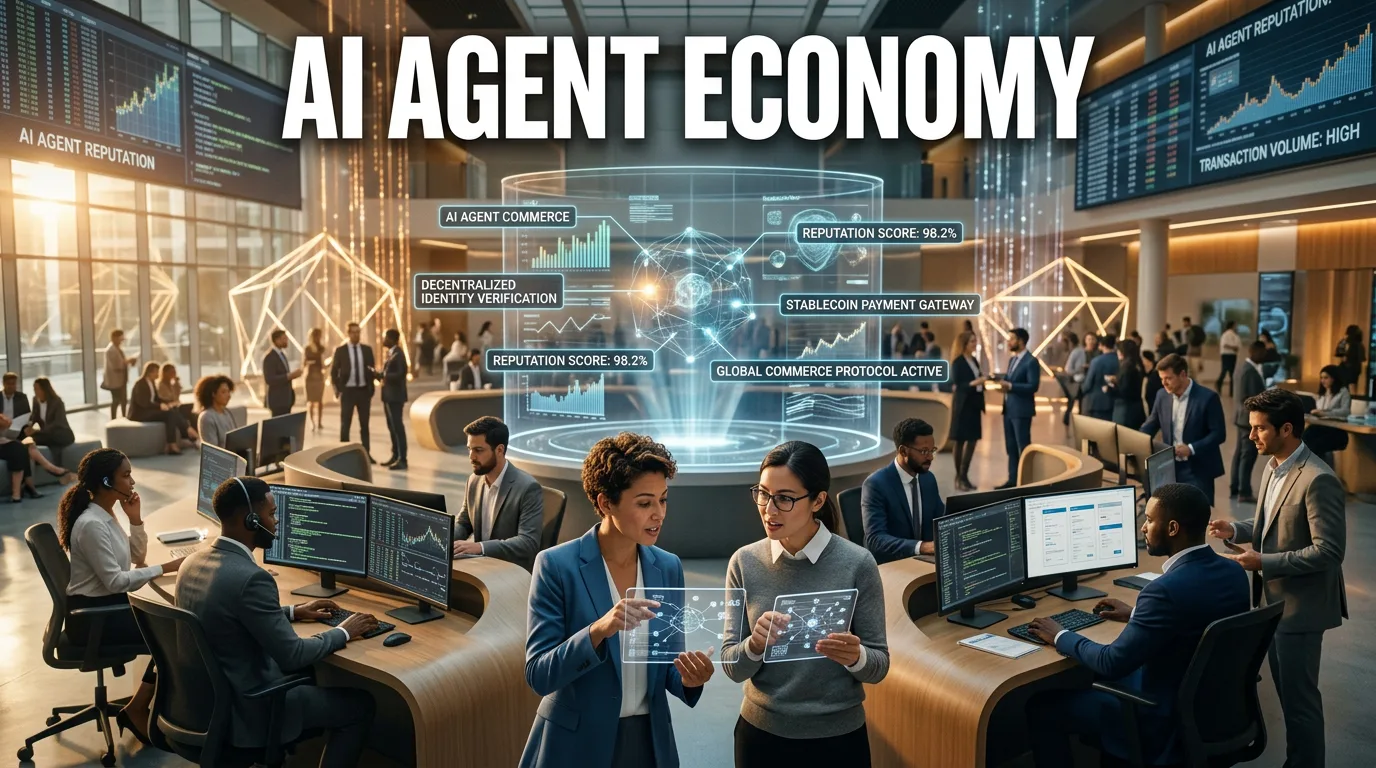
● Agent Economy Explosion
Why Does a “New Economic Explosion” Happen When AI Agents Meet Blockchain?
The core point of this shift is not simply that “AI does a good job.”
The real point is that the counterpart we transact with on the internet is increasingly likely to be not a person, but someone’s AI agent.
With blockchain, stablecoins, token economics, digital transformation, and the global economic outlook all intertwined at once, a completely new economic structure is being created.
In simple terms, people provide the intent of “what they want,” and agents automatically handle searching, negotiating, paying, executing, and verifying.
But that raises the most important question.
“Can we trust that agent?”
“If the agent takes the money and disappears, who is responsible?”
“How do we control the costs the agent pays?”
“Can existing financial networks handle thousands of transactions per second between agents?”
The answer to these questions is blockchain-based identity verification, reputation records, automatic payments, and smart contracts.
1. The essence of the AI agent economy: the actor that executes changes from people to software
The biggest change in the AI agent era is that the actor that executes shifts from people to software.
Until now, people have searched, compared, contacted, paid, and confirmed everything themselves.
But in the future, when an individual or company enters a goal, an agent will be able to call multiple services on its own, negotiate with other agents, buy data, make reservations, and even complete payments.
For example, let’s say you ask, “I want to travel to Europe, my budget is 3 million won, and please build it around hotels with a nice local vibe.”
My personal agent requests a travel coordinator agent, and the travel coordinator agent connects with a local hotel data agent, a flight price tracking agent, a restaurant recommendation agent, and a transportation booking agent.
During this process, data usage fees, reservation fees, access fees for discount information, and computing costs can occur in real time.
The problem is that these transactions won’t happen just a few times a day like they do for people; between agents, they can increase to thousands or tens of thousands per second.
That is exactly why the agent economy can grow beyond a simple AI services market into a huge economic system.
2. Why blockchain is needed: a “trust ledger” is necessary for agent-to-agent transactions
When AI agents start transacting on the internet, the first problem they run into is trust.
People and companies can verify a minimum level of trust through ID cards, business registration, contracts, reputation, and account information.
But agents are different.
Even if an agent says, “I’ll do a great job booking hotels,” it is hard to immediately verify who owns that agent, whether it has performed well in the past, or whether it has ever committed fraud.
A malicious agent could even alter its own history, display false data, or simply take the money and vanish.
That is why what is needed is identity and reputation recorded on a neutral network.
Blockchain provides a public ledger that is difficult for any single company to manipulate arbitrarily.
An agent’s owner, transaction history, task success rate, dispute records, payment history, and permission scope can all be recorded transparently.
Once this structure takes hold, there is a strong possibility that the internet will gain a digital identity and reputation for agents, just as people have resident registration numbers or companies have business registration numbers.
3. After KYC and KYB comes KYA: the era of “Know Your Agent” is arriving
In finance, the concept of KYC is already familiar.
KYC means Know Your Customer.
There is also KYB, Know Your Business, for verifying companies.
But in the agent economy, a new concept is needed.
That is KYA, Know Your Agent.
“Whose agent is this?”
“What authority has it been delegated?”
“Where does its payment authority end?”
“Who is responsible if something goes wrong?”
As agents begin opening financial accounts, making payments, signing contracts, or purchasing data, such authentication frameworks will become unavoidable.
What matters especially is that agents act asynchronously on behalf of people.
For example, while I’m asleep, my agent may discover a discounted flight and need to pay immediately.
If a pop-up asking “Do you want to pay?” appears every time, the benefits of an agent disappear.
On the other hand, handing over a credit card outright is far too risky.
So in the future, conditional financial permissions like “can only pay for flights under 1 million won,” “only specific dates and specific airlines are allowed,” or “hotel reservations only with ratings of 4.5 or higher” will become important.
If these conditions are enforced through smart contracts, the agent can only spend money within the defined scope.
4. Why agent payments are more suitable for stablecoins than cards
As the agent economy grows, payment units will become much smaller, faster, and more frequent than they are now.
A person pays once when booking a hotel, but an agent may browse hotel data, call price comparison APIs, purchase local discount information, and run review analysis, making countless micro-payments.
Some data may cost only a few won, and some information may require micro-payments below even 1 won.
If you process these transactions through existing card networks, international remittance networks, or SWIFT, fees and speed issues become significant.
Especially in global transactions, currency exchange, settlement, card fees, and payment approval delays occur.
By contrast, blockchain-based stablecoins can enable near real-time payments across borders.
In a structure where agents buy and sell data, rent computing, and request services from one another, stablecoins may function like a basic internet payment rail.
What matters here is that stablecoins are not just a speculative virtual asset, but can evolve into real-time payment infrastructure for the agent economy.
5. MCP can become the résumé of an agent
MCP, often mentioned in the AI industry lately, stands for Model Context Protocol.
In simple terms, it is a standardized way for AI models or agents to connect with external tools, data, and services.
From Jun-seo Kim’s perspective, MCP is close to an agent’s résumé.
When an agent says, “I am good at research,” “I can take over shopping,” or “I can organize accounting data,” a standardized interface is needed to show what capabilities it actually provides and how it delivers results.
If MCP is the agent’s capability manual, blockchain can be the reputation ledger that records whether the agent actually did a good job.
In other words, MCP can show “what it can do,” while blockchain can prove “how well it has done so far.”
6. Protocol economy: an economy that runs by rules, not by whim
A protocol means a promise, rule, or standard.
The real world, surprisingly, does not move according to protocol.
Promises get broken, contracts go unkept, and decisions can change depending on political judgment or emotion.
But protocols made in code are executed according to fixed rules.
Blockchain smart contracts are a representative example.
When conditions are met, they execute automatically, and anyone can verify the contents.
AI agents also fundamentally move according to rules and goals.
Of course, large language models are probabilistic, but the broader framework in which agents perform tasks is made up of code and protocols.
So when AI agents and blockchain are combined, we can reduce human whim and uncertainty and create a more predictable economic system.
That is the core point of the protocol economy.
7. Universal commerce protocols and changes in shopping
Concepts such as UCP, or Universal Commerce Protocol, reportedly proposed by Google and Shopify, are also connected to this trend.
In the future, shopping is likely to move away from people directly viewing product pages and adding items to carts.
Agents will understand the user’s preferences, budget, purchase history, and delivery conditions and choose items on their behalf.
For that to happen, product information must be standardized in a way that agents can understand.
Price, inventory, delivery time, return conditions, review quality, and discount policies must be provided in an agent-friendly data structure.
Ultimately, commerce can move away from web pages centered on human viewing and toward protocols that agents read and judge.
8. The future of organizations: people become agent managers rather than executors
When AI agents enter companies, organizational structures will also change significantly.
So far, companies have handled work through a vertical structure that runs from staff member to assistant manager to manager to senior manager to director to executive.
But in reality, bottlenecks arise more often in the decision-making process than in the work itself.
While staff prepare reports, team leaders review them, executives review them again, and the CEO approves them, time keeps stretching out.
Once AI agents enter, this structure has no choice but to become thinner.
Agents will handle execution work, while people will shift into roles that set intent, review results, and take responsibility.
The important change here is a shift from human in the loop to human on the loop.
Human in the loop means a structure in which people must approve each step before moving to the next.
By contrast, human on the loop means agents keep executing while people intervene from above when needed.
In other words, it is a shift from a structure where people are bottlenecks to one where people become supervisors and those responsible.
9. The era in which every employee becomes an “agent team leader”
In the future, a company’s competitiveness may depend not on the number of employees, but on how well one person can operate many agents.
Some people may handle only one or two agents, while others may run 50 or 100 agents like a team.
This difference can greatly widen productivity gaps.
In the past, managers managed people, but in the future, it may become common for individuals to manage teams of AI agents.
A marketing professional can operate content planning agents, ad analysis agents, competitor monitoring agents, and customer response analysis agents.
A finance professional can operate cost analysis agents, tax review agents, cash flow forecasting agents, and risk detection agents.
A developer can manage code-writing agents, testing agents, security inspection agents, and deployment automation agents all at once.
Ultimately, digital transformation in organizations is not just about introducing AI tools; it must move toward redesigning the very role of employees.
10. SSOT: agent-based companies gather all information into a single source of truth
A key concept in agent-based organizations is SSOT.
SSOT stands for Single Source of Truth.
In traditional organizations, it is difficult to understand the context if you do not attend the meeting.
So more meetings are held just to hear things again, and information gets omitted or distorted during reporting.
But in agent-based organizations, all meetings are recorded, transcribed, summarized, and automatically converted into task tickets.
And this information is uploaded to an internal, openly shared company repository.
Then executives and staff do not need to read every meeting themselves; they can simply ask an agent for the context they need.
For example, if you ask, “Summarize only the core point action items decided in last week’s meeting about customer churn,” you can get an answer right away.
The reason this structure is powerful is that information access becomes faster and political distortion in reporting decreases.
In the end, an organization’s competitiveness in the AI era depends on how transparently it accumulates information and how well agents can use it.
11. Two things remain for humans: intent and responsibility
When AI agents take over execution, the roles left for people are largely two.
The first is intent.
It is the role of deciding what you want to do, what outcome you want, and which direction matters.
The second is responsibility.
When results produced by agents create social, economic, or legal issues, the final responsibility must be borne by people or organizations.
Agents can be deleted, but they cannot take responsibility.
So in the future, the core of leadership may no longer be “How much work did I do?”
Instead, it becomes “How well did I design my intent?”, “Is that intent socially justified?”, and “Can I take responsibility for the outcome?”
12. The quality of intent comes from experience
One particularly important point emphasized by Jun-seo Kim is the quality of intent.
In the AI era, the scarcity of information itself decreases.
An AI like ChatGPT or Claude can quickly organize the history of a travel destination, explanations of buildings, restaurant information, and transportation details.
But the air, smell, sense of space, expressions on people’s faces, and cultural atmosphere you feel by going there in person are hard to fully replace with text alone.
Good intent ultimately comes from experience.
People who have not experienced things themselves tend to repeat goals already stated by others.
By contrast, people with a wide range of experiences can give agents more original and specific goals.
In the future, context directly experienced outside the screen may become a greater competitive advantage than information obtained inside a computer or smartphone screen.
The more AI organizes all information for us, the more human differentiation comes from broader experience, deeper context, and more refined intent.
13. The real core point that other news often misses
If you look at this issue simply as “AI and blockchain meet,” it is easy to miss the core point.
What is truly important is that the agent economy completely changes the trust structure of the existing internet.
- First, the counterpart in internet transactions may no longer be a person.
It becomes hard to tell whether the other side of the chat window is a person, a company, or an agent. - Second, an agent’s reputation can become as important as an individual credit score.
It must be recorded whether the agent has performed well in the past, whether it has ever committed fraud, and who owns it. - Third, stablecoins can become the payment rail of the AI agent economy.
They should be seen not as an investment asset, but as financial infrastructure for micro-payments, real-time payments, and cross-border payments. - Fourth, a company’s AI transformation is not just a matter of reducing headcount.
The core issue is turning every employee into an agent manager and redesigning information flow within the organization. - Fifth, human competitiveness shifts from the amount of knowledge to the quality of intent.
The more AI handles execution, the more people need broader experience and a clearer sense of responsibility.
14. Economically speaking, which markets will grow?
When AI agents and blockchain are combined, multiple industries are likely to be affected at the same time.
The first area to grow is agent payment infrastructure.
Wallets, permission management, limit settings, automatic payments, and tax handling services that agents can use will be needed.
The second is the agent identity verification market.
As with verifying human identity, standards for verifying an agent’s owner, permissions, and activity history become important.
The third is the agent reputation data market.
Data that evaluates which agents are trustworthy could become a new credit infrastructure.
The fourth is a corporate agent operations platform.
Companies managing dozens or hundreds of agents will need systems for permissions, security, logs, auditing, and performance evaluation.
The fifth is the stablecoin-based global payments market.
In line with interest rate conditions, regulatory changes, and global liquidity flows, stablecoins are likely to gain attention as a core payment method in the digital economy.
15. The risks are clear too: regulation, security, and responsibility are key
Of course, this shift is not all bright and rosy.
If agents engage in financial activity, hacking risks increase.
Losses can occur if an agent makes payments or signs contracts based on incorrect data.
Agents could also be used for crime.
Fake agents, phishing agents, false reputation manipulation, and automated fraudulent transactions could increase.
So regulation and standardization are as important as technological progress.
KYA authentication, permission limits by agent, on-chain reputation systems, dispute resolution protocols, and tax handling standards must all be established together.
In particular, Korea must also participate quickly in global standard discussions.
If agent authentication and transaction standards are established first around the U.S. and big tech, Korean companies may end up in a position where they simply follow those rules later.
16. What should individuals and companies prepare now?
Individuals need to go beyond simply using AI tools and develop the ability to manage agents.
Using good prompts is important, but even more important is the ability to define goals clearly and verify results.
In the future, people who can create bigger outcomes through agents may be rated higher than people who can do things directly themselves.
Companies should not view AI adoption as just a simple automation project.
They need to redesign business processes, decision-making structures, data disclosure scope, security permissions, and payment systems.
In particular, agents can only work properly if meeting minutes, documents, customer data, and work tickets are connected into one SSOT.
From an investment perspective, AI infrastructure, blockchain payment rails, stablecoins, agent security, and digital identity verification should be viewed with a long-term horizon.
This trend is less a short-term theme and more a matter of the internet economy’s structure itself changing.
< Summary >
In the AI agent era, agents will take over tasks that people used to execute directly.
For agents to buy data, request services, make payments, and sign contracts with one another, a trust infrastructure is necessary.
Blockchain can serve as a ledger that neutrally stores agents’ identity, reputation, transaction history, and payment records.
Following KYC and KYB, KYA, or agent identity verification, is likely to emerge as an important concept.
Stablecoins can become the core payment rail that handles micro-payments, real-time payments, and cross-border payments in the agent economy.
Corporate structures may become flatter, with every employee becoming an agent manager.
The core roles left for humans are intent and responsibility.
Good intent comes from richer experience and deeper context, so in the AI era, experience outside the screen becomes more important.
[Related Articles…]
- How the Agent Economy Is Changing Jobs and Corporate Strategy
- Stablecoins and Token Economics: The Payment Revolution Ahead
*Source: [ 티타임즈TV ]
– AI 에이전트와 블록체인이 만나 새로운 경제 폭발한다 (김서준 해시드 대표)