● Musk, Xi, Trump, Tesla, FSD, Shock, Surge
Why a White House Dinner with Musk, Trump, and Xi Could Move Tesla Stock: The China FSD Approval as a Key Variable
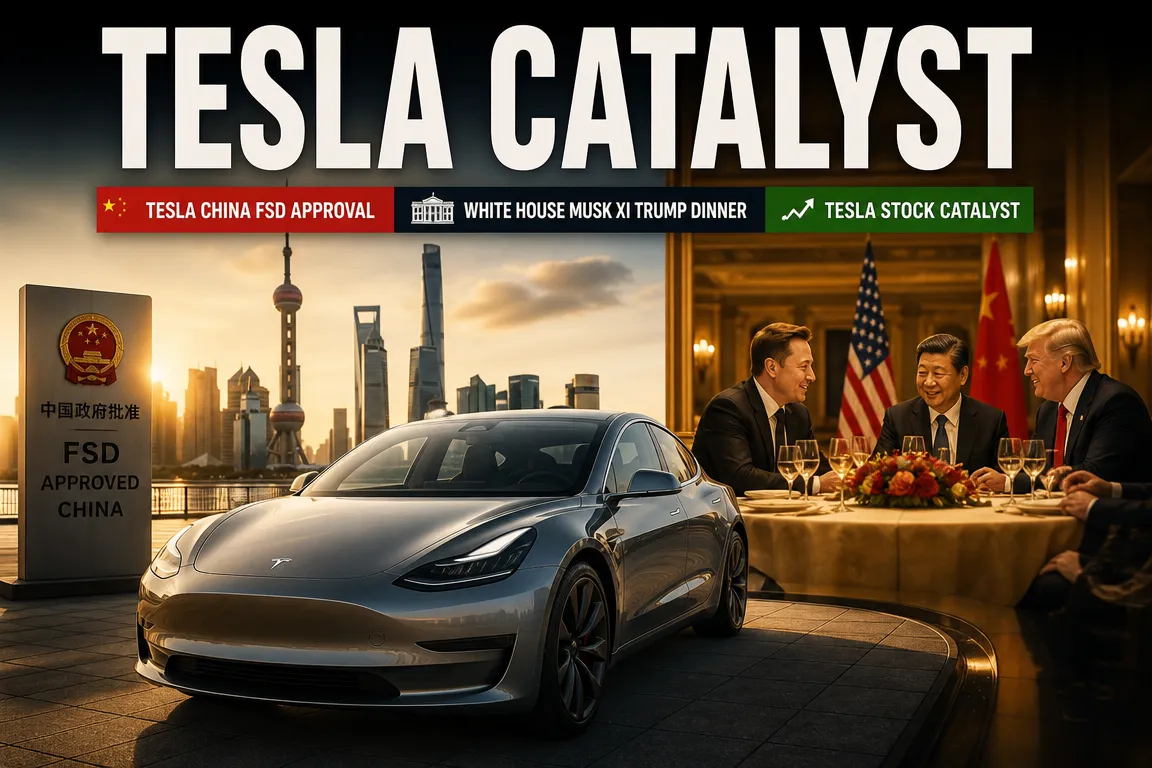
The core issue is not simply that Elon Musk will attend a White House dinner.
The real point is that China’s decision on Tesla’s FSD approval could affect Tesla’s China sales strategy, the competitive dynamics in the EV market, autonomous-driving valuation, and Tesla’s stock trend at the same time.
Many investors assume that “China FSD approval = the start of Tesla’s robotaxi business in China,” but that is a risky interpretation.
This report summarizes why the White House dinner guest list matters, what economic issues may emerge at the U.S.-China summit, why Tesla has resorted to cash discounts in China, and how a China FSD approval could affect Tesla’s earnings.
1. Why the White House Dinner Guest List Matters
The guest list for the White House East Room state dinner reportedly includes Elon Musk and other major figures from U.S. technology.
Reported attendees include Elon Musk, Jeff Bezos, Jensen Huang, Sam Altman, Sundar Pichai, Michael Dell, and Tim Cook.
This list is not just a social event roster.
It also provides a signal on which industries may be on the agenda at the U.S.-China summit.
Sam Altman and Sundar Pichai represent AI regulation and the race for AI leadership.
Jensen Huang represents semiconductor export controls and the AI chip supply chain.
Tim Cook represents Apple’s supply chain exposure to China and manufacturing dependence.
Elon Musk connects Tesla, SpaceX, and xAI.
He therefore sits at the intersection of EVs, autonomous driving, AI, China manufacturing, and semiconductor demand.
As a result, Musk’s presence should not be viewed simply as the attendance of a single CEO.
It should be viewed as an indicator of whether Tesla FSD could gain a more favorable position in China within the broader U.S.-China technology competition.
2. Core Issues in the U.S.-China Summit: Tariffs, Taiwan, AI, Semiconductors, and Rare Earths
Several major economic issues are likely to be discussed at the summit.
The first is tariffs.
As the deadline for the tariff truce approaches, a return to a more confrontational stance could create meaningful stress in global markets.
Past tariff levels exceeded 100% in some periods, showing that trade talks remain a sensitive market risk.
The second issue is Taiwan.
Taiwan is not only a diplomatic issue but also a central node in the semiconductor supply chain.
TSMC and the advanced chip production ecosystem are linked to AI, EVs, cloud infrastructure, and defense.
The third issue is artificial intelligence.
AI models, data, cloud infrastructure, and GPU access now affect both national security and economic growth.
The fourth issue is semiconductor export controls.
U.S. restrictions on high-end AI chip exports to China continue to affect Nvidia, AMD, cloud companies, and Chinese technology firms.
The fifth issue is rare earths.
Rare earths are essential for EV motors, batteries, defense systems, wind power, and advanced electronics.
Because China still has significant influence over the rare-earth supply chain, this issue is also tied to U.S. manufacturing policy.
3. Macro Environment: Why the Rate Outlook Continues to Pressure Growth Stocks
Tesla should not be viewed only through the lens of FSD.
The broader market backdrop remains interest-rate expectations.
A more hawkish shift in the Fed’s dot plot is a headwind for growth stocks.
The dot plot reflects each Fed policymaker’s expectation for the future policy rate.
Recent readings suggest a median policy rate of around 4.125% by the end of 2026.
Long-term rates may also remain elevated relative to the post-pandemic period.
This implies that rates may not return easily to the ultra-low levels seen in the past.
Tesla, Nvidia, and Apple are valued partly on future earnings discounted back to present value.
Higher rates reduce that present value and increase valuation pressure.
Therefore, even if a China FSD approval is announced, a less favorable rate environment could limit the stock’s upside.
4. Middle East Risk Adds to Market Uncertainty
The original text also referred to developments in the Middle East.
It mentioned that Iran delivered conditions to the United States through Qatar, including demands related to frozen assets and the removal of maritime restrictions.
It also referred to Houthi missile activity and possible attacks targeting Saudi Arabia.
Such risks could push up energy prices and logistics costs.
Higher oil prices would increase inflation pressure and reduce the scope for Fed rate cuts.
In short, Tesla’s stock environment cannot be explained by FSD approval alone.
It must be assessed together with U.S.-China relations, rate expectations, energy prices, and AI chip regulation.
5. Why the Market Is Sensitive to a Possible China FSD Approval
Tesla investors are paying close attention to this White House dinner because similar developments have occurred before.
According to the original text, Elon Musk and Jensen Huang accompanied President Trump during his state visit to China in mid-May this year.
About a week later, Tesla announced on X that China had been included in the list of countries where supervised FSD could be used.
That sequence was widely covered by both domestic and foreign media.
As a result, some investors now expect that Musk’s attendance at the dinner may indicate that China FSD approval is drawing closer.
This expectation is not entirely without basis.
There have been cases where industrial agreements or regulatory changes followed summits between national leaders.
The original text noted that China agreed to purchase 200 Boeing aircraft and referred to a large 737 MAX-related negotiation.
A summit may look like a diplomatic event, but in practice it can move aircraft, semiconductors, EVs, and AI services in bundled industrial agreements.
6. Tesla CFO’s Timeline for China FSD Approval
The original text stated that Tesla CFO Vaibhav Taneja mentioned a target of full China FSD approval in Q3 during the April earnings call.
If the quarter ends on September 30, that timing is close to the White House dinner.
That proximity is likely to increase market expectations.
If Tesla can fully offer FSD in China, the change would not be a simple feature update; it could alter the company’s revenue structure.
Tesla wants to be valued not only as an automaker but also as a software company.
FSD is a key product supporting that valuation framework.
If Chinese customers can already purchase FSD but cannot fully use it, then approval could significantly raise perceived value for existing buyers.
7. China FSD Pricing: A Premium Software Product Sold at a High Price
In China, Tesla FSD is reportedly priced at 64,000 yuan for a one-time purchase.
At the exchange rate cited in the original text, that is about KRW 13.06 million.
Compared with the former Korean price of about KRW 9.04 million, it is around 44% higher.
This pricing gap is important.
China is the world’s largest EV market and also one of the most competitive on price.
In such a market, selling a software option priced above CNY 60,000 has meaningful implications for Tesla’s profitability.
As margins on hardware narrow, software revenue from FSD can help support Tesla’s gross margin structure.
In other words, a China FSD approval is not just a sales-volume issue; it is also a margin-structure issue.
8. FSD Can Be Purchased in China, but It Is Not Yet Fully Usable
One point that many readers may misunderstand is important.
Tesla FSD is reportedly available for purchase in China.
However, it has not received full approval, so ordinary consumers cannot use it as freely as in the United States.
It is generally understood to be limited to test vehicles or restricted operating conditions.
By contrast, Xiaomi and Huawei are expanding driver-assistance functions rapidly within China.
Chinese consumers may still view Tesla as the original autonomous-driving brand, but in actual user experience, local brands are moving faster.
This is a difficult position for Tesla.
The company cannot yet use its strongest autonomous-driving differentiation point in the world’s largest EV market.
9. Tesla’s China Sales Weakness: August Decline and Cash Incentives
According to the original text, Tesla’s retail sales in China in August fell 12.43% year over year to 50,047 units.
The decline marked a third consecutive monthly drop.
It was also described as Tesla’s weakest August since 2022.
On a monthly basis, sales were down by roughly 7,000 units.
Following the slowdown, Tesla introduced cash incentives for inventory vehicles in China.
The reported incentives were CNY 10,000 for Model Y and CNY 5,000 for Model 3 at final settlement.
The key point is not the discount size but the method.
Tesla has not frequently used direct cash discounts in China over the past year.
Instead, it has relied on indirect promotions such as zero-interest financing, paint options, and insurance benefits.
The return of cash incentives suggests mounting pressure on sales in China.
10. Why FSD Approval Matters: Shifting From Price Discounts to Software Value
If Tesla can fully sell and deploy FSD in China, it may not need to rely as heavily on cash discounts.
Tesla’s preferred strategy is not to cut vehicle prices aggressively.
Instead, it aims to protect hardware pricing and improve total profitability through high-margin software such as FSD.
This is why China FSD approval matters.
Approval would allow Tesla to compete with Xiaomi, Huawei, and BYD on more than price alone.
It would let Tesla tell consumers that buying a Tesla also means access to usable FSD.
That message could influence purchasing decisions.
Premium EV buyers in China increasingly consider technology experience, software updates, and autonomous-driving capabilities alongside price.
For that reason, FSD approval could become a catalyst for Tesla’s sales recovery in China.
11. Cybercab on Display in China: A Show-Case Strategy, Not a Sales Launch
The original text also mentioned that Cybercab was displayed in Beijing and Shanghai.
The vehicle was shown at the Huamao Experience Store in Beijing and Taikoo in Shanghai, marking its first public appearance in China.
The timing of the display coincided with the week of the U.S.-China summit.
However, Tesla China said the event had no connection to sales.
It also said the display did not mean robotaxi commercial operations had begun in China.
In short, Tesla is showing the technology vision without claiming immediate commercialization.
This reflects Tesla’s current position in China accurately.
The technology can be displayed, but without regulatory approval and operating licenses, it cannot be sold or deployed commercially.
12. The Most Important Point: China FSD Approval and China Robotaxi Are Not the Same
This is a key distinction that is often missed in other coverage.
Even if China approves Tesla FSD, that does not automatically mean Tesla will receive permission to operate a driverless robotaxi business.
The FSD under discussion is supervised FSD.
It is generally classified as Level 2 autonomy, meaning the driver must remain attentive and ready to intervene.
Reuters and other outlets have reported that Chinese authorities are treating Tesla FSD as Level 2.
Level 2 approval is closer to driver-assistance authorization.
It is not equivalent to permission for an uncrewed robotaxi service.
To operate a true driverless robotaxi in China, Tesla would need separate approval under Level 3 or Level 4 standards.
According to the original text, China is expected to release those standards in 2027.
Without standards, it is difficult for the approval process to begin.
Therefore, even if FSD approval is announced soon, it should not be interpreted as the immediate opening of a China robotaxi revenue stream.
13. Technology Approval and Operating Licenses Are Different
Testing or offering autonomous-driving technology in China is not the same as operating a paid robotaxi service.
Technology approval means the function may be used under certain conditions.
An operating license means the company can carry passengers and charge for service.
Robotaxi operations in China require city-level approvals.
They also require safety records and operational data submitted to regulators.
Companies such as Baidu, Pony.ai, and WeRide have spent years testing and obtaining licenses in major Chinese cities.
Tesla is not believed to have a robotaxi operating license in China yet.
Accordingly, the realistic effect of a China FSD approval is not robotaxi revenue but stronger vehicle sales and increased software revenue.
14. Chinese Robotaxi Operators Are Still Not Profitable
Although robotaxis attract strong market interest, companies already operating in China have not yet achieved meaningful profitability.
The original text said WeRide’s first-half revenue rose 73%, but its net loss reached USD 98.86 million.
Pony.ai reported first-half revenue of around USD 70 million and only recently achieved break-even in one city, Guangzhou.
This shows that even when robotaxi technology works, monetization remains difficult.
Vehicle costs, sensor costs, operating staff, remote monitoring, insurance, accident liability, and city-level regulatory costs all matter.
For that reason, Tesla should not be criticized for not launching robotaxis in China immediately.
At this stage, using FSD to strengthen vehicle sales and software revenue is the more realistic strategy.
15. What This Could Mean for Tesla Stock
China FSD-related news has already moved Tesla shares in the past.
According to the original text, Tesla’s stock rose about 14% over six trading days when news emerged in May that Elon Musk would travel to China with President Trump, and the stock closed at USD 445 at the time.
This illustrates how sensitive the market is to possible China FSD approval.
The reason is straightforward.
China is the world’s largest EV market.
If a high-margin software product such as FSD can be sold there at scale, Tesla’s earnings estimates could change.
The original text also cited around 1.48 million global paid FSD users.
If China becomes part of that base, both subscription revenue and one-time purchase revenue could expand.
That said, investors should not assume that the stock will rise automatically.
Some of the optimism may already be priced in.
In addition, if approval is limited, if subscriptions are not enabled immediately, or if regional restrictions remain, the stock reaction may be weaker than expected.
The key issue is not approval alone but the scope of approval.
16. Key Items Investors Should Monitor
First, investors should verify the exact level of FSD approval granted by Chinese authorities.
It matters whether the approval is limited to Level 2 supervised driving or extends to more advanced driver-assistance functions.
Second, investors should check whether the feature is distributed immediately to general consumers.
If only test vehicles or limited users can access it, the earnings impact will be limited.
Third, investors should confirm whether a subscription model will be opened in China.
The original text noted that China is reportedly excluded from Tesla’s current FSD subscription country list.
A subscription model would support recurring revenue and is more favorable for valuation.
Fourth, data regulation remains critical.
China is highly sensitive to autonomous-driving data, map data, personal information, and vehicle operating data.
How Tesla handles local data processing and partnerships will matter.
Fifth, investors should track whether Tesla can reduce the use of vehicle discounts.
If FSD is approved but cash discounts continue to expand, it may indicate that demand recovery in China is weaker than expected.
17. The Core Point: This Is More About Margin Protection Than Robotaxis
The real significance of the China FSD issue is not robotaxi revenue.
The key question is whether Tesla can defend margins in China’s EV price war.
Competition from BYD, Xiaomi, Huawei, Nio, and Xpeng remains intense.
These companies are strengthening not only pricing but also driver-assistance features, infotainment, and smartphone ecosystem integration.
If Tesla competes only on vehicle price, its position could weaken further.
But if it can offer FSD as a usable feature, the competitive equation changes.
Consumers regain a reason to choose Tesla.
Investors gain a stronger basis to view Tesla as an AI software company rather than only an automaker.
For that reason, China FSD approval matters more for vehicle-sales recovery and software margin defense than for immediate robotaxi revenue.
18. The Most Realistic Outcomes for Tesla From the Summit
The most optimistic scenario is that China broadly approves Tesla’s supervised FSD and allows distribution to general consumers.
In that case, Tesla could use FSD as a major sales argument in China.
A neutral scenario would be a limited approval.
The feature may be available only in certain regions, on certain vehicles, or for certain users.
In that case, the stock may react in the short term, but the earnings effect would take time to materialize.
A negative scenario would be further delay.
In that case, Tesla may continue to rely on price discounts and promotions in China.
Competitive pressure from local brands would likely remain intense.
19. Conclusion: China FSD Approval Is a Test of Tesla’s AI Premium
The White House dinner and the U.S.-China summit could become an important turning point for Tesla investors.
Musk’s attendance alone is enough to raise expectations.
However, expectations should be interpreted carefully.
China FSD approval could be a major positive for Tesla, but it does not automatically mean the start of a China robotaxi business.
The realistic effects are improved China sales, expanded FSD software revenue, reduced price-discount pressure, and a stronger AI-company valuation premium.
The key question is whether Tesla can regain a differentiated position in China’s EV market.
If Tesla can provide FSD as a usable feature to Chinese consumers, it may move further away from being seen as only a car manufacturer.
If approval is delayed or limited, Tesla will likely continue facing a difficult price-based competition in China.
This issue is therefore not only a short-term stock catalyst, but also a test of whether autonomous driving and AI software can reshape EV industry economics.
< Summary >
Elon Musk’s attendance at the White House dinner is being linked to expectations of China FSD approval.
The main issues at the U.S.-China summit are tariffs, Taiwan, AI, semiconductor export controls, and rare earths.
Tesla is under pressure from weaker China sales and rising cash incentives.
If China approves FSD, Tesla could compete through software value rather than price discounts.
However, the likely approval would be for supervised Level 2 FSD, not driverless robotaxi operations.
The key issue is margin defense and China sales recovery, not immediate robotaxi revenue.
Tesla’s stock is likely to depend more on approval scope, subscription access, and actual consumer rollout than on the approval decision alone.
[Related Articles…]
Tesla FSD and the Autonomous Driving Market Outlook
AI Chips and the Shifting Global Technology Balance
*Source: [ 오늘의 테슬라 뉴스 ]
– 백악관 만찬에 머스크와 트럼프, 시진핑 — 중국 FSD 이번엔 허가 날까?
● Shocking, Urgent, Market Shift
Key Takeaways from John Lee’s Investment Philosophy: The Core Principle Is a “Time-Based Investing Structure,” Not Market Forecasting
The central message of this discussion is not simply to “invest in stocks for the long term.”
The more important issue is why the Korean economy became structurally centered on real estate, why pension and asset-management industries remain underdeveloped, and why individual investors continue to be exposed to market volatility.
John Lee linked Korea’s lack of financial education, misconceptions about stock investing, concentration in real estate, bank-centric financial structure, and retirement asset challenges into a single framework.
Against a backdrop of uncertain global economic outlook, recurring concerns over interest rates, exchange rates, and recession risk, the key focus for individuals is not market timing but asset allocation and long-term investing discipline.
1. “The market is not something to predict” — the real meaning
John Lee first pointed out that many retail investors treat stock investing as a game of price prediction.
They assume the essence of investing is to forecast when prices will rise or fall, and when to enter or exit.
He argues that if markets could be predicted, everyone would already be wealthy.
In other words, stock investing is not about forecasting the market, but about making time work in the investor’s favor.
The distinction lies in how the investment target is viewed.
Those focused on short-term price moves see stocks as numbers or charts.
Long-term investors, by contrast, view stocks as ownership in a business.
The essence of stock investing is to participate in the growth of companies as their earnings and intrinsic value expand over time.
Ultimately, the focus is not on market prediction but on quality businesses and long time horizons.
If investors believe they must track every variable — U.S. interest rates, exchange rates, CPI, FOMC decisions, and macro indicators — they can make investing unnecessarily complex.
While macroeconomic understanding is important, repeated buying and selling based on macro variables often causes investors to miss long-term performance.
2. Why Korean retail investors remain vulnerable: insufficient financial education
John Lee identified the lack of financial education as one of Korea’s most serious structural issues.
In school and at home, people are rarely taught how to make money work for them.
Instead, there has often been a cultural bias against discussing money.
As a result, many people enter adulthood without understanding how to manage capital and only learn through trial and error in the market.
He described this as financial illiteracy.
Financial illiteracy does not simply mean not knowing stock terminology.
It refers to a lack of understanding of assets versus liabilities, the importance of cash flow, the power of compounding, the balance between real estate and financial assets, and the structure of retirement planning.
The problem is that financial illiteracy eventually imposes a cost.
Issues such as retirement insecurity, debt burdens, wealth gaps among younger generations, and post-retirement income shortages are all connected to insufficient financial education.
Money is not everything, but without understanding money, personal options become significantly more limited.
Financial education should therefore be viewed not merely as investment instruction, but as a form of essential life preparation.
3. The essence of stock investing: making capital work
John Lee distinguished clearly between working for income and having capital work for you.
Many retail investors remain in a position where they are effectively working even while investing in stocks.
They monitor charts, react to news, track U.S. rates and exchange rates, and constantly search for entry and exit points.
In this case, the investor is still laboring to guess prices rather than allowing capital to work.
The alternative is to invest in strong businesses and wait for them to grow over time.
Capital is deployed into companies, and companies use that capital and their business model to create greater value.
This is the basic mechanism of capitalism.
For this reason, stock investing is closer to a long-term discipline than a trading technique.
The key is not one-time large purchases, but a steady habit of building assets over time.
Long-term investing means consistently allocating capital, maintaining positions over long periods, and benefiting from both dividends and earnings growth.
4. The critical difference between the U.S. and Korea: whether retirement assets flow into equities
John Lee emphasized the 401K retirement system as one of the most important features of the U.S. financial structure.
In the United States, when young employees contribute to retirement accounts, employers often provide matching contributions.
For example, if an employee contributes 1 million won, the company may add 500,000 won.
Under this structure, there is little reason not to invest for the long term.
These funds are generally difficult to withdraw before retirement age.
As a result, long-term capital naturally enters the equity market.
That capital is invested in companies, those companies grow, and the returns ultimately become retirement assets for households.
This retirement-system structure is one of the strongest foundations of the U.S. stock market.
In contrast, Korea has not yet created similarly strong flows of retirement capital into equities.
Retail participation remains high, and short-term trading behavior is also common.
As a result, when volatility increases, investors become anxious and may move into highly risky products such as leveraged or inverse ETFs.
John Lee argued that Korea needs a stronger system through which long-term capital can flow into companies and the stock market.
5. Korea’s structural challenge: capital flows into real estate instead of companies
One of the most important structural points in this discussion is the concentration of capital in real estate.
In Korea, real estate accounts for a very large share of household assets, while financial assets remain relatively low.
For retirement planning as well, many households rely more on a single property than on pensions or equity portfolios.
This structure can be risky for both individuals and the broader economy over the long term.
John Lee noted that in Korea, money has flowed into real estate in a way similar to Japan.
When capital is concentrated in property, less money reaches innovative companies.
If people become accustomed to earning rental income by purchasing property, the incentive to create innovative businesses or invest in new industries weakens.
This can reduce overall productivity and long-term economic growth.
He also referred to the issue of vacant commercial properties in regional areas.
Across the country, many storefronts remain empty, and numerous investors previously bought property on the assumption that real estate always rises.
However, if rental income is uncertain and the asset is not truly worth the assumed price, problems emerge.
Property debt remains even when asset prices fall.
6. Financially advanced markets versus Korea: investment banks vs. lending banks
When people think of the U.S. financial industry, names such as JPMorgan, Goldman Sachs, and BlackRock often come to mind.
These institutions do more than lend money; they allocate capital through investment and asset management.
Global capital flows into the United States and becomes the funding base for companies such as Google, Meta, Apple, and Nvidia.
Korea’s financial system, by contrast, remains heavily bank-centered and debt-oriented.
Banks fundamentally require collateral.
They lend to borrowers with assets that can serve as security and then earn interest.
However, innovative companies often lack collateral in their early stages.
Even when they have ideas and technology, financing can be difficult if they do not have real estate collateral.
This is why investment banks and asset managers matter.
Investment banks evaluate growth potential and business models rather than collateral alone.
Asset managers pool long-term capital and allocate it across companies and industries.
For Korea’s financial sector to develop further, the system must move from bank lending toward investment-led capital allocation.
7. More asset managers are needed for K-finance to develop
John Lee identified asset management firms as a key institution that must expand in the future.
A larger and more diverse asset-management industry would help capital flow into companies and industries.
At present, Korea’s asset-management sector is concentrated in Seoul, and regional investment ecosystems remain weak.
If capital is to reach future industries such as startups, AI, biotech, robotics, and semiconductors, the system must support more than traditional lending.
Young people need to participate in investing and entrepreneurship, while long-term capital must be mobilized and distributed.
This is central to changing the structure of the Korean economy.
What matters more than short-term stock picks is the financial system itself.
The government, companies, and individuals must work together to build a long-term investing structure and develop the retirement and asset-management markets.
Only then can Korea move away from dependence on rising property prices and toward an economy that consistently produces innovative companies.
8. The biggest retirement risk: owning a home without cash flow
A particularly important issue for retirees is the problem of property-based retirement assets.
Even if a person owns a home and appears wealthy on paper, retirement can still be unstable if there is no cash flow to support living expenses.
A home cannot easily be converted into regular income.
John Lee said individuals should first analyze the composition of their assets.
If more than 80% of net worth is in real estate, one must consider risks from price declines and weak liquidity.
Regional properties and commercial real estate, in particular, may not be easy to sell when needed.
In such cases, tools such as reverse mortgages may be worth considering.
It is also important to discuss financial conditions openly with family members.
Relying on ad hoc decisions or taking on debt to enter stocks is risky.
Retirement assets should be managed within a broader family financial plan.
9. The message is not “do not buy a home,” but “do not concentrate everything in one home”
John Lee’s message should not be interpreted simply as “do not buy real estate, buy stocks instead.”
The point is not that housing is bad.
The issue is putting all assets into a single property and spending decades repaying debt.
In that case, wealth becomes overly concentrated in one asset class.
From a diversification perspective, having all assets tied to one home is a major risk.
If property prices rise, the outcome is favorable; if they stagnate or decline, the risk increases significantly.
In an environment shaped by population decline and regional contraction, it is unrealistic to assume all property will keep rising as before.
He also challenged the conventional view of rent.
In Korea, rent is often seen as “wasted money.”
However, the real question is whether buying a home is financially superior to renting and investing the remaining capital.
The assumption that buying is always the right choice may reflect a lack of financial literacy.
10. The difference in housing psychology between Korea and Japan
John Lee also highlighted the differing perceptions of real estate among younger generations in Korea and Japan.
In Korea, when asked why they buy homes, many answer that prices are likely to rise next year.
In Japan, younger people are more likely to think prices may fall next year and therefore question the rationale for buying.
This difference is not merely cultural.
Japan experienced a prolonged property downturn, while Korea has had a long period of strong real estate appreciation.
As a result, the belief that property never fails remains deeply embedded in Korea.
However, past patterns may not continue if demographic trends, interest rates, and regional economic conditions change.
In the current uncertain global environment, investors should focus less on the assumption that asset prices will rise indefinitely and more on whether debt is manageable, whether cash flow exists, and whether assets are sufficiently diversified.
Real estate, like any investment asset, should be evaluated based on return and risk.
11. The most important point that is often underemphasized in media and commentary
The most important point in this discussion, and one that is often overlooked, is that the problem is not just individual investing behavior but also the financial system itself.
Retail investors’ short-term trading, concentration in real estate, and sensitivity to stock-market volatility are not simply the result of poor discipline.
They also reflect a lack of institutional and cultural mechanisms that channel capital into companies over the long term.
The U.S. system connects 401K plans, asset managers, investment banks, and equity-based retirement structures.
As a result, household retirement savings become capital for corporate growth, and corporate growth feeds back into household wealth.
Korea, by contrast, remains more concentrated in collateral-based lending, which channels money toward housing and commercial property.
This difference shapes the number of innovative companies, household retirement assets, and the overall scale of capital markets over time.
The real issue is not whether to buy Samsung Electronics, an ETF, or when to enter the market.
It is whether Korean society can move from a property-centered asset structure to a financial-asset-centered structure.
For individuals, the immediate task is to move beyond financial illiteracy and build long-term investing habits before the broader transition occurs.
12. A checklist for investors to review now
First, assess whether real estate makes up too large a share of total assets.
If a home represents most of net worth and there is no cash flow, retirement risk increases.
Second, determine whether stocks are being treated as a way to guess prices or as ownership in a company.
If decisions are driven mainly by charts and news, the investor may not be aligned with long-term investing.
Third, check whether retirement accounts such as pension plans, retirement savings accounts, and ISAs are being used effectively.
These accounts can provide both tax benefits and compounding advantages.
Fourth, confirm whether borrowing is being used to invest.
Leveraged investing can amplify returns in rising markets but can also create losses that are difficult to recover from in downturns.
Fifth, ensure that family members share a clear view of retirement assets and long-term planning.
Parents’ property, children’s housing plans, and post-retirement cash flow are interconnected issues.
13. John Lee’s investment philosophy in one sentence
Do not try to predict the market; make time your ally.
Stocks are not gambling instruments but ownership in businesses.
The assumption that real estate is always safe and stocks are always risky should be abandoned.
If capital remains locked in property, both individuals and the nation may lose growth opportunities.
Financial education, retirement systems, and asset-management industries can help reshape Korea’s long-term growth structure.
< Summary >
John Lee emphasized that the core of stock investing is not market prediction but investing through time.
Korea’s weak financial education has led many individuals to misunderstand stocks as a short-term price game.
The United States channels long-term capital into equities and companies through structures such as 401K plans, while Korea remains more dependent on real estate and debt-based allocation.
When assets are concentrated in property, retirees face higher risks from insufficient cash flow and asset-price weakness.
To prepare for the future, individuals need to move beyond financial illiteracy and build long-term investing, asset allocation, and retirement-account usage into their financial planning.
Korea’s economic structure will also need a stronger shift from bank lending toward investment banking and asset management to support sustainable growth.
[Related Articles…]
*Source: [ 경제 읽어주는 남자(김광석TV) ]
– “시장은 예측하는 게 아닙니다” 존리가 말하는 진짜 주식 투자법 | 경읽남과 토론합시다 | 존리 대표님 [1편]