● AI-Charged Growth, War-Fueled Inflation, High-Rate Risk
OECD Economic Outlook Update: AI Semiconductors Lift Growth, While Middle East Conflict Reintroduces Inflation and Rate Risks
The key message from this OECD outlook is straightforward.
The global economy remains under significant downside pressure from the Middle East conflict, but AI investment and semiconductor exports are offsetting a substantial portion of that shock.
In particular, the reason Korea received the largest upward revision among G20 economies is ultimately tied to the AI semiconductor cycle.
However, that is only a partial reading.
Headline growth has improved, but underlying domestic conditions remain weak, and semiconductor export gains continue to rely more on price effects than on volume expansion.
In other words, this OECD report is closer to a warning that “the global economy is holding up better than expected, but inflation and policy rate risks will persist longer.”
1. OECD Interim Outlook: The Global Economy Is Still Absorbing Shocks
The OECD has released its September interim economic outlook.
The OECD Economic Outlook is published in full in June and December, while interim projections focused on the global economy and G20 members are released in March and September.
The subtitle of this report is Weathering Successive Shocks.
The OECD said the global economy has shown greater resilience than expected despite the Middle East conflict.
This reflects sizable oil inventories, energy support measures by governments, and investment, production, and trade gains linked to the spread of AI.
- 2026 global GDP growth: 2.9%, up 0.1 percentage point from the June forecast
- 2027 global GDP growth: 3.0%, down 0.1 percentage point from the June forecast
- 2026 G20 inflation: 4.1%, up 0.1 percentage point from the June forecast
- 2027 G20 inflation: 3.6%, up 0.5 percentage point from the June forecast
Growth has not deteriorated sharply, but inflation is proving more persistent than expected.
That is the central message of the report.
2. Global Outlook: Low Growth Has Become Entrenched, and AI Has Limited the Downside
Since the pandemic, the global economy has not fully returned to its historical average growth rate.
The IMF, OECD, and World Bank all broadly agree that the world economy has entered a low-growth phase.
For 2026, growth is expected to weaken further, while 2027 should see a modest recovery that still leaves the economy below stronger historical norms.
The notable feature of this OECD outlook is AI.
The Middle East conflict is clearly adding pressure through energy prices and supply chains.
However, AI data centers, GPUs, memory semiconductors, semiconductor equipment, and power infrastructure investment are offsetting part of the downside.
In simple terms:
- Middle East conflict: downside pressure through higher oil, LNG, and commodity prices
- AI investment: upside pressure through higher investment in semiconductors, servers, data centers, and power grids
- Result: low growth, but no abrupt collapse
That is why the OECD described the global economy as “resilient.”
But that should not be interpreted too positively.
The economy is not growing strongly on its own; rather, a specific AI-related industrial cycle is cushioning the shock.
3. Core Impact of the Middle East Conflict: Inflation Is Not Easing Quickly
The most concerning part of the report is inflation.
If the Middle East conflict persists, the impact will not be limited to oil and LNG.
It will also affect petrochemicals, plastics feedstocks, polyethylene, and a broad range of industrial raw materials.
In particular, shipping disruptions in the Strait of Hormuz and surrounding routes would directly burden energy importers.
Such supply shocks can reaccelerate inflation and lift inflation expectations.
The OECD expects currently elevated international energy prices to stabilize gradually after the fourth quarter of 2026.
Until then, price pressure is likely to remain sticky.
Key downside risks include:
- Persistent increases in energy prices
- Supply shocks in agricultural and raw materials markets due to adverse weather, including El Nino
- Further increases in long-term government bond yields
- Higher logistics and insurance costs if the Middle East conflict continues
- Profitability concerns and high leverage in AI-related companies
If the conflict is resolved earlier than expected, lower energy prices and reduced market stress could support growth.
4. Policy Rate Outlook: The Case for Higher-for-Longer Has Strengthened Again
The OECD emphasized that monetary policy remains important for anchoring inflation expectations.
In practical terms, this means central banks will be reluctant to cut rates until inflation is clearly under control.
The resilience of the U.S. economy is especially important.
AI-related capital spending and broader investment by large technology companies continue to support U.S. growth.
When demand remains stronger than expected, inflation driven by supply shocks is harder to reverse.
As a result, if U.S. inflation does not quickly return to the 2% target, Treasury yields may remain elevated.
Because U.S. bond yields serve as the global benchmark, they affect asset prices, exchange rates, and capital flows in emerging markets.
The OECD outlook therefore sends the following message to markets:
- Inflation may decline more slowly than expected.
- Policy rate cuts may be delayed relative to market expectations.
- Higher-for-longer conditions could extend into the first half of 2027.
- The timing of a policy pivot depends on the Middle East conflict and the U.S. inflation path.
For investors, the key question is not whether rate cuts will come, but which assets can withstand a delayed easing cycle.
5. Korea Growth Forecast Revised Sharply Higher: The Largest Upgrade Among G20 Members
The OECD raised Korea’s growth outlook significantly.
- 2026 Korea GDP growth: 3.7%, up 1.1 percentage points from the June forecast
- 2027 Korea GDP growth: 2.6%, up 0.7 percentage points from the June forecast
- 2026 Korea inflation: 3.0%, up 0.4 percentage points from the June forecast
- 2027 Korea inflation: 2.7%, up 0.5 percentage points from the June forecast
In particular, the 2026 growth forecast for Korea rose from 1.7% in March to 2.6% in June and then to 3.7% in September.
This is the largest upward revision among G20 economies.
The OECD attributed Korea’s stronger outlook to robust exports and production growth.
It also expects a gradual recovery in consumption in 2027.
Inflation was revised higher as well.
That reflects both the stronger growth outlook and higher assumptions for international energy prices.
Korea’s inflation rate remains below the G20 average, but its reliance on energy imports leaves it exposed to Middle East risks.
6. Why Korea Is Especially Exposed: It Imports Energy and Exports AI Semiconductors
Korea is positioned to receive both downside pressure from the Middle East conflict and upside support from the AI cycle.
It is a major energy consumer, highly dependent on crude oil imports, and reliant on Middle Eastern supply.
As a result, a prolonged conflict would weigh on production costs, logistics, electricity prices, and the trade balance.
At the same time, Korea is deeply embedded in the global AI semiconductor value chain.
HBM, DRAM, NAND, semiconductor equipment, and materials all benefit from rising AI server demand.
Korea’s current position can be summarized as follows:
- Downside pressure: Middle East conflict, higher energy prices, and supply-chain disruptions
- Upside pressure: AI semiconductor exports, data center investment, and broader global capex spending
- Conclusion: AI semiconductors are offsetting a substantial part of the energy shock
That is the main reason the OECD raised Korea’s growth forecast so sharply.
However, that does not mean the improvement is being broadly felt across the economy.
7. Why Households and Businesses Do Not Feel the Recovery: Growth Is Too Concentrated in Semiconductors
Even if exports improve, the recovery may still feel weak because the gains are highly concentrated in semiconductors.
Korea has around 29 million employed people.
Even when including employees at Samsung Electronics and SK hynix, only a small share of the labor market is directly exposed to the semiconductor cycle.
Even when suppliers are included, most households do not experience the export boom directly.
As a result, GDP and export data may improve while wages, small-business sales, and household costs remain largely unchanged.
That is the core disconnect in the Korean economy today.
Another important point is that export growth has been driven more by price effects than by volume gains.
Export value equals price multiplied by volume.
When memory prices rise sharply, export value increases quickly.
But if volume does not rise alongside prices, export growth can slow sharply once pricing weakens.
8. The Key Issue Often Missed Elsewhere: Korea’s Semiconductor Risks Are Price and Market Share
The most important hidden point in this OECD outlook is the sustainability of Korea’s semiconductor exports.
Most headlines focus on the upward revision of Korea’s 2026 growth forecast to 3.7%.
However, the more important question is whether semiconductor prices are near a peak and whether Korean companies can maintain market share.
AI demand has pushed DRAM and HBM prices higher.
Supply shortages have driven up prices, and that has significantly increased Korea’s export value.
The issue is that shortages do not last forever.
If Micron in the U.S., CXMT in China, and Nanya in Taiwan expand production, supply constraints could ease.
If that happens, price momentum could weaken.
In some memory segments, oversupply concerns could eventually reemerge.
Market share is the second issue.
The U.S. and China are both pursuing semiconductor self-sufficiency.
Korea exports semiconductors to both markets.
But if both countries strengthen domestic supply chains, the market available to Korean companies could shrink.
Therefore, Korea’s main risk is not the Middle East conflict alone.
The larger risk is a combination of falling semiconductor prices, weaker market share, and slower AI investment growth.
9. AI Expansion Is a Growth Opportunity, but Bubble Risk Must Also Be Monitored
The OECD said AI diffusion supported global investment, production, and trade.
Investment is expanding across data centers, GPUs, memory, servers, power infrastructure, cooling systems, and communications equipment.
This trend is creating major opportunities for firms in the U.S., Korea, Taiwan, Japan, and parts of Europe.
However, the OECD also highlighted risks.
These include concerns about AI-sector profitability, heavy leverage, and overly aggressive capex competition.
In other words, AI is supporting real economic activity.
But not every AI investment will translate into profits.
The capital required for data centers, semiconductors, and power capacity is substantial.
If final service revenues and earnings fall short of expectations, the AI investment cycle could slow.
For that reason, the appropriate approach is to distinguish between companies that generate actual cash flow and those whose valuations are driven mainly by expectations.
10. OECD Policy Recommendations: Target Energy Support and Accelerate Structural Reform
The OECD offered several policy priorities for governments.
- Conduct monetary policy carefully to anchor inflation expectations
- Keep energy support measures targeted and temporary
- Gradually phase out broad-based subsidies that increase fiscal burdens
- Advance structural reforms to raise potential growth
- Build economic resilience against supply shocks
The key terms are well-targeted and phased out.
When energy prices rise, broad cash support for all households can create a large fiscal burden.
Instead, support should focus on vulnerable groups and energy-intensive sectors, and be withdrawn once conditions normalize.
The same applies to Korea.
In the short term, inflation and energy costs must be managed.
Over the medium term, growth drivers beyond AI semiconductors need to be developed.
11. Key Watchpoints for Investors and Companies
From an investment perspective, this OECD outlook highlights five key variables.
- First, international oil and LNG prices.
If the Middle East conflict continues, energy prices could again pressure inflation and corporate margins. - Second, the U.S. policy rate and long-term Treasury yields.
If inflation remains sticky, higher-for-longer conditions may weigh on growth-oriented valuations. - Third, the AI semiconductor pricing cycle.
DRAM, HBM, and NAND price trends are critical for Korean exports and earnings. - Fourth, Korean semiconductor market share.
Expansion by Micron, CXMT, Nanya, and others must be monitored closely. - Fifth, the profitability of AI investment.
The next phase of the cycle will depend on whether capex by major technology companies translates into revenue and earnings.
The market is no longer simply weighing recession against recovery.
It is facing a mixed environment in which AI-driven growth pressure and war-driven inflation pressure are operating at the same time.
12. Conclusion: Korea Is Clearly Stronger, but Structurally More Sensitive
The OECD’s upward revision to Korea’s growth outlook is clearly positive.
The fact that AI semiconductor exports are lifting the economy is also clear.
However, it is important to distinguish between broad-based growth and growth concentrated in a single sector.
At present, Korea’s headline performance improves when semiconductors are strong, and its growth outlook weakens quickly when the semiconductor cycle turns.
If the Middle East conflict pushes energy prices higher, U.S. rate cuts are delayed, and semiconductor prices correct, Korea’s economic pressure would rise on multiple fronts.
Accordingly, this OECD outlook should be read as both a statement that Korea is performing strongly and a warning that this strength is heavily dependent on AI semiconductors.
< Summary >
The OECD projects global GDP growth of 2.9% in 2026 and 3.0% in 2027.
The Middle East conflict is raising energy prices and inflation, but AI investment and semiconductor exports are cushioning part of the slowdown.
G20 inflation is forecast at 4.1% in 2026 and 3.6% in 2027, reinforcing the possibility of a prolonged high-rate environment.
Korea’s GDP growth forecast was raised to 3.7% in 2026 and 2.6% in 2027, the largest upward revision among G20 members.
However, Korea’s growth is heavily concentrated in AI semiconductors, creating a gap between macro data and household sentiment.
The main risks are weaker semiconductor prices, declining global market share, and slower AI investment returns.
This report highlights Korea’s stronger growth profile, but also its increasing structural dependence on semiconductors.
[Related Articles…]
*Source: [ 경제 읽어주는 남자(김광석TV) ]
– [속보] OECD 경제전망 보고서 : AI의 성장 압력과 중동전쟁의 인플레 압력 [즉시분석]
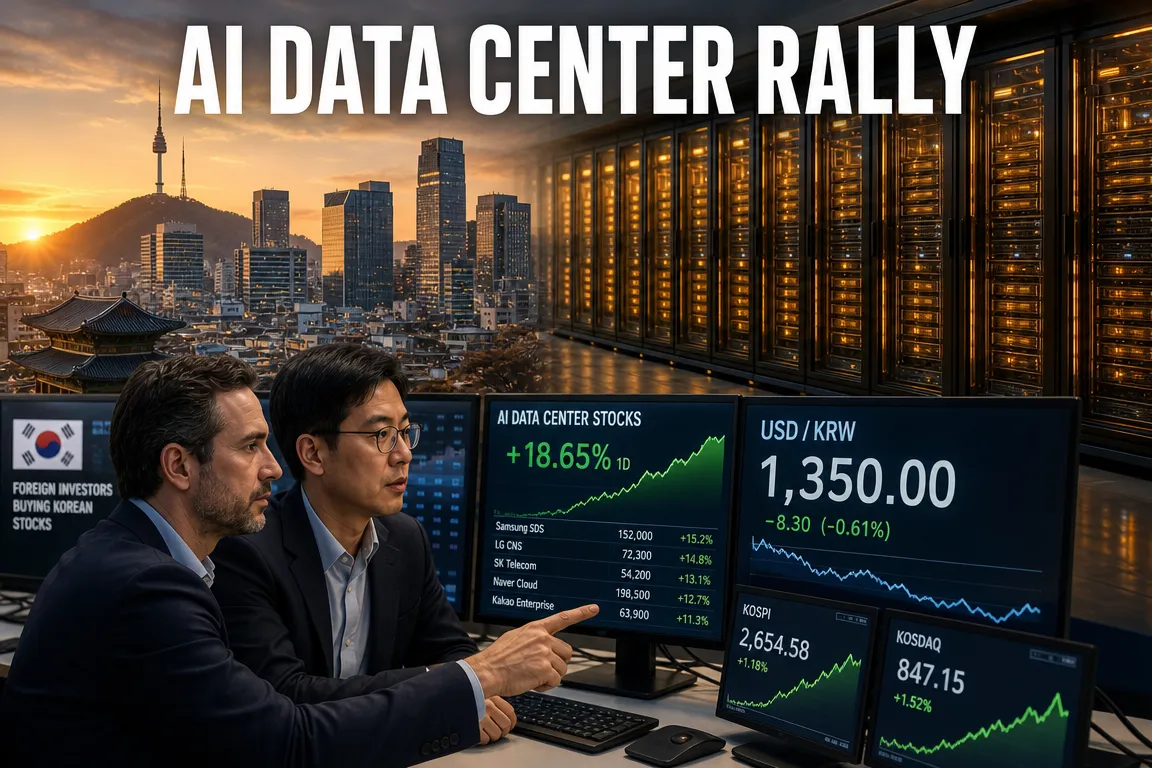
● Dollar-Slump, Foreign-Buying, AI-Surge
Exchange Rate in the 1,350 Won Range Reshapes the Investment Landscape: Foreign Investors Quietly Accumulating Korean Air, Telecom Stocks, and AI Data Center-Related Names
The key point of this article is not simply that the won has strengthened.
As the USD/KRW exchange rate has moved down to the 1,350 won range, overseas travel demand, airline earnings, foreign net buying, KOSPI liquidity, and the AI data center investment cycle are all becoming interconnected.
A particularly important point is that foreign investors are not only focusing on major semiconductor names such as Samsung Electronics and SK hynix, but are also gradually increasing exposure to Korean Air, telecom stocks, and AI data center infrastructure companies.
After Chuseok, the market is likely to diverge on one question: whether to focus only on memory semiconductors, or to also include AI infrastructure and won-benefit names.
This report summarizes the broader outlook across the exchange rate, foreign buying, KOSPI liquidity, U.S. interest rates, and AI data centers.
1. Entry into the 1,350 Won Range Changes Consumption and Investment Sentiment
As the USD/KRW exchange rate recently fell to around 1,353, market sentiment has begun to shift.
When the exchange rate was close to 1,400, overseas travel, foreign consumption, and airline ticket bookings were psychologically expensive for consumers.
At the 1,350 range, however, consumers may begin to view overseas travel as more feasible.
This shift affects more than the travel sector.
It can influence airlines, duty-free retailers, card companies, consumer names, freight operators, refiners, and import-dependent businesses.
In other words, a lower exchange rate can act as a valuation catalyst for selected sectors in the domestic equity market.
2. Changing Travel Patterns: Preference Shifting from LCCs to Full-Service Carriers and from Japan to Longer-Haul Routes
In the past, overseas travel demand expanded rapidly through low-cost carriers.
Japan routes in particular benefited from proximity, lower fares, and a weak yen.
Recently, however, consumers have been placing greater value on travel quality rather than frequency.
The preference for “travel less often, but more comfortably” can favor full-service carriers.
This trend is relatively favorable for Korean Air.
By contrast, LCCs remain exposed to intense short-haul competition, fuel costs, exchange-rate volatility, and financing concerns.
Another factor is China travel demand.
Available data indicate a recovery in China-bound travel, while U.S. routes are also showing signs of normalization.
By contrast, Europe routes have weakened due to exchange-rate pressure and high long-haul costs.
If the won stabilizes further, demand may broaden from Japan-focused short-haul travel toward U.S., China, and other long-haul routes.
3. Why Exchange Rates Remain Difficult to Forecast
Exchange-rate forecasting cannot be reduced to a simple view that the won will strengthen or the dollar will weaken.
The exchange rate is fundamentally a balance of supply and demand.
When demand for dollars rises, the exchange rate moves higher; when dollar supply increases, it moves lower.
The challenge is that this balance shifts continuously with growth expectations, U.S. rates, oil prices, inflation, foreign capital flows, and trade conditions.
If U.S. 10-year Treasury yields rise again or inflation proves sticky, dollar strength could return.
Conversely, if oil prices stabilize, inflation eases, and expectations for U.S. rate cuts improve, the USD/KRW rate may remain stable in the current range.
At this stage, the more important approach is not to predict the exact direction, but to monitor sectors that benefit from a lower won as well as those that can defend against renewed dollar strength.
4. KOSPI Liquidity: Individuals and Foreigners Sold, While Other Legal Entities Absorbed Supply
The most important point in recent domestic equity flows is the strong buying by other legal entities.
Based on the source material, other legal entities reportedly bought between KRW 1 trillion and KRW 2 trillion per day since August 20.
Meanwhile, over the past month, individuals are described as having net sold roughly KRW 20 trillion, while foreigners net sold around KRW 14 trillion.
Although the exact totals may differ slightly, the broad trend is clear.
The market did not fall sharply despite heavy selling from individuals and foreigners because other legal entities absorbed the supply.
In this context, the core driver was share repurchases by Samsung Electronics and SK hynix.
In other words, the market was not strong on its own; rather, buybacks by major semiconductor firms acted as a liquidity backstop.
5. Why the End of Buybacks by Samsung Electronics and SK hynix Matters
Samsung Electronics is said to have completed about 78% of its buyback program.
SK hynix is reported to have completed about 61%.
According to the source, Samsung Electronics has about 11.49 million shares remaining, suggesting the program could be completed within 5 to 6 trading days.
SK hynix reportedly has about 9.32 million shares remaining, implying another 14 to 15 trading days of repurchases.
Under this timeline, Samsung Electronics’ buyback could end in September, while SK hynix’s could continue until around mid-October.
The key period is after October.
Once Samsung Electronics’ buyback ends, the buying power from other legal entities is likely to decline.
The major buyer that has been absorbing supply from individuals and foreigners will no longer be as strong.
Accordingly, the critical question after Chuseok is whether a new buyer emerges to support the KOSPI.
6. Why Korean Equities Lag the U.S. Market: The Breadth of the AI Universe Differs
The U.S. equity market is recovering to record levels on the back of the AI investment cycle.
Korean equities, by contrast, have remained relatively range-bound.
This difference reflects the diversity of the AI industry structure.
The U.S. has names such as Nvidia, Microsoft, Amazon, Google, Meta, Oracle, and Broadcom across AI semiconductors, cloud, data centers, software, network infrastructure, and related services.
Using a baseball analogy, the U.S. market has left-handed pitchers, right-handed pitchers, sidearm pitchers, and closers all in place.
Korea, by contrast, remains centered on memory semiconductors.
Samsung Electronics and SK hynix are powerful memory players, but the broader AI data center ecosystem is more limited.
Compared with the U.S., Korea still has a thinner AI portfolio across optical communications, cloud platforms, large-scale data center operations, AI services, power infrastructure, and cooling solutions.
For Korean equities to reaccelerate, they need a growth story beyond memory semiconductors.
7. Following Foreign Investors: Focus on Names They Start Buying Unexpectedly
Foreign flows remain important from an investment perspective.
Foreign investors often trade tactically and may combine spot and futures positions as part of hedging strategies.
For that reason, simply copying foreign buying is risky.
However, one behavior is worth monitoring.
If foreign investors begin accumulating a stock they had not previously favored, the reason deserves analysis.
Sometimes the more important question is not why they continue buying well-known names, but why they suddenly start buying a new one.
A recent example cited in the source is Korean Air.
8. Foreign Investors Quietly Increasing Exposure to ① Korean Air
Korean Air has reportedly seen steady foreign net buying since August 25.
Foreign ownership is said to have increased from about 22.6% about a month ago to around 26.4% recently.
That scale of change suggests accumulation rather than short-term trading.
There are four main reasons Korean Air is drawing attention.
First, it could be repositioned as a larger national carrier after the integration with Asiana Airlines.
Once integration is complete, scale economies may improve route competitiveness, operating efficiency, pricing power, and the mileage ecosystem.
Second, it may benefit from a stronger won.
Airlines face significant dollar-denominated costs, including aircraft leases, fuel, and maintenance, so won strength can ease cost pressure.
Third, it is directly exposed to a recovery in long-haul travel demand.
Unlike LCCs, which are concentrated in short-haul routes, Korean Air has stronger competitiveness in long-haul markets such as the U.S. and Europe.
If the exchange rate stabilizes, consumers may once again consider long-haul travel, and major carriers are best positioned to capture that demand.
Fourth, cargo exposure matters.
Semiconductors, electronics, and high-value logistics are closely linked to air freight demand.
As AI semiconductor and server investment continues, air cargo demand could receive indirect support.
9. Korean Air vs. LCCs: Why Foreign Investors May Prefer the Larger Carrier
LCCs can also benefit from a recovery in travel demand.
However, foreign investors may view the risk profiles of full-service carriers and LCCs differently.
LCCs face intense route competition, greater sensitivity to fuel and exchange rates, and, for some companies, financing concerns.
By contrast, Korean Air has relatively lower concerns about capital dilution and has differentiation in long-haul routes and cargo operations.
After integration with Asiana, it may also gain stronger pricing power in the domestic market.
Integration costs and balance sheet considerations should still be monitored.
However, foreign investors may be focusing more on post-merger long-term dominance than on short-term cost issues.
10. Foreign Investors Quietly Watching ② Telecom Stocks
The second sector drawing attention is telecom stocks.
Traditionally, telecom names have been viewed as dividend stocks.
They are relatively insensitive to the cycle, generate stable cash flow, and have infrastructure-like characteristics.
More recently, however, telecom stocks have started to connect with AI data center infrastructure.
KT reportedly faces foreign ownership limits or is already close to those limits.
That may narrow foreign investors’ incremental options to SK Telecom and LG Uplus.
This point is important.
As foreign investors begin to assess Korea’s AI data center market, telecom operators with data center sites, network infrastructure, cloud connectivity, and power-related assets naturally come into focus.
11. Why Telecom Stocks Are Linked to AI Data Centers
An AI data center is not simply a building that houses servers.
It requires high-speed networking, large-scale power, cooling systems, security, cloud connectivity, and stable operations.
Telecom companies already have nationwide networks, enterprise customer links, and IDC operating experience.
As a result, once the AI data center market expands, telecom companies may be revalued as infrastructure operators rather than pure communications providers.
If AI data center investment accelerates in Korea, the role of the three major telecom companies could become more important.
If foreign investors begin to view telecom stocks not merely as dividend names but as AI infrastructure assets, valuation rerating could follow.
12. Foreign Investors Quietly Watching ③ AI Data Center-Related Names
Foreign investors have also been steadily accumulating selected AI data center-related names over a certain period.
The Korean government and domestic companies have announced AI data center initiatives, and expectations for actual construction and investment execution are rising.
One question is central for investors: is this real?
AI data center themes do not last long if they remain only at the announcement stage.
But if global technology firms treat Korea as a real demand market, the picture changes.
According to the source, after Nvidia GPU supply, Google is also exploring the possibility of supplying TPU to Korea.
The implication is significant.
It suggests that global firms see Korea as a market where AI infrastructure can materially develop.
13. Why Google TPU and Nvidia GPU Matter for Korea
The core asset in an AI data center is computing equipment.
Today, the global AI infrastructure market is led by Nvidia GPUs.
If discussions expand to include Google’s TPU, Korea could become an AI infrastructure market where both GPUs and TPUs are deployed.
In the U.S., competition among major technology firms in AI data centers is already intense.
China is a difficult market for global companies because of geopolitical and regulatory constraints.
That leaves Korea as a potential next expansion market.
Korea combines semiconductor manufacturing capabilities, power infrastructure, telecommunications networks, enterprise demand, and government support for AI development.
This is why foreign investors may see Korea as the next battleground for AI data centers.
14. Why AI Data Centers Could Become the Next Growth Driver After Memory Semiconductors
So far, Korea’s AI investment theme has been concentrated in memory semiconductors.
HBM, DRAM, NAND, and server memory demand have been the main beneficiaries.
However, once the AI data center market expands, the beneficiary base broadens.
Power equipment, transformers, cooling systems, telecom networks, construction, server racks, security, cloud operations, data center REITs, and semiconductor equipment can all be linked to the cycle.
This is not only a story about Samsung Electronics and SK hynix.
It is the emergence of a new industrial ecosystem.
AI data centers also require very large upfront capital expenditures.
As a result, companies with financial capacity, access to foreign capital, secured land, and policy alignment are likely to have an advantage.
Going forward, the key issue will be who can secure scale economies first.
15. The Core Point Often Missed in Other Coverage
First, the lower exchange rate is not just a consumption recovery theme; it is also linked to changes in foreign portfolio allocation.
As the won strengthens, airlines, travel, freight, and import-cost-sensitive companies may be reassessed.
Foreign investors, in turn, are likely to evaluate not only the exchange rate but also structural industry changes.
Second, the end of buybacks creates a KOSPI liquidity gap.
If Samsung Electronics and SK hynix have been supporting the market floor, that support may weaken after October.
At that point, the next sector to attract foreign buying could become the new market leader.
Third, AI data centers are a capital contest rather than a simple theme.
AI data centers do not materialize from announcements alone.
They require GPUs, TPUs, power, land, networks, cooling, operating capability, policy support, and external financing.
Ultimately, the companies that can raise capital and execute quickly are most likely to lead the market.
Fourth, Korea will need less dependence on memory semiconductors to participate fully in the AI rally.
The U.S. market remains strong because its AI ecosystem is broad.
Korea must expand beyond memory semiconductors into AI data centers, telecom infrastructure, and power infrastructure to raise its overall market upside.
16. Post-Chuseok Strategy: Track Foreign Flows and Industry Expansion Together
After Chuseok, the broader investment backdrop is unlikely to change abruptly.
The U.S. market remains supported by AI data centers and major technology earnings.
Korean equities are still being supported by memory semiconductors, but a new catalyst is needed for further upside.
There are three main candidate areas.
First, won-benefit names.
Companies such as Korean Air, which can benefit from a stronger won, long-haul travel recovery, cargo demand, and industry consolidation, belong here.
Second, AI data center infrastructure names.
Telecom operators, power equipment makers, cooling providers, data center operators, and server infrastructure companies may be included.
Third, companies receiving new foreign net buying.
Rather than focusing only on names that have already risen sharply, it is more important to track stocks that foreign investors are beginning to accumulate.
That said, investors do not need to buy everything foreigners buy.
Foreign flows are an input, while the final decision should also consider earnings, valuation, industry growth, and balance sheet strength.
17. Key Variables Investors Should Monitor
First, monitor whether the USD/KRW exchange rate remains stable in the 1,350 range.
If the won weakens sharply again, the case for airlines, travel, and import-cost beneficiaries weakens.
Second, monitor U.S. 10-year Treasury yields and inflation data.
If U.S. yields rise again, dollar strength and risk-asset correction could occur at the same time.
Third, monitor liquidity after Samsung Electronics and SK hynix complete their buybacks.
If the KOSPI remains resilient after buybacks fade, market strength may be better than expected.
Fourth, track changes in foreign ownership across key stocks.
What matters more than a single day of net buying is whether ownership continues to rise over time.
Fifth, watch whether AI data center investment announcements turn into actual construction and equipment orders.
The point at which a theme becomes earnings-driven can materially change stock behavior.
18. Summary by Key Names
Korean Air
The main themes are a stronger won, the Asiana integration, recovery in long-haul routes, and potential cargo growth.
The rise in foreign ownership also warrants attention from a flow perspective.
SK Telecom and LG Uplus
With KT facing foreign ownership constraints, these names may become alternatives for foreign investors seeking telecom exposure.
They combine dividend characteristics with AI data center infrastructure potential.
Large-cap AI data center-related names
If Google TPU, Nvidia GPU, government policy, private investment, and telecom affiliates converge, this could become a new growth sector.
However, investors should remain cautious because there is usually a lag between announcements and revenue generation.
Samsung Electronics and SK hynix
These remain the core of Korea’s AI semiconductor exposure.
However, after buybacks end, investors should monitor liquidity and memory pricing trends carefully.
Non-AI growth and consumption recovery names
A portfolio concentrated only in AI-related names may be highly volatile.
A diversified allocation that includes beauty, airlines, consumer names, and dividend stocks favored by foreign investors may remain appropriate.
19. Conclusion: After Chuseok, the Market Question Is Who Becomes the Next Breakout Name
At present, Korean equities cannot build an AI rally as strong as the U.S. market with memory semiconductors alone.
The market is therefore searching for the next growth story.
That candidate could be Korean Air as a won-benefit name, telecom companies linked to AI data centers, or power, cooling, and server infrastructure names.
The most important issue is where foreign investors are newly allocating capital.
Stocks with quietly rising ownership may provide the best signal for the post-Chuseok market.
Investors should connect exchange-rate trends, foreign buying, KOSPI liquidity, U.S. interest rates, and AI data center investment plans into a single framework.
The next market leaders are likely to emerge where those five factors converge.
< Summary >
The USD/KRW exchange rate has fallen into the 1,350 range, changing the outlook for airlines, travel, consumption, and foreign capital flows.
Buybacks by Samsung Electronics and SK hynix have supported the KOSPI floor, but that support may weaken after October.
Foreign investors are quietly increasing their exposure to Korean Air, with the key themes being a stronger won, Asiana integration, and recovery in long-haul routes.
Telecom stocks may be revalued not only as dividend names, but also as AI data center infrastructure names.
AI data centers could become a key theme that reduces Korea’s dependence on memory semiconductors and creates a new growth engine.
Post-Chuseok strategy should focus on foreign accumulation, won-benefit names, and AI infrastructure-related stocks.
[Related Articles…]
Exchange Rate Shifts and Their Impact on Global Equity Strategy
AI Data Center Investment Competition and the Outlook for Next-Generation Infrastructure
*Source: [ Jun’s economy lab ]
– 환율에 대한 생각과 외인이 몰래 비중늘리는 주식