● Tesla Semi Shock, 2500-Unit Surge, Hidden Tesla Share, Big Risk
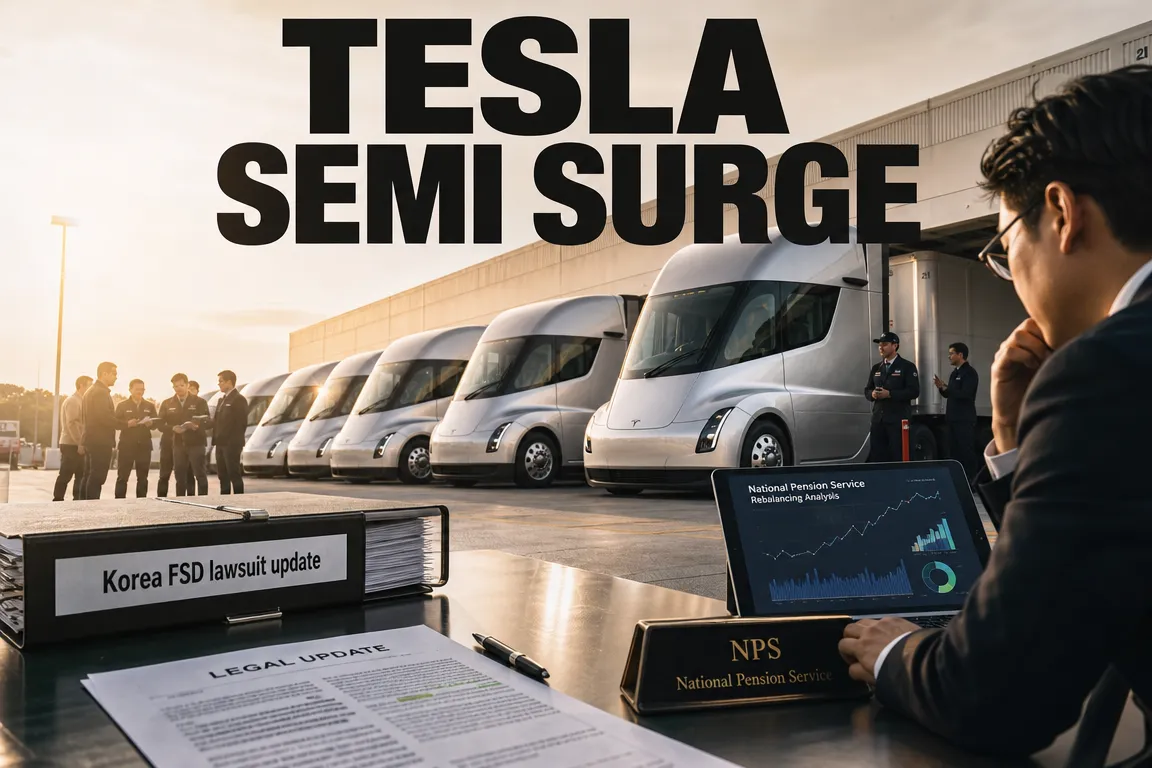
On the eve of the Tesla Semi plant opening, the number to watch is not 2,500 units, but Tesla’s share
The core issue is not simply that a record electric truck order has been announced.
While Tesla stock holds in the $380 range, the market is waiting for numbers that matter more than the headline order itself.
First, how many of the 2,500 electric heavy-duty trucks will actually go to Tesla.
Second, how quickly the Nevada Semi factory can ramp toward its annual target of 50,000 units.
Third, how much the Trump administration’s reported review of a diesel export restriction could affect the economics of electric trucking.
Fourth, how Tesla investment sentiment may be influenced by the Korea FSD lawsuit and the SpaceX lockup expiration.
Today’s discussion connects Tesla stock, U.S. Treasury yields, the electric truck market, the FSD lawsuit, and the SpaceX stock overhang.
1. Market backdrop: yields rose, but Tesla held up
According to the original report, Tesla closed at $380.12, up 0.32% on the day.
By contrast, the Nasdaq fell 1.13%, the S&P 500 declined 0.7%, and the Dow Jones Industrial Average lost 0.68%.
It was a session in which growth stocks broadly came under pressure from higher rates, yet Tesla showed relative strength.
The main backdrop was the rise in the U.S. 5-year Treasury yield to 5.03%.
This was the first move above 5% since 2007, and the market may interpret it as a sign that medium-term funding costs are at their highest in 19 years.
When Treasury yields rise, valuation pressure increases for growth stocks.
Companies like Tesla, where future growth expectations are heavily embedded in the share price, are especially sensitive to rates and inflation trends.
Even so, Tesla held up because the Semi factory and the large order headline carried greater influence that day.
In other words, Tesla was again viewed not only as an auto company, but as a key player in the electric truck market.
2. Diesel export restriction review: tailwind or headwind for electric trucks
Reports indicated that the Trump administration is reviewing a 90-day restriction on diesel exports.
Although no policy has been finalized, the market reacted immediately.
U.S. diesel futures fell more than 6%, while European diesel futures rose by more than 7%.
If the United States restricts diesel exports, diesel volumes that would have gone overseas would remain in the domestic market.
In that case, U.S. diesel prices could fall in the short term.
For trucking operators, lower diesel costs would be favorable.
For Tesla, however, the effect is more complex.
One of the key advantages of an electric truck is lower operating cost per mile versus diesel trucks.
If diesel prices fall, that cost advantage may narrow.
That could weaken the argument that electric trucks deliver major fuel savings.
However, one important point remains.
The reported diesel export restriction is being considered as a short-term 90-day measure.
Trucking operators do not evaluate purchases or leases based on only three months of fuel prices.
They assess total cost of ownership over five, seven, or even ten years.
For the electric truck market, the key issue is not whether diesel is cheap today, but whether future costs are predictable.
3. Record electric heavy-duty truck order: not all 2,500 units will go to Tesla
The nonprofit Catalyst Mobility announced an order for 2,500 electric heavy-duty trucks.
This is the largest order ever announced in the U.S. electric truck market.
Some estimates suggest that the order could nearly double the number of electric heavy-duty trucks currently on U.S. roads.
Compared with prior major orders, the scale is clearly larger.
In August, Einride announced a 500-unit order, which had been considered a leading benchmark.
In May, WattEV also announced a 370-unit order.
This new order totals 2,500 units.
In just a few months, the order size has increased to roughly five times the earlier benchmark.
IMC Logistics also announced an additional 50 Tesla Semis on the same day.
Taken together, this suggests that demand for electric heavy-duty trucks may be moving beyond the trial phase and into commercial adoption.
However, investors should be careful about one key point.
The 2,500 units have not been confirmed as Tesla Semis alone.
According to the report, Tesla is mentioned as a principal manufacturer, but Kenworth and Volvo are also included as supporting manufacturers.
That means operators may choose among different electric truck brands depending on terms and availability.
In short, the 2,500-unit electric truck order is confirmed.
But it is too early to say that Tesla has secured the full 2,500 units.
For Tesla shareholders, the key figure is not the total order size, but Tesla’s allocated share.
4. The real significance of the order: it changed the risk structure, not just sales volume
The importance of the order is not limited to sales volume.
More importantly, it changes how electric trucks are financed and deployed.
According to the report, the order aggregation role is being handled by Zescal, with large companies such as Microsoft and PepsiCo also participating.
The actual purchase was made by a leasing company, JF Financial.
That company buys the 2,500 trucks and then leases them to operators.
This structure matters because the biggest obstacle to electric truck adoption has been residual value risk.
For diesel trucks, secondhand value can be estimated with some confidence after five years.
For electric trucks, battery life, new model cycles, and price declines make residual value harder to forecast.
Operators and lenders have been reluctant to absorb that risk.
This leasing structure shifts much of that burden away from the operator.
Operators can pay a monthly fee and use the vehicle without worrying as much about what it will be worth in five years.
The leasing company assumes the residual value risk, while major shippers help secure volume commitments.
Manufacturers can lower prices by building to a larger production scale.
That is the point that is often underemphasized in other coverage.
This order is not only about how many Tesla Semis were sold.
It signals that the financial structure needed for broader electric truck adoption is being established.
5. Tesla Semi economics: lower cost per mile versus diesel is the key
Dan Priestley, who leads Tesla’s Semi program, has said the Semi is designed to deliver a lower cost per mile than diesel trucks.
For electric trucks to succeed in commercial logistics, operating economics matter more than design.
Logistics is a business driven by numbers.
What matters is the cost per mile, maintenance expense, and vehicle utilization.
The report also noted that when diesel prices first exceeded $6 per gallon, Morgan Stanley estimated an economic benefit of roughly 20 million won per Semi per month.
The higher diesel prices are, the greater the cost advantage for electric trucks.
Conversely, lower diesel prices can reduce that near-term advantage.
What operators really want, however, is not the cheapest fuel price on a given day.
They want predictable cost structures.
If diesel prices can move 6% in a single day based on policy headlines, long-term fixed charging costs may become more attractive.
6. Stock impact: a 2,500-unit order alone is unlikely to drive a major re-rating
According to Electrek, the Tesla Semi long-range configuration is priced at about $290,000 per unit.
If all 2,500 units were Tesla Semi long-range trucks, the total value would be about $725 million.
That is roughly KRW 990 billion.
Given Tesla’s second-quarter revenue of about $28.2 billion, that would equal approximately 2.6% of quarterly sales.
Moreover, this amount would not be recognized all at once in a single quarter.
It would likely be booked over several years as vehicles are delivered.
As a result, this order alone is unlikely to drive a sharp near-term revaluation of Tesla stock.
The more important issue is repeatability.
If this structure works, a second or third large order could follow.
With a target size of 10,000 units referenced in the report, 2,500 units may be only the starting point.
For investors, the question is changing.
It is no longer whether there is demand for electric trucks, but whether Tesla can produce them at scale.
7. The Nevada Semi factory: the market should focus on these numbers tomorrow
Tesla’s Semi factory is set to hold its opening ceremony in Nevada.
The reported designed annual capacity is 50,000 units.
The facility covers approximately 158,000 square meters, or about 48,000 pyeong.
That is roughly 5% of Yeouido’s area.
However, designed capacity and actual production are different.
Electric vehicle plants require an initial ramp-up period.
According to Electrek, analysts estimate Tesla Semi deliveries this year at between 5,000 and 15,000 units.
Still, early mass production often encounters bottlenecks.
The Semi factory is also linked to 4680 battery cell production at Giga Nevada.
Mass production of the Semi is likely to depend on battery supply.
Production speed is therefore not only a factory assembly issue.
It also depends on 4680 cell supply, charging infrastructure, supply chains, and logistics systems.
One possible disappointment at tomorrow’s opening would be the absence of concrete numbers.
If Tesla only offers a tour and test drives without weekly production guidance, annual output targets, or the timing of first large-scale deliveries, the market may react negatively.
Given current expectations, Tesla may need to provide specific figures.
8. What Tesla shareholders in the $380 range should watch
If Tesla is trading in the $380 range, near-term headlines matter less than confirmation points.
The first checkpoint is Tesla’s allocated share of the 2,500-unit order.
Whether Tesla receives a majority share, or only a limited allocation despite being described as a principal manufacturer, will matter.
The second checkpoint is the Nevada factory’s initial production pace.
What matters more than the 50,000-unit annual target is how many units Tesla can actually produce this year and next year.
The third checkpoint is 4680 battery supply.
The Semi uses a large number of cells.
If battery supply is constrained, deliveries may be delayed even if orders are secured.
The fourth checkpoint is the direction of diesel prices.
If the diesel export restriction remains only a short-term policy, the broader shift toward electric trucking may not change materially.
But if diesel prices fall structurally, the economic case for electric trucks could weaken somewhat.
The fifth checkpoint is whether Semi delivery figures are disclosed separately in the third-quarter earnings release.
If Tesla wants to position the Semi as a distinct growth driver, it will need to provide trackable metrics.
9. FSD update and Korea litigation: a technical issue is becoming a legal issue
Tesla has begun rolling out FSD version 14.2 Lite to Model S and Model X vehicles equipped with Hardware 3.
Model 3 and Model Y vehicles with Hardware 3 reportedly received the update in July.
Model S and Model X are receiving it about two months later.
FSD Lite can be viewed as a limited version of Hardware 4 FSD functionality adapted for Hardware 3 vehicles.
Hardware 3 vehicles had been tied to FSD version 12 for some time, but the Lite version is moving them into the version 14 family.
The issue is that this FSD Lite rollout is now linked to legal disputes in Korea.
At the Seoul Central District Court’s Civil Division 30, 98 Tesla owners are pursuing a lawsuit against Tesla Korea over FSD option payments.
The reported judgment date is October 29.
The plaintiffs argue that they purchased the FSD option about nine years ago but did not receive the core functionality and are seeking contract termination.
Some owners claim FSD Lite was installed even though they had turned off automatic updates.
They are concerned Tesla may use partial functionality as evidence that the contract has been fulfilled.
Tesla Korea says some functionality has already been delivered and that the rollout timing may differ depending on regulatory approval by country.
The plaintiffs counter that FSD Lite was introduced only after they sought termination and is not the same as the functionality originally promised.
This lawsuit is not simply about refunds.
It concerns how courts will define the gap between promised autonomous driving functionality and what was actually delivered.
The ruling could affect how autonomous software is sold going forward.
10. SpaceX lockup expiration: an indirect factor in Tesla sentiment
According to the report, SpaceX fell 4.11% to $148.36.
That remains about 9.9% above the $135 IPO price, but about 34% below the June peak of $225.
The decline was linked to two factors.
First, SpaceX President Gwynne Shotwell disclosed a plan to sell 332,170 shares.
The position is worth roughly KRW 71 billion.
These shares came from stock option exercises and were part of a prearranged sale plan established in June.
Second, SpaceX’s lockup expiration is approaching.
According to the report, up to 328.4 million shares are scheduled to be released, worth about $48.7 billion, or roughly KRW 66 trillion, based on the closing price.
Lockup expiration does not mean all shares will be sold immediately.
However, markets are sensitive to the possibility of a large supply overhang.
Because SpaceX and Tesla are both linked through Elon Musk, changes in SpaceX sentiment can also affect Tesla sentiment indirectly.
11. The most important point that other coverage often misses
The core issue is not whether demand exists for electric trucks, but whether the financial structure and production capacity are opening at the same time.
This 2,500-unit order is important as validation of demand in the electric truck market.
But its larger significance is that the leasing structure reduces residual value risk.
The reasons operators hesitated were not limited to vehicle performance.
Battery life, resale value, financing risk, and charging infrastructure were all barriers.
This structure reduces financial risk materially.
Large shippers such as Microsoft and PepsiCo commit volume, the leasing company holds the vehicles, and operators use the trucks through monthly payments.
If this model works, electric truck adoption could accelerate materially.
For Tesla, however, this is where the real test begins.
Securing orders is easier than manufacturing and delivering vehicles.
The Semi uses significantly more battery capacity than passenger EVs, and reliability is critical in commercial transport.
Therefore, the Nevada factory’s production numbers, 4680 battery supply, and charging infrastructure plans are the real focus of this story.
< Summary >
The 2,500-unit electric truck order is the largest ever announced in the U.S. electric heavy-duty truck market.
However, it has not been confirmed that all 2,500 units will go to Tesla.
The key figure for Tesla is how many units it actually receives.
The reported diesel export restriction may temporarily reduce the fuel-cost advantage of electric trucks, but operators care more about long-term cost predictability.
The real significance of the order is that the leasing structure reduces residual value risk.
For the Nevada Semi factory, the initial production pace and 4680 battery supply matter more than the 50,000-unit annual target.
The Korea FSD lawsuit could become an important precedent on autonomous software sales and delivery obligations.
SpaceX’s lockup expiration may also have an indirect impact on Tesla sentiment.
For Tesla shareholders in the $380 range, the key variables are Tesla’s allocated share of the order, Semi production volume, battery supply, diesel prices, and whether Semi deliveries are disclosed separately in earnings.
[Related Articles…]
*Source: [ 오늘의 테슬라 뉴스 ]
– 역대 최대 트럭 주문 다음 날, 트럼프 행정부가 디젤 카드를 만지작거립니다 — 근데 내일 공장 여는 테슬라가 봐야 할 숫자는 따로 있습니다, $380 주주는?
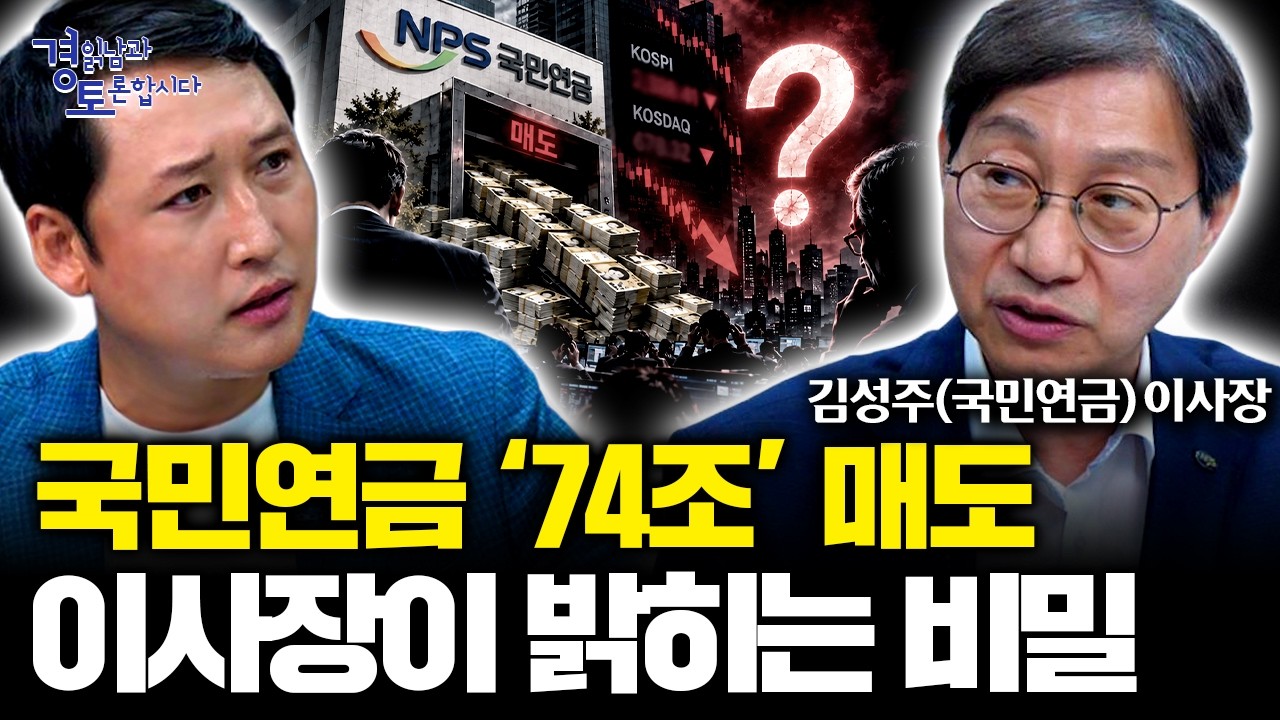
● Pension Fund Shock, KOSPI Jolt, AI Surge
Has the National Pension Service become a market mover? The key issue is not rebalancing, but a structural shift in asset allocation
There are three main points in this debate.
First, the perception that the National Pension Service dominates the KOSPI is materially different from the actual figures.
Second, interpreting all National Pension Service trading as rebalancing distorts market analysis.
Third, the National Pension Service has already evolved from a Korea-focused institutional investor into a global, large-scale long-term allocator.
A clear understanding of this issue provides a more nuanced view of the National Pension Service, the KOSPI, domestic equities, overseas investment, and the AI semiconductor cycle.
In particular, the market should move beyond the simplistic view that “the KOSPI weakened because the National Pension Service sold” and examine the real sources of volatility.
1. Key point from the news: the National Pension Service accounts for about 6% of the KOSPI market capitalization
The most important figure in this discussion is the National Pension Service’s share of the KOSPI market capitalization.
The National Pension Service was described as accounting for approximately 6% of the total KOSPI market cap.
However, the market often assumes that the National Pension Service controls 60% to 70% of the KOSPI.
That misconception supports an exaggerated narrative that when the National Pension Service buys, the market rises, and when it sells, the KOSPI collapses.
In reality, the KOSPI is shaped by foreign investors, retail investors, and institutions together.
The video described the KOSPI investor base as a 3-3-3 structure among foreigners, retail investors, and institutions.
Foreign ownership was described as rising to around 40%, retail participation moving within the 35% to 40% range, and domestic institutions estimated at around 27%.
The National Pension Service is one investor within the institutional group.
In other words, it is an important market participant, but not an absolute force that independently drives the entire KOSPI.
2. The truth about rebalancing: not all National Pension Service trading is rebalancing
The key term in this debate is rebalancing.
Many investors assume that every National Pension Service trade is rebalancing.
However, the video emphasized that rebalancing is only one part of the National Pension Service’s investment framework.
The broader framework is medium-term asset allocation.
Medium-term asset allocation is a five-year plan that determines how assets are allocated among domestic equities, overseas equities, domestic bonds, overseas bonds, and alternative investments.
This plan is reviewed again at the end of May each year, with annual detailed adjustments also made afterward.
The next concept is strategic asset allocation, or SAA.
For example, if the target allocation for domestic equities is 15%, the actual weight may rise to 15.5% or 16% as markets advance.
Conversely, it may fall to 14% or 13% when markets decline.
If the National Pension Service were to buy and sell continuously in response to every small change, trading activity would become excessive.
For that reason, a tolerance band is set around the target allocation.
Rebalancing occurs when the portfolio moves outside that band and must be returned to the target range.
In simple terms, rebalancing is not the core of the National Pension Service’s investment process, but a peripheral mechanism.
Yet the market often treats this peripheral mechanism as more important than the core strategy.
That is the starting point of the rebalancing debate.
3. Why was rebalancing suspended and then resumed?
The video directly addressed the political interpretation surrounding the suspension and resumption of rebalancing.
Some argued that the suspension was intended to support stock prices ahead of the election.
Others suggested that rebalancing was resumed only after the election.
In response, the National Pension Service stated that the key issue was not the political calendar, but the need to determine whether the market’s rapid rise reflected temporary overheating or a structural shift.
According to the explanation, the KOSPI had risen rapidly from below 3,000 to above 4,000 and then to 5,000.
In such a market, the National Pension Service faces two choices.
The first is to sell domestic equities in line with the existing asset allocation framework and reduce the weight back toward target.
The second is to increase domestic equity exposure if the market rise reflects a structural change rather than a short-term overheating phase.
The problem is that a major increase in the domestic equity allocation cannot be made impulsively.
The National Pension Service revises its medium-term asset allocation on an annual May schedule within a five-year framework.
As a result, changing the established framework abruptly in January would have been operationally difficult.
Ultimately, the decision was described as a six-month suspension of rebalancing in order to observe the market and assess the trend.
After the end-May revision of the medium-term asset allocation, the domestic equity weight was raised from 14.9% to 20.8%, and the suspended rebalancing process was resumed.
The core message is therefore that this was driven by the annual asset-allocation process and market assessment, not by the election cycle.
4. The real source of KOSPI volatility: the AI semiconductor cycle, not the National Pension Service
One notable point in the discussion is that KOSPI volatility was attributed more to the AI semiconductor cycle than to National Pension Service selling.
The main drivers of the KOSPI’s move this year have been expectations for Samsung Electronics and SK Hynix earnings.
In particular, AI semiconductors, HBM, and data-center investment trends have had a strong impact on Korean equities.
Because Samsung Electronics and SK Hynix represent a large share of the KOSPI, global investors increasingly view Korea as an AI semiconductor exposure market.
The video even suggested that if Samsung Electronics and SK Hynix were listed in the U.S., American equities would likely have risen further.
This indicates that the core driver of the Korean market is not National Pension Service trading, but semiconductor earnings and global capital flows.
The outlook for the AI semiconductor cycle remains divided.
Some view AI investment as only beginning.
Others are concerned about overinvestment, a bubble, and potential supply gluts.
When expectations diverge in this way, foreign capital and retail sentiment can shift quickly.
As a result, KOSPI volatility increases.
Adding war, oil prices, interest rates, and broader global financial stress makes the market even more unstable.
Accordingly, explaining the KOSPI correction through the National Pension Service alone is too simplistic.
5. The National Pension Service is no longer only a domestic market giant
In the past, the National Pension Service held a much larger domestic allocation.
The video stated that in 2017, domestic investment accounted for about 70% and overseas investment for about 30%.
The structure has now changed materially.
Domestic investment is around 40%, while overseas investment has risen to around 60%.
This shift is highly significant.
It means the National Pension Service is no longer an investor operating only within the Korean market.
The National Pension Service has grown into a global institutional investor with exposure to more than 80 countries.
The global investment scale was described as being around 1,000 trillion won.
Total assets under management were described as approximately 1,800 trillion won.
At that scale, the National Pension Service is not merely a domestic pension fund, but a major global liquidity provider with significant bargaining power in financial markets.
Large global investment banks and asset managers seek to do business with the National Pension Service for this reason.
The National Pension Service is no longer a big fish in a small pond; it is a large global allocator operating across markets worldwide.
6. What it means that equities now account for more than 50% of the portfolio
The equity share in the National Pension Service portfolio was described as already exceeding 50%.
This suggests a more aggressive investment posture than many assume.
Many people associate pension funds with conservative bond-heavy portfolios.
However, in an environment of low growth, low birth rates, aging demographics, and higher interest-rate volatility, bonds alone are unlikely to deliver sufficient returns.
This is why the National Pension Service has expanded into overseas equities, alternative assets, global infrastructure, and private markets.
To secure pension payments over the long term, simple capital preservation is not enough.
The fund must generate returns that exceed inflation over time and support future benefit obligations.
For that reason, the National Pension Service maintains a meaningful allocation to risk assets in pursuit of long-term return enhancement.
From this perspective, focusing only on domestic equity rebalancing captures only a small part of the overall picture.
7. National Pension Service returns and depletion timing: the core issue is sustainability, not stock-price support
The video also highlighted the National Pension Service’s recent performance.
It stated that the fund ranked first among the world’s five largest pension funds over the past three years.
It also noted an investment return above 27% in the first half of the year.
If that return were maintained or improved through year-end, it would represent a highly strong result among major global pension funds.
The key issue is the purpose of the National Pension Service.
The National Pension Service is not designed to support the KOSPI.
Its core objective is to manage retirement savings effectively and provide pensions stably.
Higher investment returns can delay the depletion timeline of the fund.
The video cited a deficit onset in 2048 and depletion in 2064.
Of course, the sustainability of the National Pension Service cannot be solved by returns alone.
Contribution rates, replacement rates, demographics, growth, and fiscal policy also matter.
Still, stronger returns clearly help delay depletion.
Ultimately, the central question is not whether the fund lifted the KOSPI, but whether it generated stable long-term returns for retirees.
8. The real issue the market is missing: raising domestic equity weight is not simply a buy signal
One point that is often underemphasized in other media coverage is that increasing domestic equity weight from 14.9% to 20.8% is not simply a statement that “Korean stocks should be bought more.”
This decision may also indicate a changed long-term assessment of the Korean market.
The rationale may include the AI semiconductor cycle, expectations for a narrower Korea discount, and improved corporate governance through reforms.
If the rise in the KOSPI reflects not a short-term thematic surge but stronger earnings and higher valuation confidence, then increasing the domestic equity target would be reasonable.
If, however, the rally is excessive, the same decision could carry risk.
That is why the National Pension Service appears to have observed market conditions for a period before incorporating the change into medium-term asset allocation.
This is the key point.
Although rebalancing appears to be a short-term trading issue, it is in fact linked to how Korean equities are assessed as a long-term investment destination.
Without this perspective, the discussion is reduced to whether the National Pension Service bought or sold shares.
9. Investment implications for individual investors
This discussion also offers several lessons for individual investors.
First, markets should be viewed through an asset-allocation lens, similar to the National Pension Service.
Many retail investors focus on a single stock or a short-term theme.
By contrast, the National Pension Service allocates across domestic equities, overseas equities, bonds, alternative investments, and cash-like assets for long-term management.
Individual investors should also avoid concentrating all capital in the KOSPI or in a single AI semiconductor stock and instead diversify across asset classes.
Second, rebalancing is a risk-management tool, not a signal of forced selling.
When asset prices rise sharply, portfolio weights increase and risk rises accordingly.
Reducing some exposure in that case is not necessarily a bearish view, but a move back toward the intended risk level.
Third, KOSPI direction should be analyzed with greater emphasis on the semiconductor cycle and foreign capital flows than on National Pension Service activity.
Earnings from Samsung Electronics and SK Hynix, investment in AI data centers, HBM demand, and the global rate environment are likely to have a more direct impact on the KOSPI.
Fourth, the debate over National Pension Service depletion should not be reduced to fear-based messaging.
It is a multifaceted issue involving fund returns, system reform, and demographic change.
The real question is not whether benefits can be paid, but how a sustainable pension structure can be built.
10. One-sentence summary of the debate
The National Pension Service is better understood as a global asset-allocation institution pursuing long-term returns and risk management than as a political tool that drives the KOSPI.
Its domestic equity trading can influence market sentiment, but it is an overstated explanation for KOSPI volatility.
The main variables for the KOSPI this year are the AI semiconductor cycle, foreign inflows, global rates, geopolitical risks, and Korean earnings expectations rather than National Pension Service rebalancing.
When analyzing the National Pension Service, the key question is not whether it sold or bought, but why it changed its asset allocation.
That is where the true direction of both the Korean market and the National Pension Service becomes visible.
< Summary >
The National Pension Service accounts for roughly 6% of the KOSPI market capitalization.
Interpreting all National Pension Service trading as rebalancing is an inaccurate view.
Rebalancing is a process of adjusting within tolerance bands under medium-term asset allocation and strategic asset allocation.
The suspension and resumption of rebalancing were described as part of the process of determining whether the market’s sharp rise was temporary overheating or a structural shift, not as a response to the election cycle.
The main drivers of KOSPI volatility are closer to the AI semiconductor cycle, foreign capital flows, global rates, and geopolitical risk than to the National Pension Service.
The National Pension Service has shifted from a domestic investment focus to a global long-term investor with overseas exposure at around 60%.
Its objective is not to support stock prices, but to strengthen long-term pension sustainability through improved returns.
[Related Articles…]
- National Pension Service Asset Allocation and KOSPI Outlook
- AI Semiconductor Cycle and Korea Equity Strategy
*Source: [ 경제 읽어주는 남자(김광석TV) ]
– 국민연금이 팔면 코스피 무너진다? 리밸런싱의 진실 | 경읽남과 토론합시다 | 국민연금 김성주 이사장 [1편]