● AI Bottleneck Surge
AI Bottleneck Investment Map 2027: After GPUs Come Memory, Power, Cooling, Networks, Data, and AI Agents
What really matters in AI investing is not “what will be hot?” but “which bottleneck comes next?”
The market is currently focused only on Nvidia GPUs and HBM memory, but the actual flow of money is already preparing to move to the next bottlenecks: power, cooling, networks, data, and AI agent infrastructure.
In this article, we will organize the sequence of AI infrastructure bottlenecks, the beneficiary companies by bottleneck, the counterattack of on-device AI, the shift from cloud to hybrid AI, and the criteria individual investors must look at to time their entries.
In particular, unlike other news or YouTube content that simply lumps everything together as “AI beneficiaries,” here we have reinterpreted things around how market leaders change each time the bottleneck shifts.
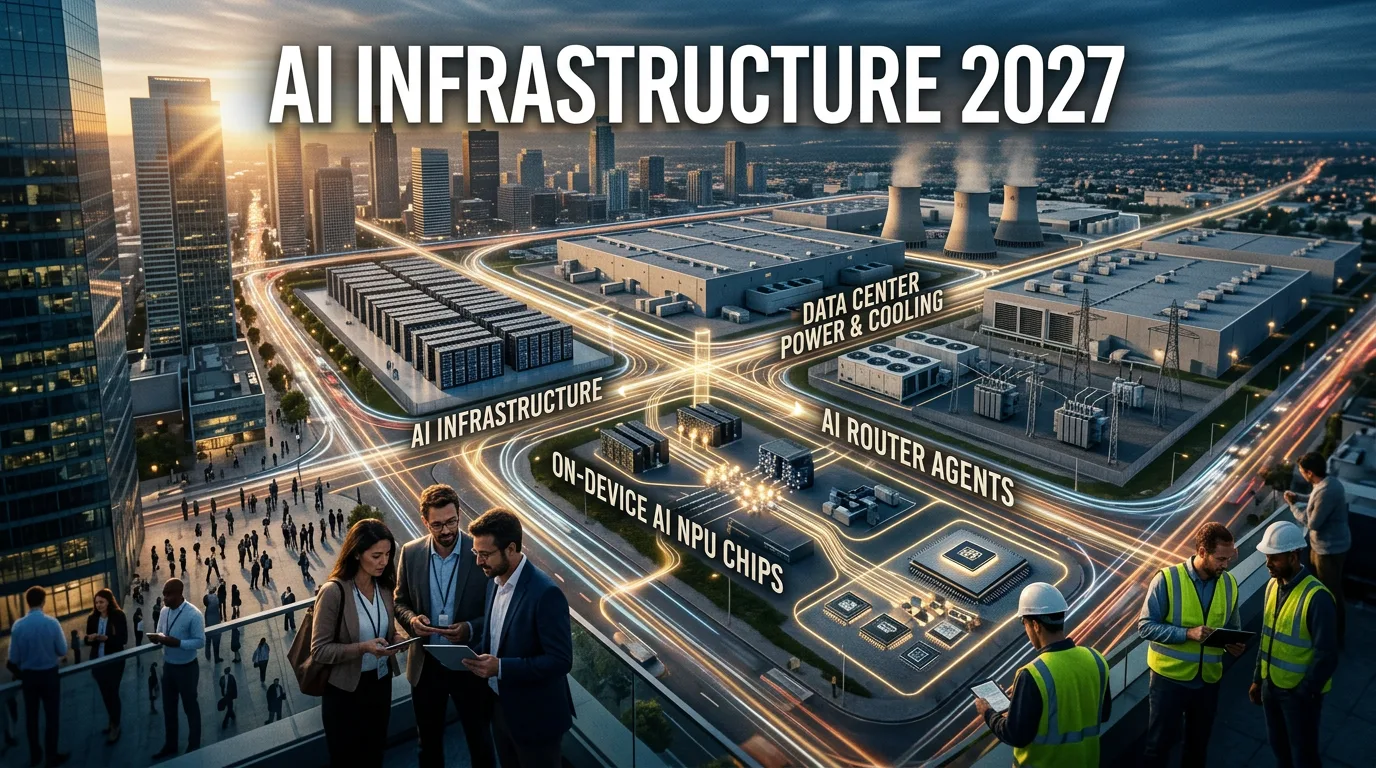
1. The core sequence of AI bottlenecks: GPU → Memory → Power → Cooling → Network → Data
The AI industry does not grow simply because model performance improves.
As models get larger, computation, memory, power, data centers, cooling, networks, and data quality all have to keep up.
That is why, in AI infrastructure investing, it is important to ask, “What is the most lacking thing right now?”
- Stage 1: GPU bottleneck — shortage of high-performance chips for AI computation.
- Stage 2: Memory bottleneck — rising demand for high-performance memory such as HBM, DRAM, NAND, and LPDDR.
- Stage 3: Power bottleneck — surging data center electricity consumption expands demand for power grids, power generation, and electrical equipment.
- Stage 4: Cooling bottleneck — heat problems in high-density servers raise the importance of immersion cooling, water cooling, and HVAC equipment.
- Stage 5: Network bottleneck — the limits of copper-based connections drive demand for optical communications and CPO.
- Stage 6: Data bottleneck — the need for cleaned data, vector databases, and data governance for AI to work properly.
The ideal scenario investors hope for is to get in ahead of this sequence and wait.
In reality, however, bottlenecks do not move neatly in order; multiple bottlenecks often break at once, or market expectations are priced in ahead of time.
So it is risky to approach this by simply saying, “Next are power stocks,” or “Next are cooling stocks.”
The key is to understand the sequence of bottlenecks while checking whether the company actually has the technology and earnings to solve that bottleneck.
2. The first bottleneck: semiconductors and GPUs remain the starting point of AI infrastructure
The biggest bottleneck in AI infrastructure is still semiconductors.
In particular, large-scale AI training and inference require high-performance GPUs.
The most representative company in this area is Nvidia.
Nvidia sits at the center of the AI data center market, controlling not only GPUs but also the CUDA ecosystem, networking, and server platforms.
However, as GPU prices rise too high and supply constraints grow, interest in alternative chips is also increasing.
- Nvidia — the undisputed leader in the AI GPU market.
- AMD — rising as an alternative to Nvidia in the AI accelerator market.
- Intel — making another push in GPUs, AI accelerators, and server CPUs.
- Broadcom — gaining attention in custom AI semiconductors and ASICs for big tech.
- Oracle — drawing attention through AI cloud infrastructure and specialized data center strategies.
The important point here is that the AI semiconductor market does not end with GPUs alone.
Big tech companies are actively introducing in-house AI chips, custom ASICs, NPUs, and TPU-family chips to cut costs.
In other words, as the GPU bottleneck grows, the GPU replacement market can also grow alongside it.
3. The second bottleneck: HBM and memory, the hidden core of AI servers
If GPUs are the engine of AI computation, HBM and high-performance memory are the fuel system that feeds data into that engine quickly.
As AI models get bigger, memory bandwidth becomes more important than raw computation performance.
For this reason, the HBM market has become one of the hottest areas in the AI semiconductor supply chain.
- Samsung Electronics — holds a broad portfolio covering HBM, DRAM, NAND, and memory for on-device AI.
- SK hynix — a key company showing strong competitiveness in the HBM market.
- Micron — a leading U.S. memory company benefiting from rising demand for AI server memory.
One more point to watch is Chinese memory companies.
Despite U.S. semiconductor regulations, China is building its own semiconductor ecosystem based on domestic demand.
- YMTC — a leading Chinese NAND flash company.
- CXMT — a leading Chinese DRAM company.
If Chinese smartphone makers such as Huawei and Xiaomi strengthen their own ecosystems, demand for Chinese memory could also rise.
In particular, since countries outside the U.S. alliance may also choose Chinese semiconductors, the global semiconductor supply chain is expected to become even more complex.
4. The opportunity in on-device AI: the backlash against cloud AI has begun
As large data centers and cloud AI grow, the need for on-device AI is growing in parallel.
If all data is sent to the cloud, costs, security, and privacy issues arise.
That is why on-device AI, which processes AI directly inside smartphones, PCs, wearables, cars, and home appliances, is becoming more important.
This trend could create new replacement demand in the smartphone market.
Just as the move from feature phones to smartphones caused the device market to explode, AI phones could create a new premium device cycle.
- Apple — strengthening a privacy-centered on-device AI strategy.
- Samsung Electronics — holds Galaxy AI, on-device AI, memory, and mobile APs at the same time.
- Qualcomm — a key player in smartphone and PC NPUs and on-device AI chipsets.
In on-device AI, NPUs and low-power memory are important.
In particular, demand for LPDDR6, high-performance NAND, and mobile DRAM could expand.
AI infrastructure is not growing only around data centers; the shift toward distribution inside devices must also be watched.
5. The third bottleneck: power, the most realistic limit for AI data centers
AI data centers consume enormous amounts of electricity.
Data centers running tens of thousands of GPUs are not just server facilities; they are closer to massive power-consuming facilities.
That is why power grids, power plants, power equipment, and power management solutions are drawing attention as the next bottleneck in AI investing.
- Korea Electric Power Corporation — of interest from the perspective of power grids and electricity supply infrastructure.
- SMR-related companies — small modular reactors are emerging as a long-term power supply alternative.
- Wind, solar, and thermal power companies — linked to rising data center power demand.
- Vertiv — a leading provider of data center power and cooling infrastructure solutions.
- Schneider Electric — a strong player in power management, automation, and energy efficiency solutions.
As AI data centers increase, grid stability becomes even more important.
In the U.S. especially, big tech companies are reviewing nuclear power, renewable energy, and long-term power purchase agreements.
This is not a short-term theme but one connected to long-term infrastructure investment.
Although AI looks like a software revolution, in reality it is expanding into a question of power grid investment and energy security.
6. The fourth bottleneck: cooling, a market shifting from HVAC to immersion cooling
AI servers generate a lot of heat.
Racks packed with high-performance GPUs run into limits with conventional air cooling alone.
That is why water cooling, immersion cooling, refrigerants, and thermal management component companies are drawing attention.
- HVAC equipment companies — rising demand for data center cooling systems.
- Immersion cooling companies — solving heat issues by submerging servers in special cooling liquids.
- Refrigerant and materials companies — supplying key materials that improve cooling efficiency.
- Data center equipment companies — providing integrated solutions for power and cooling management.
Cooling is not just a simple parts theme.
It is a core technology for reducing data center operating costs, increasing server density, and improving power efficiency.
Going forward, AI data center competitiveness will depend not only on “how many GPUs were secured” but also on “how efficiently they are cooled and operated.”
7. The fifth bottleneck: networks shifting from copper to optical communications and CPO
Inside AI data centers, data movement between GPUs and servers is exploding.
No matter how good the GPU is, if the network is slow, overall performance suffers.
That is why attention is shifting from copper-based networks to optical cables, optical devices, and CPO technology.
- Optical device companies — supplying core components that raise data transmission speeds.
- Optical cable companies — expanding demand for connections inside and outside data centers.
- CPO-related companies — improving power efficiency and speed by bringing chips and optical communications closer together.
- Lumentum Holdings — a company drawing attention in optical communications components and optical solutions.
CPO stands for Co-Packaged Optics.
In simple terms, it is a technology that improves data transmission efficiency by bringing optical communication functions closer to the semiconductor package.
As AI data centers become more advanced, network bottlenecks are likely to be mentioned more often.
8. The sixth bottleneck: data, where AI performance ultimately depends on data quality
No matter how good AI is, if the data is poor, the results will be poor too.
For companies to use AI properly, they need to organize and connect internal documents, meeting minutes, emails, customer data, and work data.
That is why data cleaning, data archiving, vector databases, and data governance companies can benefit.
- Data cleaning companies — convert unstructured data into a form that AI can read.
- Data archiving companies — systematically store internal company information and make it searchable.
- Vector database companies — provide core infrastructure for AI search and RAG systems.
- Data security companies — protect sensitive information and manage access rights.
In the future enterprise AI market, how well a company connects its own data may matter more than the model itself.
In particular, financial, manufacturing, healthcare, defense, and semiconductor companies have limits if they rely only on external AI models.
Because these companies must build AI systems based on their own data, the role of data infrastructure companies grows.
9. From cloud AI to hybrid AI: three directions in enterprise AI strategy
Enterprise AI adoption can be broadly divided into three directions.
The first is simply using public-cloud-based foundation models as they are.
This offers strong performance and fast adoption, but there are security and cost issues.
The second is operating AI models on-premises or inside a private cloud.
Security is strong, but it is difficult to use every feature of the latest models, and the operational burden is high.
The third is hybrid AI.
Sensitive data is processed inside the company, and when external model capabilities are needed, only the necessary information is selected and sent to the public model.
- Public AI — advantages are fast adoption and top performance.
- Private AI — advantages are security and control.
- Hybrid AI — seeks a balance of performance, cost, and security.
For example, let us assume a company is analyzing next year’s business strategy.
Meeting minutes, internal reports, and performance data are first analyzed inside the company firewall.
Then, if the external model’s reasoning ability is needed, the system does not send the entire file; instead, the router selects only the necessary information and passes it to the external model.
The key technology here is the AI router.
The AI router decides which tasks should be handled by the internal model, which by the external model, and how much data should be sent.
In the future enterprise AI market, router solutions, AI orchestration, and secure relay platforms could become important beneficiary areas.
10. The age of foundation models alone is ending, and vertical SLMs and sovereign AI are rising
Not every company needs to use only the highest-performing large models.
Depending on the task, smaller and lighter models may be more efficient.
They are lower cost, optimized for specific tasks, and easier to align with internal security requirements.
In this trend, sovereign AI and vertical SLMs are getting attention.
- Sovereign AI — a strategy for a country or company to secure independent AI sovereignty.
- Vertical SLM — a small language model tailored to a specific industry such as finance, manufacturing, healthcare, or law.
- Derivative model development companies — companies that build custom models for enterprises based on large models.
In Korea, companies such as Samsung SDS and Saltlux are mentioned in the areas of enterprise AI, data, and model building.
This area is much bigger than simple chatbot development.
That is because you have to understand the company’s business processes, data structure, security policies, and industry regulations together.
11. The age of AI agents: every company will have an agent after its website and app
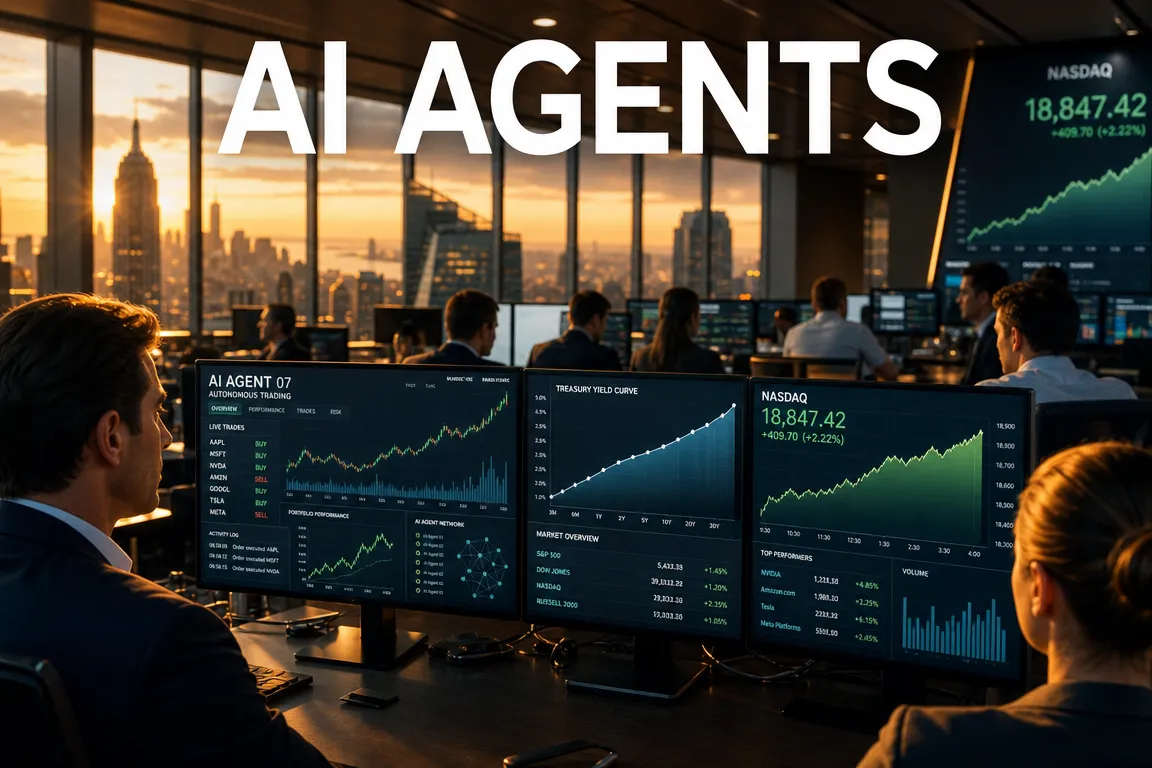
One of the biggest changes in the 2027 AI market is AI agents.
An AI agent is not just a chatbot that answers questions.
It is closer to a digital worker that understands the user’s request, opens the necessary apps, calls APIs, finds documents, and carries out tasks.
In the future, companies are likely to fall into three groups.
- Organizations where AI agents and humans work together.
- Organizations using only tools at the chatbot level.
- Organizations still working only with people.
An important concept here is the master agent and sub-agents.
The master agent is the main AI the user calls.
For example, it could be the AI assistant on a smartphone or the main AI in an enterprise work portal.
But the master agent cannot directly provide every service in the world.
That is why each company needs to create its own sub-agent and connect it to the master agent.
Just as every company once had to build a website and later a mobile app, in the future every company may have to create its own AI agent.
- SK AX — drawing attention in enterprise AI transformation and system building.
- Samsung SDS — enterprise AI, cloud, data, and automation solutions.
- LG CNS — digital transformation, cloud, and AI system building.
- Agent solution companies — building enterprise-specific work agents and API connection structures.
The AI agent market is much more complex than simple app development.
That is because it requires connecting internal systems, security permissions, external APIs, databases, and workflows.
So this area is likely to become a market where SI companies, cloud companies, AI solution companies, and data companies all compete.
12. What other news talks about less: the real beneficiaries may be “routers and the connection layer,” not “models”
Many news reports focus on visible beneficiaries like Nvidia, HBM, power stocks, and cooling stocks.
But in the long run, even more important areas may be AI routers, plugins, and the agent connection layer.
Companies will not use only one AI model going forward.
Depending on the task, they will mix GPT-family models, open-source models, internal SLMs, and industry-specific models.
At that point, a system is needed to decide which model to use and when.
That is the AI router.
In addition, the plugin ecosystem that calls external services, controls internal company software, and executes multiple tasks in sequence is also likely to grow.
In the end, the core of the AI era may not be “the single smartest model,” but rather “the structure that safely and efficiently connects multiple models and services.”
This area may still not be fully priced into the market.
13. How to time your investments: longer horizons matter more than bottleneck order
Knowing the order of AI bottlenecks may make it seem like you can time your investments.
Earn from GPUs, move to memory, move to power, move to cooling, move to networks.
In theory, it is a beautiful strategy.
But in reality, it does not move that cleanly.
Stock prices often rise before the actual bottleneck appears, and if expectations get overheated, prices can fall even when earnings are good.
That is why the important thing is a long horizon rather than short-term trading.
- Understand the technology.
- Check whether the company actually uses that technology well.
- Verify the company’s earnings, investment, M&A, and business direction.
- Look at it from a horizon of at least one year, and ideally three years.
- Do not invest with borrowed money.
The reason individual investors often fail is that they sell quickly when something spikes, buy again if it rises further, and then sell again in fear when it drops.
In the end, they get swept away by market noise and lose the original investment thesis they had set.
AI investing is in a rapidly changing industry, but investment judgment should actually be made slowly.
14. One-month validation strategy: do not buy immediately; let the technology and company mature
One impressive part of Kim Ji-hyun’s tech writer investment style is the one-month validation period.
First, she continuously observes the AI market and IT trends.
Then, when she becomes convinced about a specific bottleneck and company, she investigates intensively for about a month.
The factors checked at that time are as follows.
- Is this bottleneck actually growing?
- Does this company have the technology to solve that bottleneck?
- Are recent earnings and order trends supporting it?
- Do recent investments or M&A align with that direction?
- Is actual business execution stronger than market expectations?
The important thing here is not just searching the news.
You need to look at where the company is actually spending money.
If it says it is doing AI but investment, hiring, product launches, and partnerships do not follow, you should be cautious.
15. Scout strategy: buy one share and record your emotions and judgment
One interesting method is the “scout” strategy.
When you become interested in a company, you buy just one share before making a full investment.
The purpose of that one share is not to make money, but to observe.
When you actually hold it, your attention to the news, stock price, and company changes becomes different.
And even if you do not later invest in earnest, you can look back and see whether your judgment at the time was right.
It was also mentioned that one share is left when selling.
The reason is to track your past judgments.
The shares left in the brokerage account become a kind of investment journal.
If you leave captures and records and use AI tools to review your own investment decisions, the learning effect can increase.
What individual investors lack most is not information but review.
You need to record why you bought, why you sold, and what you missed so that your next decision improves.
16. Do not copy concentrated betting: the important thing is principle, not temperament
In the video, a concentrated investment approach was also mentioned when conviction in a certain area grew strong.
However, the speaker also explained that this is a downside.
It is dangerous for individual investors to copy this exactly.
In particular, the AI industry has high volatility, rapid technological change, and often excessive expectations priced into stock prices.
So ordinary investors must define diversification, cash ratio, acceptable loss range, and investment period.
- Borrowed-money investing should be avoided.
- You should be careful with chasing sharply rising stocks in the short term.
- The industry may be right, but the company choice may be wrong.
- Even a good company can have low returns if the entry price is too high.
- You need to see whether it connects to actual revenue and profit, not just the AI theme.
In the end, what matters in investing is not “how hard you bet,” but “how long you survive.”
17. A checklist for individual investors in AI investing
- Where is the current bottleneck? You need to check which area is most lacking among GPU, HBM, power, cooling, network, and data.
- What is the next bottleneck? You should find the area the market has not yet fully priced in.
- Can the company actually benefit? It needs products and customers, not just the AI label.
- Are earnings following? You should look at revenue, orders, margins, and investment plans.
- Are the customers solid? Real customers such as big tech, data centers, manufacturing, and financial firms matter.
- Are there security and regulatory risks? Data and AI agent companies, in particular, may be affected by regulation.
- Is it responding to technological change? You need to look at cloud, on-premises, and hybrid AI trends together.
- Is valuation overheated? Even a good company can take a long time to pay off if you buy it too expensively.
18. Core point: the AI industry is moving toward centralization and decentralization at the same time
The broad trend in the AI market is moving in two directions at once.
On one side, hyperscale data centers, high-performance GPUs, and cloud AI are growing.
On the other side, on-device AI, private AI, small models, and enterprise internal AI are growing.
In other words, AI is an industry where centralization and decentralization are happening simultaneously.
With this perspective, you can view the market much more broadly than by focusing on only one theme.
- Centralized AI — Nvidia, cloud, data centers, power, cooling, networks.
- Distributed AI — on-device AI, NPU, mobile memory, private AI, SLM.
- Connected AI — AI routers, agents, plugins, APIs, data platforms.
The AI investment opportunities of the future are likely to emerge where these three areas meet.
< Summary >
AI bottlenecks are expanding from GPUs to memory, power, cooling, networks, and data.
You need to move beyond only watching Nvidia and HBM and also look at power grids, data center cooling, optical communications, data cleaning, AI routers, and AI agents.
On-device AI is growing as a backlash to cloud AI, and companies like Apple, Samsung Electronics, and Qualcomm are key players.
Enterprise AI is moving from public cloud to private AI and then to hybrid AI.
Important beneficiary areas going forward may not be the models themselves, but routers, plugins, and agent solutions that connect multiple models and data.
Investment timing is hard to capture using bottleneck order alone.
It is important to understand the technology, verify the company’s earnings and execution, and then approach it with a long horizon of at least one to three years.
Buying one share like a scout, observing, recording your investment decisions, and reviewing them later is very useful for individual investors.
However, concentrated betting and borrowed-money investing should not be copied, and diversification and risk management are necessary given the volatility of the AI industry.
[Related Articles…]
- AI Infrastructure Bottlenecks and Data Center Investment Trends
- How AI Agents Will Transform Enterprise Automation in 2027
*Source: [ 티타임즈TV ]
– 병목의 순서는 알겠는데 유망 기업은? 투자 타이밍은? (김지현 테크라이터)