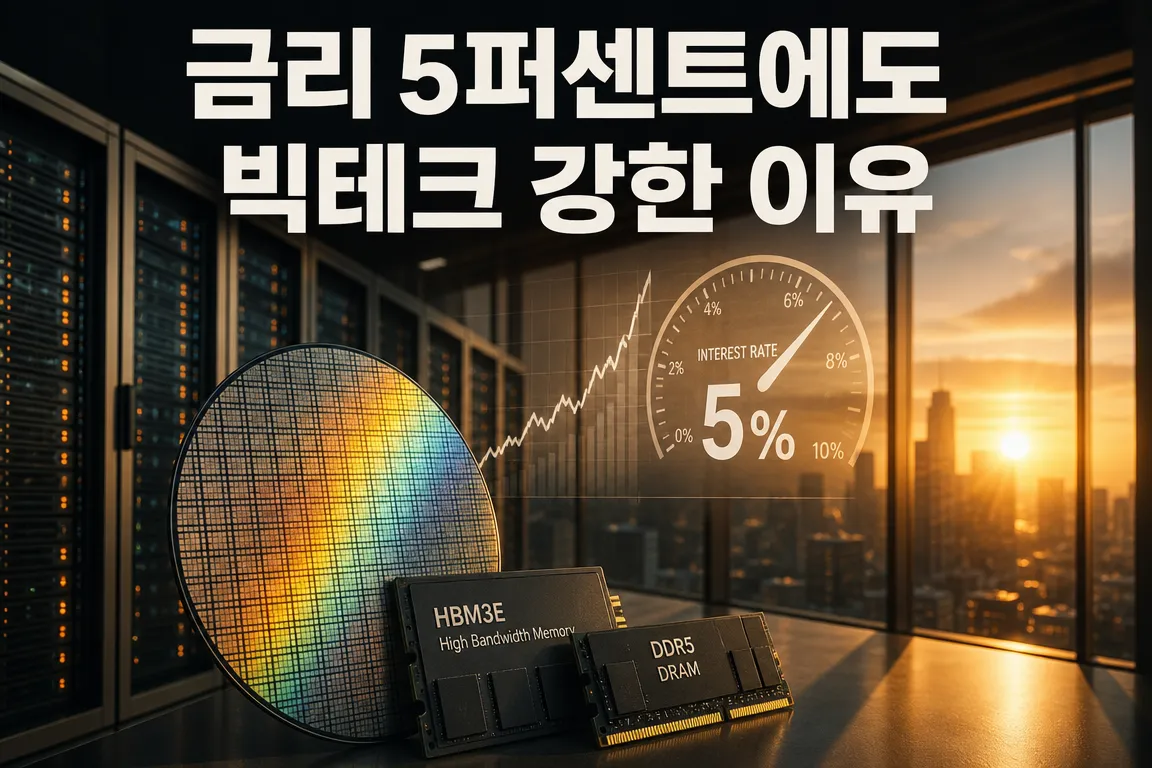
● Big Tech Shock, 5 Percent Era, AI Boom
Why Big Tech Is Holding Up in a 5% Rate Regime: U.S. Treasury Yields, Nasdaq, and the New AI Investment Framework
The core point is straightforward.
Under the traditional framework, when the U.S. 10-year Treasury yield approaches 5%, Nasdaq and growth equities are expected to face significant pressure.
Yet the market is behaving differently. Big Tech has remained resilient, and in some cases is setting new highs.
This report explains why Treasury yields have risen, why Nasdaq remains strong, and how AI investment and data center capex are reshaping market structure.
It also addresses a point often missed in market commentary: Big Tech is no longer a standard corporate sector and increasingly functions as a state-level economic actor.
1. The market’s old rulebook is breaking down
The traditional rule was simple.
When rates rise, equities, especially growth stocks, weaken.
Higher U.S. Treasury yields raise discount rates and reduce the present value of future earnings.
Historically, rising rates often translated into pressure on Nasdaq valuations.
Today, the pattern is different.
Even with the U.S. 10-year yield near 5%, Big Tech has not broken down.
Nvidia, Microsoft, Amazon, Alphabet, and Meta continue to attract global capital.
Investors are no longer selling these companies solely because rates are high.
The key shift is that the market no longer views Big Tech as ordinary growth stocks.
Big Tech now spans AI infrastructure, cloud computing, semiconductors, data centers, platforms, space technology, and biotechnology.
These firms increasingly resemble global economic systems rather than conventional U.S. corporations.
2. Why have U.S. Treasury yields risen?
The increase in Treasury yields cannot be explained by a single factor.
Three forces are working at the same time:
- Inflation uncertainty
- Rising U.S. fiscal deficits and Treasury issuance
- Corporate debt issuance by Big Tech and related capital absorption
First, inflation uncertainty.
Sharp swings in global oil prices have made inflation expectations less predictable.
Moderate oil volatility can be absorbed by the market.
However, when oil moves from below 60 dollars to 120 dollars and then back into the 70 to 90 dollar range, inflation visibility deteriorates materially.
Second, the U.S. fiscal position.
The U.S. continues to finance large deficits through sustained Treasury issuance.
Greater supply lowers prices and pushes yields higher.
Expectations of even larger future borrowing can also add a term premium to long-dated yields.
Third, structural changes in capital markets.
Big Tech is raising substantial funds for AI investment, data center construction, semiconductor procurement, and power infrastructure.
Although many firms initially relied on cash reserves, bond issuance is becoming increasingly important.
The issue is that this issuance absorbs market liquidity.
Capital that might otherwise have gone into Treasuries may instead be directed to Big Tech bonds, reducing demand for government debt and supporting higher yields.
3. Why Nasdaq is holding up despite a 5% yield environment
Investors are asking a simple question:
Why has Nasdaq not collapsed despite elevated Treasury yields?
The main reason is that Big Tech has become materially larger and more durable than in previous cycles.
During the dot-com era, companies had high expectations but limited global operating power.
Today’s leaders already have global user bases, strong cash flow, and deep ecosystem control.
Meta serves billions of users.
Microsoft is embedded in enterprise infrastructure worldwide.
Amazon has global scale across cloud, logistics, and e-commerce.
Alphabet controls search, advertising, YouTube, and AI model development.
Nvidia sits at the center of the AI semiconductor stack.
These companies are not confined to the U.S. domestic economy.
Their revenue is generated globally.
As a result, their valuations are increasingly supported by worldwide earnings power rather than only by U.S. macro conditions.
4. Big Tech now functions as a state-level economic actor
This is one of the most important points in the current debate.
Economic agents are usually classified as households, firms, and governments.
Historically, governments were understood to be the dominant force.
That framework is now changing.
Some Big Tech firms already exert influence comparable to that of mid-sized countries.
They control technology, capital, infrastructure, users, data, talent, space-related capabilities, and AI models.
The Elon ecosystem is increasingly viewed as a unified operating system spanning multiple industries.
SpaceX, Starlink, Tesla, xAI, energy storage, robotics, autonomous driving, and satellite communications form an interconnected value chain.
This is increasingly difficult to analyze as a conventional corporate group.
For macro analysis, it is no longer sufficient to focus only on the U.S. government, the Federal Reserve, or consumer inflation.
Investors also need to monitor how much Big Tech is investing, how it is funding that investment, how much debt it is issuing, and how aggressively it is building data centers.
5. AI investment and data center capex are supporting the U.S. economy
AI investment is no longer just a thematic trade in the U.S. economy.
It has become a meaningful driver of real activity.
Data center construction, power grid investment, semiconductor equipment, cooling systems, servers, and cloud infrastructure are all linked.
Corporate capex is contributing more to U.S. GDP growth, and AI spending is at the center of that trend.
As long as Big Tech continues investing, demand will remain strong across the associated supply chain.
If investment slows, semiconductors, power, construction, equipment, and cloud-related sectors could all come under pressure.
This trend is also highly relevant for the Korean economy.
Korea is heavily dependent on semiconductor exports.
Any assessment of the Korean economy now requires close attention to AI server demand and the semiconductor cycle.
In practice, U.S. Big Tech’s AI investment plans affect Korean exports, the won exchange rate, and the direction of the KOSPI.
6. The corporate bond market is also influencing Treasury yields
In normal conditions, investors focus on Treasuries when evaluating rates.
Today, Big Tech bond issuance must also be monitored.
Apple, Microsoft, and Alphabet are highly creditworthy issuers.
For some investors, their bonds may appear close to Treasury-like assets in terms of credit quality.
They are not identical to Treasuries, but their perceived safety is very high.
When these companies issue large amounts of debt, global bond investors must choose between Treasuries and high-grade corporate paper.
If capital shifts toward corporate bonds, Treasury demand can weaken.
That, in turn, can keep long-term yields elevated.
This is a dimension that is often underweighted in market coverage.
Explaining yield increases only through Fed policy or inflation misses an important part of the current structure.
7. Crude oil remains a key variable for the rate outlook
One of the most important factors for future Treasury yield direction is crude oil.
Oil directly affects inflation expectations.
Inflation expectations shape the Fed’s policy outlook.
That policy outlook then influences the U.S. 10-year yield.
The challenge is that recent oil moves have been driven more by supply shocks and geopolitical risk than by demand alone.
War risk, damage to production facilities, shipping disruptions, and OPEC policy can all move prices sharply.
These variables are difficult to forecast.
At the same time, prolonged war and elevated oil prices accelerate the case for alternative energy.
EV demand can also benefit in a high-oil environment.
If U.S. supply expands while global growth slows and the energy transition continues, oil could eventually move lower.
In some scenarios, prices could fall from the current 60-dollar range toward the 40-dollar range.
If that occurs, inflation pressure would ease significantly and long-term yields could face downward pressure.
8. Even so, 5% may become the new normal
Even if yields decline, it will likely be difficult to return to the 1% to 2% range seen in earlier cycles.
The market is increasingly treating a 5% U.S. 10-year yield as a new reference point.
This is what a rate regime reset looks like.
An analogy can be made with foreign exchange.
In the past, a KRW/USD exchange rate of 1,300 was viewed as very high.
But with a stronger dollar environment lasting longer, the market has become more comfortable with that range.
Similarly, if investors come to accept 5% as a stable benchmark, the old assumption that high rates automatically hurt equities becomes less reliable.
The key issue is not only the absolute level of rates.
What matters more is whether the market sees that level as predictable.
If 5% is perceived as a shock, risk assets will weaken.
If it becomes the baseline, investors will look for opportunities within that framework.
9. What happens to rates if AI improves productivity?
Another important question in the AI macro outlook is this:
If AI materially raises productivity, how will rates and equities respond?
Higher corporate productivity could lift GDP growth and support earnings.
That would help justify premium valuations in AI-linked sectors.
At the same time, AI could displace white-collar labor and raise unemployment.
This could create an unusual mix of stronger growth and weaker employment.
That outcome would differ from a standard business cycle.
In a traditional cycle, stronger growth usually supports stronger employment.
In an AI-driven cycle, companies may see higher productivity even as hiring weakens.
This raises a policy question for the Fed.
Should rates stay high because growth is strong?
Or should rates fall because unemployment is rising?
This tension is likely to become a central issue for future rate expectations.
10. What many market commentaries do not emphasize enough
First, Big Tech is no longer a simple equity sector.
It is now a state-level economic ecosystem spanning AI infrastructure, cloud, semiconductors, space, communications, power, and robotics.
Rate analysis that focuses only on yields is increasingly incomplete.
Second, corporate bond issuance can influence Treasury yields.
When high-grade Big Tech firms issue large amounts of debt, global capital may move away from Treasuries.
That can weaken demand for government debt and keep long-term rates elevated.
Third, the center of macro analysis is shifting from government to corporations.
Policy still matters, but data center construction, GPU demand, and AI infrastructure spending are becoming key macro variables.
Fourth, AI investment affects both financial markets and the real economy.
It supports Nasdaq valuations while also driving physical investment in data centers and power systems.
At the same time, the associated financing burden can pressure the bond market.
Fifth, 5% rates may become a baseline rather than a crisis level.
If the market accepts 5% long-term yields as normal, equity valuation frameworks will adjust accordingly.
Companies with strong cash flow and global reach can continue to command premiums even in a higher-rate environment.
11. Key items for investors to monitor
- U.S. 10-year Treasury yield: The key issue is not only whether 5% is breached, but how long the market stays near that level.
- Crude oil: Sustained prices above 90 dollars would increase renewed inflation risk.
- Big Tech bond issuance: Monitor how AI funding demand affects bond-market liquidity.
- Data center capex: A critical indicator for the durability of the AI investment cycle.
- Semiconductor demand: Relevant for both Korean exports and the global AI supply chain.
- Fed inflation assessment: Investors should monitor whether the Fed prioritizes inflation or growth slowdown.
- AI productivity effects: Watch for a combination of stronger earnings and labor-market weakness.
12. Scenario outlook
Scenario 1: Stable oil and easing geopolitical risk
If oil stabilizes and geopolitical tensions ease, inflation pressure could moderate.
In that case, Treasury yields may have already peaked and could decline gradually.
However, the market may still settle into a 4% to 5% equilibrium rather than return to the earlier low-rate regime.
Scenario 2: Oil surges again and inflation reaccelerates
If conflict intensifies or supply is disrupted, oil could rise sharply again.
That would weaken expectations for Fed easing and could push long-term yields higher.
Nasdaq may face valuation pressure in the near term.
Scenario 3: AI investment continues and Big Tech earnings expand
If AI spending translates into productivity gains and revenue growth, Big Tech can remain resilient even under higher rates.
In that case, the market may focus more on earnings growth than on rate pressure.
AI semiconductors, cloud infrastructure, power systems, and data centers would likely benefit.
Scenario 4: AI spending overheats and financing burdens rise
If AI capex expands too quickly and debt issuance accelerates, bond-market pressure could increase.
Treasury yields may remain elevated, and corporate interest expense could rise.
In that case, the gap between companies with strong cash flow and those without it may widen further.
< Summary >
Big Tech is holding up in a 5% rate environment because the market framework has changed.
These firms are no longer viewed as ordinary growth stocks but as global economic platforms with state-level influence.
AI investment, data center capex, semiconductor demand, and corporate debt issuance are now affecting both equity and bond markets.
The main drivers of higher U.S. Treasury yields are inflation uncertainty, fiscal deficits, and structural changes in corporate funding.
Crude oil remains one of the most important variables for the rate outlook.
If oil stabilizes, yields may decline, but 5% long-term rates could remain a new normal.
Macroeconomic analysis is moving beyond a framework centered only on the government and the Fed, and toward one that also incorporates Big Tech investment, leverage, and the AI supply chain.
[Related Articles…]
- U.S. Treasury Yield Outlook and Global Capital Flows
- AI Investment Cycle and Big Tech Value Chain Shifts
*Source: [ 경제 읽어주는 남자(김광석TV) ]
– 금리 5%인데도 빅테크는 안 무너진다… 시장의 공식이 바뀌고 있습니다 | 경읽남과 토론합시다 | 3자토론 김효진x김열매x김광석 [2편]
● Micron, Samsung, SK Hynix, Market Shock
Why Micron’s Earnings Have Become the Key Driver for Samsung Electronics and SK Hynix
This week’s Micron earnings release is not just a single U.S. semiconductor event.
It is a key inflection point connecting Samsung Electronics, SK Hynix, the KOSPI, foreign investor flows, AI data center investment, and the DRAM pricing cycle.
This report goes beyond the usual “HBM is strong” narrative and examines the factors that can move share prices in practice, including foreign selling, the risk of buyback expiration, China’s memory-chip catch-up, changes in DRAM spot prices, and the 2027 supply shortage scenario.
The central issue is this.
What matters more than Micron’s current earnings is whether memory-chip prices can continue rising in the next quarter and through 2026 to 2027.
1. Why the market is unusually sensitive to Micron’s earnings
Samsung Electronics and SK Hynix are now the main drivers of the Korean equity market.
The problem is that the KOSPI has struggled to sustain a strong upward trend and has repeatedly rallied, then pulled back, within a narrow range.
Foreign investor flows are a major reason.
- Foreign investors recorded net sales of roughly KRW 1 trillion in a single day.
- Over one week, selling reached roughly KRW 8 trillion.
- Over one month, they reportedly sold around KRW 20 trillion.
- Retail investors also participated in selling, with about KRW 15 trillion.
- In contrast, other legal entities absorbed about KRW 31 trillion over one month, KRW 8 trillion over one week, and about KRW 160 billion in one day.
The key question is who absorbed this supply.
The market has interpreted much of this buying by other legal entities as share repurchases by Samsung Electronics and SK Hynix or related demand.
In other words, the market held up because corporate buying offset selling by foreign and retail investors.
However, share buybacks are not a permanent source of demand.
If this buying support disappears while foreign investors continue selling and retail investors do not step in, volatility is likely to rise.
That is why Micron’s earnings and guidance matter so much.
If Micron signals that memory demand remains strong, foreign selling pressure could ease.
If the company turns even slightly cautious, Samsung Electronics and SK Hynix may also come under pressure.
2. Why Micron’s outlook is linked to Samsung Electronics and SK Hynix
Micron, Samsung Electronics, and SK Hynix are all tied to the global memory semiconductor cycle.
Their business models are not identical, but all are exposed to DRAM and HBM pricing cycles.
As a result, a strong outlook for Micron often improves sentiment toward Korean memory stocks.
Recent market commentary has suggested as much as 90% upside from Micron’s current share price.
If such an outlook were to be validated, investors would naturally extend similar expectations to Samsung Electronics and SK Hynix.
SK Hynix, in particular, is seen as deserving a premium because of its HBM competitiveness.
That said, investors should be cautious.
Stocks may move in the same direction without being revalued at the same pace.
Micron is evaluated in the U.S. market as a direct AI semiconductor beneficiary, while SK Hynix is viewed as a key supplier in Nvidia’s HBM supply chain.
Samsung Electronics is more complex because its valuation reflects not only memory semiconductors but also foundry, smartphones, and consumer electronics.
Ultimately, the market is focused less on this quarter’s revenue and more on how confidently Micron discusses DRAM pricing, HBM demand, NAND supply, and AI data center investment.
3. Data center construction pace is the real variable for semiconductor earnings
The starting point for the current memory-chip rally is AI data center investment.
Large cloud companies and hyperscalers must build data centers quickly in order to deploy GPUs.
GPU shipments drive HBM demand.
As HBM production expands, capacity for conventional DRAM becomes more limited.
This tightens DRAM supply and pushes prices higher.
This chain is the core of the current semiconductor super cycle.
- Expansion in AI data center construction
- Growth in Nvidia GPU shipments
- Higher HBM demand
- Partial conversion of DRAM capacity
- Tighter supply of conventional DRAM
- Higher memory prices
- Improved earnings for Samsung Electronics, SK Hynix, and Micron
If data center construction slows more than expected, the picture changes.
GPU demand expectations could weaken, and HBM order growth may also slow.
At the same time, excess supply from memory makers could hit the market, causing DRAM prices to fall quickly.
This is also why investors are paying close attention to Oracle, corporate bond issuance, credit ratings, U.S. interest rates, and financing conditions.
AI data centers require very large capital expenditures.
If U.S. interest rates remain high or the corporate bond market weakens, data center construction could slow.
Even a small shift here can affect HBM and DRAM pricing expectations and ultimately move semiconductor stocks significantly.
4. What it means that AI computing demand may require $6 trillion over five years
Some analysis suggests that the current AI data center buildout would require roughly $6 trillion in AI computing demand over the next five years to be justified.
This estimate is based on a view that capital expenditures can be supported if they remain around 25% of revenue.
Put simply, companies would need AI service revenue to grow dramatically in order to sustain current investment levels.
Current capital spending by hyperscalers and companies such as Oracle has been cited at around $780 billion.
To maintain and expand this level of investment over five years, annual capital spending would need to keep rising sharply.
Investors are therefore focused on one question.
Can AI demand grow enough to justify this level of spending?
If the answer is yes, the semiconductor cycle could remain strong through 2026 and into 2027.
If AI monetization slows or companies begin to moderate spending, semiconductor stocks may react before earnings do.
5. The more important variable than HBM is DRAM pricing
Market commentary often focuses on HBM.
HBM is certainly a core growth driver for Samsung Electronics, SK Hynix, and Micron.
SK Hynix, in particular, has attracted strong investor interest because of its leadership in the HBM market.
However, from an earnings perspective, DRAM pricing may be more important.
The reason is simple.
For all three companies, conventional DRAM still accounts for a much larger share of revenue and operating profit than HBM.
HBM explains growth potential, while DRAM explains current earnings power.
HBM capacity is already heavily covered by long-term contracts and advance orders.
As a result, short-term earnings uncertainty is relatively limited.
By contrast, DRAM earnings expectations can change quickly with spot and contract price movements.
Recent price trends have been mixed.
As of mid-August, major DRAM products were broadly firm.
By mid-September, however, some DDR5 16GB and DDR4 16GB products showed price declines.
Other product categories continued to rise.
This has led to differing market views.
- Bears argue that DRAM prices are rolling over and earnings may be nearing a peak.
- Bulls argue that the declines reflect only isolated spot-market movements and that overall contract prices and demand remain strong.
- Neutral observers say order inquiries and customer inventory trends matter more than short-term price fluctuations.
There have also been reports that order quotation activity has slowed recently.
In the semiconductor industry, a surge in quotation requests typically indicates urgent customer demand for supply.
A slowdown in such requests can raise doubts about demand strength.
This is one of the most important points to watch in Micron’s earnings call and guidance.
6. China’s CXMT expansion is a risk that should not be underestimated
One of the most important but often underappreciated issues is the expansion of China’s memory-chip makers.
In particular, CXMT’s capacity growth could become a medium- to long-term risk for Samsung Electronics, SK Hynix, and Micron.
Based on monthly wafer capacity, the market is discussing the following approximate figures:
- Micron: about 380,000 wafers per month
- SK Hynix: about 590,000 wafers per month
- Samsung Electronics: about 720,000 wafers per month
- CXMT: potential expansion to about 350,000 wafers per month
On a capacity basis, CXMT is already approaching Micron’s scale.
Of course, capacity is not the same as competitiveness.
Yield, quality, power efficiency, customer certification, and process technology all matter.
However, history shows that Chinese companies should not be dismissed simply because they are initially viewed as lower quality.
Similar patterns have already been seen in displays, solar, battery materials, electric vehicles, and wind power.
At first, the response often was that Chinese firms lacked technology, had poor yields, or relied on subsidies.
Over time, however, they gained share through scale and cost advantage.
Memory semiconductors are not immune to this pattern.
In particular, if global customers such as Apple, Dell, or HP begin adopting CXMT products, the situation would change materially.
Qualification by major customers would serve as a quality reference.
Once that track record is established, sales efforts to other customers become easier.
For now, Korean companies remain clearly stronger in high-performance HBM.
But in the conventional DRAM market, expanding Chinese supply could cap the upside in pricing over time.
This is a structural risk that the market may not yet fully reflect.
7. Wall Street’s view on Micron’s earnings
Wall Street currently has high expectations for Micron’s results.
Based on the source material, revenue of $50.8 billion and adjusted EPS of $3.15 are being projected.
Adjusted EPS is expected to rise sharply year over year.
Quarter over quarter, growth of more than 20% is also being discussed.
Micron has posted several consecutive earnings beats in recent quarters.
Therefore, this quarter’s earnings may also exceed consensus estimates.
However, as always, the market is focused less on the current quarter than on the next one and on full-year visibility.
What management says on the earnings call will be critical.
Statements that would likely be received positively include the following:
- AI server demand remains stronger than expected.
- HBM supply is largely booked through 2026.
- DRAM supply shortages may last longer than expected.
- Customer inventories remain at low levels.
- 2027 demand could be tighter than 2026.
By contrast, the following remarks could pressure the stock:
- Some customers adjusted orders.
- Pricing momentum may slow gradually.
- Capex growth should be approached more cautiously.
- Chinese supply growth is being monitored.
- Some data center customers are shifting investment timing.
This is why stocks can fall even after good earnings.
The numbers may be strong, but a single cautious phrase in the earnings call can unsettle investors.
8. Citi’s view: pricing may peak in Q2 2027
Citi analyst Atif Malik believes AI-driven memory demand will keep supply tight in DRAM and NAND markets.
However, he expects the pace of price increases to slow over the next four quarters.
He also maintains the view that memory prices could peak around Q2 2027.
This outlook is important.
The market is already pricing in much of the improvement expected in 2026.
If price gains continue through Q2 2027, the semiconductor cycle would still have room to run.
If the peak arrives earlier, stocks could correct before earnings do.
According to Seeking Alpha, Micron’s net income growth rate for 2027 is estimated at about 118%.
By contrast, 2028 growth is expected to slow to around 12%.
SK Hynix is also expected to show strong growth next year, but growth could moderate to about 10% in 2028.
One notable point is the difference in growth expectations between Micron and SK Hynix.
Although both are exposed to the same memory cycle, Micron is being assigned much stronger growth expectations than SK Hynix.
This may indicate that SK Hynix still has room for re-rating.
It also reflects the higher expectations embedded in U.S. equity valuations for Micron.
9. Why Sujit Sadana’s remarks matter
Micron Chief Business Officer Sujit Sadana has said that current demand growth is outpacing industry supply growth projected for 2027.
This suggests that 2027 could be tighter than 2026.
If this scenario is correct, DRAM prices could remain firm longer than the market expects.
This is positive for Samsung Electronics and SK Hynix as well.
When demand grows faster than supply, memory makers gain pricing power.
Once pricing power improves, earnings rise faster than revenue.
In an industry with high fixed costs, higher prices can significantly lift operating margins.
In other words, if the supply shortage continues through 2027, semiconductor earnings could outperform market expectations.
That said, this scenario depends on continued AI data center investment.
10. Three possible scenarios after this earnings release
Following Micron’s earnings release, Samsung Electronics and SK Hynix could move in one of three broad directions.
Scenario 1. Strong earnings and strong guidance
This is the most positive outcome.
Micron reports results above expectations and expresses confidence in future DRAM and HBM demand.
In that case, foreign selling pressure could ease or reverse.
Even if share buybacks end, foreign buying could fill the gap.
Samsung Electronics and SK Hynix could benefit from a strong momentum shift.
Scenario 2. Strong earnings but mixed guidance
This is the most likely scenario.
Current-quarter results are solid, but management mentions slower price increases or the possibility of order adjustments by customers.
In this case, shares could become volatile in the short term.
Stocks that already have high expectations may face profit-taking on good news.
Samsung Electronics and SK Hynix could also see increased intraday volatility.
Scenario 3. Weak earnings or weak guidance
This is the most difficult scenario.
Micron may provide weaker-than-expected guidance or clearly signal a slowdown in DRAM price momentum.
In that case, foreign selling could intensify.
If this coincides with the end of buyback support, a supply-demand gap could emerge.
That could also weigh on broader KOSPI sentiment.
11. The most important point that is often missed in other coverage
The key issue is not whether Micron’s earnings are good or bad.
The real question is who will buy the stock.
Foreign investors are currently selling aggressively, and retail investors are not absorbing the supply in a meaningful way.
So far, other legal entities and share repurchases have absorbed the selling pressure.
But share buybacks will eventually end.
If foreign investors do not return as buyers, share prices may struggle even if earnings are strong.
The second key issue is DRAM pricing.
HBM receives the most attention, but the largest share of profits still comes from DRAM.
HBM is the growth story; DRAM is the core earnings engine.
If DRAM pricing weakens, overall earnings expectations can deteriorate even if HBM remains favorable.
The third key issue is CXMT in China.
It may be easy to dismiss this now, but the picture changes if major global customers certify its products.
Chinese memory expansion is a structural factor that could limit DRAM price upside after 2027.
The fourth key issue is the durability of the AI investment cycle.
Current memory pricing strength depends on continued AI data center spending.
U.S. interest rates, the dollar, corporate bond markets, and hyperscaler capital spending plans are all tied to semiconductor valuations.
12. Key checklist for investors to monitor in Micron’s earnings release
- Confirm whether Micron’s revenue and adjusted EPS beat consensus.
- Review management’s comments on DRAM pricing momentum.
- Check HBM supply contracts and visibility for 2026 volumes.
- Assess whether customer inventories remain low or are starting to build.
- Monitor whether AI data center customer orders remain intact.
- See whether management maintains the view of a 2027 supply shortage.
- Evaluate how seriously management views Chinese memory expansion as a risk.
- Check whether foreign investors return to net buying of Samsung Electronics and SK Hynix after the release.
- Watch whether any new buyers emerge after share buyback support ends.
13. Conclusion: the key issue is confidence in the next cycle, not just this quarter’s numbers
Micron’s earnings are likely to be strong on a headline basis.
Given recent memory pricing trends, AI demand, and HBM contract conditions, a sharp deterioration in results appears unlikely.
However, the market always looks ahead.
Next-quarter guidance matters more than current-quarter results.
And visibility for 2026 and 2027 matters more than next quarter alone.
For investors in Samsung Electronics and SK Hynix, Micron’s earnings should not be viewed as a routine U.S. event.
This release is a test of whether foreign demand can return to Korean memory stocks.
It is also a key checkpoint for whether the KOSPI can regain upward momentum.
Ultimately, there are three items to watch.
First, whether Micron delivers strong earnings.
Second, whether it maintains confidence in DRAM and HBM demand.
Third, whether foreign investors begin buying Samsung Electronics and SK Hynix again.
If all three align, semiconductor stocks could recover a strong upward trend.
If even one of them weakens, near-term volatility will likely remain elevated.
< Summary >
Micron’s earnings release is a key event that can directly affect Samsung Electronics and SK Hynix share prices.
Foreign investors have recently been heavy sellers, while other legal entities and share buybacks have absorbed much of the supply.
If foreign buying does not return after buybacks end, supply pressure could increase.
HBM is important, but the main driver of earnings remains DRAM pricing.
Continued AI data center investment is needed to sustain demand for GPUs, HBM, and DRAM.
China’s CXMT expansion is a medium- to long-term factor that could cap DRAM pricing.
In this earnings release, investors should focus less on revenue and EPS alone and more on DRAM pricing, HBM contracts, the 2027 supply shortage outlook, and whether foreign flows turn positive.
[Related Articles…]
- Semiconductor Supercycle and Memory Pricing Outlook
- AI Data Center Investment and Global Market Outlook
*Source: [ Jun’s economy lab ]
– 삼전닉스 목숨줄을 쥔 마이크론 실적 예상