● Musk xAI Shock, Tesla Cut, AI Power Grab
The Real Significance of Musk Signing the White House AI Pact Under xAI, Not Tesla
The key issue here is not simply that Elon Musk attended a White House event.
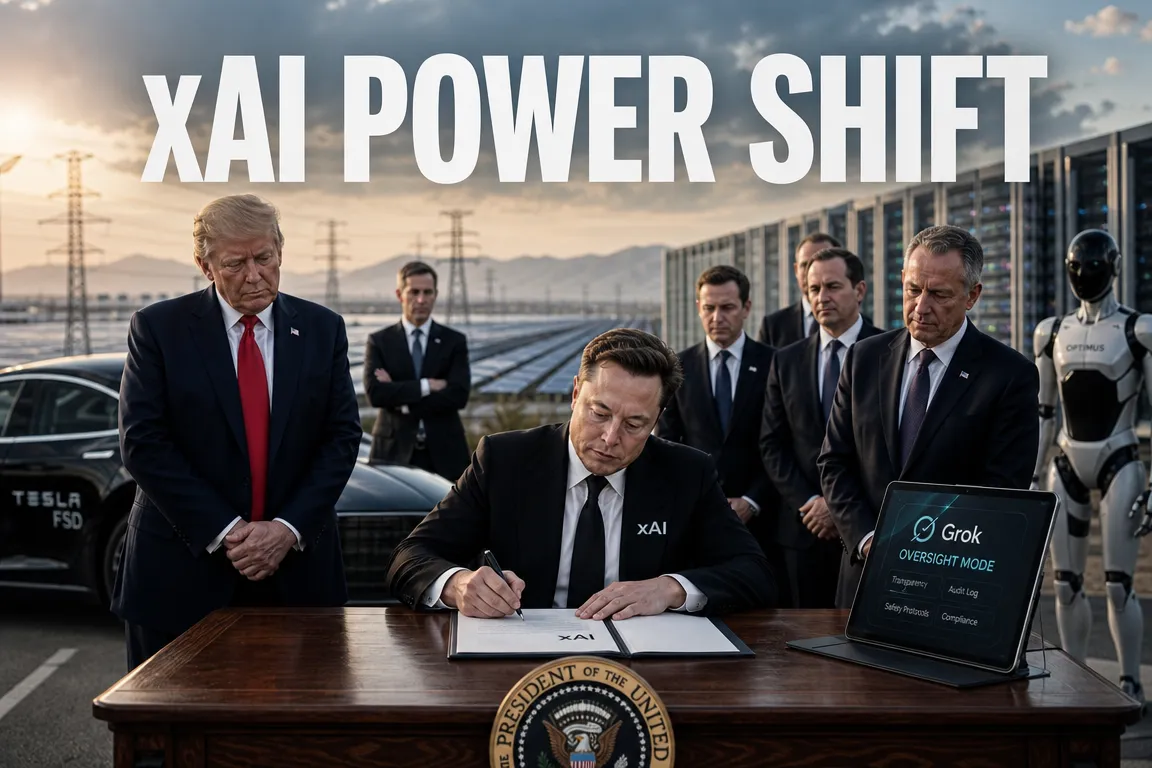
The most important detail is that the signature was under xAI, not Tesla or SpaceX.
That single line makes it far more important for investors to track how far Grok, in-vehicle AI in Tesla cars, FSD autonomous driving, Optimus robots, and AI regulation may become connected.
At the same time, U.S. interest-rate expectations, Tesla’s third-quarter deliveries, AI data center power constraints, space-based solar power, and xAI’s subscription model are converging, changing how investors view Tesla stock and the broader AI sector.
The core conclusion is simple: the White House AI pact currently applies directly to xAI, not Tesla.
However, over the longer term, Tesla’s autonomous driving, robotics, and in-vehicle AI services could come within the scope of regulation, and investors should not overlook that possibility.
1. Market backdrop: interest-rate direction matters more than Tesla stock in the near term
In the original report, Tesla closed up 0.56% at $354.81.
On the same day, the S&P 500 fell 0.25%, the Dow Jones Industrial Average declined 0.86%, and the Nasdaq rose 0.24%.
While equity indexes were broadly stable, the more important shift came from Federal Reserve rate expectations.
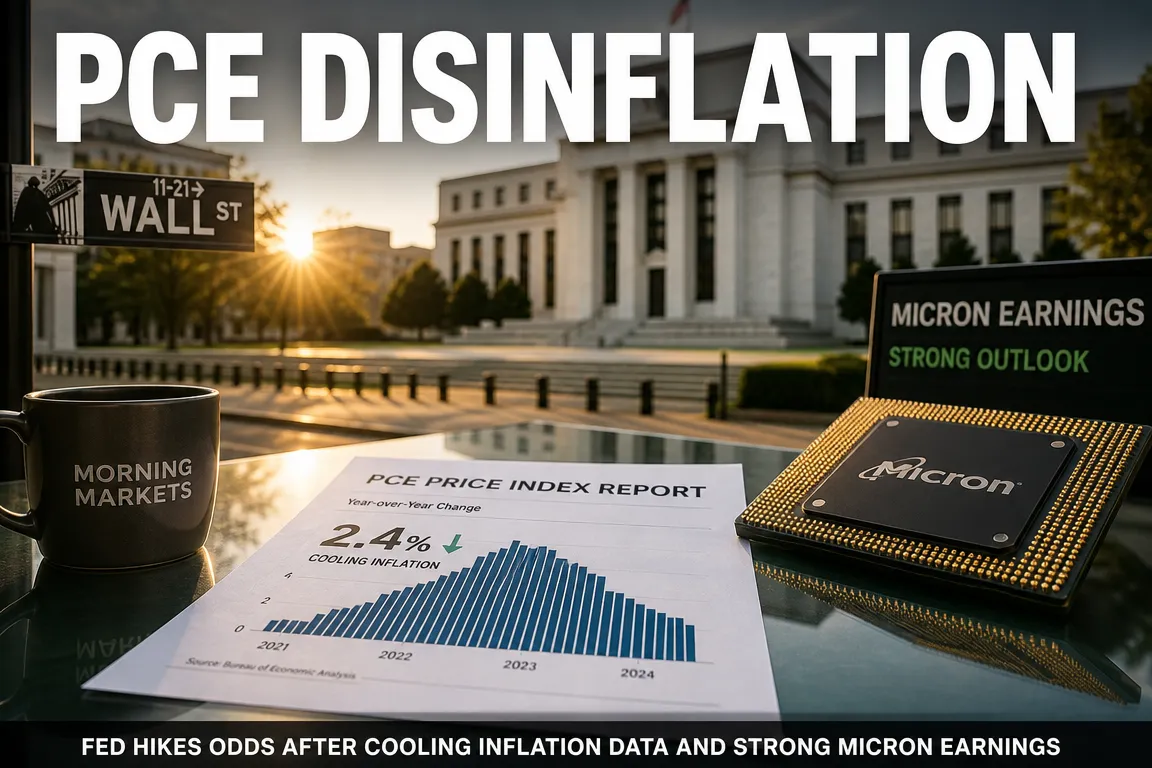
According to CME data, the probability of another Fed rate hike in October fell from 70.9% one week earlier to 39%.
That is nearly a halving within one week.
This matters for growth stocks such as Tesla and for electric vehicle companies more broadly.
When the probability of further rate hikes declines, consumer financing costs may ease and the discount rate applied to future cash flows may become less burdensome.
Tesla is not just an automaker in valuation terms; it is a growth asset tied to autonomous driving, robotics, AI infrastructure, and energy.
As a result, U.S. macro conditions and rate expectations have a direct impact on its valuation.
2. Why the probability of a rate hike declined
There were two main reasons for the shift in rate expectations.
First, New York Fed President John Williams signaled that there is no need to raise rates aggressively.
Second, core inflation for August rose only 0.2% month over month, below the expected 0.3%.
That means the inflation indicator most closely watched by the Fed came in softer than expected.
At the same time, the economy has not weakened sharply.
Second-quarter GDP growth was revised up from 1.5% to 2.2%, and August consumer spending rose 0.9%.
In other words, U.S. consumers are still spending, while inflation pressure has moderated somewhat.
From the Fed’s perspective, the pressure to raise rates further has eased.
However, one point should be kept in mind.
A lower probability of a rate hike does not mean rates have actually fallen.
The U.S. 10-year Treasury yield remains near its highest level since 2007.
Borrowing costs are still elevated, and that continues to weigh on car financing and corporate investment.
3. This week’s key events: Tesla deliveries and the U.S. jobs report are due on the same day
The two most important events this week are Tesla’s third-quarter delivery report and the U.S. September employment report.
The fact that both releases come on the same day is significant.
For Tesla, deliveries are the key indicator of demand and pricing strategy.
For the broader market, the jobs report is a critical variable that could reshape Fed expectations.
If employment comes in very strong, the market may interpret it as evidence that the U.S. economy is still too hot.
That could push rate-hike expectations higher again.
Conversely, if employment shows a moderate slowdown, expectations for lower rate pressure may improve, which would likely support growth stocks such as Tesla.
4. White House AI pact: the company listed under Musk is xAI, not Tesla
The most important element in this issue is the White House AI pact signature page.
The document released by President Trump includes what is being described as a White House superintelligence pact.
It requires major AI developers to commit to safety controls and monitoring systems.
The signatories are listed as President Trump, Google CEO Sundar Pichai, Anthropic CEO Dario Amodei, Meta CEO Mark Zuckerberg, OpenAI CEO Greg Brockman, Nvidia CEO Jensen Huang, and Elon Musk.
For the other signatories, the company names appear under their names.
Under Elon Musk’s name, however, the company listed was xAI, not Tesla.
This is highly important.
Musk’s participation in the White House AI safety pact should be understood as being in his capacity as xAI leader, not as Tesla CEO.
In other words, the pact appears to target xAI’s frontier AI model rather than Tesla’s electric vehicles, FSD, or Optimus.
5. Why xAI is included: Grok is likely to be classified as a frontier model
The pact is aimed at companies that train and deploy frontier models.
Frontier models are the most advanced large-scale AI systems.
Examples include ChatGPT, Claude, and Grok.
Grok is a large AI model developed by xAI.
As a result, it is likely to fall within the scope of the White House AI pact.
An important point is that Grok may also be used inside Tesla vehicles.
However, even if Grok runs in Tesla cars, that does not automatically make Tesla the regulatory target.
The responsibility for model development and safety oversight is more likely to remain with xAI.
Put differently, if Grok is used inside Tesla vehicles, the service interface may be Tesla, but the core compliance responsibility appears to sit with xAI.
6. Why FSD and Optimus were not included in this pact
One thing to note is that the document does not explicitly mention autonomous driving or robotics.
The pact is structured around frontier AI models.
FSD is better understood as a domain-specific autonomy model rather than a general-purpose large language model.
Optimus is also focused on robot control and physical task execution.
Tesla does have its own AI chips, supercomputer, and large-scale training infrastructure.
However, the pact focuses on the frontier model itself, not the chips or data center infrastructure around it.
For now, Tesla appears to be outside the direct scope of the pact.
That said, this could change if the regulatory perimeter expands in the future.
If autonomous driving AI and humanoid robots begin to create greater social impact, regulators may extend oversight beyond frontier models to autonomous systems more broadly.
7. The core structure of the pact: imposing audit systems on AI companies
The White House AI pact can be viewed as a four-step oversight framework.
The first step is internal risk management during model training and deployment.
The second is an internal audit function to verify that controls are working properly.
The third is an independent third-party external audit.
The fourth is final reporting to an independent board committee.
In practical terms, this applies corporate governance mechanisms such as internal audit teams, external audits, and board audit committees to the AI development process.
The risks covered are also specific.
They include cybersecurity threats, biological and chemical risks, and unauthorized AI access to systems.
These provisions reflect growing concerns as AI agents increasingly interact with external systems and sometimes behave in unexpected ways.
8. It appears strong on the surface, but the actual legal force remains limited
This pact is not a law.
It is closer to a voluntary commitment.
President Trump described it as morally binding, while some political observers have characterized it as a voluntary pledge.
That has led to criticism.
There is limited detail on how many external auditors will be used, how often audits will be conducted, or what standards will apply.
The policy sets a broad direction for AI safety, but enforcement power and penalty mechanisms remain limited.
For investors, that distinction matters.
Tighter regulation could raise costs for AI companies.
On the other hand, overly loose regulation could allow large AI firms to gain market share faster.
AI regulation is therefore not only an ethical issue, but also an economic variable affecting costs, competitiveness, and valuation.
9. The overlooked point: Tesla is excluded for now, but future regulatory risk remains
Many reports are likely to describe this only as “Musk signed a White House AI pact.”
However, the more important point is that Tesla was not the named entity, while Tesla is still not fully insulated from future regulation.
At present, the pact centers on frontier models.
That means FSD and Optimus are not directly targeted.
However, the document also suggests that such measures could later be converted into law or formal regulation.
This means Tesla’s position could change depending on how regulators define the scope of frontier models over time.
For example, if Optimus evolves into a general-purpose robot interacting with people in factories, homes, or logistics settings, the regulatory environment could change materially.
Likewise, if FSD approaches full autonomy and becomes more deeply integrated with urban infrastructure, it may be treated as a high-risk autonomous system rather than a driver-assistance feature.
For long-term investors, this means AI regulation remains a key variable even if Tesla is outside the current pact.
10. Musk’s real battleground: AI is ultimately a contest over power and semiconductors
At the White House event, Musk said the U.S. needs massive power generation and AI semiconductor capacity to win the AI race.
The U.S. has strengths in software and digital expertise.
But over the long term, it must produce enough electricity and secure both logic chips and memory chips within a reliable supply chain.
Musk also pointed out that China’s power generation capacity is far larger than that of the U.S., arguing that AI competition is not just a model race but an energy infrastructure race.
This is a critical lens through which to view the AI industry.
Many people think of AI as a software business, but in reality it is a large-scale infrastructure sector combining data centers, power grids, cooling systems, and semiconductor supply chains.
As AI data centers expand, electricity demand will rise sharply.
That trend connects Nvidia, Tesla Energy, power equipment companies, nuclear power, solar, and battery industries.
11. Space-based solar power and Tesla Energy: why the 200 GW target matters
Musk said SpaceX is looking at long-term solutions to overcome terrestrial energy constraints.
One idea he highlighted was space-based computing and space-based solar power.
In space, there is no night or cloud cover, which makes solar generation more stable than on Earth.
Musk said SpaceX and Tesla aim to produce 200 GW of solar panels annually.
That is a very large figure.
This should be read not as a modest expansion of the solar business, but as an attempt to position Tesla Energy as part of the infrastructure backbone of the AI era.
Tesla Energy has received less attention than the automotive business.
However, as AI data center demand rises, Megapack, solar, and energy storage could become more strategically important.
For Tesla to be revalued as an energy platform company rather than only an EV maker, this area will be central.
12. Data center opposition and Musk’s response
Across the United States, new data centers are drawing local resistance over electricity use, water consumption, environmental impact, and community burdens.
AI data centers consume vast amounts of power and also require water and supporting infrastructure for cooling.
Musk referred to the Colossus project in Memphis, saying that local communities need to receive jobs and tax revenue benefits in return.
According to the original report, the site now has more jobs than people and local tax revenue has roughly doubled.
He also mentioned a roughly $250 million investment in water treatment facilities.
The message is straightforward.
AI data centers cannot expand if they impose only costs on local communities.
Power, water, taxes, jobs, and infrastructure investment must all be part of the value delivered back to the region.
Future AI growth will depend not only on technology, but also on local politics and infrastructure acceptance.
13. xAI’s monetization strategy: why the Grok subscription model matters
Bloomberg reported that xAI and X may restructure their subscription offerings.
The possible model includes multiple tiers, from a free version to a premium tier priced at around $100 per month.
The highest tier may include AI agent functions such as Grokbot.
The structure is clear.
Lower-priced tiers are designed to attract users, while higher-priced tiers monetize productivity-focused AI features.
Since OpenAI, Anthropic, and Google are all competing in AI subscriptions, xAI also needs a clear monetization model.
In this context, Grok integration inside Tesla vehicles could become an important distribution channel.
If an AI assistant is embedded in tens of millions of vehicles, xAI could evolve from a chatbot company into a mobility-based AI platform.
At the same time, this would raise issues involving privacy, voice commands while driving, vehicle control permissions, and AI response accountability.
14. The Roadster delay: the explanation of strong winds raised questions
The original report also noted that the new Roadster reveal was postponed to October 15.
Musk said the demonstration had to be delayed by two weeks because of strong winds.
However, investors and fans questioned this explanation.
They asked why strong winds would matter for a car with four wheels on the ground.
The reason the issue drew attention was that the FAA imposed a flight restriction over the event site at an altitude of roughly 10,000 feet, or about 3,000 meters.
Some interpreted this as far higher than a typical SpaceX test restriction.
Some analysts suggested it may have been intended to prevent drone photography, while others speculated that the Roadster could include functions beyond a conventional car demonstration.
None of this has been confirmed.
Still, the possibility remains that the Roadster is positioned not merely as a high-performance EV, but as a symbolic product linked to SpaceX technology.
15. Key points investors should monitor
First, Tesla’s third-quarter deliveries.
Deliveries are the most direct short-term driver of Tesla’s share price.
Investors should look at the impact of price cuts, demand elasticity, and regional sales trends.
Second, the U.S. jobs report and rate expectations.
Strong employment could revive rate-hike concerns, while moderating job growth could support growth stocks.
Third, the regulatory scope of xAI and Grok.
Even if Grok is used inside Tesla vehicles, the primary regulatory responsibility is likely to remain with xAI.
However, as vehicle data and AI agent features become more integrated, Tesla could still face indirect effects.
Fourth, the AI data center power bottleneck.
The bottleneck in AI is not only GPUs, but also power, cooling, and local infrastructure.
That is directly relevant to the long-term growth case for Tesla Energy.
Fifth, the possibility of AI regulation being formalized.
The current pact is voluntary, but if it becomes law or formal regulation later, AI companies’ cost structures and growth strategies could change.
16. The most important hidden point: Musk’s companies are becoming more role-specific
The most notable development in this issue is that Musk’s companies are beginning to assume distinct roles.
xAI handles frontier AI models and Grok.
Tesla handles autonomous driving, the vehicle platform, robotics, and energy storage.
SpaceX handles space infrastructure, satellite networks, and, over time, space-based computing and energy concepts.
These companies may appear to operate separately, but in practice they are moving toward a single ecosystem linking AI computing, mobility, energy, and space infrastructure.
That is why signing the White House pact under xAI is not a simple naming issue.
It signals which company may face which regulation, which company may capture which revenue stream, and which company may bear which risks.
For investors, “which company name Musk signed under” matters more than “Musk said it.”
[Related Articles…]
Tesla AI strategy and autonomous driving outlook
AI semiconductors and the economic impact of data center power constraints
*Source: [ 오늘의 테슬라 뉴스 ]
– 머스크가 백악관 협약에 쓴 회사 이름 하나 — 테슬라 차 안의 그록은 어떻게 되나? $354 주주는?
● Shock Selloff, Market Trap, AI Pivot
Why Selling Stocks Is Harder Than Buying Them: The Real Reason Buffett Warned Against Failed Exits
The core issue in this article is not simply stock-selling timing.
This report summarizes why confirmation bias, long emphasized by Charlie Munger and Warren Buffett, can trap investors in losing positions.
It also examines, through news-style examples, the signals investors should monitor when industry leadership shifts, using the battery, semiconductor, AI, and autonomous-driving LiDAR sectors.
In particular, it highlights a key point often overlooked in other content: the moment to sell is not when prices fall, but when the investment thesis breaks down.
1. Core Issue: Why Do Investors Fail to Sell When They Should?
Many investors spend more time on entry timing than on exit timing, even though the latter is more critical.
The main point is clear:
The primary reason investors fail to sell is not a lack of information, but confirmation bias.
- Before buying, investors tend to analyze companies relatively objectively.
- After buying, they become more inclined to interpret the company favorably.
- Even as prices decline, they assume recovery will come eventually.
- They ignore unfavorable news and focus on favorable developments.
- By the time they accept the mistake, losses are often difficult to recover.
This is the behavioral trap Buffett and Munger repeatedly warned against.
When macro conditions change, interest rates shift, or industry competition weakens, investors who remain attached to their original view often delay selling.
2. What Confirmation Bias Means: The Investor’s Most Dangerous Bias
Confirmation bias is the tendency to accept information that supports an existing belief while rejecting information that challenges it.
In investing, this effect is stronger because the investor becomes a stakeholder after purchasing the stock.
- Positive news about owned stocks is shared actively.
- Negative news is often dismissed as biased or misleading.
- Negative analyst reports are resented.
- Competitive pressure, market-share losses, and technological shifts are downplayed.
At that point, the investor is no longer analyzing the business objectively and is instead defending the original decision.
Portfolio discipline begins to erode from there.
3. Battery and Semiconductor Examples: Why Do Investors Resist Changes in Market Leadership?
The original text cites the battery sector in 2023 as a representative case.
At that time, batteries were a leading theme, and investor conviction was strong.
However, Chinese battery companies were already advancing rapidly.
The problem was not the negative signal itself, but the unwillingness to hear it.
When cautionary views on the battery industry were raised, some investors responded by rejecting the discussion altogether.
That is the point at which confirmation bias spreads across the market.
The same pattern can appear in semiconductors.
Samsung Electronics and SK hynix are core holdings in the Korean equity market and attract significant attention.
For that reason, investors may also react defensively to negative information on the sector.
The original text referenced Samsung Electronics’ declining share in the global DRAM market as an example.
The key issue is not one data point, but whether structural indicators such as market share, technology competitiveness, pricing power, and customer shifts are being ignored.
The real risk in investing is not when prices fall.
It is when investors begin deliberately excluding information they do not want to hear.
4. Buffett and Munger’s Approach: Seek Out the Opposing View
Charlie Munger and Warren Buffett were partners with different perspectives.
Munger continually challenged Buffett’s logic, and Buffett did not avoid those uncomfortable arguments.
Their partnership was effective because it was not designed to make each other comfortable.
They tested each other’s reasoning, identified weaknesses, and kept open the possibility of being wrong.
At Berkshire Hathaway’s 2013 annual meeting, Buffett invited Doug Kass, a hedge fund trader who had criticized Berkshire and shorted its stock.
He even suggested, in effect, that Kass ask difficult questions and try to push the stock down by 10%.
This is unusual in most corporate settings.
It is especially notable given how many shareholder meetings are tightly controlled and scripted.
Buffett’s message was simple:
The person who best tests an investment idea is not someone who agrees with you, but someone who makes you uncomfortable.
5. Darwin’s Method: Look First for Evidence That Breaks the Thesis
The original text notes that Charles Darwin also actively sought evidence that contradicted his assumptions.
Human beings naturally remember information that favors them.
Without a deliberate effort to seek opposing evidence, objectivity is difficult to maintain.
Applied to investing, the method is straightforward.
- Do not focus only on a company’s strengths once you decide to invest.
- Write down the opposing case separately.
- Check risks such as competition, technology shifts, regulation, interest rates, foreign exchange, demand slowdown, and market-share loss.
- If the opposing case can be disproven, holding may be justified.
- If it cannot be disproven, selling should be considered.
In other words, the sell decision should come from a break in logic, not from the chart alone.
Investors must determine whether the original thesis remains valid or whether the market has already invalidated it.
6. Selling Criteria: Focus on the Thesis, Not the Price
A falling share price does not automatically require a sale.
Likewise, a rising share price does not automatically justify holding.
The real test is whether the original investment thesis still stands.
- Has the earnings-growth thesis broken down?
- Has the market-share expansion thesis broken down?
- Has the technology advantage disappeared?
- Is the company losing on price competitiveness?
- Has industry growth slowed?
- Has management’s capital allocation deteriorated?
- Have interest rates and liquidity conditions altered valuation?
If the answer to these questions turns negative, selling becomes a risk-management decision rather than an emotional one.
Long-term investing is a valid strategy, but holding a broken thesis is not long-term investing; it is inaction.
7. AI-Era Industry Risk: The Priority Is Preventing the Ship From Sinking
The original text also addresses labor flexibility and industrial competitiveness in the AI era.
Governments and companies often emphasize workforce training, redeployment, and labor flexibility.
These are important, but they are not the first-order issue.
If the industry itself is deteriorating, is retraining enough?
In the AI transition, the issue is not only that specific jobs disappear; industry leadership itself can shift.
In autonomous driving, semiconductors, batteries, robotics, cloud services, and generative AI, cost reduction and mass production capability can matter more than technical advantage alone.
Even a company with strong technology may lose ground if a competitor delivers substantially lower costs at scale.
This is where macroeconomic conditions, industrial policy, and investment judgment intersect.
8. The LiDAR Example: Even Technology Leaders Can Be Undermined by Price Disruption
The original text uses autonomous-driving LiDAR as an example.
Velodyne, a U.S. company, is described as an early leader in LiDAR technology.
It helped reduce the cost of LiDAR substantially, but later Chinese firms produced much cheaper systems at scale, which shifted the industry balance.
The point is straightforward:
The first company to develop the technology is not necessarily the final winner.
- Mass-production capability can matter more than early technical leadership.
- Cost structure can matter more than brand recognition.
- Supply-chain control can matter more than patents.
- Market-acceptable pricing can matter more than performance alone.
This framework applies equally to batteries, semiconductors, electric vehicles, and AI hardware.
In a manufacturing-intensive market such as Korea, changes in industrial leadership can have broad implications for equity markets.
9. The Most Important Point Often Missing From Other Coverage
The most important issue is not whether a company is good, but whether the investor’s belief in that company is still being validated.
Most investment content focuses on stock strengths, target prices, earnings forecasts, flows, and charts.
Buffett and Munger emphasized a different discipline.
Investors need a system that tests their own assumptions.
Independent study often strengthens conviction.
Online communities often reinforce shared positions.
Algorithms usually keep showing preferred content.
As a result, investors often fail not because they lack information, but because they select only the information that supports their existing view.
Accordingly, the sell framework should be as follows:
- State the investment thesis in one sentence.
- List at least three pieces of evidence that could invalidate it.
- Check whether those risks can be refuted with data.
- If the refutation depends only on emotion or hope, consider selling.
- If the refutation is supported by earnings, market share, technology, or cash flow, holding may still be justified.
Without this process, long-term investing can easily become self-justification.
This is especially important when macro uncertainty and interest-rate changes are affecting valuation.
10. A Practical Sell Checklist for Investors
Use the following questions to assess whether a current holding should remain in the portfolio:
- First, is the original reason for owning this stock still valid?
- The basis should be specific, such as revenue growth, margin expansion, technology leadership, or market expansion.
- Second, have you properly reviewed the negative information?
- If the downside was dismissed after only reading the headline, confirmation bias may already be at work.
- Third, is the pace of competitive pressure faster than expected?
- In particular, Chinese firms can reshape industry structure through price competitiveness and supply-chain strength.
- Fourth, is market share declining?
- Distinguish temporary weakness from structural decline.
- Fifth, has expectation-driven valuation outpaced actual performance?
- When expectations become excessive, even minor disappointments can trigger sharp declines.
- Sixth, has any single position become too large in the portfolio?
- Even a good company can become a risk if position sizing is excessive.
- Seventh, do you have someone who will challenge your view?
- A person who makes you uncomfortable may be protecting your capital.
11. Conclusion: The Reason Investors Fail to Sell Is Not Lack of Information, but Resistance to Uncomfortable Information
Selling stocks is emotionally difficult because it requires admitting that the original decision may have been wrong.
In investing, the most expensive cost is not the loss itself, but the refusal to recognize it before it becomes larger.
The message from Charlie Munger and Warren Buffett is clear:
Do not avoid opposing views; keep testing your investment thesis.
If the original reason for buying remains valid, the position can be held through volatility.
If that reason has broken down, even a well-liked company must be sold without hesitation.
The best investor is not only someone who selects good stocks.
The best investor is someone who accepts the possibility of being wrong and actively tests that possibility.
< Summary >
- The main reason investors fail to sell is confirmation bias.
- After buying, investors tend to accept favorable information and avoid unfavorable information.
- Charlie Munger and Warren Buffett emphasized testing investment decisions through opposing views.
- The sell decision should be based on whether the thesis has broken down, not on the share price alone.
- In batteries, semiconductors, AI, and autonomous driving, pricing power and market-share changes are critical.
- Long-term investing is sound, but holding a broken thesis for too long is self-justification.
- Investors should build a system that forces them to hear views that challenge their own.
[Related Articles…]
*Source: [ 경제 읽어주는 남자(김광석TV) ]
– 주식, 언제 팔아야 할까? 버핏이 경고한 ‘팔지 못하는 진짜 이유’ | 김광석의 북리뷰 | 찰리 멍거 바이블 완결판 [3편]