● Tesla-Optimus-Hands-Split,4-Finger-vs-5-Finger,Robot-War-Pivots-on-AI-Labor-Value
Hyundai’s robot removed the pinky finger, while Tesla’s Optimus keeps all five: shareholders should focus on labor value, not finger count
The core issue is not whether a robot hand has four fingers or five.
Boston Dynamics, part of Hyundai Motor Group, has removed the pinky finger in a design aimed at factory deployment, while Tesla’s Optimus continues to pursue a human-like five-finger structure.
For investors, the key question extends beyond Tesla’s short-term share price.
The more important issue is whether AI robots will remain factory automation equipment or evolve into a core labor force supporting national productivity and the reindustrialization of U.S. manufacturing, which could reshape Tesla’s valuation framework.
This report reviews Tesla’s third-quarter delivery outlook, changes in Wall Street sentiment, global EV market trends, Hyundai’s robotics strategy, Tesla’s Optimus hand design, Figure’s robot case study, and projects involving SpaceX and the U.S. Department of Defense.
1. Near-term Tesla catalyst: third-quarter deliveries come first
According to the source, Tesla closed at $354.11, down about 0.2% on the day.
U.S. equities were broadly firm, with the S&P 500 up 0.25%, the Nasdaq up 0.04%, and the Dow up 0.04%.
For Tesla investors, however, the more important event is the third-quarter delivery release.
-
Tesla’s own average analyst estimate is about 462,000 vehicles.
-
Prediction market Kalshi is at about 481,000 vehicles.
-
StoneX has the lowest estimate at about 446,500 vehicles.
-
Last year’s third-quarter deliveries were about 497,000 vehicles, so all three forecasts imply a year-over-year decline.
The key issue is not whether deliveries decline.
The market has already priced in some degree of weakness, and the near-term stock reaction will likely depend on whether the number comes closer to the mid-440,000 range or the low-480,000 range.
In the short term, demand concerns in EVs remain relevant. In the longer term, autonomy and robotics may become the main drivers of Tesla’s valuation.
2. Wall Street sentiment is shifting: fewer “sell” ratings, more “hold” ratings
Bloomberg highlighted another notable trend.
Among 61 analysts covering Tesla, the share of sell ratings is reported at 13.1%, or roughly eight analysts.
This is the lowest level since April 2023.
In January, the sell-rating share was 23.3%, indicating a clear change in sentiment.
However, the main shift is not a surge in bullish calls.
Rather, some analysts who were previously negative are moving toward neutral or hold recommendations.
This reflects growing incorporation of Tesla’s future optionality in autonomy, FSD, and AI robotics into valuation models.
That said, the change is not driven entirely by a more favorable view of the company.
In one example, Wells Fargo’s Colin Langan, long viewed as a Tesla bear, left the firm, and Wells Fargo subsequently stopped covering Tesla rather than upgrading the stock.
The broader shift on Wall Street suggests that Tesla is increasingly difficult to value as a pure EV company.
3. European EV market: some supportive data are emerging
Europe has also produced some favorable September EV sales data.
-
France rose 61.9% year over year.
-
Sweden rose 38.4%.
-
Spain rose 24.8%.
-
Norway and Denmark posted lower growth of around 2% to 3%.
Growth in Norway and Denmark is naturally slowing because EV penetration is already high in those markets.
For the January-to-August period, Tesla sales in Europe were reportedly up 43.3%.
That compares with 38.8% growth for the overall EV market, implying Tesla outperformed the market average.
Reuters noted, however, that the comparison is influenced by weak prior-year figures and high fuel prices.
Latest sales data from Germany and the UK, Europe’s two largest markets, are still pending, so broader conclusions remain premature.
4. Hyundai’s robotics strategy: why Boston Dynamics removed the pinky finger
The most interesting part of this discussion is Boston Dynamics’ new Atlas hand.
The prior design had three fingers and seven independently moving joints.
The new hand has four fingers, including the thumb, and 13 joints.
One finger was added, while the number of joints nearly doubled.
Even so, the pinky finger is absent.
Boston Dynamics engineers reportedly tested the issue by taping the pinky to the ring finger and spending a full day working that way.
The conclusion was that the extra functionality from the pinky did not justify the added complexity, size, power consumption, and actuator burden.
In practical terms, a factory robot values reliability, serviceability, and durability more than the ideal of a five-finger hand.
5. Boston Dynamics’ hand is closer to a factory component than a human hand
The new Boston Dynamics hand places a motor directly at each joint.
It does not rely on tendon-like cables pulling the fingers from the forearm.
This architecture has clear advantages.
-
If a failure occurs, the motor assembly can be replaced as a unit.
-
Maintenance can resemble swapping parts in an auto repair shop.
-
The hand can be designed to better withstand collisions in industrial settings.
-
The structure supports lower costs for mass production and deployment.
Boston Dynamics has reportedly set a target of producing 100,000 hands.
Assuming two hands per robot, that corresponds to roughly 50,000 robots.
Hyundai has also said it plans to build a U.S. robotics facility with annual capacity of up to 30,000 units and to deploy 25,000 Atlas robots in its own factories.
This indicates that Boston Dynamics is prioritizing robots for Hyundai’s factories rather than a fully general-purpose humanoid platform.
From that perspective, removing the pinky is a product decision, not a technical limitation.
6. Tesla’s Optimus is taking the opposite path
Tesla is moving in the opposite direction with Optimus.
The company is targeting a human-like five-finger hand, high degrees of freedom, and fine manipulation capability.
Elon Musk has repeatedly said that the hand is one of the hardest parts of robotics.
Optimus is believed to use motors in the forearm and tendon-like cables to move the fingers, rather than placing all motors in the hand itself.
If a human hand has roughly 27 degrees of freedom, Tesla is aiming for a structure much closer to that level.
The challenge is that this approach is harder to build, harder to repair, and likely more expensive.
However, if successful, it could expand the use cases dramatically.
The robot could move beyond parts handling in factories and approach the replacement of a wide range of physical human work.
7. Figure’s example shows how difficult human-like hands really are
The case of Figure illustrates the difficulty of this approach.
Figure deployed its prior-generation robot, F.02, at BMW’s U.S. factory.
It reportedly worked 10 hours a day for a total of 1,250 hours, moved about 90,000 parts, and contributed to BMW X3 production.
Figure later retired the F.02 and publicly melted it in a Finnish foundry as a marketing event.
The video referenced Terminator 2, with Arnold Schwarzenegger also appearing.
More important than the event, however, was the technical admission from Figure’s CEO.
The CEO said that building a robot hand based on forearm motors and tendon-like cables was a major mistake.
The implication was that the design, despite its human-like appearance, was close to a dead end for commercialization.
Tesla’s Optimus remains committed to that difficult path.
As a result, Tesla’s approach may be slower, more expensive, and riskier.
But if it works, the payoff could be much larger.
8. The key investor takeaway: Tesla is not selling a factory robot, but labor replacement
Hyundai and Boston Dynamics have a comparatively clear target.
Their objective is to deploy robots in Hyundai factories for logistics, part sorting, and assembly support.
The customer base and operating environment are relatively well defined.
Accordingly, the hand can be optimized for those tasks.
If four fingers are enough, there is no need for a fifth.
Tesla is different.
For Optimus to support Tesla’s valuation, it must be more than a factory-assist robot.
The market thesis assumes a general-purpose humanoid robot capable of replacing a meaningful share of human labor.
That is why Tesla cannot easily remove the pinky finger.
Abandoning fine manipulation would reduce the market opportunity materially.
That is the main distinction between Hyundai and Tesla.
9. Tesla Optimus also faces a credibility gap: many promises, limited public demonstrations
Even if Tesla’s direction is ambitious, the execution risk remains significant.
Musk said around December 2023 that Optimus might be able to thread a needle within a year.
At the January 2025 earnings call, he again suggested that a hand capable of piano playing or threading a needle could be completed.
But there has still been no decisive public demonstration at a level that the market can independently verify.
Prediction market Polymarket has reportedly assigned only about a 7% probability that consumers will be able to buy or reserve an Optimus robot this year.
That suggests the market does not see near-term commercialization as likely.
Investors should therefore focus on production timing, hand durability, task success rates, cost structure, and safety data rather than promises alone.
10. Hyundai’s robotics effort also faces obstacles: labor and union issues
Boston Dynamics’ practical strategy does not eliminate challenges.
According to the Wall Street Journal, Hyundai’s labor union staged a partial strike in July in response to the Atlas deployment plan.
Kia’s union has also called for a separate body to protect labor rights in the AI era.
This issue is likely to become increasingly important in robotics adoption.
Even if the technology works, factory deployment can slow without labor support and social consensus.
In practice, commercialization may depend as much on politics and labor relations as on engineering.
11. U.S. Department of Defense projects: robotics is becoming a national strategy issue
The source also mentioned Project Meridian, announced by the U.S. Department of Defense.
The project is described as a review of technologies relevant to future battlefield superiority.
The co-lead list reportedly includes Elon Musk, Anduril founder Palmer Luckey, and former House Speaker Newt Gingrich.
A public report and classified annex are due within 120 days.
The Department of Defense is also said to view AI, autonomy, and robotics as technologies that could change the nature of warfare.
That said, Musk’s participation in a defense project does not mean Tesla’s Optimus is becoming a military robot.
Musk also signed a 2017 open letter calling for a ban on autonomous lethal weapons.
Accordingly, it would be premature to draw a direct line from Tesla Optimus to defense applications.
The more important point is whether robots can help address U.S. labor shortages as manufacturing is reshored.
Reindustrialization, AI automation, and robotic labor are increasingly converging into a single strategic theme.
12. SpaceX and defense contracts: value accrues differently across Musk’s businesses
SpaceX also had notable activity.
According to the source, SpaceX was scheduled to conduct three launches in one day.
-
In Florida, a crew mission carrying four astronauts was headed to the International Space Station.
-
At Vandenberg, a Transporter mission carrying multiple companies’ satellites was scheduled.
-
Falcon Heavy was set to launch an NRO satellite, with payload details undisclosed.
NASA also awarded SpaceX three additional crew missions, with contract value reported at $946 million.
That is roughly 1.29 trillion won.
The relevance for investors is that Musk’s influence matters differently depending on which company captures the economic value.
SpaceX’s defense and space contracts accrue to SpaceX.
If Optimus solves labor shortages in industry and government, that value would accrue to Tesla.
Investors should therefore focus less on Musk personally and more on which legal entity converts the initiative into revenue.
13. China Model 3 update: V2L expands EV utility
Tesla also reportedly released updates for the Model 3 in China.
The display has been increased to 16 inches, and the vehicle now includes V2L functionality, allowing the battery to power external devices.
V2L enables use cases such as camping, outdoor work, and emergency power supply, effectively turning the EV into a mobile battery.
The base price in China was reported at 235,500 yuan, or about 47.6 million won.
If a feature previously emphasized in products such as the Model Y L is now available in the Model 3, Tesla appears to be broadening its strategy beyond driving performance toward energy utility.
14. The key point often missed in other coverage: robot hands determine market size, not just hardware design
Most coverage stops at the observation that Hyundai’s robot has four fingers while Tesla’s has five.
From an investment perspective, however, finger count is not the main issue.
The hand design helps determine the total market opportunity and valuation potential.
-
Boston Dynamics’ four-finger hand is optimized for factory work.
-
It is easier to maintain, cheaper to produce, and faster to deploy for specific tasks.
-
Its range of use cases may be more limited.
-
Tesla’s five-finger precision hand is much harder to develop.
-
Commercialization may take longer and costs may remain high.
-
But if successful, the market could expand to factories, logistics, homes, services, manufacturing, and public infrastructure.
In that sense, Hyundai is pursuing a defined first customer and a faster ROI, while Tesla is pursuing the option value of replacing human labor more broadly.
That distinction is essential for judging whether Tesla should be valued primarily as an EV company or as an AI robotics platform.
15. What Tesla shareholders should monitor next
-
First, track where third-quarter deliveries land within the forecast range.
Results near the mid-440,000 range could pressure the stock, while results closer to 480,000 would ease some concerns.
-
Second, watch for actual Optimus hand demonstrations.
Needle threading, small-part assembly, tool use, and repeated task durability are the relevant tests.
-
Third, the company needs to disclose production cost and serviceability.
Even an advanced hand is difficult to commercialize if it is too expensive or fails too often.
-
Fourth, internal deployment at Tesla factories matters.
If Optimus can improve productivity inside Tesla’s own Gigafactories, market perception could change materially.
-
Fifth, investors should assess whether the robot story ties into U.S. reshoring policy.
If robots are viewed as strategic assets that offset labor shortages, the valuation framework could change.
16. Conclusion: Hyundai and Tesla can both be right, but they are targeting different markets
Boston Dynamics’ decision to remove the pinky finger is a strategic choice, not a mistake.
If the robot is meant for Hyundai factories, four fingers may be enough.
A hand that is cheaper, more durable, and easier to maintain may be the better product.
Tesla cannot easily make the same choice.
For Optimus to matter in the market, it must be more than a simple factory-assist robot; it must be capable of replacing human labor at scale.
That is why Tesla must pursue a more difficult, more expensive, and more complex hand.
In the near term, Tesla deliveries, EV margins, and global EV competition will continue to move the stock.
Over the longer term, autonomy and AI robotics are likely to determine Tesla’s premium valuation.
Investors may eventually shift from asking how many cars Tesla sells to asking how much of human labor Tesla can replace.
Once that question starts to be answered, Tesla’s valuation may be calculated in a fundamentally different way.
< Summary >
Boston Dynamics, part of Hyundai Motor Group, selected a four-finger robot hand without a pinky finger for factory deployment.
This reflects a product strategy centered on cost, power efficiency, maintainability, and durability.
Tesla’s Optimus is pursuing a five-finger hand with human-like precision.
The development challenge is greater, but success could expand the opportunity from factory automation to broader labor replacement.
Tesla’s third-quarter delivery outlook ranges from about 446,500 to 481,000 vehicles, and the result will be a near-term stock catalyst.
Wall Street is showing fewer sell ratings and more hold ratings on Tesla, with autonomy and AI robotics gradually being incorporated into valuation models.
Shareholders should focus less on the number of fingers and more on whether Optimus can function as a true labor asset and whether that value can translate into Tesla revenue and valuation.
[Related Articles…]
*Source: [ 오늘의 테슬라 뉴스 ]
– 현대차 로봇은 새끼손가락을 뺐습니다 — 옵티머스는 정반대로 갔는데, 주주는 뭘 봐야 할까요?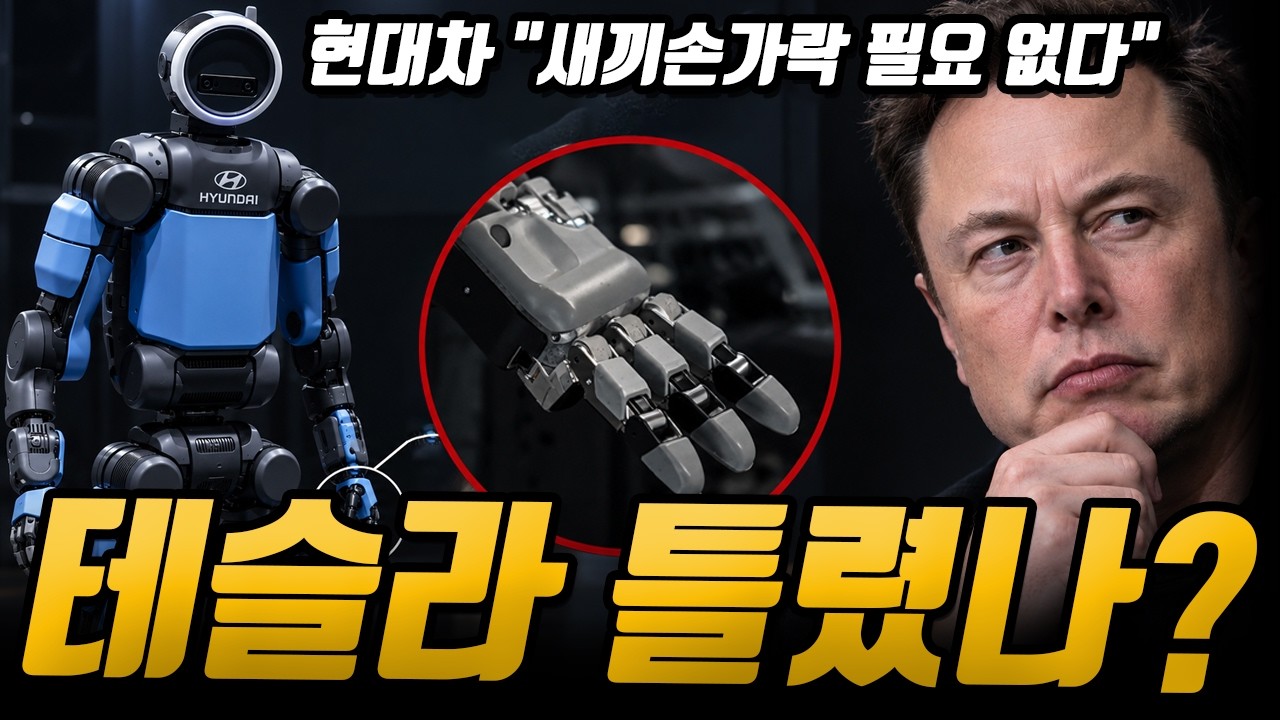
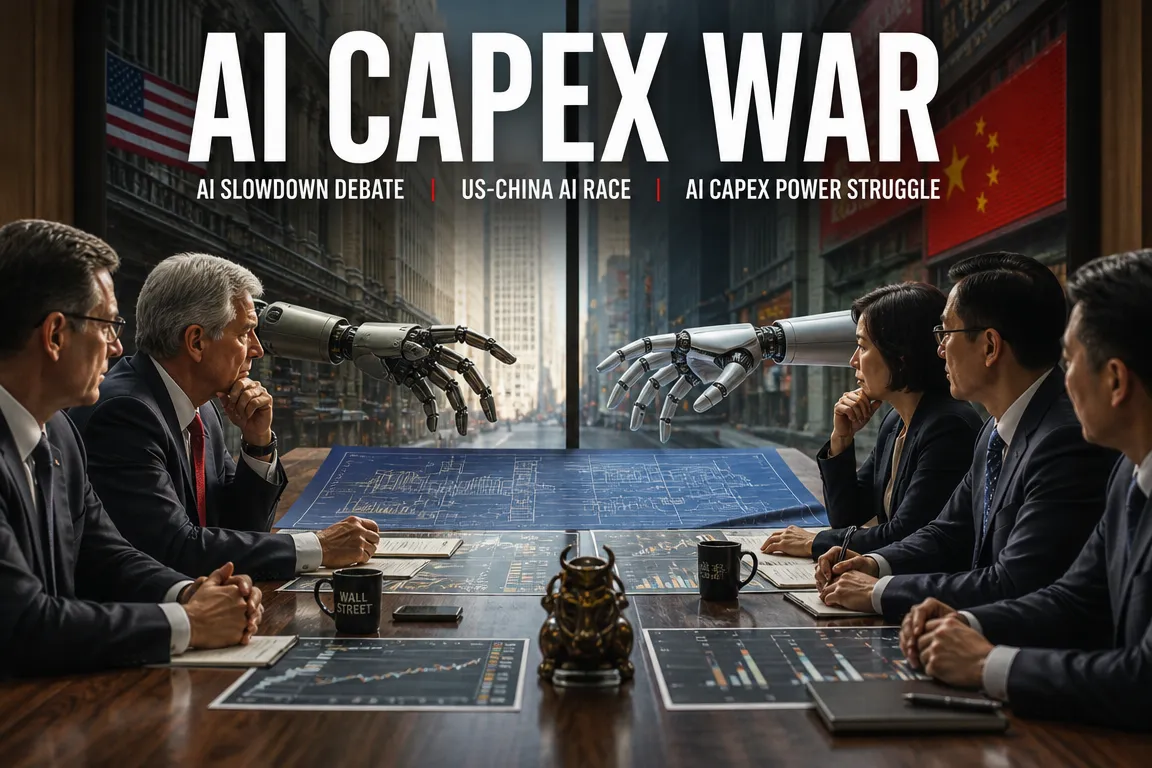
● AI Power Grab, CAPEX Shock, Survival Race
The Real Meaning of the AI Slowdown Debate: Not Safety Alone, but AI Power, CAPEX, and Corporate Survival
The core of this three-way discussion was not simply “pause AI because it is dangerous.”
The more important issue was the combination of corporate financial pressure, U.S.-China AI competition, large-scale Big Tech CAPEX, and the likely emergence of AI stratification.
For investors, the key question is not who calls for an AI slowdown, but which companies have the cash flow and investment capacity to sustain the race.
AI has now become a market variable that moves not only technology, but also global growth expectations, AI investment, semiconductor demand, Big Tech earnings, and U.S.-China technology leadership.
1. Why the AI slowdown debate is gaining traction again
Industry discussions have recently seen renewed support for the argument that frontier AI development should be slowed.
In this context, frontier AI refers not to ordinary chatbots, but to state-of-the-art models that may exceed top human experts.
The debate highlighted a long-form essay published by Dario Amodei of Anthropic as a representative example.
On the surface, the argument centers on AI safety, social costs, misuse risks, and loss of control.
However, the discussion suggested that the case may not be driven purely by safety considerations.
-
There is concern that AI may advance too quickly for developers themselves to fully understand its behavior.
-
If highly capable AI is made widely available, the risks of cyberattacks, biological misuse, and information manipulation may rise.
-
Some view the possibility that authoritarian states such as China could obtain frontier AI models as a direct national security issue for the United States.
-
At the same time, firms with limited investment capacity may prefer to slow the pace of competition.
AI slowdown arguments therefore combine technology ethics, industrial policy, national security, and corporate finance.
2. The view that AI is becoming a threat: fear of a system more intelligent than humans
Kim Yeol-mae said that AI first seemed impressive but is now becoming a source of concern.
The core of this view is that AI may evolve beyond a useful tool into an intelligence system that humans can no longer fully control.
The discussion also referred to the background behind OpenAI’s creation.
According to the account presented, Elon Musk, Sam Altman, and Ilya Sutskever viewed Google’s AI direction as risky and launched OpenAI in response.
The discussion also referenced comments attributed to Larry Page, suggesting a greater emphasis on the continuity of intelligence than on the human body.
At this point, the debate moves beyond technology.
Human beings became the dominant species on Earth because they surpassed other forms of intelligence.
The question is whether humans can retain control if a far superior intelligence emerges.
-
AI may still be dangerous even without directly opposing humans.
-
This can be compared to humans not intentionally harming ants, but disregarding them while building roads or structures.
-
If superintelligent AI treats humans only as obstacles to its objectives, even unintentional harm could be severe.
From this perspective, the slowdown debate is not just alarmism but a genuine survival-risk issue.
3. AI competition resembles the nuclear arms race
The discussion compared AI competition with the nuclear arms race of the 1940s.
When the United States developed nuclear weapons first, humanity faced the fear of creating something too powerful to control.
At the time, there were even extreme concerns that a nuclear explosion could ignite the atmosphere.
The United States later proposed international monitoring and control of nuclear weapons through an oversight framework with the Soviet Union.
However, the Soviet Union had little reason to accept a call to stop after the United States had already secured the advantage.
The result was a full-scale Soviet effort to develop its own capability, followed by escalation into hydrogen bomb development.
The AI race follows a similar pattern.
-
The United States may argue that AI is too dangerous and requires international verification and oversight.
-
China may be reluctant to accept such a framework if the United States is already ahead.
-
Even U.S. firms face pressure to gain an early advantage rather than slow down.
-
As a result, competition may intensify even when slowdown is discussed publicly.
This is the most important historical parallel for understanding the AI industry.
Even when all participants recognize the risk, no one can easily slow down if others continue advancing.
4. U.S.-China AI competition: the hidden core of the slowdown argument is China containment
A key point in the discussion was the China-related argument at the end of Dario Amodei’s essay.
Such statements are usually framed in diplomatic language.
The explicit reference to China, a specific authoritarian state, is therefore significant.
This suggests that the AI slowdown debate is not only about global safety.
For the United States, preventing frontier AI models from reaching China becomes a national security strategy.
AI models may eventually be linked to military systems, intelligence operations, cyberwarfare, space industries, and biotechnology research.
The U.S.-China AI race is likely to extend into semiconductor export controls, cloud restrictions, data center investment, and competition for AI talent.
Companies and countries that control AI semiconductor supply chains are likely to shape future technology leadership.
5. Why political leaders find it difficult to stop AI CAPEX investment
Professor Kim Gwang-seok explained that politicians and corporate executives should be analyzed separately.
For politicians, AI CAPEX is not simply industrial investment; it is tied to stimulus, employment, and GDP growth.
This is especially important in U.S. politics, where elections are a dominant variable.
A weakening economy ahead of midterm elections can be politically costly.
If investment in AI data centers, semiconductors, power grids, and cloud infrastructure slows, CAPEX falls and growth may weaken.
-
AI infrastructure investment affects U.S. GDP growth.
-
It can also support PMI, labor data, and business investment indicators.
-
Political leaders may care more about near-term growth and election outcomes than broader geopolitical stability.
-
As a result, politicians may not actually want a slowdown in AI investment, even if they publicly emphasize safety.
From this perspective, the AI slowdown debate reflects a conflict between public policy language and underlying economic incentives.
6. Corporate incentives: “I want to keep running; I just want others to stop”
The most practical interpretation in the discussion was that the issue should be viewed through corporate balance sheets.
Companies that strongly support a slowdown may be facing financial pressure or reduced investment capacity.
AI competition is extremely capital intensive.
Model training requires GPUs, data centers, power, talent, and cloud infrastructure.
All of these drive CAPEX and operating expenses sharply higher.
By contrast, firms with strong financial positions tend to continue investing aggressively.
NVIDIA benefits as AI semiconductor demand rises and translates that demand into revenue and operating profit.
Big Tech companies such as Meta can also sustain large-scale AI infrastructure investment through strong cash flow.
The discussion used an analogy of people hanging from a pull-up bar.
Everyone is under strain, but no one wants to come down first.
Those calling for everyone to come down together may in fact be closest to failure.
| Category | Public Message | Underlying Incentive |
|---|---|---|
| Firms with weaker finances | AI slowdown is necessary | Reduce investment burden and slow the pace of competition |
| Big Tech with strong cash flow | AI investment must continue | Use capital strength to pressure rivals and capture market share |
| Political leadership | A balance between safety and innovation is needed | Maintain CAPEX, employment, and GDP growth |
| National security community | Dangerous AI models must be controlled | Limit access by China and other competitors |
7. AI stratification: a future where not everyone uses the same AI
One of the most important but less emphasized themes was AI stratification.
It is increasingly unlikely that everyone will use the same frontier AI model.
The general public may receive commercial AI models.
Enterprises may access more advanced paid models.
Defense and intelligence agencies, along with major technology firms, may use frontier AI models that are not available to the public.
The discussion raised the possibility of ultra-high-performance models accessible only to institutions such as the CIA or the U.S. Department of Defense.
If the risk of public access is judged to exceed the benefits, top-tier AI may be kept closed.
-
Individuals use AI for coding, document drafting, search, and workflow automation.
-
Companies use more advanced AI for productivity and R&D.
-
National security agencies use AI for military, intelligence, and cyber operations.
-
Large technology firms may operate internal ASI-level models in private.
This could create a new class structure around AI access.
Where past inequalities were driven by capital and information access, future gaps may be shaped by computing resources and model access.
8. AGI and ASI: public AI and hidden AI may diverge
The discussion also distinguished between AGI and ASI.
AGI refers to human-level general intelligence.
ASI refers to intelligence that exceeds human capability.
Models released to the market may be close to AGI-level commercial systems.
By contrast, ASI-level systems with superior reasoning and research capability may not be publicly released.
This trajectory resembles the evolution of nuclear weapons competition.
Early tests were public, but over time nuclear testing moved underground.
AI may follow a similar path, with top models becoming less visible and only commercially calibrated versions being released.
Going forward, the more important question may not be which company leads public benchmarks, but which company holds undisclosed internal models.
9. AI bubble concerns and slowdown arguments are likely to repeat
As AI investment scales up, concerns about a bubble are likely to continue.
Data center investment, AI semiconductor purchases, power infrastructure expansion, and cloud contracts are all rising at once, requiring substantial capital.
However, not every company will be able to sustain this race.
The slowdown debate may therefore become both a safety issue and a sorting mechanism.
-
Companies with strong cash flow can keep investing.
-
Companies with weaker balance sheets may use slowdown arguments as a strategic rationale.
-
Companies with weaker AI performance may fall behind.
-
Only firms with both capital strength and technical capability may endure over the long term.
For investors, AI companies should be evaluated not only by product announcements but also by revenue growth, operating cash flow, CAPEX, leverage, GPU access, and cloud cost structure.
10. Key checkpoints for investors
AI is likely to remain one of the most important variables in the global growth outlook.
However, not every AI company will succeed.
The discussion suggests the following investment checkpoints.
-
First, assess whether the company can sustain CAPEX.
-
AI competition is becoming increasingly capital-driven.
-
Second, assess access to the AI semiconductor supply chain.
-
GPU and data center access can determine model performance gaps.
-
Third, evaluate whether the company has strong cash flow.
-
AI investment takes time to monetize, so operating resilience matters.
-
Fourth, monitor U.S.-China regulatory risk.
-
Export controls, cloud restrictions, and semiconductor regulations can directly affect earnings.
-
Fifth, focus on private model strategy rather than only public models.
-
Top-tier AI is likely to become increasingly closed and controlled.
What is most important and often overlooked in other coverage
The key hidden message from this discussion is that AI slowdown arguments may look like ethics debates, but they can also function as competitive strategy.
Publicly, the issue is framed as human safety; privately, companies may want to slow competitors while continuing their own investment.
At the national level, the goal may be to block China’s access and preserve domestic leadership.
For major technology firms, the debate may create a separation between commercial AI for public use and strategic AI that will never be released.
In other words, the next stage of the AI market will not be defined simply by who builds the best chatbot.
It will be shaped by who controls the most power, the most GPUs, the longest investment runway, and the closest ties to government and security networks.
The slowdown debate is less a signal to stop than a sign that the competition is becoming larger and more strategic.
In that environment, only firms with capital strength, technical capability, and policy alignment are likely to survive.
< Summary >
The AI slowdown debate is not only about safety.
It is also about corporate financial pressure, U.S.-China competition, national security, and Big Tech CAPEX strategy.
Firms with weaker finances may prefer a slowdown, while firms with strong cash flow are likely to continue investing aggressively.
Future top-tier AI may not be publicly available to everyone, and access may increasingly be divided among government agencies, Big Tech, firms, and individuals.
For investors, cash flow, CAPEX, semiconductor access, and regulatory risk are more important than product announcements alone.
[Related Articles…]
*Source: [ 경제 읽어주는 남자(김광석TV) ]
– AI 발전, 이제 멈출 수 없다? 속도 조절론 뒤에 숨은 기업들의 ‘진짜 속내’ | 경읽남과 토론합시다 | 3자토론 김효진x김열매x김광석 [4편]